Buyer Fit Snapshot
| Best fit | Printed Poly Mailers Affordable for High-Impact Packaging projects where brand print, material claims, artwork control, MOQ, and repeat-order consistency need to be specified before quoting. |
|---|---|
| Quote inputs | Share finished size, material target, print colors, finish, packing count, annual reorder estimate, ship-to region, and any compliance wording. |
| Proofing check | Approve dieline scale, logo placement, barcode or warning zones, color tolerance, closure strength, and carton packing before bulk production. |
| Main risk | Vague material claims, crowded artwork, missing packing details, or unclear freight terms can make a low unit price expensive after revisions. |
Fast answer: Printed Poly Mailers Affordable for High-Impact Packaging should be specified like a repeatable production item. The safest quote records material, print method, finish, artwork proof, packing count, and reorder notes in one written spec.
Production checks before approval
Compare the actual filled-product size with the drawing, then confirm tolerance on folds, seals, hang holes, label areas, and retail display edges. Reserve space for logos, QR codes, warning copy, and material claims before decorative graphics fill the panel.
Quote comparison points
Review material grade, print process, finish, sampling route, tooling charges, carton quantity, and freight assumptions side by side. A quote is only useful when the supplier can repeat the same color, closure quality, and packing count on the next order.
Printed Poly Mailers Affordable for High-Impact Packaging
A retailer can lose margin in ways the finance team only spots after the quarter closes: one route shifts into a higher carrier band, a few returns spike, and suddenly the packaging line that looked “cheap” has become expensive. I have seen that pattern more than once. For that reason, Printed Poly Mailers affordable is not really a logo decision first; it is a unit-economics decision made at the shipping label level, where even a 2-gram change can alter the cost picture across thousands of parcels.
Buyers often start with the artwork because it is the most visible part of the job. Fair enough. But the real question is whether the shipped package lowers total landed cost across product protection, print, freight, labor, and returns for the exact lane mix you ship every week. A mailer that looks simple but survives rough handling can be the cheaper choice, and a polished one that tears once can get kinda pricey, kinda fast.
Custom Logo Things builds around that same view of risk and cost. If your packaging stack needs a broader starting point, the Custom Packaging Products page is still the best place to begin. If the goal is a mailer spec that keeps brand impact without chewing through margin, the Custom Poly Mailers range makes the tradeoffs easier to compare.
A mailer that saves three cents and triggers one replacement is not a saving. It is a delayed expense.
Printed Poly Mailers Affordable: The Shipping Cost Reality Check
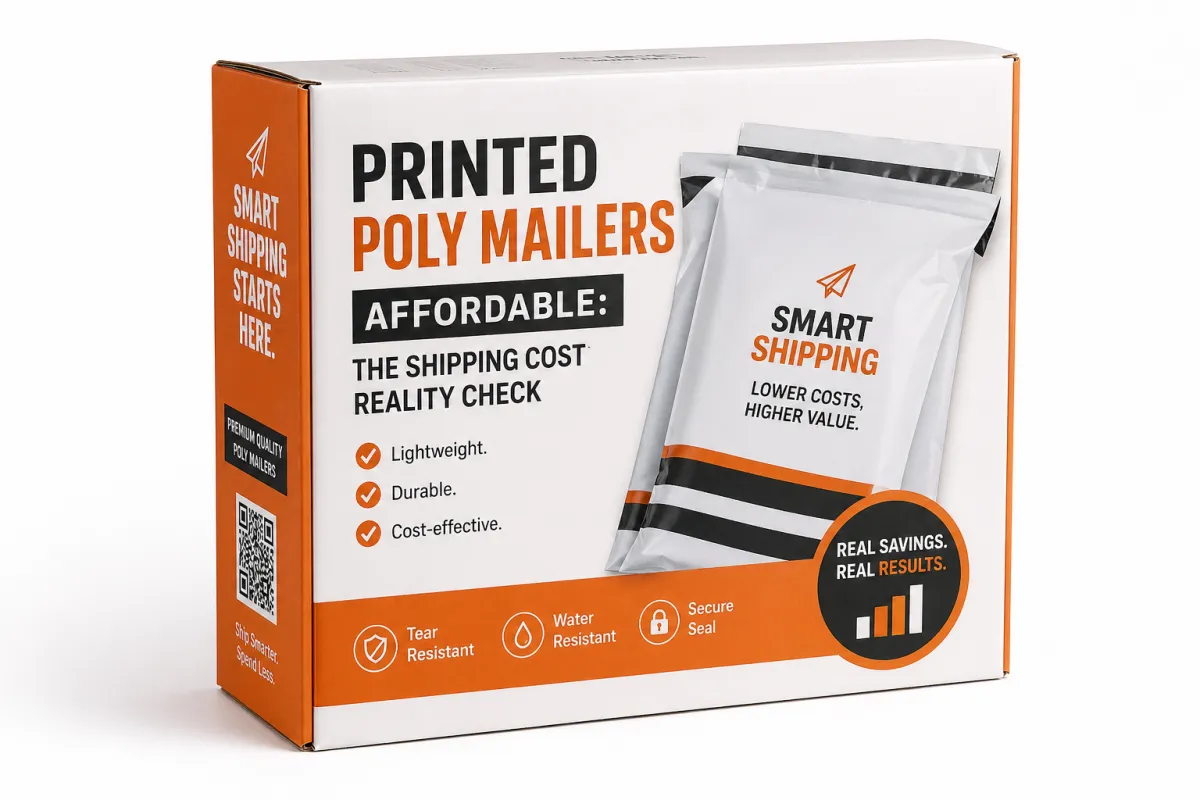
Most teams skip the first checkpoint and jump straight to graphics. That is backwards. Product weight, destination mix, carrier zones, and return profile should come first, because those four inputs decide whether Printed Poly Mailers affordable should mean a lighter film or a tougher build with better puncture resistance. Light apparel headed mostly to Zone 2 behaves nothing like a subscription box full of hard edges, and they should not be priced as though they do.
From a packaging buyer’s point of view, the mailer is never just a container. It is a managed risk object. A practical version of Printed Poly Mailers affordable earns its value only when print consistency, seal reliability, and tear strength hold through real transport cycles. Tear once, and the short-term savings disappear into re-ship cost, call handling, and trust damage that never shows up on the ink invoice.
Here is a simple comparison from a 5,000-unit run. Spec A uses 1.6 mil PE film with a clean two-color print and looks cheaper at first glance. The tradeoff is higher puncture exposure for boxed items with corners or sharp hardware edges. Spec B shifts to a 2.2 mil recycled blend with stronger seal behavior and still keeps print coverage controlled. The unit price rises, yes, but landed cost can improve if damage and surcharge costs drop. That is the field-level logic behind how Printed Poly Mailers affordable works in practice.
| Spec | Film / Print | Estimated Unit Cost | Freight Impact | Risk Profile | Likely Outcome at 5,000 Units |
|---|---|---|---|---|---|
| Spec A | 1.6 mil PE, 2-color print | $0.18-$0.20 | Lower pack weight, but higher damage exposure | Medium to high puncture risk | Looks cheaper, yet re-ship and complaint cost can erase the savings |
| Spec B | 2.2 mil recycled blend, 2-color print | $0.22-$0.25 | Small weight increase, usually still inside the same zone band | Lower tear and seal failure risk | Better total landed cost if the route is rough or the products have hard edges |
This is the most common trap: cheap-looking numbers can be a mirage. A two-cent gain on the front end collapses quickly if the replacement loop costs ten times more in labor, support, and handling. The decision for Printed Poly Mailers affordable belongs against a second-shipment probability, not just a paper quote.
Transit validation should mirror the actual journey, not a desk review. The ISTA framework helps teams stress what matters: drops, vibration, and compression. Those conditions expose weak mailer choices long before the first customer opens the parcel. I trust that kind of testing because it reflects reality, not a polished sample on a conference table.
What Makes Printed Poly Mailers Affordable Without Cutting Quality?
Printed Poly Mailers affordable usually comes down to three things: the right film gauge, restrained artwork, and a quantity that matches actual demand. That combination keeps ecommerce shipping bags, branded mailers, and low-MOQ programs from drifting into hidden costs. If a mailer protects the product, stays inside the carrier band, and avoids re-shipments, it is affordable in the only way that matters.
The strongest cost-saving move is rarely the most obvious one. A cleaner dieline, a smaller ink area, or a recycled poly mailer blend can save more across the full order than chasing the absolute lowest per-piece quote. In other words, printed poly mailers affordable is a system choice, not a single line item.
I have watched buyers spend extra on a glossy full-bleed design, only to discover the brand mark was getting scuffed in transit anyway. The fix was not more ink. It was better contrast, a better seal, and a film that matched the contents. That is the kind of adjustment that keeps budgets sane and makes the package feel intentional rather than decorative.
Printed Poly Mailers: Product Details That Protect Brand and Budgets
Material selection affects cost and function in equal measure. Polyethylene stays common for printed poly mailers affordable programs because it balances moisture resistance, stretch, and price better than most alternatives. Within the category, standard PE delivers baseline economics, anti-static blends help for electronics accessories, and metallized options create more visual depth when the brand story can justify the spend. Recycled blends have also moved from niche to mainstream for brands balancing environmental goals with production stability.
Finishes change how a package is perceived and how quickly it survives handling. Matte film resists visible scuffs and usually looks calmer under retail lighting, while glossy film pushes color density and can make a small logo read louder. Natural film, if specified properly, gives a rawer, less processed impression. If return rates are high, tamper-evident seals and reinforced pressure-seal flaps should not be treated as optional. That is where printed poly mailers affordable stops being a style discussion and becomes a reliability decision.
Thickness is still the variable most teams underplay. In the market, film gauge moves roughly between 1.0 and 4.0 mil depending on load shape, route stress, and edge profile. 1.0-1.5 mil may be right for light apparel, while it becomes a liability for hard cartons, small metal hardware, or mixed-SKU assortments. 2.0-2.5 mil often hits the sweet spot for cost control and puncture tolerance, and thicker builds should be reserved for products with clear damage exposure.
Closure logic can make or break performance. Heat-activated seals deliver high strength but demand process control and steady temperature. Peel-lock options reduce operator friction on some packing lines. Pressure seals are fast and familiar when flap design is matched to the load. Self-adhesive systems stay common for ecommerce use, but they still depend on the right adhesive window for vibration and temperature shifts. High-return SKUs usually need closure behavior that survives repeated opening cycles, and that is where under-specified stock mailers fail.
Print coverage should be engineered, not just decorative. A clean logo, return address, legal line, and controlled branding panel usually provide enough recognition while keeping ink costs contained. Full-bleed designs feel dramatic, but they are not always the lowest-cost route for mailers that move through conveyors, sorting belts, and manual handling. If brand intensity is the goal, improve contrast, placement, and spacing before flooding the entire panel with ink; that discipline is how printed poly mailers affordable stays intentional and controlled.
For teams with sustainability goals, documentation is the difference between a claim and a story. Recycled film or cartons need auditable evidence before statements are published. If your carton or insert layer needs certification language, FSC references can help shape chain-of-custody wording and prevent overclaiming. It does not automatically make a mailer premium, but it protects a brand’s sourcing narrative around printed poly mailers affordable.
Poly Mailer Specifications to Compare Before You Sign
A signed PO should only be signed when the spec sheet leaves no room for drift. Dimensions, neck size, gusset width, bottom gusset style, and panel tolerance need explicit control. A 2 mm gap in the wrong direction can trigger carton fit waste, and carton inefficiency quickly compounds into pallet planning pain. That is why printed poly mailers affordable orders succeed when structure validation happens before artwork finalization.
Demand written performance metrics, not verbal promises. Tensile strength, puncture resistance, seal strength, and tear propagation thresholds are operational checkpoints, not sales adjectives. ASTM references make this measurable: ASTM D882 for tensile properties, ASTM D1709 for impact behavior, ASTM F88 for seal integrity. A supplier that can name test standards usually has tighter process control than one speaking in soft claims. That standard-driven approach keeps printed poly mailers affordable measurable instead of speculative.
Print controls need the same precision as structure. Confirm color tolerance, DPI expectations, minimum point size, bleed allowance, registration marks, and file formats before approval. For most mailer jobs, 300 DPI at final dimension is a practical baseline for raster artwork, while body copy should stay large enough to survive compression marks and abrasion from sorting. Tiny text that disappears in transit is not design creativity; it is a spec error. Proper print instructions keep printed poly mailers affordable readable after miles of movement.
Shipping data should be operational, not theoretical. Ask whether products ship flat, wrapped in shrink, or packed in a secondary container. Confirm stacking limits so lower cartons never carry the weight of a warehouse gamble. If orders split into several cartons, define cartons per pallet and exact bundle counts per carton before release. It sounds routine, yet this check can save a launch from a week-long receiving delay. A disciplined intake process prevents printed poly mailers affordable from turning into a back-end scramble.
Sample requirements should include both appearance and performance. Request one visual sample and one loaded stress sample, then run the toughest expected route in-house or with your logistics team. Office shelf inspection is not enough. Test with hard-corner products and long-haul lane assumptions before approval is final. A buyer who validates only print pass is making an assumption, not a purchase decision rooted in printed poly mailers affordable.
Pricing & MOQ for Printed Poly Mailers Affordable Orders
Real price clarity is usually where weak suppliers hide first. A useful quote should separate setup fee, artwork approval cycles, imaging or plate cost, raw film, print operations, coating or lamination, finishing, packing, and freight. Bundle everything into one line, and the number looks simple while obscuring the levers that change with scale. Serious buyers of printed poly mailers affordable ask for every cost line before negotiations begin.
The math is simple enough to test quickly in a spreadsheet: (fixed setup + variable production + value-added finishing) divided by quantity, plus freight allocation. That expression reveals where the real gain sits. Smaller batches usually carry heavier setup burden; larger batches reduce per-unit cost, but only if inventory holding and obsolescence remain controlled. A low unit price that parks stock for six months is not a bargain, it is a capital freeze.
MOQ strategy should match channel behavior. A 500-unit run can be smart for pilots, seasonal tests, and first-time design checks. For catalog cycles, subscription cadence, and repeat ecommerce replenishment, 2,000 and 5,000 unit windows usually balance risk and cost better. Teams often compare a tiny run against a large competitor quote and call it arithmetic, but those are different orders with different economics. Build comparisons using the same quantity and the same specification.
Artwork complexity is another lever with predictable outcomes. One-color is typically strongest from a cost and speed perspective. Two-color remains manageable if file control stays clean and registration is straightforward. Four-color process builds raise setup and inspection effort, especially with heavy backgrounds or critical brand matching. Spot varnish, metallic treatments, and full backprint expand both inspection windows and invoice totals. None of these are forbidden tools; they just need clear impact expectations before art signoff.
Most surprises hide in the side clauses. Multiple color revisions can create extra proof rounds, registration corrections can push reprint activity, and rush timelines can carry surcharges large enough to erase low MOQ savings. If these triggers are not defined up front, the final invoice rarely matches the first estimate. For a disciplined buyer, the signal to trust printed poly mailers affordable is not only a low headline but a budget that remains stable through proof, freight, and revision cycles.
| Run Size | Artwork Complexity | Typical Unit Range | Best Fit | Main Risk |
|---|---|---|---|---|
| 500 units | One-color logo, simple flap | $0.28-$0.42 | Campaign tests, samples, short seasonal runs | Setup cost can dominate the quote |
| 2,000 units | Two-color branding, standard closure | $0.20-$0.31 | Recurring ecommerce demand | Artwork changes can trigger extra proof time |
| 5,000 units | Two to four colors, restrained coverage | $0.16-$0.26 | Stable SKUs, subscription and catalog programs | Inventory carry if demand is overstated |
This cost curve explains why buyers should request two quote layers: a conservative MOQ and a mid-run uplift with matching assumptions. Side by side, the lowest landed-cost outcome is easier to identify and far harder to argue with. In many programs, the winning option is not the cheapest bid, it is the one that sustains quality while preserving a realistic unit-cost trajectory under demand volatility.
Printed Poly Mailers Process and Timeline: From Proof to Dispatch
Reliable sourcing looks like a chain with ownership attached to each stage: intake, structural design signoff, digital proof, pre-production sample, final approval, conversion run, quality check, and dispatch handoff. Missing one owner usually creates delay at the handoff point, not at the press. That is why printed poly mailers affordable works best under a written timeline accepted by both buyer and supplier.
Timeline depends on design and process complexity. A logo-only order can move quickly if the dimensions are accurate and files are ready. Full-color programs with tight brand consistency requirements usually take longer because proof approval is more sensitive. Special seals, interior prints, or unusual geometry add test and validation windows. A practical baseline for many standard jobs is 12-15 business days from final proof signoff to dispatch, though queue load and lane pressure can stretch that window.
Milestone discipline matters more than speed alone. Keep spec and art validation inside 24 hours. Ask the supplier to confirm proof within one business day and lock approval before moving into the build queue. This process reduces revision loops that cost time without improving output quality. The line downshift is usually caused by unclear files, not material properties, because even premium film cannot compensate for ambiguous instruction.
Common delay triggers are predictable and avoidable. Missing bleed, soft logo files, unresolved font embedding, and late artwork revisions appear often. Custom dies add setup dependency because structural approval must happen before full production starts. Proof feedback after sample approval sends the job back through iteration. Teams wanting printed poly mailers affordable with speed should remove these variables before the first proof lands.
Fast lanes exist, but only under defined constraints. Production can accelerate when files are clean, dimensions are standard, and print demand is simple. Proof clarity and seal-strength validation should never be reduced. A rushed dispatch with poor seals becomes a delayed crisis. Skipping transit checks does not save schedule; it shifts that risk to customers and returns operations.
Why Choose Us for Printed Poly Mailers That Perform and Deliver
Buyers should be judged by the metrics, not the adjectives. A credible supplier reports on-time dispatch ratio, complaint rate, proof-to-ship cycle, and correction rate over the last year. Those numbers reveal whether process control is practical or merely promised. Teams with low correction rates usually translate customer requirements into production faster, which directly supports stable printed poly mailers affordable delivery.
Consistency is built through production infrastructure. Controlled film batching reduces lot variation. Matched ink chemistry keeps color behavior stable between repeats. Trained operators catch subtle defects before packaging, and multi-point QC inserts a second line of defense between production and dispatch. That combination turns a seller into a partner for steady printed poly mailers affordable buying, not a one-off artwork provider.
Traceability is where problems stop becoming arguments. Incoming lots need batch-level traceability, and finished goods should carry batch tracking for quick root-cause response. A clear non-conformance workflow matters more than the shine of marketing language. Documented corrective action beats improvised escalation when a spec shifts under pressure, which is how printed poly mailers affordable orders stay under control at scale.
Aftercare often determines long-term outcomes. The strongest teams support dieline logic, preflight checks, rerun consistency for repeat campaigns, and escalation paths when design intent and production realities diverge. If revisions are needed, buyers need clear rules: what is included, what is billable, and what could compromise function. Structured communication avoids invoice shock after the quote is already approved.
Pre-agreed tolerances are practical insurance. Size windows, color windows, and seal-strength thresholds should be finalized up front, so batch acceptance becomes objective. That removes debate from delivery and shortens reaction time between proof and production. The same applies to printed poly mailers affordable: accountability creates consistency, not extra rhetoric.
Final Action Plan: Order Printed Poly Mailers Affordable Without Delay
Lock three inputs first and only then proceed: size range, target average shipped weight, and lane mix. These variables decide gauge, closure type, and print architecture more than creative direction ever does. If they stay approximate, every estimate will be a moving target, and the final PO becomes a compromise instead of a strategy.
Next, prepare production files as if the line has no patience for cleanup. Submit final artwork, exact dimensions, and fold orientation together, then include both CMYK PDF output and native file sources to reduce file-related delays. If the supplier requests a dieline change, approve it before proof closure; late structural adjustments almost always pull the schedule. A clean handoff is one of the fastest ways to keep printed poly mailers affordable on the original timeline.
Then ask for two quote models: a base conservative MOQ and a mid-run uplift scenario with explicit freight assumptions. The second structure usually reveals where unit cost begins to improve without forcing oversized inventory. A stronger decision point for printed poly mailers affordable is not the smallest bid; it is the model that matches actual demand behavior and service expectations.
After that, define approval gates with timing and criteria in writing. Measure color, seal strength, and tolerance against agreed references, then run the first lot through your shipping stress route before full release. Once it passes, sign off and move forward with confidence. This prevents endless revision loops and keeps the program from drifting into avoidable delays.
When the numbers line up, the decision becomes straightforward: lower landed cost, controlled damage rate, and credible production timing. Under those conditions, place the PO, set the inbound inspection trigger, and move to production. Printed poly mailers affordable works only when choices are measured in sequence, not guessed in isolation.
FAQ
Can printed poly mailers affordable still look premium enough for high-value brands?
Yes. Premium perception comes from consistency more than from a high color count. Gauge, print placement, and seal quality determine whether the package feels controlled under touch as much as sight. Many high-value brands use two- or three-color work with restrained coverage, strong contrast, and tight closure execution. That combination keeps printed poly mailers affordable within budget while preserving a branded experience.
How do I estimate cost per piece for printed poly mailers affordable and avoid hidden charges?
Split the quote into setup, per-color print, per-mil film, finishing, and freight. Confirm what happens with proofing and revision steps before signing. Low-MOQ orders often hide small administrative fees that look minor until volume multiplies. Use identical quantities and identical specs for every comparison and keep the budget line as your anchor for printed poly mailers affordable.
What specs should I lock first for printed poly mailers affordable for e-commerce campaigns?
Start with size, gauge, closure type, and realistic package weight because those inputs shape both cost and delivery outcomes more than art complexity in most programs. After structural variables are fixed, set print boundaries: safe area, fonts, and contrast controls. Carrier profile comes next, which prevents dimensional-weight surprises later. That sequence gives printed poly mailers affordable the best shot at staying on target.
How can I get printed poly mailers affordable in smaller quantities without quality loss?
Open with a validated starter run built around one core color and full spec controls, then scale after tear and return metrics stabilize. Combining sizes by SKU profile and avoiding one-off design variants lowers setup waste and reduces inconsistency. In smaller batches, control is your quality engine, not complexity, and that discipline preserves printed poly mailers affordable value.
What is the typical process and timeline for custom printed poly mailers affordable orders?
The usual flow is technical brief, digital proof, sample production, client signoff, full conversion, quality hold, and dispatch. Standard structures can progress quickly once files are final and dimensions are stable; special seals and high-coverage designs extend lead time through testing and correction. The fastest outcome is simply the one with the fewest revision cycles, which applies to every printed poly mailers affordable order.
If the target is a quote that remains valid through proofing, freight, and production checks, anchor everything around size, gauge, and route from the beginning. That is where printed poly mailers affordable stops sounding like a slogan and becomes an operations strategy.