Buyer Fit Snapshot
| Best fit | Compostable Look Poly Mailers projects where brand print, material claims, artwork control, MOQ, and repeat-order consistency need to be specified before quoting. |
|---|---|
| Quote inputs | Share finished size, material target, print colors, finish, packing count, annual reorder estimate, ship-to region, and any compliance wording. |
| Proofing check | Approve dieline scale, logo placement, barcode or warning zones, color tolerance, closure strength, and carton packing before bulk production. |
| Main risk | Vague material claims, crowded artwork, missing packing details, or unclear freight terms can make a low unit price expensive after revisions. |
Fast answer: Compostable Look Poly Mailers: Benefits, Costs, Fit should be specified like a repeatable production item. The safest quote records material, print method, finish, artwork proof, packing count, and reorder notes in one written spec.
Production checks before approval
Compare the actual filled-product size with the drawing, then confirm tolerance on folds, seals, hang holes, label areas, and retail display edges. Reserve space for logos, QR codes, warning copy, and material claims before decorative graphics fill the panel.
Quote comparison points
Review material grade, print process, finish, sampling route, tooling charges, carton quantity, and freight assumptions side by side. A quote is only useful when the supplier can repeat the same color, closure quality, and packing count on the next order.
Compostable Look Poly Mailers: Benefits, Costs, and Fit
I still remember standing on a packaging floor in Shenzhen, Guangdong, while a buyer from a DTC apparel brand held two 9x12 mailer samples up to the light and said, "I need something that looks compostable, but I do not want it to wreck my margin." I laughed a little, because that sentence has followed me around for years. It is exactly why compostable look poly mailers exist, and why they keep showing up in brand meetings where presentation, performance, and cost all matter at once. They are built to signal eco intent, clean design, and a less wasteful feel, while keeping the unit cost closer to a normal poly mailer than a fully certified compostable structure. If you sell 5,000 to 50,000 pieces a month, and especially if your landed cost needs to stay under $0.18 per unit, that difference can be the gap between a nice brand story and a finance headache you have to explain twice.
The visual story, the material story, and the end-of-life story are three different conversations, and people mix them up all the time. Compostable look poly mailers can be printed to feel kraft-inspired, matte, muted, or minimal, yet that does not automatically make them compostable. The base film might be standard LDPE or LLDPE with 30% to 50% PCR content, a 70-micron co-extruded build, or a matte additive on a virgin film with a 20 mm self-seal strip. The look is a brand choice. The material is a procurement choice. The claim is a legal choice. Mix those up and the result is a customer service inbox full of questions and a marketing page that compliance will not sign off on. I have watched that exact mess unfold in factories in Dongguan and Ningbo, and honestly, nobody enjoys being the person who has to clean it up. For a lot of teams, compostable look poly mailers are the middle path between visual sustainability and practical sourcing, which is why they keep winning in the ugly middle of a very real budget conversation.
For Custom Logo Things customers, I usually frame it this way: compostable look poly mailers are about perception, presentation, and cost control first. If you want a premium unboxing feel, lower visual plastic shine, and a greener brand tone without jumping straight into the highest-cost material tier, this format makes sense, especially for 10,000-piece launches or 25,000-piece replenishment orders. If your goal is true compostability, then the film structure, the certification, and the disposal pathway need to be verified before a single carton gets printed. The Eco-Friendly Packaging Market is crowded with polished promises, and I have seen more than one brand fall for a pretty sample that could not survive the claim review from a retailer in Los Angeles or a marketplace in the EU. Polished is not the same as provable, and compostable look poly mailers are at their best when that line stays clear.
"I do not care if it looks green," a buyer told me in a factory conference room in Dongguan, after we had compared three 10x13 mailer builds and one 350-gsm sample insert card. "I care if my chargebacks stay low and my customers stop asking why the mailer feels cheap." That is a fair question, honestly. I have heard versions of it so many times that I can almost finish the sentence before they do.
What Compostable Look Poly Mailers Really Are
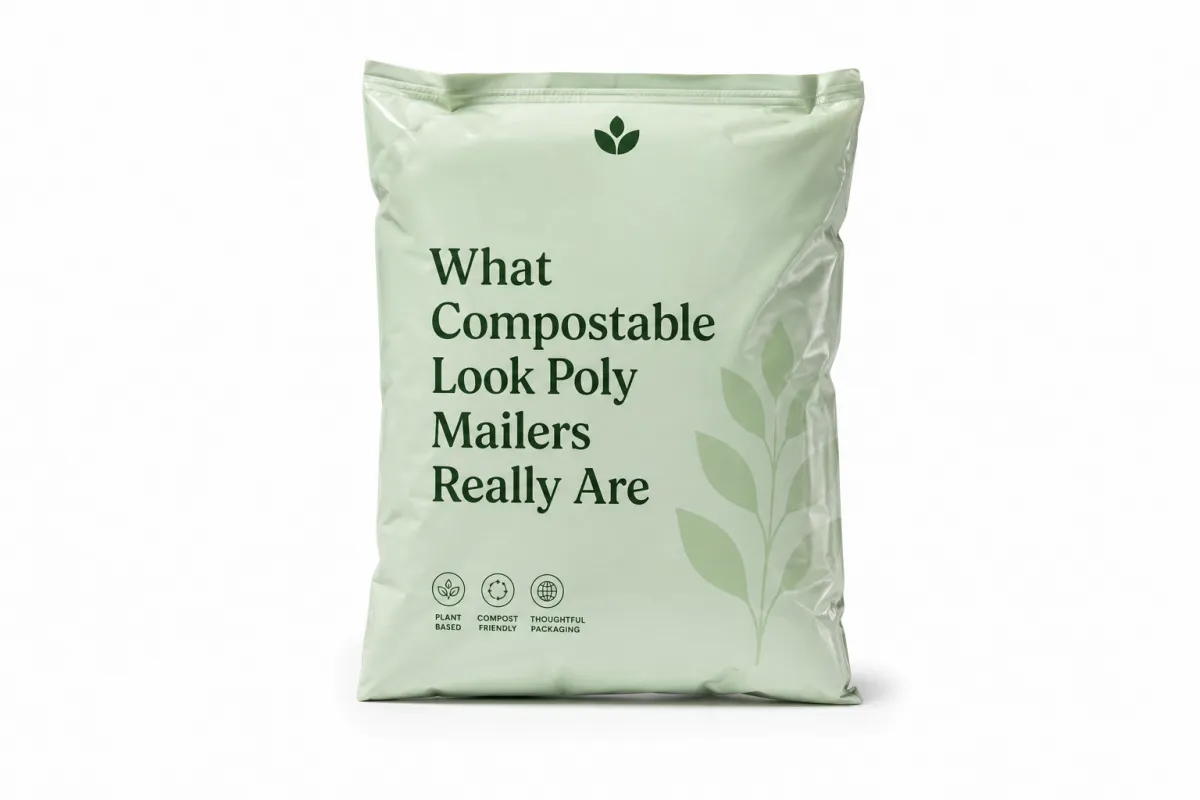
Compostable look poly mailers are shipping envelopes designed to visually communicate a lighter environmental footprint without forcing the buyer into a fully compostable structure. In plain English, they are often made from conventional poly film, sometimes with 30% PCR or 40% PCR content, then styled with the right color palette, print finish, and brand language so they feel more like green packaging and less like shiny commodity plastic. That distinction matters because your customer usually sees the outer shell first, not the resin code or the film spec. I have watched plenty of great products lose points before they even got out of the shipping bag, and that still irritates me more than it should. For brands that want a quieter, more intentional presentation, compostable look poly mailers can create that feeling without forcing a jump to a much pricier material stack.
On a production line in Foshan or Suzhou, the difference is surprisingly mundane. I have watched operators run identical bag sizes on the same machine, then change the entire perception of the product by switching from high-gloss white to a matte natural tone with a simple one-color print. One version looked like every generic shipping bag in the market. The other looked intentional. Compostable look poly mailers do not need expensive tricks to work. A soft matte surface, 1-color or 2-color ink coverage, restrained typography, and a grounded color like oatmeal, sage, stone, or recycled-paper brown can do most of the heavy lifting. That is why the format is popular with boutique apparel, cosmetics, stationery, and Subscription Brands That want the circular economy vibe without paying for a premium certified compostable build on every order.
The actual material story can vary a lot. Some compostable look poly mailers are standard co-extruded LDPE or LLDPE mailers with 50 to 80 microns of thickness and a 28 to 32 mm bottom seal, while others use a virgin base film with a matte additive and print choices that mute the plastic shine. A few buyers ask for a kraft-style printed face on a poly body, which works visually but should never be confused with a paper mailer. I have seen teams try to write "eco-friendly" on the outside and hope nobody notices the mismatch inside. That works right up until a retail partner in London asks for documentation or a customer service rep gets a return email with a photo attached from a parcel in Chicago. That is usually when the room gets very quiet, and it is usually when the phrase compostable look poly mailers starts to mean more than just a pretty surface finish.
If the claim matters to your brand, ask for the exact film build, not just the marketing sheet. ASTM and ISTA test methods are useful for checking how a mailer performs under shipping abuse, while compostability claims often need separate proof and certification. That is the difference between a mailer that looks compostable and one that can actually support a compostable claim. If you need paper-based accessories or inserts in the same program, FSC certification can matter too, and a 350gsm C1S artboard insert card may be the right choice for a premium kit. Do not confuse paper sourcing with film compostability. I have watched that mistake snowball into a very expensive reprint in a factory near Yiwu, and the memory still makes my eye twitch a little. With compostable look poly mailers, the spec sheet should always come before the storytelling deck.
There is another practical angle. Compostable look poly mailers are usually easier to source in smaller minimums than fully certified compostable options. That matters if you are testing a new SKU, a seasonal drop, or a pilot for a brand refresh. I have negotiated orders where the buyer wanted 3,000 units for a launch in March and the true compostable version only made sense at 10,000 plus. The compromise was a visually compostable style with a recycled-content story, paired with clean website copy that stayed honest. That is good packaging. Not glamorous. Just smart. And, frankly, a lot less annoying than explaining why your "eco" mailer doubled the landed cost on a line item your CFO checks every Friday.
How Compostable Look Poly Mailers Work
The look comes from a stack of small choices, not one magic material. Compostable look poly mailers often start with a co-extruded film structure, usually 60 to 100 microns depending on product weight and shipping risk, then the supplier chooses a matte or low-gloss finish, inks with lower contrast, and a design that avoids loud solid black blocks or bright neon branding. The mailer feels calmer in the hand. That calmness reads as more responsible, even if the resin is not compostable. Packaging is funny like that. People judge a whole category from one touchpoint, then spend twenty minutes debating the shade of beige as if it were a moral decision.
Texture matters more than most designers expect. A glossy bag screams cheap commodity, especially if it reflects store lights like a candy wrapper under a 4,000K warehouse fixture. A matte surface gives compostable look poly mailers a softer profile, which people often read as natural or environmentally aware. Some suppliers add a slip modifier to improve machinability, and that can keep the mailer from feeling gummy on automated packing lines. I have seen fulfillment teams in Dongguan move from a bag that stuck at the opening station to one that fed cleanly at 45 cartons an hour. That is not poetry. That is labor cost. It is also the difference between a packing lead smiling and a packing lead muttering under their breath all afternoon. It is also why compostable look poly mailers are often judged just as much by line speed as by shelf appeal.
Print choices matter too. The brands that get this right usually use one or two colors, a restrained logo, and small copy that speaks plainly about the brand. The brands that get it wrong try to cram five icons, three claims, and a leaf illustration into a space the size of a postcard. Then the whole thing looks like a discount smoothie cup. Good compostable look poly mailers use negative space. They let the material finish breathe. If the mailer is off-white, sand, or warm gray, a dark olive logo or charcoal type often looks more credible than bright green, which can feel fake if the rest of the pack is quiet. Honestly, the more a design tries to shout "eco," the more I start squinting at it.
Functionally, these mailers can perform just fine for apparel, soft goods, and lightweight accessories. Seal strength matters more than the visual story. Tear resistance matters more than the trend color. Water resistance matters more than the influencer approval. I have had customers send me complaints about a mailer feeling "eco" but failing in rain during a local delivery route in Seattle or Manchester. That is a bad trade. A better mailer combines a clean look with a reliable adhesive strip, a 40 to 80 pound burst profile depending on format, and enough puncture resistance to survive being shoved into a parcel cage by someone who definitely did not read the handling instructions. If the pack is built for shipping and not just for photos, compostable look poly mailers can hold their own in a pretty demanding workflow.
Labeling matters too. If you market compostable look poly mailers as eco-friendly packaging, be specific about what that means. Say recycled-content if it is recycled-content. Say low-gloss finish if it is a visual choice. Say compostable only if the material and certification support it. The EPA has practical information on waste and recycling choices at EPA recycling guidance, and those basics are useful because they force brand teams to think past the aesthetic. A customer may love the look, but regulators and retail partners care about the claim, and they tend not to be charmed by hand-wavy language, especially when a marketplace audit comes through on a Thursday afternoon.
Cost and Pricing for Compostable Look Poly Mailers
Price is where the conversation gets real. Compostable look poly mailers usually sit in a middle lane between stock poly mailers and fully certified compostable mailers. A basic stock poly mailer might land around $0.08 to $0.13 per unit at 5,000 pieces, depending on size and thickness. A visually eco-styled option often runs closer to $0.12 to $0.20 per unit at that same volume, and I have seen a 10x13 matte mailer in a Guangdong factory quoted at $0.15 per unit for 5,000 pieces when the print was one color and the film was 70 microns. Fully certified compostable mailers can move up to $0.22 to $0.45 per unit, and sometimes higher if the print is complex or the order is small. Those numbers change with resin pricing, shipping, and the state of your artwork, but they are a useful planning range when you are trying to keep a spreadsheet from turning into a panic attack. For buyers comparing compostable look poly mailers against a true certified compostable structure, the gap in unit cost is usually the first thing to notice and the landed cost is the second.
Five things drive the cost most aggressively: film type, thickness, print complexity, order volume, and custom finishing. If you want compostable look poly mailers with a custom matte tone, a dual-sided print, and a special adhesive, the price climbs fast. If you choose a simple one-color logo on a stock-size bag, the price stays much friendlier. I once sat through a supplier negotiation in Ningbo where the buyer wanted a pearlized finish, a heavy black interior, and a die-cut tear notch on a 9x12 mailer. The quote jumped from $0.14 to $0.19 per unit in one revision. That is not the factory being greedy. That is the cost of adding steps, materials, and a few extra reasons for the production manager to sigh.
Minimum order quantity matters too. A supplier in Ningbo once told me, very bluntly, that they could not support a 2,000-piece custom run at the same cost as 20,000 pieces. He was right. With compostable look poly mailers, the pricing curve gets much nicer once you clear tooling setup, plate costs, and print waste. If you are ordering 10,000 to 25,000 units, you usually unlock better price breaks than a tiny pilot run. If you are under 3,000 pieces, a stock-based solution with a custom label or simple overprint may make more sense than forcing a fully bespoke spec, especially if freight from Shenzhen or Xiamen is already eating into your margin.
Here is the practical buying advice I give to brands that care about margin and perception at the same time: pay for the visual details people actually see, and do not pay for invisible features that do not change buyer behavior. If the mailer is going to be opened in five seconds and tossed, a clean matte finish and solid seal matter more than exotic print effects. If the package is part of a premium unboxing, then yes, invest in the print, the tone, and the feel. Compostable look poly mailers can lift perceived value without pushing every order into the most expensive material tier. That is the sweet spot, and it is one of the few places in packaging where the math and the branding team can both be happy for once, especially when the re-order lands at the same plant in Zhejiang six months later.
| Option | Typical Unit Cost at 5,000 pcs | Visual Feel | Claim Risk | Best Fit |
|---|---|---|---|---|
| Standard stock poly mailer | $0.08 - $0.13 | Glossy, common, utility-first | Low, if no eco claims are made | High-volume shipping where branding is secondary |
| Compostable look poly mailers | $0.12 - $0.20 | Matte, muted, premium eco signal | Medium, if claims are vague | DTC brands, launch runs, eco-style presentation |
| Fully certified compostable mailers | $0.22 - $0.45 | Material-specific, often softer or paper-like | Lower, if certification and disposal path are clear | Brands with verified compostable claims and higher budgets |
One more thing: do not compare unit price only. Compare landed cost. A mailer that saves $0.03 but increases damage claims by 1.5% is not a savings. I have seen brands spend an extra $1,800 a month on returns because they chose a thinner bag that looked fine on paper and failed during distribution. If you sell fragile items, calculate the cost of breakage, not just the bag line. That is especially true for compostable look poly mailers, because people sometimes assume a softer visual style means a softer build. Not always. Sometimes the bag is strong. Sometimes it is just pretending to be delicate, which is a trick that works better on Instagram than it does in a shipping center.
Step-by-Step Process and Timeline for Ordering
The cleanest ordering process starts with a basic brief, not a mood board. For compostable look poly mailers, I want to know product weight, dimensions, shipping method, target annual volume, and what the customer sees on unboxing day. If you send me "want something eco" and nothing else, I can give you twenty pretty options and not one of them will be the right one. If you send me a 10 oz apparel spec, a 7x10 finished mailer size, and your monthly dispatch count of 8,000 units, I can narrow it down fast. That saves everyone from the ritual of pretending vague instructions are a strategy. It also helps the supplier Choose the Right film thickness, which matters more than any trend term printed on the front of the bag.
The timeline usually breaks into six stages. First comes the use-case review, which can take one to two business days if the brief is clean. Second is sizing and structure, usually another one to three days. Third is artwork prep and proofing, which often takes the longest because someone always wants the logo 8% bigger after the first proof. Fourth is sampling. For compostable look poly mailers that are stock-based, a sample can be turned in about 5 to 7 business days from a plant in Dongguan or Suzhou. Fully custom runs can need 10 to 15 business days. Fifth is approval. Sixth is production, commonly 12 to 15 business days from proof approval for a standard custom run, not counting ocean freight. If the shipment is urgent, air freight can cut transit time but will punish your margin with a smile and a very expensive invoice.
In a client meeting last spring, a cosmetics brand asked me why they could not get the sample in three days. I told them the truth: because the factory is not a vending machine. The ink has to match, the seal has to hold, and the sample has to be close enough to production that we are not lying to ourselves. That is especially true for compostable look poly mailers, where the surface finish can shift the entire look of the brand. A proof on screen is not enough. You need the real film in your hand, under warehouse lighting, next to the actual product, preferably with the same folding method the team will use on a 6,000-piece run. If that sounds fussy, well, packaging is fussy. That is part of the job.
Here is the information I ask for before I quote:
- Finished mailer size, such as 9x12, 10x13, or custom dimensions in inches or millimeters
- Product weight and packaging format, including any box, pouch, or tissue insert
- Print side count, ink colors, and whether you want matte or gloss
- Target order quantity, repeat forecast, and preferred delivery window
- Any compliance needs, such as recycled-content statements, compostability claims, or drop-test expectations
If you are buying through Custom Poly Mailers, the smartest path is often a pilot run. Start with two or three sample versions. Compare a standard stock bag, a matte eco-style bag, and your preferred compostable look poly mailers option. Then run them against real packing labor, not just a desk test. Watch how fast the product slides in, how the seal closes, how the label lands, and whether the bag scuffs inside your shipping system. I have seen brands fall in love with a concept image and then discover the mailer is awkward on a live line in a warehouse outside Chicago. That is an expensive discovery if you wait until 30,000 pieces are already printed, and I would rather help you avoid that headache entirely.
For buyers who need a broader packaging refresh, the process often starts on Custom Packaging Products and moves outward from there. That approach makes sense because the mailer should match the rest of the unboxing program. If your box inserts are rigid, your tissue is bright, and your outer mailer screams budget, the brand story gets muddy. Compostable look poly mailers work best when they are part of a coherent system, not a random green add-on. The best versions feel like they belong there, which is harder to fake than people think, especially once the pack is lined up next to a 350gsm C1S artboard thank-you card and a 12-inch shipping label.
Common Mistakes When Ordering Compostable Look Poly Mailers
The biggest mistake is simple: assuming the look proves the claim. It does not. Compostable look poly mailers can be visually aligned with compostable branding while still being made from conventional film. If your marketing team writes "compostable" on a web page because the bag has a kraft tone and a leafy print, you have created risk. I have had to clean up supplier language for customers more than once because somebody in a sales meeting used the wrong word and the website team copied it without checking. That is how little misunderstandings become big billable problems, which is a very expensive way to learn about terminology. The safer route is to describe the finish, the resin, and the claim separately.
Another common miss is poor sizing. A bag that is too small stretches the film, weakens the seal, and looks cheap. A bag that is too large lets the product flop around and makes the package feel sloppy. With compostable look poly mailers, sizing is even more important because the visual style usually promises care and restraint. If the item swims in a giant envelope, the whole effect falls apart. I once saw a fashion brand use oversized mailers for scarves at a 12x16 finished size, and the final package looked more like a misfiled document than a premium shipment. That was an avoidable mistake, and the team knew it the second they saw the first packed carton.
Weak print contrast is another one. Designers love delicate tones. Warehouse teams hate them. If the logo is too pale against a matte beige film, it looks beautiful in a presentation and vanishes in a fulfillment center. I always ask for a physical proof under real light, because fluorescent warehouse lighting changes everything. Good compostable look poly mailers balance visual softness with enough contrast that the brand name reads from arm's length. You do not need billboard loud. You do need readable, and you definitely do not want your logo to disappear the minute a dock door opens in a plant outside Atlanta or a 3PL in Rotterdam.
Then there is the failure to test. Every serious order should get sample checks for seal strength, abrasion, puncture resistance, and moisture handling. If your product ships through humid lanes, summer loading docks, or rain-heavy regions, that matters. ASTM-style material tests can help you compare options, but the real proof is a live pack-out and a short shipping trial. If you want to learn what happens under abuse, run a small batch through your actual packing line and ship it to three or four locations. That costs less than reprinting a dead-on-arrival order. I have seen brands skip this step and then act surprised when a torn mailer shows up in a customer photo from a delivery in Miami after a thunderstorm. Packaging does not care about optimism, which is a little rude if you ask me, but there it is. Compostable look poly mailers need that kind of test just as much as any other shipping envelope.
Finally, do not cheap out so hard that the savings disappear. I have watched a buyer save $0.02 per unit on compostable look poly mailers and then pay three times that amount in customer service labor because the seals were inconsistent. Cheap is only cheap if it performs. Otherwise, you are just buying future problems in bulk. That is not clever procurement. That is a trap with a nice invoice, and it usually comes from the same kind of quote that looks wonderful until you notice the adhesive strip is 5 mm narrower than the sample you approved.
Expert Tips for Better Performance and Branding
If you want compostable look poly mailers to do real work for the brand, keep the design disciplined. One strong logo, one clear message, and one material story beat ten decorative elements. I learned that the hard way after a client insisted on adding three icons, a quote, a QR code, and a leaf pattern to a 10x13 mailer. On press, it looked busy. On the shelf, it looked desperate. The revised version, with a smaller logo and a warm matte finish, looked far more premium and cost the same to produce because we removed visual clutter rather than adding materials. That is one of my favorite packaging lessons, mainly because it saves money and stops everyone from overthinking themselves into a corner.
Ask for film samples, not just digital mockups. Rub the surface. Fold the flap. Pull the tear strip. Throw it into a tote bag with metal zippers for ten minutes and see what happens. I have done that on a factory floor in Jiangsu more times than I can count, usually while someone next to me pretends the test is too crude. Crude is fine. The customer is not grading your render. They are opening a package with scissors or keys or a tired hand after work. Compostable look poly mailers need to survive real life, not just presentation boards. If the material feels good, feeds well, and survives the abuse test, then the fancy deck can catch up later.
Negotiation matters too. If a supplier quotes a great price on the first order but punishes every re-order, do not get hypnotized by the opening number. I like to ask for tiered pricing at 5,000, 10,000, and 25,000 pieces, plus a note on tooling amortization. On one deal in Zhejiang, we dropped the repeat order cost by $0.015 per unit simply by locking the print plate for six months and agreeing to a larger second run. That is not luck. That is basic supplier math. The best compostable look poly mailers programs are built with room for repeat volume, not just a one-time launch photo. A good-looking launch that cannot be reordered easily is a very expensive kind of decoration.
Keep an eye on customer perception. Sometimes the cleanest mailer beats the loudest sustainability message. A very loud green claim can invite skepticism if the rest of the packaging still feels disposable. A simpler bag with honest copy, recycled-content language where appropriate, and a neat finish often reads as more trustworthy. That is good for brand equity and good for the carbon footprint conversation too, because honest communication reduces the temptation to overclaim. If you are trying to support a zero waste positioning, the package has to be part of a broader operational plan, not just a decorative promise. I have seen brands try to paper over weak operations with louder copy, and that almost never ages well, especially after the second reorder from a plant in Malaysia or Taiwan. For that reason, compostable look poly mailers should support the brand voice rather than shout over it.
Two final practical moves: ask for a print proof in the actual finish you are ordering, and ask the supplier to confirm shipping carton counts before production starts. Those details sound tiny, but they save headaches. I have seen a beautiful batch of compostable look poly mailers arrive with the right print but the wrong carton count per master case, which slowed receiving by half a day. That is the kind of issue that never shows up in a sales deck and always shows up at 7:30 a.m. on a dock. The dock, naturally, is where everyone suddenly remembers they are in a hurry.
Next Steps: Test, Compare, and Place a Pilot Order
The smartest next move is not to place a giant order. It is to compare two or three samples, pack your real product, and see what actually happens. If you are evaluating compostable look poly mailers, run a side-by-side test with a standard poly mailer and a fully certified compostable option if budget allows. Compare feel, seal, print quality, and how the package holds up after one trip through your shipping workflow. That is the kind of data that protects margin and reduces wishful thinking. I am a big fan of wishful thinking for vacation planning, not for packaging decisions, and I would rather see the first 100 units fail in a test than the first 10,000 on a freight dock.
Use a simple checklist:
- Check seal strength with repeated open-and-close handling.
- Test puncture resistance with the product you really ship, not a dummy sample.
- Expose the mailer to moisture, abrasion, and a rough drop test.
- Compare pack speed on your actual line for at least 20 to 30 units.
- Confirm the exact claim language before any artwork goes to print.
Then place a pilot order. A pilot of 1,000 to 3,000 units is usually enough to validate cost, customer reaction, and shipping performance without locking up too much cash. That is especially useful for seasonal drops, new SKUs, or a brand refresh where the artwork might still change. A pilot also gives you a real read on whether compostable look poly mailers help the brand feel more premium or just look trendy for five minutes. I prefer proof over optimism. Optimism is cheap. Reprints are not. And if I sound a little opinionated here, it is because I have seen too many brands skip the pilot and then pay for the same lesson in a louder, more annoying way, usually after production has already moved from proofing in Dongguan to full freight out of Yantian.
If your product line is growing, make the packaging decision alongside the rest of the system: inserts, shipping labels, cartons, and messaging. A strong outer mailer can support the brand, but it cannot carry the whole story alone. That is why I keep coming back to the same point. The best compostable look poly mailers balance presentation, shipping performance, and budget in a way your finance team can live with and your customers can understand. Get the sample, check the specs, confirm the claim, and buy the pilot before you buy the fantasy. I have no problem with ambition; I just like it to survive contact with a warehouse in Phoenix, a fulfillment center in Leeds, or a Monday morning receiving dock in New Jersey.
Are Compostable Look Poly Mailers Actually Compostable?
Sometimes, but not by appearance alone. Compostable look poly mailers can be styled to look natural, matte, or kraft-inspired while still being made from conventional poly film. If the resin blend, certification, and disposal pathway are not documented, the visual finish does not make the bag compostable. That is why I always separate the design brief from the compliance brief. One covers how the mailer looks; the other covers what the mailer is.
If you need to make a compostable claim, ask for the exact material specification, the relevant certification, and the test standard behind it before you approve artwork. If you only need the visual effect, then say so clearly and describe the package as a matte or eco-style mailer instead. That keeps the messaging honest and keeps your brand out of avoidable trouble later. A clean claim is better than a flashy one that has to be walked back later, and yeah, that walk-back is always awkward.
Are compostable look poly mailers actually compostable?
Not always. The visual style and the material are separate issues. Ask for the exact film composition, such as LDPE with 30% PCR or a certified compostable blend, plus any certification documents, before you print the word compostable on the bag or on your product page. I would also ask for the actual test standard and not just a pretty PDF, because pretty PDFs have broken more than a few promises in factories from Shenzhen to Ningbo.
How do compostable look poly mailers compare on price?
They usually cost more than basic stock poly mailers but less than fully certified compostable mailers. At 5,000 pieces, a realistic range is often $0.12 to $0.20 per unit, and I have seen a matte 9x12 build land at $0.15 per unit for 5,000 pieces when the print was one color and the film was 70 microns. If the quote is much lower than that, I start asking what was left out, because the cheapest quote is often missing the most expensive part.
What is the lead time for compostable look poly mailers?
Sampling is usually the slowest step, especially if artwork needs revisions. For custom runs, 12 to 15 business days from proof approval is common for production, then you still need to account for freight and any internal packaging checks. The fastest orders I have seen were the ones where the buyer had their artwork ready, their dimensions locked at 10x13 or 12x15, and did not change the logo size three times after proofing.
Will compostable look poly mailers hold up in shipping?
Yes, if the film thickness, seal quality, and size match the product weight. Test puncture resistance, moisture exposure, and abrasion before you commit. A softer eco look does not mean weak performance. In fact, some of the better-looking bags I have handled were stronger than the plain stock versions sitting next to them, especially the 80-micron co-extruded builds coming out of Guangdong.
What should I ask before ordering compostable look poly mailers?
Ask what the material is, what the claim means, and whether there is certification. Confirm MOQ, unit pricing, sample Cost, and Production timeline up front, then request both a print proof and a physical sample before you approve the full order. If the supplier cannot answer those questions clearly, that is usually a sign to keep looking, whether the factory is in Dongguan, Suzhou, or a trading office in Shanghai.
Takeaway: treat compostable look poly mailers as a visual-and-cost strategy first, then verify the material, test the build in real shipping conditions, and only use the compostable claim if the documentation truly supports it. That sequence keeps the packaging honest, protects margin, and gives you a mailer that can actually do its job without making your team chase problems later.


