Buyer Fit Snapshot
| Best fit | sustainable packaging for subscription brands for packaging buyers comparing material specs, print proof, MOQ, unit cost, freight, and repeat-order risk where brand print, material, artwork control, and repeat-order consistency matter. |
|---|---|
| Quote inputs | Share finished size, material target, print colors, finish, packing count, annual reorder estimate, and delivery region. |
| Proofing check | Approve dieline scale, logo placement, barcode or warning zones, color tolerance, and any recyclable or compostable wording before bulk production. |
| Main risk | Vague material claims, crowded artwork, or missing packing details can create delays even when the unit price looks attractive. |
Fast answer: Sustainable Packaging for Subscription Brands: Claims, Protection, MOQ, and Cost should be specified like a repeatable production item. The safest quote includes material, print method, finish, artwork proof, carton packing, and reorder notes in one written spec.
What to confirm before approving the packaging proof
Check the product dimensions against the actual filled item, not only the sales mockup. Ask for tolerance on folds, seals, hang holes, label areas, and retail display edges. If the package carries a logo, QR code, warning copy, or legal claim, reserve that space before decorative graphics fill the panel.
How to compare quotes without losing quality
Compare board or film grade, print process, finish, sampling route, tooling charges, carton quantity, and freight assumptions side by side. A lower quote is only useful if the supplier can repeat the same color, closure quality, and packing count on the next order.
Sustainable Packaging for Subscription Brands That Works
Last spring, I opened a subscription box with one hair serum, a folded card, and enough air pillows to fill a 16 x 12 x 8 inch carton three times over. I remember staring at it on my kitchen counter in Milwaukee and thinking, "Well, this box did not get the memo." That kind of mismatch is exactly why sustainable Packaging for Subscription brands matters: the best systems protect the product, cut waste by the ounce, and still feel deliberate the moment the customer breaks the seal. Done well, sustainable packaging for subscription brands also lowers freight stress, reduces excess void fill, and gives the unboxing a cleaner, calmer rhythm.
I've spent enough hours on corrugator floors in Ohio and on packaging reviews in Southern California to know the greenest-looking box is not always the smartest one. Honestly, I think sustainable Packaging for Subscription brands only earns the label if it lowers material use, improves recyclability or reuse, and survives the actual shipping lane, not just the studio light. Pretty packaging that falls apart in a trailer at 98 degrees? That is not sustainability, that is expensive wishful thinking, especially on a 5,000-unit run with a freight bill attached. The same logic applies whether the structure uses recycled paperboard, molded fiber, or a refill-ready shell built for repeat shipments.
And because this work lives in the gap between ideal and real, there is usually a trade-off hiding in plain sight. A box can look elegant in a render and still be a headache in a warehouse if the closure is fussy, the insert is overbuilt, or the fold sequence makes the line operator slow down and squint. I have seen that happen more than once, and it is kinda funny for about five seconds before the labor report lands.
What Sustainable Packaging for Subscription Brands Really Means
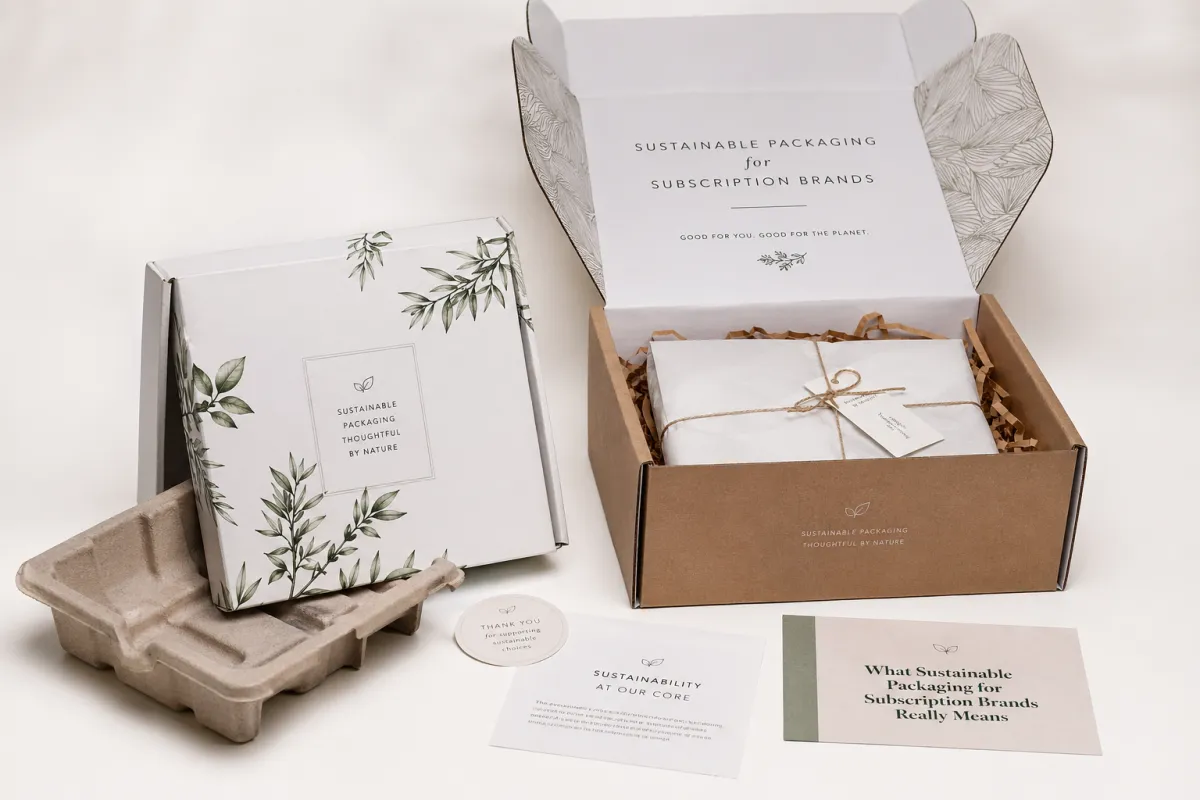
People use eco-friendly so loosely that the phrase has almost no weight on its own. In practice, sustainable Packaging for Subscription brands means packaging that uses fewer grams of material per order, relies on recycled or renewable inputs where possible, and still protects the product through a 12-inch drop, a week in a hot trailer, and a rough last-mile handoff. If the package looks virtuous but arrives with a cracked lid or a dented jar, the whole thing misses the point, no matter whether it shipped from Dallas, Dongguan, or Nashville.
I once sat in a client meeting with a skincare subscription brand in Chicago where the team loved a rigid box with foil stamping and a magnetic closure. It looked premium, sure. The package weighed 186 grams before product, and the insert added another 41 grams. We compared that to a 350gsm FSC-certified folding carton with a paperboard insert, and the lighter system cut outbound shipping weight by 14% on a 5,000-unit run. That is the difference between branded packaging that only looks responsible and sustainable packaging for subscription brands that behaves responsibly at scale. It also shows why right-sizing and material selection belong in the same conversation, not separate meetings.
Here is the cleanest definition: reduce the packaging footprint, choose materials with a real end-of-life path, and keep the fulfillment operation fast enough that labor does not eat the environmental gains. Box size, inks, adhesives, tapes, labels, and the order of packout all matter. A carton can be technically recyclable and still be a poor choice if it slows the line by 8 seconds per unit or forces the warehouse to add void fill just to keep products from rattling. I have seen that exact thing happen in a Phoenix facility, and the warehouse crew was not amused; neither was the operations lead watching overtime climb by 12 hours a week.
"The box is part of the product experience, but it is also part of the shipping system." I heard that from a plant manager in New Jersey while we were watching a 24-unit snack subscription line run on a Wednesday morning. He was right. sustainable packaging for subscription brands is not a shelf statement; it is a chain of decisions that starts in design and ends at the customer’s kitchen table, often after a 1,200-mile freight move and a final sort at a regional hub.
Vague language creates trouble fast. A brand may call something "green" because it uses kraft paper, but if the structure includes mixed laminates, foam corners, and a plastic-coated insert, the package becomes harder to sort and less useful in the real world. My rule is blunt: if a customer cannot separate the components in under 30 seconds, the design needs another pass. If I can stand there with a coffee in hand and still be peeling layers off the thing, that is a bad sign, especially if the carton is built from 18pt SBS, a PET window, and pressure-sensitive labels all fighting each other. Clear component separation is one of the simplest ways to make sustainable packaging for subscription brands easier to recover after delivery.
How Sustainable Packaging for Subscription Brands Works
sustainable packaging for subscription brands works like a system, not a single SKU. The outer mailer or carton, the insert, the void fill, the tape, the label, and the warehouse workflow all play a role. If one piece is overbuilt, the whole system gets heavier, slower, and more expensive. A 0.25-inch reduction in box depth might sound small on a spec sheet, but across 40,000 monthly shipments it can mean fewer filler sheets, lower DIM weight, and less corrugated board pulled from inventory at the plant in Fort Worth or the converter in Monterrey.
I watched that happen in a fulfillment center outside Atlanta. A beauty subscription brand was using a 10 x 8 x 4 inch custom printed box for a kit that really fit in a 9 x 7 x 3 inch footprint. Once we right-sized the carton and swapped the pulp tray for a die-cut paperboard insert made from 350gsm C1S artboard, the warehouse cut void fill by 62% and improved packout speed by almost 11 seconds per order. The packaging still felt premium; it just stopped shipping air. I still remember one picker looking at the new box and saying, "So we were mailing a lot of empty feelings?" Fair question, and the numbers backed him up. That kind of rethink is often the turning point for sustainable packaging for subscription brands.
Right-sizing is one of the easiest wins in sustainable packaging for subscription brands. Carriers charge on dimensional weight when the box takes up more space than the product deserves, so a bigger carton can cost more even if it uses a few cents less board. A box that saves $0.04 in material but adds $0.31 in shipping is not a win. That math is why package branding should stay tied to logistics, because the bill always shows up somewhere, whether the carton shipped from Shenzhen or a domestic corrugator in Georgia.
Most circular approaches fall into five buckets:
- Recycled paperboard for cartons, inserts, and mailers that can enter paper recovery streams in many regions.
- Molded fiber for protective trays, especially when the product needs shock absorption without foam.
- Mono-material plastics for cases where moisture, grease, or tear resistance matter more than fiber.
- Refillable components for subscription models that ship a durable shell and lighter refills afterward.
- Take-back or reuse loops for premium programs that can support reverse logistics without turning the warehouse into a sorting plant.
Design for disassembly is the quiet hero here. If the customer has to peel a film window off a box, break apart three layers of mixed material, and hunt for a recycling bin that accepts one piece but not the other, the system has already lost some of its sustainability value. Good sustainable packaging for subscription brands makes the end of the journey obvious: paper in one stack, plastic in another, reusable parts set aside, no mystery materials left behind. I like packaging that behaves like it respects the person opening it, because that respect tends to show up in the design, from the first score line to the final adhesive strip.
For brands building custom printed boxes or full product packaging programs, I usually start with a component map. What arrives at the fulfillment center? What gets assembled by hand? What reaches the customer? The fewer components you can count on two hands, the easier it is to keep the system clean. If you need a starting point for structures and materials, our Custom Packaging Products page is a useful reference for common formats that can be adapted without overcomplicating the line, including mailer boxes, tuck-end cartons, and insert-ready folding structures.
What Makes Sustainable Packaging for Subscription Brands Actually Sustainable?
The first factor is simple: use less. That sounds obvious, yet I still see brands jump straight to specialty materials before they trim excess board, cut oversized inserts, or remove decorative extras that never protected anything in the first place. In my experience, sustainable packaging for subscription brands usually gets stronger when the design gets simpler, not more elaborate. Honestly, the number of times I have had to say "Do we really need that second tray?" could fill a notebook from top to bottom.
Then choose recycled or renewable content. For paper-based structures, FSC certification is one of the clearest signals that the fiber source has been managed with traceability in mind, and it is worth checking the documentation instead of taking a sales rep’s word for it. The Forest Stewardship Council details chain-of-custody requirements on fsc.org, and that paperwork matters when a brand wants to make a claim that can survive scrutiny. I have seen procurement teams lose two weeks because a supplier in Qingdao could not produce a current certificate, and two weeks is expensive when a launch date is fixed and the first pallet is already booked on a Tuesday vessel.
After that, confirm the end-of-life route locally. A paperboard mailer that is recyclable in Minneapolis may not be recovered the same way in a smaller market with weaker municipal infrastructure. That is why sustainable packaging for subscription brands should always be matched to the regions where the boxes actually land, whether those shipments are ending up in Toronto, Austin, or rural Pennsylvania. The best material on paper can still fail if customers do not have access to the right disposal system. Recyclability claims only hold up when the local infrastructure can actually process the format.
Performance comes next, and product type changes everything. A fragile serum vial, a candle in a glass jar, and a dried snack kit do not need the same protection. A candle may need a die-cut lock structure and a top pad; a snack kit may need grease resistance and food-contact awareness; a serum may need crush resistance plus a tight nest to prevent pump damage. That is why sustainable packaging for subscription brands is never one-size-fits-all, no matter how badly a sales sample might want to pretend otherwise. A 6 oz candle in a 32 ECT corrugated shipper has a very different risk profile than a flat refill pouch moving through a hub in Memphis.
I remember a negotiation with a paperboard supplier in Guangdong where the team wanted to move from virgin SBS to a 30% PCR board for a wellness subscription. The recycled-content board cost 6.8% more on paper, but the lighter caliper let us remove one layer from the insert and trim freight by a measurable margin. The package looked cleaner too. The part people miss is simple: the most sustainable option often wins because it solves two problems at once, like reducing both board usage and assembly time on a line that pays $22 per hour. That is the kind of trade-off that makes sustainable packaging for subscription brands practical instead of theoretical.
Brand experience still matters. You can keep the premium feel without foam, magnets, metallic laminates, or oversized reveal trays. A well-printed 18pt folding carton with a single-color interior, tight registration, and a paper band can feel more thoughtful than a heavy rigid box that arrives with three disconnected parts. That is where retail packaging lessons help subscription brands. The box should feel like part of the brand, not a waste bin in disguise, and the finish can come from precise typography, a 1-color flood, and a crisp aqueous coat instead of a stack of mixed materials.
For verification, I like a simple checklist: FSC or SFI for fiber sourcing, PCR documentation for recycled content, How2Recycle guidance for consumer-facing disposal language, and transit testing that references recognized methods such as ISTA and ASTM D4169. If the pack is going through a long and rough route, see what the package survives against a proper standard, not just a desk drop. The ISTA site is a useful place to understand transit testing before you sign off on a structure, especially if your fulfillment node sits in Miami and the final mile runs through heat and humidity.
What Sustainable Packaging for Subscription Brands Costs
Cost conversations get messy because people talk about box price instead of the total system. sustainable packaging for subscription brands has five major cost buckets: board or film, printing, tooling, freight, warehousing, and labor. Then there is a sixth bucket that is easy to ignore: waste from overordering, damage, and replacement shipments. That last one can swallow the savings from a cheap carton in a hurry, which is why I always ask for the full story before I nod at any quote from a supplier in St. Louis, Dongguan, or Queretaro.
In one client audit, a subscription brand was paying $0.27 per unit for a larger printed mailer and congratulating itself on staying under budget. The smaller right-sized option cost $0.31 per unit, which looked worse until we calculated shipping and damage. The lighter structure reduced dimensional weight by $0.48 per shipment and cut replacements by 1.9%. That is why unit price is a weak measure on its own. Total landed cost is the number that matters, especially when the order volume is 8,000 boxes a month and the carrier rate card shifts in January.
| Option | Typical Unit Cost at 5,000 Units | Best Fit | Main Trade-Off |
|---|---|---|---|
| FSC-certified folding carton with paperboard insert | $0.24-$0.38 | Beauty, wellness, and premium branded packaging | Higher print and die costs, lower material waste |
| Molded fiber tray with paper outer carton | $0.31-$0.52 | Glass, fragile items, and mixed product kits | Tooling lead time can be longer |
| Mono-material poly mailer or pouch | $0.12-$0.22 | Soft goods, refills, and lightweight items | Less rigid protection, branding space is limited |
| Reusable rigid shell with refill insert | $0.68-$1.40 | Membership programs and premium refill models | Higher upfront cost, best only with repeat use |
Those numbers are planning ranges, not quotes. A 2-color print job on a 350gsm board can land very differently from a full-coverage design with aqueous coating, and freight from Asia, Mexico, or a domestic corrugator changes the math again. Still, the table shows the real decision: if a $0.07 increase in packaging saves $0.29 in shipping and $0.11 in damages, sustainable packaging for subscription brands is paying for itself. That is the kind of trade-off I like, because the math actually behaves in a way finance can trace line by line.
I also tell clients to measure cost per delivered order, not cost per carton. If 1,000 boxes are shipped and 23 arrive damaged, the replacement labor, customer service time, and goodwill loss can dwarf the initial purchase order. Packaging design is not just art direction; it is operations, finance, and customer retention sitting at the same table, usually with a spreadsheet open and a shipping dashboard on a second monitor.
For brands that want proof from similar work, our Case Studies page is a helpful benchmark. I like seeing how different categories handled product packaging, because a snack subscription and a skincare subscription rarely solve the same problem with the same material stack, even when both start with a 5,000-unit pilot in the same quarter.
The Process and Timeline for a Packaging Switch
A packaging switch starts with an audit, and the audit should be sharper than a sales deck. I want current box sizes, damage rates, complaints about crushed corners or leaking caps, warehouse packout times, and a sample of the old structure so I can measure where the waste is hiding. In a well-run program, sustainable packaging for subscription brands starts with facts: actual dimensions, actual weights, and actual fulfillment behavior. Guessing is how teams end up buying the wrong carton twice, then paying to scrap 2,400 pieces that never should have been ordered.
The second stage is sampling and testing. Ask for prototypes, not just PDFs. Then run them through drop and compression tests, check seam strength, and see how the structure behaves in heat and humidity. If the route includes a hot truck lane or a coastal warehouse, that matters. A box that survives in a climate-controlled room may fail after 36 hours in a warm container. I have seen nice-looking samples turn into sad, soft little squares after a humid weekend in Charleston, which is not the vibe anyone wants when the product costs $48 a unit.
For transit validation, use recognized methods and ask what the test simulates. A carton tested against ISTA 3A tells you something different than one that only survived a desk-level drop. That difference is not academic. I have seen a fragrance subscription package pass a casual bump test and then crack open on a longer route because the insert allowed 4 mm of product movement at one corner, which is enough to ruin both the bottle and the review score. Good sustainable packaging for subscription brands should survive the route the customer actually experiences, not a perfect route on paper.
The revision stage is where the real work happens. Dielines get adjusted by 1-2 mm, artwork shifts to avoid trim loss, inserts are simplified, and procurement checks whether stock fiber, special coatings, or custom tooling will slow production. If you are trying to avoid delays, this is the point where clear communication saves a week. When approvals are slow, old inventory runs low, or a vendor misses a sample window, timelines stretch fast, and every missed day can push a launch from the first week of April into mid-May.
I once watched a co-packer in Indianapolis lose 11 minutes every hour because an insert had three folds instead of one. That sounds minor until you multiply it across a 9,000-unit run. The pack line was moving at 42 units per minute before the change and 31 after the change. The design was attractive. It was also a labor trap. That is why sustainable packaging for subscription brands needs to be judged in the warehouse, not just in the design review. If the line slows down, the sustainability story gets harder to defend.
A realistic launch timeline usually looks like this: one week for audit, one to two weeks for sampling, one to two weeks for revisions, and another one to two weeks for procurement and inventory planning if the structure is straightforward. A custom redesign with new tooling, special print, or molded parts can take six to ten weeks, sometimes longer if material supply is tight. The slowest step is usually not manufacturing. It is sign-off. There is always one person who wants "just one more mockup," and somehow that person is never the one waiting for freight in a warehouse in Louisville.
Step-by-Step Guide to Choosing the Right Materials
-
Define the goal. Do you want to cut plastic, lower shipping weight, improve recyclability, reduce breakage, or hit three of those at once? I push teams to choose one primary goal and two secondary goals, because sustainable packaging for subscription brands gets muddy when every objective carries equal weight. Once everything is "critical," nothing gets solved cleanly, and the spec turns into a 14-line wish list.
-
Match the material to the product. A powder-based refill can tolerate a lighter pouch. A glass candle cannot. A snack kit may need grease resistance and clean graphics, while a perfume sample may need a tighter carton with better crush performance. That is where packaging design and product packaging should work together instead of fighting each other. I have seen a beautiful carton fail because nobody asked how the lotion bottle was actually going to sit inside it, or whether the pump needed a 2 mm headspace allowance.
-
Build a scorecard. I like a 100-point sheet: 30 points for sustainability, 25 for transit protection, 25 for cost, and 20 for brand feel. If a structure scores 90 on aesthetics but only 55 on protection, the decision is not hard. This is one of the few places where numbers make the conversation easier. They also prevent the classic "I just like the heavier one" argument, which always seems to show up five minutes before lunch in a conference room with cold coffee.
-
Prototype two or three options. Test them with real products, real filler, and real routes. A board grade that looks great in the sample room may fail when the carton is packed by a new team member at 6:30 a.m. Once the numbers hold up, lock the spec, define reorder triggers, and make the switch part of the operating playbook. That consistency is one of the underrated reasons sustainable packaging for subscription brands actually works over time, especially when the inventory is moving through both domestic and overseas supply chains.
Here is the part that saves money. Keep the structure as standard as possible. Custom printed boxes should be customized where the brand gains value, not customized just for the sake of novelty. If a standard 9 x 6 x 2.5 inch mailer can handle the product with a paperboard insert, there is usually no reason to invent a new dieline that adds tooling, setup, and inventory complexity. Fancy can be fun, but fancy with a warehouse bill is less charming, especially when the die-cut comes from a plant in Illinois and the reorder minimum is 10,000 pieces.
I have also found that the best teams involve fulfillment early. The warehouse knows whether a lock tab will snag, whether a mailer stacks cleanly on a pallet, and whether a printed interior makes scan codes harder to read. That operational feedback is gold. It is also the fastest way to make sustainable packaging for subscription brands feel practical instead of theoretical, because the people packing 1,500 orders a day can tell you in one afternoon what a design review misses in two weeks.
One more practical detail: if your line uses more than one fulfillment site, test the structure in each one. A box that behaves perfectly in a climate-controlled Midwest warehouse can act differently in a humid coastal facility, and that small difference can turn into warped board, misaligned flaps, or a surprise delay. Material choice is never just about the material. It is about where the material lives until the customer opens it.
Common Mistakes Subscription Brands Make
The first mistake is confusing recycled content with recyclability. A box can include 35% PCR fiber and still be awkward for customers to recover if it has a plastic window, a foil layer, or adhesive-heavy labels. I have seen brands celebrate the recycled content percentage in a deck while ignoring the fact that the final structure was difficult to sort. That is not
FAQ
What should I verify before ordering Sustainable Packaging for Subscription Brands That Works?
Confirm the product size, material, print method, quantity, sample route, packing count, and delivery date. A clear packaging spec is easier to quote, easier to approve, and easier to reorder.
How many samples should I review before bulk production?
At minimum, review one production-grade sample or proof that shows scale, color, logo placement, finish, and packing fit. For high-volume orders, keep the approved sample as the reference standard.
What usually changes the final cost?
Material grade, printing method, finish, tooling, quantity, packing method, revision count, and freight assumptions can all move the final price.


