Buyer Fit Snapshot
| Best fit | Corrugated Boxes Comparison projects where brand print, material claims, artwork control, MOQ, and repeat-order consistency need to be specified before quoting. |
|---|---|
| Quote inputs | Share finished size, material target, print colors, finish, packing count, annual reorder estimate, ship-to region, and any compliance wording. |
| Proofing check | Approve dieline scale, logo placement, barcode or warning zones, color tolerance, closure strength, and carton packing before bulk production. |
| Main risk | Vague material claims, crowded artwork, missing packing details, or unclear freight terms can make a low unit price expensive after revisions. |
Fast answer: Corrugated Boxes Comparison: Structure, Print Proof, Packing, and Reorder Risk should be specified like a repeatable production item. The safest quote records material, print method, finish, artwork proof, packing count, and reorder notes in one written spec.
Production checks before approval
Compare the actual filled-product size with the drawing, then confirm tolerance on folds, seals, hang holes, label areas, and retail display edges. Reserve space for logos, QR codes, warning copy, and material claims before decorative graphics fill the panel.
Quote comparison points
Review material grade, print process, finish, sampling route, tooling charges, carton quantity, and freight assumptions side by side. A quote is only useful when the supplier can repeat the same color, closure quality, and packing count on the next order.
Corrugated Boxes Comparison: Smarter Packaging Choices sounds simple until a shipment that looked fine on the loading dock starts arriving with crushed corners by lunchtime, or fulfillment spends fifteen extra minutes a day just trying to keep awkward cartons moving on the line. In my own work, I have seen the same order volume pass one month with one carton spec and fail the next month because humidity shifted and route handling changed. A real corrugated boxes comparison is not a race for the lowest unit price on the same outside size. It is a decision framework that scores strength, handling behavior, speed of packing, sustainability, and post-delivery cost together.
Two boxes can look twins in a supplier portfolio and still act like different animals in transit. That is because corrugated behavior is built from structure, process, and environment, not just width, depth, and height. When your shipping profile includes stacked pallets, conveyor transfer, manual sortation, and long warehouse waits, the carton has to prove itself through use, not through marketing copy.
Corrugated Boxes Comparison: Why Same-Size Boxes Behave Very Differently
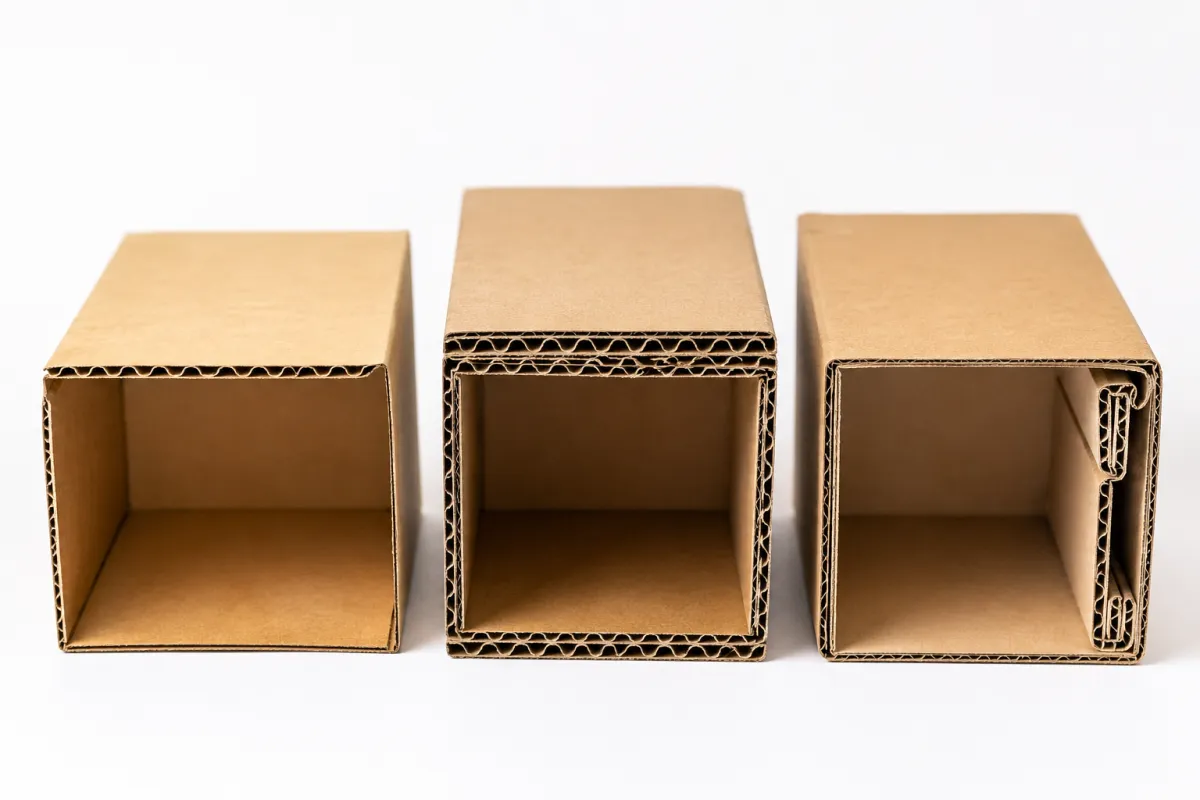
In a corrugated boxes comparison, the first correction is this: identical dimensions do not mean identical performance. A 6-inch difference in flute profile or a change in liner quality can create a 20-30% gap in stack reliability, even when the dimensions and external look match. You can have two cartons that print the same, feel similar by hand, and still fail differently under repeated loading.
Corrugated is a layered structure: linerboard skins, fluted medium, and adhesive chemistry working as one system. The line between “looks premium” and “performs premium” is where most weak decisions happen. I have seen a glossy-coated box that passed visual QA beautifully, then buckle at the edge after only part of one pallet load because the adhesive cure profile changed between production lots.
Route pressure matters as much as board strength. A warehouse-based shipment that stays on managed conveyors needs a different answer than last-mile fulfillment into dense urban hubs. A carton that performs fine in storage can still fail in the “rough handling window”: sortation drops, corner bumps, forklift nudges, and repeated pallet re-stacking. A corrugated boxes comparison that ignores these loads is comparing paper and pretending the world is an air-conditioned showroom.
There is also a mismatch people underestimate: strength is not the same as operational fit. You can reduce claims with heavy board and then lose time and money elsewhere if the carton takes longer to seal, needs awkward inserts, or creates extra void fill. A useful corrugated boxes comparison values the full chain, not just compression numbers.
A box that looks tidy in a spec sheet is nice. A box that survives the route, keeps labor moving, and still protects the product is what should win.
If you want to compare like an operator instead of a buyer, begin with a shortlist of Custom Shipping Boxes with matching internal dimensions and one shared performance target. That keeps your corrugated boxes comparison from becoming a test of “who sent the nicer PDF,” and keeps the team from comparing options that were never built to compete.
How a Corrugated Boxes Comparison Works in Real Shipping Conditions
Method starts with structure definition: flute type, wall construction, moisture behavior, and test method. A-flute cushions and is often useful in certain cushioning roles; B-flute provides a smoother print surface with good burst balance for some formats; C-flute remains a common shipping baseline; E-flute keeps wall weight lower for display-first cartons, but does not automatically mean it is better everywhere. Double-wall and triple-wall constructions move your spec into a different load class and should be treated as such in the comparison.
Strength metrics are useful only when interpreted in context. ECT tells you how much edge load the board resists at the edge, and burst strength explains rupture resistance under pressure. Puncture testing matters for point loads, especially when your product has sharp features or is moved through mixed human-machine handling. A strong corrugated boxes comparison does not pick one test and call it done.
Then come test controls: same internal dimension, same payload, same load placement, same pallet configuration, same number of drops and same vibration exposure pattern. Humidity is a real variable; corrugated can lose stiffness with moisture, and that effect is not subtle in humid transit corridors. If two samples are tested in different environments, your data is not clean, it is just noisy with paperwork.
Static compression and actual handling are not substitutes. A carton might pass a compression rig and still lose edges after vibration or corner loading. At minimum, include a basic drop profile, a corner impact sequence, and a motion simulation or at least a repeatable mock-up of your transfer process before declaring a winner in your corrugated boxes comparison.
Supplier testing language needs scrutiny. Request explicit test standard references, sample age, board source, and production lot details. Good teams cross-check against recognized procedures from ISTA where possible and confirm fiber chain-of-custody details with FSC records when sustainability is an explicit decision factor. A defensible corrugated boxes comparison is explicit about what is certified, what is estimated, and what is sales copy.
If a supplier gives impressive numbers but cannot provide tested documents for ECT, burst, or equivalent method, the comparison starts to look thin. In packaging, if method clarity is missing, the risk is not just performance uncertainty; it is procurement risk with hidden rework costs.
What Should a Corrugated Boxes Comparison Measure?
A mature corrugated boxes comparison should track protection, handling efficiency, freight impact, print accuracy, and total landed outcome. If you only track one metric, you are probably missing three critical cost leaks. At minimum, include ECT, burst, flute type, palletization behavior, and pilot damage results in the same score sheet.
The practical start is not a supplier pitch deck. It is your shipping reality. A fragile, high-value item needs a different scorecard than a heavy, abrasion-tolerant product. A corrugated boxes comparison built on product profile and route profile will be easier to defend internally, especially when exceptions and exceptions-only logic start showing up in execution.
One useful way I have used on real projects is pairing objective test scores with field KPIs: claim rate, repack incidence, and seconds per order for line fill. A carton that wins 2% on cost but drops throughput by 8% often loses more money than it saves. In a real run, speed and reliability are not “nice-to-have” columns; they are margin columns.
Key Factors for an Honest Corrugated Boxes Comparison
Match cartons to use case before matching vendors. Outbound-first packaging differs from reusable logistics loops, and mixed-SKU fulfillment needs a different geometry strategy than single-SKU programs. Storage temperature variation, seasonal moisture shifts, and transit aggression all matter more than color options when your damage tolerance is low.
Three measures should sit in every corrugated boxes comparison: protection quality, fulfillment fit, and shipment-level cost. Unit cost matters, but only in combination with rework, labor, and transport outcomes. A cheaper carton that triggers 3% higher damage claims and more labor burn is not cheap; it is a deferred cost center.
Small details can move performance in surprising directions. Die-cut positions change seam stress. Coating choice can improve moisture resistance or print feel and can also alter peel strength. Window inserts might improve merchandising, but they often reduce effective panel strength and add waste if the die has too many internal breaks. If your packaging family uses several formats, compare them within your broader Custom Packaging Products system so the logic from one box size to the next remains coherent.
Sustainability must be part of the comparison, but never the only argument. Recycled content and source certification are real, yet anecdotally they become less useful if the box fails early and ends up back in the returns pipeline. A corrugated boxes comparison should treat fiber claims, performance claims, and replacement risk as one combined decision, not separate departments arguing over slides.
A practical filter I trust is simple: if a feature does not affect product safety, labor pace, or the shipping bill, it should not become the deciding attribute. Operations responds to outcomes; brand teams respond to image; procurement responds to consistency. A structured corrugated boxes comparison gives each group something measurable.
Corrugated Boxes Comparison Step-by-Step Guide for a Reliable Decision
A lot of teams still begin with “here are three sample boxes,” and then argue for two weeks over aesthetics. Better to start with constraints. The carton has to fit the product, the pallet math, the network route, and the weekly labor cycle. If that framework is unclear, your corrugated boxes comparison becomes a story exercise, not a sourcing decision.
- Define the constraints. Lock product dimensions, weight range, fragility profile, humidity exposure, pallet height limit, and an explicit acceptable damage target (for example, 1.0 claim per 1,000 units). If your limit is fuzzy, comparisons will be too.
- Build one shared comparison sheet. Same columns for every supplier: board grade, flute profile, wall build, adhesive system, print tolerance, MOQ, lead time, and approved tests. Different template formats across vendors add noise before you even test.
- Get samples and test under your conditions. Use drop, corner crush, and vibration checks that mirror your actual handling sequence. If your route is high-touch, include an additional handling simulation and don’t rely on one static result only.
- Weight the decision before scoring. A practical split is 40% protection, 30% cost predictability, 20% lead time, and 10% brand fit. Your mix can vary, but make tradeoffs explicit before any internal vote happens.
- Pilot before full volume. Run one controlled lot, monitor claims and pack time, and then continue with the strongest two candidates. This is where most bad choices die, and where good ones prove themselves.
That sequence usually cuts through the politics. Marketing may ask for a richer print area. Fulfillment wants ease of assembly. Procurement has budget pressure. A disciplined corrugated boxes comparison makes every preference visible and prevents the loudest argument from becoming the default rule.
From practical experience, teams using short pilots with Custom Shipping Boxes often discover issues in real minutes, not theoretical meetings. You can see how panel compression feels, how tabs lock, and whether speed drops at the sealing station. That field feedback is the difference between a credible recommendation and a spreadsheet that just looks tidy.
Document the failure mode, not just the successful run. Was corner crush early? Did seal overlap fail under humid air? Did line speed fall because cartons snagged guides? That detail is what turns a corrugated boxes comparison into a reusable operating standard, not a one-off procurement story. Boxes are for execution, not theater.
Corrugated Boxes Comparison Process and Timeline: From Concept to First Reorder
Most teams that run this well can complete a first-cycle comparison in a focused 2-3 week window, but only if roles are clear and scope is controlled. A workable timeline is: week 1 constraints and shortlist, week 2 samples and test setup, week 3 pilot execution and review. If artwork and approvals are stable, this holds. If requirements drift, time expands quickly.
Review gates are important: finalize sign-off only after performance testing and cost model reconciliation. A tempting first quote has no special aura; it is just a starting number. The real cost curve includes transit damage, labor, returns, and line interruptions. Missing those checks usually creates the exact delays everyone tries to avoid.
Most cycles need one or two design refinements. Coatings, dieline geometry, and print registration can add extra days. Peak season capacity compression can also move timelines despite a clean spec. A corrugated boxes comparison is engineering plus calendar discipline, and treating it like both matters.
The first reorder is where your initial work pays off or gets erased. If the pilot was loose on specs or weak on acceptance criteria, reorder becomes cleanup and exception handling. If the pilot was disciplined, reorder is mostly execution and replenishment planning, with minimal surprises. A tight version-lock and clear revision policy prevent “just one more tweak” from becoming a permanent delay loop.
From a production perspective, lock the final die line, artwork, and board build in one controlled release packet. I have seen teams lose a week to “tiny corrections” that were never critical and should have been filtered out before approval. A corrugated boxes comparison that ends with release control is far more valuable than one that ends with perfect-looking draft emails.
Cost and Pricing in Corrugated Boxes Comparison: Where the Budget Gets Hit
In a corrugated boxes comparison, price is not a single row; it is a sequence of cost layers. The top line is unit price. Beneath it are board inputs, die creation, coating chemistry, color depth, freight lane, and inspection overhead. If you compare only the sticker, you ignore the line items that usually cause budget pain.
A lighter board can reduce inbound freight and storage load, but it can also increase transit failures if handling is rough. A heavier board often protects better but raises handling cost and shipping weight. The right question is not “which option is cheapest on carton price,” but “which option is cheapest across failure, labor, and freight assumptions.”
Below is a practical pricing snapshot for a typical corrugated boxes comparison. These ranges are directional and vary by region, paper market, print coverage, and quantity commitments, but they are useful for early discussion.
| Option | Typical Use | Approx. Unit Price at 5,000 | Strength Profile | Main Tradeoff |
|---|---|---|---|---|
| 32 ECT single-wall | Light to medium e-commerce goods | $0.38-$0.72 | Good stack performance, moderate puncture resistance | Can struggle with heavier loads and aggressive handling |
| 200# test / heavy single-wall | Denser products, stronger shipment profiles | $0.52-$0.95 | Higher burst resistance and edge support | Higher board spend and slight weight increase |
| Double-wall carton | Bulk, fragile, or pallet-stacked transport | $0.90-$1.60 | Strong compression and puncture resistance | More space required for storage and higher freight |
| Printed e-flute display-style box | Brand-forward retail and unboxing programs | $0.55-$1.20 | High visual quality, lighter overall build | Less ideal for heavy stacking and repeated rough handling |
Those ranges illustrate why every corrugated boxes comparison should include a failure-cost line. Lost product, rejection, reprints, replacement freight, and labor drift can wipe out a 4 to 8 cent per-piece advantage quickly. I have watched teams celebrate savings that vanished as soon as claims began to rise.
Model total landed cost in multiple scenarios: normal route, humidity-heavy route, and high-mix handling route. If a lower-priced option collapses in the harsh scenario, the comparison result should reflect that before contract sign-off. A corrugated boxes comparison should tell you whether you are buying dependable packaging or a slow-burn cost problem.
Common Mistakes and Expert Tips in Corrugated Boxes Comparison
The most common shortcut is focusing on one metric at a time. Thickness alone can be deceptive. A thick board with weak flute orientation or poor adhesive consistency can still fail at corners, even though it feels tough when handled by hand.
Mixing standards is another expensive habit. One supplier may push burst numbers, another ECT, another internal custom metrics. That is not a consistent comparison. You need one common benchmark set: same test method, same setup, same acceptance boundaries. If test conditions are not aligned, you are not making a decision, you are collecting incompatible stories.
A practical tip from the floor: ask for raw board specs, certification dates, and a documented case where their carton was tested under conditions similar to yours. You do not need horror stories; you need real, measurable outcomes. Suppliers who discuss both strengths and limits tend to be more transparent than those who only sell confidence.
Set a risk threshold before procurement talks begin. For example: maximum claims per 1,000 units, maximum allowable compression loss after humidity change, and acceptable pallet tilt or shock margin. Once that threshold is agreed, debate becomes narrower and less emotional.
One mistake in many programs is deciding on paper alone without considering SKU architecture. A carton system should follow product class and motion pattern, not mood. Consistency across formats reduces planning drift and improves replenishment reliability, especially when you are operating with a broader Custom Packaging Products family across fulfillment and retail channels.
Here is my blunt but helpful line: a good corrugated boxes comparison is disciplined, repeatable, and a little boring. Boring can be right. When you keep variables controlled, you cut argument, reduce rework, and protect margin. In short, you stop fighting packaging choices and start controlling outcomes.
Conclusion: Corrugated Boxes Comparison Action Steps for Your Next Production Run
If your corrugated boxes comparison is headed for better decisions instead of better slides, run it in one sequence: define constraints, standardize tests, pilot two finalists, compare total landed cost, then lock the version before broad release. Keep one scorecard and one decision owner, and avoid changing criteria midstream.
Do not skip the pilot on schedule pressure and do not skip documentation when things work. A pilot run is the only place where you can verify stack behavior, handling speed, seam integrity, and damage trend under real use. That phase is where “sounds right” turns into “actually works.”
Then set a revision protocol with a date, a version ID, and explicit exceptions. A corrugated boxes comparison is not finished when approved; it is stabilized by disciplined release and then reviewed on real shipment data. Revisit it every quarter, or whenever the shipping network, product mix, or supplier base changes. That is how teams stay out of preventable damage loops and keep cartons stable through growth.
At the next planning cycle, run one clear rule: only suppliers that clear the same test, cost, and operational criteria continue, and only one team changes the finalized spec list. That one rule has removed a lot of confusion in projects I have worked on, and it keeps packaging decisions grounded in what gets delivered, not what looks good in the draft room.
Use the final corrugated boxes comparison output in one cross-functional review with procurement, sales, and fulfillment. Keep it practical, and keep it boring enough to execute consistently: scorecard, pilot evidence, decision threshold, and locked release package. That is your control system, and it is gonna save you money the next time demand spikes.
FAQ
What is the main metric to prioritize in a corrugated boxes comparison for fragile products?
Prioritize edge crush and burst resistance together, then validate with your own drop and vibration sequence using real unit weights and real stack heights. Empty test boxes are useful for baseline control, but they do not represent the behavior of full loads under the stress patterns in a live fulfillment flow.
How do I do a corrugated boxes comparison without spending a lot on expensive testing?
Start with two to three short, in-house tests for your top two candidates: drop height, edge compression, and vibration mock-up at your normal pallet setup. Use supplier certificates only as a filter, then spend full validation budget on a pilot that includes your production operators, not only lab conditions.
How long does a corrugated boxes comparison timeline usually take before final approval?
A focused cycle often takes 2 to 3 weeks if artwork is stable and requirements are locked early: week one for constraints and matrix setup, week two for sampling and testing, week three for pilot review and scoring. Add buffer for color-proof approvals, tooling revisions, or seasonal lead-time pressure.
How much can pricing shift in a corrugated boxes comparison?
Unit price can move 10-30% by flute grade, print complexity, and volume commitments, but effective landed cost can move more when damage rework, labor drag, and freight handling are included. That is why the comparison has to stay total-cost-first, not carton-price-first.
Can I reduce risk with the same budget during corrugated boxes comparison?
Yes—keep the budget structured and run one extra pilot lot before mass release instead of paying for broad redesigns later. Tighten product fit first, reduce variable void fill, lock carton assembly steps with operations, and confirm the choice before final print decisions escalate.