Buyer Fit Snapshot
| Best fit | Corrugated Mailer Cartons Supplier projects where brand print, material claims, artwork control, MOQ, and repeat-order consistency need to be specified before quoting. |
|---|---|
| Quote inputs | Share finished size, material target, print colors, finish, packing count, annual reorder estimate, ship-to region, and any compliance wording. |
| Proofing check | Approve dieline scale, logo placement, barcode or warning zones, color tolerance, closure strength, and carton packing before bulk production. |
| Main risk | Vague material claims, crowded artwork, missing packing details, or unclear freight terms can make a low unit price expensive after revisions. |
Fast answer: Corrugated Mailer Cartons Supplier: Pricing, Timing, Fit should be specified like a repeatable production item. The safest quote records material, print method, finish, artwork proof, packing count, and reorder notes in one written spec.
Production checks before approval
Compare the actual filled-product size with the drawing, then confirm tolerance on folds, seals, hang holes, label areas, and retail display edges. Reserve space for logos, QR codes, warning copy, and material claims before decorative graphics fill the panel.
Quote comparison points
Review material grade, print process, finish, sampling route, tooling charges, carton quantity, and freight assumptions side by side. A quote is only useful when the supplier can repeat the same color, closure quality, and packing count on the next order.
Corrugated Mailer Cartons Supplier: Pricing, Timing, Fit
If you are sourcing a corrugated mailer cartons supplier, do not let the lowest box quote bully your brain. Cheap cartons have a way of collecting extra costs somewhere else: more void fill, slower packing, crushed corners, damage claims, and the lovely little bonus of customer complaints. That is not savings. That is a later invoice with better paper.
Corrugated mailer cartons are shipping cartons made from fluted board and usually used for flat products, presentation packs, subscription kits, cosmetics, apparel, samples, books, and small parts. A good corrugated mailer cartons supplier does a lot more than sell folded board. They help with sizing, board selection, print setup, structural testing, pricing, and production coordination so the carton protects the product and still looks like it belongs to the brand.
What a corrugated mailer cartons supplier actually does
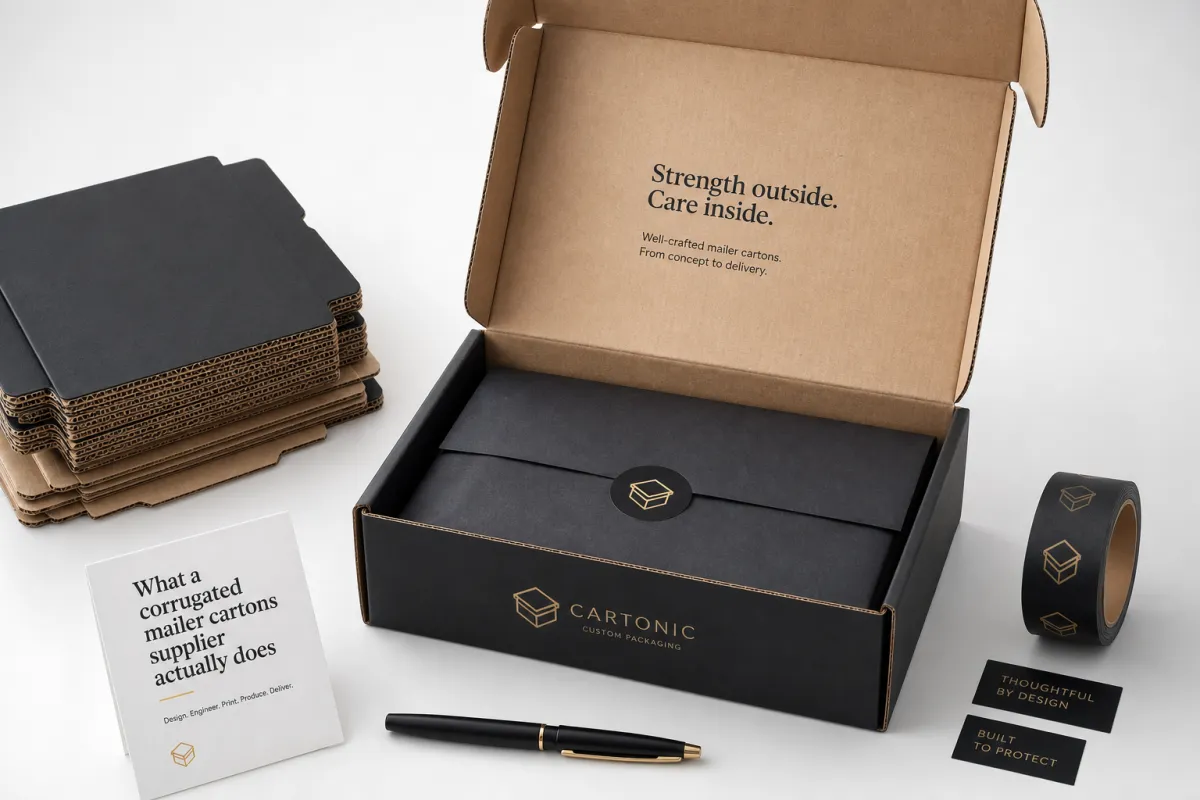
A corrugated mailer cartons supplier is part fabricator, part spec checker, part reality check. The better ones will tell you quickly whether your product fits a single-wall mailer, whether the flap needs more depth, and whether the printed carton is worth the added spend. The bargain option can get expensive fast once it crushes in transit, needs extra filler, or forces your team to re-pack returns. Boxes are funny like that. They never stay cheap for long if they are wrong.
These cartons are built from fluted board, which gives them stiffness and puncture resistance without piling on much weight. Most brands use them for products that are flat, presentation-focused, or too valuable to toss into a plain carton and hope for the best. That includes apparel, beauty sets, books, media kits, sample packs, and small parts. A corrugated mailer cartons supplier should know how to match flute type and board grade to the shipping method, not just to a pretty mockup.
The role also stretches into brand presentation. If the carton opens cleanly, prints sharply, and closes without bowing, the customer feels the product was handled with care. That matters for subscription boxes and retail-ready packaging, and it matters just as much for direct-to-consumer orders that live or die on first impression. A mailer is not only a shipping shell. It is a touchpoint. That is why the right corrugated mailer cartons supplier affects both protection and perception.
A box that looks cheap on paper can be expensive in the returns column. If it needs tape just to survive closure, the structure is wrong.
For brands shipping lighter items in adjacent formats, compare the mailer spec against Custom Poly Mailers or Custom Shipping Boxes. Sometimes the mailer is the right answer. Sometimes it is just the answer people grab because they have not checked the packout yet. A solid corrugated mailer cartons supplier will push back on that kind of guesswork.
How a corrugated mailer cartons supplier turns a brief into boxes
The production flow usually starts with the product, not the carton. A good corrugated mailer cartons supplier will ask for external dimensions, product weight, shipping method, insert requirements, closure preferences, artwork files, and any limits on stacking or shelf display. If that brief is vague, the carton will be vague too, and vague cartons are how you end up with rattling goods or crushed corners.
Next comes the dieline. That is the flat template that defines cuts, folds, glue areas, and closure tabs. For a simple pack, the supplier may already have a stock structure close to what you need. For a custom run, they will adjust width, depth, flap length, and score placement so the packout stays stable and the folds do not fight the product. This is where a corrugated mailer cartons supplier earns its keep: by translating a product brief into a carton that can be assembled and shipped at scale.
Board selection is usually the next decision. E-flute, around 1/16 inch, is common for sharper print and lighter presentation. B-flute, closer to 1/8 inch, gives more cushioning and crush resistance. Some brands need double-wall board for heavier or more fragile goods, but not every order does. Overspec the board and you pay for cardboard you do not need. Underspec it and you pay in breakage. The right corrugated mailer cartons supplier should explain that tradeoff without pretending every carton needs the strongest board in the plant.
Customization comes after structure. Printing method, coating, varnish, and inserts all affect cost and lead time. Flexographic printing is often efficient for simpler graphics and larger runs. Litho-lam or higher-end print methods can carry richer artwork and a smoother finish, but they tend to raise setup cost. Inserts and partitions add protection, especially for bottles, components, or kits with multiple items. A practical corrugated mailer cartons supplier will tell you which upgrades improve the pack and which ones just sound fancy in a quote. A lot of packaging decisions are kinda like that: the expensive choice is not always the smart one.
Quality control is not glamorous, but it separates a carton that folds cleanly from one that turns into a mangled stack at the packing table. Checkpoints should include cut accuracy, score alignment, glue integrity, print registration, and folding performance. A decent supplier will also verify that the finished carton hits the internal dimensions consistently. Millimeters matter here. A corrugated mailer cartons supplier that ignores them is basically handing your problem to the warehouse and calling it finished.
There are usually three levels of supply: stock, semi-custom, and fully custom. Stock items are quickest and cheapest, but you live with the supplier’s existing size and structure. Semi-custom gets you a modified dieline or print variation without a full tool-up. Fully custom takes longer, costs more, and gives you control over the fit. A corrugated mailer cartons supplier should make that distinction plain before you approve anything.
Key factors when choosing a corrugated mailer cartons supplier
Board strength is the first filter. A mailer that ships apparel across town does not need the same structure as one carrying bottles through multiple parcel handoffs. Ask for the board spec, flute type, and performance expectations. ECT and burst strength are still useful references, but they should be tied to the actual packout and shipping route. A thoughtful corrugated mailer cartons supplier will connect those dots instead of tossing a number at you and calling it engineering.
Fit matters just as much. A few millimeters of slack can let the product slide around, while too little clearance can make the closure bow or the sides bulge. If you are using inserts, labels, cards, or tissue, those need space too. I usually want enough room for the product and its finishing components without forcing the flap to act like a clamp. The best corrugated mailer cartons supplier will ask for a packed sample, not just a naked product measurement.
Print capability matters more than people expect. Some brands only need a one-color logo and a size mark. Others need fine graphics, tight registration, and repeatable color across reorders. Ask how the supplier controls color consistency, what proofing method they use, and whether they can handle simple branding without making the carton look like a rushed trade-show handout. A reliable corrugated mailer cartons supplier should show you actual print limits before you commit.
MOQ and reorder flexibility are where a lot of buyers get trapped. A supplier can quote a low unit price and still be a poor fit if they require a huge minimum or charge a painful premium for small replenishment runs. That matters for growing brands, seasonal products, and pilot launches. If your sales are still moving around, a corrugated mailer cartons supplier with a reasonable entry point can be more valuable than one with a perfect quote and no practical supply flexibility.
Sustainability claims deserve proof, not poetry. FSC chain-of-custody certification, recycled content percentages, and water-based inks are all useful details, but only if the supplier can document them. If you care about recyclability or sourced fiber, ask what is actually certified and what is simply “eco-friendly” because someone decided green ink on a sales sheet counts as evidence. A real corrugated mailer cartons supplier should be able to point to specs, not buzzwords. For broader shipping sustainability context, the EPA has useful guidance on packaging waste and recycling at EPA recycling resources, and FSC explains certification and responsible sourcing at FSC.
One more practical point: ask whether they test to standards like ISTA protocols or ASTM methods. Not every package needs formal lab work, but for fragile or higher-value goods, a supplier familiar with ISTA test paths can save a lot of expensive trial and error. A corrugated mailer cartons supplier that understands test logic will be far more useful than one that only understands how to quote paperboard.
Corrugated mailer cartons supplier pricing: what drives cost
Pricing starts with board grade and carton size. Bigger cartons use more material, and stronger boards cost more per sheet. Print coverage pushes cost up too, especially if the artwork uses multiple colors, white underprint, or a higher-end finish. Quantity also matters. A corrugated mailer cartons supplier can spread setup cost over a larger run, which is why unit pricing usually drops as volume rises.
Tooling and structure changes are another cost driver. A custom dieline may need design work, sample cutting, or new cutting rules, and those costs do not vanish because someone asked for a lower quote. If you need inserts, partitions, or unusual closure features, expect the price to climb. That is not a supplier being difficult. That is manufacturing doing what manufacturing does. A smart corrugated mailer cartons supplier will break these items out so you can see where the money goes.
Freight and storage can quietly change the equation. A carton quoted at a nice unit price may still land badly if it ships in a bulky configuration, takes up too much pallet space, or requires extra warehousing. That is why landed cost matters more than the number at the top of the quote. I have seen buyers celebrate a cheaper carton quote, then spend the savings on freight, storage, and a second packing operation. The corrugated mailer cartons supplier did not save them anything. The spreadsheet just looked cheerful for a minute.
Here is a simple way to compare typical supply levels without mixing apples and applesauce:
| Supply type | Typical unit price | Common MOQ | Typical lead time | Best fit |
|---|---|---|---|---|
| Stock mailer | $0.30-$0.80 | 100-1,000 pcs | 3-7 business days | Fast reorders, simple packaging needs |
| Semi-custom mailer | $0.45-$1.20 | 500-2,500 pcs | 10-15 business days after approval | Branding with moderate structure changes |
| Fully custom printed mailer | $0.70-$2.50+ | 1,000-5,000+ pcs | 12-20 business days after proof sign-off | Retail-ready, presentation-driven, long-term use |
Those ranges are not universal, because shipping lane, board spec, print coverage, and region all move the number. But they are realistic enough to keep your quote review grounded. If one corrugated mailer cartons supplier comes in dramatically below the others, check whether the quote includes the same board grade, the same print method, the same freight assumption, and the same carton count. Half the time the “best price” is just the one with missing details.
There are times when a higher-priced supplier is actually cheaper. If the carton packs faster, protects better, uses less void fill, and reduces damage claims, the business result is better even if the unit price is higher. That is especially true for cosmetic kits, retail-ready sets, and products that are awkward to replace. A disciplined corrugated mailer cartons supplier will talk in terms of total landed cost, not just unit cost theater.
Corrugated mailer cartons supplier process and timeline
The timeline usually begins with a brief. You send product dimensions, shipping weight, artwork, target quantity, and any special requirements. The corrugated mailer cartons supplier then builds a quote around that information, often with options for board grade, print level, and sample type. If your brief is incomplete, expect a few back-and-forth rounds. That is not delay for the sake of delay. It is the supplier trying to keep the final carton from becoming a regret.
After quoting, the next step is dieline review. For a stock or semi-custom pack, this can move quickly. For a new carton, you may need a structural sample or a white sample before artwork is finalized. That stage matters more than people like to admit, because the sample reveals whether the product actually fits with the chosen closure and whether the carton opens and closes cleanly. A strong corrugated mailer cartons supplier will push for that sample before production, not after a thousand pieces are already in motion.
Then comes proofing and approval. Artwork should be checked for bleed, safe zones, panel alignment, logo placement, and any print restrictions tied to the board surface. If the carton includes coated areas, matte varnish, or special finishes, proofing needs extra care. A good corrugated mailer cartons supplier will also flag if the color target is likely to shift on corrugated stock. Flat graphics on brown board do not behave like print on coated paperboard. That is not a flaw. That is physics with a grainy surface.
Realistic timing helps a lot. Stock cartons can ship in 3-7 business days if inventory is available. Semi-custom runs often need 10-15 business days after final approval. Fully custom printed cartons commonly sit in the 12-20 business day range once the sample is signed off, with freight added on top. If tooling is new, artwork changes late, or board stock is constrained, the schedule stretches. A corrugated mailer cartons supplier should tell you that up front instead of promising fantasy speed and hoping no one remembers the calendar.
Most delays come from four places: unclear specs, artwork revisions, slow sample approval, and material shortages. Rush orders can help, but they also raise cost and reduce room for error. If you are launching a product or changing a fulfillment route, build a buffer of at least two weeks around the expected delivery date. A practical corrugated mailer cartons supplier will plan backward from your launch or replenishment date and show where the slack is.
Communication should be specific, not mushy. Ask for milestones: quote sent, dieline approved, sample in transit, production start, packout complete, and ship date confirmed. A supplier that updates you before you have to ask is doing the job properly. A corrugated mailer cartons supplier that disappears for ten business days and then sends a tracking number with no context is just creating suspense nobody wanted.
Common mistakes with a corrugated mailer cartons supplier
The most common mistake is measuring the product and forgetting the rest of the packout. You need clearance for inserts, labels, protective tissue, and the pressure from the closure flap. A product that “fits” on paper can still jam the carton or make the lid bulge. That is how a corrugated mailer cartons supplier ends up getting blamed for a problem that started with incomplete measurements.
Another mistake is approving a sample because it looks nice on the desk. A carton can photograph well and still fail in a parcel network. If you are shipping fragile, retail-ready, or long-distance orders, test the real thing. Send a pilot batch through your actual route. Drop it, stack it, and inspect the corners after transit. A serious corrugated mailer cartons supplier will not be offended by that request. They should welcome it.
Chasing the lowest quote is probably the most expensive habit in packaging. Buyers often skip over board spec, print method, or finish limits because the price column looks friendly. Then the carton arrives with weak scores, muddy graphics, or an outer liner that scuffs too easily. A respectable corrugated mailer cartons supplier should be compared on spec parity, not just price parity.
Forecasting is the sleeper issue. Order too little and you pay rush fees, freight premiums, and whatever panic costs show up at the warehouse. Order too much and you park cash in dead inventory. The best suppliers help you set a reorder point based on actual usage, not optimism. A dependable corrugated mailer cartons supplier will talk through run rate, safety stock, and replenishment windows before the first order is even placed.
And yes, skipping test shipments can bite hard. A carton that survives local deliveries may behave differently once it is routed through longer zones, more handoffs, or temperature swings. Corrugated can handle a lot, but not infinite abuse. If the carton is doing both protection and presentation, you want to know its weak points before customers do. That kind of discipline separates a useful corrugated mailer cartons supplier from a transactional one.
Expert tips and next steps before you request quotes
Before you ask for pricing, build a tight brief. Include product dimensions, shipping weight, the finished packout, artwork files, target quantity, expected reorder frequency, and the lead time you actually need. The cleaner the brief, the better the quote. A corrugated mailer cartons supplier can move much faster when the spec sheet is clear enough to reduce assumptions.
Ask every supplier the same questions so you can compare answers cleanly. I would want board spec, flute type, dieline options, sample policy, production timeline, freight assumptions, and quality control checkpoints. If one vendor gives you a vague “we’ll take care of it” and another gives you exact details, the second one has already shown more useful discipline. A corrugated mailer cartons supplier worth working with should be comfortable putting numbers next to the process.
Get at least two or three quotes using identical specs. Not similar specs. Identical. Otherwise you are not comparing suppliers. You are comparing different products pretending to be the same thing. That wastes time and makes cheap quotes look smarter than they are. A good corrugated mailer cartons supplier will not mind direct comparison because the spec does the talking.
If the product is new, test a pilot batch first. A small run can reveal fit issues, print issues, assembly friction, and shipping damage before the full order lands. That is especially useful for brands launching seasonal kits, subscription programs, or new fulfillment channels. A careful corrugated mailer cartons supplier should treat the pilot as part of the launch plan, not as an annoying speed bump.
If the product suite may expand, think about the whole packaging family too. Sometimes the best move is to design the carton format around the main SKU, then extend the line later with matching formats for other products. That can include shipping boxes, mailers, and inserts that share a visual language. A corrugated mailer cartons supplier that can support the first carton and the follow-on formats gives you a cleaner path as the catalog grows.
One practical checklist before you send a quote request:
- Confirm internal dimensions and product clearance.
- Lock the board grade and flute preference.
- Decide whether print is required or optional.
- Set MOQ, reorder frequency, and target lead time.
- Share sample files and the real shipping route.
Choosing a corrugated mailer cartons supplier for repeat orders
Repeat orders are where supplier quality becomes obvious. The first run may go smoothly because everyone is focused. The second or third run tells you whether the partner can hold the same spec, the same print consistency, and the same delivery timing without hand-holding. A dependable corrugated mailer cartons supplier should be able to reorder by spec, not by memory.
For repeat programs, consistency matters as much as price. If the carton score changes, the insert fit changes, or the board surface changes enough to affect print, your packing line feels it immediately. That is why I pay attention to whether the supplier documents the exact board, the exact dieline, and any approved sample references. A corrugated mailer cartons supplier that controls those details saves time every time you reorder.
There is also a margin angle here that people ignore. A slightly stronger carton may reduce return processing. A cleaner closure may reduce tape use. A more accurate dieline may speed assembly by a few seconds per unit, which becomes real labor savings over a run of thousands. The right corrugated mailer cartons supplier helps protect margin in ways that do not show up on the first quote line.
And yes, the last mile still matters. A carton designed for a fulfillment center in one region may behave differently in another, especially if the route changes or handling gets rougher. That is why I like to see a supplier ask about shipping method, palletization, and storage conditions before quoting. If they do that, they are thinking like a packaging partner. If they do not, they are just a box vendor. A good corrugated mailer cartons supplier should be more than a vendor.
So the real decision is not just who can make a mailer. It is who can make the right mailer, on time, at a cost that still leaves room for margin, and then make it again next month without drama. That is the job of a corrugated mailer cartons supplier worth keeping.
On a few launches I have seen the same pattern repeat: the first quote looked fine, the first sample looked fine, then the team discovered the packout needed one extra millimeter of depth or the closure was fighting the insert. Fixing that after approval is always more annoying than fixing it early. So if you are comparing suppliers now, do not just ask for a price. Ask for the sample path, the board spec, the reorder record, and the shipping assumption. That is the part that saves headaches later.
How do I choose a corrugated mailer cartons supplier for my product?
Match the supplier to your product weight, fragility, and shipping method. Ask for board specs, sample options, and proof they can hit your internal dimensions consistently. If they cannot speak clearly about fit and board performance, keep looking.
What is a normal MOQ from a corrugated mailer cartons supplier?
Stock or semi-custom items often start lower than fully custom printed runs. A good supplier should explain how MOQ changes with size, print coverage, and tooling, instead of tossing out one generic minimum and calling it useful.
How long does a custom corrugated mailer cartons supplier order usually take?
Simple stock items can move quickly, while custom dielines and printed cartons take longer. The main timeline drivers are sample approval, print setup, material availability, and the production queue.
Are printed mailers worth the extra cost from a corrugated mailer cartons supplier?
Yes, if the carton is part of the unboxing experience or acts like a brand touchpoint. No, if the print adds cost without improving conversion, retail presentation, or reuse value. Nice print is not magic. It still has to earn its keep.
What should I ask before switching corrugated mailer cartons supplier partners?
Ask about lead times, quality control, sample turnaround, and how they handle reorders. Confirm the exact board spec and dieline so you do not accidentally change the packout. A switch that looks minor on paper can become a mess in production.
If you want the short version, choose a corrugated mailer cartons supplier that can prove fit, document the board spec, quote honestly on landed cost, and support reorder consistency without making every run feel like a new experiment.


