Buyer Fit Snapshot
| Best fit | packaging buyers who need clearer specs, stronger internal paths, and repeatable quote decisions where brand print, material, artwork control, and repeat-order consistency matter. |
|---|---|
| Quote inputs | Share finished size, material target, print colors, finish, packing count, annual reorder estimate, and delivery region. |
| Proofing check | Approve dieline scale, logo placement, barcode or warning zones, color tolerance, and any recyclable or compostable wording before bulk production. |
| Main risk | Vague material claims, crowded artwork, or missing packing details can create delays even when the unit price looks attractive. |
Fast answer: Cost for Embossed Kraft Bands: Pricing, MOQ, and More should be specified like a repeatable production item. The safest quote includes material, print method, finish, artwork proof, carton packing, and reorder notes in one written spec.
What to confirm before approving the packaging proof
Check the product dimensions against the actual filled item, not only the sales mockup. Ask for tolerance on folds, seals, hang holes, label areas, and retail display edges. If the package carries a logo, QR code, warning copy, or legal claim, reserve that space before decorative graphics fill the panel.
How to compare quotes without losing quality
Compare board or film grade, print process, finish, sampling route, tooling charges, carton quantity, and freight assumptions side by side. A lower quote is only useful if the supplier can repeat the same color, closure quality, and packing count on the next order.
Need the Cost for Embossed Kraft bands without the usual quote dance? Start with the variables that actually move the number: size, emboss area, quantity, paper weight, and whether you want blind emboss, foil, or print. The cost for embossed kraft bands is driven less by the kraft sheet itself and more by setup, tooling, and how cleanly the emboss can run on press.
That part trips people up all the time. A plain kraft band with one sharp emboss often reads more premium than a busy printed sleeve, and it can be cheaper to produce if the design stays disciplined. If the artwork is focused, the cost for embossed kraft bands can beat flashier options that look fancy on a screen and kind of messy in real life. The trick is knowing where the money goes before you approve the design.
Keep the design focused. One strong mark beats three decorative ideas fighting for space, especially on kraft.
What is the Cost for Embossed Kraft Bands?
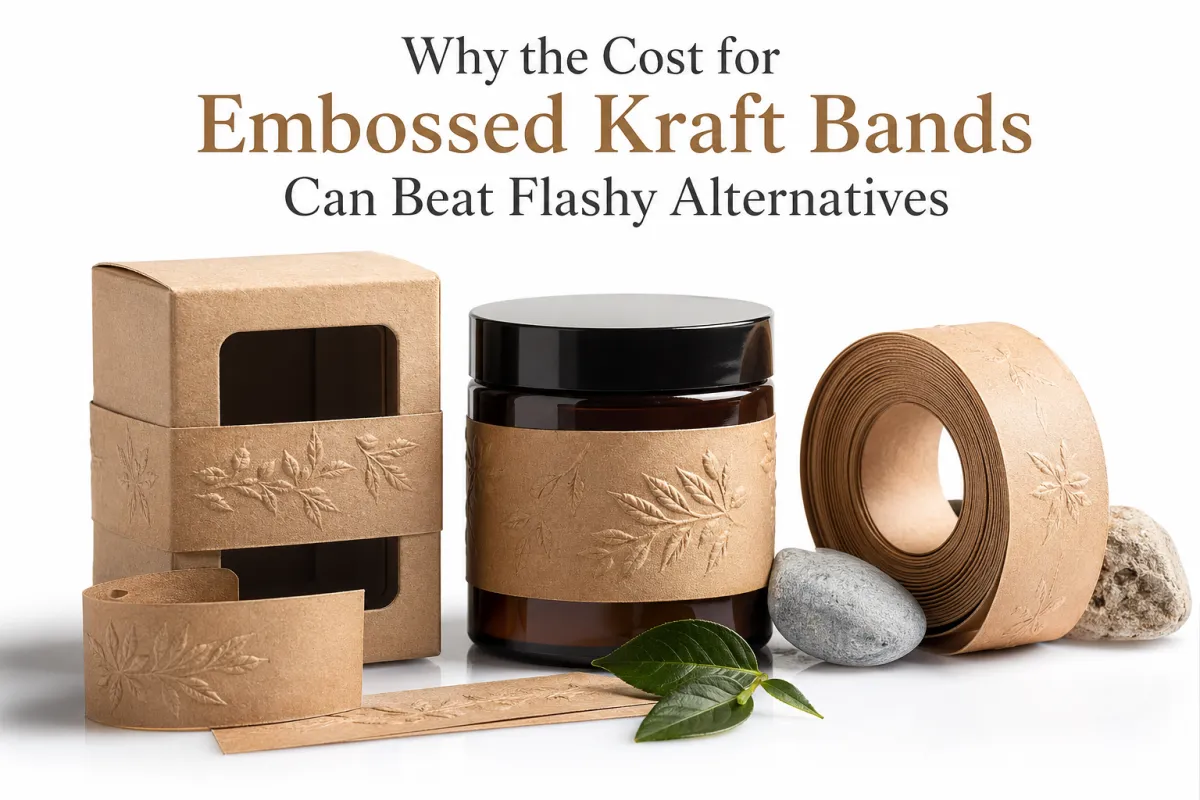
Short answer: the cost for embossed kraft bands is usually shaped more by setup, tooling, and quantity than by the kraft stock itself. A simple blind-emboss run on standard kraft is often the lowest-cost starting point, while foil embossing, larger formats, and tight registration push the price higher.
That does not mean every premium-looking band has to blow up the budget. It just means the quote should match the actual structure of the job. If the design is clean and the run is large enough, the cost for embossed kraft bands can stay practical without giving up the tactile finish that makes the piece work.
I have seen buyers assume embossing is automatically expensive because it sounds specialized. Usually, it is the opposite. The material is not the issue. The issue is whether the artwork respects the process. If it does, the cost for embossed kraft bands can sit in a very workable range.
Why the Cost for Embossed Kraft Bands Can Beat Flashy Alternatives
The cost for embossed kraft bands often surprises buyers because the finished piece can read as premium even when the structure stays simple. Kraft already has a tactile, earthy feel. Add one controlled emboss and the band suddenly carries weight. Not fake-luxury weight. The kind that makes a customer pick it up and assume the brand paid attention.
That matters because plenty of packaging budgets get burned on decoration that never improves perception. Oversized sleeves, heavy full-coverage printing, extra spot colors, and metallic tricks can push the cost for embossed kraft bands into a more sensible range than a crowded alternative. Sounds backward until you compare the production steps. One clean emboss can be easier to manage than multiple print passes and fussy alignment.
From a packaging buyer’s seat, the better question is not "How fancy can this get?" It is "What is the cleanest version that still looks intentional?" If the answer is a narrow kraft band with a brand mark, the cost for embossed kraft bands usually stays healthier than a sleeve built to do too much. I have watched buyers over-specify bands so hard that the unit cost climbed for no visual gain. Classic move. Bad one.
Here is the practical angle. Kraft stock itself is not the expensive part. The expensive part is making the emboss stay crisp across the whole run, especially if the artwork includes thin lines, deep relief, or tight alignment with print. That is why the cost for embossed kraft bands depends more on execution than on the raw paper sheet. Two bands can use the same base stock and land at very different prices because one design is simple and the other asks the factory to babysit it.
For Custom Retail Packaging, bakery sleeves, cosmetic wraps, and gift product bands, the cleanest route is often the least fussy one. A single emboss on natural kraft can give the same premium signal as a heavier printed format, but with less visual clutter. That does not mean every project should go minimal. It means the cost for embossed kraft bands should be judged against the brand value it creates, not against how many effects you can stack.
In plain terms, buyers waste budget in three common ways: they make the band too large, they print more than the surface needs, or they add specialty finishes before they know what the core quote should be. That is how the cost for embossed kraft bands gets inflated before the first sample is even made. A smarter brief keeps the message short and the production path simple.
If you want a quick filter, ask whether the customer will notice the difference between "good emboss" and "extra effects." Usually, they will notice the quality of the emboss and the fit of the band long before they care about another decorative layer. That is why the cost for embossed kraft bands can beat flashier alternatives in both price and perception.
What Drives the Cost for Embossed Kraft Bands
The cost for embossed kraft bands comes from a few predictable places, and most of them are measurable. First is size. A narrow band around a small box uses less paper, fewer press adjustments, and less finishing time than a broad wrap-around band. Second is the emboss area. A small logo in the center of the band is cheaper to manage than a full-panel raised design that stretches edge to edge.
Third is the artwork. Clean shapes are easier. Fine lines, tiny text, and multiple levels of relief increase the chance of press distortion. That can raise the cost for embossed kraft bands because the factory may need tighter registration, more prepress review, or a better die. If the art looks elegant but behaves badly on paper, someone has to solve that problem. Usually the invoice does.
Then there is the finish choice. Blind embossing is usually the simplest route. It uses pressure only, with no foil layer. Foil embossing adds material and an extra production pass, so the cost for embossed kraft bands rises. Registration becomes more important too, because the foil needs to land exactly where the die expects it. If the project is price-sensitive, blind emboss is often the better first quote to compare.
Quantity matters just as much as design. Setup charges and tooling fees get spread across every unit, so a short run feels expensive per piece. A larger run lowers the unit cost because the same die and setup are carrying more finished bands. That is why the cost for embossed kraft bands can look stubborn on a 500-piece order and suddenly make sense at 5,000 or 10,000 pieces.
Hidden cost items deserve attention too. Buyers often forget these until the quote arrives:
- Dieline setup for the exact size and fold structure.
- Tooling fees for the emboss die, especially if the design is custom.
- Sampling or proofing before production.
- Color matching if the band includes ink on kraft.
- Shipping from the factory to the destination.
Those line items are not shady. They are normal. The problem is when a buyer compares only the per-piece rate and ignores the rest. A quote with a low printed price but high setup charges can cost more in the end. That is why the cost for embossed kraft bands should always be reviewed as a landed cost, not as a single unit number pulled out of context.
Paper grade also plays a role. A recycled kraft sheet, FSC-certified stock, or a heavier board changes both handling and price. If sustainability matters, ask for verified sourcing instead of guessing. FSC standards are a real reference point, not a decorative stamp, and the organization explains the certification framework clearly at fsc.org. That matters because the cost for embossed kraft bands may be slightly higher with certified material, but the tradeoff can be worth it for retail buyers who need traceability.
One more point: the design area can create more cost than the total paper weight suggests. A large raised panel needs better pressure control, and kraft fibers can compress unevenly if the die is too aggressive. That is why the cost for embossed kraft bands is not a simple "paper price plus labor" equation. It is a production decision with a few moving parts, and the best quotes reflect that honestly.
Embossed Kraft Band Specifications That Change the Quote
Buyers get better pricing when the spec sheet is clear. The cost for embossed kraft bands changes fast when the supplier has to guess the size, structure, or finish. Start with the flat width, finished circumference, and whether the band is a tuck style or glue style. That tells the factory how the piece will be cut, folded, and packed.
Paper weight should be stated in gsm or pt, not "thick" or "premium." For kraft bands, common ranges are around 250gsm to 400gsm depending on the product, band size, and how much rigidity the brand needs. If the stock is too light, the band can warp after embossing. If it is too heavy, folding and wrapping may get awkward. Both extremes can raise the cost for embossed kraft bands because the factory has to fight the material instead of running it cleanly.
The emboss area is another big variable. A small logo lockup centered on the front panel is easier than a band with raised texture across the whole wrap. Large emboss surfaces demand more consistent pressure, better die construction, and tighter inspection. That is why the cost for embossed kraft bands tends to climb when people ask for "more presence" without narrowing the design.
Print coverage matters too. Some bands are all texture and no ink. Others use one-color print plus emboss. A few use foil on a logo only. Each jump in coverage changes setup time, alignment, and waste rates. If the artwork requires print on both sides, the cost for embossed kraft bands will usually reflect the extra pass and the extra chance for error.
Material finish is another lever. Matte uncoated kraft is the most natural look. Recycled kraft can feel slightly warmer and more rustic. A moisture-resistant coating may help if the band touches chilled packaging or sits in a humid environment. Those upgrades can increase the cost for embossed kraft bands, but they also reduce the chance of a rejected run. Cheap paper that fails in storage is not a bargain. It is just a delayed problem.
Describe the band the way a production team would describe it:
- Flat width and finished size.
- Paper grade and weight.
- Emboss area and depth preference.
- Blind emboss or foil emboss.
- Print coverage, if any.
- Glue style, tuck style, or wrap style.
- Quantity and target delivery date.
That level of detail helps a supplier quote the cost for embossed kraft bands accurately the first time. Without it, you get a soft estimate, then a revision, then another revision. Nobody enjoys that cycle. It burns calendar time and makes the landed cost harder to track.
There is also a practical limit to how much detail kraft can show. If the design uses very thin strokes, tiny type, or a heavy emboss right next to a fold, the result can flatten or distort. A good supplier will tell you that before production. A careless one will quote it anyway and leave the correction to the press floor. The cost for embossed kraft bands is lower when the specification matches how the material behaves, not how the mockup looks on a laptop.
For buyers ordering across multiple SKUs, standardizing the band size can save real money. The same die set may work across several products with only a minor art change. That improves the cost for embossed kraft bands and makes reorders easier. It also keeps the supply chain boring, which is exactly what packaging should be once the design is approved.
Pricing, MOQ, and the Real Cost for Embossed Kraft Bands
The cost for embossed kraft bands usually falls into three pricing zones: small-run, mid-volume, and bulk. Small runs carry the heaviest unit cost because setup charges and tooling fees are spread across fewer pieces. Mid-volume orders balance that overhead better. Bulk pricing is where the numbers start to look healthy, assuming the design is not overcomplicated.
Here is a realistic framework buyers can use as a starting point. These figures are indicative, not a promise, because size and finish can swing the quote. Still, they are useful for filtering suppliers and spotting nonsense fast.
| Option | Typical MOQ | Indicative unit cost | Setup / tooling | Best use case |
|---|---|---|---|---|
| Blind emboss on standard kraft | 500-1,000 pcs | $0.28-$0.60 | $120-$250 | Simple premium look, low visual clutter |
| Blind emboss on larger band format | 1,000-2,000 pcs | $0.18-$0.38 | $150-$300 | Retail sleeves, bakery wraps, gift bands |
| Emboss plus one-color print | 2,000-5,000 pcs | $0.24-$0.55 | $180-$360 | Brand mark with a little more contrast |
| Emboss plus foil | 2,000-5,000 pcs | $0.38-$0.90 | $220-$500 | Higher-end retail presentation |
| Higher-volume repeat run | 10,000+ pcs | $0.08-$0.20 | Lower per-unit impact | Best bulk pricing and lowest unit cost |
Those ranges explain why the cost for embossed kraft bands can look expensive at first and reasonable later. A 500-piece order may seem like a rough deal, but the factory is still creating the die, checking the art, and setting up the press. At 5,000 pieces, that same overhead gets diluted. At 10,000 pieces or more, the unit cost usually improves again because the run becomes efficient.
MOQ is not just a number. It is a production strategy. Some factories quote a lower MOQ to win the order, then make up the gap through higher unit pricing, extra handling fees, or stricter artwork limits. Others set a higher MOQ but give a better cost for embossed kraft bands once the order is large enough to run cleanly. The right question is not "Who has the lowest MOQ?" The right question is "Who gives the most honest total cost at my quantity?"
Requesting two or three quote versions helps a lot. Ask for:
- Base version with blind emboss only.
- Upgrade version with foil or one-color print.
- Volume version at a higher MOQ for better bulk pricing.
That comparison exposes the real economics behind the cost for embossed kraft bands. You may discover that the nicer version only adds a small amount per piece, or that the extra finish is a budget trap. Either answer is useful. Guesswork is not.
Watch shipping terms too. A quote that excludes freight can look friendly until the cartons move. Always ask whether the price is EXW, FOB, or delivered. If you are comparing suppliers across regions, freight and clearance can swing the landed cost more than a small difference in unit cost. That is why the cost for embossed kraft bands should be evaluated alongside lead time, destination, and packing method.
Some buyers worry that asking for a lower MOQ will destroy quality. Not always. A smaller order can still run well if the design is simple and the supplier has the right embossing die setup. The tradeoff is usually financial, not visual. The cost for embossed kraft bands rises because the setup burden is heavier per piece, not because the paper suddenly got worse.
Production Process and Timeline for Embossed Kraft Bands
The cost for embossed kraft bands is only one part of the job. Timeline matters just as much, especially if the band is tied to a product launch, seasonal promotion, or retail restock. A clean workflow keeps the order moving and lowers the chance of rush charges. The production path should stay simple enough that nobody has to decode it.
The usual sequence looks like this:
- Artwork review and dieline check.
- Quote confirmation with size, quantity, and finish.
- Die creation or emboss tool setup.
- Digital proof or physical sample approval.
- Production run on kraft stock.
- Cutting, embossing, folding, and gluing if needed.
- Inspection, packing, and dispatch.
On a straightforward job, simple blind-emboss bands often move through production in about 12 to 15 business days after proof approval. If the order includes foil, unusual dimensions, or a new die with a complex emboss field, add time. The cost for embossed kraft bands may stay acceptable, but the schedule gets longer because the process needs more control.
Late artwork changes are the fastest way to turn a normal order into a headache. If the dieline shifts after the die is made, the supplier may need to remake tooling or rework the layout. That adds setup time and can raise the cost for embossed kraft bands before the job even hits the press. The same thing happens when the buyer approves a design that has not been checked at actual size. A logo that looks fine on screen may collapse once it is reduced to band scale.
Sample approval is where good projects stay sane. If you need a physical sample, ask for it early and review it with the actual packaging unit next to it. This is especially useful for bands that must fit snugly around boxes, jars, or sleeves. A sample can reveal whether the emboss is too deep, the fold is too tight, or the color reads too dark on kraft. Catching that before mass production protects the cost for embossed kraft bands from avoidable rework.
Shipping and transport testing matter if the band is part of a larger pack-out system. For outer cartons, display packs, or shipping-ready assemblies, standards from organizations such as ista.org help buyers think about compression, vibration, and transit stress. The band itself may not face an ISTA test, but the full package often does. If the branding element is going to ride inside a carton for a long trip, that detail is not optional.
From a scheduling standpoint, the best way to keep the cost for embossed kraft bands under control is to approve the final dieline before tooling starts. Once the die is cut, changes become expensive. The second-best move is to keep one person responsible for art approval. Too many reviewers create contradictory feedback, and contradiction is where timelines go to die.
Packaging production rewards clarity. Send final dimensions, a print-ready file, the emboss area, the target quantity, and the delivery date in one message. A supplier can quote faster and run cleaner when the brief is complete. That simple habit does more for the cost for embossed kraft bands than any vague request for "best price."
Why Buyers Choose Us for Embossed Kraft Bands
Buyers do not want a romance novel. They want the cost for embossed kraft bands, the MOQ, the lead time, and proof that the run will hold up. That is the standard worth meeting. Clean emboss depth, consistent cutting, and stable color on kraft are not luxury features. They are the basics that keep a reorder from turning into a new project.
For Custom Logo Things, the strongest value is usually in quote clarity. A good estimate should separate the unit cost, tooling fees, setup charges, and freight so the buyer can see what changes between a 1,000-piece order and a 5,000-piece order. When that breakdown is clear, the cost for embossed kraft bands becomes easier to compare against printed sleeves, stamped wraps, or foil-heavy alternatives.
Practical support matters too. A lot of buyers do not need a more complicated band. They need a better edited one. The right supplier helps trim the artwork to what will actually print and emboss well, then recommends the simplest finish that still looks premium. That keeps the cost for embossed kraft bands from ballooning for no visible gain.
Good production also means repeatability. If the first batch looks right but the reorder comes back with a different emboss depth or shifted artwork, the whole brand experience gets sloppy. Consistency across reruns is one of the quiet reasons buyers stay with a supplier. It protects the cost for embossed kraft bands over time because the second and third run do not need extra correction.
There is another advantage that sounds boring until you need it: pre-production checks. A supplier that reviews dielines, confirms folds, and flags weak artwork before tooling saves money. Period. That early scrutiny can prevent a bad die, a bad sample, or a bad run. The cost for embossed kraft bands is almost always better when the errors are caught before the press starts moving.
From a buyer’s seat, the best partners are the ones who answer with numbers instead of adjectives. A useful response sounds like: "At 2,000 pieces, the blind emboss version is X to Y per unit; foil adds Z; a larger emboss area adds setup." That kind of answer lets you see where the cost for embossed kraft bands is actually going. It is a lot more useful than "premium quality" and other packaging folklore.
If you are comparing suppliers, ask three practical questions:
- What is included in the quote and what is separate?
- How does the unit cost change at higher quantities?
- What is the realistic proof and production schedule?
Those questions expose whether the cost for embossed kraft bands is being quoted with discipline or padded with guesswork. The answer tells you more than a glossy sample ever will.
Next Steps to Lock in the Cost for Embossed Kraft Bands
If you want a usable quote, send the basics in one clean bundle. The cost for embossed kraft bands gets sharper when the supplier knows the exact size, quantity, artwork, emboss area, and delivery date. A good brief cuts the back-and-forth and gives you a number you can actually budget against.
Use this checklist before you request pricing:
- Product size and band dimensions.
- Quantity and any forecast for repeat orders.
- Artwork in vector format if possible.
- Emboss type: blind emboss or foil emboss.
- Paper preference: standard kraft, recycled kraft, or FSC-certified stock.
- Finish: uncoated, matte, or moisture-resistant.
- Delivery window and destination.
Then ask for two or three versions of the quote. One should be the simplest functional version. One should include the finish you are considering. One should show the higher-volume price break. That comparison makes the cost for embossed kraft bands obvious instead of theoretical. It also helps you see whether the upgrade is worth it or just expensive decoration.
Do not approve samples without checking fit on the actual product. A band that looks great off the box can still be too loose, too tight, or too wide once wrapped. Fit errors affect the perceived value more than a small print variation does. If the band is off, the cost for embossed kraft bands was never the real issue. The spec was.
If you are ordering through Custom Logo Things, send a crisp request and ask for a quoted range, not a mystery price. That makes the cost for embossed kraft bands easier to compare with a plain printed band or a foil-accent version. It also keeps the buying process honest, which is rare enough to be useful.
Keep the brief tight, then compare blind emboss against foil at two quantities. That is the fastest way to find the real price point, avoid a bloated spec, and land on a band that looks deliberate instead of overworked. A clean quote starts with clean inputs. Fancy answer, simple truth.
Bottom line: the cost for embossed kraft bands stays manageable when the design stays focused, the quantity is sensible, and the brief is complete. Send the size, quantity, artwork, emboss area, and target delivery date, and the cost for embossed kraft bands becomes a real number instead of a guess. That is the fastest way to get a quote you can use, a schedule you can trust, and a band that does the job without padding the bill.
Frequently Asked Questions
What is the average cost for embossed kraft bands?
The average cost for embossed kraft bands depends most on size, quantity, and emboss complexity, not just the kraft stock. Small runs usually cost more per piece because setup and tooling fees are spread across fewer units. If you want a fair comparison, ask for tiered pricing at 500, 1,000, 2,000, and 5,000 pieces so you can see where the unit cost starts to improve.
Why does the cost for embossed kraft bands change so much between suppliers?
Suppliers quote different tooling fees, labor rates, minimums, and production methods, so the same spec can land at very different prices. Some include sampling and prepress work in the quote; others bill those separately. To compare correctly, make sure the paper weight, emboss area, finishing, and shipping terms match before you judge the cost for embossed kraft bands.
Does foil embossing cost more than blind embossing on kraft bands?
Yes. Foil usually adds cost because it needs extra material and an additional production step. Blind embossing is simpler and is often the better choice when texture matters more than shine. If your budget is tight, ask for the blind-emboss version first and then compare it with the foil upgrade to see how much the cost for embossed kraft bands changes.
What minimum order is typical for embossed kraft bands?
MOQ depends on the factory, but custom embossed work usually needs a higher minimum than plain print runs. Lower MOQs are possible, but the unit cost will usually be higher because the setup burden is not being spread across many pieces. Ask whether the MOQ changes if you keep the design simple and the size standard, because that can reduce the cost for embossed kraft bands more than people expect.
How can I lower the cost for embossed kraft bands without making them look cheap?
Keep the emboss area focused and avoid oversized artwork that needs extra setup. Use one strong brand mark instead of multiple decorative elements. Choose standard sizes and finish only what adds visible value to the product. That approach keeps the cost for embossed kraft bands under control while still giving the band a premium, tactile look.
Should I choose recycled kraft if I want the lowest cost for embossed kraft bands?
Not always. Recycled kraft can be a smart choice, but the lowest paper price does not always create the lowest total cost. Some recycled sheets are rougher, which can affect emboss clarity or folding behavior. If you are chasing the best cost for embossed kraft bands, ask for a sample on the exact stock before you lock the quote.
Can the same emboss die be reused on a reorder?
Usually, yes, as long as the artwork and dimensions stay the same. That is one of the easiest ways to improve the cost for embossed kraft bands on repeat runs. If the size changes even a little, the die may need adjustment or replacement, and the savings disappear fast.


