Buyer Fit Snapshot
| Best fit | Custom Retail Packaging Solutions projects where brand print, material claims, artwork control, MOQ, and repeat-order consistency need to be specified before quoting. |
|---|---|
| Quote inputs | Share finished size, material target, print colors, finish, packing count, annual reorder estimate, ship-to region, and any compliance wording. |
| Proofing check | Approve dieline scale, logo placement, barcode or warning zones, color tolerance, closure strength, and carton packing before bulk production. |
| Main risk | Vague material claims, crowded artwork, missing packing details, or unclear freight terms can make a low unit price expensive after revisions. |
Fast answer: Custom Retail Packaging Solutions: Artwork Proof, Packing Count, and Landed Cost should be specified like a repeatable production item. The safest quote records material, print method, finish, artwork proof, packing count, and reorder notes in one written spec.
Production checks before approval
Compare the actual filled-product size with the drawing, then confirm tolerance on folds, seals, hang holes, label areas, and retail display edges. Reserve space for logos, QR codes, warning copy, and material claims before decorative graphics fill the panel.
Quote comparison points
Review material grade, print process, finish, sampling route, tooling charges, carton quantity, and freight assumptions side by side. A quote is only useful when the supplier can repeat the same color, closure quality, and packing count on the next order.
Custom Retail Packaging Solutions: A Practical Guide
Custom Retail Packaging solutions are rarely just boxes. They are the first physical handshake between a product and the person who picked it up, and that first impression can make an item feel organized, premium, and credible before the customer ever opens it. Brands that have to balance shelf appeal, protection, and production reality usually discover that custom retail packaging solutions are where marketing, engineering, and operations stop acting like separate departments and start working as one system.
The strongest Custom Retail Packaging solutions are not chosen because they look polished in a rendering. They are built around product size, retail channel, storage conditions, shipping demands, and the way a shopper will actually handle the package in the aisle. A well-planned structure can lower damage rates, speed packing, improve shelf presentation, and reinforce brand identity at the same time. Poor planning does the opposite, and the invoice for that mistake usually shows up later, after the savings have already been spent elsewhere.
I still remember one packaging review where a carton looked beautiful on screen but added nearly seven seconds to each pack cycle because the insert needed to be folded in a fussy sequence. That does not sound like much until you multiply it by thousands of units. Small friction points are where packaging budgets get eaten alive. So yes, a package can be pretty, but if it slows the line, it is kinda lying about its own value.
If you are comparing options, it helps to think in systems rather than single boxes. A carton, sleeve, tray, insert, and outer shipper may all belong to the same retail packaging story, and the best Custom Retail Packaging solutions often combine those pieces into one coordinated approach. A practical starting point is to review Custom Packaging Products and use those formats as a reference for structure, finish, and functional needs.
What Are Custom Retail Packaging Solutions?
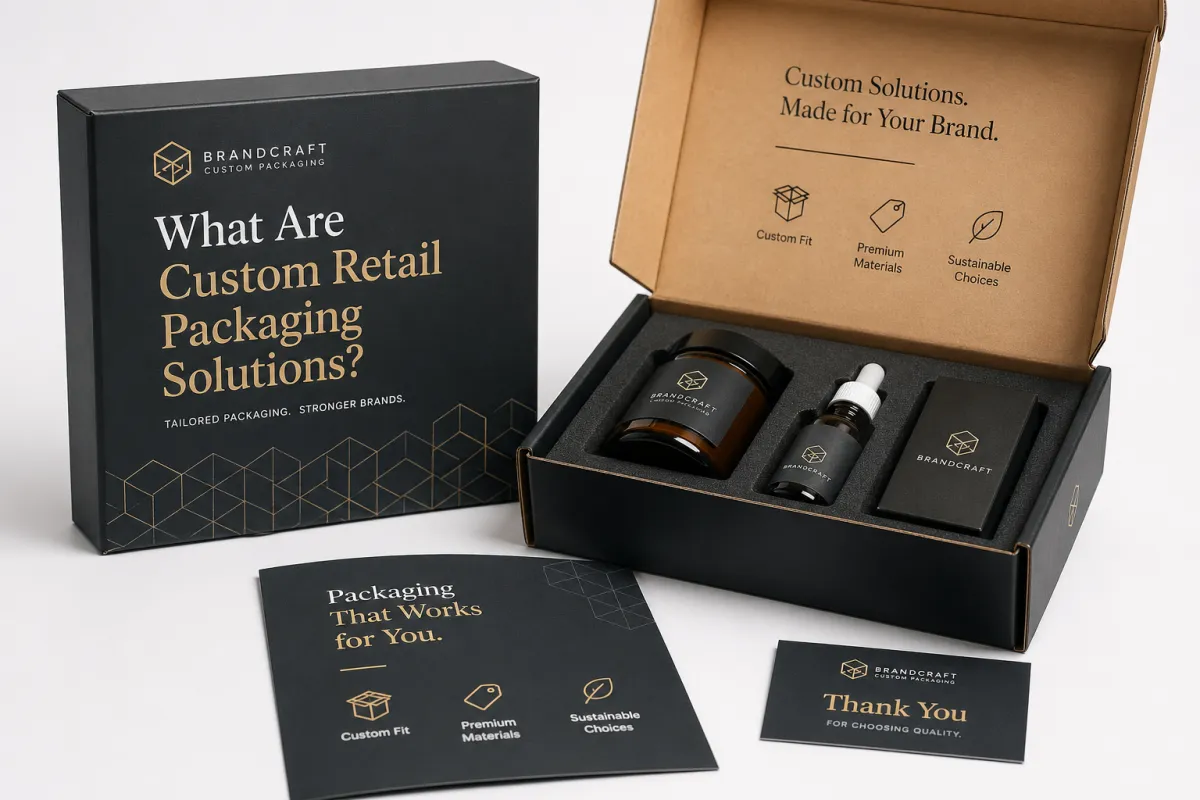
Custom retail packaging solutions include any packaging format built specifically for one product or one product family, rather than a generic stock box pulled from a warehouse shelf. That can mean folding cartons, sleeves, rigid boxes, display cartons, blister card systems, trays, inserts, or shipper-ready formats designed to hold a product securely while presenting it in a retail-friendly way. The common thread is fit. The package is measured, structured, and printed around the product instead of forcing the product to adapt to a standard box.
From a packaging buyer's point of view, the practical difference between stock packaging and custom retail packaging solutions is plain. Stock packaging is fast, but custom packaging is specific. A generic carton may save time at the start, yet it often leaves wasted space, loose movement, weak shelf presence, and extra void fill. A tailored package can solve those problems because the dimensions, insert geometry, print coverage, and opening style are selected for a real retail use case, not a rough approximation.
There is also a strong operational side to this. The best custom retail packaging solutions do not just sit on the shelf well; they must also fold cleanly, load quickly, stack neatly, and survive handling through packing, palletizing, freight, and store labor. In practice, packaging design cannot be separated from manufacturing realities. A sharp-looking carton that tears at the score line, or an insert that slows packing by fifteen seconds per unit, turns into a cost center on the production floor.
One of the biggest mistakes brands make is treating packaging as the final decorative layer. It is not. Good custom retail packaging solutions support product packaging, retail packaging, and package branding in one move. They protect the item, communicate value, and reduce friction for the people who have to move the product through the supply chain. That combination is what makes a package feel intentional instead of improvised.
Another useful way to define the term is by channel. A package for club retail, specialty retail, pharmacy, cosmetics, or electronics may all need different balances of shelf impact and protective performance. The same product can require different custom packaging systems depending on whether it is going straight to a shelf, hanging on a peg, or moving through secondary shipping before it ever reaches a display.
In short: custom retail packaging solutions are the packaging structures, print systems, and fit decisions that make one product work cleanly in one retail environment. They are not just containers. They are part of how the product is sold.
How Custom Retail Packaging Solutions Work: Process and Timeline
Most custom retail packaging solutions follow a fairly predictable workflow, even though the details change from product to product. The first step is discovery. That means gathering product dimensions, weight, fragility points, accessories, retail requirements, shipping conditions, and any brand guidelines that affect graphics or structure. Strong starting information cuts down on surprises later, and surprises are where packaging budgets start to bleed.
Next comes structure selection and dieline development. A packaging engineer or supplier will look at the product and recommend a format that fits the use case, whether that is a folding carton, tray, sleeve, display box, or a more specialized shape. The dieline is where the package becomes real on paper. It defines fold lines, glue areas, windows, panel sizes, and how artwork will land across the finished structure. In a custom project, this stage often decides whether the result feels controlled or chaotic, because a weak dieline can create print issues, fit issues, or both.
After that, the artwork team prepares the graphics for the structure. That means placing brand elements, barcodes, legal text, icons, and any product claims in a way that respects folds, seams, and finishing areas. If the package uses Custom Printed Boxes, the print plan needs to account for ink coverage, color build, finish compatibility, and any coating or lamination that affects the final look. Soft-touch lamination, aqueous coating, spot UV, or foil can all change the feel and cost of the package, so those details should be locked before production begins.
Sampling is the step that saves money later. A good physical mockup shows how the product fits, how the package opens, whether the insert holds the item stable, and whether the shelf presentation matches the concept. One clean sample can prevent a costly run of 10,000 units with a weak tuck flap or an insert that compresses the product too tightly. Serious custom retail packaging solutions usually include at least one proof or prototype, even on projects that move quickly.
Timelines vary based on complexity. Simple print-only changes on an existing structure can move in roughly 10 to 15 business days after proof approval, while new structures with custom inserts often run 3 to 6 weeks from brief to production-ready approval. If the project needs new tooling, structural testing, or multiple revision rounds, that window can stretch further. The more elaborate the retail packaging program, the more time should be reserved for fit checks and print review.
There are also handoff points that matter. The brand usually approves the graphics and positioning. The packaging supplier handles structure, material recommendations, and production feasibility. The production team cares about packing speed, carton durability, and how the finished package behaves in the real workflow. Clear ownership at each step keeps custom retail packaging solutions from becoming a guessing game.
For shipping-heavy projects, it is smart to ask whether the sample will be checked against a transit method such as ISTA procedures or an ASTM D4169-style distribution review. If the package must survive vibration, compression, or drop risk, testing against an established method is better than assuming the structure will hold up. The International Safe Transit Association publishes useful testing guidance at ISTA, and packaging teams often use those standards to reduce damage claims before a full run starts.
One more point matters here: custom retail packaging solutions are not just a design task. They are a sequence of fit checks, print checks, and manufacturing checks. That is what makes them reliable.
Key Factors That Shape the Right Package
The right custom retail packaging solutions start with the product itself. Dimensions matter, but so do weight, balance, fragile surfaces, hanging hardware, sharp edges, and how the item sits inside the package. A lightweight cosmetic item has very different needs from a boxed accessory, a countertop tool, or an electronics component that must be cushioned on multiple sides. If the product can shift during transport, the packaging is not really finished yet.
Retail environment is the next major factor. A package that will sit in a shallow shelf tray needs a different front panel than one designed for peg hooks or end-cap display. Shelf depth, facings, stacking pressure, and whether the package will be touched repeatedly all shape the final structure. Good custom retail packaging solutions account for those retail realities early, because the best design on paper is useless once it disappears visually on the shelf.
Material choice has a direct effect on both cost and performance. Paperboard grades such as SBS, C1S, or coated artboard are common for lighter retail items with strong graphics. Corrugated constructions, especially E-flute or B-flute, make more sense when the package needs extra stiffness, shipping strength, or resistance to crush. Inserts can be die-cut paperboard, corrugated, molded pulp, or even foam in certain cases, though foam should be used carefully if sustainability goals are part of the brief. In custom retail packaging solutions, the material should match the handling problem, not just the mood board.
Finish decisions matter more than many buyers expect. A soft-touch surface may feel premium, but it can raise cost and sometimes show scuffing more easily than a simple matte varnish. Gloss can improve color pop, yet it may not suit every brand. Spot UV, embossing, debossing, foil stamping, and windows can strengthen package branding, but each one adds setup, press time, or finishing complexity. The finish should support the product story, not wrestle attention away from it.
Sustainability belongs in the brief from the start, not as an afterthought. If the goal is recyclable retail packaging, the structure should avoid unnecessary mixed materials and should use coatings that do not interfere with the intended recycling stream. FSC-certified paperboard is a common Choice for Brands that want better sourcing documentation, and the Forest Stewardship Council explains certification standards at FSC. Many custom retail packaging solutions can be designed with FSC options, recycled content, and material reduction without weakening the package, but that balance has to be engineered carefully.
Compliance can also shape the design. Depending on the category, you may need UPC placement, warning language, tamper-evident features, ingredient panels, country-of-origin information, or retail-specific labeling. Cosmetics, supplements, food-adjacent items, and electronics accessories often come with different rules. The best custom retail packaging solutions make room for required copy early so the final panel does not feel crowded or improvised.
If the package must support both shelf sales and e-commerce fulfillment, that adds another layer. Dual-purpose packaging usually needs stronger corners, better internal restraint, and print that still looks good after a few shipping cycles. That does not mean every retail package must be overbuilt. It means the engineering choice should fit the actual route the product travels.
Useful rule: pick the structure from the product outward, not from the catalog inward. Custom retail packaging solutions work best when the size, shelf setting, finish, and sustainability targets are all considered together.
Custom Retail Packaging Solutions: Cost and Pricing Basics
Pricing for custom retail packaging solutions is usually driven by a few big levers: material grade, box size, print coverage, finishing, inserts, and the amount of structural work required. A small folding carton with one-color print and an existing dieline will sit at a very different price point from a large full-bleed carton with a custom insert, foil, soft-touch lamination, and tight fit tolerances. The more custom steps involved, the more setup and labor affect the unit cost.
Quantity matters just as much. Setup costs for plates, tooling, prepress, and machine adjustment get spread across the order, so unit pricing usually improves as volume rises. A 1,000-piece order often looks expensive per unit because the fixed cost is divided across a smaller run. At 5,000 or 10,000 pieces, the same structure often becomes much more efficient. That is one reason custom retail packaging solutions are easier to justify when the brand has a clear launch forecast.
Here is a practical way to think about rough pricing bands. These are not quotes, and they will shift by region, supplier, paper market conditions, and finish selection, but they are useful planning ranges for many retail projects:
| Packaging Option | Typical Use | Approximate Unit Range at Mid-Size Volume | Notes |
|---|---|---|---|
| Simple folding carton | Lightweight retail items, cosmetics, accessories | $0.18-$0.45 | Usually lower cost with standard inks and minimal finishing |
| Custom printed box with insert | Products that need restraint or product reveal | $0.35-$0.90 | Insert geometry, print coverage, and finish drive cost up or down |
| Corrugated retail box | Heavier items, shipper-ready formats, sturdier display needs | $0.55-$1.50 | Better for strength, stacking, and transit protection |
| Premium rigid box | Higher-end branded packaging and gift-style presentation | $1.20-$4.00+ | Higher material and assembly costs, especially with specialty finishes |
Those numbers can move quickly based on artwork coverage, board grade, insert complexity, and region of production. A heavy ink flood or specialty finish can add real cost. So can a tight-tolerance insert that requires more die-cut precision. If a supplier gives you a low unit price, ask whether the quote includes the dieline, proofing, structural guidance, and production-ready artwork review. A cheap number that excludes half the work is not really cheap.
There are also hidden costs that should stay visible during planning. Sample rounds, prototype shipping, structural revisions, freight, warehousing, and rush fees can all affect the final budget. The fastest projects are usually the most expensive because they compress proofing and scheduling. If your launch date is fixed, ask early about rush capacity rather than assuming the deadline can be absorbed without cost.
One area where buyers can save money is structural simplification. Not every product needs embossed panels, foil edges, or a rigid setup. Sometimes a clean, well-printed folding carton with a smart insert does a better job than a heavily decorated package. That is especially true for products that need strength, consistency, and clean shelf presentation more than ornamental detail. In those cases, custom retail packaging solutions should prioritize function first and finish second.
To compare suppliers fairly, look at total value, not just the unit line. A quote that includes engineering support, accurate dielines, sample review, and clear production specs may save more money than a lower bid that leaves your team to solve the problems later. That is especially true if a damage issue would cost you returns, replacements, or a damaged retail relationship.
Step-by-Step Guide to Planning Custom Retail Packaging Solutions
The best custom retail packaging solutions start with a clean product audit. Measure the product carefully, not just once, but with the real tolerances that happen in manufacturing. Note the widest point, the tallest point, the heaviest point, and any fragile surfaces that need clearance. List accessories, cables, instructions, samples, inserts, or extras that must fit in the package. If the product can move inside the carton, that movement has to be controlled before artwork is finalized.
Next, define the functional requirements in plain language. Does the package need to survive secondary shipping? Will it be opened by a shopper on shelf or by a fulfillment team in a warehouse? Must it hang, stack, or stand upright? Does it need tamper evidence, a window, or a tear-open feature? These choices shape the structure more than most buyers expect, and they should be decided before graphics are finalized. That is one reason custom retail packaging solutions benefit from a written brief instead of a trail of scattered emails.
After that, request a dieline or structural concept and review it against the product itself. Look at panel sizes, flap positions, glue areas, and how the insert will hold the item. Then place the artwork on the structure and inspect it panel by panel. A design that looks balanced on a flat screen can shift once folds, seams, and barcode locations are added. If you want a strong reference for how structural options are presented, compare your brief against Custom Packaging Products and identify which styles are most likely to match your actual use case.
Prototype approval is a critical checkpoint. A physical sample reveals fit, print alignment, opening behavior, and shelf presence much better than a PDF does. Test the package with real units, real hands, and the real handling motion your team uses every day. If the product slows packing, catches on the flap, or falls out of the insert during a quick shake test, the issue is easier to fix now than after a full production run.
"A box that looks expensive but fails in transit is not premium; it is a return waiting to happen."
Before full production, many teams benefit from a pilot run or pre-production check. This is the point where final artwork, coatings, stock choices, and finishing details are locked in. If the supplier offers a first article review or a press-check style approval, take it seriously. Small color shifts, weak glue, or a tiny dieline change can create much bigger problems once thousands of units are on the line. Strong custom retail packaging solutions are built through these checkpoints, not through optimism.
If you are building a family of products, treat the packaging brief like a living document. Keep notes on approved dimensions, material grades, supplier contacts, print specs, and any exceptions that came up during the first project. That way, the next launch starts from a known good position instead of rebuilding the same decisions from scratch. Over time, that process turns custom retail packaging solutions into a repeatable system rather than a one-off expense.
For brands with multiple SKUs, it can help to standardize certain elements while keeping the front-facing graphics flexible. For example, one insert footprint or one outer carton size may cover several product variations. That kind of planning reduces tooling changes and can improve order economics without sacrificing retail impact. It also makes future reorder cycles much easier to manage.
Common Mistakes to Avoid
The most common mistake is designing the graphics before the structure is confirmed. That usually leads to artwork that looks great in a mockup but fails once folds, inserts, and glue flaps are added. Text can land too close to a seam, a product image can get split across a fold, or a barcode can end up in a bad print zone. In custom retail packaging solutions, structure and graphics have to move together.
Another frequent error is choosing a package that photographs well but cannot survive real handling. Retail shelves are not studio sets. Packages get stacked, brushed, re-shelved, and sometimes opened and reclosed multiple times. If the carton scuffs easily, the insert loosens, or the flap opens too freely, the product starts looking tired long before it should. That is a branding issue, not just a packaging issue.
Under-specifying the material to save a few cents can also create expensive downstream problems. Weak board, poor compression strength, or a thin insert can lead to damage rates that erase any savings from the lower quote. That is especially true for products with corners, glass, electronics, or sharply formed components. Good custom retail packaging solutions should reduce loss, not just reduce line-item cost.
Lead time is another place where projects fall behind. Sampling, artwork revisions, and production scheduling all take time, and a launch can slip if the packaging is only started after the product is already near completion. If the timeline is tight, say it early. A realistic schedule is better than a rushed one that creates rework. In practice, custom retail packaging solutions are much easier to manage when the approval path is clear from day one.
Price-only comparisons are risky too. A low quote may exclude structural help, sample rounds, testing, or quality checks. That can leave your team holding the risk if a shipment arrives with misprints, weak glue, or a poor fit. Ask what is actually included. Ask how proofs are handled. Ask whether final production specs are documented clearly enough for a reorder six months later. Those questions are boring, but they protect margin.
Finally, do not let sustainability claims outrun the actual material plan. If the package is meant to be recyclable, make sure the board, coating, and inserts support that claim in the target market. If the goal is FSC sourcing, confirm documentation. If you are trying to reduce material use, verify that the lighter structure still protects the product. Custom retail packaging solutions should be honest about tradeoffs rather than pretending every goal can be maximized at once.
Expert Tips and Next Steps for Custom Retail Packaging Solutions
One of the smartest things a brand can do is create a one-page packaging brief before talking to suppliers. Include product dimensions, quantity, launch timing, display environment, shipping method, sustainability goals, and any must-have features such as windows, inserts, or tamper evidence. That simple document helps custom retail packaging solutions move faster because everyone is working from the same assumptions.
Ask for two or three structural options if the project allows it. A folding carton, a tray-and-sleeve format, and a corrugated retail box can each solve the same basic problem in different ways. Comparing them side by side gives you a better read on cost, protection, and shelf presence. It also helps reveal which version is most efficient to produce, which is often not the one that looks most elaborate in a rendering.
Test the package with real units, real hands, and real handling conditions. Put it in a carton, place it on a shelf, open and reclose it, stack it, and move it through the steps your warehouse or retail team will actually use. The best custom retail packaging solutions perform well in the aisle and in fulfillment, not just in a presentation deck. That practical test often exposes tiny issues that are very expensive to ignore later.
Keep approved specs, dielines, print files, and reorder notes in one place. If a package becomes a successful format, you want that knowledge preserved so future launches can reuse what already works. In packaging design, consistency pays off. The same structure can often be adapted for new SKUs with smaller artwork changes, which keeps package branding recognizable and protects production efficiency.
If you are building out multiple product lines, standardize wherever you can without flattening the brand. A shared insert style, a common carton footprint, or a repeatable coating strategy can reduce complexity. Then use graphics, color, and copy to distinguish each SKU. That balance is a practical way to make custom retail packaging solutions scalable instead of one-off.
It also helps to think of your packaging partner as a technical resource, not just a print vendor. Ask about board calipers, flute profiles, compression strength, finish compatibility, and packing line behavior. A good supplier should be able to explain why one structure holds better than another, or why a particular coating may scuff less under store handling. That kind of detail is what separates thoughtful custom retail packaging solutions from generic order fulfillment.
For teams that need a simple next step, start with a comparison sheet. List three candidate structures, estimated unit prices, sample timelines, and the key risks for each. That sheet turns a vague packaging conversation into a decision you can defend. It also makes it easier to align sales, operations, and finance around the same plan.
Custom retail packaging solutions work best when they are treated as a repeatable operating tool, not a one-time design flourish. The more each launch teaches you about fit, cost, shelf impact, and production flow, the stronger the next package becomes. That is how smart brands build retail packaging that looks good, protects the product, and keeps the business moving.
If you are ready to move from concept to production, start with a tight brief, a realistic sample plan, and a clear understanding of what the package needs to do. The right custom retail packaging solutions can lift the product story, reduce damage, and make the whole launch feel more polished. The practical takeaway is simple: define the product, define the shelf, and prototype before artwork lock. That order saves time, money, and a lot of awkward rework.
Frequently Asked Questions
How long do custom retail packaging solutions usually take?
Simple print updates on an existing structure can move quickly, but new structures, inserts, and sample rounds add time. A realistic timeline includes discovery, dieline setup, proofing, prototype approval, and production scheduling. The fastest custom retail packaging solutions are the ones where product specs, artwork, and approval responsibilities are clear from the start.
What affects the cost of custom retail packaging solutions the most?
Material grade, box size, print coverage, and special finishes are usually the biggest cost drivers. Low order quantities often cost more per unit because setup and tooling are spread across fewer pieces. Sample rounds, freight, inserts, and rush orders can also change the final Budget for Custom retail packaging solutions.
Which materials work best for custom retail packaging solutions?
Paperboard works well for lightweight products and high-graphic retail presentation. Corrugated construction is often better when the package needs more strength, stacking support, or shipping durability. The best material for custom retail packaging solutions depends on product weight, handling conditions, and the brand experience you want to create.
Can custom retail packaging solutions be sustainable?
Yes, many packages can be built with recyclable paper-based materials and thoughtfully chosen coatings. Sustainability should be balanced with protection, shelf performance, and retail compliance rather than treated as a single feature. Ask suppliers about recycled content, FSC-certified options, and ways to reduce excess material without weakening the structure in custom retail packaging solutions.
What should I prepare before requesting a quote for custom retail packaging solutions?
Have your product dimensions, quantity, target launch date, and display environment ready. Share any branding rules, sustainability goals, and structural needs such as inserts, windows, or tamper-resistant features. The clearer the brief, the more accurate the quote and timeline for custom retail packaging solutions will be.

