Buyer Fit Snapshot
| Best fit | cost of recycled mailer alternatives for packaging buyers comparing material specs, print proof, MOQ, unit cost, freight, and repeat-order risk where brand print, material, artwork control, and repeat-order consistency matter. |
|---|---|
| Quote inputs | Share finished size, material target, print colors, finish, packing count, annual reorder estimate, and delivery region. |
| Proofing check | Approve dieline scale, logo placement, barcode or warning zones, color tolerance, and any recyclable or compostable wording before bulk production. |
| Main risk | Vague material claims, crowded artwork, or missing packing details can create delays even when the unit price looks attractive. |
Fast answer: Cost of Recycled Mailer Alternatives: Pricing Breakdown should be specified like a repeatable production item. The safest quote includes material, print method, finish, artwork proof, carton packing, and reorder notes in one written spec.
What to confirm before approving the packaging proof
Check the product dimensions against the actual filled item, not only the sales mockup. Ask for tolerance on folds, seals, hang holes, label areas, and retail display edges. If the package carries a logo, QR code, warning copy, or legal claim, reserve that space before decorative graphics fill the panel.
How to compare quotes without losing quality
Compare board or film grade, print process, finish, sampling route, tooling charges, carton quantity, and freight assumptions side by side. A lower quote is only useful if the supplier can repeat the same color, closure quality, and packing count on the next order.
Cost of Recycled Mailer Alternatives: Pricing Breakdown
I still remember standing beside a heat-sealing line in Shenzhen with a stack of sample bags, a notepad full of dimensions, and a stopwatch running a 20-piece pack-out test. It made me feel a little more official than I probably was, but the exercise was useful. The buyer next to me kept staring at the quote sheet and asking why the cost of recycled mailer alternatives was not dramatically cheaper or dramatically higher, as if packaging pricing had to behave like a plot twist. What I saw instead was much more practical: a 9 x 12 inch bag, a 2.5 mil recycled PE film, and a dependable press-and-seal closure turned the cost of recycled mailer alternatives into a manageable line item instead of a headache.
That same lesson has repeated itself in factory after factory, from a converted warehouse in Dongguan, Guangdong, to a fulfillment center outside Chicago where the packing crew was losing 14 to 18 seconds per parcel because the mailers were oversized by nearly an inch. A lot of buyers get trapped by the sticker price and never make it to the part where freight density, damage rates, and labor all pile into the final bill. That is why I always push people to look at the cost of recycled mailer alternatives as a full system, not as one lonely number on a quote sheet. A bag that looks $0.02 more expensive can still save $0.11 to $0.18 per order if it cuts pack time and reduces claims, and packaging has a stubborn way of proving that in the warehouse.
There is also a branding side to the calculation that finance teams sometimes miss on the first pass. Recycled Poly Mailers, recycled paper mailers, and hybrid mailers each send a different signal at the doorstep, and the signal matters because it changes perceived value, complaint rates, and even the way customers talk about the package in reviews. If the cartonization is clean and the print is restrained, the cost of recycled mailer alternatives can buy a better first impression instead of just a different substrate. That is a trade worth understanding before anyone signs off on volume.
Why the cost of recycled mailer alternatives is often lower than expected
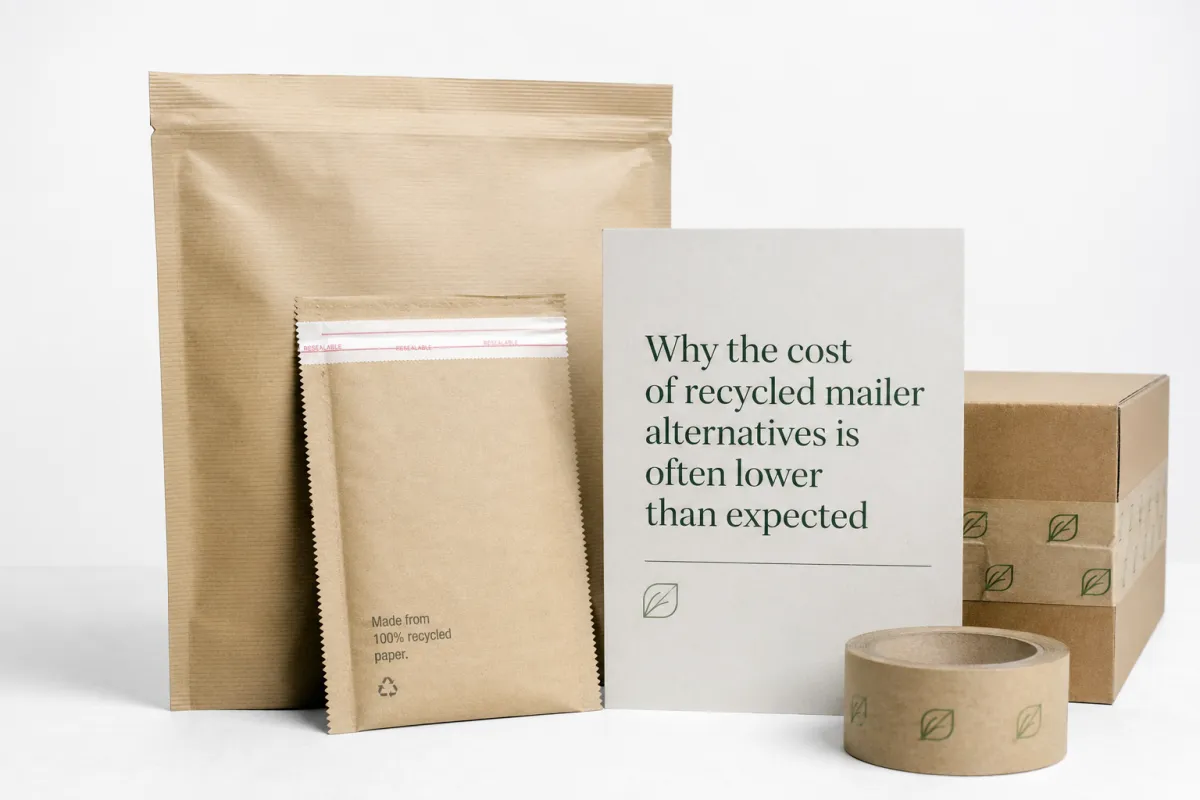
One thing I learned early, usually after a buyer had already spent too much time fighting with a bad spec, is that a recycled mailer sized correctly can eliminate waste in several places at once. If the mailer is an inch too wide, the team reaches for filler, tape use creeps up by a roll or two per shift, and freight weight inches higher than it should. If the length is wrong, the packer folds and re-folds the product like they are trying to win an awkward origami contest. Once the size fits the product, the cost of recycled mailer alternatives often drops in the way that actually matters: total spend per shipped order, not just the quoted unit price.
I saw that clearly with a footwear brand in Atlanta, Georgia, that had been using one oversized 10 x 14 inch mailer for three different box sizes. Their warehouse manager was convinced that moving to recycled options would raise the cost of recycled mailer alternatives, and I do not blame him for being cautious; nobody likes a surprise on a budget meeting slide. But once we matched the width to the actual packed shoe box, moved to a 2.0 mil recycled PE construction with a 20 mm seal, and removed a layer of unnecessary overpack, the numbers moved in the right direction fast. Carton efficiency improved, the pallet pattern got cleaner by two extra cases per layer, and the packing station stopped wasting motion on void fill that did absolutely nothing for protection.
Another place the cost of recycled mailer alternatives bends in your favor is damage reduction. A recycled mailer with the right gauge, seal profile, and scuff tolerance can handle conveyor movement, trailer vibration, and the general chaos of parcel networks better than a flimsy bargain option. I once watched a shipment in a Midwest DC outside Indianapolis come back with the corners rubbed raw because the previous mailer was 1.8 mil and the closure was a little too optimistic. When I compare suppliers, I always ask what one crushed corner, one wet parcel, or one popped seam really costs in refunds, reships, and customer service time. That number is usually much uglier than a few cents of unit cost.
For buyers who track metrics carefully, landed cost gives the clearest view. Unit cost, freight, carton count, warehouse labor, and the cost of claims belong in the same spreadsheet, and I usually want to see them measured over a 30-day or 90-day shipping window. The cost of recycled mailer alternatives can look higher on paper if you only compare the bag itself, yet still save money when it ships more units per pallet or removes a second packaging step. Procurement teams get tripped up there more often than they like to admit, and I say that with affection because I have seen the same spreadsheet mistake in Dallas, Toronto, and Los Angeles. A tidy quote can hide a messy operation, and a messy operation will eventually collect its tax.
Recycled content is not the only lever in the equation. A smart closure style, a cleaner print layout, and a custom width that mirrors the product can all reduce the cost of recycled mailer alternatives. If you are paying for extra film, extra paper, or extra handling because the bag is the wrong shape, you are not buying efficiency. You are buying waste with a logo on it, which is not exactly the brand message anyone wants to defend in a budget review. A 5 mm wider seal area or a 15 mm shorter flap can sound tiny in a sample room and still change the final quote by thousands of dollars over a 50,000-piece run.
"We thought recycled packaging would blow up our budget," one operations director told me after a review at his Atlanta warehouse. "Then we switched to the correct 8 x 11 inch size, used a 2.5 mil recycled film, and the cost of recycled mailer alternatives settled right where we needed it, while our damage rate fell from 2.7 percent to 1.1 percent in the same quarter."
That quote sums up the practical truth. The cost of recycled mailer alternatives is not charity, and it is not a luxury either. If the spec is right, the freight lane is efficient, and the pack line is tuned to the product, the numbers often land in a range that a serious buyer can defend to finance without needing a three-hour pep talk and a whiteboard. I have had to make that case myself in conference rooms in Seattle and St. Louis, and it is much easier when the packaging actually earns its keep at 300 to 500 parcels per shift.
Product details that shape recycled mailer alternatives
The first decision is which family of mailer you actually need, because the cost of recycled mailer alternatives changes with structure, and structure changes everything from print behavior to how the parcel feels in the hand. In the market, I usually see three broad options: recycled poly mailers, recycled paper mailers, and hybrid constructions that borrow strength from both. Each one behaves differently on the line, ships differently through parcel networks, and lands differently in the final quote. A buyer in Hamburg will often want a different feel than a buyer in Phoenix, and that distinction matters once the pallets start moving.
Recycled poly mailers are popular for apparel, soft goods, catalogs, and light hard goods because they are compact, moisture resistant, and easy to print. Recycled paper mailers bring a different look and can feel more natural for brands leaning into fiber-based packaging, though they may need a 60gsm to 90gsm kraft face and a stronger adhesive strip to resist puncture and humidity. Hybrid styles sit in the middle, and the cost of recycled mailer alternatives can swing depending on how much recycled content is inside the film or paper layer. I have seen a hybrid mailer save the day for a brand that wanted a softer look without giving up too much strength, especially on 2 lb to 4 lb apparel shipments out of Portland, Oregon.
Material structure matters more than most first-time buyers expect. A 2.5 mil recycled poly mailer with a good seal can outperform a thinner option that looks cheaper on the quote sheet, especially if the bag uses a 38 micron outer layer and a clean hot-melt closure. If the bag has a weak seal or a poor slip profile, the warehouse team spends more time fighting it, and the cost of recycled mailer alternatives rises in the form of labor, waste, and rework. That is the kind of problem you only catch by watching a pack line run, not by admiring a PDF in a conference room. I have stood there in Ningbo, Zhejiang, while a roll of film kept grabbing the operator's glove and making the whole station grumpy.
Print changes the picture too. One-color logos on a clean recycled substrate are usually simple, but a full-coverage design, multiple print stations, or heavy ink coverage can change bulk pricing quickly. I have seen brands insist on a dramatic visual treatment that added $0.03 to $0.07 per unit without adding much shelf value. My honest opinion? A smaller logo in the right place often does more for the brand and keeps the cost of recycled mailer alternatives under control. Some designs are trying to win an art award when they really just need to survive a fulfillment center in Columbus, Ohio.
Use case matters just as much as appearance. Apparel teams care about scuff resistance and a crisp presentation when the customer opens the parcel. Book sellers worry about corner wear and moisture. Lightweight hard goods need puncture resistance and a closure that stays shut through transit. If you are not sure which path fits, start with a request for Custom Poly Mailers and compare them against recycled paper or hybrid samples side by side. That exercise usually makes the cost of recycled mailer alternatives much easier to justify, because the differences stop being theoretical and start being obvious in your hands, especially with a 12 x 15 inch sample set and a 1,000-gram drop test.
- Recycled poly mailers: best for lightweight e-commerce, apparel, and high-volume parcel shipping, usually in 2.0 to 3.0 mil film.
- Recycled paper mailers: better for fiber-forward branding and products that benefit from a natural look, often using 60gsm to 90gsm kraft.
- Hybrid mailers: useful when you need a balance of presentation, moisture control, and puncture resistance, especially for 2 lb to 5 lb parcels.
- Custom sizes: often reduce the cost of recycled mailer alternatives by lowering waste and improving fit, particularly on 8 x 10, 9 x 12, and 10 x 13 formats.
If you want to compare performance instead of guessing, ask for sample packs, a spec sheet, and a short test run on the actual pack line. I have watched teams discover in ten minutes that the cheaper-looking option was actually the more expensive one because it snagged in the chute or required extra tape at the mouth. That sort of moment is always a little embarrassing, but it saves a lot of money. The cost of recycled mailer alternatives should always be read alongside the process it will serve, because a mailer that behaves badly on the floor can cost more than one that looks slightly pricier upfront.
For transit validation, I often point buyers to the ISTA testing standards, especially if the product is going through rough handling or mixed parcel networks. For fiber-based options, the FSC chain-of-custody framework is useful when a procurement team needs evidence for sustainability reporting, and a factory in Suzhou or Guangdong can usually provide the paperwork if the order is structured correctly. Those references do not choose the mailer for you, but they do help keep the cost of recycled mailer alternatives tied to real performance instead of glossy claims. I like glossy claims fine as decoration; I just do not want them running the warehouse.
Specifications buyers should lock in before pricing
If you want a quote that actually means something, lock the specification before you talk numbers. The cost of recycled mailer alternatives is driven by width, length, gusset depth, film thickness, closure style, print count, and whether the run is stock or fully custom. Leave those variables fuzzy and you will get a quote that sounds useful but falls apart the moment the buyer starts comparing it to another supplier. I have seen that movie in a plant outside Ho Chi Minh City, and it is not a good one.
The first spec I ask for is size in real terms, not just a rough guess scribbled into an email after a hurried meeting. Measure the product packed the way it will actually ship, not the way it looks on a desk. I have seen a client with a 9 x 12 inch bag order a 10 x 13 because nobody measured the folded garment with the tissue and barcode insert in place. That extra inch looked harmless, but it pushed the cost of recycled mailer alternatives up across 25,000 orders and increased carton cube by nearly 8 percent. Little gaps in planning love to become expensive habits.
After size, I look at thickness and closure. A mailer that is too light can tear at the seam or split on a sharp edge, and a closure that is weak can fail in the back of a trailer on a warm route day. That part is especially irritating because the bag can look perfect right up until it gets transported in real life, which is a much less polite environment. When I review film, I like to see a clear gauge callout and, if the supplier has it, an ASTM test summary such as tensile data from ASTM D882. The buyer does not need a thesis; they need enough proof to compare the cost of recycled mailer alternatives on a fair basis.
Documentation matters too. If your procurement team reports recycled content, ask for the claim structure, any supplier certification details, and the recycled feedstock percentage in writing. Some buyers need this for internal sustainability reporting, while others need it for customer-facing claims. Either way, the cost of recycled mailer alternatives should include the value of clean documentation, because a cheap bag with no traceable paper trail can create a much bigger problem later. I have watched compliance teams in Minneapolis and London turn very quiet and very serious over a missing certificate, and I do not recommend that experience.
Performance specs deserve more attention than marketing language. I want to know about tear resistance, water resistance, seal strength, scuff tolerance, and whether the print will hold up after it slides across a conveyor belt for 18 feet or more. In a packaging room, real life is not kind to fragile finishes. I have seen glossy claims disappear the first time a case rubbed against a metal guide rail. That is not a design problem; that is a bad spec. The conveyor, as far as I can tell, has no respect for brochure copy.
There is also a plain business reason to tighten the spec early. A correctly sized recycled mailer reduces the number of bags, cartons, and pallet layers your team needs to manage. That is how the cost of recycled mailer alternatives gets brought down without sacrificing presentation. The gains are not dramatic in a single order, but they add up quickly across a seasonal program or a recurring replenishment plan, and those quiet savings are the kind finance actually likes. A reduction of just 0.5 seconds per pack can matter when the line runs 2,000 units per day in Nashville or Reno.
Before you approve volume, ask for a sample and a written spec sheet. I do not care whether the order is 5,000 pieces or 500,000; a sample catches problems that a spreadsheet never will. I have seen artwork shift, closures sit crooked, and sealing tolerances drift just enough to create headaches in production. A few days spent checking the sample can protect the whole cost of recycled mailer alternatives calculation. That is not dramatic advice, just hard-earned common sense from too many dusty factory tables in Dongguan and Ningbo.
Cost of recycled mailer alternatives: pricing and MOQ explained
Now to the number everyone wants first. The cost of recycled mailer alternatives usually depends on the material choice, dimensions, print coverage, recycled content level, and whether the order is stock or custom. A plain recycled poly mailer in a standard size might price very differently from a Custom Printed Paper mailer, and the gap widens when the order includes special finishes, extra color stations, or uncommon dimensions. I have seen people blink at a quote, then relax immediately after they realized they had compared two very different products. It happens more than it should, especially when one quote comes from Shenzhen and another from a domestic converter in Ohio.
MOQ is the other word buyers need to understand early. A simple stock-style recycled mailer may have a modest minimum, while a custom printed version can push the MOQ higher because the factory has to set up film, plates, or cutting tools. That is where tooling fees and setup charges come in. They are not hidden if the supplier is honest, but they do change the way the cost of recycled mailer alternatives looks on the first order versus the second. I always tell people: the first run teaches you the truth about the spec, and the repeat run tells you whether the spec was actually worth keeping.
I have sat across the table from buyers who were shocked that a first order looked expensive and the repeat order looked much cleaner. That is normal. On the first run, you may be paying for development, plates, sample rounds, and setup time, which can add $150 to $650 depending on the factory and the print method. On the next run, those costs spread out better. If a supplier cannot explain how the unit cost changes with volume, keep pressing until the math is clear. The cost of recycled mailer alternatives should never be a mystery wrapped in jargon and blessed with a vague smile.
To make the comparison easier, I like to show buyers a table that separates the mailer itself from the other costs around it. This is not a perfect science, because freight lanes from Vietnam, China, or Mexico change by region, but it gives a far better picture than a single line item. The table below is a useful starting point, not a promise carved into stone.
| Option | Typical Unit Cost | MOQ | Lead Time | Best Fit |
|---|---|---|---|---|
| Stock recycled poly mailer, unprinted | $0.08 - $0.14 | 500 - 1,000 pcs | 7 - 12 business days | Fast replenishment, low design complexity |
| Custom recycled poly mailer, one-color print | $0.12 - $0.20 | 5,000 pcs | 12 - 15 business days from proof approval | Branding, apparel, recurring e-commerce orders |
| Custom recycled paper mailer | $0.18 - $0.32 | 5,000 - 10,000 pcs | 15 - 25 business days | Natural look, retail presentation, fiber-forward programs |
| Hybrid mailer with custom print | $0.16 - $0.28 | 5,000 pcs | 14 - 20 business days | Balanced protection and appearance |
Those figures are not a promise, and they are not one-size-fits-all, but they are close enough to anchor a real conversation. If someone offers a quote that is far below that range, ask what is missing. Sometimes the bag is thinner, sometimes the print is simpler, and sometimes the freight is not included. The true cost of recycled mailer alternatives depends on the complete package, not just one tempting number. I have had quotes that looked like a bargain until the freight, duties, inland drayage, and packing cartons were added back in, and suddenly the "cheap" option was not cheap at all.
The same logic applies to stock versus custom programs. A stock recycled poly mailer may seem like the least expensive choice at first glance, but a custom recycled mailer that fits the product better can reduce dimensional waste, improve pallet loading, and lower damage rates over time. That is why I tell buyers to judge the cost of recycled mailer alternatives across the whole lifecycle of the order. The first invoice matters, but it is only one chapter in the story.
Volume also changes the conversation in a way that many teams underestimate. A run of 25,000 pieces can look very different from a run of 250,000, not only because raw material is spread across more units, but also because production scheduling, print plates, and slit widths can be optimized more aggressively. For some brands, the cost of recycled mailer alternatives falls noticeably once the production team can lock into a stable repeat spec. That is one reason I like to keep the sample approval process tight; once the spec is stable, the savings have room to show up.
How much does the cost of recycled mailer alternatives really include?
The honest answer is more than the bag, and less than a surprise. The cost of recycled mailer alternatives should include material, converting, print, internal packing, freight, and any special testing or documentation needed for the order. If the quote does not spell out these pieces clearly, someone will have to reverse-engineer them later, and that usually means time lost in procurement, finance, or both. I have seen teams spend an afternoon arguing over a number that turned out to be incomplete rather than wrong, which is a remarkably unproductive way to use a calendar.
Material cost is the obvious part, but material does not act alone. A recycled poly film with a higher recycled content percentage may cost more per kilogram if the feedstock stream is inconsistent or the extrusion line needs tighter control. A recycled paper mailer can carry a different cost profile because the kraft face, adhesive strip, and internal reinforcement all contribute to the final number. Hybrid mailers sit between those poles, and the cost of recycled mailer alternatives often reflects how much engineering went into balancing the layers. The more components, the more the quote needs to be unpacked.
Converting matters a great deal too. Slitting, gusseting, sealing, and print registration all affect the speed of the line and the quality of the finished product. A factory in Suzhou running a well-tuned line can produce consistent mailers with very little waste, while a less organized line may burn time on adjustment and scrap. That difference ends up in the price whether it is itemized or not. I always want to know whether the factory uses automated inspection, what the trim tolerance looks like, and whether the operator checks seal integrity during the shift. Those process details often tell me more about the cost of recycled mailer alternatives than the quote itself.
Testing and compliance can also influence the total. If the order needs drop testing, seal validation, humidity resistance checks, or sustainability paperwork, those activities have a value. Sometimes that value is modest; sometimes it is the thing that prevents a chargeback or a claims issue later. If your team ships into a strict retail channel, the cost of recycled mailer alternatives is not just about packaging. It is about the paperwork and proof that keep the channel happy, especially if the buyer is asking for recycled content data or transit-performance evidence.
Freight is another piece that deserves attention. A mailer that packs more tightly can lower cube and reduce the burden on the lane, especially when shipments move by pallet or container. I have watched a warehouse in Vancouver save meaningful space simply by switching to a flatter format that nested better on the pallet. The cost of recycled mailer alternatives then became part of a transportation conversation instead of just a sourcing discussion, which is where the real savings often live. Packaging people love to talk about film and seal strength, but logistics usually gets the final vote.
There is also a labor angle inside the building that can be easy to miss. If the opening, filling, and sealing steps take longer because the mailer is awkward, then the packaging line loses throughput. A small penalty per unit becomes a serious number over the course of a quarter. I have seen the cost of recycled mailer alternatives drop on paper while labor remained stubbornly high because operators had to fuss with a closure or flatten an oversized panel before sealing. That is the kind of issue that disappears only after a real trial run.
One practical way to judge the total is to compare three scenarios side by side: stock unprinted, custom one-color, and custom high-coverage. The stock path may lower the cost of recycled mailer alternatives for immediate needs, while the custom path can improve brand consistency and reduce damage or void fill in the long run. The right choice depends on the product, the channel, and the warehouse rhythm. A subscription brand shipping soft goods has different priorities than a home-goods seller shipping hard corners and small accessories, and the quote should reflect that reality rather than flatten it.
I also like to ask buyers to estimate their own hidden costs before they choose. What does a damaged parcel cost after reshipment, customer support time, and goodwill are added? What does a slower pack station cost during peak season? What does a higher return rate do to inventory flow? Those questions bring the cost of recycled mailer alternatives back into business terms. Packaging is rarely just packaging; it is a moving piece of the service model.
Process and timeline for recycled mailer alternatives orders
Most buyers want two things after pricing: clarity and speed. The process for recycled mailer alternatives orders usually starts with a spec review, then sample development, then proof approval, then production, then quality check, then shipping. If the product is straightforward and the spec is already locked, the whole cycle can move quickly. If the order is custom printed or includes special recycled content documentation, the calendar naturally stretches. That is normal, and it is better to know it upfront than to pretend the lead time will shrink because everyone is busy.
A good first step is a sample pack or prototype set. I like to see the actual product next to the mailer, not a sketch of the product or a vague measurement list. In one project for a subscription apparel brand in Nashville, the sample round revealed that the initial recycled mailer was beautiful but too slippery for the packers to stack cleanly. That tiny issue would have turned into a larger cost of recycled mailer alternatives problem once the line went live. A revised matte finish solved it, and the warehouse team stopped fighting the bags before the cartons even reached the scale.
Once the sample is approved, artwork proofing becomes the next point of control. Print placement, color count, seal margin, and barcode zones all need to be checked carefully. The goal is not just to make the mailer look right; it is to keep the cost of recycled mailer alternatives from drifting because of avoidable rework. A proof that looks fine on a monitor can still be wrong on the substrate, and that is why I insist on checking the actual dimensions against the approved spec before the plates are cut or the film is scheduled.
Production itself should be monitored with a mix of inspection and common sense. I like to confirm the first-off samples, the mid-run checks, and the packed carton count. If a factory uses recycled poly mailers or recycled paper mailers at scale, the team should already know how to spot seal issues, print drift, and trim problems before the order ends up on a container. The cost of recycled mailer alternatives gets protected when mistakes are caught early, not after the pallet wraps have already been applied.
Shipping and delivery close the loop. If the order is traveling internationally, plan for customs, consolidation, and last-mile receipt. If it is domestic, confirm whether the quote includes freight or whether the logistics line is separate. A well-structured order makes the total cost of recycled mailer alternatives easier to defend because the buyer sees the full path from factory to dock. That transparency matters to finance, but it matters just as much to the warehouse team that has to receive, stage, and use the product without wasting time.
Lead times also depend on the level of customization. A stock recycled poly mailer can move fast, while a custom printed hybrid mailer with specific recycled content claims may take longer because the factory has to coordinate printing, lamination, inspection, and documentation. None of that is unusual. What matters is that the cost of recycled mailer alternatives is balanced against the timeline your operation actually needs. I have seen people save a few cents and lose a week, and the week was always more expensive than the cents.
For reference, a clean order flow often looks like this:
- Share the packed product dimensions, target ship weight, and preferred mailer style.
- Review material options, recycled content targets, and closure choices.
- Approve a sample and confirm print artwork or plain construction.
- Lock the production spec and request a final quotation with freight terms.
- Schedule production, quality inspection, and delivery timing together.
That sequence keeps the cost of recycled mailer alternatives stable and prevents the kind of last-minute changes that make sourcing teams nervous. It also gives the factory enough information to run efficiently, which usually means fewer surprises for everyone involved.
Why choose us and what to do next for the cost of recycled mailer alternatives
We work with buyers who want clear specs, honest pricing, and packaging that survives contact with real operations. That sounds simple, but it is surprisingly rare. The best results usually come from a conversation that starts with the product, not the quote. If you know the ship dimensions, the desired print style, and the level of recycled content your team needs, we can usually narrow the field quickly and make the cost of recycled mailer alternatives easier to compare across formats.
My preference is always to reduce the noise in the decision. If recycled poly mailers are the right fit, I will say so. If recycled paper mailers or hybrid mailers make more sense for the brand, I will say that too. The point is not to sell a particular material at all costs; the point is to match the material to the shipping reality so the cost of recycled mailer alternatives lands where it should. A fair quote is useful only when it reflects the job the mailer actually has to do.
That approach also helps with internal alignment. Finance wants landed cost, operations wants throughput, marketing wants presentation, and sustainability wants traceability. A well-built recycled mailer can satisfy all four if the spec is disciplined. The bag does not need to be fancy; it needs to be right. I have seen that principle hold up in warehouses from Toronto to Los Angeles to Suzhou, and it tends to reduce friction everywhere it goes. Good packaging has a way of making meetings shorter.
If you are narrowing down options now, ask for a sample kit, a spec sheet, and a side-by-side quote for recycled poly mailers, recycled paper mailers, and hybrid mailers in the sizes you actually ship. That comparison usually reveals the true cost of recycled mailer alternatives faster than any theory ever will. Once you see the pack line, the pallet pattern, and the customer presentation in the same frame, the decision gets a lot easier.
The most useful next move is simple: measure the packed product, test two or three mailer styles on the actual line, and ask each supplier to quote the same spec with freight called out separately. That way the cost of recycled mailer alternatives becomes a real operating decision instead of a vague sustainability expense, and you can make the call with your hands on the sample and your eyes on the numbers.
FAQ
What Affects the Cost of recycled mailer alternatives the most?
Size, material structure, print coverage, recycled content percentage, closure style, and order volume usually have the biggest impact. Freight and testing can also move the final number.
Are recycled Poly Mailers Cheaper than recycled paper mailers?
In many cases, yes. Recycled poly mailers often have a lower unit cost and stronger moisture resistance, while recycled paper mailers can cost more because of the kraft face and reinforcement layers.
How can I lower the cost of recycled mailer alternatives without hurting performance?
Use the smallest workable size, keep the print simple, lock the spec early, and test the mailer on your real packing line before placing a large order. That is usually the fastest path to lower total cost.
What MOQ should I expect?
Stock options can start around a few hundred to a thousand pieces, while custom printed orders commonly start around 5,000 pieces or more depending on the factory and the print method.
Do recycled mailer alternatives need testing?
For most shipping programs, yes. ISTA drop testing, seal checks, and material data such as ASTM D882 tensile results help validate the packaging before volume approval.
Can the cost of recycled mailer alternatives still make sense for a small brand?
Yes. Small brands often benefit from better fit, lower damage rates, and cleaner presentation, which can offset a slightly higher unit price. The key is to match the mailer to the product instead of buying by price alone.
If you are comparing recycled poly mailers, recycled paper mailers, or hybrid mailers for your next order, the cost of recycled mailer alternatives should be judged on landed cost, line efficiency, and customer experience together. That broader view is usually the one that holds up after the first shipment leaves the dock.

