Buyer Fit Snapshot
| Best fit | Cost of Reusable Corrugated Shipping Cubes Explained projects where brand print, material claims, artwork control, MOQ, and repeat-order consistency need to be specified before quoting. |
|---|---|
| Quote inputs | Share finished size, material target, print colors, finish, packing count, annual reorder estimate, ship-to region, and any compliance wording. |
| Proofing check | Approve dieline scale, logo placement, barcode or warning zones, color tolerance, closure strength, and carton packing before bulk production. |
| Main risk | Vague material claims, crowded artwork, missing packing details, or unclear freight terms can make a low unit price expensive after revisions. |
Fast answer: Cost of Reusable Corrugated Shipping Cubes Explained should be specified like a repeatable production item. The safest quote records material, print method, finish, artwork proof, packing count, and reorder notes in one written spec.
Production checks before approval
Compare the actual filled-product size with the drawing, then confirm tolerance on folds, seals, hang holes, label areas, and retail display edges. Reserve space for logos, QR codes, warning copy, and material claims before decorative graphics fill the panel.
Quote comparison points
Review material grade, print process, finish, sampling route, tooling charges, carton quantity, and freight assumptions side by side. A quote is only useful when the supplier can repeat the same color, closure quality, and packing count on the next order.
The first time I watched a buyer compare the cost of reusable corrugated shipping cubes, the lowest quote did not survive the afternoon. A cube priced at $0.68 per unit looked great on paper until a 1,200-unit test run produced three return loops, two crushed corners, and a 19-second slowdown at pack-out on the B-4 line. That is the sort of thing that makes a tidy spreadsheet look mildly embarrassed, especially when the carton was built for a 6.5-pound product and the route included two warehouse handoffs between Dallas and Atlanta. The “expensive” option at $0.94 ended up cheaper in use. The real question is not what one cube costs today; it is what that number looks like after handling, damage, freight, and reuse are all counted.
I saw the same pattern in a distribution center outside Columbus, Ohio, and again during a supplier review in Shenzhen, Guangdong. Procurement wanted the lowest unit price, while operations cared about stackability, packing speed, and how many trips the cube could survive in a closed-loop network. That tension is healthy because it exposes the difference between a purchasing decision and a packaging decision. Once the same shipping carton moves through a returnable route with 24-hour dock turns and palletized backhauls, a one-way pricing model misses the point. The cost of reusable corrugated shipping cubes is a total-cost decision, and the first quote is only the opening line.
Buyers get misled when they compare only unit cost. A $1.12 cube that survives six trips costs $0.19 per use before freight; a $0.74 cube that fails after two trips costs $0.37 per use, and that still leaves out rework, product damage, and labor. In a fulfillment center running 8,000 orders a month, that 12-second pack-out gap becomes nearly 27 labor hours per month, which is the kind of detail finance notices fast. The point is simple: the best packaging decision comes from total landed cost, not purchase price alone. I have watched a “cheap” box quietly eat a budget alive, which is a special kind of infuriating.
Most people miss one basic point: a reusable cube is not a standard carton with a better sales pitch. It is a structural package. Board grade, closure style, score geometry, and closure strength all shape how many cycles the cube can endure. Too light, and the cube fails early, sending the economics upward because replacement frequency spikes. Too heavy, and you pay for strength you never use. The smart target is the spec that matches the route, the product weight, and the reuse target without padding the bill of materials by 15% to 25%, which is often the difference between a $0.83 and a $1.07 build.
“We stopped buying on unit price and started buying on cost per trip.” That was the line a plant manager gave me after a pilot run with 1,500 cubes in Monterrey, and he was right. The cube that wins is the one that reduces breakage, speeds packing, and survives the shipment loop.
Cost of Reusable Corrugated Shipping Cubes: Why Buyers Reconsider the First Quote
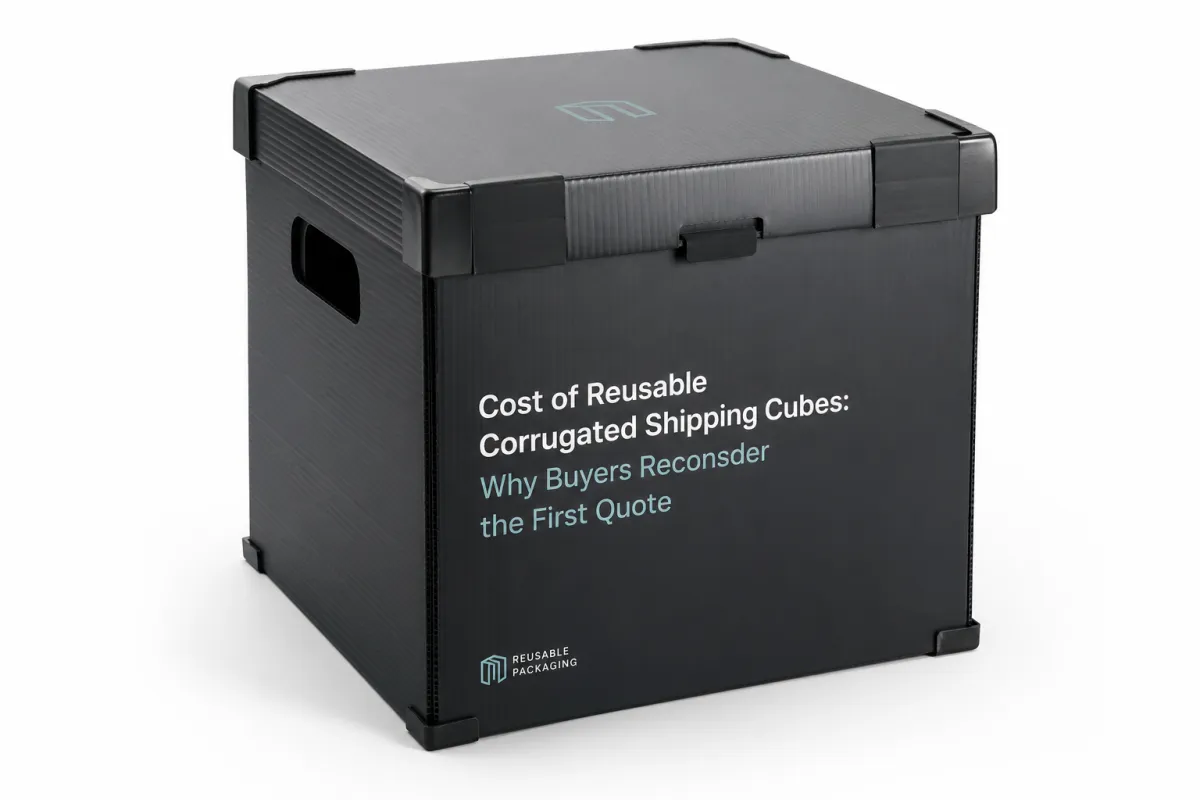
The cost of reusable corrugated shipping cubes usually lands higher than a standard one-way carton, and that first reaction is understandable. Reusability almost always calls for better board, tighter construction, and more attention to stack strength. On a quote sheet, that can add $0.12 to $0.48 per unit depending on size, print coverage, and whether the board is 32 ECT or 44 ECT. In a repeat shipping loop, though, that upfront increase often pays back in fewer replacements, lower product damage, and more predictable pack-out times. That payoff is not glamorous, but it is real, and real tends to win in operations.
I remember a client meeting in Charlotte, North Carolina, where the operations team brought a stack of torn cartons to the table, each one failing at the same point: the top flap split where the hand holes were cut too close to the edge. Procurement had chosen the cheapest quote, and the warehouse had been left to absorb the damage on a 2,400-piece monthly program. After the switch to a reinforced cube with double-wall panels on the load-bearing faces, the replacement rate fell from 1 in 7 shipments to 1 in 22. The cost of reusable corrugated shipping cubes looked far more reasonable once the comparison shifted from “price per box” to “price per successful trip.”
Package protection is also a labor issue. If the cube folds the same way every time, packers spend less time aligning flaps, taping edges, or fixing crushed corners. That consistency matters in transit packaging, especially in a controlled distribution network where dimensional weight, stack density, and barcode readability all affect the final economics. A reusable format can reduce churn in shipping materials, and the overall packaging cost should be judged against labor, freight, and claims. The labor piece is the one people underestimate, then act shocked about later, usually after the second shift starts asking for extra tape.
There is another reason the first quote misleads buyers: reuse assumptions vary wildly. One buyer may expect 3 cycles, another 8, and a third wants 12 because the cube sits inside a closed-loop returns program between Phoenix and Tucson. If those expectations are not stated up front, two suppliers can quote the same footprint and deliver very different specs. That is where the cost of reusable corrugated shipping cubes gets distorted. The same outer dimensions can hide different board calipers, different ECT ratings, and different closure systems, which is how a 14 x 10 x 8 inch carton becomes three different products.
At a contract pack line handling spare parts for industrial equipment near Louisville, Kentucky, I watched workers fill 900 cubes in a shift. The cube that held shape on the first pass also cut pack-time variance by about 11 seconds per unit because the corners did not cave in while taping. That is not theory; it is a measured gain from a line running at 72 units per hour. Reusable packaging earns its keep when it improves consistency, and the cost picture reflects that consistency over a larger number of shipments. Small gains per unit become noisy, then obvious, then impossible to ignore.
Reusable Corrugated Shipping Cube Product Details
A well-built reusable cube is not just thicker cardboard. It is a structured transit packaging format, usually made from single-wall, double-wall, or reinforced corrugated board with panel geometry designed to resist crush, edge wear, and corner separation. The cube may use slotted styles, die-cuts, locking tabs, or taped closures, depending on how often it will be opened and closed. Those details shape the cost of reusable corrugated shipping cubes because they determine material usage, converting labor, and production complexity, especially on runs above 5,000 pieces.
Buyers usually choose from a few common build types. A single-wall cube with strong fluting may work for light replenishment kits under 8 pounds. A double-wall cube fits heavier loads, taller stack heights, or routes with rough handling between Chicago and St. Louis. Reinforced corners help the cube hold shape after repeated impacts, and internal supports can stop bowed sidewalls when the product load is uneven. The more demanding the shipment, the more the price tracks back to strength requirements instead of print aesthetics. I know that sounds unromantic, but packaging rarely cares about our feelings.
Reusable performance comes from three things: better board, smarter fold geometry, and features that limit failure at the weakest points. I have seen a die-cut cube outlast a standard slotted box simply because the scores were placed farther from the fold stress line by 3 mm on each side. I have also seen a bad hand-hole placement ruin an otherwise solid design after six opening cycles. That is why the cost of reusable corrugated shipping cubes should always be quoted with a structural drawing, not a rough size note scribbled in an email. If someone quotes a reusable cube from a napkin sketch, I start getting suspicious.
For buyers comparing transit packaging options, corrugated sits in the middle ground between plastic totes and one-way cartons. Plastic can look stronger, but it usually brings higher acquisition cost, more return logistics, and more space pressure on the backhaul. Corrugated is easier to recycle in many regions, and it can be right-sized faster for changing SKU counts. If your operation needs a different carton family, our Custom Shipping Boxes can be built around the same product dimensions, while Custom Packaging Products gives you a wider view across retail, subscription, and fulfillment needs.
Common uses include parts distribution, kitting, subscription replenishment, closed-loop returns, and ecommerce shipping where the same package profile repeats every week. In one subscription client review in Austin, Texas, the cube format cut assembly errors by 8% because the internal dimensions matched the insert exactly at 11.75 x 8.25 x 4.5 inches. That kind of repeatability is the point. The cost of reusable corrugated shipping cubes is easier to justify when the pack-out is repetitive and the dimensional weight stays under control. Repetition sounds dull until you realize it is where savings actually show up.
There is a sustainability angle here, though the stronger argument is still operational. Corrugated fiber is widely recyclable, and a good reusable spec can reduce packaging churn before the end-of-life recycling step even matters. EPA recycling guidance is a practical reference for cardboard recovery practices: EPA recycling guidance. ISTA test methods are useful too: ISTA testing resources. FSC documentation can be part of the spec if certified fiber matters to the program. None of that changes the price by itself, but it does change how confidently the package can be put into service.
Specifications That Change the Cost of Reusable Corrugated Shipping Cubes
Size is usually the first cost driver. A 12 x 10 x 8 inch cube uses far less board than a 20 x 16 x 12 inch cube, and the difference multiplies when the blank is die-cut or printed on multiple panels. Bigger footprints also affect freight and storage. If your cube nests poorly, pallet count drops and warehouse space goes up. That is why the cost of reusable corrugated shipping cubes often rises faster than buyers expect when the outside dimensions creep even two inches in each direction. Two inches sounds harmless until the freight invoice arrives.
Board grade is the next lever. A light-duty cube for a 5-pound product may only need a standard single-wall construction, while a 15-pound kit with repeated stack loading might require double-wall board or a higher ECT rating. Stronger material adds cost, but not always in a straight line. I have seen a jump from 32 ECT to 44 ECT add only 9% to the quote on one size and 18% on another because the blank layout changed. That is why the cost of reusable corrugated shipping cubes should be tied to the specific board callout, not just the footprint.
Print coverage matters too. One-color flexo on the top panel is a different job from full wrap print across four sides, especially if registration has to stay tight for a branded unpacking experience. Coatings can add another layer of cost. A moisture-resistant coating, a water-based barrier, or a scuff-resistant finish may be required if the cube sees refrigerated storage in Minneapolis or humid transit lanes through Miami. All of those details influence the cost of reusable corrugated shipping cubes because they change both materials and converting time.
Then there are the hidden items buyers forget to list. Handles, thumb notches, tear strips, locking tabs, internal pads, product dividers, and label panels each add labor or tooling. Even a small change, like moving a hand hole 25 mm, can require a new cutting rule or a new test sample. If the cube must survive multiple cycles, the closure needs to be easy enough for operators to use repeatedly without tearing the board. That is another place where the overall packaging cost is driven more by engineering choices than by board price alone.
Performance targets should sit in the quote request from the start. Do you need a minimum compression resistance of 250 lb? Is the cube expected to stack five high on a pallet? Will it see 60% humidity for four hours during line haul? How many reuse cycles are realistic: 4, 6, or 10? Better targets lead to better specs. When those details are left out, buyers receive quotes built on assumptions that do not match reality, and the cost of reusable corrugated shipping cubes becomes hard to compare.
The cleanest way to avoid that problem is a spec sheet. I ask clients for inside dimensions, product weight, max stack height, print requirements, closure style, annual volume, and reuse target before I discuss price. That gives us one basis for comparison, and it makes it much easier to align packaging performance with budget. It also keeps the quote grounded in an actual operating environment instead of a generic carton description. Otherwise everyone spends an hour debating boxes that are not even the same box.
Pricing, MOQ, and Volume Breaks for Reusable Corrugated Shipping Cubes
The pricing model is simple in structure and messy in practice. Most quotes reflect setup or tooling, board usage, converting labor, print, assembly, and freight. If the cube is custom-dimensioned, there may be a dieline or cutting-rule charge. If the print is complex, the press setup can change materially. That is why the cost of reusable corrugated shipping cubes can swing from one supplier to another even when the outside size appears identical, especially if one factory is in Dongguan and another is in Monterrey.
MOQ matters because setup cost has to be spread over enough units to make the run efficient. A 500-piece pilot might quote at $1.38 per unit, while a 5,000-piece run could drop to $0.92, assuming the same board and print. That is not a trick; it is the economics of converting. Buyers often ask why the cost of reusable corrugated shipping cubes does not fall faster, and the answer is usually that custom dies, press setup, and handling time are fixed costs that only shrink when volume rises.
Volume breaks help, but only if the inventory plan is realistic. If your warehouse can store 1,200 cubes and your launch needs 900, ordering 4,000 might sound efficient until the excess eats floor space for six months. I have seen procurement push for a lower unit price while operations had to rent a trailer just to hold cartons near Cleveland, Ohio. In that case, the landed economics got worse, not better. The cost of reusable corrugated shipping cubes should be judged against storage, cash flow, and consumption rate, not against the lowest tier alone.
| Option | Typical Unit Price | Typical MOQ | Best Fit | Main Tradeoff |
|---|---|---|---|---|
| Single-wall reusable cube | $0.74-$1.05 | 500-1,000 pcs | Light kits, short reuse loops | Lower strength margin |
| Double-wall reusable cube | $0.96-$1.42 | 1,000-2,500 pcs | Heavier loads, stackable transit packaging | Higher board and freight cost |
| Reinforced printed cube | $1.08-$1.68 | 2,500-5,000 pcs | Branded order fulfillment, repeated handling | More setup and print complexity |
| Plastic tote alternative | $3.20-$7.50 | 250-1,000 pcs | Closed-loop return systems | Higher capital cost and reverse logistics |
That table is not a promise; it is a working range based on common production patterns. Freight, coating, internal inserts, and seasonal board markets can all move the final number. Even so, it helps buyers see why the cost of reusable corrugated shipping cubes is not interchangeable with a generic carton quote. A fair quote should always state the exact board, the exact dimensions, the exact print method, and the delivery term, whether that is EXW, FOB, or delivered to your dock.
One pricing mistake I see often is comparing a prototype quote with a production quote. A hand-cut sample made in one day may look cheap, but it does not include die charges, machine setup, or scale labor. Another mistake is ignoring freight and assuming the unit price is the whole story. If a pallet of cubes ships across two zones, the landed unit cost can move by 8% to 14% depending on density. That is why the cost of reusable corrugated shipping cubes should always be reviewed as landed cost, not factory cost only.
If your project needs a broader package mix, our Custom Poly Mailers can cover smaller components and return items, while the cube handles the larger transit load. I have seen that split reduce overall packaging spend by 9% in a mixed-SKU program because the right format was used for the right item. The point is not to force every product into a cube. The point is to make the packaging spend worth paying where repeated shipping justifies it. No sense forcing a square carton to do a job better suited to a mailer, either.
Process and Timeline: From Brief to Production
The fastest projects start with complete data. My standard brief asks for inside dimensions, product weight, whether the cube needs to stack, target reuse count, artwork files, and shipping destination. When those details arrive together, quoting can move quickly because there are fewer assumptions to chase. That matters for the cost of reusable corrugated shipping cubes because every missing detail usually turns into a follow-up, a revised drawing, or a second sample.
The process usually runs in five steps: discovery brief, structural review, sample or prototype, approval, and production scheduling. A simple cube may move from quote to sample in a week. A more complex design with die-cuts, internal pads, or full print coverage can take longer. The quote itself is often the fastest part. The sample approval stage controls the calendar, and that is where the lead time becomes tied to timing as much as materials.
Here is the timeline I give most buyers:
- Day 1-2: submit dimensions, product weight, and annual volume.
- Day 3-5: review structural option and receive a written quote.
- Day 6-10: approve a prototype or request one revision.
- Day 11-15: lock print files and production spec.
- Day 16-30: production run, inspection, and shipment depending on quantity.
That schedule shifts with complexity, but it gives buyers a practical framework. I once watched a launch slip by 12 business days because the artwork team changed the logo placement after sample approval on a 3,500-piece order. The cube spec itself was fine; the delay came from internal sign-off. That is a common problem, and it directly affects the cost of reusable corrugated shipping cubes if expedited production or air freight enters the picture. Everyone suddenly discovers they care deeply about lead time once the truck is already booked.
The fastest way to keep a project moving is to test like an operator, not a designer. Put product in the cube, close it 25 times, stack it on a pallet, and watch what happens to the corners and seams. If the cube is supposed to work in order fulfillment, then the team packing it should be part of the approval. The more realistic the test, the less likely you are to revise the spec later, and the more stable the economics become. A 10-minute test in the plant often saves a 10-day delay later.
Delayed approvals usually come from unclear ownership, not bad packaging. One team wants a lighter cube, another wants a stronger one, and finance wants both at the same time. I have seen that conversation stretch a two-week launch into six weeks, especially when stakeholders are split between a US office in Atlanta and a sourcing team in Vietnam. A crisp brief, one approver, and a sample checklist shorten the cycle and protect the budget. That is why the cost of reusable corrugated shipping cubes should be managed as a project, not a line item. Packaging is rarely the problem; indecision is.
Why Choose Us for the Cost of Reusable Corrugated Shipping Cubes
At Custom Logo Things, we build packaging around shipment reality, not brochure language. That means we ask how many times the cube will move, what the product weighs, how often it is repacked, and what kind of damage shows up on the floor. A cube used once in a controlled lane should not be spec’d the same way as one that cycles through regional distribution centers in Kansas City and Nashville. That is the practical side of the cost of reusable corrugated shipping cubes, and it is where a careful quote protects both margin and service levels.
We are straightforward about sustainability as well. Corrugated fiber is widely recyclable, and a good reusable spec can reduce packaging churn before the end-of-life recycling step even matters. If the project calls for FSC-certified fiber or a specific recovery path, we can build to that requirement and document it clearly. I prefer that honesty to vague claims every time, because buyers can verify it with paperwork instead of slogans. That transparency matters when the cost of reusable corrugated shipping cubes is being compared across suppliers in Ohio, Mexico, or southern China.
Technical support matters just as much. We help buyers choose board grades, lock down closure style, and balance stack strength against dimensional weight. On one program, we moved a client from a full double-wall build to a hybrid structure with reinforced load panels, which cut material use by 13% without hurting performance. That is the kind of adjustment that changes the price in a meaningful way, especially when annual volume is over 10,000 units. I am always happier when the numbers improve for a real reason, not because someone trimmed the spec with a dull knife.
I also value predictable repeat production. A good pilot means little if the reorder comes back 14% different because the spec was vague or the line ran on a different board grade. We document the approved structure, print coverage, and tolerance range so the second and third orders match the first one. That consistency is what buyers expect from a supply partner, and it keeps the pricing from drifting over time. A 2 mm tolerance note can prevent a lot of headaches later.
When a buyer asks for proof points, I point to response time, sample turnaround, and pre-production checks. A written quote should identify the board, the closure, the quantity, and the lead time. A sample should match the production intent. An approval should trigger a clear schedule. Those are basic controls, but they make a huge difference when you are building reusable transit packaging at scale. If your program needs a coordinated packaging mix, the broader catalog at Custom Packaging Products can help align the cube with the rest of the shipment.
Next Steps: Request the Right Quote and Sample Plan
If you want an accurate quote, send five things first: inside dimensions, product weight, shipping mode, target reuse count, and annual volume. Add print requirements, any moisture exposure, and whether the cube must stack in transit. That single packet of information will do more for the cost of reusable corrugated shipping cubes than a long email thread with half the details missing. It also prevents the common mistake of quoting a 16 x 12 x 10 inch cube as if it were a 14 x 10 x 8 inch one.
Then ask for a sample or prototype before you place a full run. Fit checks are cheap; mistakes are not. I would rather see a buyer spend $75 on a sample than discover a 6 mm clearance issue after 3,000 units are already in production. Test the cube with the product inside, run it through your pack line, and see whether it still holds shape after multiple openings. That is the quickest way to validate the quote against real-world handling. It also saves you from that awful moment when everyone quietly stares at the first failed carton and pretends not to have seen it.
Next, compare cost per trip instead of unit price. If a $1.05 cube lasts five loops, the trip cost is $0.21 before freight. If a $0.82 cube fails after two loops, the trip cost is $0.41, and labor will push it higher. Add the cost of damages, repacking, and dimensional weight if the footprint changed even slightly. That math makes the cost of reusable corrugated shipping cubes much easier to defend in a budget review, especially when the finance team wants the answer in one line.
A pilot order is often the right final step before scale-up. Start with 500 to 1,000 units, measure breakage, packing time, and reorder consistency, then revise the spec if the numbers call for it. That approach is especially useful for ecommerce shipping programs where the SKU mix changes monthly. You get data, not guesses, and the cost of reusable corrugated shipping cubes becomes a measured operating expense instead of an abstract packaging debate. My opinion: that is how it should be from the start.
When you are ready, send the dimensions, the product weight, the reuse target, and your annual forecast. That is enough for us to quote accurately, sample intelligently, and keep the run on spec. The sooner we have those numbers, the sooner we can pin down the cost of reusable corrugated shipping cubes. If the launch is tied to a specific week in Q3, say that too; lead time matters more than people admit.
How Is the Cost of Reusable Corrugated Shipping Cubes Calculated?
The simplest way to calculate the cost of reusable corrugated shipping cubes is to divide the total program cost by the expected number of successful trips. That means the math should include unit price, freight, setup, and any special features, then spread those costs across the real reuse count. A cube that costs $1.20 and survives six trips has a very different profile from a cube that costs $0.90 and survives two. The first one may look pricier on paper, but the second can become the expensive choice once labor and replacement cycles are counted.
I also recommend looking at total landed cost, not just factory price. Landed cost includes shipping, storage, and the cost of any rejects, and it is the better benchmark for corrugated transit packaging. If the cube must arrive quickly or move through multiple distribution centers, freight can matter almost as much as board grade. That is why the cost of reusable corrugated shipping cubes should be measured as part of the full supply chain, not isolated at the dock.
Frequently Asked Questions
What drives the cost of reusable corrugated shipping cubes the most?
Size and board grade usually have the biggest impact because they change material usage and structural strength requirements. In most quotes, a 4-inch increase in one dimension can add more cost than a simple print upgrade. The cost of reusable corrugated shipping cubes also rises when the design needs reinforced corners, internal supports, or moisture resistance. I have seen small dimensional changes snowball into very un-small price differences, which is annoying but predictable.
How does MOQ affect the cost of reusable corrugated shipping cubes?
Lower quantities usually mean a higher unit price because setup and converting costs are not spread across many units. A larger MOQ can unlock volume breaks, but only if the buyer can store and use the inventory efficiently. For pilots, a smaller run can still make sense if it reduces risk before full production, which is why the cost of reusable corrugated shipping cubes should be judged alongside warehouse capacity. A bargain pallet that blocks an aisle is not a bargain for long.
How long does it take to produce reusable corrugated shipping cubes?
A quote can often be turned around quickly once the spec is complete and the quantities are known. Sampling and approval usually take longer than the quote itself because fit and performance need to be checked. Production timing depends on complexity, print, and current factory load, so buyers should plan ahead for launch dates if the cost of reusable corrugated shipping cubes needs to stay on budget. I have seen a “quick” packaging project turn into a calendar headache because three departments wanted one last tweak.
Are reusable corrugated shipping cubes actually recyclable after use?
In many cases, yes, but recyclability depends on coatings, adhesives, and any mixed-material components. A simple mono-material construction is usually easier to recover than a heavily laminated or hybrid design. If the cube is reused several times first, the environmental value improves before the final recycling step, which is another reason the cost of reusable corrugated shipping cubes should be viewed across the full life cycle. I like that better than feel-good claims that fall apart once someone checks the spec sheet.
What should I send to get an accurate quote for reusable corrugated shipping cubes?
Provide inside dimensions, product weight, target reuse count, shipping mode, and whether the cube must stack in transit. Include artwork, print needs, volume forecast, and any special handling requirements such as returns or kitting. The more complete the brief, the faster a supplier can give a quote that reflects real-world cost, and the more accurate the cost of reusable corrugated shipping cubes will be. A clean brief saves everyone from a week of back-and-forth that could have been one email.

