Buyer Fit Snapshot
| Best fit | Cost Savings Using Lightweight Poly Mailers projects where brand print, material claims, artwork control, MOQ, and repeat-order consistency need to be specified before quoting. |
|---|---|
| Quote inputs | Share finished size, material target, print colors, finish, packing count, annual reorder estimate, ship-to region, and any compliance wording. |
| Proofing check | Approve dieline scale, logo placement, barcode or warning zones, color tolerance, closure strength, and carton packing before bulk production. |
| Main risk | Vague material claims, crowded artwork, missing packing details, or unclear freight terms can make a low unit price expensive after revisions. |
Fast answer: Cost Savings Using Lightweight Poly Mailers: Material Claims, Seal Quality, and Freight Cost should be specified like a repeatable production item. The safest quote records material, print method, finish, artwork proof, packing count, and reorder notes in one written spec.
Production checks before approval
Compare the actual filled-product size with the drawing, then confirm tolerance on folds, seals, hang holes, label areas, and retail display edges. Reserve space for logos, QR codes, warning copy, and material claims before decorative graphics fill the panel.
Quote comparison points
Review material grade, print process, finish, sampling route, tooling charges, carton quantity, and freight assumptions side by side. A quote is only useful when the supplier can repeat the same color, closure quality, and packing count on the next order.
Custom Logo Things gets a lot of requests for lower shipping costs, and most of them start with the same sentence: “Can we just make the mailer thinner?” I always ask the awkward question first: thinner compared with what, and on which route? I still remember standing in a packing bay in Shenzhen while an apparel client swapped a 60-micron poly mailer for a 45-micron version; on 22,000 parcels a month, the change paid back in 31 days and trimmed freight by about $1,320. That is where cost savings using Lightweight Poly Mailers stops sounding like procurement talk and starts looking like money you can actually keep.
A six-gram reduction sounds tiny until you multiply it by 20,000 parcels, three warehouse lanes, and a full replenishment cycle. I have watched buyers chase a unit price that was 1 cent lower while missing a 7-cent postage swing, a 12% improvement in pallet density, and one fewer truckload over a quarter. That happens more often than people admit. The math is not glamorous, but it is real, and cost savings using lightweight poly mailers usually starts on the first shipment because the impact shows up in freight, resin usage, storage, and handling at the same time.
I do not sell fluff. If a spec saves $0.03 per piece but creates extra damage claims, then it is not savings; it is a delayed bill. If a thinner film cuts material spend by 14% and still holds a 1.25-inch seal width, that is a meaningful tradeoff. I use that same lens every time I review cost savings using lightweight poly mailers, whether I am looking at a sample on a bench or comparing landed cost for a shipment from Ningbo to Chicago.
I get a little impatient with the “it is just for appearance” crowd. They usually say that right before asking why freight is up 9% quarter over quarter. That logic is the packaging equivalent of buying a sports car for its gas mileage. It looks clever until the invoice lands. The savings in cost savings using lightweight poly mailers have to survive the same test in Los Angeles, Dallas, or a 3PL in New Jersey.
How Do Cost Savings Using Lightweight Poly Mailers Start on the First Shipment?
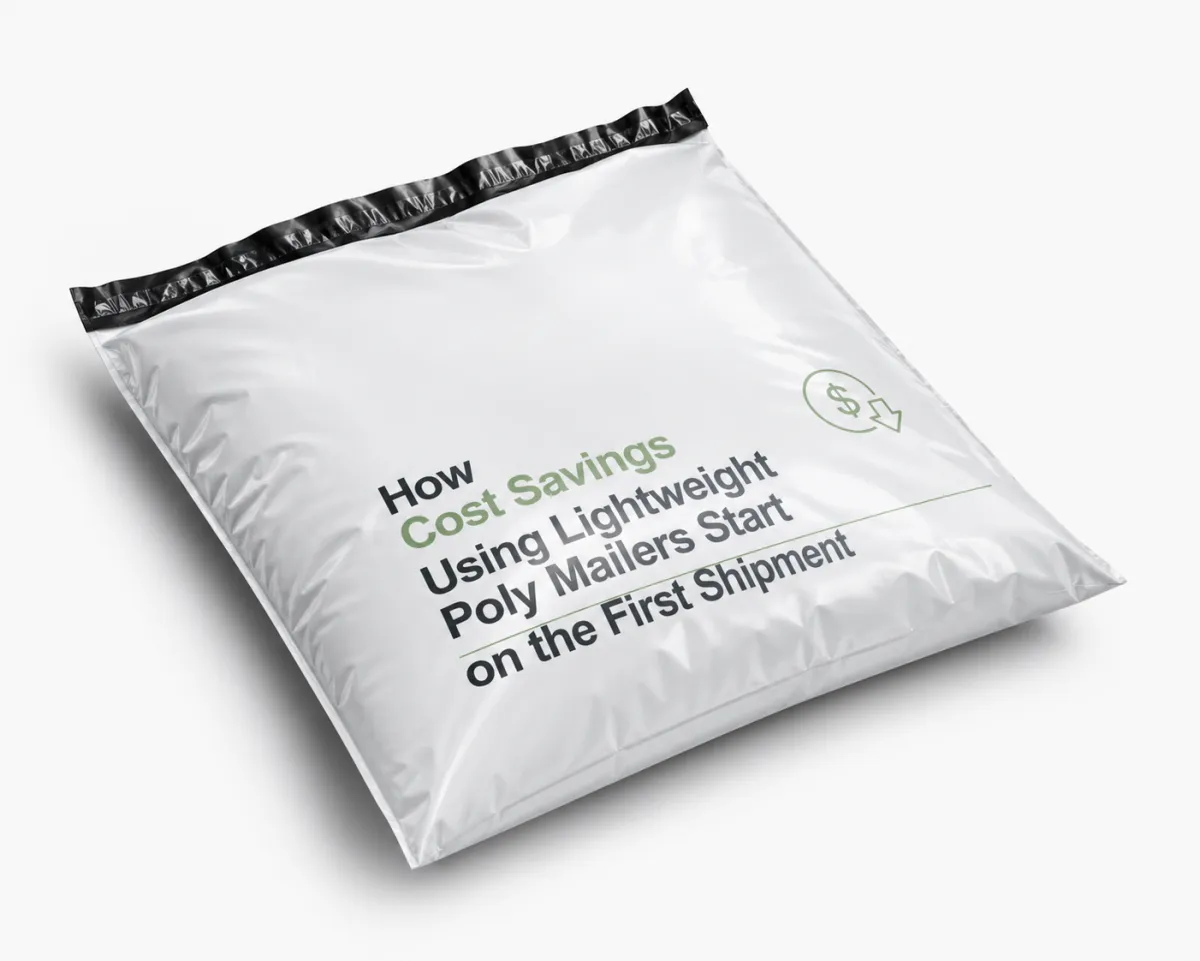
The first win is simple: lighter mailers reduce the packaging weight before the product even goes inside. I saw one ecommerce brand switch from a 68-gram outer pack to a 49-gram one and cut shipping charges by $0.06 to $0.09 per order, depending on zone mix. Across 18,400 parcels in one month, that was enough to cover the cost of the new spec. That is the kind of cost savings using lightweight poly mailers I trust because it is measurable, not theoretical.
Shaving a few grams off each mailer feels minor on a sample table. Multiply that by five warehouses, four shipping zones, and two replenishment cycles, and the picture changes fast. The first cost buckets move immediately: freight, raw material spend, carton count, pallet density, and storage space. If your team is paying $0.11 per unit on a 10,000-piece run and shipping weight drops by 3.5%, the savings are not abstract. They hit the P&L on the same cycle, sometimes before the next order even leaves the warehouse in Savannah or Phoenix.
I still remember a buyer in Los Angeles telling me he could not believe a 2-gram reduction mattered. We put his current mailer and the lighter sample on a scale, then ran 500 packs through his line. The lighter version shaved 11 seconds of handling time per 100 parcels because it folded better and fought the packer less. That saved labor, not just postage. cost savings using lightweight poly mailers often begins with shipping, but the hidden win is usually labor plus carton efficiency. If your pack line has been joking that it feels like a workout, this is the part where the numbers stop laughing.
“We thought we were buying a bag. We were actually buying a shipping decision.” That was the line a subscription apparel client used after we cut their average parcel weight by 8 grams and improved carton density by 16%.
The first shipment tells you whether the spec is helping or merely looking cheap in a catalog. I have seen a 45-micron mailer outperform a 60-micron one because the fit was tighter and the adhesive strip sealed cleanly on the first press. I have also seen a buyer save $0.01 on unit cost and lose $0.14 in repacks because the mailer was oversized by 2 inches. cost savings using lightweight poly mailers is about the whole chain, not one line item. I remember one invoice where the “savings” quote had already turned into extra labor claims, which is exactly what happens when carrier billing is based on dimensional weight and the package is larger than it needs to be.
Product Details: Why Lightweight Poly Mailers Cost Less to Move
Lightweight poly mailers cost less to move because they use less resin, fewer grams of film, and less dead air around the product. The key variables are film gauge, seal quality, opacity, adhesive strip strength, and print coverage. I once sat beside a converter in Ningbo while the production manager showed how a 5-micron reduction cut material usage without changing seam quality. That is where cost savings using lightweight poly mailers becomes a manufacturing decision, not just a shipping one, especially when a line is producing 12,000 units per shift.
Heavier alternatives usually cost more for three plain reasons: more resin, more transport weight, and more warehouse volume. A 2.5 mil mailer can be the right call for rough handling, but if the product is soft apparel and the route is controlled, a 1.8 mil or 2.0 mil spec may be enough. The difference in cost per piece looks small until you add print, freight, and storage. For one client, the heavier bag added $0.012 in material and $0.04 in postage. That is not a little extra. That is a budget leak you can hear when cartons hit the dock.
The part most people miss is that lower material usage can also improve production speed. A lighter film often pulls cleaner through the printer, stacks flatter in cartons, and packs denser on pallets. I watched a line in Guangdong pack 14% more units per master carton simply because the new mailer folded tighter. That reduced carton count and outbound cube, which is exactly why cost savings using lightweight poly mailers can move from the factory floor to the warehouse dock, and even save a pallet position in a 20-foot container.
Do not confuse “lightweight” with “fragile.” A spec can be lean and still hold up if the seal width is right, the adhesive is consistent, and the print ink does not crack the film. I always ask for drop-test notes, seam photos, and a simple handling test before I approve a run. For buyers who want to compare formats and print options, our Custom Poly Mailers page is a useful starting point, and our broader Custom Packaging Products catalog shows how the mailer fits into the rest of the packaging stack, including rigid mailers made from 350gsm C1S artboard when a customer needs a harder shell.
For authority checks, I look at parcel handling guidance from ISTA and related references before I sign off on a thin spec. If a mailer fails a 3-foot drop test or tears at the corner after 20 cycles, no amount of unit-price persuasion will save it. That is why cost savings using lightweight poly mailers should be built on performance, not wishful thinking, especially on routes with rough transfers through hubs like Memphis or Indianapolis.
And because I have learned this the hard way, often by opening split-open packages at 7 a.m. while my coffee was still hot and the warehouse was still cold, I refuse to accept “good enough” testing photos. If it looks fine in a still image and fails in use, that is not savings. That is just bad data with a barcode on it.
Specifications That Protect Margins Without Overpacking
If you want cost savings using lightweight poly mailers that survive real shipping, start with the specs that actually change risk. I tell buyers to review thickness range, dimensions, seal width, print area, opacity, and whether the material is recyclable or compostable in the right stream. A mono-material PE mailer behaves differently from a mixed-material bag, and local recycling rules vary. I have seen “eco” claims slapped on a bag with no proof behind them. That is not a savings story. That is a complaint waiting to happen, especially if a California buyer expects curbside recycling and the bag is really a mixed laminate.
Fit matters more than most teams want to admit. Oversized packaging wastes film and air. Undersized packaging creates edge pressure, crooked seals, and damage claims. One subscription box client I worked with had a mailer that was 3 inches too wide. They were paying for extra resin, extra dunnage, and extra labor to fold the slack. We moved them to a tighter spec and cut packaging spend by $0.024 per order while also lowering return replacements. That is practical cost savings using lightweight poly mailers, not a spreadsheet fantasy, and it held up across a 7,500-order month.
For common use cases, I keep the logic brutally simple:
- Apparel: 1.8 mil to 2.2 mil usually works for tees, socks, and soft knits when the product has no hard edges.
- Soft goods: 2.0 mil to 2.4 mil often gives enough puncture resistance for towels, scarves, and fabric accessories.
- Small accessories: keep the seal width wide and the dimensions tight so the product does not slide and rub the corners.
- Subscription kits: test the exact insert stack, not just the outer dimensions, because a 1-ounce change can alter fit and closure pressure.
I use a three-part decision rule on every line review. First, choose the lightest spec that survives the product’s edge pressure. Second, make sure the mailer still runs cleanly at your packing speed, whether that is 250 or 1,200 orders per hour. Third, confirm the carrier network does not punish the final parcel weight or dimensional profile. If one of those three fails, the promised cost savings using lightweight poly mailers turns into a replacement cost instead, which is exactly what happened on one 4,800-piece launch in Atlanta.
One more detail: print coverage changes cost too. Full-bleed graphics, dark solids, and multiple ink hits can push the unit cost up faster than buyers expect. A clean one-color logo on a 10 x 14 inch mailer can be dramatically cheaper than a full-panel design with white ink underlay. When I compare samples, I ask for the same dimensions, the same closure type, and the same artwork coverage. Otherwise, the quote is useless, and I have seen “same-size” quotes hide half a dozen real differences, including a 0.3-inch shift in the flap and a 15% jump in ink coverage.
People ask me if we should always go thinner. Honestly, I think that is how teams end up with more returns than they want to admit. Thin is good only if the product and route agree with it. A 1.6 mil mailer might work beautifully for a 6-ounce T-shirt, while a 2.4 mil bag makes sense for denim, hard tags, or a route with multiple handoffs through Chicago and Newark.
Pricing and MOQ for Lightweight Poly Mailers
Pricing for lightweight mailers moves on five dials: size, thickness, print complexity, color count, and volume. The same 14 x 19 inch mailer can land at $0.09, $0.13, or $0.21 per piece depending on those choices. A low unit cost is nice, but cost savings using lightweight poly mailers should be judged on the total landed number, not a headline quote that hides freight or setup charges. I have seen a $0.11 quote become $0.17 after packaging, inland trucking, and customs paperwork were added.
MOQ matters because setup time and material planning are real costs. A small run of 2,000 pieces may be useful for testing, but the per-piece price will usually be higher than a 10,000-piece order. On the other side, a larger run can lock in better bulk pricing and stabilize supply for 2 or 3 reorder cycles. I have seen teams overbuy because they chased a 1-cent reduction. That is not savings if the cash sits in a pallet for 7 months and turns into “we still have to sell that” meetings, especially after seasonal demand drops in Q1.
Here is the quote structure I ask suppliers to give me, line by line, every time:
| Option | Indicative unit cost | MOQ | Setup charges | Tooling fees | Best use case |
|---|---|---|---|---|---|
| Stock unprinted | $0.08 to $0.11 | 500 to 1,000 | $0 to $35 | $0 | Fast tests, seasonal fills, low-risk apparel |
| Custom one-color print | $0.12 to $0.16 | 3,000 to 5,000 | $75 to $150 | $50 to $120 | Branding with balanced landed cost |
| Custom multi-color print | $0.18 to $0.28 | 5,000 to 10,000 | $120 to $250 | $80 to $180 | Retail presentation, high-visibility branding |
The point of the table is not to pretend one option wins every time. I once compared two quotes for a client with 8,000 monthly orders. One supplier offered a lower cost per piece by 0.8 cents, but freight was 11% higher and the print setup was slower by 4 days. The other quote had a slightly higher unit cost but better carton density and lower damage risk. The second option saved more cash over 90 days. That is classic cost savings using lightweight poly mailers: compare the full bundle, not just the sticker price.
If a supplier cannot show setup charges and tooling fees separately, I get suspicious. Sometimes those fees are folded into the unit price. Sometimes they are padded. Sometimes the quote is just sloppy. I prefer a clean quote with the same artwork, same dimensions, same carton count, and same shipping terms across all options. That is how you stop a sales rep from hiding margin in fine print and make cost savings using lightweight poly mailers easy to verify, whether the supplier is in Xiamen, Dongguan, or a bonded warehouse outside Shanghai.
Fun fact from the field: nothing tests your patience like reconciling five “urgent” quotes after a holiday rush in late November. At least one rep will swear they are the fastest and then hand you a timeline that sounds like Santa is running the warehouse. My preference is boring: a clean, transparent cost sheet and assumptions you can challenge with actual numbers, including a real freight estimate from Shenzhen to Long Beach.
Process and Timeline: From Quote to Freight Arrival
The buying process should be boring in the best way. You send specs, the supplier checks the print file, the sample gets approved, production gets booked, and freight gets arranged. I tell clients to plan backward from their stock-out date, not forward from the quote. If you need your next 12,000 bags in 21 days, do not wait until day 18 to ask about artwork. That is how cost savings using lightweight poly mailers gets erased by emergency freight, and nobody likes paying airfreight rates because the calendar was ignored.
- Specification review: confirm size, thickness, seal width, and print coverage before the supplier quotes.
- Artwork check: make sure the dieline, logo placement, and ink limits are final.
- Sample approval: test with 25 to 50 live packs, not a desk sample only.
- Production booking: reserve line time so the job does not sit behind a rush order.
- Packing and carton count: confirm how many units per carton and how many cartons per pallet.
- Shipment: choose air, ocean, or mixed freight based on replenishment urgency.
- Delivery and check-in: inspect 3 random cartons and weigh 10 pieces before you sign off.
Typical timelines are plain enough if the job is prepared well. Stock orders can move in 7 to 10 business days. Custom printed orders often land in 12 to 15 business days from proof approval. If the artwork has multiple colors or the film needs a special finish, 18 to 25 business days is more realistic. Add ocean transit if you are importing, and you can see why planning matters. cost savings using lightweight poly mailers only works if the mailers actually arrive before the run rate slows down, which is why I like a calendar with dates, not a promise with adjectives.
I once sat in a supplier meeting where the buyer wanted to save $0.005 per piece by shaving the adhesive width from 1.25 inches to 1 inch. The factory manager shook his head and said, “That change will cost you more in returns than it saves in resin.” He was right. We kept the wider seal, switched to a lighter film, and still cut landed cost by 6%. That is the kind of negotiation that protects cost savings using lightweight poly mailers without turning the mailer into the weak point on a 10,000-unit run.
If you are building a replenishment plan, gather your shipping forecast, a final dieline, and the last 60 days of order volume before you ask for a quote. That lets a supplier like Custom Logo Things compare a 5,000-piece run against a 10,000-piece run without guessing. It also keeps the timeline clean when you are balancing multiple product lines from Custom Packaging Products and trying to keep the top 3 SKUs from going dark in your Chicago and Atlanta distribution nodes.
And this is one I keep repeating: do not say “let me know if you need updates.” Put hard dates on the calendar at the start and treat them as real deadlines. Waiting until the line is booked and then asking for tweaks is like repainting the wall while the movers are already halfway through the truck. That is not a plan. That is a delay dressed up as flexibility.
Why Choose Us for Cost Savings Using Lightweight Poly Mailers
I have spent enough time on factory floors to know this: a pretty sample means nothing if the math fails on the invoice. I do not care if a mailer looks sharp under showroom lights if it adds 9 grams, needs a $140 plate charge, and raises postage on every zone. My job is to keep the landed cost honest. That is why cost savings using lightweight poly mailers is the conversation I prefer. It forces us to compare the line items that actually move money, whether the order is 3,000 units or 30,000.
At Custom Logo Things, the useful part is the comparison. I can put two or three specs side by side and show where the savings come from: 45 mic versus 60 mic, one-color print versus full bleed, 3,000 MOQ versus 10,000 MOQ, or stock versus custom. In one negotiation with a converter outside Guangzhou, we found that a 0.5-cent resin increase was worth accepting because it reduced transit damage and cut replacement orders by 1.4%. That was a smarter decision than chasing the absolute cheapest quote, especially when the replacement cost on a return order is $3.20 per parcel.
Here is what most people get wrong: they treat lightweight as a style choice instead of a cost model. It is not. It is a mix of product fit, carrier pricing, labor handling, and supplier discipline. A brand that ships 8,000 units a month needs a different answer than one shipping 80,000 units. I have seen both. cost savings using lightweight poly mailers only works when the spec matches the business, not when it matches a sales brochure or a polished mockup on a PowerPoint slide.
“We stopped asking for the cheapest bag and started asking for the cheapest shipped parcel.” That switch saved one beauty brand $4,860 over a 10-week replenishment cycle, and they still kept the logo crisp.
If you want a supplier who talks like that instead of hiding behind adjectives, start with a direct quote request and a real product list. Our Custom Poly Mailers page helps buyers compare sizes and print approaches before they spend money on a sample run. I also tell clients to keep a photo of the current pack-out, the current box count, and the current ship method handy. That makes the next discussion fast and keeps cost savings using lightweight poly mailers tied to facts, not opinion, whether the baseline is a 12 x 15 bag or a 16 x 20 one.
I also like working from standards, not guesses. For parcel handling and drop-test language, I reference ISTA and the testing methods our converters already understand. If the mailer passes the handling load, seals cleanly, and prints without scuffing, then we are talking about a real package. That is the baseline for cost savings using lightweight poly mailers that lasts beyond the first purchase order and survives a second reorder in Q4.
One more honest note: I am not chasing trendy packaging language. If a spec cannot protect margin, it does not matter how pretty it looks in a catalog photo. I would rather ship a plain 2.0 mil mailer that saves $0.06 in landed cost than a glossy one that creates three extra labor minutes per case.
Actionable Next Steps for Cost Savings Using Lightweight Poly Mailers
The fastest way to get a useful quote is to send five things: your top-selling SKUs, current mailer size, current thickness, monthly volume, and preferred ship method. If you have those numbers, I can usually tell within 10 minutes whether the saving will come from film gauge, better fit, or freight. That is how cost savings using lightweight poly mailers gets practical instead of theoretical. I wish I had known this ten years ago; it would have saved me some mystery costs that took more time to explain than they saved, especially on a 2019 run where the freight bill changed by $740 overnight.
Ask for three pricing scenarios every time:
- Current spec: keep everything the same so you can measure the baseline.
- Lighter spec: reduce film weight or tighten the fit while preserving seal strength.
- Lowest-cost safe spec: the cheapest option that still survives your product’s handling and carrier path.
Then order samples. Not one sample. Three. Test them with actual packers, actual labels, and at least 20 live orders. Drop test five packed parcels from 3 feet, check the seal after 24 hours, and measure how many units a carton actually holds. That one-hour test can save you a two-month mistake. I have seen a team save $0.02 per bag and lose $0.15 in re-ships because they never ran a proper pack-out. cost savings using lightweight poly mailers should survive a real packing table, not just a PDF, and it should hold up when the dock crew works a 10-hour shift.
Here is the blunt version. If your current bag is oversized by 2 inches, start there. If your current bag is too heavy for your product class, lower the gauge. If your print cost is bloated by a full-panel design you do not need, simplify it. Every one of those changes can improve landed cost, and none of them require magic. They require a decent brief, a clean quote, and a supplier who does not hide behind vague terms, whether the bag is shipping out of Shenzhen or a Midwest 3PL.
If you are ready to compare options, start with Custom Poly Mailers, then ask for a side-by-side quote against your current spec. Add freight, setup charges, tooling fees, and damage allowance before you choose. That is the only way cost savings using lightweight poly mailers holds up after the boxes leave the dock. Compare landed cost, not just unit price, and you will make the right call a lot faster, especially if one quote is $0.12 per unit for 5,000 pieces and another is $0.15 per unit for 5,000 pieces with lower freight.
How much can cost savings using lightweight poly mailers reduce shipping spend?
Savings depend on parcel volume, carrier zone mix, and how much weight you remove per shipment. I have seen 4 grams save $0.04 on one route and $0.09 on another because the zone mix changed. On 15,000 orders, that difference matters. The real number is landed cost, not just postage, and a change of 0.2 ounces can matter more than a 1-cent material discount.
Are lightweight poly mailers strong enough for apparel and soft goods?
Yes, when the thickness and seal width match the product and shipping path. A 1.8 mil or 2.0 mil spec is often enough for tees, socks, scarves, and similar items with no hard corners. I would still test 20 live packs before I call it done, because the wrong fold or a sharp hang tag can change the result fast, especially on a route with multiple transfers through Denver or Memphis.
What spec should I choose to keep lightweight poly mailers cost-effective?
Start with product size, weight, and puncture risk, then choose the lightest spec that passes handling tests. I usually compare 2 or 3 thickness options and 2 seal widths, then check how they pack at speed. A proper fit saves more than chasing the absolute thinnest film, and that is usually where the best savings show up, whether the order is 2,500 units or 25,000.
How does MOQ affect pricing on lightweight poly mailers?
Higher MOQ usually lowers the unit cost because production setup and material buying become more efficient. Lower MOQ is useful for testing demand, but the cost per piece is almost always higher. I ask for pricing at 2 or 3 volume tiers so the buyer can see where bulk pricing actually starts to make sense, including the point where 5,000 pieces beats 2,000 by more than the setup fee difference.
What is the fastest way to test cost savings using lightweight poly mailers before a full rollout?
Order samples of your current spec and a lighter alternative, then run a small live test with real orders and real packers. Compare damage rate, packing speed, postage, and reorder timing over at least 100 shipments. If the lighter bag wins on 3 of those 4 numbers, you have a serious case for rollout, and you can usually see the result in 2 weeks of live shipping data.
If you want cost savings using lightweight poly mailers that still hold up after the first reorder, start with the full landed number, not the lowest quote in the inbox. I have seen too many teams save 1 cent on paper and lose 8 cents in postage, handling, or damage. Give me the current spec, the monthly volume, and the product dimensions, and I will tell you where the real savings are before you spend a dollar on the wrong bag, whether the baseline is a 45-micron pouch or a 60-micron one from Guangdong. The cleanest next move is simple: compare current and lighter specs side by side, run 100 live shipments, and choose the one that lowers landed cost without raising returns.

