Buyer Fit Snapshot
| Best fit | Order Matte Black Poly Mailers Bulk projects where brand print, material claims, artwork control, MOQ, and repeat-order consistency need to be specified before quoting. |
|---|---|
| Quote inputs | Share finished size, material target, print colors, finish, packing count, annual reorder estimate, ship-to region, and any compliance wording. |
| Proofing check | Approve dieline scale, logo placement, barcode or warning zones, color tolerance, closure strength, and carton packing before bulk production. |
| Main risk | Vague material claims, crowded artwork, missing packing details, or unclear freight terms can make a low unit price expensive after revisions. |
Fast answer: Order Matte Black Poly Mailers Bulk: Pricing & Specs should be specified like a repeatable production item. The safest quote records material, print method, finish, artwork proof, packing count, and reorder notes in one written spec.
Production checks before approval
Compare the actual filled-product size with the drawing, then confirm tolerance on folds, seals, hang holes, label areas, and retail display edges. Reserve space for logos, QR codes, warning copy, and material claims before decorative graphics fill the panel.
Quote comparison points
Review material grade, print process, finish, sampling route, tooling charges, carton quantity, and freight assumptions side by side. A quote is only useful when the supplier can repeat the same color, closure quality, and packing count on the next order.
A fulfillment manager who asks me to order matte black Poly Mailers Bulk is rarely thinking about color for its own sake. The real problem is usually messier: scuffed parcels, weak seals, lagging pack-out speed, and packaging that makes a premium product look kind of tired before it even leaves the dock. In a warehouse shipping 1,500 orders a day, a four-second delay per parcel turns into more than 100 labor minutes across a 50-person shift. That is not a design issue. That is payroll.
I remember one apparel client in Dallas who replaced glossy black mailers with matte film and sent me a photo of the first pallet with a note that said, "Why does this suddenly look expensive?" The answer was partly visual and partly practical. The matte surface cut the glare from overhead LEDs, hid the scuffs that show up after a few conveyor transfers, and made the outbound rack feel more intentional. Same size, same contents, different read. That small shift mattered more than anyone expected.
For teams evaluating Custom Poly Mailers, this is still a procurement decision first. A mailer spec that lands near $0.15 per unit at 5,000 pieces can stabilize budgets in a way a cheaper, inconsistent source cannot. It also reduces stockouts because one approved format can cover tees, hoodies, socks, and small accessories without creating a separate SKU for every category. Growing programs often do better with Wholesale Programs than with piecemeal buying, especially when the same bag moves through Atlanta, Phoenix, and New Jersey distribution points without retraining the pack team every quarter.
A lot of buyers overcomplicate black mailers. They look at the sample photo, nod at the finish, and stop there. That is a bit like choosing a forklift because the paint matched the dock doors. The better question is more practical: does the mailer reduce friction at the pack station, and does it still read clean after it has been handled a dozen times, stacked under tape, and shipped 1,800 miles? If you need to order matte black Poly Mailers Bulk, that is the performance test worth running.
What Should You Know Before You Order Matte Black Poly Mailers Bulk?
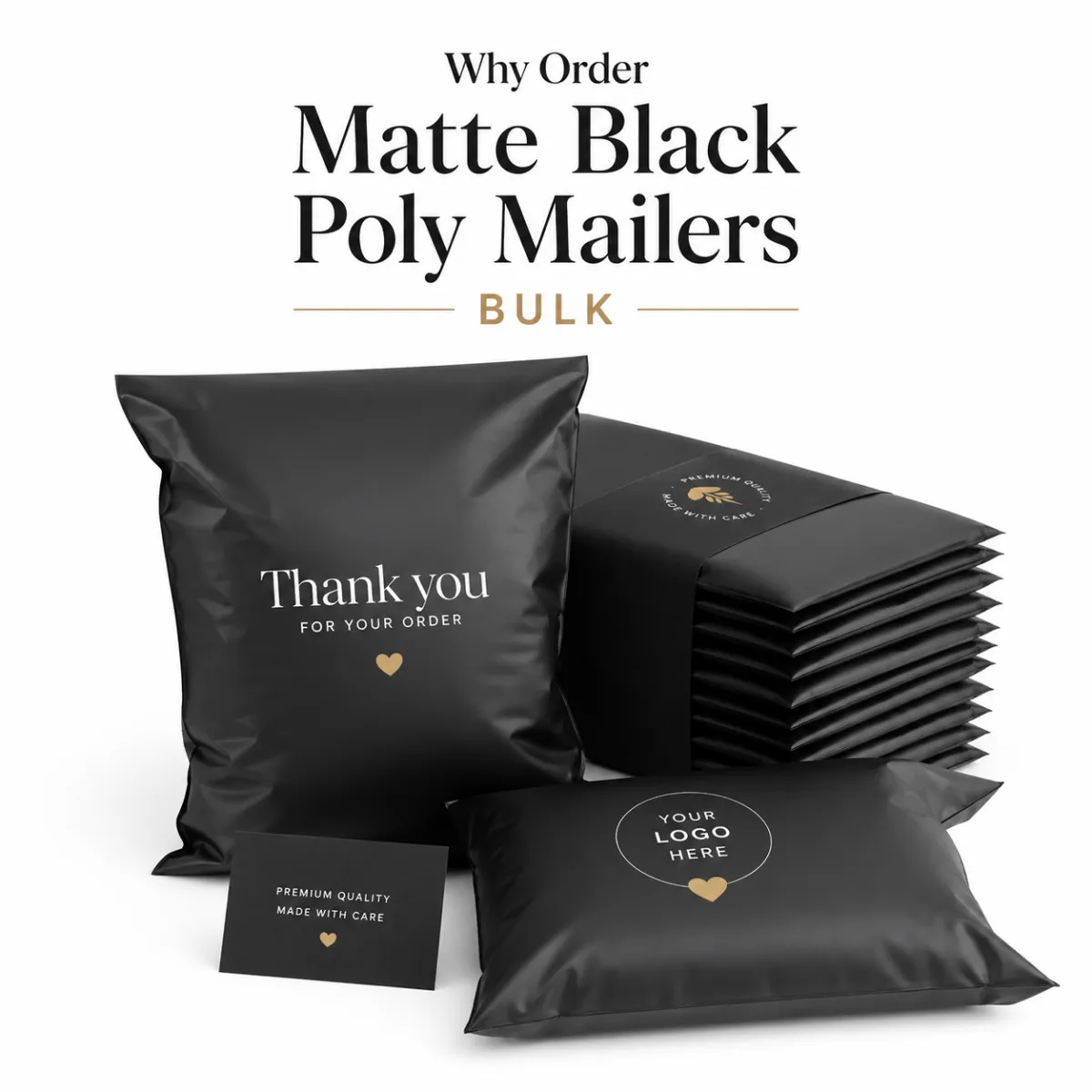
Start with the job the mailer has to do. A matte black poly mailer is strongest as a lightweight shipping bag for apparel, accessories, subscription inserts, and other soft goods that do not need a corrugated box. If your product is flat, flexible, and not easily crushed, you can usually order matte black Poly Mailers Bulk and cut material cost and pack time at the same time.
The next filter is consistency. Bulk buying matters because it locks in size, film thickness, adhesive behavior, and presentation across every shipment. That matters even more when a brand ships from multiple fulfillment centers. One approved format means fewer exceptions, fewer training notes, and fewer emergency purchases when the shelf starts running low. In practice, buyers who order matte black poly mailers bulk are usually buying predictability as much as they are buying a bag.
Then check the economics. A low sticker price can still be expensive if the mailer tears, slows the line, or forces a switch to cartons for goods that never needed them. The smartest procurement teams compare landed cost, labor time, defect rate, and storage footprint together. That is the difference between a cheap supply item and a stable wholesale packaging decision. If the numbers hold, you can order matte black poly mailers bulk with a lot more confidence.
Why Order Matte Black Poly Mailers Bulk
Perception leads the list. Matte black reads as deliberate, not accidental. Compared with white, it hides dirt better after a few days on a warehouse cart; compared with clear, it protects privacy for apparel and subscription inserts; compared with glossy black, it avoids the mirror effect that shows fingerprints under bright packing lights. If you order matte black poly mailers bulk, you are buying a cleaner visual baseline, not merely a darker bag.
Protection comes next. A poly mailer is still a lightweight shipping tool, not a corrugated box, but the right build can do solid work for non-fragile goods. A 2.5 mil co-extruded polyethylene mailer handles folded denim, knitwear, swimwear, and soft accessories better than a flimsy 1.5 mil option, especially when the parcel goes through sortation hubs and gets handled more than once. I have watched teams lose time because a bag was too thin, then lose margin because they switched to cartons for items that never needed one. That kind of overcorrection costs real money. Bulk mailers sit in the middle: lower material cost than cartons, better protection than paper envelopes, and a tighter form factor for dimensional shipping control.
Consistency matters just as much. Repeat shippers do not want a different finish every time they reorder from a factory in Dongguan, a converter in Ningbo, or a mill partner near Ho Chi Minh City. They want the same length, the same seal strength, the same opacity, and the same carton count per pallet, ideally 500 bags per case and 48 cases per pallet if the supplier uses a standard export build. That is why buyers who order matte black poly mailers bulk usually care less about one polished sample and more about whether the supplier can repeat that sample six months later with the same adhesive strip and the same usable interior space.
Bulk buying also changes the math. One stocked spec means fewer emergency purchases, fewer temporary substitutions, and fewer arguments about whether a new size will fit the packing bench. I have sat in meetings where a shipper was using three mailer colors across three channels, and the cost was not only the product price. It was the time spent checking each line, the confusion during peak weeks in November and December, and the extra pallet space taken up by overlapping inventory. A single bulk spec removes those problems quietly, which is exactly why procurement teams like it.
Compared with white, clear, and glossy black options, matte black occupies a useful middle ground. White is easier to print on but shows handling marks after a single rainy dock transfer. Clear exposes the contents, which is useful for some promo goods and awkward for premium apparel. Glossy black can photograph sharply, but it often reveals fingerprints and tape rub in a way matte film does not. For cosmetics, streetwear, private-label accessories, and subscription programs, matte black usually lands in the sweet spot because it feels premium without pushing the cost into box territory. That is the real appeal when you order matte black poly mailers bulk: better presentation with a clear unit-cost ceiling.
"We thought black was black until the matte run arrived," a warehouse manager in Riverside told me after the first pallet went live. "The bags stopped looking scuffed before they even left the dock."
If you want a broader look at packaging formats, Custom Packaging Products gives you a useful reference point, but the decision here is narrower than that. The choice is about a mailer that supports repeat shipment behavior, not a decorative one-off. That is why many teams order matte black poly mailers bulk after the first quarter of growth, when order volume crosses 300 to 500 parcels a day and the same packaging decision starts to affect labor, storage, and customer perception at once.
What You Get When You Order Matte Black Poly Mailers Bulk
A standard matte black mailer is usually built from co-extruded polyethylene film with an opaque black outer layer and a self-sealing adhesive strip. The common specification is 2.5 mil for everyday apparel shipping, though some lightweight runs sit at 2.0 mil and some heavy-duty options climb to 3.0 mil. That construction matters because it keeps the bag light enough to avoid waste while still giving enough structure to hold folded shirts, small boxes, and soft goods without collapsing in your hands. When buyers order matte black poly mailers bulk, they are usually trying to preserve that balance: thin enough to avoid inflated freight, strong enough to survive normal parcel handling.
The matte finish is not just a style choice. It lowers glare, which helps in two places: photos and packing tables. Product photos look more even because the surface does not throw hot spots back at the camera, and warehouse staff can read shipping labels more easily because the film does not compete with the adhesive backing. I have seen this matter on a Tuesday morning in Los Angeles when a team was shooting 60 SKU flats for a launch; the matte mailer made the set lighting simpler by one stop, and the photographer noticed immediately. That is the kind of detail that gets overlooked during supplier calls and praised later by operations.
On the floor, matte black also tends to look more uniform in storage. Glossy bags can stack in a way that makes a pallet look patchy under fluorescent lighting, especially in older buildings where the fixtures are uneven. Matte film gives the eye fewer distractions. I noticed that during a supplier visit in Shenzhen, where a line supervisor pointed to two pallets and said the matte film looked "finished" even before the outer cartons were sealed. That comment stuck with me because it came from the production floor, not a sales deck. If you plan to order matte black poly mailers bulk, the visual consistency is part of the value.
The best use cases are predictable. Apparel is the obvious one, but it is not the only one. Accessories, subscription inserts, non-fragile ecommerce orders, return shipments, and private-label programs all fit well. If your items are soft, flat, and not easily crushed, a matte black mailer is often a better fit than a carton because it keeps the footprint smaller and the pack-out faster. Teams that order matte black poly mailers bulk usually do so for repeat behavior, not novelty, and the repeat behavior is what allows a 14-second pack time to stay stable across a 1,000-unit launch.
Customization is where the product becomes even more useful. Common options include multiple sizes, thickness choices, printed logos, warning text, tear strips, and inner lining variations. A fashion client once asked me to compare a plain matte black run with a logo-printed version, and the best answer was not "yes" or "no." It was this: if the mailer is part of your brand's first touchpoint, the print area should be planned with the same discipline as a label. One useful reference point is a proof card printed on 350gsm C1S artboard, which gives a realistic sense of contrast before the film runs in bulk. A brand that wants to order matte black poly mailers bulk should treat the mailer as packaging inventory, not as a shipping supply that gets added at the last minute.
For teams that need a cleaner decision path, ask for a sample kit, a spec sheet, and a packed test with your real product. That three-step check will tell you more than a product photo ever will. It also makes it easier to compare FAQ guidance with real operating numbers, such as seal pull force, label adhesion after 24 hours, and whether a folded hoodie still fits with 0.75 inches of headspace. That is where procurement decisions get easier to defend.
Matte Black Poly Mailers Specifications That Matter
Before you order matte black poly mailers bulk, lock down the specs that actually affect performance. Start with usable dimensions, not just the nominal size on the product page. A bag listed as 10 x 13 inches may deliver closer to 9.5 x 12.5 inches of practical room once you account for side seals and the adhesive flap. Then confirm film thickness in mils, seal strength, opacity, and whether the bag can support printed artwork without the surface bleeding or distorting the logo. If the supplier cannot answer those details in one email, the quote is not ready.
Thickness is one of the most misunderstood variables. A buyer hears "2.5 mil" and assumes it is always better than 2.0 mil, but that is not always true. A thicker bag can add cost and stiffness without solving the actual problem. If your goods are soft tees and folded hoodies, 2.0 to 2.5 mil is often enough. If you ship bulkier or sharper-edged items, you may want a heavier build. I have seen teams order matte black poly mailers bulk at 2.5 mil only to discover that the extra stiffness slowed their pack line by three seconds per order because the flap did not lay flat as quickly. Nobody enjoys admitting that the "better" spec made packing worse, but the stopwatch does not lie.
Size selection changes more than fit. It changes labor, waste, and shipping cost. A bag that is too large wastes film and can look sloppy on the line, especially if the item slides around after insertion. A bag that is too small forces workers to press too hard, which can strain seams or slow the sealing motion. If you are shipping multiple SKUs, match the mailer to the folded product size plus a modest allowance for insertion and seal space. This is where sample testing matters more than guessing. When buyers order matte black poly mailers bulk without a pack test, they often miss the time cost that shows up later in the warehouse and the shrink-wrap bin.
Performance expectations should include tear resistance, puncture resistance, and moisture resistance. Poly mailers are not waterproof in the sense of a hard container, but they should handle rain during transfer, damp loading docks, and normal parcel sorting. If your line ships in cold weather, ask how the adhesive behaves at 40 to 50 F, because some adhesives hold well at room temperature and struggle when the carton room is cold. That is not a minor detail if you want to order matte black poly mailers bulk and keep them in service through the full season from October through February.
For testing and documentation, I like to see references to industry standards rather than vague claims. The ISTA test framework is useful for parcel handling expectations, especially if your shipments face drops, vibration, or compression during transit. FSC certification matters in a different way: it applies to paper-based components like outer cartons and printed inserts, not to the poly film itself, and that precision keeps claims accurate. If a supplier cannot explain which part of the pack is tested or certified, I would ask more questions before I order matte black poly mailers bulk.
- Confirm interior dimensions with your real folded product, not a flat sample.
- Verify thickness in mils, not just "heavy duty" language.
- Check seal behavior in warm and cool conditions, ideally 68 F and 45 F.
- Ask for opacity details if privacy matters for retail or subscription orders.
- Review print compatibility before you approve artwork and ink coverage.
- Request pallet and carton counts so storage math is clear before delivery.
That checklist is dull on paper. It saves money in practice. A buyer who can compare specs side by side is in a better position to order matte black poly mailers bulk with confidence instead of relying on product photography or a quick sales promise. In procurement, dull is often the adjective that keeps a quarter from getting expensive.
Pricing, MOQ, and Unit Economics for Order Matte Black Poly Mailers Bulk
Pricing is where the conversation gets real. If you order matte black poly mailers bulk, the unit cost will usually move based on quantity, thickness, print complexity, freight, and whether the product ships from stock or needs production time. Standard stock sizes cost less because the supplier has already committed to the film, the tooling, and the inventory. Custom printing adds setup and proofing. A heavier film adds raw material cost. Freight can swing the final landed price more than people expect, especially if the destination is far from a port like Long Beach, Savannah, or Seattle.
Minimum order quantity is not a nuisance; it is the point where the economics change. Some suppliers will lower MOQ for plain stock mailers because they can pull from existing inventory in Chicago, Dallas, or Newark warehouses. Custom printed runs usually ask for a larger quantity because the press setup and proof cycle need enough volume to make sense. If your monthly use is steady, that is not a problem. If your volume is uneven, ask for the threshold at which the price breaks improve. Buyers who order matte black poly mailers bulk with no MOQ clarity often get surprised later by a 10,000-piece minimum they were not planning for, and then the email chain starts, and suddenly everyone is "just checking on options" for three days.
Here is a practical comparison I have used in client meetings. Numbers vary by supplier, region, and freight method, so treat these as planning ranges, not a final quote. Still, they give purchasing teams a better sense of where the value shifts.
| Option | Typical MOQ | Example Unit Price | Best Fit |
|---|---|---|---|
| Stock matte black mailer, 10 x 13 in, 2.5 mil | 500 to 1,000 pcs | $0.18 to $0.23 | Fast-moving apparel and accessory orders |
| Bulk stock matte black mailer, 10 x 13 in, 2.5 mil | 5,000 pcs | $0.14 to $0.16 | Stable monthly volume and warehouse standardization |
| Custom printed matte black mailer | 10,000 pcs | $0.26 to $0.39 | Branded unboxing and repeated retail shipments |
| Glossy black mailer | 500 to 1,000 pcs | $0.15 to $0.24 | Low-cost color option where handling marks are less important |
| White poly mailer | 500 to 1,000 pcs | $0.11 to $0.19 | General shipping with less emphasis on premium presentation |
The table tells part of the story, but not all of it. A cheaper mailer can still cost more per shipped order if it tears, slows the packing team, or triggers customer complaints. The right metric is unit economics, not unit price alone. I ask buyers to look at cost per shipped parcel, labor time per pack, defect rate, and the savings from lower waste. That is the honest way to order matte black poly mailers bulk without fooling yourself on paper savings that disappear in the warehouse.
One client in the apparel space reduced rework because their new mailer sealed more predictably. Their purchase price was slightly higher than a previous quote, but the labor time dropped by 6 percent, which offset the difference within one quarter. That is why I push for landed cost. Freight, duty where applicable, setup fees, and sample charges should all be visible before approval. If you order matte black poly mailers bulk on sticker price alone, you may miss the real cost of the program.
The smartest quote requests include exact size, thickness, color, print area, freight terms, lead time, and any setup fees. Ask for tiered pricing at multiple volume levels, such as 1,000, 5,000, and 10,000 pieces. Then compare the break between them. Sometimes the best value is not the biggest run; it is the tier that aligns with your replenishment cycle and storage space. That is especially true for teams that order matte black poly mailers bulk as part of a broader packaging mix across two or three fulfillment centers.
Process and Timeline: From Quote to Delivery
The order flow should be simple. First, request a quote with the exact spec. Second, confirm whether the mailers are stock or custom printed. Third, approve artwork if needed. Fourth, lock the quantity and freight method. Fifth, schedule production or warehouse pick. That sequence sounds basic, but I have seen deals stall because the buyer said "mailer" when the supplier needed a size, a thickness, and a print location. If you want to order matte black poly mailers bulk without delay, make the quote request easy to execute and include the receiving dock hours, which can save a day or two on arrival.
Lead time depends on three variables: inventory, customization, and freight distance. Stock orders can move quickly, sometimes in 2 to 4 business days if the product is already sitting in a warehouse in California or New Jersey. Printed orders need artwork approval, proofing, and production time. For a made-to-order run, I often see 12 to 15 business days after proof approval as a realistic production window, though the actual shipping time depends on the route. A truck from a West Coast warehouse does not follow the same clock as ocean freight, and anyone who promises a speed number without asking about freight is leaving out half the schedule.
Seasonal congestion adds a less visible variable. When shipping lanes get crowded or carriers tighten capacity, the same order can arrive later than expected even if the production schedule is intact. That is why buyers who order matte black poly mailers bulk should build a 7 to 10 day buffer into their reorder calendar. A one-week cushion can prevent a lot of emergency freight, and emergency freight is where procurement budgets go to bleed. It is also where the phrase "I thought we had more of those" tends to appear in Slack messages at 6:40 p.m.
Buyers should prepare four things before they request the quote: final dimensions, estimated monthly usage, the receiving address, and branding files if printing is involved. If the supplier needs a vector logo, send a vector logo. If the receiving dock requires appointments, say so early. During one negotiation with a subscription brand in Austin, the quote was ready in 90 minutes, but the shipment sat because the receiving contact had not been named. The cost was not the price of the mailer. It was the delay. That is the kind of waste that disappears when teams order matte black poly mailers bulk with a complete brief.
Service level should be clear before you commit. I want to know how fast the quote response will arrive, how often production updates are shared, and whether the supplier provides tracking or delivery confirmation with carrier scans. None of this is glamorous, but it makes a difference when you run a tight operation. If you need more background on ordering flow, the FAQ page is a useful secondary check, especially for buyers who want to order matte black poly mailers bulk and keep the process repeatable.
Why Buyers Keep Reordering Matte Black Poly Mailers
Reliability is the hidden reason. Once a buyer finds a matte black mailer that holds color consistently, seals the same way every time, and arrives on schedule, they stop treating the product like a disposable commodity. They start treating it like part of the operating system. That is why teams reorder. The batch color stays stable. The sizing stays predictable. The adhesive behaves. And the purchasing team does not have to requalify the item every cycle. If you order matte black poly mailers bulk and the product behaves exactly the same on the second run, you have already won a major part of the battle.
High-volume shippers also like the storage profile. Mailers stack flat. They do not demand the floor space of cartons. They can be pulled quickly by a packer without a lot of motion. For a warehouse that ships apparel, the math is obvious: faster pack-out, lower cubic storage burden, and a presentation that does not look cheap. I have watched teams switch from mixed packaging to a single matte black spec and see the line calm down. Fewer decisions. Fewer exceptions. Less clutter. That matters more than most executives admit when they decide to order matte black poly mailers bulk, especially at facilities moving 8,000 units a week.
Brand consistency is another reason the reorder happens. A customer sees the same finish in every channel, whether the order came from a website, a wholesale account, or a subscription renewal. That consistency also shows up in user-generated photos, where matte film tends to photograph more evenly than reflective alternatives. Better photos do not guarantee better sales, but they do reduce the chance that the package itself becomes a distraction. I have seen that in client meetings, especially with direct-to-consumer apparel brands in Brooklyn and Portland that wanted the shipping bag to feel premium without paying box rates. For them, to order matte black poly mailers bulk was a brand decision with a measurable cost ceiling.
There is also a practical comparison worth making. A packaging upgrade is not always about adding more material or more layers. Sometimes the smartest move is a better exterior on the same basic shipping format. Poly mailers are often one of the lowest-cost ways to improve the customer's first physical touchpoint. That is why they stay in the reorder list. They are not flashy. They are effective. If your current packaging is causing complaints, then the path to better perception may be as simple as deciding to order matte black poly mailers bulk instead of piecing together smaller purchases that vary from month to month.
When I visit a plant or distribution center, I always ask the same question: what proof would make you reorder without hesitation? The answers are usually the same. A sample kit. A spec sheet with clear dimensions. Freight options. Order history support. Material consistency notes. Those are not marketing features. They are buying tools. And if a supplier can provide them cleanly, the next purchase becomes easier to approve. That is the difference between a one-time trial and a repeat program, and repeat programs are what make buyers order matte black poly mailers bulk again.
"The first order is about price. The second order is about trust," a brand operations lead in Jersey City told me during a reorder review. "If the color drifts or the seal fails, the whole package story falls apart."
Next Steps to Order Matte Black Poly Mailers Bulk
Start with three decisions: size, quantity, and whether you need plain or printed mailers. Those are the variables that move everything else. Once they are set, request a formal quote that includes freight so the landed cost is visible before approval. If you plan to order matte black poly mailers bulk for a growing business, the best time to decide is before inventory pressure forces a rushed choice. Rushed packaging buying almost always produces that slightly haunted feeling of "we should have checked that one thing."
Then compare three quotes: one sample run, one short-run estimate, and one bulk tier. That comparison shows where the real savings begin. Sometimes the lowest sticker price is tied to a size that wastes space. Sometimes the bulk tier is the only one that makes sense because it stabilizes your unit economics enough to justify the storage. I have seen buyers save themselves weeks of friction by comparing those tiers side by side before they order matte black poly mailers bulk, and I have seen that decision cut reorder churn by one full cycle.
Before you submit the order, use a simple checklist:
- Confirm the exact dimensions and thickness.
- Send artwork in the requested file format.
- Approve one sample or proof before production.
- Verify freight terms and receiving instructions.
- Set a reorder point before the last carton is opened.
That last point matters more than people think. Procurement teams do their best work when the reorder trigger is calm and visible, not when the shelf is empty and everyone is calling for a rush shipment. If you need a stable program, lock the spec, verify the price, and place the first order with the next cycle already mapped out. That is the cleanest way to order matte black poly mailers bulk and keep the operation steady.
For brands that want a broader sourcing view, Custom Packaging Products and Wholesale Programs are useful starting points. The decision here stays focused: choose the matte black spec that fits your product, confirm the landed cost, and move before stock levels become urgent. If you need one final rule, make it this: order matte black poly mailers bulk only after you have a sample in hand, a freight quote in writing, and a reorder plan on paper.
Can I order matte black poly mailers bulk with custom printing?
Yes, if the supplier offers print-ready film and your artwork is in the right format, usually vector-based. Ask about imprint area, ink limits, and setup fees before you approve the quote. I would also request a proof or sample so you can confirm contrast on the matte surface, because a logo that looks crisp on a screen can read differently on film. I learned that the hard way with a sample that looked perfect on my monitor and a little less perfect on the actual bag, and the printer was right.
What size should I choose when I order matte black poly mailers bulk?
Match the mailer to the folded product size, then leave a little room for insertion and seal space. If you ship multiple SKUs, pick the size that covers the majority of orders without forcing overstuffing. I have seen teams test one packed sample and avoid a lot of shipping mistakes, which is why I always recommend a real pack test before the full bulk order. Paper specs are useful; a real hoodie in the actual mailer is better, especially if the finished product lands at 9.25 x 12.25 inches inside a 10 x 13 bag.
How do bulk pricing tiers usually work for matte black poly mailers?
Price usually drops as quantity increases because material, setup, and freight costs are spread over more units. Custom printing and thicker film tend to raise the unit cost, while standard stock sizes are often the lowest-cost option. Ask for tiered pricing at several volume levels so you can compare the actual savings per unit instead of guessing. I like 1,000, 5,000, and 10,000 units as a quick sanity check, and I like seeing the $0.15 to $0.16 range on 5,000 pieces because it usually tells you the quote is real.
What is the typical MOQ for matte black poly mailers bulk orders?
MOQ depends on whether the mailers are stock or custom printed, and whether the supplier is pulling from inventory or scheduling production. Standard stock sizes often have lower minimums than branded runs. I always recommend getting the MOQ in writing with the lead time, because that keeps the reorder cycle aligned with your monthly usage. Otherwise, the "small order" that seemed fine somehow turns into a storage headache in week 6, usually after the dock door is already crowded.
How fast can I receive matte black poly mailers after ordering in bulk?
Delivery time depends on inventory, custom work, and freight distance. Stock orders usually move faster because there is no artwork approval or production queue, while printed orders need proofing and manufacturing time. If timing matters, ask for both production lead time and transit time before you place the order so the arrival date is based on reality, not hope. For planning, a printed run typically takes 12 to 15 business days after proof approval, then another 3 to 7 business days for domestic freight if the bags ship from a U.S. warehouse.
If you need a clean, repeatable shipping format, the most practical move is still the same: confirm the spec, compare the landed price, and order matte black poly mailers bulk with enough inventory to protect the next reorder window.

