Buyer Fit Snapshot
| Best fit | Custom Apparel Hang Tags Packaging projects where brand print, material claims, artwork control, MOQ, and repeat-order consistency need to be specified before quoting. |
|---|---|
| Quote inputs | Share finished size, material target, print colors, finish, packing count, annual reorder estimate, ship-to region, and any compliance wording. |
| Proofing check | Approve dieline scale, logo placement, barcode or warning zones, color tolerance, closure strength, and carton packing before bulk production. |
| Main risk | Vague material claims, crowded artwork, missing packing details, or unclear freight terms can make a low unit price expensive after revisions. |
Fast answer: Custom Apparel Hang Tags Packaging: Design and Cost should be specified like a repeatable production item. The safest quote records material, print method, finish, artwork proof, packing count, and reorder notes in one written spec.
Production checks before approval
Compare the actual filled-product size with the drawing, then confirm tolerance on folds, seals, hang holes, label areas, and retail display edges. Reserve space for logos, QR codes, warning copy, and material claims before decorative graphics fill the panel.
Quote comparison points
Review material grade, print process, finish, sampling route, tooling charges, carton quantity, and freight assumptions side by side. A quote is only useful when the supplier can repeat the same color, closure quality, and packing count on the next order.
The first thing many shoppers touch is not the garment itself. It is the tag hanging off the collar, sleeve, waistband, or hang tab. In custom apparel hang tags packaging, that small piece of board can change how premium a product feels before anyone even tries it on. It also carries the practical information that keeps a line moving on the sales floor. I treat custom apparel hang tags packaging as a branding decision and an operations decision, not just a print file with a hole punched in it.
Think about how a shirt, jacket, or accessory is presented. The tag, the string, the folded insert, the barcode, the care copy, and the hole placement all shape the customer experience. Good custom apparel hang tags packaging supports the garment, reinforces brand identity, and fits cleanly into the rest of the product packaging system, whether that includes tissue, polybags, custom printed boxes, or a retail display tray.
For brands trying to build a consistent shelf presence, hang tags belong inside branded packaging and package branding, not somewhere off to the side. A strong tag can make a $28 tee feel considered. A weak one can make a premium garment look rushed. Small detail. Real effect.
What Custom Apparel Hang Tags Packaging Actually Is
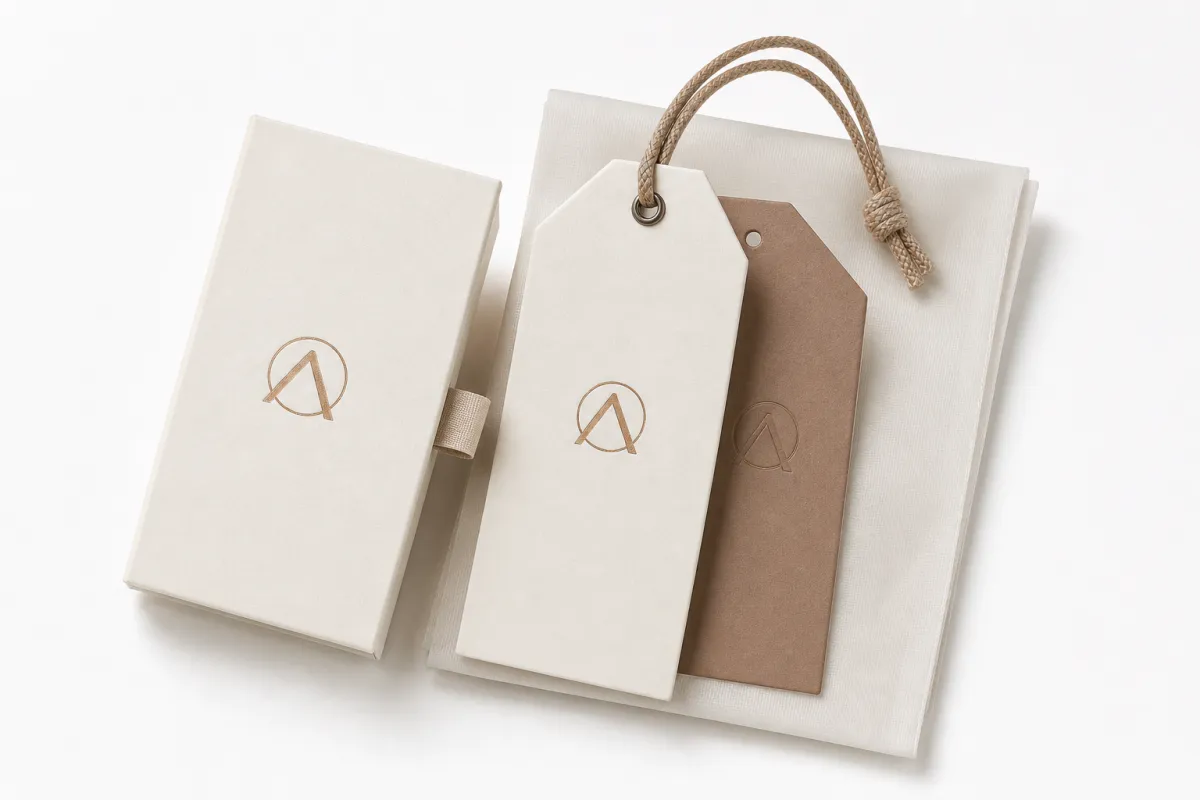
Custom apparel hang tags packaging is the set of printed tags attached to garments for branding, retail information, and presentation. At the simplest level, it is a single card tied to a shirt. In a more developed system, it can include a folded tag, a brand story insert, a size panel, a barcode panel, and an attachment method that suits the garment weight and the way the item will be sold.
A lot of people use the phrase loosely, but the parts matter. The tag shape can be a rectangle, rounded-corner card, die-cut silhouette, or folded multi-panel piece. The stock might be coated paper, uncoated board, kraft, recycled stock, or a textured specialty paper. The finish could be matte, gloss, soft-touch, foil, embossing, or spot UV. Then there is the attachment method, which might be string, elastic loop, safety pin, or a pre-punched hole for automatic tagging.
The reason custom apparel hang tags packaging matters goes far beyond decoration. It can carry size information, SKU data, barcodes, care content, fiber content, origin statements, sustainability claims, and price markers in one compact package. That matters on the sales floor, in the stock room, and during fulfillment, because a tag that prints clean and reads clearly cuts friction at every step.
There is also a difference between a simple retail tag and a broader packaging system. A retail tag stands alone. A brand system coordinates the tag with belly bands, stickers, insert cards, tissue, labels, or outer boxes. When those pieces are designed together, custom apparel hang tags packaging feels more deliberate and the whole line gains consistency.
The best hang tags do not beg for attention. They earn it by feeling right in the hand, reading clearly on the rack, and matching the garment they are attached to.
That is the practical lens I like to use. If a tag looks good on a screen but feels flimsy in hand, curls at the corners, or becomes a pain to scan, it is failing its job. In real retail packaging, the tag has to survive store lighting, human hands, and the occasional rough treatment from the back room.
I have seen brands spend weeks perfecting a logo placement and then ignore the punch hole. Bad move. A tag that tears at the top edge after a single try-on tells the customer a lot about the rest of the product, and none of it is flattering.
How Custom Apparel Hang Tags Packaging Works From File to Garment
The production flow for custom apparel hang tags packaging is easy to sketch on a whiteboard. The details are what make or break it. A good job usually moves through concept, size selection, dieline setup, artwork placement, proofing, printing, finishing, cutting, and assembly. Rush any of those steps and the final tag can lose sharpness, alignment, or consistency.
It starts with the brief. The brand needs to know what the tag must do: sell the product, hold regulatory data, support a seasonal launch, or fit into an existing packaging design system. Once that is clear, the supplier can recommend dimensions and stock thickness. A 2 x 3.5 inch tag works for many basics. A folded or oversized format may make more sense for premium outerwear or a line that needs more room for story and details.
Artwork setup is where the structure becomes real. Dielines define safe zones, trim lines, fold lines, and punch locations. In custom apparel hang tags packaging, barcode placement deserves extra attention because a barcode too close to the edge can scan badly or fail the quiet zone the scanner needs. If the tag includes a price, make sure that field sits where it can be read without turning the garment into origami.
Print method changes the outcome too. Digital printing is usually the best fit for short runs, variable data, and quick proofs. Offset printing makes more sense for larger quantities and tighter brand color control. Specialty methods, such as foil or spot UV, add texture and visual depth, but they also add setup complexity. They only make sense when the line can support the budget and the extra handling.
Finishing choices matter because they affect feel and durability. Matte coatings keep the surface calm and readable. Gloss makes color punchier, although it can also throw reflections under store lighting. Soft-touch creates a velvety hand feel that many premium fashion brands like. Embossing and debossing add tactile contrast, while foil can give the logo a sharper presence. Rounded corners reduce dog-earing, which helps when the tag gets handled a lot.
Attachment is not a tiny detail. A thin knit tee needs a different attachment than a heavy denim jacket or a folded sweater. String length, loop strength, and hole placement all need to match the garment weight and the retailer's merchandising habits. If a tag spins too freely or tears too easily, custom apparel hang tags packaging starts creating work instead of reducing it.
- Digital print works well for lower quantities, fast turnarounds, and variable data tags.
- Offset print is usually better for larger runs that need steadier color and lower unit cost.
- Foil, emboss, and spot UV should be reserved for brand moments that justify the extra cost.
- String, loop, or pin attachment should match garment weight and store handling.
In practice, the tag has to work in two places at once: on the garment and in the box. That is why many brands now treat custom apparel hang tags packaging as part of a broader retail packaging system instead of a separate print task. I think that shift is healthy. It stops teams from making each piece in a vacuum.
Key Factors That Shape Custom Apparel Hang Tags Packaging
Several decisions shape how custom apparel hang tags packaging looks, costs, and performs. The first is substrate choice. Coated paper gives crisp images and strong color contrast, which works nicely for fashion labels with clean photography or saturated brand colors. Uncoated board feels more natural and tactile, and it supports a quieter, more artisan look. Kraft stock has a rougher, earthier character that fits casual or sustainability-focused brands, while textured board adds depth without relying on heavy ink coverage.
Heavier paperboard often signals value, but weight alone is not the answer. A tag that is too thick can feel awkward on lightweight garments, and a tag that is too thin can look disposable on a premium item. In custom apparel hang tags packaging, the right sheet stock should reflect the garment price point, the brand voice, and the retail environment. That is where packaging design starts turning into a merchandising choice.
Structure is the next big variable. A single-card tag is the most common choice, and it keeps the process simple. Folded tags give you more room for story, compliance copy, and care details. Multi-panel tags help when a line needs a lot of information, especially when the brand wants to separate emotional content from practical information. Variable data tags are useful for collections with multiple SKUs, but they demand careful file control.
Color and typography deserve more attention than they usually get. The tag should feel like it belongs with the garment label, the box, and the rest of the package branding. If the outer system uses muted neutrals, a neon tag can feel like it wandered in from another brand. If the line relies on sharp black-and-white contrast, a washed-out logo weakens the whole presentation. The best custom apparel hang tags packaging carries the same visual language across categories even when sizes and materials change.
Durability is another practical concern. A tag may only need to survive a single store display cycle, or it may need to travel through fulfillment, bagging, shipping, and repacking before it reaches the customer. Scuff resistance, corner strength, moisture exposure, and ink rub all matter depending on the channel. For shipping-heavy programs, it helps to think about how the tag behaves under transit stress, much like teams think about outer product packaging and the durability standards used for mailers or boxes.
Compliance can be just as important as the visual design. Barcodes, SKU fields, care instructions, fiber content, and country-of-origin information must be accurate. If the brand sells into multiple channels or regions, the tag may need to support several data points at once. I like to remind teams that an attractive tag is useful, but an accurate one is essential. A tag that fails the operational side of custom apparel hang tags packaging creates avoidable rework. Regulations can also vary by market, so the compliance copy should be checked against the destination country and retailer requirements, not just the brand deck.
For teams that also manage broader sustainability and material sourcing goals, it is worth checking whether the paper can be specified as FSC-certified. The certification framework is explained at FSC, and that can help internal teams document chain-of-custody expectations more cleanly. If the tag needs to survive rougher handling or shipping tests, the general test philosophy used by ISTA methods can also help teams think more practically about handling and transit stress. Those references do not replace your own specs, but they are useful anchors.
- Coated stock suits sharp graphics and strong color reproduction.
- Uncoated and kraft stock suit tactile, natural, or heritage-inspired branding.
- Folded or multi-panel tags help when the line needs more storytelling or compliance space.
- Variable data should be managed carefully so SKU, barcode, and size fields stay consistent.
Custom Apparel Hang Tags Packaging Cost and Pricing Factors
Pricing for custom apparel hang tags packaging usually comes down to six variables: quantity, stock choice, size, color count, print method, and finishing. If the job also includes assembly, stringing, or variable data, the cost climbs again. That is normal. The real question is not whether a tag is cheap or expensive in the abstract. It is whether the spec matches the brand goal and the unit economics of the garment line.
Short runs almost always cost more per tag because setup time and press changeovers are spread across fewer pieces. A 500-piece order might feel surprisingly expensive next to a 10,000-piece run, even when the artwork is simple. If a brand is testing a new capsule collection, the higher unit price can still be the smarter move because it reduces inventory risk. That tradeoff shows up constantly in custom apparel hang tags packaging conversations.
Special finishes are where budgets can move quickly. Foil stamping, embossing, die-cut shapes, and soft-touch lamination all add handling steps. If the tag also needs a folded structure or a glued insert, the labor load goes up again. From a practical standpoint, those upgrades are worth it only when they reinforce the brand position. A premium outerwear line can justify them more easily than a basic tee program.
There are hidden costs too. Proof rounds take time. Color matching can need an extra press adjustment, especially if Pantone accuracy matters. Shipping may cost more if the tags are rushed or if freight needs to hit a narrow receiving window. If the tags arrive pre-stringed or kitted by size, that labor usually appears somewhere in the quote. The cheapest unit price is not always the real low-cost option for custom apparel hang tags packaging.
Here is a realistic comparison for common apparel tag specs. These ranges are directional, not promises, because paper markets, labor rates, and finishing costs vary by region and by supplier. Still, they help brands benchmark quotes and avoid comparing very different jobs as if they were the same.
| Option | Typical Use | Approx. Unit Cost at 5,000 | Notes |
|---|---|---|---|
| 14pt coated card, 4-color, no finish | Basic tees, entry-level retail lines | $0.08-$0.16 | Good for clean graphics and fast production |
| 16pt uncoated or kraft, 1-2 color | Natural, heritage, or eco-positioned apparel | $0.10-$0.20 | Less color pop, stronger tactile feel |
| Coated board with matte or soft-touch finish | Mid-tier fashion, better shelf presence | $0.14-$0.28 | Improves hand feel and reduces glare |
| Die-cut shape with foil or embossing | Premium launch pieces, seasonal drops | $0.24-$0.48 | Higher setup and finishing labor |
| Folded multi-panel tag with assembly | Lines needing story, compliance, and barcode space | $0.22-$0.55 | More complex to print, finish, and fold |
To compare quotes fairly, ask suppliers to price the same spec sheet. That means the same dimensions, stock, print count, finish, hole placement, attachment method, and assembly level. Without that discipline, a quote for custom apparel hang tags packaging can look lower simply because it leaves out a finish, uses thinner stock, or excludes labor that will be added later. For brands managing multiple categories, that consistency matters just as much as the printed look of the tag itself.
A quote only tells the truth when the spec does. If the size, stock, finish, and assembly do not match, the lowest number is often comparing a different product.
If your brand is building a broader kit that includes stickers, sleeves, or boxes, it can help to compare tag pricing with other packaging pieces like Custom Packaging Products and Custom Labels & Tags. That wider view makes it easier to decide where to spend and where to simplify.
Custom Apparel Hang Tags Packaging Process and Timeline
The production timeline for custom apparel hang tags packaging depends on complexity, but the sequence is usually the same. First comes the brief, then artwork prep, then proof approval, then production, finishing, assembly, and shipping. Simple jobs move quickly once the files are clean. More complex jobs slow down when the layout needs folding, special finishes, or exact data handling.
A standard flat tag can often be turned in about 7-12 business days after proof approval, depending on quantity and supplier capacity. Specialty pieces with foil, embossing, custom shapes, or pre-stringing more often run 12-20 business days, and larger or more layered jobs can stretch beyond that. For seasonal apparel launches, I would rather see a brand plan extra buffer time than rush the last week and compromise the print. Nobody wants the last mile of a launch to turn into a panic sprint.
Most delays happen for predictable reasons. Missing barcode data is a common one. Another is artwork that looks ready but has no actual dieline, no bleed, or no safe zone around the fold. Slow approvals create a different kind of delay, especially when marketing, merchandising, and operations are all reviewing the same custom apparel hang tags packaging proof at different speeds. Every extra revision adds calendar days, not just design time.
The smartest schedule is usually built backward from the apparel production window. If the garments must be packed, tagged, and shipped by a fixed date, the hang tags need to be approved well before the garments are ready. That gives room for a proof, a correction, a second proof if needed, and transit time. In retail packaging, that buffer is not wasted time. It is the part that prevents expensive last-minute air freight or overnight reprints.
For seasonal lines, reorders deserve the same discipline. A tag spec that worked once should be stored with dimensions, finish, attachment method, barcode format, and approved artwork files so the next run does not drift. That is especially useful when a brand updates packaging design for a capsule collection and wants the system to stay recognizable across sizes and colorways.
- Brief - Define what the tag needs to do, who will read it, and where it will be attached.
- Artwork prep - Build or confirm the dieline, bleed, quiet space, and data fields.
- Proofing - Check copy, barcodes, color intent, and finish notes carefully.
- Production - Print, finish, cut, and assemble the tags in the approved format.
- Delivery - Leave enough transit time so the apparel line is not waiting on tags.
In a well-run program, custom apparel hang tags packaging is not the bottleneck. It is a planned component, and that shift in thinking saves time across the entire product packaging schedule.
Common Mistakes With Custom Apparel Hang Tags Packaging
The most common mistake is designing for the mockup instead of the store floor. A tag can look perfect in a flat digital render and still fail in hand because the type is too small, the hierarchy is muddy, or the barcode takes over the face. In custom apparel hang tags packaging, the final read matters more than the presentation board.
Another problem is choosing a stock or finish because it looks good online, not because it performs well in use. Gloss can show fingerprints. Certain uncoated stocks can smudge if the ink coverage is heavy. Very thin boards can curl, especially in humid storage conditions. The most attractive tag is not always the most reliable one. I have had to talk more than one team out of a finish that looked gorgeous in a PDF and awful under a warehouse fluorescent light.
Barcode and SKU errors are especially costly. I have seen teams approve a beautiful tag, then discover that the operational data came from the wrong product line or that the barcode was built at the wrong size. That mistake does not just delay print. It can disrupt receiving, POS setup, and inventory tracking. Accurate data is a core part of custom apparel hang tags packaging, not a clerical detail left for last.
Inconsistent visual systems create a quieter but still damaging problem. If one product family uses a serif logo, one uses a condensed sans, and another uses unrelated color combinations, the collection starts to feel scattered. Strong package branding needs enough consistency that customers recognize the line instantly, even when the garments shift from basics to premium pieces. The same principle shows up in branded packaging and in the way custom printed boxes are used across a larger assortment.
Skipping samples is another mistake that costs more than people expect. Paper feel, hole placement, hole reinforcement, and string behavior are hard to judge on a screen. A physical sample shows whether the tag hangs straight, whether the logo reads well under store lighting, and whether the finish feels right against the fabric. For custom apparel hang tags packaging, a sample often catches the issue that would otherwise become a full reprint.
One more issue that gets ignored: overstuffing the tag with marketing copy. A tag is not a brochure. If every side is crowded, shoppers stop reading anything at all. Keep the front focused, move the operational data where it belongs, and let the material and finish do some of the talking.
- Designing too small makes pricing, care, or story copy hard to read.
- Choosing the wrong finish can lead to glare, smudging, or a flimsy feel.
- Ignoring operational data causes barcode and SKU problems later.
- Mixing styles across lines weakens recognition and slows brand recall.
- Skipping samples hides problems with paper feel, alignment, and attachment.
Expert Tips and Next Steps for Custom Apparel Hang Tags Packaging
The easiest way to keep custom apparel hang tags packaging under control is to build one master spec sheet and use it for every reorder. Lock in the dimensions, stock, finish, hole position, attachment method, barcode format, and approved copy. Once those details are stable, the brand can change campaigns or seasonal messaging without rebuilding the tag from scratch every time.
For many brands, it is smart to have two tag families: one premium version for higher-margin products and one simplified version for basics. That keeps the system efficient while still letting the best items carry a richer visual treatment. It also helps teams avoid overspending on products that do not need foil, embossing, or a multi-panel layout. Custom apparel hang tags packaging works best when the spec matches the role of the garment in the line.
Before final approval, review the tag in real light next to the actual garment colorways. A warm cream stock can look elegant beside navy knitwear and muddy beside a bright white tee. A dark logo may disappear on a textured kraft board. Those relationships are hard to see on a laptop screen, but they matter immediately once the tags are printed and bundled into the merchandising flow.
I also recommend ordering a small pilot run whenever the line is new or the finish is unusual. Even 250 to 500 pieces can reveal whether the hole tears cleanly, whether the string behaves well, and whether the barcode scans fast. That small test is often far cheaper than fixing a six-figure apparel production run that already moved into packing. It is boring advice, sure, but boring is better than a reprint.
When the tag system is ready, keep the paperwork tidy. Save the artwork files, the spec sheet, the approved proof, and the barcode list together. That simple habit makes reorders easier, keeps the production team aligned, and reduces the chance that a revised logo or changed size chart sneaks into the next job without review. In a busy retail packaging calendar, orderliness is a real cost saver.
For teams building a larger packaging program, tags should sit alongside the rest of the system, not outside it. That means looking at hang tags with the same care you give tissue, insert cards, labels, mailers, and product packaging for the full assortment. The more those pieces agree, the more polished the brand feels.
My practical next step is simple: gather the artwork, confirm the compliance copy, lock the barcode data, request matched quotes from the same spec sheet, and schedule proof approval before the apparel production window closes. If you do those five things, custom apparel hang tags packaging becomes a controlled part of the launch instead of a late-stage scramble. That usually shows up in stronger presentation, fewer errors, and a better first impression on the shelf.
Handled well, custom apparel hang tags packaging supports the garment, reinforces the brand story, and keeps the operations side clean. The takeaway is simple: choose one master spec, prove it with a physical sample, and lock the data before production starts. Do that, and the tag stops being an afterthought and starts doing real work.
FAQs
What should custom apparel hang tags packaging include?
At minimum, include the brand name, product name, size, barcode or SKU, and any required care or fiber details. If the tag is meant to sell the product visually, add a short brand story or material note, but keep the layout readable and leave enough quiet space so the tag does not feel crowded in hand. Good custom apparel hang tags packaging balances information with clarity.
How much does custom apparel hang tags packaging cost?
Cost depends on quantity, paper stock, size, print method, and whether you add specialty finishes like foil or embossing. Short runs usually have a higher unit price because setup and proofing are spread over fewer pieces. The safest way to compare vendors is to request quotes from the same spec sheet so the pricing is truly comparable for custom apparel hang tags packaging.
How long does custom apparel hang tags packaging take to produce?
Simple tags can move quickly once the artwork and data are approved, but proofing still adds time. Specialty finishes, custom shapes, or string assembly usually extend the timeline because they add more production steps. Build in buffer time for revisions, freight, and any last-minute barcode or copy corrections so custom apparel hang tags packaging arrives before the garments do.
Which materials work best for custom apparel hang tags packaging?
Coated stocks give sharp images and strong color, while uncoated and kraft papers feel more natural and tactile. Heavier boards are a good choice when the tag needs to feel premium or survive more handling. The best material is the one that matches the garment price point, brand voice, and retail environment in your custom apparel hang tags packaging plan.
How do I keep custom apparel hang tags packaging consistent across reorders?
Save one master spec with exact dimensions, stock, finish, hole position, and approved artwork files. Keep barcode data and variable fields in a controlled spreadsheet so updates do not drift between runs. Request a proof on every reorder if the color or finishing standard is critical to the brand experience, because consistency is what makes custom apparel hang tags packaging feel intentional over time.

