A custom takeout paper Bags Bulk Order sounds like a simple procurement decision. It is not. The bag affects how fast staff can pack, whether food arrives upright, how often handles fail, and how polished the order feels when it leaves the counter. If the bag is wrong, the problem shows up everywhere else.
That is why experienced buyers treat takeout bags as part of service flow, not as disposable filler. A good bag disappears into the operation. Staff stop second-guessing the size. Managers stop scrambling for emergency stock. Guests get a clean handoff instead of a stack of containers held together by hope and tape.
There is also the branding side, though that gets overstated pretty quickly. A printed paper bag is not magic. It is a moving surface that gets seen in parking lots, elevators, offices, and delivery lobbies. If the bag is sturdy, sized well, and printed cleanly, it does more than carry food. It carries the standard the brand wants people to associate with the order.
Why bulk bag ordering quietly lowers front-of-house friction
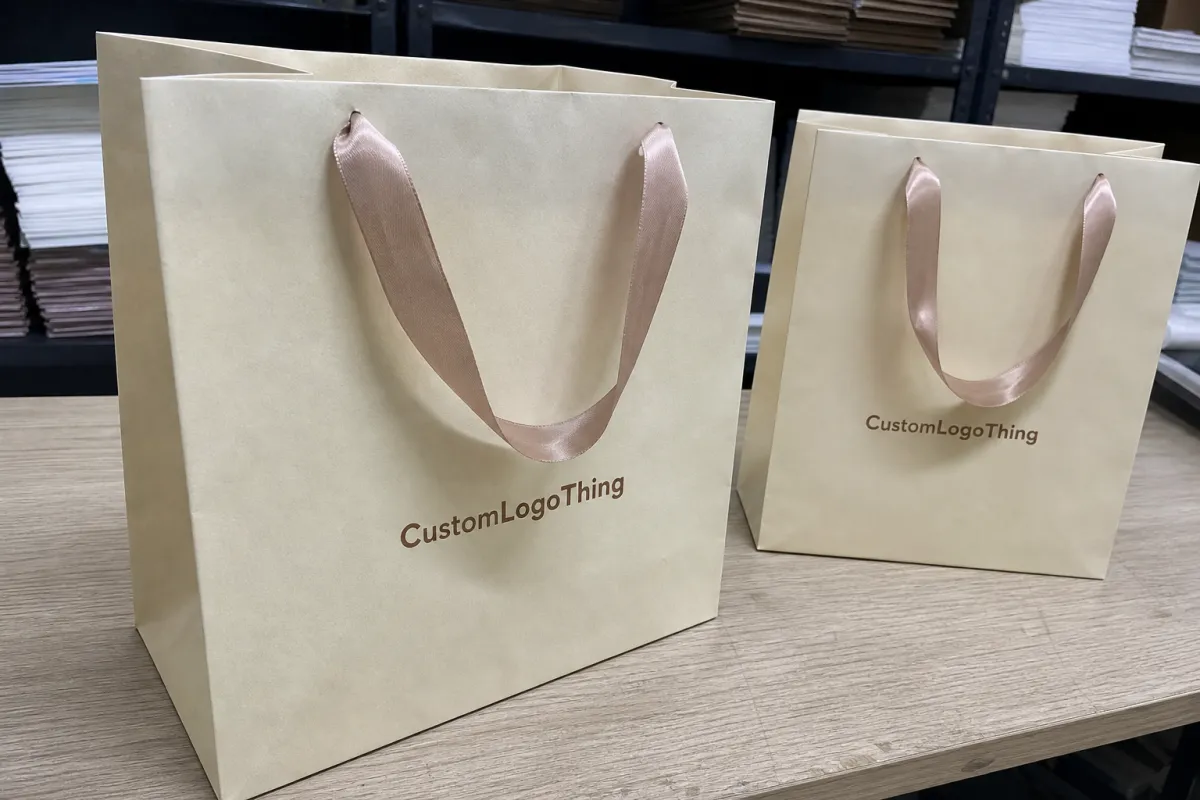
Lunch rush exposes weak packaging fast. One server is waiting on a bag that is two sizes too small. A runner is trying to fit soup, fries, and a drink into one awkward stack. The cashier is talking through a delay while the line keeps growing. Nobody complains about the bag first, because the bag is never the only thing failing. But it is usually involved.
A bulk program reduces those moments because inventory stops behaving like a daily gamble. The team can pull the correct size without checking every order against a panic pile of leftovers. That matters more than the purchase price suggests. A bag that costs a few cents less but slows the line is not cheaper. It is just hidden labor.
Bulk ordering also gives operators room to plan around demand spikes. Catering lunches, weekend rushes, holiday volume, and weather-driven takeout surges all stress packaging inventory in different ways. A well-sized stock position lets the kitchen and the front counter keep moving without awkward substitutions. Running out of the right bag at 12:15 p.m. is the kind of mistake that feels small only from the outside.
A bag shortage rarely looks like a packaging issue in the moment. It looks like slower service, more apologies, and a team improvising in front of guests.
That is why a custom takeout Paper Bags Bulk Order should be evaluated on operational behavior first. Price matters, obviously. But the real value shows up in fewer interruptions, fewer return complaints about crushed packaging, and fewer reorder emergencies. The best bag program is boring in the right way.
Paper grades, handles, and print styles that match menu mix
Paper choice starts with use case, not with aesthetics. Natural kraft gives a practical, durable look and tends to hide scuffs better. White paper gives better contrast for logos and can look cleaner for brands that use fine lines, dense typography, or darker ink. Neither one is universally better. A ramen concept with heavy sauces has different needs from a bakery sending out light boxed goods.
Handle style matters just as much. Twisted paper handles are the default for a reason: they are comfortable, better for heavier meals, and easier to trust when the order includes stacked containers. Flat handles can work for lighter loads and lower-cost programs, but they do not always hold up as well when the bag carries dense, uneven weight. Die-cut handles look tidy and save bulk, though they need careful testing because the comfort of the grip is not the same thing as actual carrying strength.
Print style changes both cost and durability. One-color logos remain common because they keep setup simpler and usually look cleaner on kraft stock. Two-color or spot-color printing gives more brand presence without turning the bag into a full illustration project. Full-coverage artwork can look sharp, but it raises the risk of higher setup cost, longer proofing, and more visible flaws if registration drifts. Fancy artwork is fun right up until the print is off by a few millimeters and the whole job looks tired.
For foodservice use, the paper itself needs more scrutiny than many buyers give it. Ask about stiffness, not just thickness. Ask how the ink behaves on warm paper. Ask whether the bag keeps its shape after steam exposure. Those details matter when the order includes hot containers, condensation, or longer carry distances. A bag that looks fine on a sample table can buckle in actual service, which is where the real test starts.
- Kraft paper: practical look, better at hiding minor wear, good for high-turnover restaurants.
- White paper: stronger visual contrast, better for detailed logos and cleaner presentation.
- Twisted handles: best all-around option for heavier takeout orders.
- Flat handles: acceptable for lighter bags and tighter budgets.
- Die-cut handles: clean appearance, but only if the load is truly light enough.
If the bag is part of a larger packaging system, the visual and structural choices should stay consistent with the rest of the line. A bag that clashes with the brand’s boxes, cups, or wrappers feels accidental. Packaging should not look like it was ordered by three different people during three different fire drills.
Sizing and strength specs that prevent spills and returns
Size should be based on what actually goes into the bag, not on a menu label like “single meal” or “combo order.” Those categories are too vague to be useful. A sandwich shop, a noodle counter, and a family-style chicken concept can all claim similar order volume while needing completely different bag geometry. Box shape, cup height, and side-item packaging all change the dimensions that matter.
The most useful strength details are paper weight, bottom reinforcement, handle reinforcement, and finished load behavior. Paper weight is often discussed in gsm, and a common restaurant bag can fall anywhere in roughly the 120-200 gsm range depending on construction and size. That number means little on its own. A well-built lighter bag can outperform a heavier sheet if the glue lines are strong and the base is reinforced correctly. The reverse also happens. Heavier paper with poor construction is still a weak bag.
Moisture deserves more attention than it usually gets. Hot food creates steam. Cold drinks create condensation. Greasy containers soften the paper surface and can affect print clarity. If the order travels a long distance or sits in a delivery tote before handoff, those factors compound. In practice, a paper bag is not just carrying static weight; it is dealing with heat, moisture, and time.
That is why the size conversation should be concrete. How many containers are going in? What is the largest common box footprint? Does the order usually include a drink carrier, dessert, or sauce cups? What is the average loaded weight? Does the bag move a few feet from counter to car, or does it need to survive a longer transfer through a hotel, office, or delivery hub? A supplier can only recommend the right build if the use case is described in plain language.
A practical spec checklist helps avoid expensive guesswork:
- Largest common container dimensions.
- Average loaded weight, not just item count.
- Handle preference and comfort requirement.
- Need for moisture resistance, extra bottom support, or stronger glue.
- Whether the same bag must cover pickup, catering, and delivery support.
Some buyers also ask for transit and carton durability guidance similar to shipping validation standards used elsewhere in packaging. That is sensible if the bags are moving through distribution instead of being picked up locally. It does not mean every restaurant order needs lab-style testing. It does mean the outer cartons, pallet wrapping, and receiving conditions should be taken seriously.
Pricing, MOQ, and quote variables that move unit cost
Quote comparison gets messy when buyers compare products that are not really the same product. A bag size change, paper grade change, handle change, or print change can swing the price more than people expect. So can coating, special finishes, and shipping distance. A lower number on a quote sheet means little if the spec is lighter, the freight is vague, or the finished bag cannot handle the actual order.
The cleanest way to compare is to lock the specs first. Same dimensions. Same paper weight. Same handle style. Same print coverage. Same destination. If one quote includes reinforced twisted handles and another does not, that is not a fair comparison. It is just a different bag pretending to be equivalent.
Minimum order quantity matters for the same reason. Small runs usually cost more per unit because setup, plate work, proofing, and print labor are spread across fewer pieces. Larger runs lower unit cost, but they also require storage space and cash tied up in inventory. The right MOQ is the one that fits the operator’s turnover rate and storage reality, not the one that looks best in a sales email.
| Order Profile | Typical Quantity | Approx. Unit Range | Best For | Buyer Note |
|---|---|---|---|---|
| Starter Run | 1,000-3,000 | $0.24-$0.42 | Testing a new design or opening one location | Setup cost has more impact; useful for first approval cycle |
| Core Bulk Order | 5,000-10,000 | $0.14-$0.28 | Independent restaurants and small chains | Usually the best balance of price, storage, and reorder speed |
| High-Volume Program | 25,000+ | $0.10-$0.19 | Multi-location groups and catering-heavy operations | Best when artwork and structure are already finalized |
Those ranges assume a standard restaurant kraft bag with common dimensions and simple print coverage. White paper, extra colors, specialty finishes, oversized handles, and reinforced bottoms can increase the cost. Freight can too. A quote that looks cheaper before shipping can become the expensive one after carton counts, fuel surcharges, and destination charges are added. Landed cost is the only number that matters.
There is a second cost that gets ignored too often: failure cost. A bag that tears under load, ships in damaged cartons, or arrives with inconsistent print can trigger repacking, receiving disputes, and reorders. That labor does not show up on the bag invoice, but it still gets paid by somebody.
For operators buying both bags and other branded packaging, the same comparison logic should apply across the entire line. Material, fit, print coverage, and freight should all be compared on the same basis. Otherwise the packaging program becomes a pile of disconnected purchases with no real standard behind it.
Production steps, proofs, and turnaround milestones
Most delays happen before production starts. The artwork file is wrong. The logo is not vector. The buyer wants a certain size, but the containers need a different footprint. A tiny typo in the art file turns into a proof correction. Each round adds time, and the schedule starts slipping before anything has been printed. Packaging projects rarely fail in the press room first. They fail in the email chain.
The usual workflow is straightforward: artwork submission, dieline setup, digital proof, approval, production, packing, and shipment. The proof stage is where the bag’s final look and fit are locked in. That includes logo position, print area, handle placement, and dimensions. A rushed approval can save a day and cost a week later. Buyers who skip the proof details usually end up discovering the mistake in receiving, which is a bad place to make design decisions.
Typical turnaround for a standard custom bag order often lands around 12-15 business days after proof approval, though print complexity, order size, and factory workload can stretch that. Rush orders are possible in some cases, but only if the artwork is ready and the spec is already settled. If the file is missing bleed, the fonts are not outlined, or the size is still under debate, the schedule will move. That is not a supplier problem. That is a planning problem.
Reorders move faster because the approved spec, artwork, and proof can be reused. That is one reason multi-location operators standardize early. A good reorder file should preserve the exact bag size, paper spec, handle style, print notes, and carton configuration. If those details change without warning, the bag can look and perform differently even when the logo is the same.
For buyers comparing a custom takeout paper Bags Bulk Order across multiple vendors, proof quality is a useful filter. A clear proof should show dimensions, imprint placement, and any print limitations. If the proof is vague, expect problems later. If the supplier cannot explain the spec in simple terms, that is also a signal. Good packaging work tends to be precise without trying to sound impressive.
For sourcing context, sustainability claims should be backed by documentation rather than vague green language. FSC certification is one of the clearer references for responsibly sourced paper, and the standards are published at fsc.org. That does not make every paper bag automatically better, but it gives buyers a concrete way to compare claims.
How tight quality checks keep reorders consistent
Consistency is one of those things people only notice when it breaks. A slight shift in paper shade makes a reorder look off next to the last shipment. A handle glued a little too high changes the carry feel. A weak bottom seam may survive the first handful of orders and then fail under a heavier stack. None of these problems sounds catastrophic on its own. Together, they make a bag program look careless.
A supplier worth working with should be checking print registration, glue line integrity, finished dimensions, handle pull strength, and carton counts before the order ships. Those checks are basic. That is the point. The issue is not that the tests are exotic; the issue is that many buyers never confirm whether the tests happen at all.
Carton condition matters too. Crushed boxes, sloppy pallet wrap, and moisture exposure during transit can damage bags before they are even unpacked. Bent handles and warped corners slow receiving and create count disputes. Staff then spend time inspecting every case instead of stocking the shelf. The hidden labor adds up quickly, especially in operations that reorder often.
For repeat programs, the cleanest method is to treat the bag like any other controlled packaging item. Keep the approved art. Keep the exact dimensions. Keep the paper spec and the carton configuration on file. If the supplier changes something without telling anyone, that is not a minor variation. It is a process failure that can spread across multiple orders before anyone notices.
The better suppliers do not promise perfection. They promise predictable output. That is the more useful standard. Buyers need fewer surprises in print, strength, and delivery than they need polished language. A packaging program that behaves the same way every time is worth more than one that sounds impressive and misses the basics.
What to prepare before you request a quote
The fastest quote requests answer the obvious questions before they are asked. Start with the bag dimensions, estimated quantity, logo files, delivery address, and the menu items the bag has to carry. If the order needs to hold a soup cup, a dessert box, and utensils, say so. If it only needs to carry one boxed entrée and a napkin packet, say that instead. Vague requests usually come back with vague answers.
Budget guardrails help the process too. A restaurant opening one test location may want a smaller run to validate the bag before scaling. A chain rollout may care more about landed cost, reorder timing, and consistency across stores. Those are different buying models, and they should not be treated like the same thing with slightly different labels.
Before approval, ask for three items: a proof image, confirmation of MOQ, and a shipping estimate to the exact destination. Then make sure every quote uses the same assumptions. Matching dimensions, paper weight, handle type, print coverage, and freight terms is the only fair way to compare suppliers. A lower base price with heavier freight, weaker stock, or an unclear proof is not a better deal. It is just a prettier number.
There is also value in planning the reorder before the first shipment arrives. Keep the approved proof and the final spec sheet together. That saves time later, especially if the bag performs well and the same build needs to be repeated. If the packaging line includes other printed items, keeping the same naming and spec format across bags, boxes, and other branded pieces reduces confusion. That sounds dull because it is dull. Dull is good here.
For most restaurants, the right approach is practical: define the load, match the bag to the containers, compare quotes on identical specs, and approve the proof only after the size and strength have been checked against actual menu items. That is how a custom takeout Paper Bags Bulk Order becomes a dependable part of operations instead of another recurring sourcing problem.
Frequently Asked Questions
What is the usual MOQ for a custom takeout paper bags bulk order?
MOQ depends on bag size, print complexity, handle style, and the supplier’s setup process. Smaller runs usually cost more per unit because fixed costs are spread across fewer bags, while larger runs reduce unit price but require more storage space and cash tied up in inventory.
How do I compare custom takeout paper bag bulk quotes correctly?
Compare identical specs: dimensions, paper weight, handle type, print coverage, carton count, and freight destination. If one quote includes reinforcement or a stronger stock and another does not, the lower number is not actually cheaper.
Can bulk takeout paper bags hold hot food and drink carriers?
Yes, if the paper grade, bottom reinforcement, and handle strength are matched to the full loaded weight. Steam, condensation, and grease can weaken a weak build fast, so test the bag with the actual containers you plan to use.
How long does production usually take for custom takeout paper bags bulk orders?
Standard production often takes around 12-15 business days after proof approval, though complexity and workload can extend that. Orders move faster when artwork is ready, the size is finalized, and the proof is approved without revisions.
What artwork files work best for printed takeout paper bags?
Vector files are the safest option because they stay sharp at print size and separate cleanly for production. Outline fonts, include color references, and confirm the print area before approving the proof so the final bag matches the intended layout.
A strong custom takeout Paper Bags Bulk Order is built on plain decisions: right size, right paper, right handles, clear proof, and honest pricing. Get those pieces aligned and the bag stops being a recurring headache. It becomes part of the service standard, which is exactly where it should be.

