Buyer Fit Snapshot
| Best fit | Custom Bakery Box Supplies Wholesale projects where brand print, material claims, artwork control, MOQ, and repeat-order consistency need to be specified before quoting. |
|---|---|
| Quote inputs | Share finished size, material target, print colors, finish, packing count, annual reorder estimate, ship-to region, and any compliance wording. |
| Proofing check | Approve dieline scale, logo placement, barcode or warning zones, color tolerance, closure strength, and carton packing before bulk production. |
| Main risk | Vague material claims, crowded artwork, missing packing details, or unclear freight terms can make a low unit price expensive after revisions. |
Fast answer: Custom Bakery Box Supplies Wholesale: Costs, Specs, Timeline should be specified like a repeatable production item. The safest quote records material, print method, finish, artwork proof, packing count, and reorder notes in one written spec.
Production checks before approval
Compare the actual filled-product size with the drawing, then confirm tolerance on folds, seals, hang holes, label areas, and retail display edges. Reserve space for logos, QR codes, warning copy, and material claims before decorative graphics fill the panel.
Quote comparison points
Review material grade, print process, finish, sampling route, tooling charges, carton quantity, and freight assumptions side by side. A quote is only useful when the supplier can repeat the same color, closure quality, and packing count on the next order.
Custom Bakery Box Supplies Wholesale looks like a tiny line on a spreadsheet until somebody notices the margin hit on a top seller. I have seen a baker place a short run with a local supplier, pay expedited freight because of a sticker error, then spend the next quarter explaining why packaging cost moved from six percent to fourteen percent of gross. The issue is rarely creativity. Usually it is sourcing discipline, and that is where most teams lose money without really knowing it.
For buyers focused on repeatable product packaging, the benchmark is not the pretty render. It is whether that package protects margin, preserves product condition, and stays dependable at every reorder. A good custom bakery box supplies wholesale setup ties printing, cutting, finishing, and assembly into one production logic. That reduces handling waste, reduces surprise defects, and reduces firefighting when demand spikes.
Bakery packaging gets pulled in two directions at the same time. It must survive movement in delivery, pickup, and warehouse handling, and it must still look like a shelf-ready product people want to buy. It needs to protect frosting, crumbs, moisture, and shape while signalling freshness and quality. Weak packaging rarely fails in the design review; it fails in real transit.
At Custom Logo Things, we started with economics because that is what keeps the lights on. Custom bakery box supplies wholesale is not branding cosplay with a procurement budget. It is a practical method to turn packaging from a silent margin leak into a controlled operating input. When the box is sized to your product, your pallet, and your channel, your costs behave better and your customer sees a cleaner handoff. That is where the actual value hides.
For teams comparing bakery packaging options, the goal is not a prettier carton. It is a supply system that protects product and keeps reorder cost stable. A lot of teams underestimate this and overfocus on foil, while the real risk is operational fragility. The shelf is forgiving; the distribution chain is not.
Why Custom Bakery Box Supplies Wholesale Protects Margins
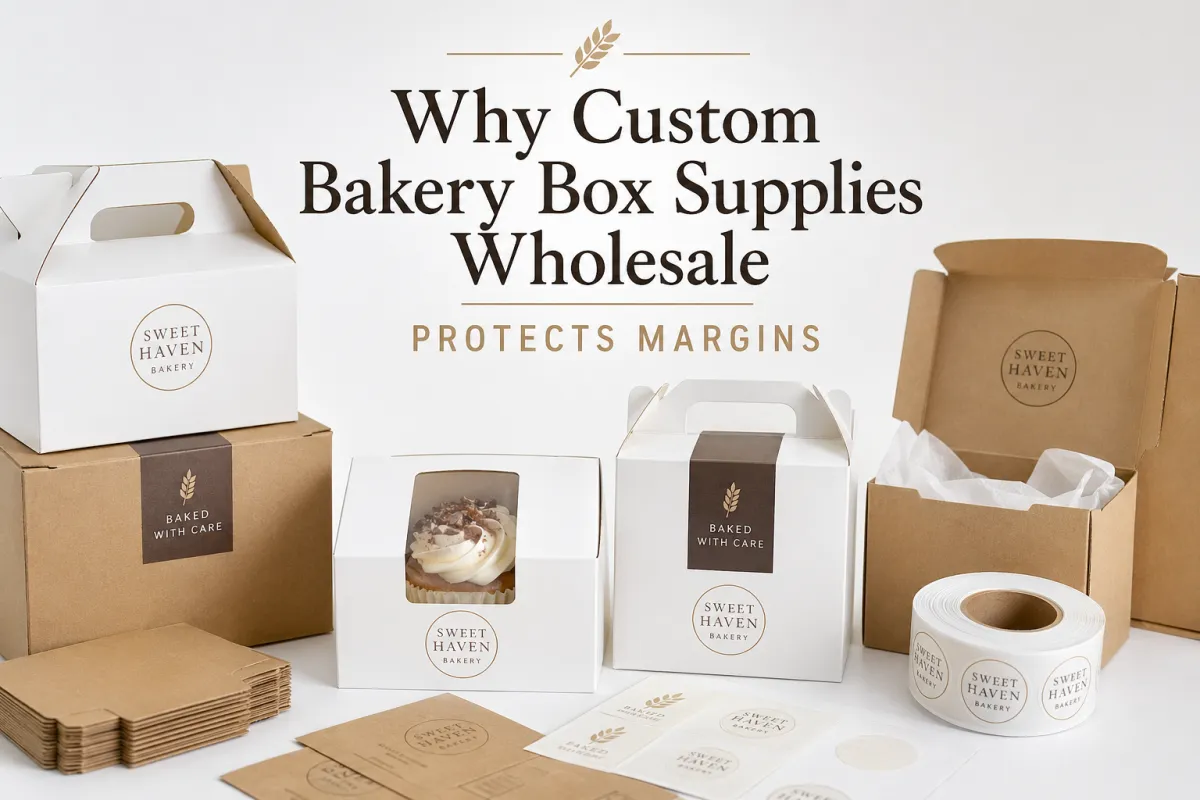
Most bakery buyers track ingredient inflation in real time. Fewer track packaging with that same frequency. A carton can look cheap on a quote and still cost a lot over time when you factor in damage claims, redelivery, and manual repacking. Custom bakery box supplies wholesale helps teams compress those hidden costs in one framework instead of tackling them order by order.
The margin mechanics are boring in the best way possible. Standardized dimensions cut sizing errors. Stable print setups reduce setup waste. A reliable supplier lowers artwork churn, which means fewer late-stage edits. A box engineered for true product weight and height lowers loss in transit. This is why wholesale workflows usually beat one-off sourcing once volume becomes predictable.
Here is the comparison teams usually need to see early:
| Option | Best For | Typical MOQ | Approx. Unit Cost | Main Tradeoff |
|---|---|---|---|---|
| Tuck-in kraft carton | Cookies, pastries, slices | 1,000-3,000 | $0.18-$0.34 | Lower price, simpler print |
| Windowed folding box | Retail display, gift sets | 1,500-4,000 | $0.24-$0.46 | Better shelf visibility, more die complexity |
| E-flute mailer | Delivery, e-commerce bakery packs | 2,000-5,000 | $0.32-$0.68 | Stronger transit protection, higher board cost |
| Rigid-lid presentation box | Premium assortments, gift bakery | 500-2,000 | $1.10-$2.80 | Premium feel, more expensive storage and freight |
| Sleeve and tray system | Multipack assortments, seasonal bundles | 1,500-4,000 | $0.28-$0.60 | Flexible branding, more parts to manage |
The numbers are practical, not theoretical. They reflect the way buyers compare Custom Printed Boxes by style and volume. The cheapest quote is not always the right one. A carton at $0.22 that damages three percent of units can quietly cost more than a $0.31 carton that ships without drama and stacks correctly.
A box that looks polished but fails in transit is expensive theater. A box that fits the product, the line, and the pallet is a margin machine.
Channel behavior adds another layer to margin planning. In premium retail, visual cues can support price. In wholesale distribution, closures and stack performance reduce product loss more than they support “wow.” Retail packaging that is easy to handle under pressure is usually worth more than packaging that is just visually loud.
Short runs still matter. Not every SKU should jump into annual commitments before it proves demand. A good supplier supports pilots and seasonal trials, then scales only the variants that perform. In practice, teams do a test first, validate stack and durability, and only then fold it into routine replenishment.
When procurement is under pressure, the target should be a lower-cost, lower-friction flow wrapped around branded packaging that still works on shelf. If you can keep reorder cost stable while supporting sales growth, custom bakery box supplies wholesale starts behaving like a margin defense instead of a decorative cost center.
Product Details for Custom Bakery Box Supplies Wholesale Buyers
The right box family follows product chemistry, route to market, and handling before the customer touches it. I keep saying this because teams often skip it and then discover their “delivery carton” is basically a pickup carton with extra labels. A bakery box for walk-in pickups and a subscription delivery carton are not the same design problem.
Most buyers in custom bakery box supplies wholesale start with familiar formats:
- Tuck-in kraft cartons for cookies, slices, danishes, and lighter pastries.
- Windowed folding cartons for display-driven retail packaging and gift sets.
- E-flute mailers for delivery or subscription-style bakery shipping.
- Rigid presentation boxes for premium assortments and special events.
- Sleeve-and-tray systems for multi-item bakery bundles and seasonal promotions.
- Inserts and partitions for cupcakes, macarons, or items with delicate decoration.
Each format changes behavior. If tolerances are too loose, product shifts. If lids are too tight, toppings compress. Soft sidewalls fail under compression. A board too stiff for the fold pattern slows line speed as operators force closures and correct defects. These issues are not aesthetics, they are throughput costs disguised as packaging choices.
Fit starts with actual dimensioning, not guesswork. Internal sizes have to include product swell, topping height, and any liner or insert. Tolerance matters more than a rounded nominal size. A two-millimeter window can be fine for a dry cookie carton, but it may ruin a frosting-heavy cupcake run where lid contact causes drag marks.
Board selection is where people often get surprised. A 300gsm to 400gsm kraft carton performs differently from an E-flute shipper. E-flute at roughly 1.5-1.8mm supports cleaner retail presentation in lighter formats, while B-flute around 3.0-3.5mm handles stacking better in tougher handling chains. For heavier products, those extra millimeters protect both product and margin.
Branding choices also move quickly. One-color remains useful, but teams now use CMYK, spot color control, matte or gloss finish, blind emboss, and selective varnish depending on channel. Multilingual markets need copy planning early, because language changes are not a minor afterthought. For food-adjacent contact, ask for ink and coating compatibility before approval; yes, this can sound technical, but it saves expensive production mistakes.
For teams trying to build a repeatable program, custom bakery box supplies wholesale should include these often-missed details before launch:
- Tamper-evident seals for takeout and delivery routes.
- Inner partitions to prevent item movement and crush damage.
- Venting paths for high-moisture routes and warm transfers.
- Anti-moisture barriers for chilled, frozen, or humid transport conditions.
- Cold-box tolerance when product leaves blast chilling late in fulfillment.
Line compatibility is just as important as print quality. Can the design pass through your fill-close equipment without manual workaround? Does it tolerate shrink-wrap without lid deformation? Can mixed-SKU pallet patterns still balance? Those questions prevent custom bakery box supplies wholesale from becoming an accidental labor sink.
One practical move: do physical sample testing before full volume. Run open-and-close cycles, side-to-side corner pressure checks, and lid-retention trials on a representative SKU. This usually reveals weak architecture before expensive revisions and can prevent a full reprint cycle.
For sourcing structure, it still helps to review current Wholesale Programs and the broader range of Custom Packaging Products before finalizing art files and production scope.
Specifications That Matter for Custom Bakery Box Supplies Wholesale
Specifications are where good intentions become reliable execution. A beautiful mockup means nothing if score lines split, glue joints fail, or legal text lands over the die-cut window. For custom bakery box supplies wholesale, the spec sheet should read like production instructions, not a marketing brief.
Start with material structure. E-flute, B-flute, and solid paperboard each solve different constraints. E-flute is common for lighter boxes and cleaner print surfaces. B-flute performs better for compression and larger set values. Rigid board lifts brand presence, but adds storage and freight drag that can erode its benefit in small-footprint operations.
Performance testing should not be a checkbox. Compression, burst resistance, moisture behavior, and fold fatigue determine whether a box survives real handling. A bakery carton can pass through at least three handlers before it reaches the end buyer, and that is where weak tabs and corners fail. Ask for evidence of fold consistency and, if relevant, testing against distribution standards like ISTA guidance.
Artwork control matters as much as board selection. The first draft should include a clean dieline, correct bleed, accurate crop marks, and locked color profile. Nutrition labels, allergen warnings, regional language, and recycling marks must be positioned before prepress starts. Legal copy cannot be bolted on at the end; in food retail, late legal updates are the number-one trigger for schedule risk in custom bakery box supplies wholesale.
A practical spec checklist for buyers usually covers:
- Exact internal and external dimensions with tolerance windows.
- Board grade and flute profile where applicable.
- Print method, color count, and finish requirements.
- Color target and allowed variance across production batches.
- Glue zone behavior and residue acceptance tolerance.
- Readable legal copy and allergen text size.
- Unit count per carton and pallet density pattern.
- Recycled-content targets or certification requirements.
Material sourcing policy can either hold the program together or quietly ruin trust. If chains require FSC or PEFC documentation, ask for chain-of-custody details and cert ownership, not a floating claim in a sales deck. You can review standards at FSC. Some channels demand certified content, while others still prefer premium white SBS for image, so choose according to actual customer and retailer requirements.
Transportation specs are often ignored until returns spike. A sample carton that is strong in the office test can fail at 24 high on a pallet during humid dock swings. Ask for unit weight limits, expected pallet yield, and humidity sensitivity. If boxes are likely to sit in warm distribution loops, moisture performance is not optional.
Custom bakery box supplies wholesale should include a proofing sequence that reduces surprises. A disciplined sequence uses CAD validation, die proof, color proof under different lighting, then pre-production sample before release. It may feel conservative, but it avoids the expensive “why did the logo shift after 5,000 units?” moment.
If multiple SKUs are involved, cluster by spec families. Shared paper grades, finishing methods, and print logic simplify purchasing and reduce changeover waste. That is how teams keep branded packaging consistent while containing complexity.
Pricing, MOQ, and Margin Math for Custom Bakery Box Supplies Wholesale
Packaging pricing only gets real when you stop counting only unit cost. A custom bakery box supplies wholesale quote should be judged on total landed cost: tooling, proofing, finishing, freight, storage, and quality failures. If those are missing, the “price” is only half the story, and often the wrong half.
Paperboard grade is often the first cost driver. Print coverage is the second. Finishing is the third and often the expensive one. One-color kraft without coating is one profile. Full-wrap CMYK with spot varnish and complex insert design is another. Higher complexity usually lowers throughput, and throughput changes pricing in a way that is easy to underestimate.
Common cost drivers in custom bakery box supplies wholesale usually include:
- Paperboard grade and thickness.
- Number of print colors and area of ink coverage.
- Coating choice: matte, gloss, soft-touch, or varnish.
- Die complexity and window cutout area.
- Insert count, glue points, and manual assembly steps.
- Artwork revisions after prepress signoff.
- Freight-efficient carton count and palletization strategy.
MOQ is often the second strategic decision point, and it usually maps to style and size before account value. A six-SKU bakery can still carry six minimums if every SKU has a different structure. Split-MOQ structures can help: group similar materials and print logic, then stage quantity expansion. That lowers setup drag without forcing overproduction.
Margin math keeps teams from negotiating with their feelings. Start with:
Gross margin impact = Sell price - unit packaging cost - fulfillment overhead.
Then test demand shifts at 10%, 20%, and 30%. A promotion can look like a volume win while destroying margin through rush freight and overtime labor. Custom bakery box supplies wholesale demands the same forecasting discipline as production forecasting, not less.
Use practical thresholds, not one-size-fits-all doctrine:
- Low-volume pilot: 500-1,500 units for proof-of-concept or seasonal testing.
- Standard production band: 2,000-5,000 units for repeatable retail packaging.
- Cost-curve sweet spot: 5,000-20,000 units where setup costs normalize.
Hidden costs remain the true margin killers. A design correction after proof can trigger retooling. A rejected proof delays launch and increases freight risk. Old art files in circulation can create dead stock, even when the unit cost itself looked small. Keeping Custom Printed Boxes in control starts with version discipline.
Ask for a clear price ladder up front. If entry MOQ exceeds commercial reality, negotiate staged pricing, mixed-size master cartons, or a pilot allowance with defined approval gates. That keeps custom bakery box supplies wholesale accessible and avoids lock-in at the wrong quantity point.
For example, a bakery might pay $0.48 per unit in a local low-volume run and then move to $0.26-$0.34 in a structured wholesale program as volume scales, even after freight. That gap is often enough to fund a new SKU test. A yearly view is the only view that matters, not a single PO snapshot.
The strongest sourcing decision is not a lowest-unit call. It is the call where the right box reduces product loss, supports handling reliability, and keeps brand cues repeatable. In that case, custom bakery box supplies wholesale stops being overhead and becomes managed cost.
Process & Timeline from Sample to Ship for Custom Bakery Box Supplies Wholesale
Speed comes from clear decision gates, not from frantic speedups. For custom bakery box supplies wholesale, marketing, procurement, and QA need a shared sequence from day one, or revisions will still show up at the worst moment. A defined process is the difference between predictable launches and calendar panic.
A practical workflow usually follows:
- Brief supplier with dimensions, product weight, sales channel, and brand requirements.
- Request cost breakdowns including freight and tooling assumptions.
- Lock structure and dieline.
- Review concept artwork and mockups.
- Approve proof colors and legal text blocks.
- Sign off on pre-production sample.
- Run production.
- Complete incoming QA checks.
- Confirm dispatch and pallet counts.
Timeline differs with complexity. A simple single-color carton with stable dieline can move quickly. Multi-color full-wrap structures with cutouts, inserts, or premium finishes need more time. Rigid formats add finishing and assembly risk, which often pushes delivery by several days. Teams commonly see a 3- to 10-business-day spread between simple and complex runs.
Parallel work in the front half of the process helps more than it sounds. You can submit dieline before design review, resolve legal text before color proofing, and preapprove acceptable board and finish substitutions. Group SKUs with one die footprint and one paper family where possible. It won’t erase every risk, but it cuts avoidable delays.
For transport confidence, ISTA-style testing remains a useful benchmark. It evaluates vibration, drop, and compression behavior under plausible distribution conditions. If you handle e-commerce, icing-heavy products, or cold-chain routes, this step is not extra. It is survival planning.
Internal approvals are often the real bottleneck. A dependable custom bakery box supplies wholesale workflow defines decision rights from start to finish. Marketing owns brand and graphics. QA owns structure, compliance, and handling quality. Procurement owns terms and commercial controls. If one person can edit artwork after production release, you are set up for chaos.
Separate blocking issues from non-blocking tweaks early. A typo in allergen text is blocking. A minor shade adjustment within approved tolerance is often non-blocking. That distinction is what keeps teams moving without compromising safety and legal obligations.
Use these timing habits:
- Freeze dimensions before artwork starts.
- Set a hard date for seasonal and legal copy.
- Allow one revision cycle before sample release.
- Keep backup art files ready for urgent reprints.
- Build a contingency buffer for promotional spikes.
Promotions are where schedules break, and I have seen teams miss a launch window by trying to fix art in the last forty-eight hours. If packaging is ready, freight pressure is manageable; if not, shelf time disappears. A reliable custom bakery box supplies wholesale timeline protects your best growth periods.
Why Choose Us for Custom Bakery Box Supplies Wholesale
The supplier with the loudest marketing deck is not always the best partner. The strong supplier proves consistency across production, transit, and repeat reorder cycles. That is the standard Custom Logo Things applies to custom bakery box supplies wholesale.
Proof beats adjectives every time. Buyers should expect transparent cost breakdowns, clear QC checkpoints, revision rules, and realistic delivery commitments. If a supplier cannot explain where costs sit in tooling, print, and logistics, trust gets thin very quickly. If they cannot show defect trends and control logic, reorder execution becomes guesswork.
Data-driven packaging support should match SKU behavior, not force everything into one template. A 120-gram cookie box is not the same as a 480-gram assortment box. Same-day delivery routes need one structural logic. Long dwell cold-chain routes need another. That distinction is where real packaging competency shows.
Operational support matters most during scale-up. Good custom bakery box supplies wholesale support includes rapid prototyping, practical MOQ batching, and technical help for seasonal campaigns or multilingual copy. For most brands, that support decides whether a new launch lands on time or slips into the next cycle.
Risk handling should be explicit and documented. Buyers need clear steps for defect logging, replacement process, and what happens when a lot arrives with sizing drift or print mismatch. No mature packaging program pretends defects do not happen. Good programs define recovery so operations do not halt.
Branded packaging also reduces internal friction when it is handled consistently: stable logo placement, consistent color hierarchy, and repeatable label structure. Warehouses pick faster, fulfillment errors drop, and assortments move through stores with fewer touches. In a low-margin business, that is actual, measurable value.
For comparison, this is a practical supplier scorecard:
- Unit price at three volume tiers.
- MOQ flexibility by SKU or family.
- Sample and revision turnaround.
- Quality-control documentation depth and traceability.
- On-time delivery performance and exception handling.
- Technical file support and rework responsiveness.
Phased rollout lowers commercial risk. Start with one or two SKUs, validate fit and transport behavior, and expand into routine production only after proof. Most bakery portfolios mix fast movers and slow movers, so this approach protects working capital without killing launch momentum.
For wider review, Custom Packaging Products helps align structures and materials, while Wholesale Programs supports commercial terms and reorder logic. Looking at both layers gives procurement confidence and marketing consistency.
My take is simple and a little blunt: a supplier earns repeat business by reducing uncertainty. In custom bakery box supplies wholesale, that means exact specs, realistic timelines, and a paper trail your team can actually execute.
What Should Custom Bakery Box Supplies Wholesale Include?
Custom bakery box supplies wholesale should include structure, print plan, fit specs, compliance requirements, and commercial terms that support reorders without drama. If one element is vague, the quote is incomplete.
A useful wholesale package should cover:
- Exact internal dimensions and accepted tolerance ranges.
- Board grade, flute profile, or rigid stock choice.
- Print method, finish, and color target.
- Allergen text, recycling marks, and regional legal copy.
- MOQ, pricing ladder, and freight assumptions.
- Sample approval steps and replacement policy.
That is the short version, not glamorous, but practical. The expensive part is always the one line you skipped, like barcode size or clear legal text placement.
Action Plan: Next Steps to Close Your First Bulk Order
To get a first solid order done, remove ambiguity before the quote is signed. If custom bakery box supplies wholesale has to protect margin, your spec package needs more structure than a long chat thread. Without structure, you trade price pressure for revision chaos.
Start with your product set. Pick three to five SKUs that drive revenue and test fit directly on those sizes. Confirm internal dimensions first. Prioritize branding in this order: logo and color, window visibility, legal copy, then seasonal variations. Set a target landed cost per unit before supplier outreach; that number becomes the control line for every proposal.
A strong RFP pack usually includes:
- Exact internal and external dimensions.
- Unit count by SKU and forecast window.
- Print method, finish, and color targets.
- Destination city and primary shipping lane.
- Acceptable defect threshold and rejection criteria.
- Required labels, allergen language, and regulatory copy.
- Timeline target and planned launch date.
Supplier comparisons work when evaluated through one sheet, not eight email threads. Track at least five metrics: unit price, MOQ flexibility, timeline reliability, sample quality, and post-production support. A cheaper supplier with weak proofing discipline can become the most expensive option when launch pressure rises.
Test from the customer’s side before full rollout. Does the box open cleanly? Is the closure secure but not crushing? Does the look hold after transport handling? Can the brand read clearly at typical shelf distance? These checks tell you if packaging is supporting sales or just filling storage.
Assign ownership from the start, not when things go sideways:
- Procurement controls pricing, payment terms, and commercial structure.
- QA controls acceptance criteria, fit, and handling quality.
- Marketing controls branding, artwork, and shelf presentation.
- Operations controls packout flow and warehouse efficiency.
Clear ownership avoids late-stage fights. Most late changes that hurt custom bakery box supplies wholesale are small: ingredient text updates, window-size tweaks, promo badge shifts, barcode repositioning. Tiny edits. Big schedule impact. Very often.
Ask for first-shipment acceptance terms before issueing the PO, yes, typo included. Then everyone knows how to act if dimensions drift, color is off, or glue defects appear. Contract language here is not paperwork theater; it is operating protection.
Then move once quote, sample, and timeline are aligned. If anything stays fuzzy, pause and tighten it before release. In practice, the team that owns specs owns final cost discipline, and that team usually keeps expansion profitable.
With custom bakery box supplies wholesale, margin improvement does not come from raw volume alone. It comes from precise specs, realistic forecast planning, and timeline commitments that prevent improvisation near launch. Nail those three and packaging stops being a cost sink and starts acting like an asset.
Frequently Asked Questions
How much can I save with custom bakery box supplies wholesale compared with ad-hoc local buy-in rates?
Judge outcomes by all-in landed cost, not unit price alone. Freight, tooling, revisions, handling losses, and defect recovery can wipe out a seemingly good headline quote. In many programs, savings become visible once one structure and one artwork family are reused across multiple SKUs, because die changes and color complexity drop while brand consistency holds. For custom bakery box supplies wholesale, a 12-month spend model with staggered MOQ and explicit reorder contingencies gives a realistic answer.
What MOQ is realistic for custom bakery box supplies wholesale if I run multiple SKUs?
MOQ is usually set by style and package size, not annual volume alone. A high-velocity SKU can support larger runs while slower SKUs stay at smaller pilot quantities. If materials and structure align, ask for split-MOQ by family and not one flat minimum for every variation. A pilot allowance with clear approval gates is usually safer than committing annual quantities before fit is proven.
Do custom bakery box supplies wholesale still meet strict food-safe and brand requirements in one run?
They can, but only when the technical package is finalized before prepress. Material, coating chemistry, ink system, and label placement all need to be reviewed together. Ask for a written compliance sheet covering ink and adhesive type, food-adjacent handling assumptions, and disposal or recycling instructions for your market. That keeps custom bakery box supplies wholesale consistent and audit-ready across repeat orders.
How long does the process and timeline usually take from artwork to production for custom bakery box supplies?
Simple runs with stable structures can move quickly, while multi-color, structural complexity, and premium finishes usually take longer. The biggest delays are almost always revision-driven: missing dielines, unresolved artwork, or late legal updates. A two-stage approval model with technical review before marketing signoff usually keeps things moving. For custom bakery box supplies wholesale, lock your critical dates early and avoid asking for speed right before shipment.
What should I ask in a quote for custom bakery box supplies wholesale to avoid surprises?
Request line-item pricing that separates paper grade, print method, color count, coating, tooling, sample cost, freight terms, and QA correction policy. Also ask for lead-time assumptions at each stage: sample, approval, production, and dispatch. If revision rules, acceptance criteria, and replacement policy are unclear, uncertainty gets built into the contract. In custom bakery box supplies wholesale, that lack of clarity usually ends up costing money later.