Buyer Fit Snapshot
| Best fit | Custom Ocean Plastic Packaging projects where brand print, material claims, artwork control, MOQ, and repeat-order consistency need to be specified before quoting. |
|---|---|
| Quote inputs | Share finished size, material target, print colors, finish, packing count, annual reorder estimate, ship-to region, and any compliance wording. |
| Proofing check | Approve dieline scale, logo placement, barcode or warning zones, color tolerance, closure strength, and carton packing before bulk production. |
| Main risk | Vague material claims, crowded artwork, missing packing details, or unclear freight terms can make a low unit price expensive after revisions. |
Fast answer: Custom Ocean Plastic Packaging: Real Costs and Timeline should be specified like a repeatable production item. The safest quote records material, print method, finish, artwork proof, packing count, and reorder notes in one written spec.
Production checks before approval
Compare the actual filled-product size with the drawing, then confirm tolerance on folds, seals, hang holes, label areas, and retail display edges. Reserve space for logos, QR codes, warning copy, and material claims before decorative graphics fill the panel.
Quote comparison points
Review material grade, print process, finish, sampling route, tooling charges, carton quantity, and freight assumptions side by side. A quote is only useful when the supplier can repeat the same color, closure quality, and packing count on the next order.
Custom Ocean Plastic Packaging: Real Costs and Timeline
Custom ocean plastic packaging sounds clean on a deck. The reality is messier. A brand runs out of standard mailers, the launch date does not move, and someone decides overnight shipping will save the day. It will not. It never does. That is why custom ocean plastic packaging needs a real plan, not a nice-looking sustainability claim and a late-night quote.
In plain language, this format uses plastic recovered through marine-waste recovery streams or connected collection programs, then cleaned, processed, and transformed into packaging built for a specific brand, product, or shipment. It can be shaped, printed, and finished for a shipping carton, retail display, or insert layer. The point is not magic. The point is control. Control keeps packaging from turning into a budget leak.
I have watched teams get tripped up by one small assumption: that anything described as recycled behaves the same way. It does not. Ocean-recovered input can be a great material path, but it is not commodity resin with a new label slapped on top. Feedstock quality, traceability, and processing discipline all matter. A little boring? Sure. Also unavoidable.
People still assume sustainability is cheaper by default. Cute idea. Wrong idea. This packaging approach can cost more up front because feedstock selection is stricter, quality windows are narrower, and sampling takes more discipline than standard plastic. That is not a defect. It is the price of using a managed circular packaging system. Brands that treat it like commodity plastic usually pay twice: first in tooling or testing, then again in delays.
If your package size is locked, your product weight is stable, and your print needs are clear, custom ocean plastic packaging can be a strong fit. If specs shift every week, the project will wobble. This format works best for brands with repeatable demand, stable packaging design, and enough patience to test before they buy volume. For the right SKU, it can align sustainability with reliable supply. For the wrong one, it becomes an expensive lesson nobody wanted.
If your team is still comparing formats, start with the basics in Custom Packaging Products and work backward from the product, not the logo. That simple order saves time and keeps people honest.
Why Custom Ocean Plastic Packaging Is a Bigger Deal Than You Expect
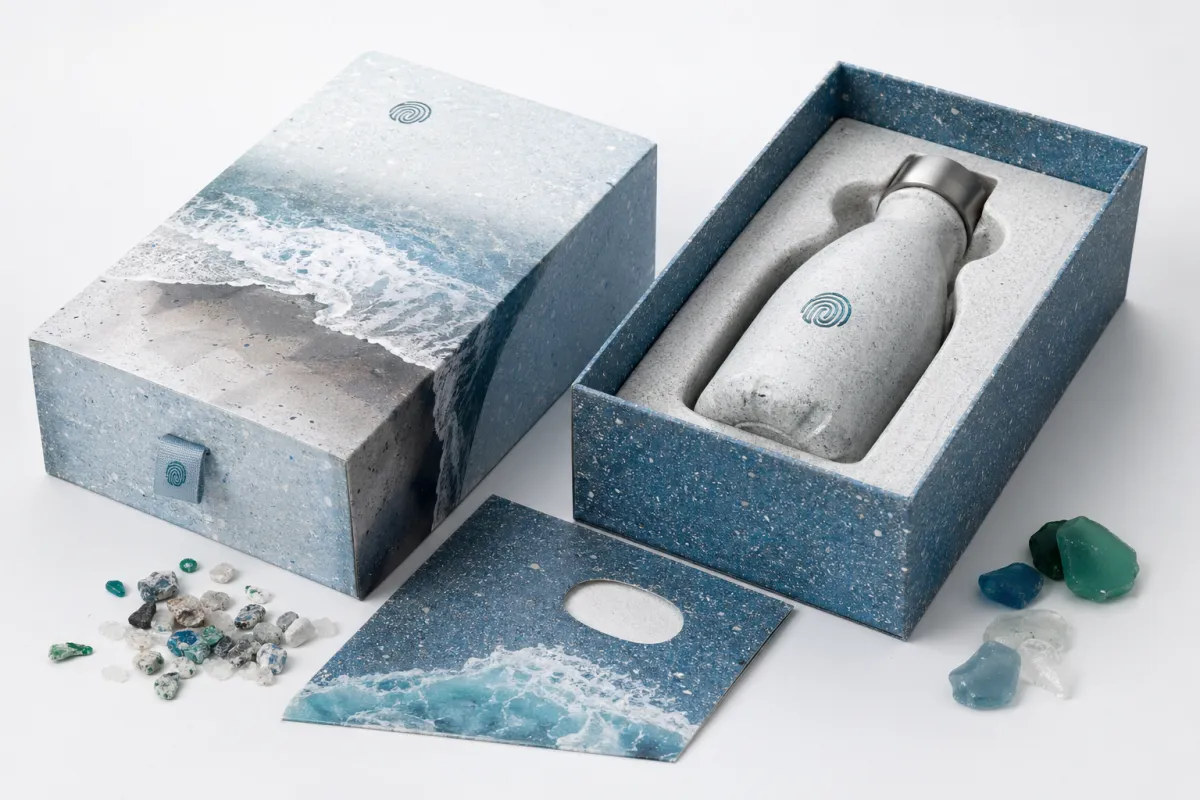
Custom ocean plastic packaging is not another checkbox on a sustainability deck. It affects buyer behavior, freight planning, shelf performance, and launch risk. A marketer cares about story. A buyer cares whether the shipment arrives intact, whether the supplier can repeat the run, and whether the margin survives the invoice. Those are not glamorous questions. They are the ones that matter.
The biggest mistake is assuming all recycled marine-content material behaves like virgin plastic. Usually, it does not. Custom ocean plastic packaging often has tighter processing limits, more variation in material behavior, and a narrower range for temperature, pigment load, and print adhesion. Good suppliers build within those constraints. Bad ones act like the press can fix everything. It cannot.
Sustainability does not automatically lower total spend. Sometimes it lowers long-term risk, especially when teams want more supply resilience or want to avoid emergency buys of generic packaging. Upfront cost can still be higher because recovery, sorting, testing, and quality control are built in. Not fantasy. Not branding fluff. Work.
For a buyer making a call, this format works best once five questions are answered before quoting starts: What is the unit weight target? What shipping abuse will it survive? What print coverage is required? What minimum order quantity is acceptable? How much time is left before launch? If those answers are fuzzy, the quote will be fuzzy too. Fuzzy quotes are how budgets get ambushed.
There is a brand angle worth noting. Custom ocean plastic packaging can support a sustainability story without turning the entire product into a lecture. Use the function-first rule: packaging has to perform first, then the story earns attention. Retail packaging and DTC product packaging usually get better outcomes when this order is respected. Buyers remember what works in use; they forgive less what is just pretty.
One filter keeps teams out of trouble: if your packaging spec will change in three months, wait. If launch is stable, the line is repeatable, and testing time is real, custom ocean plastic packaging becomes a legitimate option instead of an expensive experiment.
How Custom Ocean Plastic Packaging Is Made
Custom ocean plastic packaging starts long before artwork. Supply begins with feedstock collection from marine recovery streams or certified collection programs. That material gets sorted, washed, de-waxed, and processed so contamination, salt, labels, and mixed polymers are reduced. Then reclaimed resin becomes pellets or flakes, which become the base material for the next stage. That base matters because every downstream process depends on it being stable.
After reclaim, the resin is engineered into film, sheet, molded parts, or hybrid structures depending on the use case. That can include thermoformed trays, blow-molded bottles, sleeves, shipping mailers, inserts, and rigid containers with closures. The sequence should always be: understand material profile, then finalize shape. Reversing that order means you are likely redesigning for a package that was never suited to the feedstock.
Terminology often hides variation. Ocean-claimed polymer is not one fixed material, and behavior can shift by batch. Melt flow, moisture sensitivity, odor, and color consistency vary by recovered source and reclaim method. That is why process control matters more than a glossy sample image. A good supplier knows this window. A careless supplier pretends every run is identical and lets the press do the thinking.
Customization appears in structure and finishing layers. Artwork lands on film, labels, sleeves, or direct print surfaces. Die-lines define geometry. Inserts and closures control fit and handling. Finish choices like matte, soft-touch, UV, or anti-scratch coatings can improve shelf feel, but also change adhesion and cure time. In this format, add beauty after stability. Fancy surfaces cannot rescue weak base structure.
Process constraints need respect. Moisture control affects extrusion and molding. Regrind content can shift stiffness. Pigment compatibility influences how close final color gets to proof. Print adhesion windows matter for brand integrity because a striking graphic that scuffs in transit is not brand strategy; it is packaging failure. If the package is truly ocean-derived, these variables are where teams either win or burn cycles.
For teams weighing options across broader programs, a practical comparison point is our packaging product lineup before locking specs. Compare custom printed boxes, mailers, sleeves, and hybrid structures side by side. Comparison is cheaper than guessing.
One simple rule holds: as complexity rises, process control must tighten. Custom ocean plastic packaging can work in premium product packaging and retail packaging, but only if reclaim-to-print execution is stable.
Key Factors That Decide Quality in Custom Ocean Plastic Packaging
Quality starts with the material profile. Resin type, contamination tolerance, melt-flow behavior, wall thickness, and barrier needs shape the end result. This packaging format for a lightweight cosmetic mailer has a very different profile than one for a food-safe tray or a long-haul shipping shell. Better quotes already include these distinctions instead of pretending every package can be the same.
Design still matters more than teams want to admit. A package can look beautiful and still fail if grip is awkward, stack height is wrong, or carton-to-case fit wastes space. Those misses create returns, dented corners, and warehouse complaints. Packaging design should help the package travel, not just look good in a mockup. If handling is ignored, the package takes blame later.
Print and branding are their own minefield. Color matching is never exact across recycled streams, so bright whites and saturated tones can shift more than expected. Ink compatibility, registration tolerance, and UV resistance should be checked before full production. Custom ocean plastic packaging that sits on shelf for months needs better abrasion resistance than short-life e-commerce packaging. If the surface scuffs in transit, brand trust drops quickly.
Compliance should be front-loaded, not an emergency email three days before launch. Food-contact, child safety, recycled-content claims, and local recycling rules all need verification early. If the structure is mixed-material, paper components can require FSC-aligned documentation. For performance testing, ISTA methods and ASTM-style distribution standards are common for reducing guesswork. This is not overkill. It is operational risk control.
Storage and shipping behavior also matter. Some ocean-recovered blends are more sensitive to heat swings than virgin resin, affecting warp, seal integrity, and stack stability. Carton design, secondary packaging, and pallet strategy should be included in the quality checklist, not added at warehouse level. If the package needs a liner, sleeve, or protective insert, build that into the spec from day one.
One blunt truth: custom ocean plastic packaging gets judged by the weakest link in the chain. Strong resin will not save weak print adhesion. Nice graphics will not save bad fit. A clean sustainability angle will not save a package that fails transit testing. Every stage has to hold.
If a supplier cannot explain how lot traceability, moisture control, and dimensional consistency are checked, keep shopping. Reliable marine-sourced packaging is evidence-based. Buyers should ask for batch records, process photos, and a clear approval path before production funds move. I know that sounds fussy. It is. Fussy is cheaper than a recall.
How Much Does Custom Ocean Plastic Packaging Really Cost?
Cost becomes clearer when split into buckets. Material premium is one bucket. Tooling or die creation is another. Printing setup, pre-production sampling, compliance validation, and freight each add their own costs. If the supplier is vague about the buckets, the quote looks attractive until the first revision lands. Then budget starts bleeding in slow motion.
Small-volume mistakes are expensive because setup cost does not care about optimism. A $2,000 setup on a 500-unit job can sound fine until it is divided across units. The smarter move is usually to batch smarter, reduce variation, and push volume into a cleaner tier. This principle applies to custom ocean plastic packaging, Custom Printed Boxes, and most branded packaging formats.
The cost curve often improves with volume, but only when the specification stays stable. When designs keep changing, scale discount gets eaten by rework. Higher recycled content can raise base material price, while better nesting and stackability can lower freight and storage. A cheap unit price on paper can still be the wrong choice in a warehouse if it consumes too much space.
For planning, many brands should budget at least one sample cycle and one pilot run before full production. On smaller jobs, setup often lands in the few-hundred to few-thousand range depending on print coverage, die complexity, and finish choice. At mid-volume, per-unit differences between standard custom plastic packaging and custom ocean plastic packaging often settle into a modest premium instead of a dramatic jump, especially if the structure is efficient. The hidden cost is usually engineering iteration, not raw resin.
| Run Type | Typical MOQ | Setup / Tooling | Indicative Unit Cost | Best Fit |
|---|---|---|---|---|
| Pilot Run | 250-1,000 units | $500-$3,000 | $0.85-$2.40 | Testing fit, print, and shipping performance |
| Standard Production | 2,000-10,000 units | $1,000-$6,000 | $0.28-$0.95 | Launches with stable artwork and repeat demand |
| Scaled Production | 10,000+ units | $2,500-$12,000 | $0.12-$0.48 | Ongoing product packaging and replenishment programs |
Those ranges are planning estimates, not promises. A rigid container with complex closure behaves differently from a simple sleeve or mailer. Print coverage changes the math. Full-wrap artwork, white underprint, and multi-color branding raise setup and QC demands. Still, custom ocean plastic packaging should not be judged on unit price alone. Freight efficiency, fewer damage claims, and stronger proof can improve total landed cost.
Another trap is paying for volume before the spec is locked. If the first test lot already needs major rework, stop. Do not force scale. Tighten dieline, tolerance, or resin grade first. It may feel slower now and saves money later. It also keeps teams from throwing cash at a problem that was visible at sample stage.
To compare pricing accurately, request quotes on the same file set and tolerance sheet. That lets buyers compare apples to apples instead of one cheap proposal against another’s deeper engineering. If speed is the goal, start with a short list from Custom Packaging Products and then move into committed custom ocean plastic packaging.
One blunt observation: this format is usually not expensive because of one giant reason. It is expensive because of small reasons that stack up: loose spec discipline, inconsistent samples, late revisions, and weak supplier accountability.
Process and Timeline for a Custom Ocean Plastic Packaging Project
Custom ocean plastic packaging projects move fastest when every decision has an owner. The timeline starts with a technical brief, not a mood board. The brief should define product weight, shelf life, climate exposure, shipping routes, and actual packaging function. A package crossing hot warehouses needs different behavior than one in climate control. That sounds obvious until launch slips because nobody documented it.
A practical schedule often looks like this: technical spec in 3-5 days, sample development and approval in 7-14 days, pilot run check in 5-10 days, and full production ramp in 7-21+ days depending on complexity. Simple thermoformed inserts usually move faster than rigid multi-component systems with liners and closures. Full-wrap printing, multi-part assembly, or extra compliance review can stretch that timeline.
Teams avoid timeline creep with review gates. Material test sign-off first. Then fit and pack testing. Then print approval. Then logistics simulation. That sequence catches expensive surprises before scale. If the package fails drop resistance or vibration testing and a lid pops open, the team should know before 8,000 units sit on a truck.
Buffer days matter. Hold at least one engineering buffer and one supplier-revision buffer. That is not pessimism. It is procurement with a memory. Teams that build that discipline usually pay less for freight, avoid emergency charges, and skip weekend approvals. This format is not the place to assume every step will follow script.
There are ways to shorten cycles without cutting corners: pre-approved artwork specs, clean dielines, single-point approvals, and clear finish references help. Give the supplier everything up front: desired finish, Pantone range, carton pack count, and required test standard. If the project includes multiple SKUs, standardize base format first and vary only graphics. That can cut days off sampling and approval.
Many teams assume timeline is manufacturing speed alone. It is usually the number of reopened decisions. A five-minute logo shift can add two days if it forces a new proof, fit check, and approval cycle. That is why custom ocean plastic packaging projects reward process discipline over drama.
For format selection, confirm whether the package should perform like retail packaging, shipping packaging, or a hybrid. Once that is clear, this production method can be scheduled with much better accuracy. Fewer moving targets means fewer surprises.
Step-by-Step Guide to Selecting and Launching Custom Ocean Plastic Packaging
Start with the real brief, not the marketing brief. Product weight, shelf life, climate exposure, compression risk, and shipping route belong on paper before any color discussion. Custom ocean plastic packaging performs better when the use case is precise. E-commerce needs different priorities than shelf-ready retail or gift mailers. This distinction saves money and avoids rework.
Choose format and material blend with function first. Some applications need rigid shell. Others need flexible mailer or thermoformed insert. Wall thickness, stiffness, barrier needs, and print surface have to match the product profile. A beautiful shape that collapses under stack load is just an expensive mistake.
Prepare standard files before quoting. Send a dieline, artwork, tolerance limits, finish notes, and mandatory compliance language. That cuts guesswork and gives suppliers a cleaner pre-quote. If your brand already uses a stable system for Custom Printed Boxes or product packaging, reuse those parts that already work. No prize exists for reinventing everything.
Run a controlled pilot. Keep to one or two test SKUs if possible. Measure seal integrity, drop performance, print durability, dimensional consistency, and fit. If the package has inserts or closures, test those too. The pilot should answer one question: can this package perform consistently at scale? If not, change the spec now, not after a big purchase order.
Compare suppliers on traceability and QC, not just unit price. A transparent batch report, readable test records, and direct communication are worth real money. For custom ocean plastic packaging, lot-level proof helps isolate issues if a batch behaves differently. Ask for sample photos, test logs, and a written approval path. If the supplier cannot explain controls, the quote is not the only thing to challenge.
Do not scale volume until material behavior, package fit, and brand presentation are stable across at least one pilot lot. Teams that jump too soon often spend savings on rework, expedited freight, and replacement inventory. That is not a win. It is a bigger bill with prettier visuals.
If launch spans multiple channels, keep the system consistent. Use the same base structure for retail packaging and DTC where possible, then vary graphics or shipper labels by channel. It keeps presentation tight and cuts variables. It is boring. It also works.
Common Mistakes to Avoid with Custom Ocean Plastic Packaging
The first mistake is overdesigning too early. Many teams add features because they sound premium, not because they solve a real problem. Extra windows, hidden inserts, odd folds, and decorative layers can all increase tooling complexity. With custom ocean plastic packaging, every added feature increases rework risk. Confirm structure first. Add flourishes later if they still make sense.
Second, assuming every recycled marine-content material prints the same. It does not. Batch variation is real, and proofing is non-negotiable. If exact branding matters, color calibration has to happen against actual material, not a generic sample. That matters for branded packaging because a logo can look clean on one lot and muddy on another.
Third, ignoring MOQ math. Tiny pilots can be smart, but very small runs can crush margin if setup cost is spread too thin. Custom ocean plastic packaging is not cheapest when ordered in microscopic quantities with complicated print. If the business is testing a concept, stage it: pilot first, scale after data is clean.
Fourth, treating legal and facility requirements as optional. A package can look perfect and still be held up if approvals are missing. Food-contact declarations, recycled-content documentation, batch traceability, and fulfillment center requirements can stop shipment. Keep all clearances in one folder, not in five inboxes.
Fifth, treating sustainability copy as decoration. Claims without evidence are fragile. If sourcing cannot be audited, customers and retailers will notice. This is especially true for custom ocean plastic packaging, where the claim carries more weight than a generic recycled sticker. Support it with process records, testing, and clear sourcing documentation.
A common failure point: teams adopt this format but forget to test the complete system. Package plus secondary carton plus pallet pattern plus warehouse handling all matter. The weak link usually appears during shipping. Test under realistic handling and route conditions. If the package is meant for export or rough handling, use appropriate distribution standards, not wishful assumptions. The EPA recycling guidance is useful when claims should align with real recovery practices.
One final error happens a lot: teams choose a supplier before defining acceptance criteria. That reverses the order and guarantees noise later. Define success standards first, then source. It saves everyone time, including the supplier.
Conclusion and Action Steps for Your Custom Ocean Plastic Packaging Next Move
Custom ocean plastic packaging works when the business treats it like a production project, not a marketing flourish. The package needs clear specs, stable inputs, controlled testing, and a realistic timeline. If those pieces are in place, this approach can support sustainability goals, strengthen brand presence, and reduce surprises in production. If they are not, it becomes another expensive lesson in why packaging should respect the factory, not just the mood board.
Here is a practical way to decide: build a scoring matrix with five columns: performance target, recycled content requirement, expected transit or shelf demand, budget cap, and launch date. Score suppliers against the same criteria. It is straightforward. It is also how teams stop paying for promises that collapse at approval time.
For this week, keep the move simple: pick one lead supplier, request two material test samples, run a 48-hour stress check, and lock file formats and tolerances before production approval. If the package is meant to behave like product packaging in a complex supply chain, prove it early. If it is meant for retail, prove shelf behavior early too. Waiting until the full order ships is expensive.
For next week, place a realistic pilot with measured counts, capture QC photos and dimensional checks, and create a supplier scorecard with traceability, communication, and consistency. That creates a record you can use next quarter. It also helps when comparing custom ocean plastic packaging against other custom printed boxes or hybrid packaging options.
For launch month, publish a concise claims page documenting sourcing, process checks, and test outcomes. That supports sales, support, and account teams without forcing improvised answers. It also prevents overclaiming sustainability. A credible claims page is easier to defend than a dramatic sentence in a press release.
My blunt take: custom ocean plastic packaging is not about hero messaging. It is about disciplined execution. Test early. Document everything. Keep the spec tight. And when a quote looks too good to be true, it usually is. The brands that win with this format are the ones that plan like operators, not dreamers.
Handled well, custom ocean plastic packaging becomes a strong component of a smarter packaging system. Handled badly, it becomes another costly line item. The difference is not luck. It is the work before the order goes out. If the plan is solid, the packaging stops being a talking point and starts doing its job.
Can I verify that my custom ocean plastic packaging supplier is using real ocean-recovered input?
Yes, but ask for more than a logo on a quote. Request a bill of materials, recycled-content percentage, and a feedstock source statement tied to your lot. Third-party certification or audit access helps. For custom ocean plastic packaging, lot-level proof matters more than broad sustainability language.
How much does custom ocean plastic packaging cost compared with standard custom plastic packaging?
Expect a per-unit premium that can be modest or meaningful depending on resin grade, print coverage, and MOQ. In many cases, the bigger hidden cost is engineering iteration, not the base material. If the spec is stable, this approach can be competitive because better planning reduces freight waste and rework. If the spec is a moving target, costs climb fast. That is just how it goes.
What is a realistic timeline for a custom ocean plastic packaging prototype and approval cycle?
Most brands should plan roughly 2-6 weeks for the first approved pilot when artwork is ready and the structure is not unusually complex. Build buffer days for a rerun or reprint. custom ocean plastic packaging moves faster when approval rounds are short and the file set is clean.
Which products should avoid custom ocean plastic packaging because of performance limits?
High-heat, aggressive chemical, and extreme-shock applications need full validation first. Food-contact and outdoor storage need extra tests for seal strength, brittleness, and UV exposure. If one test fails, switch resin grade or package format instead of forcing this option to cover a poor use case.
Can I start a small custom ocean plastic packaging run without losing too much cash on MOQ?
Yes, if you treat it as a staged launch. Negotiate a capped setup fee, keep the pilot spec tight, and avoid unnecessary print complexity. A conservative pilot gives performance data before scale, which is usually the cheapest way to confirm whether this format is worth expanding.

