Buyer Fit Snapshot
| Best fit | Custom Barcode Hang Tags projects where brand print, material claims, artwork control, MOQ, and repeat-order consistency need to be specified before quoting. |
|---|---|
| Quote inputs | Share finished size, material target, print colors, finish, packing count, annual reorder estimate, ship-to region, and any compliance wording. |
| Proofing check | Approve dieline scale, logo placement, barcode or warning zones, color tolerance, closure strength, and carton packing before bulk production. |
| Main risk | Vague material claims, crowded artwork, missing packing details, or unclear freight terms can make a low unit price expensive after revisions. |
Fast answer: Custom Barcode Hang Tags: Material, Adhesive, Artwork, and MOQ should be specified like a repeatable production item. The safest quote records material, print method, finish, artwork proof, packing count, and reorder notes in one written spec.
Production checks before approval
Compare the actual filled-product size with the drawing, then confirm tolerance on folds, seals, hang holes, label areas, and retail display edges. Reserve space for logos, QR codes, warning copy, and material claims before decorative graphics fill the panel.
Quote comparison points
Review material grade, print process, finish, sampling route, tooling charges, carton quantity, and freight assumptions side by side. A quote is only useful when the supplier can repeat the same color, closure quality, and packing count on the next order.
Custom barcode hang tags are usually doing far more work than they get credit for. They are not just there to look polished on a rack or sit quietly on a product; they help keep inventory accurate, reduce mis-picks, and stop checkout delays from piling up into a mess that somebody has to explain twice. A well-built tag carries three jobs at once: it supports branding, it presents product information clearly, and it gives a scanner a clean target. Miss one of those jobs and the whole piece starts working against you. For retailers, apparel brands, accessory lines, and packaged goods, the practical value of custom barcode hang tags shows up in fewer manual checks, faster handling, and fewer avoidable mistakes.
Plenty of teams start on the visual side and leave operations for later. That usually leads to a tag that looks good in a proof and causes grief after the first shipment lands. A product can sit beautifully on a shelf and still create friction if the barcode scans slowly, the tag tears off too easily, or the printed data does not match the SKU in the system. That is a workflow issue, not just a print issue. Custom barcode hang tags work best when they are treated as part of the product system, not as a decorative extra bolted on at the end.
"If the code does not scan cleanly, the tag is just expensive paper with ambition."
Why custom barcode hang tags solve more than labeling
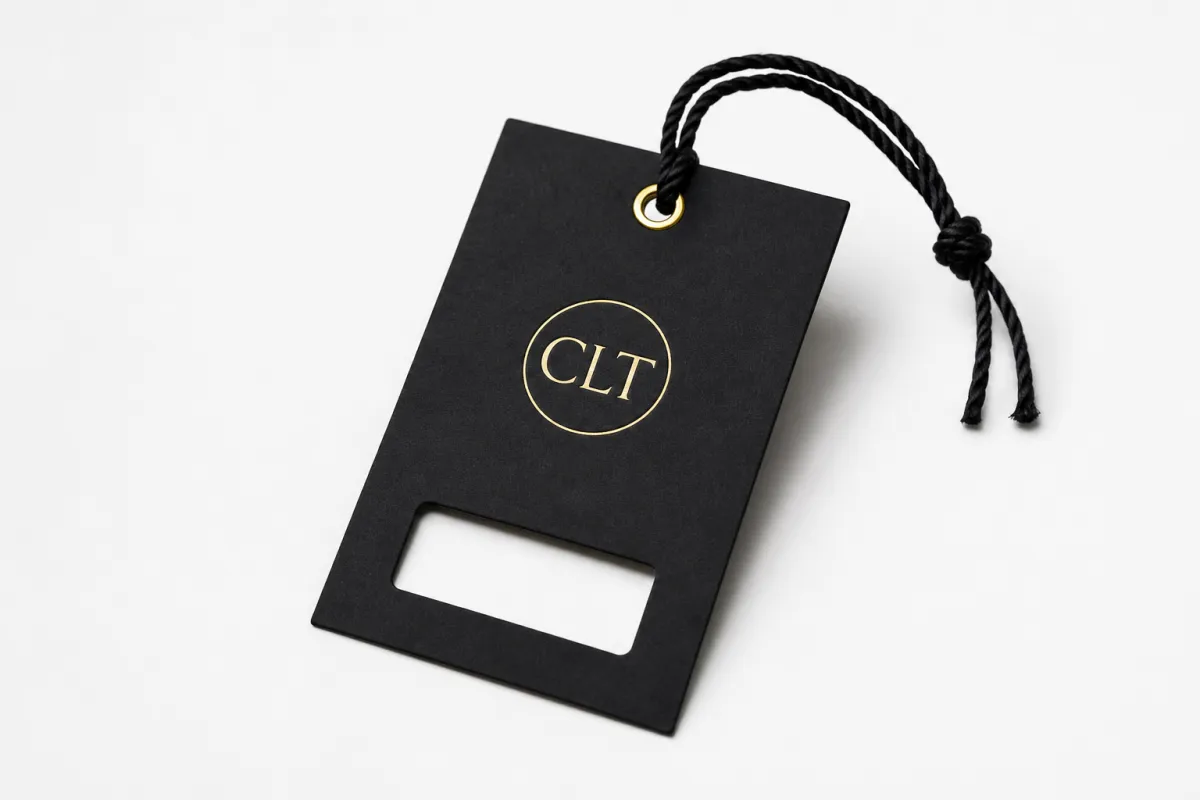
At the simplest level, custom barcode hang tags combine human-readable information with machine-readable data on one piece of card or board. That sounds plain because it is plain, but the effect reaches farther than many buyers expect. A hang tag can carry the product name, price, SKU, size, color, care notes, and brand story while still giving a cashier or warehouse associate a quick scan. For retail packaging and product packaging workflows, that matters because every manual lookup costs time and opens the door to mistakes.
From a packaging buyer's point of view, the value is not limited to the scan itself. The real benefit shows up after the scan. A receiving team can move goods faster, a floor associate can restock with less second-guessing, and checkout stays steady instead of pausing while someone squints at a tiny printed number. That matters even more in apparel and accessories, where style, size, and color combinations multiply fast. Custom barcode hang tags help keep those combinations organized without making the package design feel like a spreadsheet in disguise.
The brand side matters just as much. A tag is visible. Customers touch it. Staff use it. If the tag feels flimsy, looks cheap, or arrives with a crooked barcode, that impression spreads fast. I have seen brands spend real money on custom printed boxes and polished branded packaging, then attach a weak hang tag that makes the whole product look rushed. That mismatch is easy to avoid once the tag is treated as part of the same visual language. Custom barcode hang tags should belong to the product family, not fight it.
Used well, these tags save money in places that do not look glamorous on a spreadsheet: fewer reprints, less labor wasted on relabeling, fewer POS interruptions, and fewer returns caused by item mismatch. Used badly, they create the opposite. The difference usually comes down to clear specifications, clean barcode setup, and a realistic view of how the tag will be handled after printing. In other words, the boring details matter. A lot.
How custom barcode hang tags work in retail and inventory systems
The workflow behind custom barcode hang tags is straightforward. Artwork is built, barcode data is merged, the tags are printed, and each tag is tied to a SKU or item record. That record might live in a POS system, an ERP, an inventory platform, or a warehouse database. Once the code is scanned, the system can pull up the matching product information instantly instead of relying on someone to type it in by hand. That is the whole reason these tags exist.
Variable data printing is where the format becomes especially useful. One layout can stay fixed while the barcode, SKU, price, or color changes from tag to tag. That means custom barcode hang tags can support large product catalogs without forcing a full redesign each time a new style launches. Static barcodes still make sense for fixed items, but variable data is a better fit when a brand has dozens or hundreds of item-level variations.
Scanability depends on a few hard rules. The barcode must be large enough for the chosen symbology, the contrast must be strong, and the quiet zone around the code cannot be crowded by logos, borders, or decorative graphics. People love to tuck the barcode into a corner because it feels tidy. Scanners do not care about tidy. They care about a clean read area. That is why custom barcode hang tags need design discipline, not just visual polish.
Here is the practical flow in plain English:
- The team assigns a SKU, style code, or item number.
- The barcode type is selected based on the retail system or internal rules.
- The tag layout is built around the data, not the other way around.
- The proof is checked for spelling, barcode placement, and data accuracy.
- The printed tags are tested with the actual scanner or POS equipment.
That last step gets skipped too often. A digital proof can look perfect on screen and still fail in the store. If the barcode prints too small, the quiet zone gets clipped, or the contrast is weak, the tag may scan slowly or not at all. For custom barcode hang tags, a live scan test is not optional. It is the cheapest insurance in the project, and it is the part that saves everybody from a bad day later.
If the tags are part of a broader rollout, the data should match the rest of the product records already in use. A store associate should be able to scan the item, identify the size and color, and move on. A warehouse clerk should be able to receive, sort, and shelve it without opening a second spreadsheet on the side. That kind of control is what makes custom barcode hang tags useful across retail packaging, accessories, gifts, and some packaged goods categories.
Custom barcode hang tags cost: pricing, MOQ, and unit cost
Pricing for custom barcode hang tags depends on a handful of variables that actually matter. Tag size, paper or board stock, finish, ink coverage, barcode variables, die cutting, stringing, and packing all affect the quote. The mistake I see most often is asking for a number before the spec is clear. That is how people compare apples to shipping crates and wonder why the quotes are all over the place.
Minimum order quantity changes the math. Small runs usually carry a higher unit cost because setup, proofing, plate or digital workflow, and inspection costs get spread across fewer pieces. Larger runs lower the per-unit number, sometimes sharply, if the artwork stays stable. For custom barcode hang tags, the first question is not "what is the cheapest option?" It is "what volume do I need, and how long will the tag stay in use?" That answer tells you more than a flashy quote ever will.
There is a real tradeoff between budget and durability. Basic stock can work for short-life items, temporary promotions, or products that stay mostly undisturbed. Heavier board, coating, or lamination makes more sense for premium goods, products that get handled a lot, or environments with humidity and abrasion. In practice, custom barcode hang tags for a winter apparel line do not need the same structure as tags for a gift item that sits in a bag until checkout.
Good quotes should show more than a single total. Ask for a breakdown that includes quantity, size, stock, print sides, finishing, hole style, attachment method, proofing, and shipping. If the vendor only gives a lump sum, you lose the ability to compare options cleanly. That is how a quote that looks cheap turns out expensive once extras get added. With custom barcode hang tags, the real number is usually the total landed cost, not the headline price.
| Option | Typical use | Common spec | Indicative unit cost at 5,000 pcs | Notes |
|---|---|---|---|---|
| Economy | Short-life promotions, fast turns | 14pt-16pt uncoated card, simple one-color print | $0.08-$0.14 | Good for basic custom barcode hang tags if handling is light |
| Midrange | Most apparel and accessory programs | 18pt coated board, 2-sided print, punched hole | $0.12-$0.22 | Usually the best balance of cost, scanability, and appearance |
| Premium | High-touch branding, heavier handling | 20pt-24pt board, soft-touch or laminate finish, special shape | $0.20-$0.40 | Better for polished branded packaging and stronger shelf presence |
For smaller runs, the economics shift. A 500-1,000 piece order can easily land in the $0.30-$0.75 range depending on finish and barcode complexity, especially if variable data and manual sorting are involved. That is not a rip-off. It is the reality of setup costs. If you only need a limited batch of custom barcode hang tags, the easiest way to keep costs sane is to simplify the structure and skip decorative extras that do not help the operation.
Repeat orders should be cheaper in the ways that matter. If the template, barcode logic, and die stay the same, you should not be paying for the same prep work every time. A supplier that understands custom barcode hang tags should be able to quote reorders cleanly and tell you what changed, what stayed fixed, and where the savings come from. That kind of transparency is worth more than a discount that disappears the moment you ask a follow-up question.
Production steps and turnaround: from artwork to delivery
The production path for custom barcode hang tags is usually predictable if the input is clean. It starts with a brief, then a dieline, then artwork setup, barcode generation, proof review, printing, finishing, packing, and shipment. The process sounds boring because it is supposed to be boring. Boring production is good production. It means the tags get made without surprise calls, last-minute file hunts, or someone discovering the SKU list changed after approval.
Delays usually come from the same places. Missing barcode data slows setup. Late artwork changes restart the proofing loop. Unclear finish instructions can hold the job while the supplier asks whether the tag needs gloss, matte, soft-touch, or no coating at all. For custom barcode hang tags, the schedule rarely slips because of printing alone. It slips because the spec was fuzzy at the start.
Turnaround should be understood in two parts: production time and total delivery time. A simple job might print in 7-10 business days after proof approval, then take a few more days to ship depending on destination. A more complex build with variable data, special shapes, or multi-step finishing can move into the 10-15 business day range before freight is even added. If you are planning a product launch, store opening, or seasonal reset, give yourself a buffer. Custom barcode hang tags are not the place to gamble on a miracle schedule.
Fast and safe are not the same thing. A rushed proof that skips scan testing can cost more than a slower, cleaner approval cycle. If the tag needs to match a retail set with Custom Labels & Tags or coordinate with Custom Packaging Products, it is worth taking the extra hour to make sure the layout, finish, and code hierarchy all line up.
For jobs that travel long distances or need sturdier packout, shipping tests and material handling also matter. The International Safe Transit Association publishes useful test methods at ISTA, and FSC guidance is worth checking if the paper source needs chain-of-custody documentation at FSC. Neither one replaces common sense, but both help set expectations for custom barcode hang tags that need to arrive flat, clean, and ready to use.
Key factors that affect scanability, durability, and brand fit
Scanability comes first. Fancy graphics are nice, but a barcode that does not scan is just decoration with a bad attitude. For custom barcode hang tags, the main variables are barcode contrast, module size, placement, and quiet zone spacing. Black on white still works for a reason. Dark gray on pale cream can work too, but the margin for error shrinks. If the brand team insists on a dark background, the barcode usually needs careful reversal testing.
Durability depends on handling. A tag on a soft item that hangs on a boutique rack all week has different needs than a tag on a product that gets picked up, restacked, shipped, and displayed again. Coated stock, lamination, and heavier board help when abrasion or humidity is part of the picture. If the tag is meant for a product that will spend time in storage, transit, and repeated store handling, custom barcode hang tags need a structure that can survive the trip without curling or smudging.
Brand fit is the part people sometimes dismiss, usually right before they regret it. The tag should look like it belongs to the product line. That means the typography, paper choice, print finish, and hole placement should match the brand language. A refined jewelry line does not need the same visual treatment as a sporting goods program. Good custom barcode hang tags support brand identity without hijacking the layout or burying the operational details.
Attachment choice is practical, not decorative. Strings, fasteners, and punched holes all behave differently. A soft string can protect delicate items. A plastic fastener may be better for certain retail systems. A standard hole position can speed assembly, but the wrong placement can damage the product or make display awkward. That is why custom barcode hang tags should be checked against the actual product, not just against the proof file. A tag can be technically correct and still feel wrong in hand, and that is a problem worth catching early.
Compliance can matter too. Some categories need care text, fiber content, country-of-origin details, warnings, or regulatory copy. If the tag is trying to do too much, the barcode gets squeezed. That is a design problem, not a legal one. Keep the hierarchy clear: the machine-readable code should be easy to scan, and the human-readable text should be easy to read. For custom barcode hang tags, clarity beats cleverness every time.
There is a packaging design angle here as well. The best tags feel like part of the broader system, alongside branded packaging, custom printed boxes, and the rest of the shelf presence. They do not need to shout. They need to coordinate. That is the difference between a tag that looks accidental and one that reinforces package branding without stealing the scene.
Step-by-step: ordering custom barcode hang tags without rework
Start with a clean SKU audit. Before requesting quotes for custom barcode hang tags, count the number of unique items, check how many barcode versions are needed, and confirm which data fields are fixed versus variable. A surprising amount of rework comes from discovering that the "simple" order actually includes six size-color combinations and three price tiers. Inventory needs accuracy more than optimism.
Build a spec sheet that a production team can actually use. Include tag size, stock, finish, hole position, barcode type, data fields, quantity, and target delivery date. If a vendor has to guess at any of those points, the proof cycle will take longer. Good custom barcode hang tags start with a document that removes guesswork and makes the approval path obvious.
Barcode data should be locked before artwork approval. That means checking each code against the correct item record and making sure the sequence, symbology, and human-readable text all match. A single swapped digit can turn a clean run into a reprint. If your team manages custom barcode hang tags across multiple seasons or stores, version control is not optional. It is the difference between order and chaos, full stop.
Request a digital proof, then test it. If the job depends heavily on scan performance or color accuracy, ask for a physical sample. The sample does not need to be luxurious; it needs to tell you whether the tag works in real life. A barcode that scans on a desktop preview but fails at the register is not useful. With custom barcode hang tags, the proof is not the finish line. It is the start of the quality check.
A clean approval process usually looks like this:
- Confirm the final SKU list and barcode data.
- Approve the dieline and layout hierarchy.
- Check the barcode size and quiet zone.
- Review the stock, finish, and attachment method.
- Test the code on the actual scanner or POS system.
- Release the job only after all checks pass.
If you are buying from a supplier that also handles custom packaging products, it helps to keep the tag spec aligned with the rest of the launch materials. That way the retail packaging, shipping materials, and custom barcode hang tags all feel like parts of the same system instead of a pile of unrelated print jobs. That coordination saves time, and it also cuts down on the little errors that tend to show up when different teams are working from different files.
Common mistakes with custom barcode hang tags
The most common failure is basic and avoidable: barcode art that looks fine on screen but scans poorly because the contrast is too weak or the code is too small. That is not a printing mystery. It is usually a file setup problem. For custom barcode hang tags, the code should be treated like a functional component, not a design accent squeezed in after the layout is finished.
Another common mistake is crowding too much onto one tag. Branding, pricing, care instructions, size charts, compliance text, and multiple codes can all compete for the same small rectangle. The result is a tag nobody can parse quickly. If the tag is crowded, the barcode usually suffers first. Custom barcode hang tags work best when the message hierarchy stays strict: brand first visually, scan code first operationally.
Skipping sample scans is a classic shortcut that costs more later. The actual scanner in the store or warehouse should test the final code. Different devices have different read tolerances. A tag that works on one scanner may be slow or unreliable on another. That is why custom barcode hang tags should be checked in the same environment where they will be used, not just in a design review.
Data mistakes are painful because they are so avoidable. Wrong SKU mapping, incorrect symbology, stale pricing, and premature approval before the product list is locked can all trigger reprints. The print vendor can only make what it is given. If the file is wrong, the tags will be wrong in exactly the way the file told them to be. With custom barcode hang tags, the spreadsheet matters as much as the artwork.
Cheap shortcuts can erase any savings. A lower bid can look attractive until you factor in rework, labor, delayed launches, and stock that cannot be received or sold correctly. The real cost of custom barcode hang tags is not the invoice total alone. It is the sum of the print job, the handling time, and the operational damage if the tag fails where it counts. That is the part budgets miss when they focus only on the first number they see.
Expert tips and next steps before you request a quote
Choose the simplest structure that still does the job. That sounds obvious, but buyers often add finish layers, extra copy, and decorative details because they want the piece to feel premium. Sometimes that helps. Often it just pushes cost up without improving function. For custom barcode hang tags, simplicity is usually the smartest luxury.
If the product line matters, ask for two sample directions: one that leans harder into branding and one that leans harder into scan reliability. Compare them in real use, not just in a meeting. The version that looks slightly less polished on a screen may behave better at the register. That is not a compromise. It is the reason custom barcode hang tags exist in the first place. Sometimes the cleaner operational choice is the one that wins when the store gets busy and nobody has time to fumble around.
Keep a master file for approved barcode data, dielines, and version control. Repeat orders become easier when the source of truth is clear. Without that, every reorder turns into archaeology. If your team already handles custom barcode hang tags alongside other product packaging assets, the same discipline should cover labels, box copy, and seasonal artwork too.
Compare quotes on more than price alone. Look at proof support, turnaround, material options, repeat-order consistency, and whether the supplier actually understands barcode setup. A slightly higher quote can be cheaper if it prevents errors and saves a reprint. That is especially true for custom barcode hang tags tied to retail packaging programs where a single bad batch can slow launches or disrupt receiving.
Before you send a request, do four things: audit your SKUs, define the barcode standard, choose your tag size and stock, and test a sample. Then ask for pricing on the exact build you want, not a vague version of it. If you are collecting references across branded packaging, custom printed boxes, and custom barcode hang tags, keep the specs together so the whole program stays consistent. That is the boring, practical path, and boring is usually where the money gets saved.
What should custom barcode hang tags include?
At minimum, include the barcode, SKU or style number, product name, and price if the tag will be used at retail. Add brand details, size or color, and any care or compliance text only if the layout still leaves the barcode easy to scan. For custom barcode hang tags, the machine-readable part should never feel like an afterthought.
How much do custom barcode hang tags usually cost?
Pricing depends on quantity, stock, finish, barcode variables, and whether you need special shapes or attachments. Smaller runs usually cost more per tag, while larger orders lower the unit cost and spread setup costs across more pieces. If you are quoting custom barcode hang tags, ask for setup fees separately so you can see what is driving the total.
How do I make sure a barcode hang tag scans correctly?
Use strong contrast, proper barcode sizing, and enough quiet space around the code so scanners can read it cleanly. Always test the final proof with the actual scanner or POS system before full production. That one step saves a lot of embarrassment. It also saves custom barcode hang tags from becoming a very expensive design exercise.
How long does production take for custom barcode hang tags?
Turnaround depends on proof approval speed, print complexity, finishing, and shipping distance. Simple jobs move faster, but variable data, custom shapes, or extra finishing steps can add days to the schedule. A realistic plan for custom barcode hang tags often includes a buffer so the tags arrive before the merchandise does.
Can small businesses order custom barcode hang tags in low quantities?
Yes, but low quantities usually carry a higher unit price because setup and proofing costs have less volume to spread across. If the order is small, keep the spec simple and avoid unnecessary finishes so the budget stays sane. Small runs of custom barcode hang tags can still work well if the data is clean and the tag is built for the actual use case.
If you want fewer mistakes, fewer reprints, and a cleaner rollout, start with the data, not the decoration. That is the shortest path to custom barcode hang tags that actually earn their keep. A solid spec, a live scan test, and a clear approval chain will do more for your launch than another round of last-minute styling ever will.

