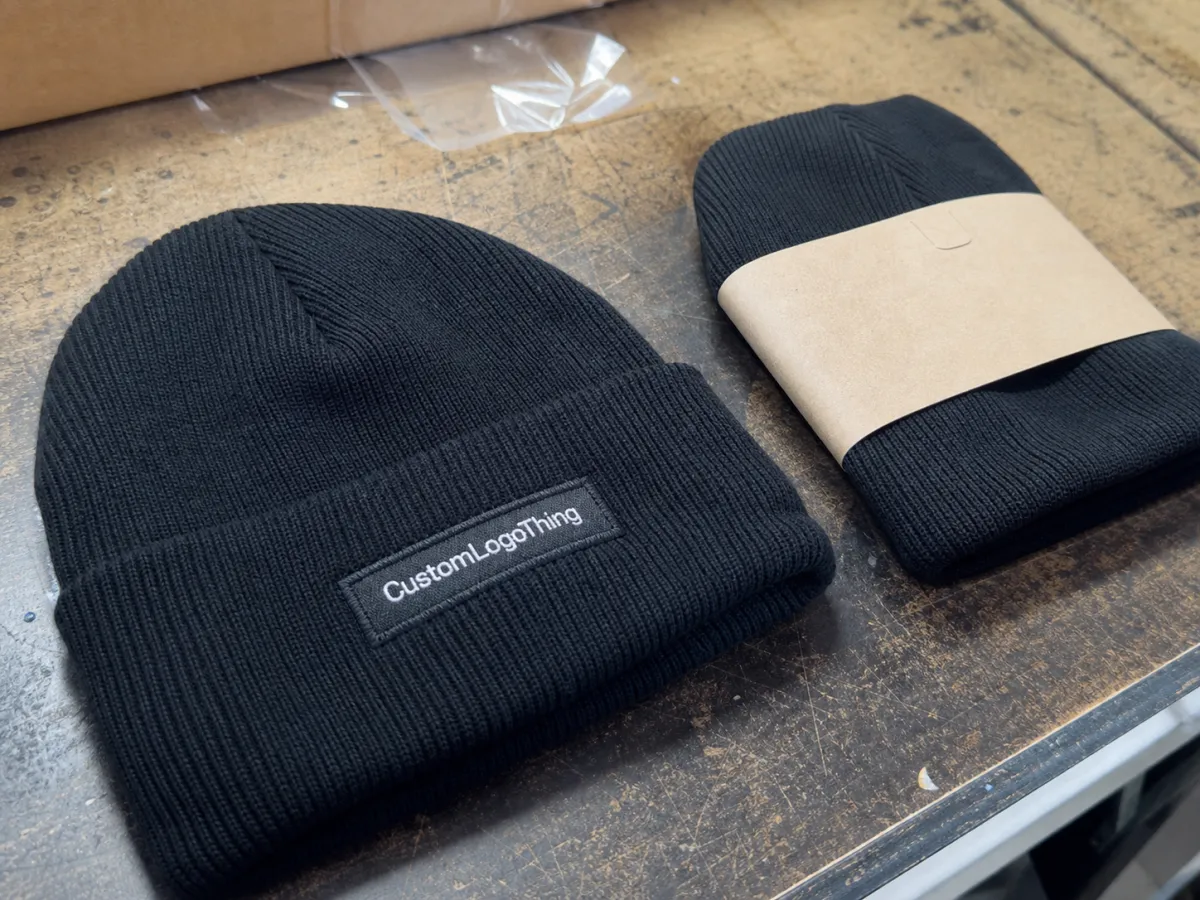
|
| Style | Best use | Branding space | Practical note |
|---|---|---|---|
| Cuffed | Staff wear, retail, member gifts | Reliable front cuff area | Usually the easiest format for embroidery |
| Slouch | Lifestyle merch, casual studio brands | Moderate placement area | Works best with a simple, clean logo |
| Ribbed | Athletic studios, instructor uniforms | Good stretch with tidy placement | Feels structured without looking stiff |
| Fleece-lined | Outdoor bootcamps, colder regions | Limited by bulk and lining | Warm, but not always the best hair-friendly fit |
Comfort testing should happen before the order is finalized, not after the boxes arrive. A beanie that feels scratchy, stretches out quickly, or twists on the head will get worn less often no matter how good the logo looks. Small quality issues matter here. Loose stitching near the cuff, a label that rubs, or a patch edge that curls can turn a usable item into drawer clutter.
Ask how the beanie handles care as well. If the material pills easily, shrinks, or loses shape after one wash cycle, the product will disappoint faster than a plain tee would. That is one reason buyers should ask for fabric weight, fiber content, and construction notes rather than just a photo mockup. If sustainability claims are part of the pitch, ask for current certificates such as GOTS for organic cotton, OEKO-TEX Standard 100 for fabric safety, GRS for recycled content, and WRAP or BSCI for social compliance documentation.
Pricing, MOQ, and quote factors to plan
Pricing depends on a small group of variables that show up on nearly every quote: quantity, decoration method, yarn choice, artwork complexity, packaging, and whether the order is stock-based or fully custom. For a decorated stock beanie, a realistic range is often $2.50 to $4.00 per unit at 500 MOQ for simple embroidery, while woven patch versions may land around $3.10 to $5.20 per unit at the same volume. Fully custom knit beanies usually price higher, commonly $5.80 to $9.50 per unit at 300 to 500 MOQ depending on color count, yarn mix, and finishing.
Setup fees are common on headwear. A digitizing or program fee might run $25 to $75 for basic embroidery, while more complex custom knit development, label weaving, or color matching can add $35 to $120 in one-time charges. If a supplier is quoting significantly below that, ask what is missing. The low number may not include sampling, label application, packaging, or freight to the final destination.
MOQ is not only about factory preference; it is also about how the beanie is built. A one-color embroidered stock beanie may be available at 50 to 100 units if the blank inventory is already on hand. A woven patch program may start closer to 100 to 250 units. Fully custom knit styles often begin around 300 units and move up to 500 units or more, especially when there are multiple yarn colors or private labels.
Quote factors should be reviewed line by line. Ask for blank cost, decoration cost, setup fee, sample cost, labeling, packing, and shipping as separate items. That makes comparison easier and prevents surprise increases later. It also helps identify where the extra money is going: embroidery stitch count, specialty yarns, custom woven labels, or more demanding quality control.
For a studio planning winter retail, a good practice is to price the landed cost with a 30 to 50 percent markup target for retail sales and a lower internal budget for staff or giveaway use. That keeps the program realistic without undercutting margin.
Step-by-step buying plan for studio orders
Buying headwear for a studio is easier when the order is structured in stages. Start with the use case. Decide whether the beanie is for staff, retail, promotions, or challenge rewards. That decision affects the style, quantity, and decoration method. A staff program may only need 24 to 48 units. Retail or seasonal sales often justify 100 to 300 units. Member gift campaigns can move higher if the budget and timing support it.
Next, lock the product spec before chasing design polish. Choose the knit style, fiber content, color, and decoration zone. For example: 100% acrylic, cuffed, 12-inch body, 2.5-inch cuff, black with white embroidery. That level of detail makes quoting faster and keeps the supplier from guessing. If the goal is premium positioning, consider a 50/50 acrylic-wool blend or a recycled polyester blend with OEKO-TEX Standard 100 or GRS documentation where relevant.
Then request a digital proof and, if needed, a physical sample. Review the sample under normal lighting, not just in photos. Check the cuff height, crown shape, logo centering, seam finish, and yarn color against the approved artwork. If the product is going into a retail program, test it on different head sizes and compare comfort after 10 to 15 minutes of wear.
- Define the goal: Staff wear, retail, giveaway, or seasonal promo.
- Select the base: Cuffed, slouch, ribbed, or fleece-lined.
- Choose the material: Acrylic, acrylic-wool blend, cotton blend, or recycled yarn.
- Approve the decoration: Embroidery, woven patch, sew-on label, or knit-in logo.
- Review the sample: Check fit, color accuracy, stitch quality, and logo placement.
- Confirm the QC plan: Ask for AQL standard, carton count, and defect photos if issues appear.
- Release production: Approve bulk only after the sample matches the expected result.
Final approval should include inspection expectations. Ask for in-line checks during knitting or decoration, a finished goods inspection before packing, and carton-level verification before shipment. A common quality standard is AQL 2.5 for major defects and 4.0 for minor defects, with checks for broken stitches, missing labels, loose threads, color variation, and measurement tolerance. For branded retail pieces, many buyers also request a random pull test on patches or labels and a count check on each carton.
Common mistakes that make beanies miss the mark
The biggest mistake is overcomplicating the logo. A detailed mark with thin lines, multiple gradients, or tiny text rarely translates well to knitwear. If the logo needs to be shrunk below 2 inches wide, simplify it first. Another common miss is choosing a style that looks good in a mockup but feels awkward on the head. Too much bulk, poor stretch recovery, or a stiff cuff will reduce wear frequency fast.
Buyers also underestimate how much the decoration method shapes the final result. Embroidery is durable, but it can distort fine lettering if the stitch count is too dense. Patches solve detail problems but can feel heavy if they are oversized or heat-applied incorrectly. Knit-in artwork is attractive, yet it demands early design discipline because the yarn structure limits what can be reproduced cleanly.
Another mistake is skipping the test phase. A sample is not a formality. It is the only reliable way to catch issues like off-center logos, loose seams, or a crown that sits too shallow. If a supplier cannot provide a sample or a clear pre-production proof, that is a warning sign.
Finally, some buyers ignore documentation. If the order depends on sustainability or compliance claims, ask for current certificates rather than marketing language. For example, OEKO-TEX Standard 100 is useful for fabric and trim safety, GRS supports recycled content claims, and WRAP or BSCI can support factory social compliance expectations. If a claim matters to the buyer, it should be backed by an actual certificate and current scope.
Expert tips for stronger branding and better wear
Keep the branding zone disciplined. On a cuffed beanie, an embroidery placement between 2.0 and 2.5 inches wide usually reads well without overwhelming the garment. If you want a more premium retail look, try a woven patch with a merrowed edge in a 2.25 to 2.75 inch size range. That gives better legibility for small type and keeps the beanie from feeling too promotional.
Use contrast strategically. High-contrast logo and base color combinations read best in winter lighting and in low-contrast gym environments. Black-on-white, white-on-navy, or charcoal-on-heather gray are dependable choices. If the studio brand is built on softer tones, keep the mark simple enough that it still reads from a few feet away.
Pay attention to finishing details. A woven interior label, a clean wash tag, and a folded presentation can make a low-cost beanie feel much more considered. If the order is retail-facing, ask for individual polybagging or a size sticker on the bag. If the order is for instructor uniforms, a simple folded pack may be enough. Packaging should match the channel, not just the product.
If the studio wants a more sustainable angle, do not rely on one feature alone. Recycled yarn is useful, but the claim is stronger when the whole package is considered: recycled content, OEKO-TEX Standard 100 or similar safety documentation, and packaging that avoids excessive plastic. Those details usually matter more to buyers than vague eco language.
As a final check, compare the beanie against the rest of the winter assortment. If hoodies, tees, or water bottles already carry a loud logo, keep the beanie quieter. If the beanie is the only winter item, it can carry a slightly bolder mark. The goal is consistency across the product mix, not repeating the same treatment everywhere.
Next steps for ordering and launch
Once the style and decoration are selected, work backward from the launch date. For a fall retail drop or winter membership campaign, build in enough time for sample approval, production, inspection, and freight. A practical planning window is 30 to 45 days for decorated stock beanies and 45 to 60 days for custom knit styles. If the launch is tied to an event or class series, leave extra time for one revision round.
Ask for a quote that includes unit price at the exact MOQ, sample cost, setup fees, decoration method, and shipping assumptions. That makes it much easier to compare suppliers and prevents an artificially low estimate from hiding the true landed cost. If you are evaluating multiple options, the cheapest quote is not always the best one. The better quote is the one that gives a clear sample path, realistic lead time, and documented quality checkpoints.
For studios that want a smoother first order, keep the design simple, choose a proven base style, and ask for current compliance documents before production starts. That approach reduces revision cycles and gives the final product a better chance of becoming a repeat seller instead of a one-time giveaway.
FAQ
What is a realistic MOQ for custom beanies?
For decorated stock beanies, 50 to 100 units is often possible. Woven patch programs usually start around 100 to 250 units. Fully custom knit styles commonly begin around 300 to 500 units.
How long does production usually take?
Decorated stock beanies often ship in 18 to 22 business days after approval. Fully custom knit beanies usually need 4 to 6 weeks, and complex programs can take 6 to 8 weeks.
What is the best decoration method for fitness studios?
Embroidery works best for most simple logos. Woven patches are better for detailed artwork. Knit-in logos work well for larger runs when the design is simplified early.
Which materials are most common?
100% acrylic is the most common starting point. Acrylic-wool blends feel more premium. Recycled polyester blends can support lower-impact claims if backed by GRS documentation.
What certifications should buyers ask for?
Ask for OEKO-TEX Standard 100 for material safety, GRS for recycled content, and WRAP or BSCI for social compliance where relevant. If the fiber claim is organic cotton, ask for GOTS.
What should be checked before approving bulk?
Confirm logo placement, color accuracy, stitch quality, seam finish, measurement tolerance, label placement, and carton count. AQL 2.5 for major defects is a common inspection reference.
Related Articles

How Much Are Custom Stickers Before You Order?
Jun 26, 2026

Order Very Small Custom Stickers That Actually Read
Jun 26, 2026