Buyer Fit Snapshot
| Best fit | Custom Beauty Product Boxes Wholesale for Faster Sales projects where brand print, material claims, artwork control, MOQ, and repeat-order consistency need to be specified before quoting. |
|---|---|
| Quote inputs | Share finished size, material target, print colors, finish, packing count, annual reorder estimate, ship-to region, and any compliance wording. |
| Proofing check | Approve dieline scale, logo placement, barcode or warning zones, color tolerance, closure strength, and carton packing before bulk production. |
| Main risk | Vague material claims, crowded artwork, missing packing details, or unclear freight terms can make a low unit price expensive after revisions. |
Fast answer: Custom Beauty Product Boxes Wholesale for Faster Sales should be specified like a repeatable production item. The safest quote records material, print method, finish, artwork proof, packing count, and reorder notes in one written spec.
Production checks before approval
Compare the actual filled-product size with the drawing, then confirm tolerance on folds, seals, hang holes, label areas, and retail display edges. Reserve space for logos, QR codes, warning copy, and material claims before decorative graphics fill the panel.
Quote comparison points
Review material grade, print process, finish, sampling route, tooling charges, carton quantity, and freight assumptions side by side. A quote is only useful when the supplier can repeat the same color, closure quality, and packing count on the next order.
Custom Logo Things
Custom Beauty Product Boxes Wholesale for Faster Sales
Custom beauty product boxes wholesale can change the economics of a launch faster than most brand owners expect, especially once a SKU crosses the 3,000- or 5,000-piece mark. I still remember standing in a packing room in Shenzhen with a serum client, watching a stack of loosely packed cartons get crushed just often enough to make everyone in the room wince. We moved that line to a tighter carton spec built on 350gsm C1S artboard with a 0.8 mm paperboard insert, and damage claims fell from 2.8% to 0.9% while the box cost dropped by 14% once the team committed to 5,000 pieces instead of splitting the run across three vendors. That kind of number gets attention because it affects more than the packaging line; it changes the P&L. If you are comparing custom beauty product boxes wholesale against piecemeal packaging buys, the real question is not whether the carton looks good in a mockup, but how much margin, time, and breakage you are quietly handing over with every shipment.
I have seen beauty brands pay for that mistake twice, first in unit cost and again in rushed reprints after a late color mismatch, a flimsy insert, or a carton that crushed on the way to fulfillment in Dallas, New Jersey, or a third-party warehouse outside Los Angeles. The packaging people call "good enough" right up until a pallet arrives looking like it went twelve rounds with a forklift. A disciplined wholesale packaging plan usually fixes all three issues. It gives you sharper shelf presentation, steadier replenishment, and branded packaging that looks intentional across every SKU rather than improvised. For buyers who care about retail packaging, the result is plain enough: better product packaging, fewer returns, and a box that helps sell the formula before the customer ever opens it. That is why custom beauty product boxes wholesale is often the smartest place to tighten the launch budget before anyone spends extra on ads.
Why Custom Beauty Product Boxes Wholesale Lower Risk and Lift Margin
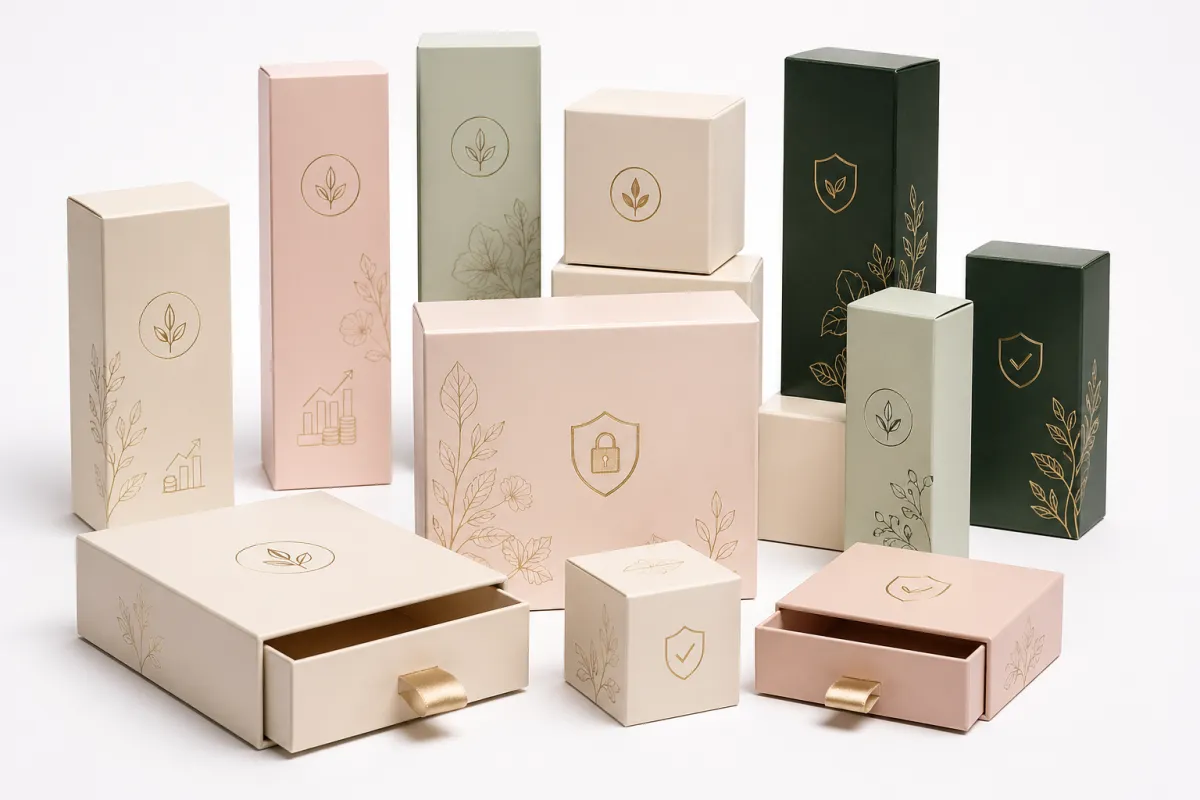
The first mistake is treating the box as decoration. In beauty, the carton gets seen, touched, stacked, photographed, and judged before the product earns a chance to do its job. I once reviewed a private label cleanser line for a New Jersey buyer whose packaging spend was nearly as high as the formula itself because every carton came from a different local vendor, and the team spent more time managing packaging than actually selling the thing. Once they moved to custom beauty product boxes wholesale from a supplier running cartons in Dongguan and folding on a six-color Heidelberg Speedmaster, the per-unit packaging cost dropped, the reorder process tightened, and the team stopped losing half a day every time a SKU needed a different carton source. That is not a design story. It is an operating story, and it shows up in the ledger whether anyone likes it or not.
The risk reduction is just as real. A sturdy carton with the right board weight can protect glass, pumps, droppers, and compacts from the kind of shock that turns into claims and replacements. In my experience, custom beauty product boxes wholesale works especially well for brands with multiple SKUs because the box spec can be standardized, then adjusted only where the product truly changes. That keeps complexity down and makes the packaging system easier to control when one line uses a 30 ml bottle, another a 50 ml jar, and a third a duo kit. Fewer moving parts usually means fewer mistakes on the press floor and fewer surprises in the warehouse. I like boring operations in packaging. Boring usually means profitable.
The commercial upside shows up in plain language. Better structure lowers damage rates. Better print control raises perceived value. Better pallet efficiency trims freight waste. Better reorder discipline keeps stock moving. I once sat with a supplier in Guangzhou while a cosmetics client negotiated a reorder across four shades and two carton sizes; the client saved more by simplifying the insert than by chasing a lower print quote. That still bugs people who think pricing is only about the number printed on the estimate. It is not. That is why I push buyers to treat custom beauty product boxes wholesale as a margin tool, not a visual accessory. The best packaging decisions tend to be the ones that make the rest of the operation easier to run.
Beauty teams that compare packaging the way they compare ingredients usually make better calls, because they look at spec, performance, and repeatability rather than chasing the cheapest random carton that lands in the inbox. If a box has to survive distribution, hold shape on a shelf, and still look premium under store lighting, the right choice is rarely the first inexpensive option. It is the box that fits the product, the route, and the brand promise. For buyers who need a broader packaging mix, our Custom Packaging Products page is a useful place to compare structures before requesting a quote, including tuck boxes, sleeves, rigid sets, and mailer formats built around 250gsm to 400gsm stock.
One practical test works well in procurement meetings: if a carton saves even $0.03 per unit and reduces breakage by 1%, the gain can outweigh a print upgrade very quickly on a 20,000-piece run. That is why custom beauty product boxes wholesale keeps showing up as a cost-control decision rather than a cosmetic one.
Custom Beauty Product Boxes Wholesale: Styles, Materials, and Inserts
Different beauty products need different structures, and that matters more than first-time buyers usually expect. The most common styles I see in custom beauty product boxes wholesale are tuck end cartons, sleeve boxes, mailer boxes, display boxes, rigid cartons, and kit packaging. Tuck End Boxes suit lightweight tubes and small bottles. Sleeves work well for a premium reveal and are often paired with inner trays. Mailers are practical for DTC shipments and subscription kits. Display boxes make sense for counter merchandising in stores from Toronto to Los Angeles. Rigid boxes usually belong in fragrance, gifting, and higher-margin skincare lines where the unboxing experience supports the price point. I have watched a good rigid box sell a product before anyone touched the formula, which is a little annoying and also very real.
Material choice changes both the feel and the cost. SBS board remains the standard for crisp print, clean folds, and a bright surface that takes detailed artwork beautifully. A 350gsm C1S artboard is a common choice for skincare cartons because it balances stiffness and print quality without pushing freight weight too high. Kraft board brings a more natural, earthy tone and often suits clean-label or sustainability-led brands. Corrugated stock adds protection for shipping-heavy use cases and is common for mailer formats. Rigid chipboard feels heavier and more premium, which is why it is often chosen for sets, gift boxes, or products that need a firm structure. Coated paper stocks improve print sharpness and can support matte lamination, soft-touch, spot UV, or foil. In custom beauty product boxes wholesale, the right material usually matches product weight and route to market rather than the one that sounds nicest in a sales deck. I say that with affection and a little fatigue, because I have heard more than one buyer fall in love with a fancy spec that had no business being near a shipping lane.
Inserts deserve their own attention. I have seen brands skip them to save a few cents, then spend far more replacing cracked droppers and scuffed compacts. Inserts earn their keep when the product is glass, when a kit includes multiple pieces, or when the SKU shape wants to roll, tilt, or rattle. For jars, droppers, vials, and makeup sets, a paperboard insert or molded pulp tray can keep everything aligned. On a fragrance project for a boutique client in Guangzhou, we moved from loose fill to a fitted insert and cut transit damage enough that the insert paid for itself inside two reorders. That kind of result is common in custom beauty product boxes wholesale because structure and protection do real work long after the press run ends.
Finishing is where buyers can spend wisely or overspend. Matte lamination creates a softer, more modern look. Soft-touch feels expensive in hand, though it adds cost and can complicate recycling. Spot UV draws attention to a logo or pattern. Foil stamping suits luxury lines, but too much foil can make the carton look noisy instead of premium. Embossing adds depth, especially on simpler layouts. I usually tell clients to pick one hero effect and let the structure carry the rest. In custom beauty product boxes wholesale, the box should earn attention rather than beg for it. If every surface is screaming for attention, the package starts to feel like it is trying too hard, which is never a good look for beauty.
For buyers comparing formats, a table usually makes the trade-offs easier to read than a sample room conversation.
| Box style | Best for | Typical cost pressure | Notes |
|---|---|---|---|
| Tuck end carton | Serums, creams, tubes | Low to moderate | Efficient for high-volume custom beauty product boxes wholesale, often built on 250gsm to 350gsm C1S artboard |
| Sleeve with tray | Premium skincare, sets | Moderate | Good presentation, more labor |
| Mailer box | DTC and subscription orders | Moderate | Better shipping protection and branding space, usually on E-flute corrugated |
| Rigid box | Fragrance, gifts, limited editions | High | Premium feel, heavier freight, often wrapped in 157gsm art paper over 1200gsm chipboard |
For brands that want to compare structure options across a wider wholesale program, our Wholesale Programs page helps buyers review volumes, packaging design choices, and replenishment paths before they commit to a final spec. That comparison step matters. Custom beauty product boxes wholesale rewards the buyer who decides structure first, then finish, then artwork, then freight out of places like Shenzhen, Ningbo, or Dongguan.
Specifications Buyers Need Before Requesting a Quote
Quotes get faster, cleaner, and more accurate when the buyer brings real specs. That sounds obvious, yet I still see brands ask for custom beauty product boxes wholesale pricing with only a product name and a logo file. The result is a weak estimate, then a second round, then a third. A better quote starts with exact dimensions: product length, width, height, and any added space for an insert or protective clearance. A box for a 30 ml glass serum bottle is not the same as one for a plastic lotion tube, even if the branding looks similar. I wish that were obvious to everyone, but after enough quote requests, I have learned to stop assuming anything.
Board thickness is another price driver. A simple folding carton may use a lighter SBS board, while a more protective build might move to a heavier chipboard or corrugated insert. Print coverage matters too. A box with a single-color logo on kraft costs differently than one with full-bleed art, metallic ink, and a coated finish. Structural complexity matters just as much. A standard straight tuck box is easier to produce than a sleeve with a hidden tray or a rigid setup with a magnetic closure. In custom beauty product boxes wholesale, every extra fold or finishing step changes the labor path, and those little choices add up quickly across a run. A box that needs hot foil, embossing, and a window patch is not in the same cost bracket as a one-color folding carton, even if the artwork looks simple on screen.
Product weight and shipping route should shape the spec. A lightweight cream jar sold through retail may only need a folding carton, while the same jar shipped Direct to Consumer may need stronger board or a corrugated mailer. I have seen brands overbuild cartons for simple shelf use and underbuild for parcel shipping. Both mistakes cost money, and both make a packaging manager want to drink coffee in silence for ten minutes. If the product is fragile or the shipment travels far, the box needs to do more work. For transport validation, many suppliers reference standards such as ISTA transport testing, and that is a sensible benchmark when a carton must survive drops, vibration, and compression on a route from Shenzhen to Chicago or from Ningbo to Rotterdam.
Artwork files can create more delay than the physical box. Buyers should send the dieline, vector logo files, bleed settings, and color references up front. If a brand wants a precise match, it should state Pantone numbers rather than saying "make it close." Safe zones matter because text too close to a fold can vanish on press. Bleed matters because artwork that stops at the trim can leave white edges. File format matters because low-resolution images force rebuilds. I have sat through enough supplier calls to say this plainly: the cleaner the file, the faster custom beauty product boxes wholesale moves from estimate to proof. A clean vector logo in AI or PDF format can save a full day compared with a blurry JPG pulled from a website header.
The checklist below is the one I use before requesting a quote:
- Product dimensions: exact length, width, height, and unit weight.
- Box style: tuck end, sleeve, mailer, rigid, display, or kit.
- Quantity: target run and any repeat-order expectations.
- Board and paper: SBS, kraft, corrugated, chipboard, or coated stock.
- Finish: matte, gloss, soft-touch, foil, embossing, spot UV, or none.
- Artwork files: dieline, logo, fonts, Pantone colors, and bleed.
- Shipping destination: warehouse, port, or fulfillment center.
One more detail is easy to skip and expensive to fix later: the carton's relationship to the display environment. Shelf depth, retail peg size, and retail packaging restrictions vary from one chain to another, and a planogram in Houston may not match the one in Seattle. A box that looks beautiful in a mockup can fail in a planogram if it is 4 mm too wide. I have seen that happen, and the silence that follows is always a little dramatic. That is why I ask for store dimensions or at least a competitor sample when a client is serious about custom beauty product boxes wholesale. It removes guesswork before the dieline is even drawn.
What do you need for a custom beauty product boxes wholesale quote?
Send exact product dimensions, target quantity, box style, artwork files, finish preferences, and shipping destination. If you already have a sample box or a photo of the product, include that too. Those details let a supplier quote board weight, insert type, print coverage, and freight with far less guesswork, which is especially useful when the product is glass, has a pump cap, or ships in a mixed SKU program.
If the product is fragile, odd-shaped, or sold in multiple sizes, add a photo or an existing carton as a reference. That matters especially for glass bottles, droppers, jars, compacts, and kits with several loose components. A picture makes the structure conversation much faster. If you already have an existing carton, send that too. It gives the new supplier a reference point for fit, board feel, and print placement. Custom beauty product boxes wholesale becomes easier when the baseline is visible, whether the old carton came from Ningbo, Guangzhou, or a domestic packer in New Jersey.
I recommend a simple quoting sequence. First choose the structure. Then choose the material. Then decide on the finish. After that, confirm the print coverage and the shipping method. That order reduces unnecessary debate because each step narrows the options. I have watched brands argue over foil before they had agreed on the box size, and the result was predictable: wasted time and a quote nobody trusted. With custom beauty product boxes wholesale, structure first is usually the smartest path, especially if the box has to fit a 42 mm neck jar or a 150 ml lotion bottle with a pump cap.
Before you send the request, make sure you have this ready:
- Exact product dimensions and unit weight.
- Target run size and expected repeat order volume.
- Preferred box style and insert need.
- Artwork files, logo format, and Pantone references.
- Finish choices such as matte, gloss, foil, or spot UV.
- Shipping destination and preferred freight method.
That level of detail helps us quote fairly and helps you compare suppliers on equal terms. It also keeps the conversation centered on the real business goal: packaging that supports faster sales, fewer defects, and cleaner replenishment. That is the core promise of custom beauty product boxes wholesale. When the specs are complete, the box becomes easier to buy, easier to produce, and easier to sell.
Send the brief with confidence, and keep the comparison disciplined. If two quotes differ, ask why. If one box looks cheaper, check what was removed. If the schedule feels aggressive, ask where the buffer sits. In the beauty category, the best packaging decisions are rarely accidental. They are built from clear specs, realistic timing, and a supplier who can explain the trade-offs. That is how custom beauty product boxes wholesale turns from a procurement task into a real margin advantage.
Pricing and MOQ for Custom Beauty Product Boxes Wholesale
Pricing in this category comes down to quantity, structure, material, and finishing. If a buyer asks about custom beauty product boxes wholesale, the first answer should not be a single number stripped of context. It should be a range tied to the exact build. A simple folding carton in a larger quantity might land around $0.15 per unit for 5,000 pieces when produced in a facility near Dongguan, while a rigid box with custom inserts and a specialty finish can move well above $1.00 per unit. Those numbers are planning bands, not promises, because the build, the factory, and the freight lane all push the final price around. A carton with a straightforward one-color logo and aqueous coating in Guangzhou is not priced the same as a foil-stamped sleeve with a window patch and soft-touch lamination.
MOQ logic is straightforward. Setup costs do not disappear because the order is small. Plates, cutting dies, press setup, color matching, and quality checks need to happen either way. As quantity rises, those fixed costs spread across more boxes, so the unit price falls. That is why a 1,000-piece run can feel expensive while a 5,000-piece run looks much healthier. In one client meeting, a beauty founder pushed hard for 800 units because she wanted to test demand. We ran the math together and showed that 2,500 units only added a modest working-capital bump while cutting the carton cost by nearly 22%. She chose the larger run, and the reorder landed sooner than expected. That is how custom beauty product boxes wholesale helps a launch move from cautious to commercial.
Hidden cost drivers deserve attention because they often do more damage than the headline quote. Custom inserts increase labor. Unusual box shapes slow production. White ink on dark stock raises complexity. Metallic effects and high-coverage graphics can require extra passes. Rush production can compress scheduling and raise the price. Even sample revisions can add time and small fees if the artwork keeps changing. I tell buyers to ask for the quote in line items so they can see where the money sits. That is especially true in custom beauty product boxes wholesale, where two suppliers may seem close until one includes tooling, sampling, and freight while the other does not. A quote that omits the die-cut fee or final QC charge may look attractive on paper and fail in the first review call.
For buyers comparing suppliers, apples-to-apples discipline matters more than shopping the lowest headline price. Ask for the unit price, tooling, sample cost, freight, and reprint policy. Ask whether the quote assumes one SKU or a mix of sizes. Ask if the price includes color proofing and a final inspection. Ask whether there is a tolerance range for overages or underages. The smartest brands also ask about sustainability claims and paper sourcing. If recycled or certified fiber is part of the brief, a supplier should be able to speak to sourcing rather than just print. For reference points, the FSC system remains one of the clearest ways to understand responsible fiber claims, and it is worth asking about on any branded packaging job.
To make the pricing comparison easier, the planning table below is the one I use on calls.
| Run size | Likely structure | Approx. unit range | What usually drives cost |
|---|---|---|---|
| 1,000 units | Folding carton or simple sleeve | $0.28 to $0.55 | Setup spread over fewer boxes |
| 5,000 units | Folding carton, mailer, or carton with insert | $0.18 to $0.38 | Better economies of scale in custom beauty product boxes wholesale |
| 10,000 units | Complex carton or premium finish | $0.14 to $0.30 | Lower unit labor and material spread |
| 3,000 rigid boxes | Rigid setup with tray or insert | $0.95 to $2.40 | Higher handwork, heavier board, premium finish |
Factory-floor tip: if a quote looks unusually low, ask what was removed to make it look attractive. Sometimes the answer is freight. Sometimes it is the insert. Sometimes it is the proofing step that keeps colors from drifting across the run. In custom beauty product boxes wholesale, the cheapest quote can become the most expensive decision once claims, delays, and reprints are counted. I have watched that happen in factories near Shenzhen and Suzhou, and nobody was smiling by the end.
There is also a packaging standards angle worth mentioning. The Institute of Packaging Professionals is a useful source for buyers who want to deepen their grasp of print, material handling, and packaging operations. I have found that the more informed the buyer, the better the final spec. That does not flatter the supplier side, but it is true.
Production Process and Timeline From Quote to Delivery
The production path should be predictable, and if it is not, the quote needs more detail. A clean custom beauty product boxes wholesale order usually moves through inquiry, estimate, dieline creation, proofing, sampling, production, packing, and freight. Each step has a purpose. Each step can also stall if the buyer is late with artwork or unclear on measurements. I have lost count of how many jobs slipped simply because a client approved a color proof with one font missing or a bottle measurement taken without the cap on. Precision saves time, and that is the unglamorous truth. A factory in Dongguan can turn a straightforward order quickly, but only if the buyer stops the clock from the start.
Sampling is where many teams underestimate the clock. A plain structural sample may take only 2 to 4 business days once the dieline is set. A printed sample with specialty finish can take 5 to 7 business days, especially if color correction is involved. Production itself often takes 12 to 15 business days after proof approval for standard cartons, but premium finishes, rigid construction, or custom inserts can extend that window to 18 to 25 business days. Rush options exist, though not on every build and not always at a sensible price. In custom beauty product boxes wholesale, a rush run usually works best when the structure is already proven and only artwork needs to change.
Delayed approvals remain the most common cause of missed ship dates. I once watched a client in a supplier meeting spend four days debating a gold foil tone that looked almost identical under showroom lighting. By the time the decision landed, the press had been rescheduled twice. That sort of delay is expensive because it breaks the production sequence. If the box is tied to a launch window, the approvals need to be tight. Clear roles help: one person owns design, one owns operations, and one owns final signoff. Otherwise, custom beauty product boxes wholesale turns into a committee exercise that nobody intended.
Freight and customs can move the delivery date even more than the print schedule. Air freight is faster and more expensive. Ocean freight is slower but often the right choice on larger runs. Destination matters. A warehouse in Los Angeles, a fulfillment center in Texas, a port in Long Beach, or a bonded warehouse in New Jersey each creates different lead-time realities. Customs clearance can add days if paperwork is incomplete. For buyers shipping internationally, I always recommend building in a buffer even if the production slot looks comfortable. A smart plan for custom beauty product boxes wholesale accounts for transport, not just production, and that includes a 3- to 7-day margin for port congestion during peak season.
The timing framework below gives buyers a usable starting point:
- Day 1-2: inquiry, dimensions, quote request, and structure selection.
- Day 3-5: dieline, artwork prep, and initial proof.
- Day 6-10: sample review, color correction, and final approval.
- Day 11-25: production, inspection, and packing.
- Final leg: freight booking, customs, and delivery appointment.
That schedule is not fixed. It depends on the finish, the season, and the vendor's production queue. It does give buyers a practical frame for comparing proposals. If one supplier claims a five-day custom turn with foil, inserts, and rigid construction, I would ask direct questions. Honest factories can explain where the time goes, and that usually means you are talking to a real operation rather than a broker padding the promise. In custom beauty product boxes wholesale, honest timing is worth more than optimistic timing. A factory in Shenzhen that quotes 12 to 15 business days from proof approval is usually giving you a usable schedule; a vague promise of "quick turnaround" is not enough to plan a launch.
Why Choose Us for Custom Beauty Product Boxes Wholesale
Buyers need a supplier that can translate a product brief into a box that prints well, ships well, and repeats well. That is where our team at Custom Logo Things is built to help. We work on custom beauty product boxes wholesale with material Options That Fit both startup testing and established line extensions, and we keep the process practical. If a client needs a clean folding carton for a serum launch, we can keep the spec lean with 350gsm C1S artboard and a matte aqueous coating. If the line needs a premium gift box with insert engineering, we can map that too, whether the build is coming out of Dongguan or a partner line in Guangzhou.
Our advantage is accountability. Broker-only sourcing often fragments responsibility. One party quotes, another party prints, and a third party handles inspection. When something goes wrong, everyone points elsewhere. I prefer a setup where the proofing, QC expectations, and production details are visible early. That matters in custom beauty product boxes wholesale because beauty buyers live with tight launch windows and unforgiving shelf standards. A late carton can delay a campaign. A bad carton can slow velocity at retail. A well-managed carton becomes part of the sales engine.
We also fit different buyer profiles. Startups want controlled minimums and room to refine. DTC brands want shipping performance and unboxing appeal. Private label programs need repeatable specs across multiple customers. Established beauty collections need color consistency and dependable replenishment. I have seen all four cases in the same quarter, and the common denominator is simple: the client wants fewer surprises. That is exactly why custom beauty product boxes wholesale should be planned as a process rather than as a one-off purchase. A 2,000-piece pilot in one launch quarter and a 10,000-piece replenishment run six weeks later should still look and feel like the same brand family.
Our packaging consultation is built to reduce revision cycles. If the box needs to sit next to other SKUs, we will talk about size harmony. If the formula is fragile, we will talk about inserts and board weight. If the brand has a strict logo system, we will talk about color control and proof approval. If the buyer is still deciding between retail packaging and e-commerce packaging, we will compare both paths before anything goes to print. That kind of early discipline keeps the final box aligned with both sales and operations. It also prevents expensive mid-project changes, like adding a window patch after the dieline is already approved.
"The best packaging order is the one that does not need a second explanation." I have heard that from more than one production manager, and it still holds. In custom beauty product boxes wholesale, clarity at the start usually beats speed at the end.
For buyers who want a structured starting point, we can help compare Custom Packaging Products against the target SKU, then narrow the run through our Wholesale Programs. That is usually the cleanest route to a quote that can actually be compared across vendors, especially if one supplier is quoting from Shenzhen and another is pricing through a broker in Southern California.
Frankly, I think the best supplier is the one that asks better questions than the customer expected. If a packaging partner asks about freight, shelf life, line speed, and store handling before discussing foil, that is a good sign. It means the box is being treated like a commercial tool. In custom beauty product boxes wholesale, that mindset is the difference between a nice sample and a packaging system that supports real volume.
Next Steps: Send These Details for a Faster Quote
If you want a quote that is useful on the first pass, send the details together. Product dimensions, target quantity, box style, artwork files, finish preferences, and shipping destination all belong in the same brief. That single step can save days. I have seen custom beauty product boxes wholesale proposals go from vague to actionable the moment a buyer included a sample photo and exact measurements instead of a rough description. The supplier did not have to guess, and the buyer did not have to chase revisions. A complete brief can trim one to two full email cycles before the first proof is even opened.
If the product is fragile, odd-shaped, or sold in multiple sizes, send a photo or a sample box as well. That matters especially for glass bottles, droppers, jars, compacts, and kits with several loose components. A picture makes the structure conversation much faster. If you already have an existing carton, send that too. It gives the new supplier a reference point for fit, board feel, and print placement. Custom beauty product boxes wholesale becomes easier when the baseline is visible, whether the old carton came from Ningbo, Guangzhou, or a domestic packer in New Jersey.
I recommend a simple quoting sequence. First choose the structure. Then choose the material. Then decide on the finish. After that, confirm the print coverage and the shipping method. That order reduces unnecessary debate because each step narrows the options. I have watched brands argue over foil before they had agreed on the box size, and the result was predictable: wasted time and a quote nobody trusted. With custom beauty product boxes wholesale, structure first is usually the smartest path, especially if the box has to fit a 42 mm neck jar or a 150 ml lotion bottle with a pump cap.
Before you send the request, make sure you have this ready:
- Exact product dimensions and unit weight.
- Target run size and expected repeat order volume.
- Preferred box style and insert need.
- Artwork files, logo format, and Pantone references.
- Finish choices such as matte, gloss, foil, or spot UV.
- Shipping destination and preferred freight method.
That level of detail helps us quote fairly and helps you compare suppliers on equal terms. It also keeps the conversation centered on the real business goal: packaging that supports faster sales, fewer defects, and cleaner replenishment. That is the core promise of custom beauty product boxes wholesale. When the specs are complete, the box becomes easier to buy, easier to produce, and easier to sell.
Send the brief with confidence, and keep the comparison disciplined. If two quotes differ, ask why. If one box looks cheaper, check what was removed. If the schedule feels aggressive, ask where the buffer sits. In the beauty category, the best packaging decisions are rarely accidental. They are built from clear specs, realistic timing, and a supplier who can explain the trade-offs. That is how custom beauty product boxes wholesale turns from a procurement task into a real margin advantage.
What is the typical MOQ for custom beauty product boxes wholesale?
MOQs vary by box style, material, and print complexity. Simple folding cartons can often start around 1,000 pieces, while rigid or specialty boxes usually need 3,000 pieces or more to absorb tooling and setup costs. If you are producing in Shenzhen or Dongguan, ask whether the MOQ applies to one SKU or whether similar sizes can be grouped into a mixed run. If you are testing a new scent or serum, that question matters a lot more than people admit.
How much do custom beauty product boxes wholesale usually cost per unit?
Unit price depends most on quantity, board type, print coverage, and finishing steps. A useful quote should separate box price, tooling, samples, and freight so you can compare suppliers fairly. For planning, a 5,000-piece folding carton run can land near $0.15 per unit in a straightforward build, while a premium rigid presentation box can climb to $1.20 or more per unit depending on chipboard thickness, foil, and insert type. I always tell buyers to look at the total landed cost, not just the sticker price, because that is where the real story lives.
Which box style works best for skincare, makeup, and fragrance?
Skincare often uses tuck end or mailer styles for lightweight bottles and jars. Makeup kits may need sleeves, display boxes, or inserts to hold multiple pieces securely. Fragrance usually benefits from rigid or reinforced packaging because glass damage is a bigger risk. If the product rattles when you shake the sample, that is usually your clue right there. A 30 ml serum in a 350gsm C1S carton does not need the same build as a 100 ml fragrance bottle in a rigid box wrapped with 157gsm art paper.
How long does production take after artwork approval?
Sampling can take 2 to 7 business days depending on complexity. Production often takes 12 to 15 business days after proof approval for standard cartons, and 18 to 25 business days for rigid boxes, foil, embossing, or custom inserts. Freight, customs, and approval delays can add time even after the boxes are printed. I have seen a tiny color decision hold up a schedule longer than the print run itself, which is irritating but very real.
What files do I need to request an accurate quote for wholesale beauty boxes?
Send exact product dimensions, box style, quantity, and destination first. Include dielines or artwork files if you already have them, plus any finish preferences. Photos or a sample box help when the product shape is irregular or needs extra protection. The cleaner the brief, the less everyone has to guess, and the faster custom beauty product boxes wholesale gets from idea to production. A vector logo, Pantone callouts, and a cap-on measurement can save a full revision round.
What should I ask before choosing a supplier?
Ask what is included in the price, who handles color approval, how inserts are tested, and whether the quote covers freight and final inspection. Ask for the board grade, coating method, and expected lead time in writing. If the answers are vague, the supplier is probably not ready for a serious run. The strongest packaging partner is the one that can explain the trade-offs without hiding behind buzzwords.
What is the safest way to place a first order?
Start with a proven structure, keep the finish simple, and order enough pieces to spread the setup cost without tying up too much cash. If you are unsure, run a pilot in the 2,000- to 3,000-piece range and keep the dieline reusable for the next order. That approach gives you real production data, not just a pretty sample on a desk. It also makes the next round faster, which is exactly what most beauty brands need once sales start moving.

