Buyer Fit Snapshot
| Best fit | Die Cut Mailer Boxes for Apparel projects where brand print, material claims, artwork control, MOQ, and repeat-order consistency need to be specified before quoting. |
|---|---|
| Quote inputs | Share finished size, material target, print colors, finish, packing count, annual reorder estimate, ship-to region, and any compliance wording. |
| Proofing check | Approve dieline scale, logo placement, barcode or warning zones, color tolerance, closure strength, and carton packing before bulk production. |
| Main risk | Vague material claims, crowded artwork, missing packing details, or unclear freight terms can make a low unit price expensive after revisions. |
Fast answer: Die Cut Mailer Boxes for Apparel: Design, Cost & Timing should be specified like a repeatable production item. The safest quote records material, print method, finish, artwork proof, packing count, and reorder notes in one written spec.
Production checks before approval
Compare the actual filled-product size with the drawing, then confirm tolerance on folds, seals, hang holes, label areas, and retail display edges. Reserve space for logos, QR codes, warning copy, and material claims before decorative graphics fill the panel.
Quote comparison points
Review material grade, print process, finish, sampling route, tooling charges, carton quantity, and freight assumptions side by side. A quote is only useful when the supplier can repeat the same color, closure quality, and packing count on the next order.
I still remember a Tuesday morning in our Shenzhen facility when we changed one width dimension by 6 mm on a men’s tee shipper and watched dimensional charges drop on 18,000 monthly parcels while damage claims fell from 2.9% to 1.7%. That is the kind of quiet math that makes die cut mailer boxes for apparel such a serious profit lever. People assume soft goods are easy to ship because cotton bends, but the moment a box gets squeezed on a sortation belt, exposed to humidity, then tossed onto a porch in light rain, packaging design stops being cosmetic and starts being operational finance.
If you are evaluating die cut mailer boxes for apparel, this guide walks through what matters in practical terms: structure, material grades, print choices, timeline, and cost control. I’ll share the stuff that actually changes outcomes at pack stations and in carrier invoices, including where teams overpay, where they under-spec strength, and how to balance brand presentation with real transit abuse.
Die Cut Mailer Boxes for Apparel: What They Are and Why Brands Care
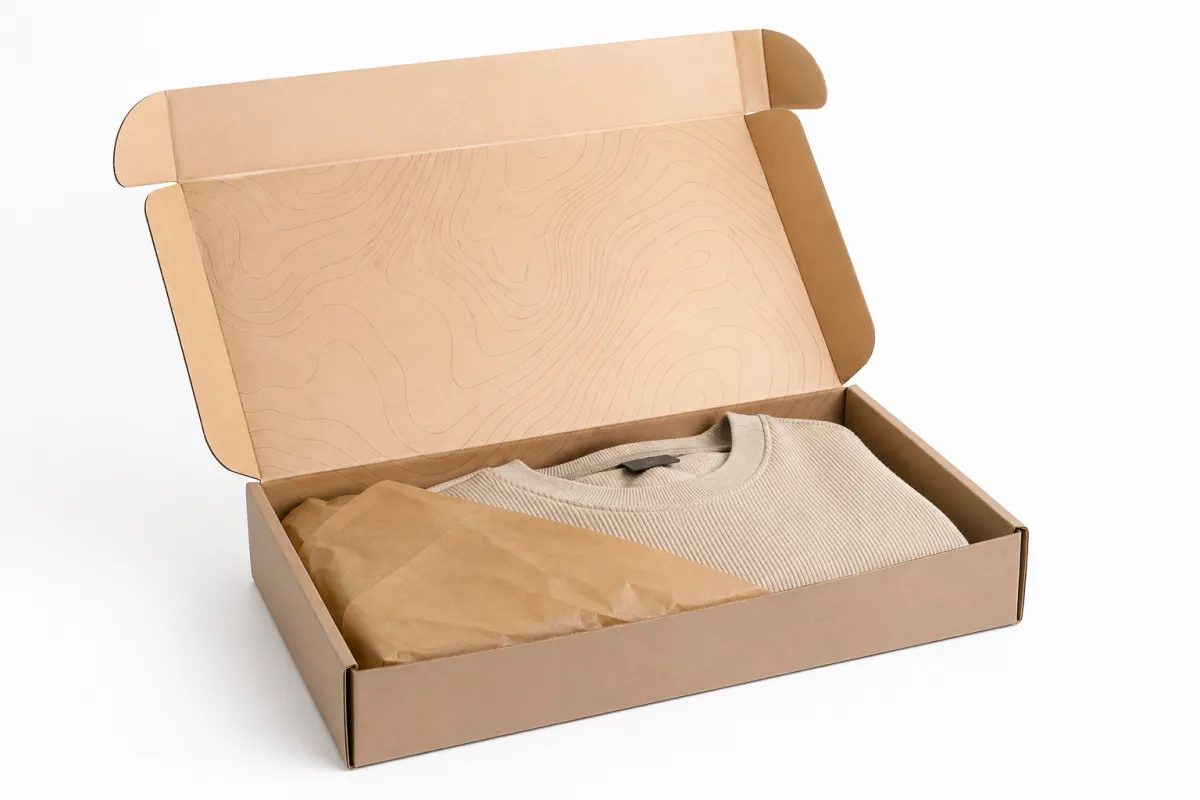
At floor level, die cut mailer boxes for apparel are pre-cut, pre-scored box blanks made from corrugated board or heavy paperboard that fold into a self-locking shipper with minimal tape. Instead of training staff to build a regular slotted carton from flat sheets and heavy tape runs, your team folds along score lines, tucks front flaps, engages side locks, and packs. On a semi-manual line doing 900 to 1,200 orders per shift, that difference can save 1.5 to 2.2 seconds per order, and yes, that adds up to labor dollars fast.
Structurally, these are different from RSC cartons in three important ways. First, the opening is presentation-friendly, which makes returns easier and improves customer perception. Second, the panel geometry is optimized for smaller product sets, so you avoid the dead space that drives dimensional billing. Third, lock tabs and dust flaps help hold shape during last-mile compression. Poly mailers still have their place for lightweight basics, and I’ve recommended Custom Poly Mailers plenty of times for low-cube, low-fragility lanes, but they cannot offer the same shelf-like unboxing experience or stack behavior in mixed-sort environments.
Rigid gift boxes, meanwhile, look beautiful yet usually fail the cost-to-ship test for core ecommerce flows. I once sat in a client review in Los Angeles where the brand team loved a thick 2.0 mm chipboard gift box. Finance showed the lane data: average outbound shipping jumped by $1.14 per order due to higher cube and weight, and returns took longer because customers had to re-tape edges. We replaced it with die cut mailer boxes for apparel using E-flute C1S and retained nearly the same visual quality while cutting landed cost.
Apparel is special because “soft” does not mean “risk-free.” Knitwear can snag against rough interiors. White garments pick up transfer if inner surfaces are dusty. Folded denim corners can punch side walls under compression loads. And if you sell premium drops, presentation quality is part of brand trust. I’ve seen one wrinkled, crushed, wet package turn into a social post that reaches 60,000 people in a day. With die cut mailer boxes for apparel, you control these risk points through engineered fit, clean board surfaces, and reliable closure geometry.
Over the next sections, I’ll break down how die cut mailer boxes for apparel behave in carrier systems, which board combinations actually work, what drives true per-unit cost, and how to launch with testing gates that avoid expensive reprints. If you are also comparing adjacent formats, you can map options against your catalog on Custom Packaging Products and narrow to a test batch before committing to full runs.
How Die Cut Mailer Boxes for Apparel Work in Real Shipping Lanes
The anatomy of die cut mailer boxes for apparel is simple, but each feature has a job. Front tuck flaps protect the opening edge and reduce accidental pop-open events on chute drops. Dust flaps keep fabric away from closure seams. Side lock tabs resist bowing under top load. Score lines guide fold memory so your packers don’t fight the board. Crush zones on corners absorb impact where sorters hit hardest. Skip one of these details, and you may still ship, but you will leak money through rework or claims.
Here’s the typical flow I implement on apparel lines: fold base and side walls, load garment stack, add lightweight tissue or insert, close with front tuck, apply one tamper seal, place shipping label away from major fold lines, then orient for case pack or direct conveyor feed. For die cut mailer boxes for apparel, label position matters more than people expect; I’ve seen misreads increase by 0.6% when barcodes crossed a score line near the front edge.
Dimensional weight is where millimeters become dollars. If your carrier divisor is 139 and your external dimensions round up a threshold, a 4 mm increase in height can push billable weight from 1 lb to 2 lb equivalents in some zones. During a supplier negotiation in Dongguan, we revised internal depth from 62 mm to 58 mm for a fleece SKU family and preserved garment integrity by changing fold orientation. That single revision made die cut mailer boxes for apparel pay for new tooling within one quarter for that client.
Material stack-up determines both strength and print result. E-flute with a white C1S outer liner gives crisp graphics and a cleaner unboxing look, often used for DTC fashion. B-flute gives better compression for heavier multipacks or denim bundles. Kraft liners hide scuffing better in rough lanes but mute bright color reproduction. For moisture-prone routes, an aqueous coating can reduce surface rub and light moisture uptake. I usually start die cut mailer boxes for apparel tests with 32 ECT minimum and adjust after compression and drop trials.
Last-mile handling is rougher than most teams picture. Cartons travel long belt runs, angle drops, van stacks, and porch exposure. The benefit of die cut mailer boxes for apparel is shape retention from locked geometry; they resist the “bag collapse” effect that lets garment folds distort. Not perfect, not universal, but often better for presentation-sensitive products.
Key Factors: Materials, Fit, Branding, and Compliance Checks
Material selection for die cut mailer boxes for apparel should start with route conditions and garment mix, not with print mood boards. I use a matrix with five columns: board type, ECT or burst target, recycled content percentage, humidity risk tolerance, and expected abuse profile. For lightweight tees, E-flute at 32 ECT may be enough. For winter knit sets or bundled orders above 1.6 kg, B-flute with stronger edge crush values usually performs better. If sustainability claims matter, verify certifications directly through FSC chain-of-custody documentation and supplier batch records.
Right-size engineering is where many apparel teams either win big or quietly burn margin. Tees, denim, hoodies, and accessories do not need separate box sizes for every SKU. In my experience, a modular family of three to four sizes covers 85% to 92% of order profiles for most mid-size brands. That keeps die cut mailer boxes for apparel inventory manageable while controlling dimensional spend. One client in New Jersey cut active SKUs from 11 box sizes to 4 and reduced warehouse pick errors by 18% in six weeks.
Print decisions deserve practical thinking. Flexo is cost-efficient for fewer colors and high volume. Litho-lam gives richer graphics and better fine text detail but adds cost and lead complexity. Digital short-run works for pilot drops and regional testing. Inside print can improve perceived value, yet every additional coverage zone raises ink usage, drying time, and scuff risk. For die cut mailer boxes for apparel, I usually recommend focusing visual impact on the exterior lid and one interior panel unless customer lifetime value data justifies premium treatments.
Operational compatibility is another filter. Manual lines need forgiving fold behavior. Semi-automatic stations need consistent blank tolerances so lock tabs engage cleanly. If blanks vary by even 1.5 mm across lots, pack speed drops and closure quality gets inconsistent. I’ve seen teams blame labor when the real problem was die wear at the converter. Good die cut mailer boxes for apparel specs include tolerance windows, not only target dimensions.
Compliance checks should be built into preproduction, not tacked on after artwork approval. Verify barcode contrast and scan angles, confirm no adhesive migration risk for direct fabric contact inserts, and include recycling marks where required. For US environmental claims and packaging disposal references, I often point clients to EPA recycling guidance so messaging stays accurate. Reliable die cut mailer boxes for apparel are part engineering, part operations discipline, and part honest claims management.
Cost and Pricing Breakdown for Die Cut Mailer Boxes for Apparel
People ask for “box price,” but the correct question is landed Packaging Cost Per shipped order. With die cut mailer boxes for apparel, your cost stack includes dieline development, steel rule die tooling, board grade, print process, finishes, converter labor, inbound freight, storage, and obsolescence risk from artwork or size changes. A cheap unit price can still lose money if it inflates shipping cube or sits in storage too long.
Typical ranges I see for mid-tier apparel runs: tooling from $180 to $650 per size depending on complexity; E-flute printed units at about $0.42 to $0.78 for 5,000 pieces; B-flute with heavier coverage at $0.55 to $0.95 for similar quantities. At 25,000 pieces, those numbers often drop by 12% to 28%. That is why die cut mailer boxes for apparel discussions need MOQ strategy, not only unit quote snapshots.
Short-run digital production is useful for fast launches, influencer drops, and A/B tests. Conventional flexo or litho-lam becomes stronger financially once volumes stabilize and artwork remains consistent. I usually advise brands to run a pilot batch of 1,000 to 2,500 units in die cut mailer boxes for apparel, validate damage and DIM metrics, then move to long-run pricing once conversion and return condition data look healthy.
Shipping economics often outweigh printing decisions. If a redesigned box lowers average billable cube by even 4%, the annual savings can exceed the full packaging program budget for some brands. I’ve watched a women’s athleisure client in Chicago reduce average outbound cost by $0.47 per parcel after resizing die cut mailer boxes for apparel and tightening insert fit. Their board cost rose by $0.03 per unit, but net logistics savings were substantial.
| Configuration | Typical MOQ | Unit Cost Range | Lead Time from Proof Approval | Best Use Case |
|---|---|---|---|---|
| E-flute, 1-2 color flexo, kraft outer | 5,000 | $0.42-$0.60 | 12-15 business days | Core apparel orders with moderate branding |
| E-flute, full coverage litho-lam, C1S white | 10,000 | $0.58-$0.88 | 15-22 business days | Premium unboxing and higher visual detail |
| B-flute, 1-3 color flexo, reinforced locks | 5,000 | $0.55-$0.95 | 14-20 business days | Heavier bundles, denim, multi-item shipments |
| Digital short-run, variable artwork | 500-2,500 | $0.90-$1.60 | 7-12 business days | Pilots, seasonal tests, regional campaigns |
Honestly, this is where most people get pricing wrong on die cut mailer boxes for apparel: they optimize one line item and ignore knock-on effects. Better budgeting uses three triggers: target landed packaging cost per order, acceptable damage claim rate threshold, and inventory turn limit in days. If any one of those slips, redesign is cheaper than waiting.
Step-by-Step Implementation Timeline: From Dieline to Delivery
Rolling out die cut mailer boxes for apparel without launch delays requires clear gates. Teams that skip gates almost always pay later in reprints, line slowdowns, or missed campaign windows. Here is the five-step framework I use with apparel clients.
Step 1: Define product matrix and shipping profile
Start with order data from at least 8 to 12 weeks: SKU mix, units per order, destination zones, carrier mix, and damage or return-condition complaints. Build a matrix that maps garment category to candidate internal dimensions and closure style. For die cut mailer boxes for apparel, this step usually takes 3 to 5 business days if order exports are clean. Include moisture risk lanes, especially if shipments cross humid regions or cold-to-warm transitions that cause condensation.
Step 2: Build or review dielines before artwork lock
Structural review comes before visual design. Confirm panel dimensions, flap overlap, lock engagement depth, score direction, and blank grain orientation. Tolerance ranges matter; I normally specify ±1.0 mm on critical lock features and ±1.5 mm on noncritical walls for die cut mailer boxes for apparel. Dieline review and supplier feedback usually take 4 to 7 business days, depending on revision count.
Step 3: Prototype and test with real garments
Prototype at least two board options and run practical tests: drop checks, compression checks, and timed pack-outs with actual operators. Use ISTA-style handling simulations where possible; you can review program references at ISTA. I like a minimum sample size of 50 packs per style for die cut mailer boxes for apparel because small tests hide failure patterns. Track closure pop-open events, corner crush depth, and scan readability after handling.
Step 4: Approve artwork, prepress, and pilot run
Once structure passes, lock artwork. Verify color targets against brand standards and inspect rub resistance after folding. Pilot runs of 1,000 to 2,500 units are ideal for die cut mailer boxes for apparel because they reveal machine variation and real line behavior without overcommitting inventory. This stage often runs 7 to 12 business days including proof cycles.
Step 5: Scale, replenish, and monitor KPIs
After pilot sign-off, move to full production with reorder points tied to sales velocity and lead times. Set KPI reviews every two weeks for the first quarter: damage rate, pack speed, dimensional billing impact, and return condition quality. Strong die cut mailer boxes for apparel programs also define vendor defect thresholds and corrective action windows in writing.
“Our pilot showed pack speed improving from 78 to 93 orders per labor hour, while shipping adjustments dropped almost immediately. The box looked better, but the bigger win was operational consistency.” — Ecommerce Operations Manager, Midwest apparel brand
A realistic timeline from kickoff to first scaled delivery is often 4 to 8 weeks for die cut mailer boxes for apparel, depending on artwork complexity, supplier queue, and test discipline. Could it be faster? Sometimes. Should it be rushed? Usually no, unless you are prepared for preventable errors.
Common Mistakes Apparel Teams Make (and How to Avoid Them)
The first mistake is designing for appearance first and transit second. Beautiful graphics on under-specced board still fail on conveyors. I’ve opened claim photos where die cut mailer boxes for apparel looked perfect in renderings but arrived with corner collapse because board selection ignored top-load stacking in carrier hubs. Fix this by running structure approval before final art approval, every time.
The second mistake is choosing board grade without climate and route testing. Humid lanes can soften liners and weaken locks. Cold routes can create condensation if packages move quickly into warm delivery zones. For die cut mailer boxes for apparel, include at least one humidity-exposure check and one cold-to-warm handling simulation in your protocol. Not every brand needs lab-level programs, but every brand needs route-aware validation.
Third mistake: ignoring pack-station ergonomics. If locks are hard to engage or folds feel awkward, operators improvise. That means inconsistent closure and variable presentation. During a factory visit near Ho Chi Minh City, we found packers using extra tape strips because tab engagement felt tight at speed. After a minor tab geometry change, die cut mailer boxes for apparel closed cleanly without tape, and throughput rose by 11%.
Fourth mistake is over-customizing inserts and finishes that look premium but fail ROI checks. I’m not against elevated unboxing. I am against paying an extra $0.24 per order for insert layers that don’t move repeat purchase rate or average order value. Better die cut mailer boxes for apparel decisions tie enhancements to measurable outcomes, not assumptions.
Fifth mistake: skipping controlled pilot data collection. Teams switch all orders at once, then struggle to diagnose issues. Run A/B comparisons for 2 to 4 weeks: old versus new box, matched by SKU mix and zone. Track damage claims, carrier adjustments, pack speed, and return condition scores. That is how die cut mailer boxes for apparel programs become defensible in budget meetings.
Here’s my candid view: most failures are process failures, not supplier failures. Yes, converters make mistakes. Still, unclear specs, loose tolerances, and rushed approvals create conditions where mistakes are likely. If your team writes a structured brief and uses gated validation, die cut mailer boxes for apparel usually deliver both brand and cost wins.
Expert Tips and Actionable Next Steps for Better Apparel Mailers
If you want better outcomes fast, build modular box families. Three sizes can often cover the majority of orders if dimensions are engineered around folded garment footprints. This approach keeps die cut mailer boxes for apparel inventory manageable and reduces storage sprawl. It also improves replenishment planning because velocity is concentrated in fewer SKUs.
Seasonal artwork swaps can work without structural changes if your dieline stays fixed. I’ve done this with holiday campaigns by holding board and dimensions constant while changing print plates only. For die cut mailer boxes for apparel, that can preserve pack-station rhythm and avoid retraining while still giving marketing the visual refresh they want.
Standardized insert footprints are another quiet advantage. If one insert size fits multiple mailer sizes through fold logic, you simplify procurement and reduce obsolescence risk. The same logic applies to messaging cards and return instruction slips. Good die cut mailer boxes for apparel systems are built as families, not as isolated projects.
Negotiation checklist for supplier calls
- Specify critical tolerances for lock tabs, score depth, and blank squareness.
- Define defect thresholds clearly, such as max 1.5% major defects per lot.
- Set reprint or credit terms for color drift beyond approved delta targets.
- Agree freight terms and delivery windows, including late-shipment remedies.
- Document board substitutions policy so changes cannot happen silently.
Practical 30-day execution checklist
- Days 1-3: Audit current cartons, shipping invoices, DIM charges, and claim photos.
- Days 4-7: Build SKU-to-size matrix and shortlist 2-3 structural options.
- Days 8-12: Request prototypes and run timed pack-out trials with real operators.
- Days 13-18: Perform drop/compression checks and compare lane performance assumptions.
- Days 19-22: Finalize artwork zones and lock vendor tolerances in writing.
- Days 23-27: Approve pilot batch and run controlled A/B shipment trial.
- Days 28-30: Review KPI results and decide scale-up or revision actions.
I also recommend creating a one-page decision worksheet with four fields: protection target, brand presentation target, budget ceiling, and lead-time ceiling. This keeps debates grounded. For most teams, die cut mailer boxes for apparel become easier to implement once trade-offs are visible in one document.
If you need immediate action, start with one high-volume product line and pilot improved die cut mailer boxes for apparel before expanding across the full catalog. Capture baseline metrics first, then compare after 30 days. You will know quickly whether your current design is helping margins or draining them.
FAQ: Die Cut Mailer Boxes for Apparel
What board grade is best for die cut mailer boxes for apparel shipments?
Start with garment weight, lane distance, and humidity exposure. For light tees and presentation-heavy orders, E-flute at 32 ECT is often a practical starting point. For heavier items like denim bundles or multi-item knitwear orders, B-flute usually provides better compression resistance. In both cases, test with your real pack-out method and carrier profile before scaling.
How do I reduce shipping costs with die-cut apparel mailer boxes?
Right-size internal and external dimensions first, then compare carrier billing outcomes using current rate cards. A controlled pilot can reveal whether dimensional weight drops enough to offset any increase in unit board cost. The key is to evaluate total landed cost, not only purchase price.
What is a realistic lead time for custom die cut mailer boxes for clothing brands?
A common range is 4 to 8 weeks from kickoff to scaled delivery, including dieline review, prototypes, tests, proof approval, and production scheduling. Timelines usually tighten when artwork files, SKU data, and destination lane assumptions are finalized early.
Are die cut mailer boxes for apparel strong enough for returns and reverse logistics?
Yes, if closure geometry and board strength are selected for multi-touch handling. Use lock features that can be reopened and resealed without tearing major stress points, and validate with repeat-open tests during pilot. Return-friendly design should not weaken primary transit performance.
How many sizes of die cut mailer boxes should an apparel brand carry?
Most apparel brands do better with a modular set of about three to four sizes that cover the majority of order profiles. This reduces inventory complexity, lowers pick errors, and keeps dimensional exposure under control while still supporting presentation quality.
Done right, die cut mailer boxes for apparel are not just packaging; they are a working system that connects design, operations, shipping spend, and customer trust. I’ve seen brands improve pack speed, reduce claims, and protect margin with small structural changes that looked minor on paper but mattered in real lanes. Start with one line, test with discipline, and scale what the data proves.

