Buyer Fit Snapshot
| Best fit | Custom Biodegradable Mailers Branding for Better Unboxing projects where brand print, material claims, artwork control, MOQ, and repeat-order consistency need to be specified before quoting. |
|---|---|
| Quote inputs | Share finished size, material target, print colors, finish, packing count, annual reorder estimate, ship-to region, and any compliance wording. |
| Proofing check | Approve dieline scale, logo placement, barcode or warning zones, color tolerance, closure strength, and carton packing before bulk production. |
| Main risk | Vague material claims, crowded artwork, missing packing details, or unclear freight terms can make a low unit price expensive after revisions. |
Fast answer: Custom Biodegradable Mailers Branding for Better Unboxing should be specified like a repeatable production item. The safest quote records material, print method, finish, artwork proof, packing count, and reorder notes in one written spec.
Production checks before approval
Compare the actual filled-product size with the drawing, then confirm tolerance on folds, seals, hang holes, label areas, and retail display edges. Reserve space for logos, QR codes, warning copy, and material claims before decorative graphics fill the panel.
Quote comparison points
Review material grade, print process, finish, sampling route, tooling charges, carton quantity, and freight assumptions side by side. A quote is only useful when the supplier can repeat the same color, closure quality, and packing count on the next order.
Custom Biodegradable Mailers branding does its work before the customer even touches the product. The parcel lands on a porch, at a front desk, or in a receiving area, and the mailer has already done the talking. It has set the tone, hinted at the quality inside, and quietly told the customer whether the brand pays attention or just ships things out the door and hopes for the best.
Custom Biodegradable Mailers branding is bigger than a logo slapped on a bag. It includes structure, print coverage, color contrast, surface texture, and how the package holds up after it leaves fulfillment. A mailer can look environmentally conscious and still be a mess if the seam splits, the ink smudges, or the flap gives up too early. Packaging that carries a brand has to earn trust and survive the trip.
If you are sorting through mailer options across Custom Packaging Products, this one deserves real attention because it sits right where brand identity, shipping practicality, and the unboxing experience overlap. The best version feels deliberate without turning into a design circus, a cost sink, or a fragile prop. That balance is the whole trick.
I have seen brands spend weeks polishing a product page and then ship the order in a plain mailer that made the whole thing feel cheaper. That mismatch is avoidable. A branded biodegradable mailer does not magically fix a weak product, obviously, but it does keep the first physical impression from undercutting everything else.
What Custom Biodegradable Mailers Branding Really Means
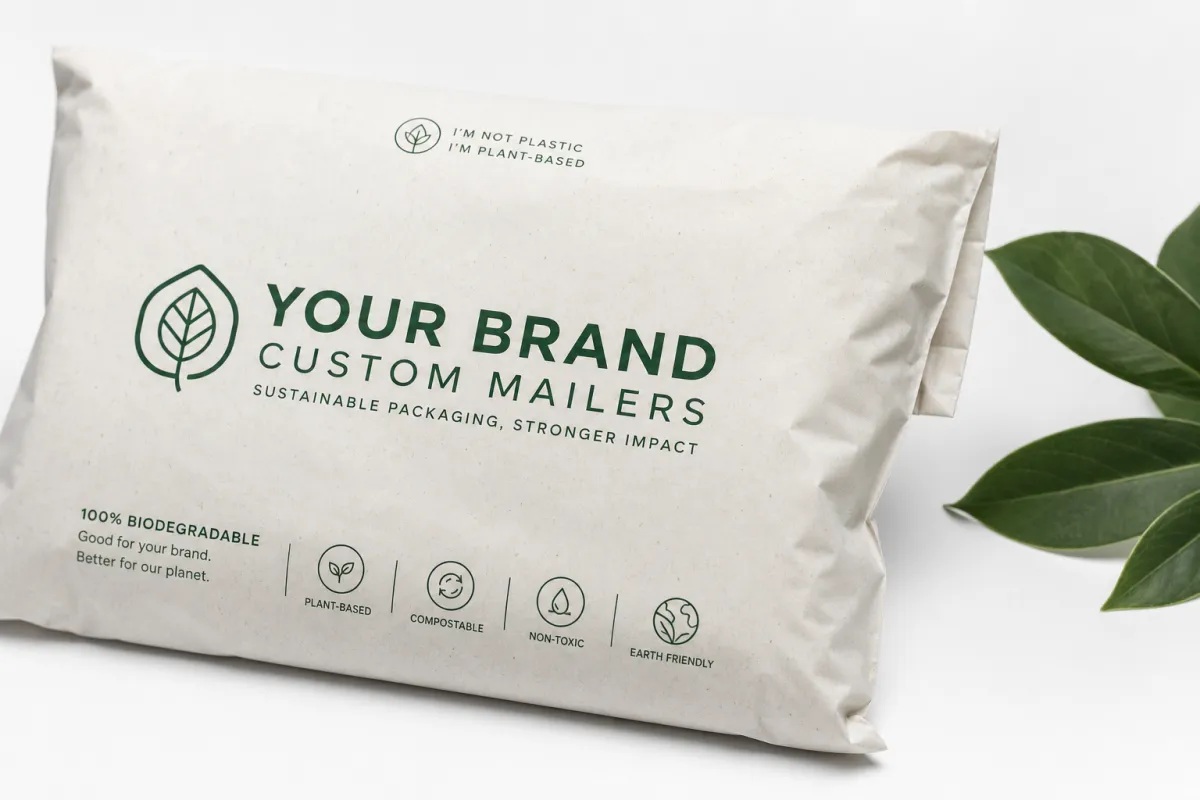
Custom biodegradable mailers branding starts with a simple fact: the mailer is often the first physical touchpoint in the customer's packaging experience. Before the product is visible, the outer shell makes a judgment call. It can read as generic shipping material or as a real branded package. That difference is not subtle. A plain eco mailer says, "We shipped this." A branded one says, "We thought this through."
Biodegradable packaging usually means the material is designed to break down under specific conditions, but that claim is not a free-for-all. Some materials are paper-based. Some are bio-based films. Some are meant for industrial composting, not a backyard bin. The branding sits on top of that material choice, and it includes the logo, typography, color palette, messaging, and the way the bag feels when someone picks it up. That is why custom biodegradable mailers branding needs both design judgment and material awareness.
A plain eco mailer can do the job, but it tends to leave too much unsaid. A branded version can signal premium, playful, clinical, wellness-focused, or retail-ready in a matter of seconds. That matters because package branding shapes the price conversation in the buyer's head. If the outer pack looks polished, the product inside gets a better opening act. If the bag looks rushed, even a good product can feel downgraded.
Good custom biodegradable mailers branding also protects trust. A pretty mailer that scuffs, curls at the edges, or tears during packing can damage the whole shipment's credibility. From a packaging buyer's point of view, the real balancing act is simple: the mailer should communicate sustainability and brand identity, but it also has to seal properly, resist abrasion, and hold up through carrier handling. That part is not glamorous, but it is the part customers actually notice when something goes wrong.
A mailer does not need to shout to feel premium. It needs to look considered, stay intact, and make the customer feel like the brand paid attention to the details that matter most.
For teams comparing other formats such as Custom Poly Mailers or even Custom Labels & Tags for inserts and returns, the mailer usually becomes the outer layer of a wider packaging system. That system should look like it belongs together, not like someone assembled it during a coffee shortage. I've seen that kind of mismatch turn a polished shipment into something oddly half-finished.
How Custom Biodegradable Mailers Branding Works
Custom biodegradable mailers branding comes together through print method, substrate behavior, and art discipline. Flexographic printing and digital printing are the usual options. Flexo tends to suit steady repeat production, while digital helps smaller runs and artwork with more moving parts. Flexo usually favors simple one- or two-color layouts. Digital gives more room for detailed graphics. The right choice depends on quantity, finish, and how the mailer is built.
Artwork has to be designed for a flexible surface. That means safe print zones, seam placement, flap areas, and the way the bag folds once it is packed. A logo that looks perfect on a flat proof can drift too close to a seal line once the artwork is mapped onto the actual bag. Keep key copy and fine detail away from seams and closure edges. Those are the spots where cracking, distortion, and partial blocking show up first. A beautiful file on a monitor is nice. A usable file on a mailer is what pays the bills.
Typography matters more on a mailer than many brands expect. The parcel is usually seen at arm's length, in motion, and often for only a few seconds. Thin type, delicate scripts, and weak contrast disappear fast. With custom biodegradable mailers branding, bold logo marks, clear sans-serif type, and a disciplined layout usually outperform crowded graphics. That is the same reason strong retail packaging reads better than decorative noise. People need to recognize the brand, not solve a visual puzzle.
The shipping experience should shape the artwork, not the other way around. Some brands place the main logo on the front panel, a short message or return note on the back, and a small surprise on the inner flap. That can be a thank-you line, a care message, a brand mantra, or a QR code that leads to product setup or recycling guidance. The trick is keeping the communication useful. Decorative copy that helps nobody just makes the mailer look busy. And yes, a hidden joke on the inside flap can be charming, but it has to be on-brand instead of weird for the sake of being weird.
Sampling matters because biodegradable substrates can react differently from coated paper or rigid packaging. Ink density, press pressure, and folding behavior all affect how the final mailer reads in real light. A sample run shows whether the branding lands cleanly, whether the closure stays strong, and whether the color still matches the approved brand system once the material is actually formed. This is where a production-friendly proof saves everybody a headache.
For sustainability claims, keep the language grounded in standards and documented proof. The U.S. EPA has a useful overview of sustainable materials guidance at EPA Sustainable Materials Management, and paper-based programs can reference fiber sourcing through FSC. Those resources do not replace supplier documentation, but they do help teams avoid vague language that sounds nice and proves nothing. If a supplier cannot back up a claim, do not print it. That part is simple.
Key Design and Material Factors That Affect Results
The substrate drives a lot of the final result. A softer mailer with a matte surface absorbs ink differently than a smoother, denser one, and that changes both color density and line sharpness. Thickness matters too. A lighter mailer can feel flexible and economical, while a heavier build, often somewhere in the 60 to 100 micron range depending on the design, usually feels sturdier and handles carrier abuse better. With custom biodegradable mailers branding, the material is never just a background. It is part of the message.
Color strategy shapes perception fast. Natural kraft-style tones read earthy and quiet. White mailers make logos pop and feel cleaner. Tinted substrates push the package toward a more premium or more distinctive visual language. Background color changes contrast, but it also changes the sustainability cue. A brand that wants a quieter, material-first look may use minimal print on a natural base. A brand aiming for a cleaner retail feel might use white with restrained color blocks. Neither is automatically better. The product, category, and brand voice decide that.
Typography, iconography, and spacing need to work harder on a moving parcel than they do on a shelf box. Customers are not studying the package for a minute. They are glancing at it while carrying groceries, opening a mail stack, or sorting deliveries at a desk. That is why custom biodegradable mailers branding tends to perform best when the hierarchy is obvious: logo first, supporting message second, secondary marks or icons third. When everything tries to compete, nothing wins.
If the customer can see the logo, understand the message, and trust the closure in one quick look, the design is doing real work. If they have to decode it, the mailer is asking too much.
Sustainability messaging has to stay clean and accurate. Claims should match the material and the certification path behind it. "Biodegradable" is not the same as "home compostable," and neither should be printed casually if the supplier cannot document the claim. That is where packaging design meets trust. Customers expect honesty from product packaging, and the shipper should not be the place where language gets slippery.
Audience fit matters just as much. A luxury beauty brand may want restrained copy, tight logo placement, and a soft color story. A subscription brand might lean into stronger graphics and a more playful unboxing experience. A wellness startup could choose a calmer, earthy look that lines up with clean ingredients and simple routines. Custom biodegradable mailers branding works best when the package feels like it belongs in the category without copying every other brand in it.
For teams deciding whether the visual language should feel more premium or more operational, a useful exercise is comparing the mailer against the rest of the system. Does it match the labels, inserts, and outer shipper language? Does it sit comfortably beside the wider brand identity? Those are the questions that keep a one-off design from feeling disconnected. A lot of packaging problems are really consistency problems wearing a fake mustache.
Material finish also changes how a design reads in the real world. A matte biodegradable mailer can make low-contrast artwork look more restrained and intentional, but it can also mute colors faster than expected. A glossier surface may brighten the print, yet it can show scuffs more obviously during transit. So the art direction and the durability choice should be made together, not in separate meetings that never talk to each other.
Cost and Pricing for Custom Biodegradable Mailers Branding
Custom biodegradable mailers branding pricing usually comes down to five variables: size, material, print colors, artwork coverage, and quantity. A small mailer with one-color branding is obviously cheaper than a larger bag with full-panel artwork and multiple setup steps. Material choice matters too. A more durable biodegradable construction can cost more up front, but it may reduce damage claims and replacements later, which changes the real cost picture.
Lower quantities almost always carry a higher unit price. Setup and plate charges do not disappear just because the run is small, so a 500-piece order can feel annoyingly expensive next to a 5,000-piece order. That is normal. What buyers sometimes miss is that a clean, simple design can keep those setup costs under control. If the artwork only needs one or two colors, custom biodegradable mailers branding can stay focused and economical without looking cheap.
Here is a practical pricing snapshot for mid-size runs. These are not universal quotes, because substrate, artwork, and shipping all move the numbers, but they are useful for planning.
| Branding Approach | Typical Use | Approx. Unit Cost at 5,000 Units | Main Tradeoff |
|---|---|---|---|
| One-color logo print | Simple, clean brand mark on a natural or white mailer | $0.18-$0.28 | Most economical, but limited visual depth |
| Two-color brand system | Logo, short copy, and a secondary graphic element | $0.24-$0.38 | Better presence, slightly higher setup complexity |
| Full-coverage artwork | Patterned or highly styled branded packaging | $0.32-$0.55 | Stronger shelf-like impact, higher print and proofing effort |
There are hidden costs worth watching. Freight can be meaningful if the mailers are bulky or the order ships in pieces. Storage matters if you overbuy and clog up floor space. Rush production can push the schedule and the budget. Even the wrong size costs money, because an undersized mailer can raise return rates while an oversized one wastes material and looks sloppy. Custom biodegradable mailers branding should fit the product the same way a good carton fits the contents: snug enough to protect, not so tight that it strains.
The value case is usually stronger than the sticker price suggests. If the mailer improves repeat purchase behavior, lowers breakage, and gives the customer a more memorable unboxing experience, the extra cents per unit can pay for themselves faster than people expect. That logic is familiar in retail packaging and custom printed boxes too. Packaging is not just a shipping expense. It is a brand touchpoint that can support revenue or quietly weaken it.
For brands comparing package formats, real examples beat guesses every time. Our Case Studies show how different packaging choices affect presentation, handling, and cost across product lines. That kind of side-by-side review is usually more useful than spreadsheet optimism, which tends to be very confident right up until the first pallet lands.
Step-by-Step Process and Timeline
The most reliable custom biodegradable mailers branding projects follow a clear workflow. Start with the brief: product size, shipping method, target audience, sustainability requirements, and the tone the mailer should set. Next comes material and size selection. After that, artwork gets adapted to a dieline or template, proofed, checked for safe zones, and reviewed for ink placement and closure areas. Once the proof is approved, sample runs or pre-production checks may follow, and then the full order moves into production.
The slowest part is rarely the press itself. It is usually the back-and-forth around artwork revisions, color approval, and sign-off from different internal stakeholders. Marketing may care about logo scale and visual impact, operations may care about fill speed and pack-out behavior, and sustainability teams may care about claim language and material documentation. Custom biodegradable mailers branding moves faster when those voices show up early instead of after the first proof already exists.
A realistic production window often lands around 12 to 15 business days after proof approval for straightforward runs, but more complex artwork, larger quantities, or sampling can stretch it further. If the design has several colors, special messaging, or tighter color matching requirements, the project can run into three or four weeks or more. That is not a flaw in the process. It is the price of getting the package right. Rushing branded packaging usually costs more than it saves.
Internal coordination makes a big difference. A packaging change can affect warehouse workflow, subscription inserts, returns handling, and even customer support questions. If the mailer will carry scannable information, return cues, or care messaging, it makes sense to align the artwork with any related inserts or labels at the same time. That is where Custom Labels & Tags can fit into the same approval cycle without spawning another round of disconnected decisions.
Launch timing matters too. Seasonal campaigns, product drops, and inventory rollouts do not leave much room for packaging surprises. A good plan builds in safety stock, proof review time, and one buffer week for corrections that will happen whether anyone likes it or not. That is especially true with custom biodegradable mailers branding, because a sustainable material choice often needs more careful validation than a generic stock bag. In shipping and packaging, the cheapest mistake is the one you catch before production starts.
For teams that want to validate performance with recognized test methods, shipping durability is often checked against ISTA procedure families, while material claims and fiber sourcing should stay tied to supplier documentation and recognized standards. That part is less glamorous than the mockup, but it saves headaches later. It also keeps everyone from arguing over a package that looked great in a mockup and terrible after two days in transit.
A lot of teams underestimate the handoff step. Once the design is approved, the real work is making sure the factory brief, proof notes, and quality expectations all say the same thing. If those documents drift apart, the final mailer can still be technically correct and practically wrong. That is how avoidable rework happens.
Common Mistakes to Avoid With Custom Biodegradable Mailers Branding
Overdesign is one of the easiest ways to wreck a good mailer. A package can only carry so much visual information before it becomes hard to read and expensive to print. Too many colors, too many slogans, and too many visual tricks usually make the bag feel cluttered instead of confident. With custom biodegradable mailers branding, restraint usually wins because the shipping environment is already noisy enough.
Choosing a fragile or undersized mailer because it looks sleek is another trap. A package that fails in transit does more damage to the brand than a plain bag ever could. If the seams split or the closure pops open, the customer does not think about the design team. They think about the inconvenience. That is where product packaging and performance need to be treated as one decision, not two separate ones.
Vague sustainability language creates credibility problems fast. If the material is compostable under industrial conditions, say that only if the supplier documentation supports it. If the fiber content is FSC-certified, state that clearly and accurately. If the mailer is simply designed to reduce waste, say that instead of dressing it up with a claim you cannot prove. Custom biodegradable mailers branding should feel honest enough that a skeptical buyer would still trust it.
Print constraints also get ignored more than they should. Tiny text, thin lines, low contrast, and artwork too close to folds all reduce readability. A design can look great on a screen and still fall apart on a flexible bag. The fix is not to erase detail. It is to prioritize what matters most: logo visibility, message hierarchy, and clean spacing. If the artwork has to survive handling, bending, and stacking, it needs to be built for those conditions from the start.
The last mistake is not testing the package with real products and real people. A mockup is not a packing line. The people filling the order may tuck items differently than the design team imagined, and the carrier may treat the shipment more roughly than the sample table did. Custom biodegradable mailers branding should be checked with actual product weight, actual pack-out speed, and actual transit conditions before the order goes live. That is how you find the weak point before customers do.
Another common miss: approving artwork before confirming the exact bag size. A logo can look centered on a PDF and still sit awkwardly once the mailer is filled and folded. That kind of problem is annoyingly common, and it is entirely preventable with one extra review. I would rather be boring in the proof stage than clever in production and wrong on arrival.
If you want a practical way to sanity-check the direction, compare it against past jobs and different formats. Seeing how similar programs were handled in our Case Studies section can help you spot whether the concept is practical or just pretty on paper. Pretty is fine. Pretty and functional is better. Pretty alone is where people start pretending problems are not real.
Expert Tips and Next Steps for a Stronger Mailer Program
My first tip is simple: pick one primary goal for the mailer. Custom biodegradable mailers branding can support sustainability, unboxing, returns, or premium perception, but if you try to make one bag do everything, the result usually feels muddled. Decide which message matters most, then build the layout around that priority. Once that is clear, the rest of the decisions get easier.
Second, order a physical sample or proof run before full production. Screen proofs are useful, but they do not tell you how the material feels, how the logo reads in daylight, or whether the closure behaves the way your warehouse needs it to. A sample also helps the team compare the mailer against other branded packaging pieces in the kit, such as inserts or outer cartons, so the whole package looks coordinated instead of improvised. If the team is still debating paper vs. film, a sample settles the argument faster than three meetings and a mood board ever will.
Third, create a short packaging checklist and keep it consistent. Include logo files, approved colors, print-ready copy, sustainability claims, safe-zone rules, and any special handling instructions. That checklist saves time every time you reorder. It also cuts the risk of a tiny artwork change turning into a production mistake. Custom biodegradable mailers branding benefits from discipline because the package gets handled quickly and repeated many times.
Fourth, compare three variables side by side: look, cost, and performance. The cheapest mailer is not always the best value, and the most decorative one is not always the smartest brand move. A mid-range option often wins because it feels polished, ships reliably, and keeps the budget under control. That middle ground is usually where practical packaging design lives. It is not flashy. It is just usually the right answer.
Here is a sensible next-step sequence for a brand that wants to improve the mailer program without making it weirdly complicated:
- Audit the current mailer for fit, print quality, and transit performance.
- Define the shipping experience you want customers to feel.
- Request samples in the sizes and material styles you are considering.
- Confirm artwork specs, closure zones, and any claim language.
- Build the next order around what customers and packing staff will actually handle.
If your team is still deciding which package format belongs in the line, reviewing Custom Poly Mailers alongside biodegradable options can clarify the tradeoffs fast. Sometimes the answer is a more sustainable outer pack. Sometimes the better answer is the one that survives the route and keeps the product looking right on arrival. The honest answer is the one that fits the business, not the one that sounds best in a meeting.
Custom biodegradable mailers branding works best when it is treated as part of the full customer journey, not as a decorative afterthought. A mailer that looks good, closes well, and supports a believable sustainability story will do more for brand trust than a louder design ever could. That is the practical side of packaging: it has to look right, feel right, and function right, all in the same handoff.
The takeaway is straightforward. Choose a material that matches your claim, build the artwork for the real bag size, and test the final mailer with actual products before you place the full order. Do that, and the branding stops being decoration and starts doing its job.
How does custom biodegradable mailers branding differ from printed poly mailers?
Biodegradable mailers are usually chosen for a more sustainability-forward material story, while Printed Poly Mailers tend to prioritize moisture resistance and toughness. The branding approach on a biodegradable substrate often needs to be simpler and more disciplined because the material can behave differently under ink and pressure. The right choice depends on the product, the shipping route, and the kind of package branding the customer should feel at first touch. If your shipment is likely to get wet or face rough handling, the tradeoff deserves a hard look instead of a wishful one.
What artwork works best for custom biodegradable mailers branding?
Bold logos, clean typography, and strong contrast usually perform best because they remain readable during handling. Simple layouts often beat crowded art, especially when folds, seams, and print zones can disrupt detail. For custom biodegradable mailers branding, artwork should be built around the mailer size and print method before final approval, not after. That usually means fewer surprises and fewer ugly compromises when the sample lands on your desk.
How long does custom biodegradable mailers branding usually take?
The timeline depends on artwork readiness, proof approvals, material availability, and order quantity. Straightforward runs may finish in about 12 to 15 business days after approval, while sampling or multiple revision rounds can extend that. Planning ahead is still the safest route because custom biodegradable mailers branding rarely fits a rushed schedule without some tradeoff. A rush order can be done, sure, but it tends to be expensive and a little irritating for everybody involved.
Is custom biodegradable mailers branding expensive for smaller brands?
It can feel expensive at low quantities because setup charges and small-run pricing affect the unit cost. Smaller brands usually control spending by limiting print colors, choosing standard sizes, and keeping the layout focused. The best value comes from custom biodegradable mailers branding that looks polished, ships reliably, and does not create avoidable damage or rework. A cheaper bag that fails twice is not cheap. It is just a different kind of expensive.
What files should I prepare for custom biodegradable mailers branding?
Vector logo files, approved brand colors, and print-ready artwork are the best starting points. A dieline or packaging template helps keep copy and logos away from folds, seams, and closure areas. It also helps to send a clear brief about the product size, shipping requirements, and any sustainability claims that need to appear on the final mailer. If you have a packaging style guide, send that too. It saves a bunch of back-and-forth later.
Can custom biodegradable mailers branding support premium positioning?
Yes, if the material, print finish, and typography all support that goal. Premium positioning is not about adding more stuff. It is about making fewer choices look intentional. A restrained logo, good color contrast, and a mailer that feels sturdy in hand can signal quality without acting like it is trying too hard. That usually reads better than shouting.

