Buyer Fit Snapshot
| Best fit | Custom Biodegradable Packaging Supplies projects where brand print, material claims, artwork control, MOQ, and repeat-order consistency need to be specified before quoting. |
|---|---|
| Quote inputs | Share finished size, material target, print colors, finish, packing count, annual reorder estimate, ship-to region, and any compliance wording. |
| Proofing check | Approve dieline scale, logo placement, barcode or warning zones, color tolerance, closure strength, and carton packing before bulk production. |
| Main risk | Vague material claims, crowded artwork, missing packing details, or unclear freight terms can make a low unit price expensive after revisions. |
Fast answer: Custom Biodegradable Packaging Supplies: Quote Scope should be specified like a repeatable production item. The safest quote records material, print method, finish, artwork proof, packing count, and reorder notes in one written spec.
Production checks before approval
Compare the actual filled-product size with the drawing, then confirm tolerance on folds, seals, hang holes, label areas, and retail display edges. Reserve space for logos, QR codes, warning copy, and material claims before decorative graphics fill the panel.
Quote comparison points
Review material grade, print process, finish, sampling route, tooling charges, carton quantity, and freight assumptions side by side. A quote is only useful when the supplier can repeat the same color, closure quality, and packing count on the next order.
Custom Biodegradable Packaging Supplies: A Practical Guide
I still remember the first time I watched Custom Biodegradable Packaging supplies run through a heat tunnel in our Shenzhen facility. One pouch looked perfectly ordinary on the table, almost suspiciously ordinary, and then the seal area puckered at 78 C and reminded everyone in the room that materials do not care about our optimism. I have seen that same moment in client meetings from a cold brew startup in Chicago to a supplements brand in Los Angeles: the idea sounds clean and simple until seal strength, barrier layers, print coverage, and shelf life all land in the same sentence and start arguing with each other.
At Custom Logo Things, I usually tell buyers to treat custom biodegradable packaging supplies as a packaging engineering decision first and a branding decision second. Honestly, I think that order matters. The right structure supports package branding, protects the product, and still fits the realities of line speed, warehouse conditions, and freight budget, which is why custom biodegradable packaging supplies deserve a careful spec sheet instead of a quick yes or no tossed out in a meeting because the mockup looked nice under office lighting.
What follows stays close to the factory floor: what the materials do, how certification language works, which price drivers show up on the quote, and where projects tend to stall. If you are comparing custom biodegradable packaging supplies against Custom Packaging Products, or lining them up with branded packaging options for a retail launch, the goal is simple: make a cleaner decision with fewer surprises and less of that annoying "why did nobody mention this before production?" feeling.
What Custom Biodegradable Packaging Supplies Really Are
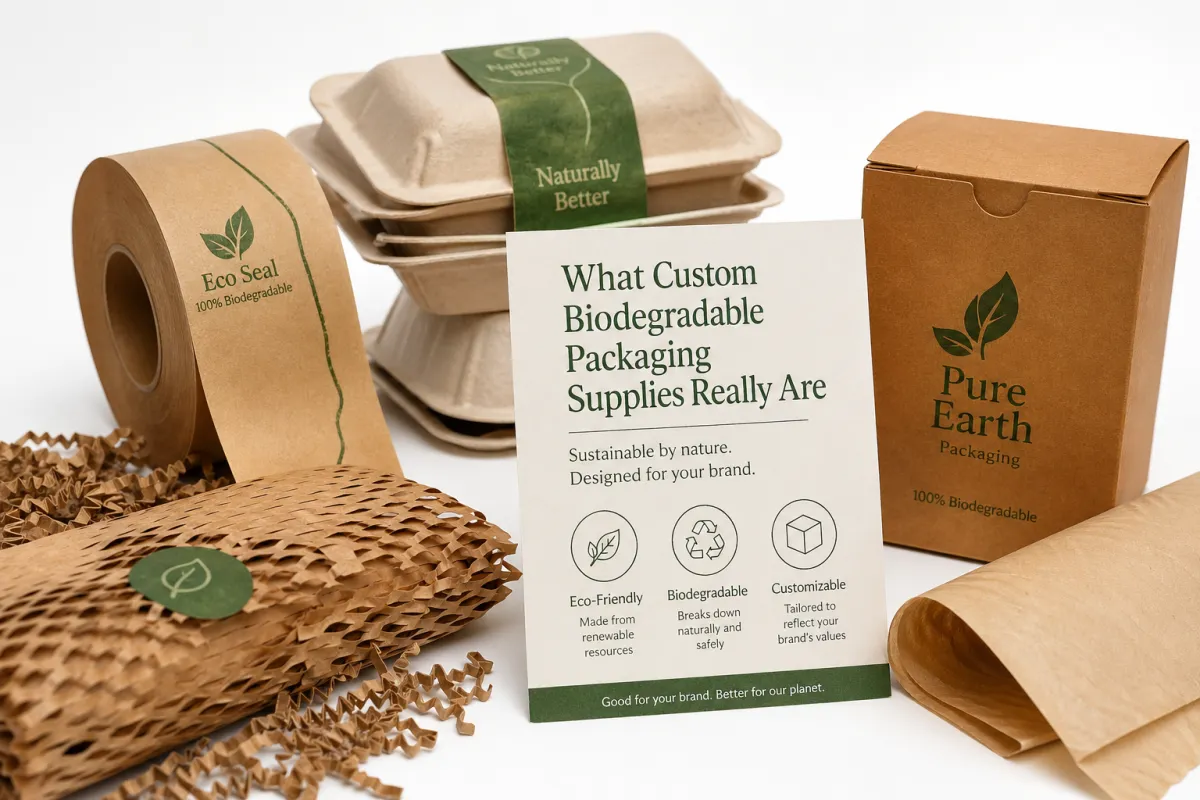
Biodegradable packaging is built from materials that can break down under the right environmental conditions, usually with heat, moisture, oxygen, and microbial activity doing the heavy lifting over time. In practice, that can mean a 60gsm kraft mailer with a starch-based lining, a 12-micron PLA window film, or a molded pulp tray pressed in Dongguan from bagasse fiber. The words on the spec sheet matter, because a pouch that degrades in an industrial composting facility in 90 to 180 days is very different from a bag that only claims it will fragment in a backyard pile after two rainy seasons.
For most buyers, custom biodegradable packaging supplies fall into three broad groups: paper-based formats, compostable films, and molded fiber structures. A 350gsm C1S artboard carton with soy-based ink can work beautifully for cosmetics, while a stand-up pouch built from 45-micron PLA and PBAT blend film may suit dry snacks better because it holds a better seal on vertical form-fill-seal lines. The right choice depends on whether the product is a 250 g granola pouch, a 30 mL serum box, or a rigid sleeve for a candle jar shipped from a warehouse in Phoenix in August.
The custom part is where the value shows up. You can specify spot varnish, debossing, water-based coating, tear notches, tamper-evident strips, or die-cut windows sized to the product at 1.5 inches by 2.25 inches instead of a generic opening that reveals too much dust and not enough of the actual item. In our Shenzhen and Ningbo factory network, that level of detail changes whether the final pack feels like a retail-ready finished object or like a compromise that arrived one revision too late.
What Should Buyers Expect From Custom Biodegradable Packaging Supplies?
Buyers should expect custom biodegradable packaging supplies to behave like real production materials, not like a virtue signal with a dieline. That means checking how the substrate folds, whether the seal survives the actual fill temperature, and how the print system behaves after stacking, transit vibration, and a few days under warehouse lighting. A compostable mailer that looks excellent on a render can still fail if the adhesive strip lifts in humid conditions or if the paper face stock scuffs too easily on a fulfillment line.
The best projects begin with a clear use case and a short list of non-negotiables. If the package must protect a dry snack, the priorities might be oxygen barrier, moisture resistance, and clean tear behavior. If it must present a skincare item, the priorities may shift toward package branding, tactile finish, and a crisp closure that feels intentional in the hand. In both cases, custom biodegradable packaging supplies need to match the product environment, not just the mood board.
That is also why sample testing matters so much. A physical prototype reveals how kraft board, compostable film, or molded fiber actually performs under pressure, and it often exposes the tiny decisions that shape the whole launch, such as insert tolerances, ink density, and whether a bagasse tray nests cleanly inside a carton from a Shenzhen line. The more closely the sample reflects production, the less likely the first shipment will become an expensive lesson in what the spec sheet left out.
There is one caveat I always give buyers: "biodegradable" is not a magic stamp that covers every use case. A material may break down in one controlled facility and sit stubbornly intact in another, and that difference is not marketing fluff, it is the reality of composting infrastructure. If your brand is making a public sustainability claim, your wording needs to match the exact certification and the region where the package will actually be disposed of.
How Custom Biodegradable Packaging Supplies Break Down
Most biodegradable packaging starts with a base substrate, then adds coatings, adhesives, inks, and closure systems that determine how it performs on the line and on the shelf. A paper mailer made in Guangzhou might use 80gsm unbleached kraft, a 12gsm compostable barrier coat, and a water-activated adhesive strip rated for cartons up to 5 kg. A pouch made in Suzhou might use a 3-layer structure with PLA, metal-free barrier film, and a matte finish that keeps fingerprints off retail displays in New York or Toronto.
The breakdown is not just technical trivia; it is the difference between a package that protects a product for 30 days and one that survives a 14-week distribution cycle through humidity swings from 35 percent to 80 percent. For coffee, tea, or nutraceuticals, oxygen transmission rate and moisture vapor transmission rate are as important as print quality. A pouch with an OTR of 10 cc/m2/day will behave very differently from one at 80 cc/m2/day, especially if the product is roasted beans packed at 450 g and expected to stay fresh through a July launch in Miami.
Manufacturing location also matters because it affects lead time, finishing options, and freight. A carton line in Shenzhen can often turn a 5,000-piece order with foil stamping and window patching in 12 to 15 business days from proof approval, while a molded pulp order from a facility in Wenzhou may need 18 to 22 business days if the tooling is new. Those numbers are not glamorous, but they are usually the ones that determine whether your launch hits a Monday shelf reset or slips into the next retail cycle.
It is also worth separating "break down" from "look like they break down." I have seen sample materials that visibly soften in a humid room and then fail certification once tested by a third-party lab. If a vendor cannot explain the resin, coating, adhesive, and print stack in plain language, that is a warning sign, not a small communication gap.
Materials, Certifications, and Performance Tradeoffs for Custom Biodegradable Packaging Supplies
Material choice starts with the product itself. Dry goods often work well in kraft paper, paperboard, or compostable film, while greasy foods, bath salts, and liquid-adjacent products need a stronger barrier layer and tighter seal control. A 320gsm SBS carton with a water-based dispersion coating can be excellent for candles and apparel, but it will not do the same job as a 45-micron PLA/PBAT pouch for dehydrated fruit sold in a 2 oz format.
Certifications add another layer of discipline. Buyers commonly ask for ASTM D6400, EN 13432, BPI certification, FSC certification for paper inputs, and ISO 9001 factory documentation. Those labels are not decorative, and they are not interchangeable. A bag can be biodegradable in theory but still fail a compostability test because the adhesive patch, ink system, or laminate layer contains a component that does not break down at the same pace as the main substrate.
There is always a tradeoff between performance and end-of-life claims. A heavy barrier pouch with a 25-micron protective layer may extend shelf life by several months, yet it can also complicate certification or raise the cost by 18 to 30 percent over a simpler paper build. In a project for a skincare brand shipping from Austin to retailers in Oregon and Colorado, we moved from a rigid 400gsm carton with a PET window to a 380gsm paperboard box with a cellulose window, which preserved the visual reveal while keeping the structure closer to compostable requirements.
Ink and finishing details matter more than many teams expect. Water-based inks and soy-based inks are often preferred for custom biodegradable packaging supplies because they reduce the chemical load, but heavy flood coverage can still affect recyclability and compostability if the print area is too dense. For a luxury tea line in London and a satellite warehouse in Los Angeles, we reduced the coverage from 85 percent to 62 percent and switched to a matte aqueous coating, which kept the premium feel without burying the board under unnecessary layers.
Not every project needs the greenest possible claim on paper. Sometimes the smartest move is choosing the structure that meets the product's shelf-life and shipping needs first, then tightening the sustainability profile where the material actually allows it. That kind of practical compromise is not a failure; it is usually what keeps a launch from turning into a messy rewrite six weeks later.
Cost, Pricing, and What Drives the Quote
Pricing usually comes down to material, print complexity, size, volume, and finishing. A simple kraft mailer might land around $0.15 per unit for 5,000 pieces, while a printed compostable stand-up pouch with a zipper closure can run closer to $0.22 to $0.38 per unit at the same quantity. Once you add embossing, custom die-cut windows, or metallic foil, the quote can move another 8 to 15 cents per piece depending on the factory and the tooling involved.
Quantity changes everything. A 1,000-piece order often carries a much higher unit cost because plate setup, die cutting, and proofing overhead get spread across fewer units, while 10,000 pieces can bring the price down quickly if the design is stable. I have seen a 350gsm C1S folding carton drop from $0.41 at 1,000 units to $0.19 at 10,000 units after the die was approved and the print run moved to a press line in Dongguan with a cleaner scheduling window.
Shipping and duty also deserve a place in the budget conversation. A pallet of flat-packed boxes from Shenzhen to Los Angeles may travel efficiently by sea freight, but a rush air shipment for 2,400 units can add several hundred dollars before the cartons are even opened. If the packaging is going to a fulfillment center in Chicago, Newark, or Dallas, it helps to compare FOB pricing, carton dimensions, and pallet count before anyone approves the artwork and assumes the quote is final.
To keep the quote honest, ask for line-item pricing on the substrate, print method, finishing, and packing method. A factory might quote a pouch at $1,250 for tooling, $0.24 per unit for 3,000 units, and a separate $85 charge for a sample set shipped by DHL from Ningbo. That level of detail makes it much easier to compare suppliers in Shenzhen, Suzhou, and Xiamen without guessing where the difference in price is actually coming from, and it helps buyers of custom biodegradable packaging supplies see whether the low bid is truly the better one.
One more practical thing: watch for quotes that hide freight inside the unit price. That can make a cheap-looking proposal feel attractive until the carton dimensions, export packing method, or destination port are finalized. A transparent quote might not be the lowest line on the page, but it is usually the one that survives comparison without surprises, which is kinda the whole point.
Process and Timeline: From Spec Sheet to Production
The process usually starts with a spec sheet that lists product dimensions, target fill weight, barrier needs, print colors, closure style, and sustainability goals. If you are ordering a carton for a 120 mL lotion bottle, the most useful notes are rarely "make it premium" and much more often "use 350gsm artboard, matte aqueous coating, one Pantone spot color, and a 0.5 mm tolerance on the insert." That kind of specificity saves at least one revision cycle, and in many cases it shortens the first proof to 2 or 3 business days.
Once the artwork is approved, sampling begins. A digital mockup may arrive within 24 hours, followed by a physical sample in 5 to 7 business days if the factory is already running similar stock in Guangzhou or Shenzhen. For custom die-cut work, especially if the project uses an unusual insert or a window patch shaped to a product silhouette, the sample window is more often 7 to 10 business days, and the first actual press proof should be checked under the same lighting you will use for retail photography.
Production timing is usually straightforward if the spec stays stable. Many carton and pouch orders are typically 12 to 15 business days from proof approval, while molded pulp and specialty structures can take 18 to 25 business days, especially if the tool is new or the coating needs a longer curing period. If you are launching in Los Angeles on a fixed retail calendar, it helps to build another 7 to 10 days for ocean transit or domestic receiving so the project is not depending on a single truck arrival to save the launch.
Quality control should happen in the factory, not only at the receiving dock. In our experience, a batch inspection in the production city, whether that is Shenzhen, Dongguan, or Wenzhou, catches print registration drift, weak seals, and off-spec board weights before the cartons are packed into export boxes. A simple checklist can verify board thickness, ink density, fold score accuracy, and compression resistance, which is especially useful when the order size is 8,000 pieces and a one-percent error rate would still create 80 rejected units.
When a project runs smoothly, it is usually because the team treated each step as a gate instead of a formality. Spec sheet, sample, press proof, production sample, and final inspection each deserve a real sign-off. Skip one, and the mistake tends to show up later, usually on a day nobody wanted to spend reprinting labels.
Common Mistakes to Avoid When Ordering
The first mistake is choosing the material before defining the product environment. A tea bag inside a dry warehouse in Denver does not need the same barrier strategy as a protein powder shipped through humid Houston in July. I have seen teams approve a compostable pouch in theory and then discover that the fill line in their Sacramento co-packer needed a different seal temperature, which changed the bond quality at the edge by enough to matter in real production.
The second mistake is treating certification language like a marketing slogan. A supplier in Shenzhen may say a film is biodegradable, but if the buyer needs EN 13432 for retail in the European Union, the paper liner, adhesive, and print system all need to be checked as a unit. That same principle applies to FSC paperboard from a mill in Zhejiang or a compostable mailer assembled in Guangdong; one noncompliant layer can undo the whole stack.
The third mistake is underestimating dielines and structural tolerances. A carton designed for a 2.5 inch jar with a 0.08 inch shoulder tolerance can fail if the insert is too tight or the fold lines are off by even 1.5 mm. That is why a sample that looks fine in a photo can still crush corners, scuff labels, or slow down fulfillment in a warehouse that processes 600 orders a day.
The fourth mistake is ignoring the real cost of iteration. A rushed change after artwork approval can add a new plate charge, a new die charge, and another 4 to 6 business days of delay. If your launch date is fixed and the packaging is part of a retail display set, it is usually cheaper to spend an extra hour reviewing the proof than to pay for an expedited air shipment from Ningbo to Chicago because a barcode was placed 6 mm too low.
The fifth mistake is assuming the same package will perform the same way in every climate. A box that holds up in San Diego can warp in a humid receiving room in Atlanta, and a compostable seal that stays tidy in winter may get soft during summer transit. These are boring details until they become expensive ones.
Expert Tips and Next Steps for a Smarter Launch
Start with a clear target use case and write the spec as if a factory engineer in Shenzhen or Suzhou will be reading it at 9:00 a.m. on a Monday, because that is usually close to the truth. Include product dimensions, fill weight, storage conditions, expected shelf life, and the exact finish you want, whether that is matte aqueous, soft-touch film, or no coating at all. A few precise numbers, such as 180 mm by 120 mm by 45 mm, will do more for the project than a page of adjectives.
If your budget is tight, choose the structure that protects the product first and reserve premium finishing for the visible surfaces. A 60gsm kraft mailer with one-color print can look sharp and still come in under $0.20 per unit at 5,000 pieces, while a fully laminated presentation box with foil, embossing, and a custom insert may be better saved for a limited run or a higher-margin product line. That approach keeps custom biodegradable packaging supplies aligned with both margin goals and brand presentation.
Always request a physical sample before placing a full order, even if the digital proof looks convincing. A sample mailed from Guangzhou or Ningbo will reveal things that screen mockups hide, such as how the fold holds, how the ink sits on the board, and whether the closure feels secure after repeated opening. I usually recommend testing the sample under actual use conditions for at least 48 hours, because a pouch that looks right on day one may reveal seal creep or panel curl after a night in a warm warehouse.
For teams planning a launch in multiple markets, build a simple timeline that includes proof approval, sample review, production, transit, and receiving. A practical schedule might be 3 days for artwork adjustments, 7 days for sampling, 12 to 15 business days for production, and 5 to 20 days for shipping depending on the route from China to the United States or Europe. That timeline is not glamorous, but it gives marketing, operations, and fulfillment one shared calendar instead of three hopeful guesses, and it keeps custom biodegradable packaging supplies tied to real launch dates instead of wishful ones.
Here is the cleanest next move I can suggest: lock the product environment first, then the material, then the certification, in that order. If those three pieces line up before artwork is finalized, the rest of the project usually behaves. Skip that sequence, and the packaging conversation tends to drift into revisions, freight surprises, and a lot of unnecessary hand-wringing.
Frequently Asked Questions
What are custom biodegradable packaging supplies used for? They are used for products that need branded protection and a lower-impact material story, including snacks, cosmetics, supplements, apparel, and mail-order kits. Common formats include 350gsm paperboard cartons, Molded Pulp Inserts, kraft mailers, and compostable pouches made from PLA or PBAT blends.
How much do custom biodegradable packaging supplies cost? Pricing varies by structure and quantity, but a basic kraft mailer can start around $0.15 per unit at 5,000 pieces, while a printed compostable pouch may sit around $0.22 to $0.38 per unit at the same quantity. Tooling, special finishes, and small orders can move the price noticeably higher, especially when the order is under 2,000 units.
How long does production usually take? For many carton and pouch projects, production typically runs 12 to 15 business days from proof approval, with molded fiber or more complex builds closer to 18 to 25 business days. Add sampling time, which is often 5 to 10 business days, and shipping from Shenzhen, Dongguan, or Ningbo to your destination warehouse.
Which certifications should I ask for? Ask for the certifications that match your market and material, such as ASTM D6400, EN 13432, BPI, FSC, and ISO 9001 documentation. If the order includes paper, film, adhesive, and ink, each layer should be checked rather than assuming one certification covers the whole package.
What material works best for premium branding? A 350gsm C1S artboard carton with matte aqueous coating, a water-based print system, and a precise die-cut insert often gives the cleanest premium look for beauty, wellness, and gift packaging. If the product needs more barrier protection, a PLA or PBAT-based pouch with a custom printed outer layer may be the better fit.
Can I get samples before I place a full order? Yes, and you should. A physical sample from a factory in Shenzhen, Guangzhou, or Ningbo will show you the real fold quality, print density, and closure behavior, which are much easier to judge on the table than in a PDF proof. Testing the sample for 24 to 48 hours usually catches the problems that photos miss.
If you are planning a launch and want Packaging That Feels careful, specific, and grounded in real manufacturing constraints, custom biodegradable packaging supplies can do that work well as long as the spec is clear and the timeline is realistic. The strongest projects I have seen were not built on vague sustainability claims; they were built on the right board weight, the right seal temperature, the right city for production, and a quote that told the truth from the start. The practical takeaway is simple: define the product conditions, verify the material stack, approve a real sample, and only then lock production, because that order saves time, money, and a fair amount of grief.

