Buyer Fit Snapshot
| Best fit | Compare Rigid Setup Boxes vs Custom Sleeves projects where brand print, material claims, artwork control, MOQ, and repeat-order consistency need to be specified before quoting. |
|---|---|
| Quote inputs | Share finished size, material target, print colors, finish, packing count, annual reorder estimate, ship-to region, and any compliance wording. |
| Proofing check | Approve dieline scale, logo placement, barcode or warning zones, color tolerance, closure strength, and carton packing before bulk production. |
| Main risk | Vague material claims, crowded artwork, missing packing details, or unclear freight terms can make a low unit price expensive after revisions. |
Fast answer: Compare Rigid Setup Boxes vs Custom Sleeves: Board, Finish, Dieline, and Unit Cost should be specified like a repeatable production item. The safest quote records material, print method, finish, artwork proof, packing count, and reorder notes in one written spec.
Production checks before approval
Compare the actual filled-product size with the drawing, then confirm tolerance on folds, seals, hang holes, label areas, and retail display edges. Reserve space for logos, QR codes, warning copy, and material claims before decorative graphics fill the panel.
Quote comparison points
Review material grade, print process, finish, sampling route, tooling charges, carton quantity, and freight assumptions side by side. A quote is only useful when the supplier can repeat the same color, closure quality, and packing count on the next order.
Compare Rigid Setup Boxes vs Custom Sleeves: Which Wins?
If you need to compare rigid setup boxes vs custom sleeves, the first quote can trick you in a way that feels almost deliberate. I remember a candle client in New Jersey who saw a sleeve quote that came in 34% lower on paper, then we added a 1.5 mm paperboard insert, hand packing, and LCL freight from Shenzhen, and the spreadsheet started telling a very different story. I have watched the same thing happen with fragrance kits, Bluetooth speaker sets, and holiday gift packs: the package that looks inexpensive in round one can become the pricey one once it meets a real packing line, a master case, and a freight invoice that actually includes fuel surcharge. That is why I keep telling buyers to compare rigid setup boxes vs custom sleeves with landed cost in hand, not just a neat unit quote from a sales email.
My rule is straightforward. Rigid setup boxes usually win when the package itself has to feel premium and protect the product with confidence, especially with items above $40 retail or components that can scratch in transit. Custom sleeves usually win when speed, flexibility, and a lower starting cost matter more, like a 5,000-piece seasonal launch or a quarterly subscription refresh. Procurement teams tend to like that kind of clarity because it gives them something concrete to price against: unit cost, damage rate, shelf impact, and approval time measured in business days, not feelings. If you are trying to compare rigid setup boxes vs custom sleeves for a launch that has to hit a hard date, that clarity matters more than the prettiest mockup.
Over the years, I have watched a 1200gsm greyboard setup box wrapped in 157gsm C1S art paper turn an ordinary serum bottle into a giftable object in one move. I have also seen a 350gsm C1S sleeve make a plain folding carton feel retail-ready in 12 business days from proof approval. Both formats can work, but the real question is what the pack has to do first: protect, impress, or move fast. That order matters more than many teams expect, especially when the line is in Dongguan and the sales team is trying to hit a retailer set date in Chicago. If you need to compare rigid setup boxes vs custom sleeves honestly, that order is usually the cleanest way to start.
Honestly, I think too many teams compare rigid setup boxes vs custom sleeves as if one format should win every time. That misses the practical part of the decision. A luxury fragrance launch in Milan, a subscription kit with four SKU changes per quarter, and a high-margin gadget sitting in a retail display in Dallas all need different packaging choices. Keep that in mind as you read. This is a buyer’s decision path, not a packaging philosophy lecture, and the numbers should guide it from the first sample through the final pallet count. The best way to compare rigid setup boxes vs custom sleeves is to keep one eye on the shelf and the other on the warehouse dock.
Which is better when you compare rigid setup boxes vs custom sleeves?
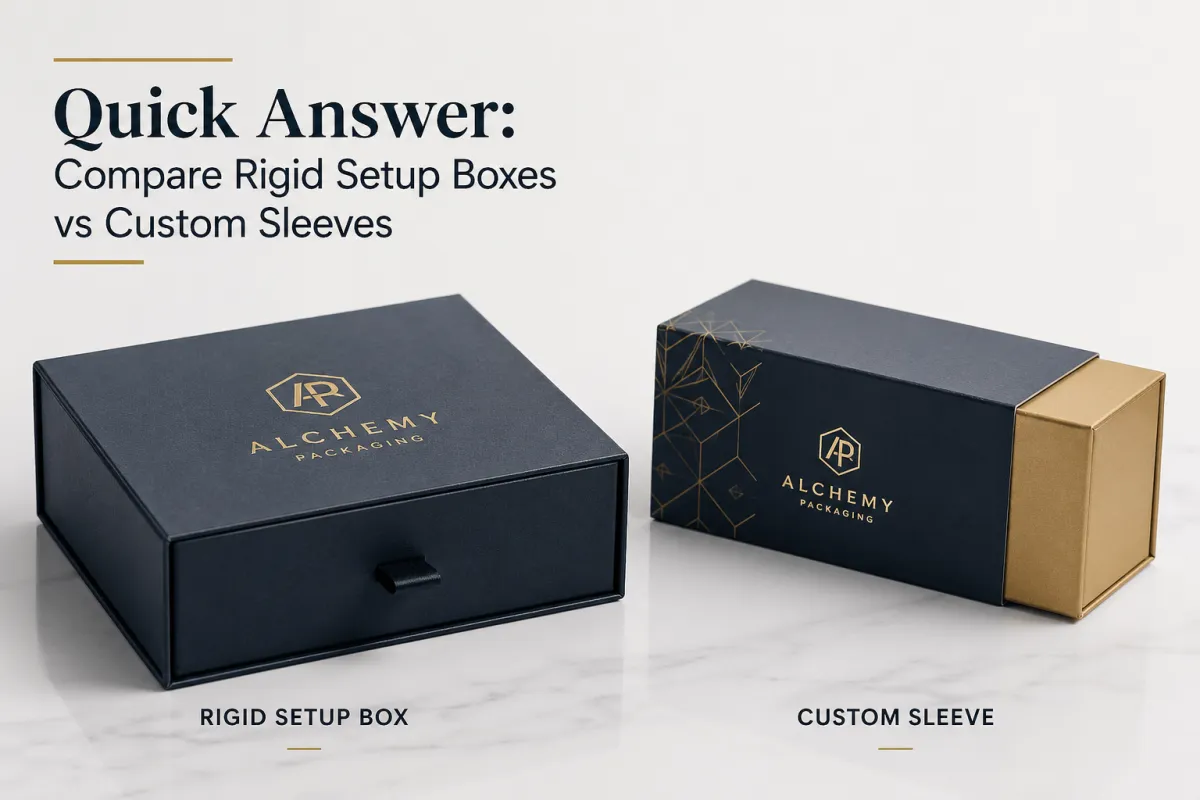
The short answer is this: if the pack itself has to signal value the second a customer touches it, rigid setup boxes usually win. If the base carton already does the structural job and you want a faster branding layer, custom sleeves usually win. I have seen that pattern hold across 3,000-piece test runs and 50,000-piece retail programs, with the biggest surprises showing up in labor and freight instead of print price. Packaging has a habit of hiding the real cost until the line starts moving at 22 units per minute, which is why it pays to compare rigid setup boxes vs custom sleeves before anyone signs off on a glossy render.
In one client meeting for a premium tea set, the buyer assumed the sleeve would be the cheap option and the rigid box would be the expensive one. On the spreadsheet, yes. On the dock in Long Beach, not always. Once we added a separate tray, molded pulp insert, and the extra cubic inches needed by the setup box, the landed cost difference shrank to 11% on a 7,500-piece order. That is why I tell teams to compare rigid setup boxes vs custom sleeves using landed cost, not just unit price. Unit price alone is the packaging version of judging a box by its lid and missing the shipping bill underneath. If you only compare quotes, you do not really compare the formats.
The simplest rule of thumb looks like this:
- Rigid setup boxes are better for luxury cues, fragile products, and gift-ready presentations with a 1200gsm to 1500gsm board build.
- Custom sleeves are better for fast branding refreshes, multiple SKU programs, and lower-risk items on 300gsm to 400gsm stock.
- Protection matters more than appearance if the item is glass, ceramic, polished metal, or a product with a lacquer finish.
- Speed matters more than structure if your existing carton is already validated, pre-punched, and stocked in your 3PL.
One more layer procurement teams should watch is storage and handling waste. A rigid setup box often takes more cube space, usually 20% to 35% more freight volume than a folded carton or sleeve-based system, especially if it includes a lid and base shipped nested. That matters if you are importing 10,000 units through a 3PL in Dallas or Rotterdam with tight pallet rules and a 48-inch pallet height limit. I have seen packaging budgets get blown up by pallet inefficiency long before the foil stamp ever entered the conversation. The warehouse rarely cares that a box is beautiful if it takes up too much room on a rack in aisle 14. That is another reason to compare rigid setup boxes vs custom sleeves with the warehouse manager in the room, not just the brand team.
So if you need a direct answer before you read further, here it is: rigid setup boxes are the safer premium choice, and custom sleeves are the faster operational choice. The right call depends on whether you are trying to protect a fragile item, elevate an unboxing moment, or refresh existing product packaging without tearing apart a working supply chain. That choice usually becomes obvious once you compare freight cube, labor minutes, and the shelf life of the artwork. If you are trying to compare rigid setup boxes vs custom sleeves for a launch next month, that operational view is the one that saves the most money.
For a deeper benchmark on transport testing, I also recommend checking the ISTA testing standards that many brands use before approving retail packaging for shipment. If a design cannot survive a 24-inch drop, vibration testing, and a hot warehouse in Phoenix, the quote price is a distraction.
Top Options Compared: Compare Rigid Setup Boxes vs Custom Sleeves
To compare rigid setup boxes vs custom sleeves properly, I separate the decision into five buying criteria: structure, print impact, assembly effort, storage footprint, and first impression. That sounds basic, but I have watched teams spend 45 minutes arguing about matte foil and spot UV while ignoring that their warehouse in Atlanta had room for only 14 pallets of finished goods. The structure of the pack changes the business math just as much as the artwork does, and sometimes more if the product is seasonal and the stock needs to turn by February 1. If your team keeps asking which format is “better,” I usually say to compare rigid setup boxes vs custom sleeves by the job each format is meant to do.
A rigid setup box is a fully built container. It usually uses greyboard or chipboard, wrapped in printed paper, fabric, or specialty stock, with the lid and base built to hold shape. Custom sleeves, by contrast, are an outer layer. They slide over an existing carton, tray, clamshell, or mailer and add branding without replacing the base structure. That difference matters because one format changes the core package, while the other upgrades it with a relatively thin layer of print and board, often just 0.4 mm to 1.0 mm thick. If you are trying to compare rigid setup boxes vs custom sleeves on construction alone, that distinction is the starting point.
In branded packaging, that distinction affects almost every downstream choice. A rigid structure supports a stronger tactile story, especially with embossing, foil stamping, magnetic closure, or soft-touch lamination. A sleeve depends on the substrate beneath it. If the base carton is flimsy, the sleeve can only disguise so much. I have seen a beautiful sleeve wrapped around a weak 250gsm folding carton feel cheap the moment a buyer squeezed the corner in a showroom in Boston. That was a very awkward silence, and it lasted long enough for the sales rep to check his watch twice. That kind of failure is why brands should compare rigid setup boxes vs custom sleeves in hand, not just on a screen.
Where each format tends to fit best is fairly predictable, though there are exceptions:
- Rigid setup boxes: cosmetics, candles, premium apparel, jewelry, collector sets, limited editions, and high-margin gifts priced above $75 retail.
- Custom sleeves: subscription kits, inner cartons, retail promos, seasonal SKUs, and line extensions with shared base packs.
- Hybrid use: rigid tray plus sleeve, or corrugated mailer plus printed sleeve for direct-to-consumer shipping from a facility in Tennessee or northern Mexico.
Here is the quick scoring framework I use in buyer meetings. Score each category from 1 to 5, then compare totals. A 5 means the format performs strongly in that category for your product line, not in theory, and not in a showroom sample that never touched a line operator’s hands.
| Buying Criteria | Rigid Setup Boxes | Custom Sleeves | What It Means in Practice |
|---|---|---|---|
| Protection | 5 | 2 | Rigid boxes usually hold shape better in transit and on shelf. |
| Premium feel | 5 | 3 to 4 | Rigid boxes create more weight and presence in hand. |
| Speed to launch | 3 | 5 | Sleeves often move faster if the base box already exists. |
| Storage efficiency | 2 | 4 to 5 | Sleeves store flat and reduce cube pressure. |
| SKU flexibility | 3 | 5 | Sleeves can refresh graphics without changing the full pack. |
| Brand drama | 5 | 3 | Rigid packs usually make a stronger first reveal. |
The category mix changes by product type. For cosmetics, the touch of a lid and the sound of closure can matter as much as the graphics. For tech accessories, a sleeve may be enough if the item sits in a well-engineered tray with a 1.2 mm insert. For apparel, a rigid box can support a premium unboxing moment, but a sleeve around a folding carton may be smarter if you expect seasonal artwork changes every 90 days or four times per year. That is why I always say to compare rigid setup boxes vs custom sleeves by product category, not by packaging label alone. A luxury pack and a fast-turn pack are not asking the supply chain to do the same work.
If sustainability optics are on your brief, do not make assumptions. A sleeve can reduce material use if it upgrades an existing carton instead of replacing it. A rigid box can still be sourced with FSC-certified paper wrap and recycled greyboard, but it will almost always use more board. For buyers who need a paper sourcing reference, the FSC certification system is the common baseline I see requested in RFPs from Toronto to Singapore. That is another reason to compare rigid setup boxes vs custom sleeves with material data in front of you, not just a render.
One more practical point: sleeve programs often get faster design approvals because the die line is simpler. A rigid pack can take more rounds of structural alignment, especially if the insert, closure, and lid depth all interact. That means the best fit is rarely just the cheapest looking quote. The better choice is the one that fits your supply chain, artwork calendar, and sales story, especially if your manufacturing partner is in Ningbo, Ho Chi Minh City, or Guadalajara and the calendar is already tight. In real terms, that is often the difference between a calm launch and a long week.
Detailed Reviews: What Buyers Actually Experience
To compare rigid setup boxes vs custom sleeves from the buyer’s chair, I start with the part most spec sheets ignore: how the pack feels after 500 units have been packed by hand on a Tuesday afternoon. That sounds small, but it is often the point where a design succeeds or falls apart. The difference between a packaging concept and a production reality shows up in speed, rejection rate, and whether the line supervisor starts calling the supplier before lunch. And yes, that usually happens if the carton is fighting the operator. If you want a useful answer when you compare rigid setup boxes vs custom sleeves, the line speed tells the truth faster than any sales deck.
Rigid setup boxes give you structure, weight, and a better chance of surviving crush events. In one factory floor visit near Dongguan, I watched a luxury skincare run use 1200gsm greyboard with a 157gsm printed wrap and EVA inserts cut to 3 mm thickness. The boxes looked excellent. They also took more dock space, and the packers needed a minute to align each insert before closing the lid. That minute mattered. At 4,000 units, it added nearly 67 labor hours across the run. Nobody on that line was applauding the elegant structure by hour six, especially when the humidity sat at 78% and the glue set time slowed down. If you are going to compare rigid setup boxes vs custom sleeves fairly, labor hours like that belong in the model.
The buyer benefits are real, though. Premium unboxing is stronger, the box resists corner damage better, and the product looks more protected before the customer even opens it. For high-value retail packaging, that perception can support a higher price point. I have seen a perfume line move from a plain folding carton to a rigid box and add 12% to average order value because the package finally matched the product margin. The packaging stopped under-selling the product, which is a pretty useful outcome when the retail price sits at $88 and the customer expects a little ceremony. That is usually where rigid construction earns its keep when you compare rigid setup boxes vs custom sleeves for premium products.
Custom sleeves tell a different story. They are not a substitute for a weak base pack; they are an upgrade layer. If the underlying carton is solid, a sleeve can add color blocking, seasonal messaging, limited-edition graphics, QR codes, and bilingual copy without redesigning the whole structure. That makes sleeves especially useful in product packaging programs that change often. One client in a subscription business used the same base mailer for 8 months and only swapped the sleeves quarterly. Their print admin got simpler, their warehouse stopped carrying three separate box builds, and their reordering cycle moved from 6 weeks to 3 weeks for the graphic layer alone. That is the kind of operational calm that often makes sleeves the better answer when brands compare rigid setup boxes vs custom sleeves for recurring campaigns.
The limits are just as clear. Sleeves do not protect edges, corners, or contents. A sleeve can hide a simple carton, but it cannot fix a bad one. I once saw a launch where the sleeve stock was only 250gsm and the base carton was slightly oversized by 2 mm on the width. On shelf, the whole thing looked loose, almost tired. The buyer said it felt like “a costume over a box,” and, frankly, that was a better description than any polished report could give. The product itself was good; the packaging was just not doing enough work. That kind of mismatch is exactly why teams should compare rigid setup boxes vs custom sleeves with a real sample in hand.
Print and finish options also differ in practice. Rigid setup boxes are better suited to foil stamping, embossing, debossing, textured wraps, and spot UV because the surface usually supports stronger premium treatments. Sleeves can use many of the same effects, but the visual payoff depends on the base pack underneath. If the substrate is inconsistent, the finish loses force. In packaging design, the wrapper cannot carry every burden. I know that sounds obvious, but I have watched more than one brand try to make a sleeve do the work of an entire structure, including one project in Verona where the client wanted premium finish cues on a carton that flexed at the corners. That is another reason I tell teams to compare rigid setup boxes vs custom sleeves in the same room with the same product.
Assembly is another place where real life gets messy. Rigid setup boxes may arrive pre-formed, but they still require careful filling, insert placement, and closure management. Sleeves can be applied fast, sometimes in one motion, yet complexity returns if you are pairing a single sleeve design with multiple carton sizes. I have seen teams save 18 seconds per unit with a sleeve, then lose that gain because they were sorting three box sizes on the line. That kind of “efficiency” has a nasty sense of humor, especially at 1,200 units per hour when the bins are labeled too loosely. If you need to compare rigid setup boxes vs custom sleeves for a live production line, the assembly step is where the spreadsheet usually gets corrected.
That is the part buyers often miss: the format that looks simpler on paper can become more complex in operations. If your team handles 6 SKUs, a sleeve system may be easy. If you handle 36 SKUs with frequent art changes, the same system can turn into a labeling puzzle. That is why I keep returning to the phrase compare rigid setup boxes vs custom sleeves rather than choosing one by instinct. Instinct is nice; line reality is better, particularly when the packaging is being assembled in Monterrey or Chennai by a contract packer who charges by the hour.
“The sleeve looked cheaper until we paid for the extra packing step and the shrinkage from misfit cartons,” a procurement manager told me after her first pilot run in 2023. She was not exaggerating. Her landed cost moved by 14% once labor and waste were counted properly, and the mistake showed up fastest in the carton tally at the end of shift.
If you want a clean product launch, both formats can work. The package still has to fit the product, the line, and the shelf. That is the real review. Everything else is decoration around the numbers, even when the decoration uses foil, embossing, or a spot varnish that looks great under showroom lighting in Los Angeles. And if you plan to compare rigid setup boxes vs custom sleeves for future SKUs as well, that same review should include your next product wave, not just the current one.
Price Comparison and Total Cost of Ownership
Pricing is where teams usually make their first mistake. They ask for unit quotes, compare them, and stop there. To compare rigid setup boxes vs custom sleeves properly, you need to add tooling, finishing, freight, storage, and packing labor. A $0.22 sleeve that reduces handling time can outperform a $0.58 rigid box if the base carton is already doing the heavy lifting. The reverse is also true when product damage is expensive. The quote is only the opening line, not the whole story, especially once the carton crosses an ocean and lands in a warehouse with hourly labor. If you only look at the print line, you do not really compare rigid setup boxes vs custom sleeves; you compare two sticker prices and hope the rest behaves.
As a rough commercial benchmark, I usually see rigid setup boxes quote anywhere from $0.45 to $1.80 per unit at mid-volume, depending on board grade, wrap material, insert complexity, and finish count. At 5,000 units, a soft-touch rigid box with foil detail might land around $0.92 to $1.25 each, and a more elaborate set with a magnetic closure and printed EVA insert can go higher. Custom sleeves are often cheaper at the starting line, with many programs landing between $0.10 and $0.38 per sleeve at 5,000 pieces, especially if the sleeve is printed on 350gsm C1S artboard or 400gsm coated kraft board. Those are not fixed prices. They move with size, market, and finish count, and they can swing quickly if the paper mill in Asia raises board prices by 3% or the freight lane gets tight. That is why a good buyer uses the same benchmark every time they compare rigid setup boxes vs custom sleeves.
Here is what people miss in a price conversation: a rigid setup box often carries more freight cost because the structure ships with greater cube, and finished goods take more shelf room before they leave the warehouse. A sleeve ships flat. That means you may save on inbound volume, pallet density, and storage, especially if you order 10,000 to 25,000 units at a time and store them in Louisville or Tilburg. In one negotiation with a supplier in South China, we cut freight spend by 17% simply by switching the outer branding layer from rigid to sleeve on a product family that already used a strong folding carton. That was one of those rare moments where the numbers behaved themselves. It also showed that the best way to compare rigid setup boxes vs custom sleeves is often to ask how much the existing carton already contributes.
Another hidden cost is damage replacement. If the product is fragile and the outer pack is weak, the replacement cost can exceed the packaging savings by a wide margin. I have seen a glass home-fragrance line save $0.31 per unit by changing packaging, then lose $0.74 per shipped unit to breakage and customer service credits. That math does not take long to fix once you see it. Rigid setup boxes usually reduce that risk, but only if the insert and closure are correctly engineered. A premium box with a sloppy insert is just expensive cardboard wearing a tuxedo, and the tuxedo still needs to survive the UPS sorter. When teams compare rigid setup boxes vs custom sleeves for fragile items, damage cost belongs in the first row of the sheet, not the last.
To make the difference easier to scan, here is a simple cost view:
| Cost Factor | Rigid Setup Boxes | Custom Sleeves | Buyer Impact |
|---|---|---|---|
| Unit price | Higher | Lower | Sleeves often win on sticker price. |
| Material usage | Higher | Lower | Rigid boxes use more board and wrap stock. |
| Freight cube | Higher | Lower | Sleeves store and ship flat. |
| Labor impact | Medium to high | Low to medium | Depends on insert count and SKU complexity. |
| Damage cost | Lower | Higher or variable | Rigid wins if the product is fragile. |
| Brand value | Higher | Medium to high | Rigid carries a stronger premium signal. |
The real answer is total cost of ownership. If packaging is part of the selling price, premium construction can pay back. If the pack is just there to identify the item and keep the line moving, sleeves often deliver the better return. That is why buyers should always compare rigid setup boxes vs custom sleeves after freight, storage, and labor are added in, not before. The cheap-looking option can turn expensive very quickly once the warehouse gets involved, especially if the cartons are being pulled from a high-rack system in New Jersey.
Also, do not forget minimum order quantities. A rigid setup box program might require a higher MOQ if specialty finishing or custom inserts are involved. Sleeves can sometimes start smaller, which helps if you are testing a new channel, launching a limited edition, or reacting to a retail chain’s 6-week sell-in deadline. I have seen fast-moving brands avoid dead stock simply by using sleeves for the first market trial. That kind of restraint can save a lot of pain later, especially when sell-through is uncertain and the retailer wants a second design in 45 days. When you compare rigid setup boxes vs custom sleeves this way, MOQ becomes a strategy question, not just a factory requirement.
One last commercial detail: if you are building a branded packaging line across several sizes, sleeves can help unify the look while keeping each base carton standard. That can reduce SKU chaos. By contrast, a rigid setup box family can create a premium presence but may require more space, more capital, and more planning across the warehouse floor. I like nice packaging as much as the next person, but I also like not paying for unnecessary pallet space in a facility that already runs at 92% occupancy. That is another place where compare rigid setup boxes vs custom sleeves can sharpen both the design and the budget.
Process and Timeline: Compare Rigid Setup Boxes vs Custom Sleeves
The production timeline is usually faster for sleeves, but only if the base carton is already approved. That is why I tell teams to compare rigid setup boxes vs custom sleeves only after confirming what already exists in the supply chain. If the carton is stable, the sleeve can become a smart update layer. If the carton is still under review, the sleeve advantage shrinks quickly. Packaging timelines have a habit of punishing half-finished planning, especially when the sample ship date is already on a Friday. If your schedule is tight, the practical way to compare rigid setup boxes vs custom sleeves is to start with what can be approved in the least number of steps.
A rigid setup box project often starts with dimensions, board grade, liner choice, wrap stock, closure method, and insert planning. That is at least 5 decisions before artwork even becomes final. A sleeve project may only need dieline fit, artwork positioning, stock selection, and finishing. Fewer structural variables usually means fewer revisions. On paper, that saves time. In practice, it also saves calls. I have sat through 9-round approval chains on rigid structures and 3-round approval chains on sleeves, and the difference in calendar days can be the difference between shipping from Qingdao in March or missing a spring retail reset entirely. That is the kind of detail that makes people compare rigid setup boxes vs custom sleeves with a calendar in one hand and a ruler in the other.
Here is a common timeline I see in the field:
- Brief and dimensions: 1 to 3 business days.
- Dieline and structural review: 2 to 5 business days.
- Artwork proofing: 2 to 4 business days.
- Sampling and color approval: 5 to 10 business days.
- Production: 7 to 18 business days after approval.
Rigid setup boxes generally sit on the longer end of that range because construction and finishing take more coordination. A sleeve project may finish faster if the base pack exists and the printer can move immediately into sampling. I have seen custom sleeves ship in 12 to 15 business days from proof approval when the dieline was already locked and the artwork changes were minor. I have also seen rigid boxes take 4 extra days because the insert fit was off by 2 millimeters. Two millimeters. Not glamorous, but it matters more than any mood board ever will. Anyone who has had to compare rigid setup boxes vs custom sleeves after a fit issue knows exactly how expensive those two millimeters can become.
Delay points are predictable. Dieline revisions eat time. Color proof approval eats time. Last-minute size changes eat time. The most painful delay I have seen came from a buyer who changed the bottle height after the carton was signed off by the plant in Vietnam. The rigid structure had to be rebuilt, and the whole launch slipped by 11 business days. The sleeve version would have survived that same change with much less pain, which is one reason sleeves are so useful for fast-moving product packaging programs and for brands that still finalize SKUs two weeks before print. If you need to compare rigid setup boxes vs custom sleeves for a volatile launch calendar, flexibility is worth real money.
Assembly testing matters too. If a rigid setup box uses a magnetic closure, a ribbon pull, or a complex insert, test the line speed before ordering 20,000 units. If a sleeve has to glide over a carton that varies by even 1.5 millimeters, test fit before you approve the artwork. In packaging design, a tiny tolerance miss becomes a very large labor problem very quickly. I have seen people lose an afternoon over a fraction of a millimeter in a plant outside Shenzhen, which is not how anyone wants to spend a production review. That small mismatch is a good reminder to compare rigid setup boxes vs custom sleeves with production tolerances in the same conversation.
Procurement teams also need to think about change control. A rigid box program often locks a design for a longer period. A sleeve program can absorb seasonal artwork swaps, retailer-specific messaging, and market-by-market language changes with less disruption. That is why, in high-SKU environments, I often see buyers compare rigid setup boxes vs custom sleeves and pick the sleeve for the first launch, then revisit rigid structure once sales volume proves the concept and the reorder forecast is stable for at least two quarters.
One practical tip: ask for a sample run and a line test before you approve the full order. Use actual operators, actual product, and actual packing pace. Fifteen minutes on a demo table does not tell you much. Forty minutes on a real line in a facility in Ohio or Penang tells you almost everything, including whether the adhesive timing and closure sequence fit the team’s actual work rhythm. That test is often what turns a guess into a decision when you compare rigid setup boxes vs custom sleeves.
How do you compare rigid setup boxes vs custom sleeves?
The best way to compare rigid setup boxes vs custom sleeves is to ask four questions in order: how fragile is the product, how premium must the package feel, how fast is the launch, and how many SKUs are in play? I have used that four-question filter in client meetings from boutique fragrance houses in Paris to industrial electronics brands in Chicago, and it usually cuts the debate in half. Sometimes it ends the debate entirely, which is refreshing when the marketing team and the buyer have been in the room for 40 minutes already.
Choose rigid setup boxes if protection, luxury perception, and giftability matter most. A $120 fragrance set, a jewelry assortment, or a collector’s edition with multiple components usually deserves a structure that feels substantial in hand. The box becomes part of the product story. I have seen sales teams close larger wholesale deals after replacing a thin carton with a rigid presentation box because buyers could feel the upgrade immediately. Humans are tactile creatures, and packaging knows it. A box with a 1400gsm board base and a 157gsm textured wrap can change the whole impression in less than 3 seconds. That is often the strongest argument when teams compare rigid setup boxes vs custom sleeves for high-margin goods.
Choose custom sleeves if the base pack already performs well and your main need is branding agility. That can mean a retail refresh, a market test, or a seasonal promotion that only runs for 8 weeks. Sleeves are also smart for subscription programs because they let you change messaging without retooling the whole box system. If your team cares about package branding but not a full rebuild, a sleeve is often the cleaner path, especially when the base carton is already sourced from a supplier in Shenzhen or Monterrey. In practical terms, that is why many teams compare rigid setup boxes vs custom sleeves and use sleeves for the first wave.
Scenario by scenario, the answer shifts:
- Retail shelf: sleeves work if the base carton is strong and the shelf face is crowded; rigid works if premium signaling matters more.
- Direct-to-consumer shipping: rigid works for fragile, high-value items; sleeves work on top of a durable mailer or carton.
- Subscription: sleeves usually win because seasonal changes are frequent and SKU counts are high.
- Seasonal gifts: rigid usually wins because the box itself helps sell the item.
There is also a sustainability lens, and it should be handled carefully. A sleeve can be the lower-material option if it upgrades an existing carton, but only if the carton stays in use. A rigid box can still use FSC-certified wrap stock and responsible paper sources, but it will often require more raw material. Buyers should ask for specification sheets, recycled content data, and end-of-life guidance rather than making a guess based on appearance. Pretty is not the same thing as responsible, even though brands sometimes act like those are twins. If sustainability is part of the brief, make it one of the first things you use to compare rigid setup boxes vs custom sleeves.
If you are building a line from scratch, I would ask your supplier to show both versions side by side. At Custom Packaging Products, that usually means reviewing custom printed boxes, sleeve formats, and the inserts or inner cartons that affect the final landed cost. The best comparison is not theoretical; it is physical. Put the samples on a table in daylight, pick them up, and open them twice. The second opening tells you a lot about what the first glance missed, especially if the lid fit is tight and the print registration is clean. That hands-on step is where many teams finally compare rigid setup boxes vs custom sleeves with confidence instead of opinion.
I also recommend testing three things before you decide: shelf appearance, packing speed, and drop performance. A format that looks great on a render can still fail at a 36-inch drop or slow a line by 9 seconds per pack. That is the sort of detail that changes profit, not just presentation. If the packaging is meant to support a $50 retail price, those seconds and drop scores start to matter very quickly. A careful buyer will always compare rigid setup boxes vs custom sleeves against those practical thresholds.
So if you need my direct answer after years of watching this play out, here it is: rigid setup boxes win when the box is part of the premium promise, and custom sleeves win when the base pack already works and speed matters more. That is the cleanest way to compare rigid setup boxes vs custom sleeves without getting trapped by a quote sheet, a mockup render, or a salesman’s best-case sample.
Practical Takeaway
My recommendation is practical, not romantic. Choose rigid when the package has to carry the brand story on its own. Choose sleeves when the base carton already solves protection and you need the fastest path to a refreshed look. If I had to compare rigid setup boxes vs custom sleeves for a high-margin retail launch, I would look first at how much unboxing value the package needs to create in the first 10 seconds. That first contact is where the money either feels justified or awkward, especially when the product is sitting at a premium shelf price of $68 or more.
I have a memory from a supplier negotiation in Guangdong that still guides my thinking. The buyer wanted the cheaper option, but after we mapped freight cube, line labor, and replacement risk, the sleeve-based system only made sense if the base carton stayed in production for at least 18 months. Once that condition was clear, the decision became obvious. That is the kind of detail teams should document before they sign anything. It saves a lot of “wait, why is this costing more?” meetings later, particularly when the annual forecast gets revised in Q2. It also shows why you should compare rigid setup boxes vs custom sleeves using real operational assumptions, not just preferred aesthetics.
Use a side-by-side sample test with one fragile item, one shelf-ready item, and one giftable item. Measure assembly time to the nearest minute. Check the fit with actual operators. Ask for dielines, minimum order quantities, freight estimates, and proof timelines. If you are comparing vendors, ask them to quote the same finish levels so you are not mixing apples and oranges. A soft-touch rigid box and a plain sleeve are not equivalent products, even if both carry the same logo and both arrive in the same branded carton master. That side-by-side is still the most honest way to compare rigid setup boxes vs custom sleeves.
The last thing I would suggest is a short pilot run. Fifty or 100 units are enough to reveal the real issues: buckling, scuffing, misregistration, slow packing, and customer reaction. That pilot will tell you more than a 30-minute sales demo ever will. If you need to move fast, keep the first order narrow, then expand once the packaging proves itself in the warehouse and on the shelf. I have seen pilot runs save brands from 5,000 units of regret more than once. That small test is usually the difference between an informed decision and a costly assumption when teams compare rigid setup boxes vs custom sleeves.
For teams that want premium presentation plus operational control, there is often a middle path: use rigid setup boxes for hero products and custom sleeves for line extensions or seasonal variants. That mixed strategy can reduce risk while preserving brand consistency. It also gives your buying team room to negotiate material grades and print finishes without forcing every SKU into the same structure. I like that kind of balance because it feels grown-up, and because it usually survives contact with the warehouse in a way that one-size-fits-all packaging rarely does.
So here is the clean takeaway: compare rigid setup boxes vs custom sleeves using sample kits, landed cost, and a small pilot before you commit to scale. If the product is fragile or the unboxing moment is part of the value, go rigid. If the base carton already works and the calendar is tight, go with sleeves. If the numbers point one way and the sample feels another, trust the pilot data from the plant in Mexico or Malaysia before you trust the render. That rule has saved more launches than any trend I have seen.
Are rigid setup boxes better than custom sleeves for premium retail products?
Rigid setup boxes usually deliver the stronger premium cue because a 1200gsm to 1500gsm structure feels substantial in hand and protects corners better in transit. Custom sleeves can still look high-end if the base carton is well made, the print is sharp, and the finish is consistent on 350gsm or heavier stock. If shelf presence and unboxing matter most for a product priced above $60, rigid is usually the safer bet. That is why many brands first compare rigid setup boxes vs custom sleeves with the premium shelf in mind.
Which option is usually cheaper when you compare rigid setup boxes vs custom sleeves?
Custom sleeves are often cheaper to start, especially if you already have a carton or tray in production and the sleeve prints on 300gsm to 400gsm board. Rigid setup boxes tend to cost more because they use more board, more construction, and more freight space, with many 5,000-piece runs landing around $0.92 to $1.25 each. The cheapest option on paper is not always the cheapest after labor, storage, and damage are included. When buyers compare rigid setup boxes vs custom sleeves, that total cost view usually changes the answer.
How long does production take for rigid setup boxes versus custom sleeves?
Custom sleeves are often faster because they can be added to an existing packaging structure, and I have seen them ship in 12 to 15 business days from proof approval when the dieline is already locked. Rigid setup boxes usually take longer due to structural approval, insert fit, and finish decisions, with production often sitting in the 7 to 18 business day range after approval. Exact timing depends on sampling, proof speed, and whether your supplier is in Dongguan, Ningbo, or another manufacturing hub. That timing gap is one of the clearest reasons to compare rigid setup boxes vs custom sleeves before your launch calendar gets tight.
Can I use custom sleeves on my existing stock boxes?
Yes, if the box size is consistent and the sleeve is designed to fit cleanly without buckling or scuffing. This is one of the strongest use cases for sleeves because it refreshes branding without replacing the whole package, and it often works best when the carton tolerance stays within 1 to 2 mm. You should test fit, print registration, and how the sleeve holds up during shipping and shelf handling Before You Order 10,000 pieces. For brands trying to compare rigid setup boxes vs custom sleeves on an existing line, the sleeve often becomes the faster path.
What should I test before deciding between rigid setup boxes and custom sleeves?
Test drop protection, shelf appearance, assembly time, and the feel of the unboxing moment using real products and a real packing team. Compare landed cost, not just unit price, so freight and labor are included, and ask for the exact quote at 5,000 pieces and again at 25,000 pieces. If possible, run a small pilot in the same warehouse that will ship the full order, because the difference between a sample table and a live line is often where the answer becomes clear. That is the most reliable way to compare rigid setup boxes vs custom sleeves without guessing.