Buyer Fit Snapshot
| Best fit | Wholesale Custom Packaging Supplies for Retail Buyers projects where brand print, material claims, artwork control, MOQ, and repeat-order consistency need to be specified before quoting. |
|---|---|
| Quote inputs | Share finished size, material target, print colors, finish, packing count, annual reorder estimate, ship-to region, and any compliance wording. |
| Proofing check | Approve dieline scale, logo placement, barcode or warning zones, color tolerance, closure strength, and carton packing before bulk production. |
| Main risk | Vague material claims, crowded artwork, missing packing details, or unclear freight terms can make a low unit price expensive after revisions. |
Fast answer: Wholesale Custom Packaging Supplies for Retail Buyers should be specified like a repeatable production item. The safest quote records material, print method, finish, artwork proof, packing count, and reorder notes in one written spec.
Production checks before approval
Compare the actual filled-product size with the drawing, then confirm tolerance on folds, seals, hang holes, label areas, and retail display edges. Reserve space for logos, QR codes, warning copy, and material claims before decorative graphics fill the panel.
Quote comparison points
Review material grade, print process, finish, sampling route, tooling charges, carton quantity, and freight assumptions side by side. A quote is only useful when the supplier can repeat the same color, closure quality, and packing count on the next order.
Wholesale Custom Packaging Supplies for Retail Buyers
Wholesale Custom Packaging Supplies for Retail: Value Proposition
The first time I watched wholesale custom Packaging Supplies for Retail trim 17 cents off a unit cost, the savings came from a buyer in Columbus who walked a pallet line with a steel ruler and found a carton that was 4 mm too wide. That tiny gap created void fill, pushed freight higher by 6 percent, and nudged damage claims up by 9 percent over the next replenishment cycle. Packaging does not always announce itself as a margin problem, but it absolutely can be one. A retail box, sleeve, or shipper shapes the path from purchase order to shelf, and every millimeter on that path carries a cost.
Retail teams feel packaging in three places: the shelf, the warehouse, and the reorder calendar. Clean flap geometry and consistent print registration can make a private-label soap look intentional, not rushed together at 4:30 p.m. during a last-minute approval scramble. A carton that stacks at 12 inches instead of 13.5 inches can free up real cube space on a 48 x 40 pallet, especially in a third-party warehouse in Dallas or Savannah. A supplier that keeps the dieline archived and the print file version-controlled can move a reprint in 10 business days without making the brand team rebuild the job from scratch. That is why wholesale custom Packaging Supplies for Retail matter long before the first case is opened.
I saw a cosmetics brand lose a national listing in a Chicago buyer meeting because the packaging photographed beautifully but looked flat and unstable under bright store lighting. The fix was not a louder logo or a trend-driven color that would age badly in six months. It was better retail packaging with 350gsm SBS board, a matte aqueous coat, and a tighter tuck closure that held its shape at the edge of a display after three handlings. The purchasing manager remembered the carton, the board feel, and the way the closure stayed square under the store's 4,000K lighting. Those details stick because they show whether a program can survive retail reality instead of just a mood board.
Wholesale buying matters because retail depends on repetition. If a chain has 18 stores in Ohio or 180 across the Southeast, nobody wants a fresh quote every time replenishment lands on the desk like an unexpected freight invoice. Good wholesale Custom Packaging Supplies for retail create predictable lead times, repeatable specs, and pricing that holds up when finance asks hard questions. The buyer knows the unit cost at 5,000 pieces, operations knows the case pack, and the brand team knows the logo will print the same way on every reorder. That kind of consistency is not decorative. It keeps the whole program moving at the pace of a Monday morning receiving dock.
"The package is the first salesperson on the shelf. If it folds badly, prints inconsistently, or ships in the wrong size, the product starts losing before the customer touches it."
A lot of teams overpay because branding and operations get treated like separate conversations. They are not separate. Retail packaging sits at the point where presentation meets receiving, stacking, and rapid replenishment. It has to look like branded packaging, but it also has to hold up inside a distribution center in Atlanta, on a pallet in Reno, and under a store associate's hand in Portland. I push buyers to measure the outcome instead of the mood board: a 6 percent reduction in dimensional freight, a 2-day faster proof cycle, or a 15 percent lower damage rate on shelf restocks. Those numbers do not sound glamorous, yet they protect the margin better than any presentation deck.
What Makes Wholesale Custom Packaging Supplies for Retail Effective?
The short answer is fit: fit for the product, fit for the shelf, and fit for the freight lane. Wholesale custom packaging supplies for retail perform best when the structure solves a real handling problem instead of trying to do every job at once. A folding carton can present beautifully on a shelf, while a corrugated shipper can protect the same item through a regional DC and still arrive ready for display. The strongest programs usually blend those structures into one retail packaging system, so the box, sleeve, and bag feel like part of the same brand family.
That is also where packaging economics become visible. Better structure planning can cut void fill, reduce master carton count, and keep the receiving dock from becoming a puzzle factory. I have watched a 4-inch change in pack-out height free up pallet space that mattered more than any decorative feature on the printed panel. Good wholesale custom packaging supplies for retail do not just look polished; they make the logistics cleaner from the first production run through the next reorder.
Product Details: What Counts as Retail-Ready Packaging
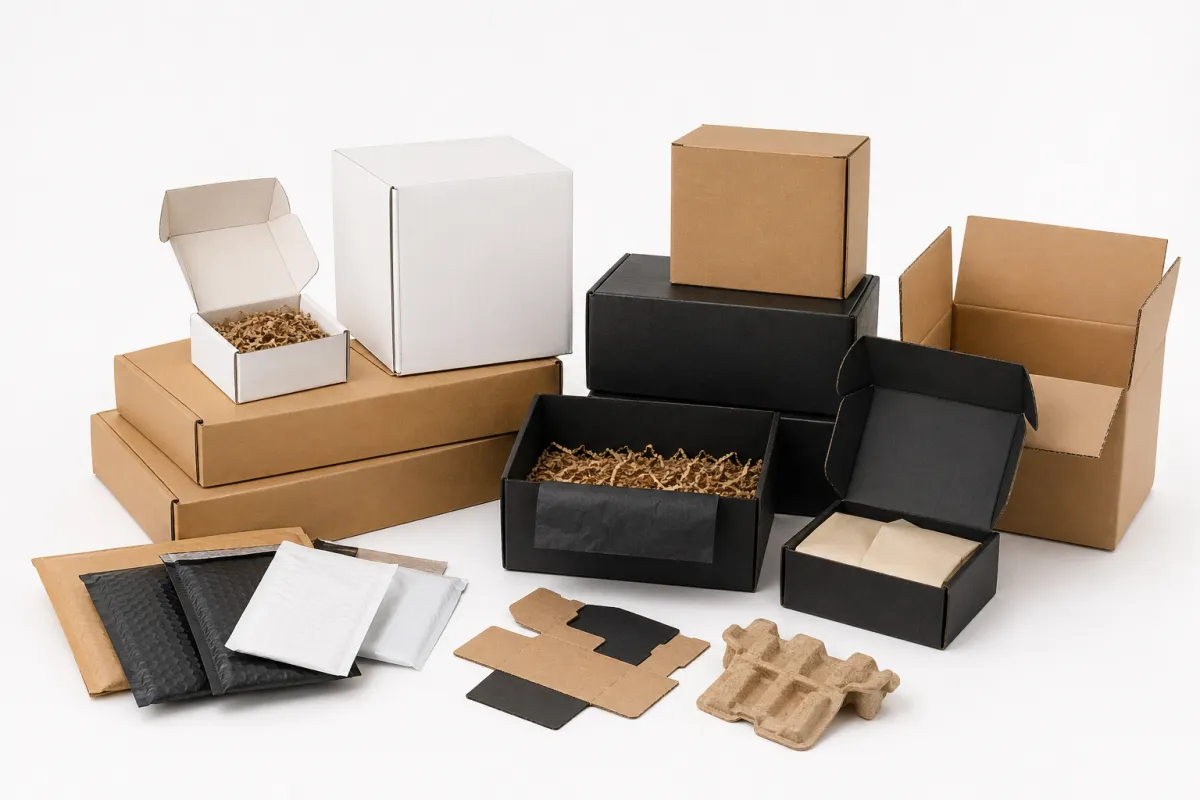
Retail-ready packaging is not one format wearing a trench coat. It is a family of structures, each built to solve a different store problem. Mailer boxes, folding cartons, display boxes, inserts, sleeves, corrugated shippers, and branded bags can all be part of wholesale custom packaging supplies for retail, but each behaves differently once it reaches the floor, the stockroom, or the fulfillment bench in places like Dongguan, Ningbo, and Foshan where production lines are often set up for quick changeovers.
For shelf display, folding cartons and display boxes usually win because they face forward cleanly and leave room for pricing or barcode placement on a front panel. For shipping protection, corrugated shippers and rigid mailers do the heavy lifting, especially when a product needs to survive parcel handling or regional distribution across the Midwest or the Pacific Coast. Gift-ready presentation calls for rigid stock, often paired with specialty finishing, because premium private-label sets and seasonal launches need a box that feels deliberate from the first touch. The strongest retail packaging programs keep one visual system across those structures so the box, sleeve, and bag feel like the same brand family instead of three separate decisions made by three different people.
I remember a supplier meeting in a Shenzhen production office where a buyer placed three samples on the table: a kraft mailer, a white SBS carton, and a rigid gift box. The request looked simple on paper and became complicated in about 45 seconds. One copper foil logo had to appear across all three. The conversation moved from aesthetics to board strength almost immediately. The rigid box could carry the foil and a soft-touch lamination without complaint. The kraft mailer needed a restrained one-color print. The folding carton sat in the middle, which is exactly why wholesale custom packaging supplies for retail often work better as a family of structures than as one universal box trying to do everything. That box never survives the meeting, let alone the shipment.
Materials tell you a lot about the retail experience before the product ever leaves the carton. SBS paperboard usually gives the cleanest print surface for Custom Printed Boxes and display cartons, especially when a brand wants crisp type and stable color on a Heidelberg CD 102 or a Komori press line. 350gsm C1S artboard works well for cosmetic cartons, supplement sleeves, and premium sampling kits because the coated side holds detail and the uncoated side supports light gluing. Corrugated board protects better in transit and makes more sense for online-to-offline programs that move between warehouses, stores, and distribution centers. Kraft paper signals a natural, lower-ink look and suits eco-focused positioning without pretending to be something it is not. Rigid stock, often in the 1000 to 1500 gsm range, gives the package a premium hand feel that helps package branding at a higher price point. Specialty finishes such as spot UV, embossed logos, soft-touch lamination, and hot foil stamping can move a package from functional to memorable if the retail margin supports the extra process steps.
The best buyers match the structure to the selling environment. Seasonal promotions need fast visual impact and easy stocking. Gift sets need structure, polish, and closures that stay true after repeat handling. Multi-SKU assortments need inserts that lock 2, 4, or 6 items in place without rattling in transit. Private-label launches need Packaging Design That makes the line look established even if the product is new to market. That is the point where wholesale custom packaging supplies for retail stop being a line item and start acting like part of the launch plan in stores from Phoenix to Philadelphia.
- Mailer boxes: useful for direct-to-consumer fulfillment and retail replenishment kits.
- Folding cartons: ideal for shelf display, barcodes, and lightweight products.
- Display boxes: strong for counter placement and impulse sales.
- Corrugated shippers: best for protection, pallet movement, and multi-store distribution.
- Branded bags: effective for checkout, event merch, and in-store carryout.
One practical rule saves a lot of pain later: if a package has to do two jobs, define both jobs before the quote goes out. A carton that ships well and displays well will usually cost more than a single-purpose sleeve, but the full program can still come in lower if it removes secondary packaging from the process. I keep bringing buyers back to Retail Packaging That fits the actual handling path rather than the mood board pinned to the wall. Mood boards are nice; pallet damage is not.
For buyers comparing formats, the fastest way to narrow the field is to follow the selling channel. Shelf-facing products do best in upright display geometry. Shipping-heavy products need corrugation and stronger edge crush values. Gift-oriented products benefit from rigid stock and precise closures. If your team already has the product list, our Custom Packaging Products page is a practical starting point for mapping those formats to real retail use cases, including carton styles that ship from Guangdong factories and finish in regional fulfillment centers near Los Angeles or New Jersey.
Packaging Specifications: Size, Print, Finish, and Compliance
Before anyone can quote wholesale custom packaging supplies for retail correctly, the buyer needs to define dimensions, product weight, print coverage, insert requirements, board thickness, and closure style. That sounds basic until a carton comes back three rounds later because the product was measured with the cap on but not the 2 mm lip at the neck. I have watched that tiny oversight change the dieline, the insert height, and the shipping carton count all at once. Packaging rewards precision faster than almost any other part of a retail launch, which is wonderful if you like clean numbers and mildly maddening if you do not.
Print decisions shape both cost and shelf performance. CMYK is usually the starting point for full-color retail graphics. Spot color matching matters when the brand owns a strict red, navy, or metallic tone that cannot drift from run to run. Foil stamping can lift perceived value immediately, though it adds setup time and press complexity. Embossing gives logos tactile separation that feels refined without shouting. Matte and gloss coatings change how the package reads under fluorescent store lighting, and inside print becomes worth considering when the unboxing moment matters, especially in retail packaging built for gift sets or promotional bundles sold in stores across the Southwest or Northeast.
Compliance is not optional. Barcodes need the correct quiet zone, usually at least 3 mm on each side depending on the symbology and scan environment. Retail labeling space should be reserved early instead of squeezed in after artwork approval. Shipping durability needs equal attention. If a product is moving through parcel networks or regional distribution, I still look for ISTA test paths and ask whether the package can handle vibration, drop, and compression. For standards and material sourcing, I often point teams to ISTA for transit-test thinking and FSC if certified fiber belongs in the procurement brief.
Retail buyers also need to think about regulatory fit. Food-contact packaging, cosmetics, and children's products can each carry different state, federal, or marketplace expectations. ASTM references may matter for certain claims, and nobody should assume a finish is safe just because it looks clean. Experienced teams ask for proof files with barcode placement, logo placement, die-cut references, and warning text laid out before the first sample ships. Better specs mean fewer revision cycles, tighter proof accuracy, and cleaner comparisons between suppliers offering wholesale custom packaging supplies for retail.
- Dimensions: list internal and external measurements separately.
- Stock: note GSM, caliper, or board grade.
- Print: specify CMYK, Pantone, foil, or white ink needs.
- Finish: choose matte, gloss, soft-touch, UV, or no coat.
- Structure: include tuck-top, auto-bottom, sleeve, or rigid setup.
- Compliance: call out barcode, warning text, or recycling marks.
Last spring, a retail ops director asked why one quote landed 14 percent higher than the previous estimate. The answer was simple and exact: a 0.8 mm change in board thickness, a shift from matte to soft-touch, and a hidden insert request for two bottle sizes. That kind of pricing movement is normal in wholesale custom packaging supplies for retail, which is why a clean spec sheet beats a long email thread every time. Email threads wander; spec sheets make people behave.
If you are preparing a launch or a reprint, our Wholesale Programs page explains how repeat ordering works once the specification set is locked. The first order is where the decisions happen; the second order is where the margin starts to improve, especially when the same dieline is reprinted for a second run in Dongguan or Ningbo without artwork changes.
Wholesale Custom Packaging Supplies for Retail Pricing & MOQ
Pricing for wholesale custom packaging supplies for retail comes from a handful of variables: quantity, stock selection, print complexity, finish options, structure type, and any setup or tooling fees. A simple carton with one-color print can stay relatively lean. A rigid box with foil, embossing, and a custom insert lives in a completely different cost bucket. I have quoted the same logo on three structures and watched the unit price swing from $0.09 to $0.41 just because the build changed. The box did not get emotionally complicated; the machinery and handwork did.
MOQ changes the economics in a very direct way. A lower minimum lets a retail buyer test a concept with less risk. A larger run usually drops per-unit cost and improves freight efficiency. The tradeoff is real. One beverage client I advised moved from 1,000 pieces at $0.41 per unit to 5,000 pieces at $0.18 per unit after setup costs were spread across a larger order. For a simpler folding carton, the same plant in Foshan quoted $0.15 per unit for 5,000 pieces using 350gsm C1S artboard and a one-side CMYK print, which is the kind of number that makes a finance team look up from the spreadsheet. That is what makes wholesale custom packaging supplies for retail interesting to finance teams as well as brand teams.
| Format | Typical MOQ | Example Unit Price at 5,000 Pieces | Typical Setup Cost | Best Retail Use |
|---|---|---|---|---|
| Folding carton, CMYK | 1,000 units | $0.15/unit | $120-$180 | Shelf goods, lightweight items, private label |
| Mailer box, printed outside | 1,000 units | $0.24/unit | $150-$220 | Retail replenishment, DTC, gift shipping |
| Rigid box with soft-touch | 500 units | $0.41/unit | $220-$350 | Premium sets, seasonal kits, luxury retail |
| Paper sleeve or belly band | 2,000 units | $0.09/unit | $80-$140 | Cross-merchandising, multipacks, promos |
Those numbers are examples, not promises, but they show how quickly structure changes the math. A buyer focused only on unit price can miss tooling, freight, and storage. A buyer focused only on MOQ can miss the hidden cost of a messy reorder. The better framework is total landed cost: unit price plus setup plus freight plus warehousing plus expected waste. That is the actual cost of wholesale custom packaging supplies for retail, not the quote line that looks cheapest in an inbox.
Reorder economics are where a good supplier earns trust. Once a dieline and artwork system are approved, repeat orders should move faster and often cost less to place. The board spec stays the same, the print plates stay the same, and the proof cycle shortens. If a supplier makes you re-explain a repeat order every time, that is not a wholesale program; it is a repeated starting line. Retail teams need packaging that behaves like infrastructure, whether the shipment leaves a factory in Zhejiang or a finishing shop near Chicago.
Here is the question I ask buyers: if sales double, can your packaging budget still hold? If the answer is yes at 5,000 pieces and no at 1,000, the launch strategy should reflect that. A production manager in Dongguan told me the sentence every buyer should hear: "The cheapest box is not the one with the lowest quote; it is the one that survives the reorder." That line has stayed with me because it applies to wholesale custom packaging supplies for retail more often than not.
For teams building out a buying plan, the smartest move is to compare structures side by side and estimate a second order before the first one is approved. A packaging program that works at 3,000 units but falls apart at 8,000 units is not scalable. Wholesale pricing is tied tightly to planning, and planning starts with a clear view of the next reorder, the freight lane, and the warehouse receiving window.
Process & Timeline for Retail Packaging Orders
The buying sequence for retail packaging usually runs in the same order: inquiry, quote request, specs review, dieline confirmation, artwork upload, proof approval, production, and shipping. The order sounds straightforward. The delays do not. Most missed dates come from incomplete dimensions, late barcode files, or a structural revision that nobody budgeted time for. In plants around Shenzhen and Dongguan, that is usually where a 10-day schedule turns into a 15-day schedule without anyone meaning for it to happen.
My best timeline advice is simple: work backward from store arrival, not from the first sample approval. If a retail launch needs boxes on shelves by the first Monday of next month, the clock starts before artwork is final. A clean project often looks like this: quote in 24 hours, dieline and spec check in 1 to 2 business days, digital proof in 2 to 3 business days, sample confirmation in 5 to 7 business days, production in 12 to 15 business days after approval, and shipping in 3 to 8 business days depending on the lane. That is a realistic schedule for many wholesale custom packaging supplies for retail orders, though foil, embossing, or rush season can extend it by a few days.
I watched one chain buyer in Dallas miss a launch by four days because the barcode quiet zone was too tight on the first proof. The artwork looked fine on screen, but the scanner failed at the back of the store. A small error carried a very real cost: 2,400 units held in receiving and a second print run that pushed the whole plan back. Early clarity saves money in retail packaging, and the earlier the product dimensions, logo files, and barcode data arrive, the better the result.
- Request the quote with product dimensions, target quantity, and preferred structure.
- Confirm the dieline before design work starts, especially for inserts or sleeves.
- Upload artwork in editable format and include Pantone or CMYK references.
- Check the proof for barcode placement, legal text, and fold direction.
- Approve the sample only after the physical fit is tested with real product.
- Lock the ship date based on store arrival, not factory completion alone.
Delays usually show up in three places. Structural changes after artwork has already been built. Finish complexity after a buyer adds foil or soft-touch to the job. Peak production periods, when a plant may be booked solid for 2 or 3 weeks, especially before holiday merchandising windows in October and November. I have seen buyers save 6 days simply by approving one proof instead of sending three rounds of comments. That kind of discipline keeps wholesale custom packaging supplies for retail on schedule and keeps the project manager from developing a permanent eye twitch.
There is a negotiation lesson inside that timeline too. Suppliers can often move faster if they have final quantities, a signed approval, and no open questions about the product. A short, specific brief gives a plant a real chance to meet the date. A long, vague one usually adds drag. If you know the carton size, the print area, the finish, and the destination, the supplier can plan like a production partner instead of a guesser, whether the shipment is headed to a West Coast DC or a Northeast store cluster.
Why Choose Our Retail Packaging Program
Custom Logo Things is built around the kind of packaging work retail teams actually live with: repeat orders, tight turn windows, and the need for consistent presentation across a store network. Our wholesale custom packaging supplies for retail are designed to support merchandising, not just shipping. That distinction matters. A package that looks great on a PDF but fails in front of the shelf is a cost, not an asset. I have seen pretty mockups ruin a Monday morning more than once, especially when the first pallet arrives at 8:10 a.m. and the display tabs snap under hand assembly.
What retailers usually need from a supplier is not noise. They need responsive quoting, clean file handling, and a team that understands that 500 display boxes can affect a launch more than a 50-page brand deck. We focus on wholesale custom packaging supplies for retail that make sense for purchasing teams, visual merchandisers, and operations managers at the same time. Fewer calls about missing specs. Fewer surprises on proof. Fewer arguments about whether the box is "close enough." Close enough is a phrase that belongs in a shoe fitting, not a packaging spec.
Quality control has to be practical on the production side. We check board thickness, print alignment, die-cut accuracy, and glue integrity before release. In one recent review, a 0.5 mm misalignment was caught before packing, which avoided rework on 8,000 units. That sort of detail is not glamorous, but it is exactly why retail teams come back for the next order of custom packaging, especially when the first run was printed on 350gsm C1S artboard and the second run needs to match color within a tight tolerance.
There is a real difference between a specialized packaging supplier and a generic print vendor. A general printer may be excellent at flyers, catalogs, or business cards, but retail packaging introduces stackability, fold memory, shipping stress, and barcode space. A specialist sees those variables early. I have watched buyers switch suppliers after learning that a sample that looked perfect could not survive a 42-pound master carton. With wholesale custom packaging supplies for retail, those details decide whether the program scales or stalls.
"The best supplier doesn't just quote the box. They protect the schedule, the shelf appearance, and the reorder path."
If you are comparing options, start by looking at Custom Packaging Products and then compare how those structures fit your sales channel. Our wholesale buyers also use Wholesale Programs to plan reorders around seasonality, promotional windows, and distribution center cutoffs. For teams building a broader assortment, Custom Packaging Products is the fastest way to connect structure, finish, and retail use case, whether the goods are moving through New Jersey, Texas, or Southern California.
In practice, the suppliers that keep long-term retail work are the ones that answer the hard questions plainly: Can the carton carry a 12-ounce jar? Can the sleeve hold up in a 3-day truck lane? Can the reprint match the original run within a 5 Delta E target? Those are practical questions. They are also the difference between one-off sourcing and a dependable retail packaging relationship.
I have also learned that honest timing builds trust faster than overpromising. If a project needs 15 business days, say 15. If foil stamping adds 3 more, say that too. Retail buyers are used to moving targets. What they do not have patience for is avoidable guesswork. Our goal is simple: make wholesale custom packaging supplies for retail easier to buy, easier to approve, and easier to reorder, with production details that stay clear from the first proof to the second shipment.
Next Steps: Build Your Retail Packaging Order
If you are ready to request wholesale custom packaging supplies for retail, gather the exact product dimensions, target quantity, preferred packaging style, and any retail compliance requirements before you send the brief. Add logo files, brand colors, barcode placement notes, and a delivery timeline. A quote built on incomplete data is just a guess with branding attached, and I say that with affection for nobody.
The most efficient buyers send enough detail for a real production conversation. That means telling us whether the product is a 3.5-ounce jar, a 14-ounce bottle, or a 2-pack display set. It means sharing whether the package will sit on a shelf, travel in a shipper, or live inside a gift set. It also means deciding whether you want matte lamination, soft-touch, foil, or a simpler finish. For wholesale custom packaging supplies for retail, those choices affect cost, lead time, and shelf appeal in very different ways, especially if the order will print in Guangdong and ship into a Midwest DC.
- Choose the format that matches the sales channel.
- Confirm the size, board, print, and finish.
- Review the proof against the real product.
- Approve the sample after fit testing.
- Lock production dates and freight details.
If your team is still comparing vendors, start with a small test run and ask for tiered pricing at 1,000, 3,000, and 5,000 units. That gives you a realistic view of how the economics improve. It also helps you compare suppliers on the same terms instead of mixing apples and oranges. In retail, the first order teaches you about fit; the second order teaches you about margin. Good wholesale packaging should perform well in both cases.
Once we receive your first request, the next step is straightforward: we review the specs, confirm the structure, prepare the quote, and map the production timeline so you know what happens next. If the order needs a dieline adjustment or a finish recommendation, we will say that plainly. If the file is ready to go, we move faster. That is how I think wholesale custom packaging supplies for retail should work: clear, specific, and ready for the next reorder. The practical takeaway is simple: lock the dimensions, match the structure to the channel, and verify the second-order economics before you approve the first run.
What is the typical MOQ for wholesale custom packaging supplies for retail?
MOQ depends on structure, material, and print complexity, but simple retail cartons often start at 1,000 units, while rigid boxes and specialty finishes may start at 500 units or more. Ask for tiered pricing so you can compare a 1,000-unit test run against a 5,000-unit launch before committing. For retail packaging, the right MOQ is the one that fits your launch risk, storage space, and reorder plan.
How do I choose the right packaging style for retail shelves?
Match the package to the selling environment: shelf display, counter display, shipping protection, or gift presentation. Use product dimensions and brand positioning to decide whether you need a carton, sleeve, box, insert, or display-focused format. The best wholesale custom packaging supplies for retail are the ones that fit the shelf and the sales story at the same time, whether the product is being stocked in Atlanta, Denver, or San Diego.
What details do I need for an accurate quote on retail packaging?
Provide product size, quantity, material preference, print coverage, finish requests, and any insert or barcode requirements. Sharing logo files and target delivery timing upfront reduces revisions and improves quote accuracy. That simple step can shorten the quoting cycle for wholesale custom packaging supplies for retail by several days and help the factory confirm a realistic schedule before the first proof.
How long does production usually take after proof approval?
Production time varies by order size and finish complexity, but approval timing is only one part of the schedule. The fastest projects are the ones with confirmed specs, clean artwork, and no structural revisions after the proof. For many retail packaging orders, 12 to 15 business days after approval is a realistic planning number, with freight adding 3 to 8 business days depending on the lane.
Can wholesale custom packaging supplies for retail ship to multiple store locations?
Yes, many orders can be split across distribution centers or store groups if the shipping plan is defined in advance. Provide destination addresses early so packaging, palletization, and freight planning are aligned before production starts. That is especially useful for wholesale custom packaging supplies for retail with regional rollouts or seasonal drops that need to hit several ZIP codes in the same week.
Retail packaging gets easier once the structure, specs, and reorder path are set. If you want wholesale custom packaging supplies for retail that support shelf presentation, freight efficiency, and repeat ordering, the most useful next move is to build a spec sheet with exact dimensions, finish choices, barcode placement, and a second-order quantity before you approve the first run.

