Buyer Fit Snapshot
| Best fit | Custom Box Die Cutting projects where brand print, material claims, artwork control, MOQ, and repeat-order consistency need to be specified before quoting. |
|---|---|
| Quote inputs | Share finished size, material target, print colors, finish, packing count, annual reorder estimate, ship-to region, and any compliance wording. |
| Proofing check | Approve dieline scale, logo placement, barcode or warning zones, color tolerance, closure strength, and carton packing before bulk production. |
| Main risk | Vague material claims, crowded artwork, missing packing details, or unclear freight terms can make a low unit price expensive after revisions. |
Fast answer: Custom Box Die Cutting: How It Works and What It Costs should be specified like a repeatable production item. The safest quote records material, print method, finish, artwork proof, packing count, and reorder notes in one written spec.
Production checks before approval
Compare the actual filled-product size with the drawing, then confirm tolerance on folds, seals, hang holes, label areas, and retail display edges. Reserve space for logos, QR codes, warning copy, and material claims before decorative graphics fill the panel.
Quote comparison points
Review material grade, print process, finish, sampling route, tooling charges, carton quantity, and freight assumptions side by side. A quote is only useful when the supplier can repeat the same color, closure quality, and packing count on the next order.
Custom Box Die Cutting: How It Works and What It Costs
Custom box die cutting looks simple from a distance: a flat sheet goes into the press and a finished box blank comes out. In practice, it is a tighter, fussier process than most people expect. Custom box die cutting sits right at the intersection of packaging design, board behavior, and press control, so a dieline that looks dead-on on screen can still fail once steel meets paperboard. A shift of just a few millimeters can affect fit, stacking, closure strength, and how the carton behaves when someone opens and folds it by hand.
That precision matters because the box does more than hold a product. It carries branding, protects contents in transit, and shapes the first physical experience a buyer has with the package. For custom printed boxes used in ecommerce, retail packaging, or product packaging built for shipment, the die is the part that turns artwork and dimensions into a repeatable manufacturing process. I have seen beautiful layouts get held up by a score that was a hair too deep or a tuck flap that landed in the wrong spot, and that kind of miss tends to ripple through the whole job. When you are comparing suppliers or planning a new format, it helps to understand both the tooling and the production path, along with the difference between Manufacturing Capabilities and the kinds of Custom Packaging Products that fit a specific line.
A box earns trust twice: first on the proof, then again when someone folds it under real production pressure.
Custom Box Die Cutting: Why Small Cuts Change Everything
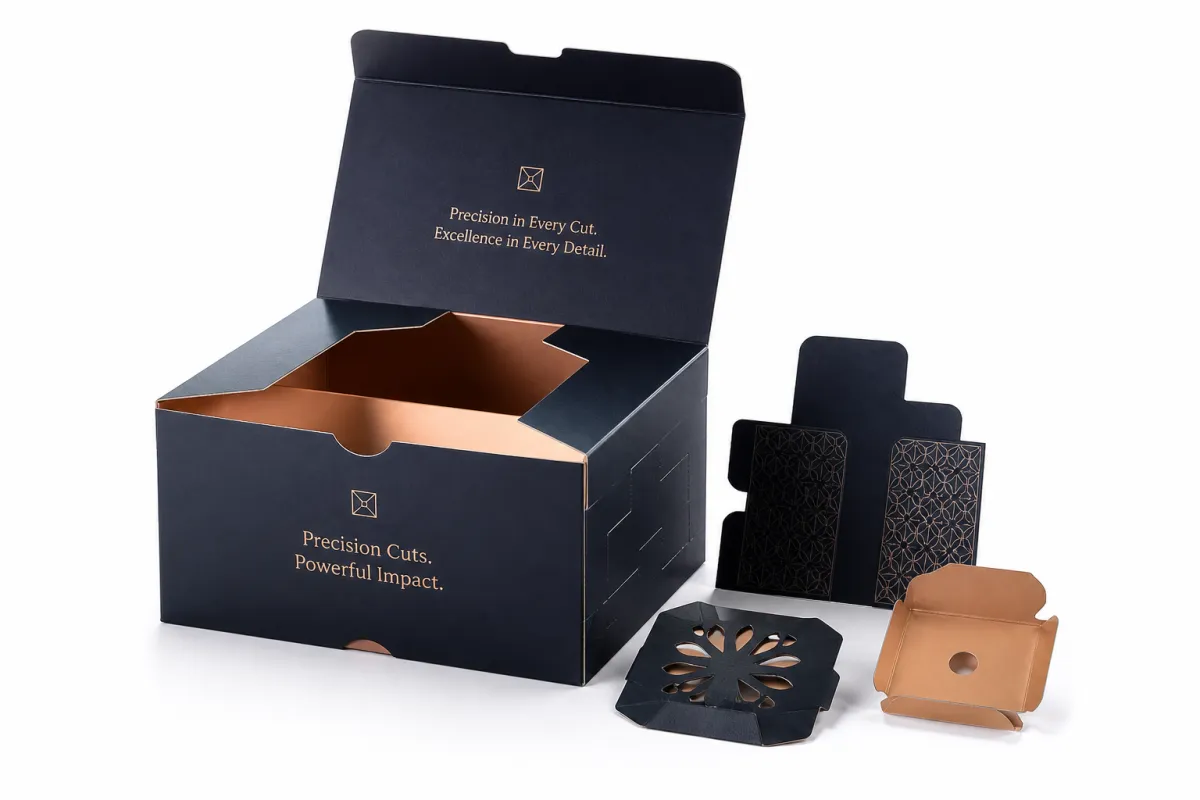
Custom box die cutting is the process of shaping flat board into a precise carton form with a steel-rule die. That die can cut, score, perforate, and register special features in a single pass, which keeps production consistent once the tooling is approved. Hand trimming may work for one-off samples, and laser cutting can be useful for prototypes, but neither one matches the repeatability of a properly built die when quantities start climbing.
A carton can look flawless in a digital layout and still behave badly in production if the geometry is slightly off. Small changes in tuck depth, panel width, or score placement can create weak closures, crushed corners, or a flap that refuses to lock cleanly. Custom box die cutting carries the practical burden of fixing those problems before they show up on a packing line or on a store shelf. A few millimeters decide a lot more than most buyers expect, which is why the proof stage can feel a little obsessive.
Packaging teams rely on custom box die cutting because it reduces variation. Clean cuts and accurate scores make folding easier, lower the chance of hand correction, and keep workers from fighting the blank during assembly. That is valuable in branded packaging, but it matters even more when boxes are being packed by a co-packer, moved through a fulfillment center, or launched under a tight retail schedule. Fewer manual adjustments usually mean a steadier run and fewer headaches later on.
It also helps to separate die cutting from nearby processes. Scoring establishes a fold line, slitting creates a partial cut, and perforating sets a controlled tear path. Custom box die cutting brings those operations together in one physical tool, which is why it tends to be the better choice for production-grade custom printed boxes. Laser work still has its place for samples or very low quantities, yet it rarely replaces a die when speed and consistency are the goal.
Finish work is another separate layer. Foil stamping, embossing, and spot varnish can raise the visual quality of a carton, but none of those treatments solve structural fit. The die does that job. In practical terms, custom box die cutting is the skeleton of the package, and printing and finishing sit on top of it.
A useful way to think about the die is as a mold for paperboard. When the tooling is right, the rest of the project becomes easier to manage. When the tooling is wrong, every downstream step becomes more expensive to correct. That is why custom box die cutting deserves a careful review early in the quote process, not after the artwork is already locked.
How Custom Box Die Cutting Works
Custom box die cutting begins with finished dimensions rather than with the board itself. Those dimensions become a dieline, and the dieline becomes a physical die. The die mounts to a press, the board feeds through, and the press stamps out blanks with cut lines, score lines, and any special features needed for assembly. The motion is mechanical, but the tolerances are tight enough that setup still requires real attention.
The die is built from several parts, each with a specific job. Cutting rules slice through the board. Scoring rules compress the fibers so folds happen cleanly rather than cracking along the bend. Perforation rules create tear points for easy-open features, coupons, or tabs. Ejector rubber or foam pushes waste away so the blank releases cleanly. In custom box die cutting, every one of those details affects how the carton feels in the hand and how it behaves once packed.
Sheet alignment and registration on press matter more than many buyers realize. If the board enters the press out of alignment, the print-to-cut position drifts and the blank starts to miss spec. Pressure control matters just as much. Too little pressure leaves incomplete cuts; too much pressure crushes the board or makes the score too deep. Custom box die cutting is a careful balance of pressure, speed, board thickness, and grain direction.
Material choice changes the job substantially. Folding carton behaves differently from corrugated board, and rigid board reacts differently again. A lightweight retail carton may cut cleanly with lower pressure, while a corrugated shipper usually calls for more force and a different rule height to account for flute structure. That is why custom box die cutting cannot be treated as a one-size-fits-all setup. The board changes the tool, and the tool has to match the board.
Structural features add another layer of complexity. Tuck ends, locking tabs, thumb notches, windows, inserts, and carry handles all create stress points that have to be placed carefully. A window cut too near a fold may need reinforcement. A crash-lock bottom may need a different score depth to close reliably. In custom box die cutting, each added feature carries a trade-off between convenience, display value, and manufacturability.
The workflow usually follows five practical steps:
- Finished size and structure are defined.
- The dieline is built and reviewed.
- The steel-rule die is fabricated and mounted.
- Test cuts confirm pressure, fit, and score quality.
- Production blanks are run, stripped, stacked, and inspected.
That sequence is what separates custom box die cutting from casual cutting methods. The work is not just about shaping a sheet. It is about building a repeatable manufacturing system around that shape, then keeping that system stable long enough to support production.
Key Factors That Shape the Final Box
Material choice is usually the first major decision in custom box die cutting. Thickness, coating, fiber structure, and flute direction all affect cut quality and fold memory. A coated SBS board may offer a cleaner print surface for retail packaging, while corrugated board provides better stacking strength for shipping. If the board is too stiff, the score can crack. If it is too light, the box may lose rigidity or show compression marks near the folds.
Structural format matters just as much. Mailers, sleeves, tuck-end cartons, crash-lock bottoms, and display trays all handle stress in different ways. A mailer often needs strong side walls and a locking flap that resists popping open. A tray needs crisp corners and dependable stacking. In custom box die cutting, structure shapes the die, the press setup, and the amount of waste generated during production, so it is part of the cost rather than a separate design detail.
Fit tolerance is where many projects drift off course. Packaging buyers often focus on the outside dimensions, but the real question is what happens inside the box once the product, insert, or accessory set is placed. There needs to be enough clearance for loading, yet not so much that the contents move around during transport. For product packaging, that balance becomes especially important when the item is fragile, heavy, or irregular in shape. Custom box die cutting should support the product, not force the product to make up for a poor carton.
Artwork placement affects the final result more than people expect. Glue tabs, scores, and cut edges reduce safe print space, and a strong layout can still fail if text crosses a fold or a logo sits too close to a seam. Dieline proofing belongs early in the process for that reason. Good packaging design has a spatial side as well as a visual one, and the artwork has to respect the mechanics of custom box die cutting.
Volume shifts the economics and can even change the design choice. A small launch may justify a simpler tool or a different board grade, while a larger program may benefit from tighter tooling and a format that runs faster on press. Custom box die cutting tends to become more efficient as volume rises, yet only if the structure is built for the machine that will actually run it. Designing for a hand-assembled mockup is not the same job as designing for a high-speed folding line.
Compliance and sourcing may also come into play. If a buyer wants FSC-certified board, procurement and documentation need to reflect that. If the box has to survive parcel handling, transit testing such as ISTA protocols can help validate the structure before launch. The goal is not to turn every carton into a lab exercise. The goal is to match the box to the use case before production locks in the wrong choice. For sourcing references, see FSC for fiber certification and ISTA for transit testing standards.
Too many buyers under-spec the job. They ask for a size and a quantity, then expect the rest to sort itself out. Custom box die cutting responds better to a fuller brief: define the board, closure, load, print coverage, and shipping path. The quote becomes sharper, and the box usually does too.
For a quick comparison, here is how common box styles tend to behave in custom box die cutting:
| Box style | Typical tooling complexity | Approx. unit cost at 5,000 units | Best use case |
|---|---|---|---|
| Simple tuck-end carton | Low to moderate | $0.18-$0.32 | Light retail packaging, cosmetics, small consumer goods |
| Mailer-style box | Moderate | $0.28-$0.55 | Ecommerce, subscription, branded shipping |
| Corrugated shipper | Moderate to high | $0.35-$0.70 | Transit-heavy product packaging, heavier contents |
| Rigid setup box | High | $1.00-$3.00+ | Premium retail packaging, luxury sets, presentation kits |
Those figures are directional, not universal. Custom box die cutting costs move with print coverage, board grade, glue areas, and finishing options such as foil or embossing. Even so, the table gives a practical starting point when a buyer is comparing formats instead of chasing the lowest headline number.
Custom Box Die Cutting Process and Timeline
The cleanest custom box die cutting projects begin with intake rather than with artwork. A supplier needs finished dimensions, product weight, board preference, closure style, target quantity, and any shipping or shelf constraints. If the box will be hand packed, machine packed, or inserted into a kit, that should be stated at the start. A complete brief cuts down on surprises later, and it makes the quoting conversation a lot more honest.
Dieline proofing and prepress review come next. Panel sizes get checked, score locations get checked, glue tabs get checked, and artwork safety margins get checked again. The schedule usually stays steady or starts slipping right here, because a missed detail can force another round of revisions. If a print element sits too close to a fold or a window lands too near a corner, the supplier should catch it before the die is built.
Die fabrication and sampling usually require the most patience. A simple one-up carton may move quickly, while a more complicated box with locking features, perforations, or inserts may need additional tuning. Once the die is mounted, test cuts confirm whether the board separates cleanly and whether the scores fold the way they should. In custom box die cutting, a sample is not a formality. It is the proof that the structure, the board, and the press settings work together.
Production adds another layer of setup. The press operator calibrates pressure and registration, then runs a small batch before moving into full output. Stripping and stacking need inspection so waste does not stick in the blanks or warp the edges. Depending on the project, a production run may be ready in roughly 12-15 business days after approval for simpler structures, while more complex custom box die cutting jobs can take longer if revisions, specialty boards, or finishing steps are involved. That estimate is practical, not guaranteed, because plant load and material availability can move the calendar in either direction.
Delays tend to come from a short list of issues. Late artwork changes are one common cause. Material substitutions are another. If the selected board is unavailable, the score depth or blade pressure may need to change. Sample approval can also stretch the schedule when several stakeholders need to sign off. A packaging team may like a sample on Monday and wait until Friday for final approval. Custom box die cutting does not stop the calendar; it just reveals where the calendar was too optimistic.
Version control matters just as much as speed for teams managing several SKUs. A revised dieline should be named clearly, archived cleanly, and checked against the approved sample before the next run starts. That may sound administrative, yet it prevents expensive rework. One wrong file can send a custom box die cutting project backward faster than any press can recover it.
Freight and warehousing add another layer. If the blanks ship flat, carton dimensions and pallet patterns affect freight cost. If the boxes sit in storage before use, humidity and stacking pressure can change board behavior. That is another reason to treat custom box die cutting as a full workflow rather than just a tooling order.
Custom Box Die Cutting Cost and Pricing Factors
Custom box die cutting cost is shaped first by tooling complexity, then by material, then by quantity. A die with straight cuts and simple scores is easier to build than one with windows, thumb notches, perforations, or irregular locking tabs. Every extra feature adds rule length, layout complexity, and the chance that the press will need more adjustment. A simple carton and a structural carton with several closures belong to very different cost tiers.
Material choice affects price in subtler ways. Heavier board needs more careful setup and can slow the press. Coated boards may improve print quality, yet they can respond differently at the score line. Corrugated board often produces more waste and may need stronger tooling, while rigid board usually demands careful handling because it does not forgive poor pressure settings. In custom box die cutting, the cheapest board is not always the least expensive option if it increases spoilage or setup time.
Quantity is where unit cost usually moves downward. Tooling and setup are front-loaded expenses, so a short run carries more of that burden per box. Once the run scales up, the cost per unit usually drops. That is why custom box die cutting quotes for 500 pieces and 5,000 pieces can look very different even when the carton design is unchanged. The press still has to be set up either way.
Sampling, prototyping, and revisions should also be budgeted honestly. A first sample is often a working sample, not the final approved version. If the product fit is tight or the structure is new, a second or third round may be needed. That is normal. What catches many buyers off guard is that sample corrections can cost more than the original proof if the design needs a structural change rather than a simple artwork edit. Custom box die cutting is sensitive to that distinction because the die itself may need to be rebuilt.
Quote comparison deserves a careful eye. Ask whether the supplier owns the die or charges for it separately. Check whether revisions are included. Find out if one proof is covered or if multiple sample rounds are built into the estimate. Ask whether storage, shipping, and finishing such as embossing are included. A low quote can be useful only when it actually covers the work. Without that clarity, the comparison is incomplete.
Here is a practical pricing lens that helps when ordering custom box die cutting:
- Simple structure: lower tooling cost, faster sampling, fewer setup issues.
- Mid-complexity structure: moderate die cost, more score management, more revision risk.
- Feature-heavy structure: higher tooling cost, longer lead time, tighter quality control.
- Small quantity: higher per-unit cost because setup is spread across fewer boxes.
- Larger quantity: lower per-unit cost, but only if the structure is stable and easy to run.
If you are buying for retail packaging or branded packaging, the cheapest quote can still turn out expensive if it produces waste, misfolds, or returns. Custom box die cutting should be judged on fit, yield, and repeatability, not just the number at the bottom of the page. A box that runs cleanly saves time every time it is assembled.
There is also a strategic side to cost. A slightly better board can save money if it reduces collapse during shipping. A simpler tuck style can outperform a more elaborate structure if labor is the real bottleneck. Experienced buyers often ask for two or three configurations instead of one because that comparison makes the trade-offs clearer. Custom box die cutting becomes easier to price once the structure is measured against the actual use case.
Common Mistakes in Custom Box Die Cutting
The first mistake is designing before measuring the product properly. A sketch can be useful at the start, but custom box die cutting depends on real dimensions, actual weights, and a clear understanding of any inserts, accessories, or closures. If the item is measured without packaging clearance, the box may end up too tight to assemble or too loose to protect the contents. That sounds basic because it is basic, yet it still happens all the time.
The second mistake is crowding the layout. Cut lines, score lines, glue tabs, and artwork all need space. When they are squeezed together, the carton becomes harder to manufacture and less reliable in use. In packaging design, negative space is not wasted space. It is the buffer that keeps custom box die cutting workable on press and dependable on the assembly table.
The third mistake is choosing the wrong board for the application. A material that looks premium may not fold well. A light board may print beautifully but fail in transit. Corrugated stock may protect the product better than a folding carton, yet it can change the presentation entirely. The right choice depends on whether the box is meant for shelf impact, shipping protection, or both. Custom box die cutting only performs well when the substrate matches the job.
Skipping samples is another expensive habit. A dieline can look correct in a PDF and still behave badly in the real world. The score may be too deep. The flap may catch. The insert may rub against the side wall. Testing reveals those issues before production turns them into waste. In custom box die cutting, the sample is often the least expensive form of risk control.
Rushed approvals create a different kind of problem. When revisions are signed off too quickly, a later reviewer may spot a fit issue after the die is already approved. That leads to rework, delay, and avoidable frustration. If the box affects launch timing, then the sign-off process matters too. A clear approval checklist can save a surprising amount of money in custom box die cutting.
Here is a short list of issues worth checking before final approval:
- Does the finished size match the product plus clearance?
- Are the score lines aligned with the fold sequence?
- Are glue areas free of critical artwork?
- Does the board grade support the required strength?
- Has the sample been assembled by hand and inspected under realistic use?
One more mistake is easy to overlook: underestimating how the box will be used after it ships. A carton for ecommerce may face drop impact, vibration, and repeated handling. A carton for a shelf display may need to stay visually crisp under repeated customer contact. Custom box die cutting should be planned around the environment, not just the print file. That distinction often separates a nice prototype from a dependable production package.
Expert Tips and Next Steps for Custom Box Die Cutting
Start with a complete spec package. Finished dimensions, product photos, board preference, quantity, assembly method, target ship date, and use environment all help a supplier quote custom box die cutting accurately. If a carton needs to survive parcel transit, say so. If it is for premium retail packaging, say that too. The brief should describe the job, not just the size.
Ask for a physical mockup or sample kit before full production whenever possible. Screens are useful, but they do not show how a flap feels in the hand or whether a corner crushes under pressure. A mockup can reveal fit issues, closure tension, and folding behavior in a way no PDF can. For custom box die cutting, tactile review is not a luxury. It is the fastest way to catch trouble early.
Build a small approval checklist and use it consistently. Version control, artwork placement, score locations, glue tabs, and sample sign-off should all be documented. That may sound procedural, yet it prevents confusion when several people are reviewing the same carton. The most efficient custom box die cutting projects are usually the ones where the team knows which file is current and which sample is final.
Test the box in the real environment it will face. Put shipment cartons in a stack. Run retail packaging through the shelf handling scenario. Check whether the closure opens too easily or resists too much. In custom box die cutting, a box that behaves well on a desk can still fail in a warehouse. Real conditions matter more than presentation alone.
If the design needs visual lift, explore finish options without losing sight of structure. Foil stamping, spot coating, and embossing can support package branding, but they should sit on top of a carton that already works. The structure comes first. The decoration comes after. That order may sound obvious, yet early design conversations often flip it around and cause trouble later.
Here is the shortest practical path forward:
- Measure the product and any inserts accurately.
- Choose the board based on the real use case.
- Estimate quantity and target lead time.
- Request a quote that includes sample approval and production.
- Review the sample under actual handling conditions.
From there, custom box die cutting becomes easier to control. The supplier can tune the die, the press, and the score lines to the project instead of guessing at the requirements. Once the run starts, the result is usually better: cleaner folds, more stable stacking, and fewer surprises at assembly.
For buyers comparing vendors, it helps to think beyond the carton and look at the full production path. A capable partner should be able to explain board options, tooling choices, and schedule risks in plain language. If you are evaluating a new run, the right question is not only “How much does custom box die cutting cost?” It is also “What will make this box reliable when it is printed, cut, folded, shipped, and opened?”
What is custom box die cutting used for in packaging?
It is used to create precise box shapes, folds, windows, and locking features from flat board with repeatable accuracy. Custom box die cutting helps packaging lines move faster because the blanks arrive ready to fold instead of needing hand trimming. It is especially useful for custom printed boxes that need inserts, handles, or unusual structural details.
How does custom box die cutting affect pricing?
Pricing rises when the die is more complex, the design has more blades or special features, or the material is harder to cut. Custom box die cutting usually becomes cheaper per unit as quantity increases because tooling and setup are spread across more boxes. Quotes should always be compared by what is included, not just by the headline number.
How long does a custom box die cutting project usually take?
Simple designs can move quickly, but complex cartons usually need more time for die build, sample approval, and production setup. The timeline depends on how fast the artwork and dieline are approved and whether the chosen board is in stock. Rush changes, revisions, and sample corrections are the most common reasons lead time expands in custom box die cutting.
What information should I send for a custom box die cutting quote?
Send finished dimensions, product weight, material preference, target quantity, and how the box will be assembled or shipped. Include artwork files, any insert requirements, and notes about windows, handles, or special closures. The more exact the spec sheet, the more accurate the custom box die cutting quote and lead-time estimate will be.
Can custom box die cutting work for corrugated and folding carton boxes?
Yes, but each material needs different blade pressure, scoring depth, and tolerance settings. Corrugated board is better for shipping strength, while folding carton often suits retail presentation and lighter products. Rigid board can also be die cut, but it usually needs more careful handling and a different production setup in custom box die cutting.
Custom box die cutting is one of those packaging steps that stays invisible when it is done well. The folds feel right, the closure holds, the print lands where it should, and the box does its job without calling attention to itself. That is the real standard. Treat custom box die cutting as a structural decision instead of a minor finishing step, and you get better product packaging, fewer production surprises, and a carton that earns its place on the shelf and in transit.
The most practical takeaway is simple: define the product, the board, the closure, and the actual handling environment before the die is built. That one move saves time, cuts down on rework, and gives the press team a box they can run without babysitting it every minute. Once those basics are locked, custom box die cutting stops feeling like a gamble and starts acting like a dependable part of production.

