Buyer Fit Snapshot
| Best fit | Custom Box Sizes for Shipping projects where brand print, material claims, artwork control, MOQ, and repeat-order consistency need to be specified before quoting. |
|---|---|
| Quote inputs | Share finished size, material target, print colors, finish, packing count, annual reorder estimate, ship-to region, and any compliance wording. |
| Proofing check | Approve dieline scale, logo placement, barcode or warning zones, color tolerance, closure strength, and carton packing before bulk production. |
| Main risk | Vague material claims, crowded artwork, missing packing details, or unclear freight terms can make a low unit price expensive after revisions. |
Fast answer: Custom Box Sizes for Shipping: What Actually Matters should be specified like a repeatable production item. The safest quote records material, print method, finish, artwork proof, packing count, and reorder notes in one written spec.
Production checks before approval
Compare the actual filled-product size with the drawing, then confirm tolerance on folds, seals, hang holes, label areas, and retail display edges. Reserve space for logos, QR codes, warning copy, and material claims before decorative graphics fill the panel.
Quote comparison points
Review material grade, print process, finish, sampling route, tooling charges, carton quantity, and freight assumptions side by side. A quote is only useful when the supplier can repeat the same color, closure quality, and packing count on the next order.
Custom Box Sizes for Shipping: What Actually Matters
Custom box sizes for shipping sound straightforward until the first real pack-out starts. Then the little mistakes show up. A quarter-inch too much space. A flap that fights the tape gun. A product that looked fine in a mockup and now slides around like it has somewhere better to be. That is usually where the "good enough" spec gets exposed for what it is.
From a packaging buyer's point of view, custom box sizes for shipping mean cartons built around the product's actual dimensions, the protection it needs, and the way it will travel. Not the nearest stock box. Not the one that was on clearance. Not the size someone guessed would work because it looked close on paper. Actual fit is the job.
These sizes matter most when the product can shift, crush, scratch, or arrive looking sloppy. Glass, cosmetics kits, electronics, candles, subscription bundles, retail packaging, and multi-item sets all get touchy when the box is lazy. Add inserts or dividers and the margin for error gets smaller fast. A bad fit does not just look bad. It drives returns, breakage, and a waste pile that grows way too quickly.
The point is not cosmetic polish, though that helps. Custom box sizes for shipping affect protection, freight cost, and customer perception at the same time. Too much empty space means you are paying to ship air. Too little space means you are paying for damage and replacements. Most teams do not really have a box-size problem. They have a measurement problem.
A well-fit box is quiet. It does not rattle, bow, or need a mountain of filler to pretend it is doing its job.
Customers notice that quiet fit first. Carriers notice it too, just in a less sentimental way. The real goal behind custom box sizes for shipping is simple: lower damage, lower waste, lower freight cost, and less chaos on the packing line. Not fancy. Just useful.
Custom Box Sizes for Shipping: Why the Right Fit Matters
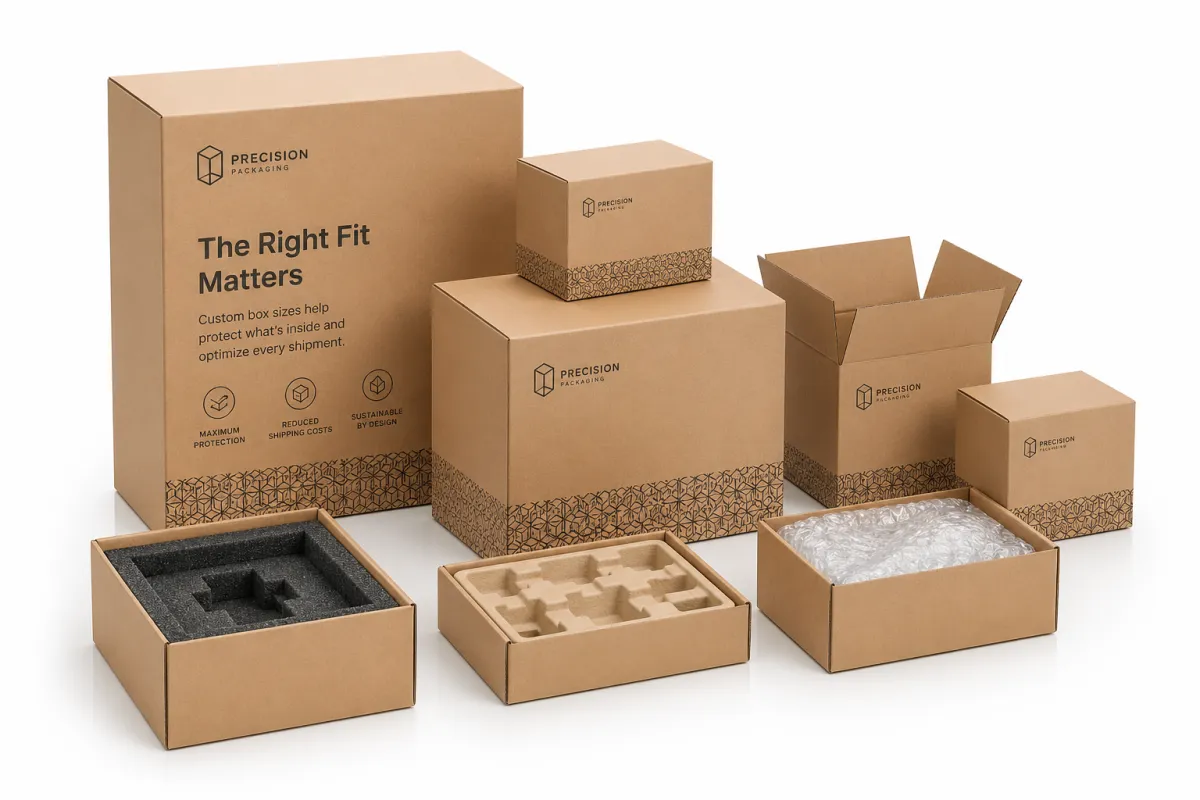
A lot of packaging problems start with one bad assumption: the product size on paper equals the package size you need in the real world. It does not. Packaging needs room for inserts, closures, tape, protective wrap, and a little crush space so the carton can survive stacking, handling, and the occasional rough moment on the lane. When that allowance gets skipped, custom box sizes for shipping turn into a guessing game.
A box that is too large wastes corrugated board, filler, labor, storage space, and carrier budget. A box that is too tight can damage corners, scuff finishes, or slow the packing line to a crawl while someone wrestles every order into place. Either way, the bill comes due. Usually after the spec has already been approved by someone who never packed a single unit. That part never gets old.
The fit matters even more when the carton is doing more than containing a product. In product packaging and retail packaging, the box also has to support branding, hold inserts, and survive the whole trip from warehouse to porch to customer counter. That is why custom box sizes for shipping are not just a nice touch for premium brands. They are basic operating sense for anything fragile, awkward, or expensive to replace.
Customer perception is part of the math too. A product sliding around inside a box feels cheap. A bundle shipped in a carton that is twice the necessary size looks wasteful, even if the item inside is fine. Custom box sizes for shipping help close that gap between product value and package behavior.
For brands using Custom Printed Boxes or other branded packaging, fit also changes the visual read. A box that is too large makes the graphics feel lost. A box that is too small can arrive scuffed before anyone sees the logo. Packaging design is not just print. The footprint matters.
Experienced buyers usually keep a small set of sizes that cover most of the line instead of a closet full of nearly-right cartons. Fewer solid sizes beat a pile of mediocre ones. Inventory gets cleaner, packing errors drop, and reordering gets less painful. That is where custom box sizes for shipping start paying back the work.
I have seen teams save more by trimming size clutter than by squeezing another cent out of board cost. That is not glamorous, but it is real.
What Are Custom Box Sizes for Shipping?
They are cartons built to the product's real inside footprint, plus the clearance needed for inserts, cushioning, closure, and the shipping lane. That usually means corrugated boxes sized around the item instead of forcing the item into a stock box and calling it strategy.
Done right, custom box sizes for shipping reduce movement, lower dimensional weight waste, and make pack-out faster. Done wrong, they create crushed corners, ugly void-fill mountains, and a carrier bill that feels like a prank. Nobody needs that kind of excitement.
In practice, "custom" does not always mean one-off. It can mean a family of standard sizes built for your product line, with inside dimensions dialed in so the line stays consistent. That is usually the smarter play. A few well-designed formats beat fifty almost-sizes that nobody trusts.
How Custom Box Sizes for Shipping Are Planned and Built
Good custom box sizes for shipping begin with real measurements, not a catalog estimate and a prayer. Measure the product at its widest and tallest points. Note whether it is rigid, fragile, oddly shaped, top-heavy, or prone to sliding inside the shipper. If you need an insert, tray, sleeve, or divider, include that from the start instead of trying to bolt it on later like a patch job.
A supplier will usually ask for the basics: product dimensions, weight, fragility, shipping lane, storage limits, branding needs, and the carton style you want. That list looks dry. It is the difference between a box that works and a box that only looks good in a quote email. Custom box sizes for shipping should be built around actual use, not best-case assumptions.
Board grade and structure matter just as much as length, width, and depth. A small mailer made with the wrong flute can collapse under stack pressure. A larger carton built with the right board can protect heavier items without turning the pack line into a wrestling match. Packaging suppliers will look at single-wall, double-wall, flute direction, closure style, and whether the design needs a locking bottom, tuck flap, or score-line adjustment.
Sampling is where the expensive mistakes show up early. A quote gives you a unit price. It does not tell you whether the product moves in transit, whether the lid pops open under compression, or whether the void fill turns into a mess in order fulfillment. That is why custom box sizes for shipping usually go through one or more prototypes before production makes sense.
The timeline is usually reasonable, just not instant. Simple custom box sizes for shipping can move from brief to sample in a few business days. A fully approved production spec often takes one to three weeks once revisions, sample shipping, and artwork checks get folded in. Printed cartons, structural changes, or multiple SKUs add more time. Rushing fit testing is a great way to pay twice.
For teams already sourcing through Custom Packaging Products, it helps to treat the process like a spec lock, not a casual buy. You are defining the box family, the inside dimensions, the board grade, and the finish in one place so the next reorder does not become a scavenger hunt.
If the packing flow also includes lighter goods, the right shipper may sit next to a mailer-based setup. Apparel, accessories, and some flat items can work well with Custom Poly Mailers, but that solves a different problem than protecting rigid items in corrugated cartons.
For sourcing standards, it helps to check testing references from ISTA and fiber sourcing guidance from FSC. You do not need a lab coat. You do need enough structure in the spec that the box does not change every time a new buyer gets involved.
Key Factors That Change Box Size, Cost, and Protection
Custom box sizes for shipping are shaped by more than the item itself. Start with the obvious pieces: product dimensions, weight, and tolerance. Then factor in surface fragility, center of gravity, sharp edges, and whether the product needs inserts, partitions, or a molded tray. A box can be dimensionally correct and still be wrong if the product moves inside it.
Shipping method changes the spec quickly. Parcel shipping punishes oversize cartons through dimensional weight. LTL and palletized freight care more about stackability, compression, and cube efficiency. International freight adds more handling, more transfer points, and more chances for a weak corner to become a claim. Custom box sizes for shipping need to match the lane, not just the product.
Money shifts in places people do not always watch. A slightly larger box might only add a few cents of board, but it can trigger a much bigger carrier charge if dimensional weight climbs. The material cost barely moves while the shipping cost jumps. That is why box price alone is a bad way to judge the spec.
Customization level changes the math too. Plain corrugated shippers are cheaper than fully branded cartons, but the difference is not only about print coverage. Tooling, die cuts, minimum order quantity, and custom inserts all affect landed cost. If the structure gets unusual, setup and tooling can matter almost as much as the board.
To keep the tradeoffs visible, it helps to compare the common options side by side. The ranges below are directional, not universal, because size, print, board grade, and order volume all move the number around.
| Option | Typical Use | Approx. Unit Cost | Fit and Protection | Best For |
|---|---|---|---|---|
| Stock corrugated box | General shipping with loose sizing | $0.35-$1.10 | Depends on void fill | Low-risk items, temporary volume, test runs |
| Custom regular slotted carton | Standardized box with exact inside dimensions | $0.28-$0.90 at volume | Better fit, lower waste | Most ecommerce shipping and product packaging programs |
| Custom printed shipping box | Branded unboxing and repeat shipments | $0.55-$1.80+ | Strong fit plus visual impact | Premium branded packaging, subscription, retail packaging |
| Custom box with inserts | Fragile or multi-item kits | $0.85-$2.50+ | Highest control over movement | Glass, electronics, gift sets, parts kits |
Those price bands only make sense if you also compare damage rates, void-fill use, and freight cost. A cheaper carton that causes more returns is not cheaper. Custom box sizes for shipping should be judged on total cost per shipped order, not just the box invoice.
Warehouse handling gets ignored more than it should. If the box is awkward to pick, hard to seal, or too tall for storage shelves, labor cost climbs. A design that looks efficient on paper can slow packing speed in practice. That mistake shows up a lot in packaging design, and it hits order fulfillment where it hurts.
If you are comparing options in a real sourcing cycle, one thing I tell teams is to test the package against the shipping lane, not just the product. A box that looks great on a bench can still fail once it gets stacked, sorted, and moved two or three times. That is the kind of failure nobody spots in a clean conference room.
Step-by-Step Process for Ordering Custom Box Sizes for Shipping
The cleanest way to order custom box sizes for shipping is to treat the work like a spec project, not a one-line purchase. Start by measuring the product as it will actually ship. That means real dimensions, real weight, and real accessories. If the product needs a sleeve, insert, or protective wrap, include it now. Do not wait until the trial pack is on the bench and everyone is staring at the math like it might improve under pressure.
- Measure the true shipping footprint. Capture the largest usable product dimensions and note fragile zones, corners, or protrusions.
- Set the inside dimensions first. Work backward from fit, then choose board thickness and box style.
- Choose the structure. Compare tuck top, mailer, RSC, die-cut, or specialty inserts instead of defaulting to whatever is easiest.
- Request samples. Fit-test with the actual product, real cushioning, and real sealing materials.
- Run basic abuse checks. Shake, drop, and stack test before you approve production.
- Lock the spec. Save a dimension sheet so reorder boxes match the approved version.
The inside dimension step matters more than most buyers think. Outside dimensions are useful for freight planning and storage, but the product fit is determined by the inside size plus the material thickness. If you build custom box sizes for shipping from outside measurements alone, you can end up with a carton that technically exists and practically fails.
Prototype runs are not a luxury. They are cheap insurance against ordering 5,000 units of something that only works in a spreadsheet. A short sample run shows whether the product shifts, whether void fill bunches in the corners, and whether the carton opens and closes cleanly during packing. That matters even more for branded packaging and Custom Printed Boxes, where the visual side carries real weight.
Testing does not need to be fancy. A basic drop test, shake test, and stack test can reveal a lot. If the product is fragile, test with the exact insert system and cushioning you plan to use. If the item is heavy, load the carton near full weight and stack it under pressure. The point is not to stage packaging theater. The point is to find failure before production does it for you.
For teams managing multiple SKUs, a smart move is to build a family of sizes with shared footprints and varying depths. That keeps inventory cleaner and reduces guesswork in ecommerce shipping. It also makes the packaging line easier to train. The more a packer has to think, the more mistakes show up. Simple is not boring when it saves money.
Once the final spec is approved, document it tightly. Record inside dimensions, board grade, flute, print requirements, closure style, insert details, and acceptable tolerances. If the next reorder depends on someone "remembering the size," the process is already shaky. Good custom box sizes for shipping are repeatable by design, not memory.
Common Mistakes With Custom Box Sizes for Shipping
The most common mistake is also the easiest to avoid: measuring only the product and forgetting the closure, cushioning, and clearance. That creates a box that looks efficient and behaves badly. The product gets jammed in, the tape line gets stressed, and the packer has to force every unit. Custom box sizes for shipping should make packing easier, not turn every shipment into a wrestling match.
Another mistake is mixing up inside and outside dimensions. It sounds basic because it is basic, yet people still do it. The result is usually a carton that "fits" on paper and fails in the real world. The gap gets worse when board thickness changes or when the box style shifts. No one enjoys explaining why the approved box is suddenly too small once it reaches the warehouse.
Teams also get stuck optimizing for one shipping lane only. A box built for parcel shipping might be terrible for pallet stacking or storage. A box built for storage might waste too much cube in transit. If your product moves through different channels, custom box sizes for shipping need to handle the whole trip, not just the first leg.
Skipping test packs is another classic. The quote looks right, the sample photo looks fine, and someone decides that is enough. It is not. Real product, real seal, real void fill, real handling. That is the test that matters. If you are dealing with fragile or high-value product packaging, even one skipped test can cost more than the entire sampling phase.
There is also a branding mistake with custom printed boxes. People over-focus on the graphics and under-focus on the fit. Nice artwork cannot rescue a carton that arrives crushed or sloppy. Package branding works best when the box performs cleanly and the visual side supports the structure instead of hiding from it.
If you need a quick benchmark, compare the box job with a single-piece mailer or a multi-piece shipper. For lightweight items, Custom Poly Mailers may be the cleaner option. For rigid products, forcing the wrong format usually creates more damage, not less. The right answer is a box that matches the product, not the one that happened to be cheapest in the quote round.
One more thing: do not let a pretty sample bully the rest of the spec. I have seen teams approve a box because the print looked great and then discover the actual fit was off by enough to matter. That is an expensive way to learn that graphics do not stop corners from getting crushed.
Expert Tips to Lower Cost Without Losing Protection
The easiest way to save money on custom box sizes for shipping is to stop designing every SKU like it deserves its own private carton family. Build a small set of sizes that covers the main products, then use inserts, dividers, or a small void-fill adjustment to bridge the gap. Shared footprints reduce complexity, and complexity is expensive. It eats storage space, slows purchasing, and creates reorder mistakes no one wants to clean up later.
Standardizing board grades is another quiet win. If you can use a few known constructions - say, one lighter single-wall option and one stronger grade for heavier items - procurement gets simpler and trial-and-error drops. The savings may not look dramatic on the unit price, but they matter once labor and spec variation get counted in.
Ask suppliers for total landed cost, not just carton price. That means board, print, inserts, freight, damage risk, and the time spent packing it. A cheap-looking box that triggers oversize fees or returns is not cheap at all. Custom box sizes for shipping should be judged by cost per shipped order, because that is the number that actually hits margin.
Match the packaging to the volume you actually sell. A lot of teams design for the dream version of the product line. Nice idea. Wrong budget. If the main SKU ships 4,000 units a month and the seasonal version ships 200, build the spec around the volume driver and treat the seasonal run as the exception. That keeps production steady and the warehouse calmer.
Do not overbuild every carton just because one item in the line is fragile. Use stronger construction where the risk justifies it and lighter construction where it does not. A heavy-duty box for a soft apparel item is just margin dressed up as caution. A glass item shoved into a weak carton is an insurance claim waiting to happen. Good custom box sizes for shipping are about balance, not brute force.
One more practical point: if the assortment includes both rigid items and lighter goods, split the packaging strategy. Boxes, mailers, and inserts are not interchangeable just because the art team wants one clean template. Mixing them without a rule is how order fulfillment turns messy. A tight spec sheet saves more time than another round of "quick" approvals ever will.
For teams building out broader branded packaging programs, it can help to keep a central view of the range through Custom Packaging Products. That way the box, the mailer, and the branded insert sheet all follow the same shipping logic instead of competing with each other.
Next Steps to Lock in the Right Box Spec
If you want custom box sizes for shipping to work, start with a short spec sheet for the top SKUs. Include product dimensions, weight, fragility notes, shipping method, and any insert or branding needs. Keep it plain. The point is not to impress anyone with formatting. The point is to remove guesswork from the next quote.
Then pick two or three candidate sizes and test them with real product. Use real void fill, real tape, and the same people who will pack the orders. Compare fit, protection, packing speed, and carrier rate. A simple side-by-side trial usually tells you more than a week of internal debate. Custom box sizes for shipping are easier to approve when the test data is sitting in front of everyone.
Build a short approval checklist before the order goes live. Fit correct? Stackability acceptable? Seals cleanly? Freight cost in range? Artwork approved? If the answer to any of those is no, stop and fix it. That is the difference between a controlled packaging program and a reorder process built on optimism.
From there, make the spec repeatable. Save the final dimensions, board grade, print requirements, and tolerance notes in one place so the next order matches the approved version. If a new product line shows up later, use the same framework instead of rebuilding the process from scratch. That is how custom box sizes for shipping stay useful instead of becoming another file nobody trusts.
The payoff is simple: less damage, less waste, less confusion. That is what good packaging does. When the fit is right, the box protects the product, the freight bill stays calmer, and the customer sees a package that feels deliberate instead of improvised. For a lot of brands, custom box sizes for shipping are the difference between shipping that barely works and shipping that quietly improves everything around it.
How do I choose custom box sizes for shipping fragile products?
Measure the product at its widest point and add room for inserts, cushioning, and a safe closure. If the item is fragile, choose the protection system first, then size the box around it. A snug protected fit is usually better than a roomy box packed with too much void fill.
Are custom box sizes for shipping more expensive than stock boxes?
Usually the unit price is higher than stock, but the real comparison is total cost. Custom box sizes for shipping can reduce damage, lower dimensional weight, and cut filler use. If the box saves on claims, labor, or freight, the premium can pay for itself quickly.
What information does a supplier need for custom box sizes for shipping?
Give actual product dimensions, weight, shipping method, required clearance, and any insert or branding needs. If you have multiple SKUs, share the full size range so the supplier can recommend a practical box family instead of building one-off cartons for every item.
How long do custom box sizes for shipping usually take?
Simple specs can move fast, but sampling, revisions, and approval usually add time before production starts. A realistic plan includes room for prototype testing, because fixing a fit problem after mass production is the expensive version of learning.
Can one custom box size for shipping work for multiple products?
Yes, if the products are close enough in size and protection needs that one footprint can handle all of them with minor inserts or fill. That approach often works better than chasing perfect dimensions for every SKU, because it simplifies inventory and makes reorders less chaotic.

