Generic pouch packaging can make a small beverage line look unfinished fast. The liquid may be fine. The pack still reads like a prototype. That is where custom capri sun labels earn their place. They turn a plain drink pouch into branded packaging that looks ready for retail, school programs, samplers, and event giveaways without forcing a full printed-pouch commitment.
From a buyer’s perspective, the appeal is practical. Labels give you shorter lead times, less upfront risk, and a cleaner path when you are testing flavors or building out a seasonal line. They also keep revision costs under control. If artwork changes, you are updating a label spec, not scrapping a whole pouch run.
That flexibility matters more than most people think. In beverage packaging, the difference between “temporary” and “finished” is often just the label. Done well, it makes the product feel intentional and retail-ready. Done badly, it makes even a strong formula look rushed.
If you are mapping out a broader packaging program, it helps to think of the pouch label as part of the full system: outer cartons, trays, shipping packs, and display presentation. Buyers comparing formats often also review Custom Labels & Tags and broader Custom Packaging Products while planning a launch.
On flexible drink packs, the label often has to do three jobs at once: carry branding, hold required copy, and survive handling.
For short runs, sustainability and waste reduction matter too. Right-sizing the label spec can reduce obsolete inventory and unnecessary scrap. EPA resources on reducing and reusing are a useful reference if your team is trying to think more carefully about packaging waste: EPA’s reducing and reusing basics.
What custom drink pouch labels actually solve in real packaging
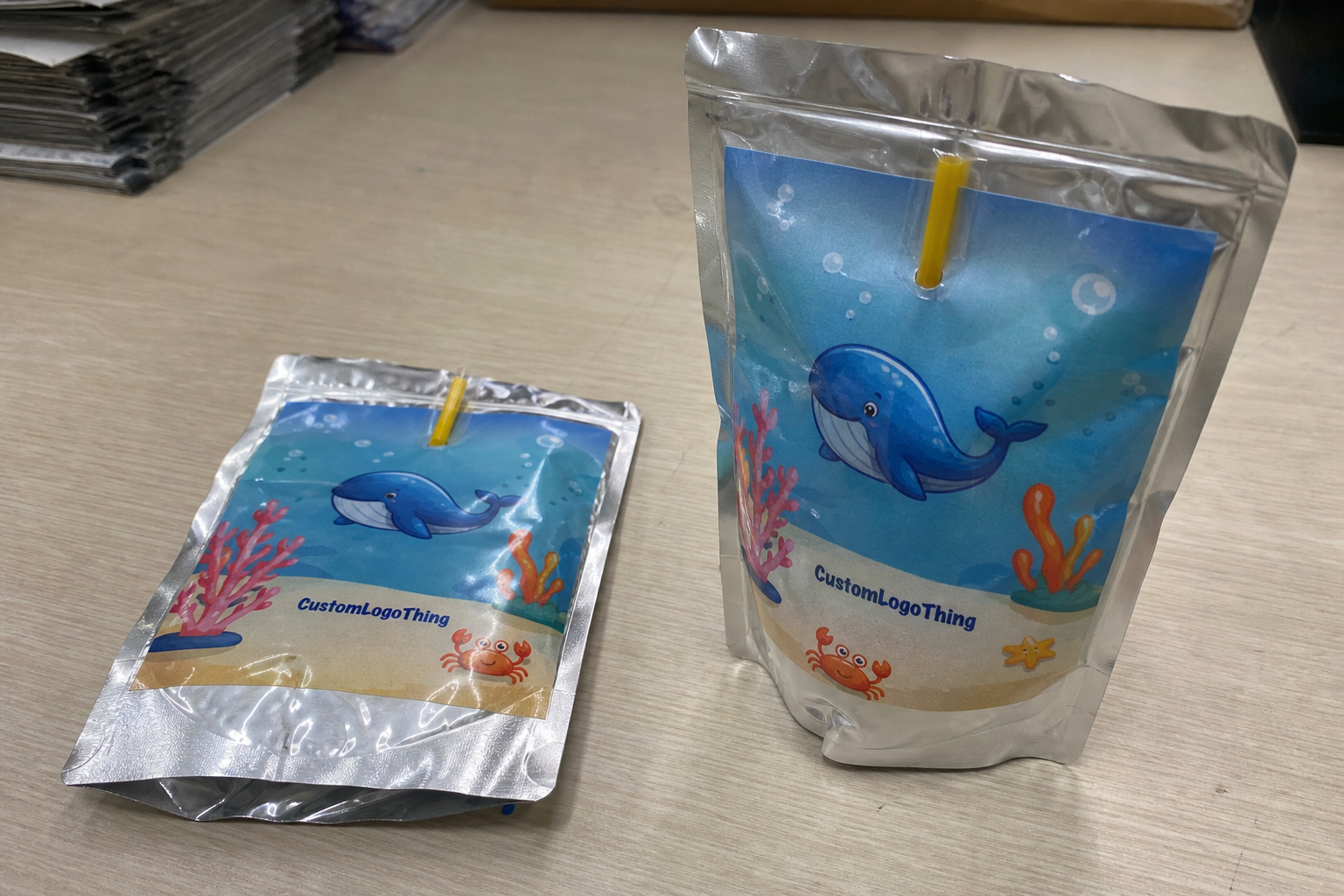
Custom capri sun labels are pressure-sensitive labels or film-based labels made for juice-style pouches, drink sachets, and similar flexible packs. They can cover a front panel, sit on a defined branding zone, or wrap a limited area depending on the pouch shape and fill layout. That matters because these packs rarely offer the wide, forgiving surface area of a carton.
The biggest advantage is speed. Labels are usually the faster option when you need a short run, a limited seasonal drop, or a quick test of a new flavor. Fully printed pouches can be efficient at scale, but they tie you to larger minimums and a fixed artwork structure. Labels let you change SKU details without rebuilding the whole package.
They are common in school drinks, kids’ beverages, sampler packs, and event service because the packaging has to work from a few feet away and in someone’s hand. The front panel needs to read clearly in a cooler, on a tray, or on ice. The copy also has to stay legible enough for ingredients, warnings, or barcode placement if the package moves into retail.
A lot of buyers underestimate how much the label controls shelf appeal. A clean label spec can make a pouch feel organized, polished, and production-ready. A weak one can make the same product look temporary, even if the liquid and recipe are solid.
There is also a practical production angle. Labels are often easier to update than direct print when you are juggling multiple flavors, limited editions, or regional variations. That flexibility reduces the risk of dead inventory when one SKU changes late in the schedule. It is not glamorous. It just saves money.
For refrigerated products or pouches that may travel through coolers, condensation is the part that usually separates a good label from a bad one. Paper can work in dry conditions, but synthetic or film-faced materials generally hold up better when moisture is involved. Flexible packaging does not forgive weak adhesive performance.
| Label option | Best for | Typical strengths | Trade-offs |
|---|---|---|---|
| Paper-faced label | Dry, short-term use | Lower cost, easy printability | Less resistant to moisture and scuffing |
| Film label | Cold drinks, handling, refrigeration | Better moisture resistance, cleaner finish | Usually costs more per unit |
| Matte finish | Readable, restrained branding | Reduces glare, can feel premium | May show scuffs more than gloss |
| Gloss finish | Retail packaging with strong shelf pop | Vivid color, high shine | Can reflect light on small text |
| Soft-touch finish | Premium or gift-style packs | Distinct tactile feel | Higher cost and not always necessary |
For beverage teams comparing packaging formats, the label is usually the least disruptive way to get to market quickly. It gives you room to test demand before investing in more complex pouch decoration. That is the kind of boring, sensible decision that tends to work.
How the label application process works on Capri Sun-style pouches
The path from artwork to finished pouch usually follows a predictable sequence: file review, material selection, proofing, printing, finishing, cutting, and then either shipment for in-house application or direct use on a labeling line. If the setup is clean, the job moves faster and waste stays lower. If the dimensions are wrong, the whole process gets more expensive for no good reason.
Label placement matters more than first-time buyers expect. Capri Sun-style pouches have seams, gussets, straw zones, and fill-related boundaries that limit the usable area. If a label crosses a seam or lands too close to an edge, it can wrinkle, lift, or look crooked. Good package design starts with the pouch dimensions, not the artwork mockup.
Application method changes the spec. Machine-applied labels need consistent size, roll direction, and registration so they feed properly. Hand-applied labels allow a little more variation, but the die cut still has to release cleanly and land in a way that does not create bubbles or crooked placement. A label that sounds easy on paper can be annoying on a packing table.
Common constructions include permanent adhesive films, removable labels, and finishes like matte, gloss, or soft-touch. For chilled products, film-based stocks are usually safer than paper-faced materials because they resist condensation better. The adhesive has to bond to a flexible surface and keep holding after the pouch bends, stacks, or gets squeezed in transit.
Before full production, proofing and test application are worth the time. Color matching, fit, and real-world handling all deserve a sample check. A label that looks good in a PDF can still fail once it meets cold storage, ice buckets, or a rushed production line.
For brands that care about distribution performance, pack testing references such as ISTA methods are useful when you are discussing shipping stress, compression, and vibration. ISTA’s site is a good starting point for basic packaging test information: ISTA packaging testing resources.
Cost, pricing, and MOQ factors that change your quote
Pricing for custom capri sun labels usually comes down to quantity, material choice, ink coverage, finish, and die-cut complexity. A simple rectangle in a standard stock will be easier on the budget than a custom contour with heavy coverage and a specialty finish. That is not a mystery. It is just press economics.
Smaller runs almost always cost more per unit because setup, prepress, and tooling are spread across fewer pieces. A 500-piece order and a 10,000-piece order may need similar proofing and setup time, but the larger run absorbs fixed costs better. That is why the per-label price drops faster than most buyers expect once volume rises.
Minimum order quantity, or MOQ, is usually tied to material roll sizes, press setup, and waste control. A supplier may quote an MOQ of 1,000, 2,500, or more depending on the construction and how the job is run. Ask early. MOQ can affect both budget and timeline, and nobody likes discovering that after design approval.
Moisture-resistant or condensation-safe labels often cost more, but they can save money by preventing peeling, damaged packs, and rejected product. That matters most for refrigerated drinks, ice displays, and event service where pouches are handled repeatedly. A cheaper label that fails in the cooler is not cheaper.
Typical market pricing varies a lot, but buyers usually see the best value when they balance unit cost against application speed and failure risk. In practice, label orders for short beverage runs often land in a range of roughly a few cents per piece for simple, higher-volume jobs to noticeably more for smaller runs, custom shapes, premium finishes, or extra moisture resistance. There is no useful magic number until you know the exact spec.
Here is a clean way to think about quote structure:
- Material: paper, film, or specialty stock
- Print coverage: light branding versus full-color coverage
- Finish: matte, gloss, soft-touch, or protective coating
- Die shape: standard rectangle or custom contour
- Volume: low runs cost more per label
- Application method: hand applied versus machine applied
My practical advice is simple: compare the quote against how the pack will actually be used. If the pouch is going into a cold chain, a weekend event, or a retail window with lots of handling, durability matters more than shaving a few cents off the label.
Choosing the right materials, adhesives, and finish for your pouch labels
Material selection starts with the environment. Paper-faced labels can work fine in dry conditions, but film and synthetic stocks are usually the safer choice for coolers, refrigerated distribution, and any pack that may collect condensation. Flexible pouch surfaces do not behave like rigid cartons. They bend. They flex. They punish weak adhesive choices.
Adhesive selection matters as much as facestock. Pouches compress during packing and transport, and the label has to stay put through all of that. A good proof on a flat sheet does not guarantee the same performance on a curved, squeezable pouch body. Test application is the part that exposes that gap early.
Finish affects both appearance and function. Matte cuts glare and helps small text stay readable. Gloss boosts color and gives stronger shelf presence. Soft-touch feels more premium, though it is not always a good fit for a kids’ beverage or a short-lived event pack. The best finish is the one that supports readability and use, not the one that sounds fancy in a spec sheet.
Some pouch labels need white ink support, especially when transparent or tinted areas would otherwise muddy the artwork. Barcode contrast also deserves attention. A pretty barcode that does not scan is not useful packaging; it is just decoration with problems.
For retail packaging, the spec should match the use case. Promotional samples can stay simpler. Party packs may need bright graphics and fast application. Seasonal beverages may want a cleaner premium look without a premium production burden. Matching the label to the job usually beats overbuilding every order.
FSC-certified paper can matter if the label is part of a broader sourcing strategy. If that is relevant to your packaging program, review FSC’s certification resources and confirm whether the stock options align with your compliance requirements.
When buyers compare options, it helps to think in terms of end use:
- Promotional samples: cost-conscious, clean branding, shorter lifespan
- Kids’ beverages: bold graphics, easy readability, durable adhesion
- Retail beverage line: stronger finish control, barcode clarity, consistent branding
- Event giveaways: fast turnaround, flexible quantities, simple application
Production steps and turnaround: from proof to delivery
Production usually starts with artwork review. A supplier should check dimensions, bleed, safe zones, and file quality before anything goes to press. That step may feel slow, but it prevents the kind of mistake that burns time later. Once the proof is approved, the schedule becomes real.
The usual chain is straightforward: proofing, revision if needed, print production, curing or finishing, slitting or die-cutting, final inspection, and shipping. If the files are print-ready and the label size is confirmed early, turnaround can move quickly. If the job needs a custom contour, specialty coating, or late artwork edits, expect more time.
Delays usually come from predictable places: low-resolution images, last-minute copy changes, color corrections, or a die shape that needs adjustment after proofing. Moisture-resistant constructions and specialty stocks can also add time if the material has to be ordered or slotted into a busy press calendar.
For straightforward label jobs, many buyers see production windows around 12 to 15 business days after proof approval, though quantity, stock availability, and the production queue can push that longer. Custom shapes and premium finishes can extend the schedule. Shipping is separate, so confirm both production and transit time before you lock in a launch or event deadline.
If the labels are part of a larger package rollout, coordinate the timing with cartons, trays, and shipper packaging. One late component can slow the whole program. That is the kind of operational headache people only notice after the pallet is already sitting half-finished.
Common labeling mistakes that hurt shelf appeal and application
Designing too close to seams, folds, or edges is one of the most common mistakes. On a flexible pouch, that can cause lifting or wrinkling and also throw off the visual balance of the entire pack. If the label needs to sit on a panel, respect the pouch shape instead of forcing a flat graphic to do something it cannot do.
Tiny text is another problem. A pouch offers limited space, so every line has to earn its place. If the type is too small or too low in contrast, the label may look fine on a monitor and fail in the hand or on shelf. That is a design issue, not a print issue.
Condensation and refrigeration create more failures than many buyers expect. If the pouch is cold, wet, or packed tightly, weak adhesive and paper stock can let go sooner than intended. Smudging is another risk if the print system is not matched to the environment.
Dimensional mismatch causes plenty of avoidable grief. A mockup may look perfect on screen, but if the flat panel is narrower than expected or the seams sit differently on the actual pouch, the finished label can look crowded or off-center. A physical sample is worth requesting whenever the run matters.
Skipping a test run is especially risky when the product will be filled, chilled, and distributed quickly. The cost of one sample batch is minor compared with scrapping a whole production lot because the label peeled, wrapped badly, or covered an important panel.
Expert tips for ordering labels that look polished and run smoothly
Start with the pouch, not the artwork. Measure the exact front panel, confirm seam positions, and note the straw area or any no-print zone before design begins. That one step prevents a long list of expensive fixes later.
Use a simple visual hierarchy. Brand name first, flavor or variant second, required information below that in a readable structure. On a small-format pack, the label has to communicate quickly. A cluttered panel usually works against both shelf appeal and legibility.
If the run is tied to a launch, event, or seasonal window, order a pre-production sample. It gives you a real read on adhesion, color, and placement before you commit to the full quantity. I would rather see a buyer spend a little on sampling than spend a lot correcting a finished run.
Ask how the labels will be applied. Hand application, semi-automatic equipment, and high-speed lines each place different demands on the material and die cut. A label that peels easily by hand may not feed well on a machine, and the reverse can be just as annoying.
Keep one master layout for future reorders and swap only variable content where possible. That keeps the branding consistent, shortens revision cycles, and makes seasonal updates easier. It also helps when you are building a family of products and want each flavor to feel connected to the rest.
If your product line includes pouches and other formats, it often makes sense to keep the visual system aligned across custom printed boxes, labels, and retail display packs. Consistency is what makes a small line feel established.
Next steps for ordering the right pouch label spec
Before requesting a quote for custom capri sun labels, gather the basics: pouch dimensions, usable label area, quantity, finish preference, storage conditions, and whether the labels will be applied by hand or by machine. Those details shape both price and manufacturing approach.
Have your artwork ready in the correct format and note any required copy such as ingredients, warnings, barcode placement, or batch code space. If the file setup is uncertain, ask for a preflight review before production starts. A cleaner proof process usually means fewer revisions and a better result.
Think through the use case before choosing a spec. If the pouches will live in cold storage, choose moisture-resistant construction. If the product is a premium retail launch, consider a finish that supports the look you want on shelf. If the job is a short-run promotion, keep the construction practical and price-conscious.
Ask for a sample or material recommendation before committing, especially if the schedule is tight. That advice can save you from choosing the wrong adhesive or finish for the environment. It also shows how the label behaves during application and distribution instead of only on a proof sheet.
When you review the final quote, confirm four things: cost, MOQ, turnaround, and application method. If those are aligned, the order usually moves from approval to production without much drama. If one of them is vague, stop and clear it up first.
For buyers building a beverage line or promotional pack, the best results come from thinking like both a production team and a brand team. That is the point where custom capri sun labels stop being a decorative extra and start acting like real packaging infrastructure. Small detail. Big difference.
Are custom capri sun labels better than printing directly on the pouch?
Labels are often the better choice for short runs, seasonal products, and faster launches because they avoid full-package print tooling. Direct printing can be more efficient at scale, but labels give you more flexibility for changes, versioning, and smaller quantities. The right choice depends on volume, artwork complexity, and how quickly the product needs to be ready.
What size should custom capri sun labels be for a pouch?
The correct size depends on the exact pouch dimensions and where the label will sit relative to seams, gussets, and the straw area. Measure the flat front panel and confirm the usable space before designing. A supplier can usually help adjust the dieline so the label fits cleanly without wrinkling or overlap.
What affects the cost of custom pouch labels the most?
Quantity, material choice, adhesive performance, finish, and die-cut complexity usually have the biggest impact on price. Smaller runs often cost more per label because setup costs are spread across fewer units. Special moisture-resistant or premium-looking finishes can raise cost, but they often improve durability and shelf appeal.
How long does production usually take for custom capri sun labels?
Production timing depends on proof approval, material availability, and whether the design needs a custom cut shape. Standard jobs move faster when artwork is print-ready and dimensions are confirmed early. Always separate production time from shipping time so you understand the true delivery window.
Can these labels hold up in refrigerators or on cold drinks?
Yes, but you should choose a label material and adhesive designed for moisture and condensation. Film-based stocks and stronger adhesives generally perform better than basic paper labels in cold environments. A test application is smart if the pouches will be chilled, handled often, or displayed on ice.