Buyer Fit Snapshot
| Best fit | Custom Cardstock Inserts for Packaging projects where brand print, material claims, artwork control, MOQ, and repeat-order consistency need to be specified before quoting. |
|---|---|
| Quote inputs | Share finished size, material target, print colors, finish, packing count, annual reorder estimate, ship-to region, and any compliance wording. |
| Proofing check | Approve dieline scale, logo placement, barcode or warning zones, color tolerance, closure strength, and carton packing before bulk production. |
| Main risk | Vague material claims, crowded artwork, missing packing details, or unclear freight terms can make a low unit price expensive after revisions. |
Fast answer: Custom Cardstock Inserts for Packaging: Material, Print, Proofing, and Reorder Risk should be specified like a repeatable production item. The safest quote records material, print method, finish, artwork proof, packing count, and reorder notes in one written spec.
Production checks before approval
Compare the actual filled-product size with the drawing, then confirm tolerance on folds, seals, hang holes, label areas, and retail display edges. Reserve space for logos, QR codes, warning copy, and material claims before decorative graphics fill the panel.
Quote comparison points
Review material grade, print process, finish, sampling route, tooling charges, carton quantity, and freight assumptions side by side. A quote is only useful when the supplier can repeat the same color, closure quality, and packing count on the next order.
Custom Cardstock Inserts for Packaging: A Practical Guide
A box can arrive in perfect shape and still feel a little off. The print may look crisp, the shipper may have done its job, and the product may be completely fine, yet the unboxing still lands flat because the contents slide around, the accessories bunch up in one corner, and the inside never feels fully resolved. Custom cardstock inserts for packaging fix that by holding the product in place, organizing the contents, and giving the opening moment a more deliberate shape. For brands focused on product packaging, branded packaging, and retail packaging, that difference shows up quickly.
One mistake I see a lot is treating the insert like a throwaway filler. It is not. In practice, custom cardstock inserts for packaging do two jobs at once: they stabilize the product during shipping and they shape how the customer experiences the package the moment it opens. That matters for cosmetics, candles, subscription kits, food gifts, and custom printed boxes, where the interior structure is part of the product story rather than a background detail.
What custom cardstock inserts for packaging do
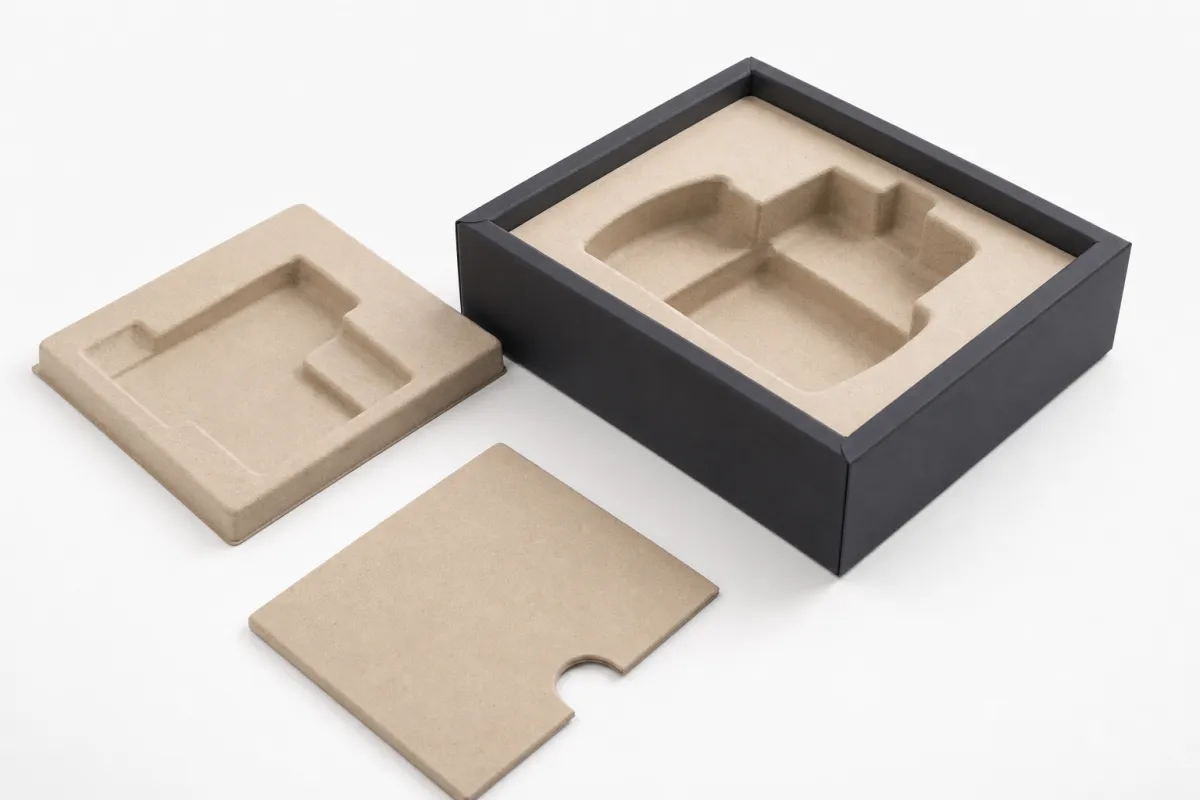
At the simplest level, custom cardstock inserts for packaging are die-cut or folded paperboard components that sit inside a carton and keep one or more items positioned correctly. They may take the form of trays, collars, sleeves, separators, cradles, or layered supports. The shape can be simple, but the effect is not. A well-built insert keeps bottles upright, separates fragile pieces, centers a product in a window, or frames a gift set so the inside looks finished as soon as the lid comes off.
Cardstock stays popular for a few practical reasons. It is lighter than foam, often easier to recycle than plastic-heavy alternatives, and usually gives the interior a cleaner look than materials that feel industrial. In branded packaging programs, that lighter footprint can support a more careful sustainability story. Many teams choose custom cardstock inserts for packaging because they pair naturally with paper-based outer cartons, reduce total material weight, and fit cleaner sourcing goals. Still, cardstock is not the right answer for every item. A 1 kg glass jar asks for something very different than a 120 g skincare set.
The best inserts do more than protect. They present. That distinction matters. Protection means limiting movement, impact, and toppling. Presentation means guiding the eye, revealing the item in a controlled way, and making the pack-out feel intentional from the first touch. Custom cardstock inserts for packaging work best when both goals are designed together rather than patched in later after the carton is already approved.
"If the insert slows packing or looks like an afterthought, the whole package feels cheap, even if the box print is beautiful."
Packaging design teams usually treat the insert as part of the full system instead of a loose accessory. The outer carton, the print, the insert, and the product all need to fit together. In retail packaging, that alignment can decide whether a box blends into the shelf or reads as carefully considered from every angle. Custom cardstock inserts for packaging help close that gap without adding much weight or bulk.
How custom cardstock inserts for packaging work
The mechanics are pretty straightforward once you look at the structure closely. Slots, folds, tabs, friction fits, and cavity layout do most of the work. If a product shifts, one of those structural choices is usually missing or undersized. A bottle may need a neck lock. A compact device may need sidewalls that stop lateral drift. A multi-piece kit may need separators so one component does not press into another. Custom cardstock inserts for packaging manage movement by controlling space instead of stuffing in padding everywhere.
Dimensions carry more weight than many teams expect. A good insert is not built to the exact product size; it is built to the product size plus clearance, tolerance, and room for labels, caps, rounded shoulders, or decorative finishes. A perfume bottle with a different cap profile may need a cavity adjustment. A jar label can sit slightly proud of the glass and change the fit. I have seen that tiny detail cause a good design to bind up in sample testing. That is why the strongest custom cardstock inserts for packaging are based on measured reality, not the neat numbers on a spec sheet.
The production path tends to follow a familiar sequence: dieline creation, sample approval, cutting, creasing, folding, and sometimes gluing or locking. A simple insert may need only die-cutting and a few scored folds. A more complex design may use lock tabs or nested layers so it ships flat and assembles quickly at pack-out. Custom cardstock inserts for packaging can be built as one-piece layouts or multi-part systems, depending on how much support the product needs and how the assembly line is set up.
Single-item, multi-item, and layered layouts each solve a different problem. Single-item inserts usually feel cleaner and move faster through assembly. Multi-item layouts suit kits, bundles, and subscription boxes because they separate pieces without making the interior feel crowded. Layered structures make sense when a product needs both display and transit protection, such as a bottle seated above an accessory card or a device paired with a small tray. Custom cardstock inserts for packaging adapt well across these formats because the structure can change without leaving the paperboard family.
For parcel testing, it helps to think in terms of movement under stress. A package that ships through standard carriers should be checked against vibration, drop, and compression conditions that resemble real handling. The ISTA test procedures are a useful benchmark for that kind of review, especially when a brand wants fewer surprises after launch.
Key factors that affect cost and performance
Pricing starts with the material choice. Board thickness, surface finish, print coverage, and coating all influence cost, and so does the amount of complexity built into the die. A simple insert with clean cutouts costs less than a layered structure with tight tolerances and several lock points. If the insert needs soft-touch lamination, spot UV, or heavy ink coverage to match package branding, the price climbs again. Custom cardstock inserts for packaging are rarely expensive in isolation, but design decisions can move the number faster than people expect.
Quantity changes the picture. A steel rule die or similar setup charge gets spread across the run, so the unit price usually falls as volume rises. That is why a 500-piece order and a 10,000-piece order can look like different products on the quote sheet. Prototype work can cost more per piece, yet it is usually worth the money because a bad fit in the sample stage is far cheaper than 5,000 mispacked units. For custom cardstock inserts for packaging, setup discipline matters just as much as board selection.
Here is a practical way to compare common options. The figures below are broad planning ranges rather than firm quotes, since print coverage, shipping method, and finishing details can move them. Even so, they are useful for early budgeting.
| Insert option | Typical structure | Best use | Approx. unit cost at 5,000 pcs | Notes |
|---|---|---|---|---|
| Simple folded SBS insert | 14-18 pt paperboard, minimal print | Light cosmetics, small accessories, mailer kits | $0.10-$0.18 | Fast to pack, good for clean presentation |
| Printed die-cut tray | 18 pt board, full or partial print | Gift sets, retail packaging, multi-item kits | $0.14-$0.28 | Better visual impact, more setup time |
| Reinforced kraft insert | Kraft board or heavy liner, often uncoated | Natural-looking branded packaging | $0.12-$0.24 | Good for paper-forward sustainability stories |
| Micro-corrugated insert | Thin corrugated board with higher crush resistance | Heavier products or longer shipping lanes | $0.18-$0.40 | More protection, less elegant than plain cardstock |
Hidden costs deserve just as much attention as the quote. One damaged item can wipe out the savings from a stack of cheaper inserts once freight, repacking labor, customer service time, and replacement stock enter the picture. If an insert saves even one return in a small run, it may already have paid for itself. That is why the lowest price is not the same thing as the lowest total cost. Custom cardstock inserts for packaging should be judged by the whole system, not by unit cost alone.
Performance depends on product weight, fragility, shipping distance, humidity, and the role of the box on arrival. A candle moving through a short regional lane has different needs from a glass bottle passing through several distribution centers. If the insert has to support shelf display as well as transit, it also needs to look neat after the lid opens and the item is removed. Many brands learn that the insert is not just a hidden part of product packaging; it is often the first structure the customer actually touches.
Sustainability goals matter here too. FSC-certified paperboard can support sourcing claims, and a paper-based build often makes end-of-life communication easier. If that is part of the brief, the material spec should be checked early rather than after artwork approval. The FSC certification system is a useful reference point for paper sourcing, and it helps keep custom cardstock inserts for packaging aligned with a broader sustainability narrative.
Process and timeline: from brief to production
The quickest projects start with clear inputs. A supplier needs exact product dimensions, product photos, the pack-out method, shipping conditions, and any branding or display requirements. If the product arrives in a glass bottle with a new cap profile, send the full assembled sample. If the insert must fit a custom printed box, share the carton dimensions and inside clearance, not just the outer size. Custom cardstock inserts for packaging move much faster when the brief removes guesswork.
A realistic timeline usually moves through five stages: concept review, sample or prototype, approval, prepress, production, and shipment. For a straightforward project, sampling may take 3-7 business days and production another 10-15 business days after approval. Complex locking features, specialty coatings, or seasonal factory congestion can stretch that window to 3-4 weeks or longer. That is not a failure in the process; it is normal planning friction. The trouble usually comes from missing information that forces extra revision cycles.
A few delays show up again and again. Missing measurements are the obvious one, but repeated revisions can be just as costly. A team may change the product cap after the insert is sampled, then ask for a cavity adjustment by a few millimeters, then decide the reveal window should be larger. Each change looks small in isolation and expensive in sequence. Custom cardstock inserts for packaging work best when they are treated like tooling-sensitive components, because once a dieline is set, every revision sends ripples through the rest of the process.
Special coatings can add time as well. Soft-touch lamination, aqueous coatings, and certain print finishes may need extra setup or drying time. If the insert must be packed flat for fulfillment, the assembly method also needs to be checked. An insert that looks excellent in a mockup can still slow a packing line if it takes 40 seconds to build by hand. That kind of delay can erase the savings from a lower board price very quickly.
Practical rule: build the insert timeline around the outer box, the product arrival date, and the replenishment schedule. The insert should not show up after the box has already been printed and stored, because that often forces a costly rework of the rollout. Custom cardstock inserts for packaging should be planned as part of the launch sequence, not as a final purchase order after the product is locked.
Step-by-step: specify the right insert
The best starting point is a product audit. Measure every dimension, note fragile points, and identify anything that must stay visible, protected, or easy to remove. If the item has a pump, cap, connector, or sharp edge, record that separately. Take photos from several angles too. Custom cardstock inserts for packaging are easier to design when the supplier can see where the product bulges, where it flexes, and where a customer will naturally grip it.
After that, choose the pack-out strategy. One product per insert works well for premium single-item retail packaging. Multiple items in one layout make sense for gift sets, subscription boxes, or bundled products. Presentation-first layouts suit projects where the goal is to show the contents instead of hiding them. Good packaging design begins with that choice, because the insert cannot solve a pack-out problem that has not been defined. Custom cardstock inserts for packaging should match the way the product will actually be opened and used.
The next step is choosing the board structure and print approach with the customer experience in mind. A plain kraft insert can feel restrained and natural. A printed insert can reinforce package branding and make the interior feel like part of the same story. If the rest of the line uses custom printed boxes, the insert should support the same visual language rather than fight it. Sometimes the smartest choice is not the lowest-cost board, but the one that makes the package read as one system.
Samples and prototypes deserve real testing. Fit is the first check, but it is not the only one. Shake stability, drop resistance, compression behavior, and unboxing flow all matter. If the product rattles after a few shakes, the cavity is too loose. If the user has to tug too hard, the fit may be too aggressive. For fragile bottles or jars, cap clearance and shoulder contact should also be checked, because neck damage is often the hidden failure point. Custom cardstock inserts for packaging earn their place when they pass real handling, not just a desk-top mockup.
- Audit the product dimensions and fragile points.
- Choose the pack-out style based on the customer journey.
- Match the board and print method to the desired presentation.
- Prototype, test, revise, and only then approve the run.
That sequence sounds simple because it is. The hard part is holding the line when deadlines tighten. A rushed approval often creates the same problem later in a more expensive form, which is why custom cardstock inserts for packaging should never be approved on appearance alone.
Common mistakes with custom cardstock inserts for packaging
The first mistake is designing to the ideal product size instead of the real one. Manufacturing tolerances exist, and they are not small enough to ignore. A bottle neck that varies by 1 mm or a jar label that sits slightly proud can turn a snug fit into a crush risk. Custom cardstock inserts for packaging need breathing room, but not so much that the item floats. The sweet spot usually appears after sampling, not before.
The second mistake is trying to make one insert do five jobs at once. Some teams want the insert to protect, display, separate, decorate, and speed fulfillment all at the same time. That can work in a few cases, but more often it creates a structure that is awkward to assemble and fragile in use. Simpler designs tend to be more forgiving. In other words, custom cardstock inserts for packaging should be engineered, not overloaded.
Assembly time gets overlooked often. A design that looks elegant in a render may be painful on a packing line if it needs too many folds, manual tabs, or alignment steps. Flat-pack shipping helps only if the insert can be assembled quickly and repeatably. If one operator can build 120 units per hour and another can only manage 70, the insert is no longer just a material choice; it becomes a labor decision.
The final mistake is comparing only the quoted unit price. That is how projects drift into false economy. A cheaper insert that increases breakage, slows pack-out, or frustrates customers is not actually cheaper. It is only cheaper to buy. Custom cardstock inserts for packaging should be measured against returns, complaints, and repacking costs, because those costs are where the real margin leak lives.
"Cheap inserts are often the most expensive part of the package once labor and breakage are counted."
Brand perception matters too. If the insert looks sloppy, the entire retail packaging story weakens. Customers rarely separate the carton from the interior structure. They just feel whether the package was designed with care. That is why custom cardstock inserts for packaging should be reviewed alongside the outer box, the artwork, and the shipping plan.
Expert tips and next steps for smarter inserts
Design for speed first. Standardized folds, repeatable dielines, and fewer hand-assembly steps usually outperform clever structures that look beautiful but slow fulfillment. A good insert should make pack-out easier, not harder. If a team is shipping at scale, custom cardstock inserts for packaging need to fit the line rhythm as well as the product cavity.
Ask for both digital proofs and physical samples. Digital proofs are useful for checking copy, panel placement, and overall layout. Physical samples are where fit, stiffness, and unboxing quality become real. One without the other leaves a gap. If the project is tied to a launch, compare the sample against the product, the carton, and the shipping method together. That is the only way to see the full system.
It also helps to compare at least three specs side by side: material, structural complexity, and timeline. Price matters, but only in context. A slightly more expensive board can reduce assembly time. A simpler die can improve pack-out speed. A longer timeline may be worth it if the insert prevents damage during distribution. If you are reviewing broader packaging options, the full range of Custom Packaging Products can help you see how the insert fits inside the larger packaging stack.
Keep an eye on the customer experience after the product leaves the box. Does the insert hold the item upright on first opening? Does it protect labels from scuffing? Does it make the reveal feel controlled and premium, or does it force the customer to work for the product? Those details shape brand perception more than many teams realize. Custom cardstock inserts for packaging are not just structural parts; they are part of the message.
Useful next steps: gather measurements, define your pack-out, request a sample quote, and decide what matters most - protection, presentation, cost, or speed. If you can rank those priorities before sending the brief, the supplier can design a better insert on the first pass. If the program includes Custom Packaging Products beyond the insert itself, build the carton and insert together so they behave like one system.
From a packaging buyer's point of view, the strongest projects are the ones where custom cardstock inserts for packaging are planned early, tested honestly, and tied to the real shipping route. That is the difference between a package that merely holds a product and one that makes the product feel finished. If the box, the print, and the insert all work together, custom cardstock inserts for packaging do more than reduce movement - they improve the whole experience from carton opening to shelf display.
So the clear takeaway is this: start with the product, not the artwork. Measure the real item, choose the pack-out that fits how it will be used, and test the insert against actual handling before you approve the run. Do that, and custom cardstock inserts for packaging become a practical part of the build instead of a last-minute patch.
How do I know if custom cardstock inserts for packaging are strong enough for my product?
Match board weight and structure to the product's weight, shape, and fragility instead of choosing by appearance alone. Then test custom cardstock inserts for packaging with real shipping conditions, including vibration, shake, and drop simulations. If the item has sharp edges, heavy glass, or a high breakage risk, add reinforcement or switch to a different insert material.
What products work best with custom cardstock inserts for packaging?
They work especially well for cosmetics, candles, small electronics, bottles, jars, subscription kits, and gift sets. Custom cardstock inserts for packaging are strongest when the product needs both separation and presentation, not just basic cushioning. They are less ideal for very heavy, highly fragile, or moisture-sensitive products unless the structure is reinforced carefully.
How much do custom cardstock inserts for packaging usually cost?
Price depends on size, board type, print coverage, die complexity, finishing, and order quantity. Prototype or short-run work usually costs more per unit because setup costs are spread across fewer pieces. The real comparison is total cost, including reduced breakage, faster packing, and fewer customer complaints from custom cardstock inserts for packaging that fit well the first time.
How long does the custom cardstock inserts for packaging process take?
Simple designs can move quickly once dimensions are approved, while custom tooling, revisions, and specialty finishes add time. Most timelines include sampling, approval, production, and shipping, so build in buffer time before a launch. Having exact measurements and clear pack-out instructions upfront is the fastest way to avoid delays with custom cardstock inserts for packaging.
Are custom cardstock inserts for packaging recyclable?
They are usually recyclable when made from paperboard and kept free from problematic plastic laminations or mixed-material builds. Local recycling rules matter, so coating type and adhesive choice should be checked before final approval. If sustainability is a priority, ask for paper-based materials and inks that support the recycling stream, and keep custom cardstock inserts for packaging aligned with that goal.
For most brands, the smartest move is simple: define the product, test the fit, and make sure custom cardstock inserts for packaging serve both transit and presentation before the full run starts.

