Buyer Fit Snapshot
| Best fit | Custom Carton Labels for Ecommerce projects where brand print, material claims, artwork control, MOQ, and repeat-order consistency need to be specified before quoting. |
|---|---|
| Quote inputs | Share finished size, material target, print colors, finish, packing count, annual reorder estimate, ship-to region, and any compliance wording. |
| Proofing check | Approve dieline scale, logo placement, barcode or warning zones, color tolerance, closure strength, and carton packing before bulk production. |
| Main risk | Vague material claims, crowded artwork, missing packing details, or unclear freight terms can make a low unit price expensive after revisions. |
Fast answer: Custom Carton Labels for Ecommerce: Material, Adhesive, Artwork, and MOQ should be specified like a repeatable production item. The safest quote records material, print method, finish, artwork proof, packing count, and reorder notes in one written spec.
Production checks before approval
Compare the actual filled-product size with the drawing, then confirm tolerance on folds, seals, hang holes, label areas, and retail display edges. Reserve space for logos, QR codes, warning copy, and material claims before decorative graphics fill the panel.
Quote comparison points
Review material grade, print process, finish, sampling route, tooling charges, carton quantity, and freight assumptions side by side. A quote is only useful when the supplier can repeat the same color, closure quality, and packing count on the next order.
Custom Carton Labels for Ecommerce: A Practical Guide
Custom carton Labels for Ecommerce do a lot more than point a carrier toward the right address. In a busy pack room, the right label helps a picker spot the correct carton, keeps order flow sorted, and gives the shipment a tidy first impression before anyone opens the box.
That puts custom carton labels for ecommerce right at the intersection of warehouse control, product packaging, and package branding. They are small printed components, yet they influence scan speed, damage prevention, compliance, and the way a shipment feels the moment it reaches a receiving dock or a front porch.
I have watched more than one operation slow down because a label was treated like an afterthought. The artwork looked fine on a screen, but the real carton had a rougher surface, a seam in the wrong place, or a barcode that was just a hair too small. That kind of miss is easy to underestimate until it starts creating rework.
What Custom Carton Labels for Ecommerce Actually Do
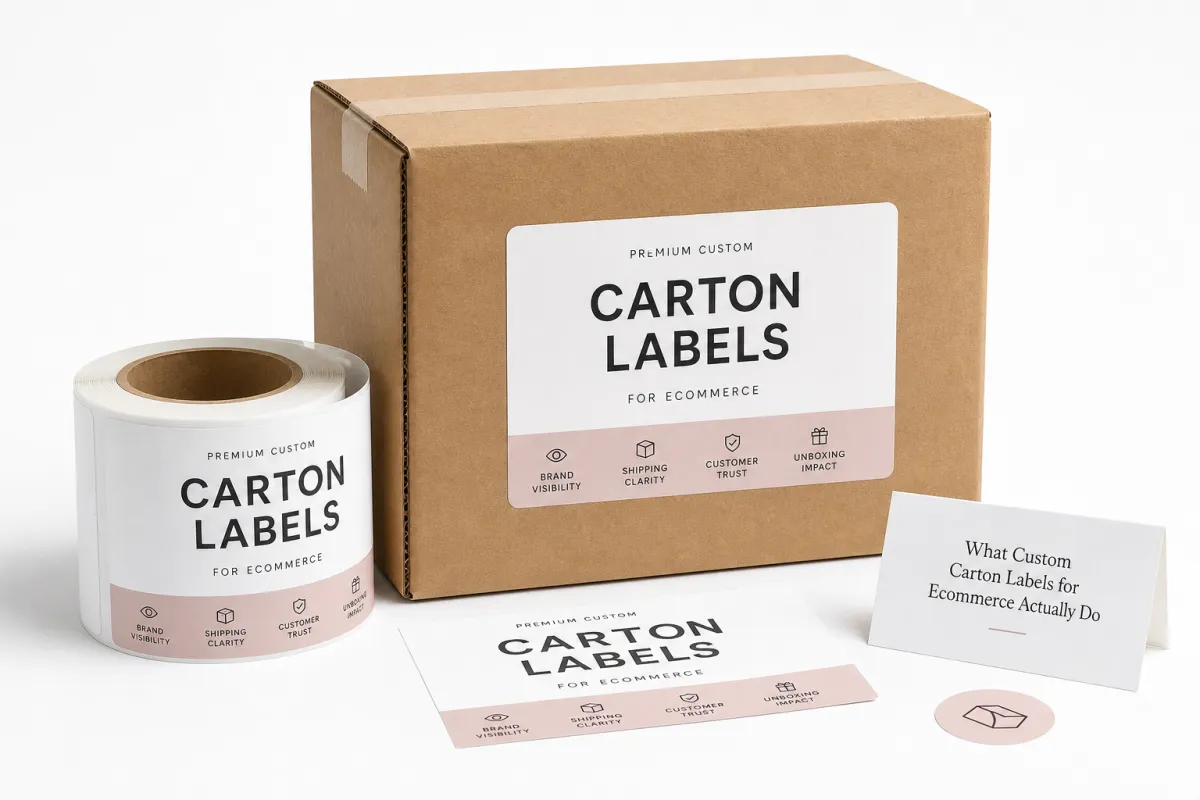
At the simplest level, custom carton labels for ecommerce are printed labels applied to shipping cartons, mailers, or outer cases. In practice, they may carry a barcode, a SKU, a destination code, a handling note, a lot number, a recycled-content mark, or a brand message that supports package branding before the box is even opened. A carton label is not decoration sitting on the surface; it is a working communication tool.
That matters because ecommerce cartons move through many hands. A picker sees it. A packer sees it. A sorter sees it. A carrier scans it. A customer may spot it on a porch, in a lobby, or at a receiving desk. Each handoff gives custom carton labels for ecommerce a chance to prevent errors or introduce confusion. If the label is clear, readable, and placed well, the whole operation moves with fewer corrections.
From a packaging buyer's point of view, the label also helps define the look and feel of the shipment. Some brands use labels to complement custom printed boxes, while others rely on a plain carton and let the label carry the brand identity. Either approach can work. The key is simple: custom carton labels for ecommerce should support the workflow first and the visual story second, not the other way around.
There is a practical advantage here that people sometimes overlook. A good carton label can improve the shipping experience without adding box complexity. Instead of redesigning the carton, you can use custom carton labels for ecommerce to separate storage zones, identify product families, mark fragile loads, or call out assembly steps. That makes them especially useful for fast-moving retail packaging programs where SKUs change often and the carton structure needs to stay straightforward.
That also keeps inventory life a little less annoying, which matters more than people admit. When a packaging program is changing every few weeks, a label can carry the variable details while the carton itself stays stable. That is a cleaner system, and it usually means fewer surprises on the floor.
“The best carton label is the one that gets ignored by everyone except the people who need it.” The floor usually teaches that lesson quickly. A label should not create extra attention; it should quietly prevent extra work.
A few common jobs for custom carton labels for ecommerce include:
- Picking and sorting - helping warehouse teams identify the right carton at a glance.
- Shipping and routing - carrying scan data, service codes, and destination information.
- Branding - adding a logo, color block, or message that strengthens the unboxing moment.
- Compliance - showing recycling marks, handling instructions, or traceability codes.
- Damage prevention - warning about orientation, temperature limits, or fragile contents.
When buyers think through these jobs early, custom carton labels for ecommerce usually become easier to spec, easier to approve, and easier to keep consistent across a large order book. The value shows up in fewer relabels, fewer misships, and a cleaner shipping process that does not force the team to slow down for avoidable problems.
How Custom Carton Labels for Ecommerce Are Applied
The workflow for custom carton labels for ecommerce begins long before the label touches the carton. It starts with artwork, variable data needs, carton dimensions, and the surface the label will stick to. A corrugated case with a recycled liner behaves differently than a glossy mailer or a coated folding carton, so the first question is not “What does it look like?” but “What does it need to survive?”
Once the use case is clear, the next steps are material selection, adhesive selection, print setup, finishing, and application. In a small operation, labels may be printed in a batch and applied by hand. In a larger fulfillment center, they may run through a dispenser or a print-and-apply system that places each label in a fixed position. Either way, the goal stays the same: custom carton labels for ecommerce need to land in the right spot, stay legible, and stay attached.
Placement matters more than many teams expect. A top-panel label is usually best for carrier scanning. A side-panel label can help warehouse staff identify the carton while it is on a pallet. A front-facing label can carry a brand message or a receiving instruction. With custom carton labels for ecommerce, the best location depends on who needs to read the label first and how the carton will move through the building.
In my own press checks and dock-side reviews, the same pattern shows up over and over: the label is only “fine” until the carton has to pass through a real workflow. Once it gets stacked, wrapped, handled with gloves, or set down on a dusty conveyor, a weak spec starts to show its cracks. That is why location and material choice deserve more attention than they usually get.
In practice, the most reliable applications come down to a few checks:
- Surface condition - cartons should be clean, dry, and free of dust or heavy fiber fuzz.
- Texture - rough corrugate needs an adhesive that can wet out properly.
- Fold lines - labels should not bridge seams, score lines, or tuck flaps.
- Stacking - the label must remain readable after pallets are compressed and shifted.
- Environment - humidity, cold storage, and transit vibration all affect performance.
For automated operations, custom carton labels for ecommerce also need consistent die-cut dimensions, liner release, and roll wind direction. A few millimeters off on label width can jam a print-and-apply head or create a crooked placement that slows down scanning. On a floor with tight throughput, that becomes a labor issue very quickly.
Manual application is simpler, but it still benefits from discipline. A hand-applied label that is slightly skewed or half-pressed onto a seam can peel early and create rework later. That is why the application method should get the same care as the artwork. Custom carton labels for ecommerce are only as good as the way they are installed.
If you already source Custom Labels & Tags, it is worth aligning the label spec with carton handling from the start. And if the same shipment also uses inserts, tape, or protective materials, it helps to review the full line of Custom Packaging Products so the label works with the rest of the pack-out system instead of against it.
Materials and Design Choices That Affect Performance
Material choice is where custom carton labels for ecommerce either become dependable or turn into a headache. Paper labels are common for dry, short-duration shipping and are usually the most economical choice when the carton will not face much abrasion or moisture. Film labels, often polypropylene or polyester, cost more but hold up better against scuffing, condensation, and rough handling. If the carton is headed into a humid warehouse, a cold chain, or a long parcel route, that extra durability is often worth the spend.
Adhesive choice matters just as much as face stock. A permanent acrylic adhesive is usually the right starting point for custom carton labels for ecommerce because most carton labels are not meant to come off cleanly after use. Removable or repositionable adhesives have their place, but they fit a narrower set of jobs. If the label must stay on through sorting, transport, and customer receipt, permanent adhesion is usually the safer call. If the carton surface is unusually rough, dusty, or recycled, the adhesive should be tested on the actual board, not guessed from a spec sheet.
Printing method affects both appearance and durability. Direct thermal can be fast and simple for short-lived use, but it is not ideal when heat, friction, or sunlight may fade the image. Thermal transfer gives better durability because the ribbon transfers ink to the label face stock. Digital printing works well for short runs, full color, and variable data. Flexographic printing makes sense for high volumes and repeat jobs where setup cost can be spread across many units. The right choice for custom carton labels for ecommerce depends on quantity, visual requirements, and how long the print needs to last.
Design decisions can help or hurt performance faster than people expect. A barcode needs strong contrast, enough quiet space, and enough room to scan at the expected distance. Thin type may look elegant in artwork approval, but it can disappear on a carton that picks up dust or rubs against another case. Overcrowded layouts show up often in custom carton labels for ecommerce because teams try to fit shipping data, brand art, handling notes, and promotional copy onto one small surface. That usually creates a label that is visually busy and operationally fragile.
The practical rule is straightforward: make the scan content obvious first, then build the brand around it. Good package branding does not need to compete with function. A logo, a clean color block, or a short line of copy can reinforce the brand without crowding the critical information. If a label carries both operational and marketing roles, the hierarchy needs to be clear enough that a warehouse worker can read it in a second and a customer can still feel the brand story.
Environmental realities matter too. Cartons stored in cold rooms can collect condensation. Recycled corrugate can have a more open surface profile. Dusty warehouses can reduce initial tack. Conveyor belts and pallet wrap can abrade print. For that reason, custom carton labels for ecommerce should be checked against the full trip, not just a polished proof. If the sourcing conversation includes paper stock, it is worth asking whether the facestock or liner supports responsible forestry documentation from groups such as FSC. That does not solve performance by itself, but it gives procurement teams a cleaner sustainability story when they need one.
For testing transit performance, it helps to think in terms of standardized methods rather than gut feel. The International Safe Transit Association publishes widely used procedures for package distribution testing at ISTA, and that mindset is useful even for a label-only decision. If the carton, adhesive, and print are not checked under realistic handling conditions, the failure usually shows up later as peeling, smearing, or missed scans.
Strong custom carton labels for ecommerce usually balance five things at once: durable face stock, the right adhesive, readable typography, enough white space, and a layout that fits the carton panel without straddling folds. If any one of those is off, the label may still look fine on screen, but it can become weak in the field.
What Custom Carton Labels for Ecommerce Cost
Pricing for custom carton labels for ecommerce gets easier to understand once you break it into parts. Buyers are not just paying for ink on paper. They are paying for material, adhesive, print method, size, quantity, finishing, proofing, and any variable data or sequence work. A 2 x 4 inch label with simple black print is a very different cost structure than a full-color synthetic label with a die-cut shape and serialized barcode data.
The biggest cost driver is usually quantity. Higher volumes spread setup and press time across more labels, so unit cost drops. A low-volume run can still be the right choice, but it will almost always cost more per label because prepress and proofing are being amortized over fewer pieces. That is why custom carton labels for ecommerce often look inexpensive in a 10,000-piece quote and noticeably less inexpensive in a 500-piece quote. The equipment and setup do not scale down proportionally.
Complexity adds cost as well. Full-color branding, specialty adhesives, foil, varnish, or custom die-cuts will raise the price compared with a standard stock label. Variable data can add another layer if the run needs individual barcodes, order-specific text, or sequential numbering. None of that is unusual, but it should be accounted for early so the quote does not surprise anyone later.
A practical budget view helps. For simple custom carton labels for ecommerce at around 5,000 pieces, a paper label with minimal print might land roughly in the $0.06-$0.12 per unit range. A fuller branded paper label may sit around $0.09-$0.18 per unit. A synthetic film label with stronger durability can move into the $0.14-$0.28 per unit range, and specialty work can push beyond that. Small runs can come out much higher on a unit basis, while very large runs can come down, but those ranges are a useful planning starting point rather than a promise.
Sample pricing comparison
| Option | Typical Use | Estimated Unit Cost at 5,000 Labels | Main Tradeoff |
|---|---|---|---|
| Standard paper, 1-color print | Basic carton ID, internal routing, short shipping cycle | $0.06-$0.12 | Lowest cost, but less resistant to moisture and abrasion |
| Paper with full-color branding | Retail packaging, brand messaging, seasonal cartons | $0.09-$0.18 | Good visual impact, moderate durability |
| Synthetic film with permanent adhesive | Higher-abuse cartons, humidity, longer transit | $0.14-$0.28 | Better performance, higher material cost |
| Variable data or serialized print | Traceability, order-specific labeling, lot tracking | +$0.01-$0.04 add-on | More setup and data handling |
| Special die-cut or finish | Premium package branding, custom carton panel shapes | $0.18-$0.35+ | Distinct look, more tooling and approval time |
Those numbers should be read as planning ranges, not a fixed menu. Artwork coverage, carton application method, and supply chain constraints can move pricing in either direction. The best habit is to ask for a sample or a short test run before placing a large order. A quote sheet can tell you one story, but the actual carton surface will tell you the truth. That matters especially for custom carton labels for ecommerce that need to sit alongside other print elements on the same shipper.
Budgeting also gets easier when the label system is standardized. If one label size can cover several carton families, purchasing and inventory management become simpler. That is one reason buyers often compare label specs alongside Custom Labels & Tags and the rest of their Custom Packaging Products. A little standardization can reduce waste, simplify storage, and keep procurement from chasing too many one-off SKUs.
Step-by-Step Process and Typical Turnaround
A solid process for custom carton labels for ecommerce usually starts with discovery. Before artwork is finalized, the buyer should define carton size, shipping environment, barcode format, surface type, volume, and any compliance or brand requirements. A label meant for dry, domestic parcel shipping has a very different spec than one meant for temperature swings, pallet compression, and repeated touches in a fulfillment center.
After discovery comes proofing. That is the stage where dimensions, copy, colors, adhesive, and placement are confirmed. A digital proof is useful, but a physical sample is better when the label needs to be judged against the actual carton board. If the carton is a recycled corrugate with visible fiber, the label may look fine in artwork approval and still fail on the floor. Custom carton labels for ecommerce improve when the proof includes the real substrate, not just a screen rendering.
Production timing depends on how simple or complex the job is. Clean artwork, standard paper stock, and a straightforward print method can move quickly, often in 5-8 business days after proof approval. If the job needs special die-cuts, synthetic materials, multiple inks, or serialized data, 10-15 business days is a more realistic expectation. Very large volumes or multi-step finishing can take longer. Custom carton labels for ecommerce are not usually slow because the print is hard; they are slow because approvals, testing, and setup need to be right.
Once labels are printed, they are packed and prepared for the next step, whether that is hand application, label dispensing, or machine-fed use. The handoff matters. A roll wound the wrong way can slow an applicator. A box count that is off by even a small percentage can create a shortage in the packing room. Good fulfillment is built on consistency, and custom carton labels for ecommerce should arrive ready for the way the operation actually runs.
Turnaround also improves when the buyer provides a clean brief. The most helpful materials are carton dimensions, a spec sheet with adhesive preference if one is known, artwork in the right format, and a clear description of the shipping environment. If variable data is involved, the data file should be checked for duplicates, missing fields, or barcode errors before production begins. That is not glamorous work, but it saves time and cost.
For teams that want a more rigorous packaging check, the thinking used in parcel testing is worth borrowing. The family of procedures published by ISTA can help teams ask better questions about drop risk, vibration, compression, and orientation. Even if the labels themselves are not being formally certified, the package system should still be judged as a package system. Experienced packaging engineers tend to review custom carton labels for ecommerce with that same lens.
A good process usually follows this order:
- Define the job - shipping, branding, compliance, or internal handling.
- Confirm carton details - board type, panel size, and environmental exposure.
- Select stock and adhesive - based on durability needs and carton surface.
- Approve proof - verify layout, contrast, and barcode readability.
- Run a sample - test on the actual carton before full production.
- Release production - finalize the run once the sample behaves correctly.
That sequence keeps surprises to a minimum. It also makes custom carton labels for ecommerce easier to repeat in future orders because the team has a documented reference point instead of a vague memory of what “seemed fine” the last time.
Common Mistakes That Make Carton Labels Fail
Most carton label failures are not dramatic. They are small misses that multiply. A label is too narrow. A barcode sits too close to a fold. The adhesive was chosen for a smooth carton, not a rough one. None of these sounds disastrous on its own, yet together they can create missed scans, peeling edges, and rework in the warehouse. That is why custom carton labels for ecommerce deserve the same attention as the carton itself.
- Wrong size - labels that are too small can reduce barcode scan performance, while oversized labels can wrinkle or bridge seams.
- Poor contrast - light text on a busy background may look stylish and still scan badly under warehouse lighting.
- Bad placement - labels applied across folds, score lines, or textured seams are much more likely to peel.
- Wrong material - paper stock can fail in humid or cold environments where film would hold up better.
- No real testing - skipping samples means the first test happens in production, which is the most expensive place to find a problem.
Another common issue is overdesign. A label can carry a lot of information, but it should not try to carry everything. If the buyer insists on putting a barcode, logo, multi-line instruction set, regulatory copy, and a marketing message onto one small carton panel, the result is often cluttered. Custom carton labels for ecommerce work best when the essential information is obvious in less than a second.
Process discipline matters, too. Application temperature affects adhesive performance. So does carton dust, condensation, and the amount of recycled fiber in the board. On some corrugate, the surface is open enough that the label needs stronger initial tack to settle in properly. On other cartons, the board is coated enough that a different adhesive chemistry makes sense. The point is simple: custom carton labels for ecommerce should be tested against the actual carton, not just the artwork file.
One more mistake is changing specs without control. A packaging team may shift carton sizes, switch label vendors, or update artwork for a seasonal campaign and forget that the warehouse has already built its process around the old format. Then inventory gets mixed, scanners get confused, and the label becomes a moving target. A stable spec is often more valuable than a slightly prettier one.
The cheapest label is rarely the cheapest outcome. If a relabel, a missed scan, or a customer service call gets triggered, the unit price stops being the real number.
That is why experienced buyers treat custom carton labels for ecommerce as part of the packaging system, not an afterthought. A carton label that survives the route, scans cleanly, and looks intentional on the receiving side is doing real work, even if nobody in the building pauses to admire it.
Expert Tips and Next Steps for Custom Carton Labels for Ecommerce
Start with the use case
The best decisions start with purpose. Is the label mainly for shipping, internal handling, compliance, or brand presentation? That answer shapes everything else. Custom carton labels for ecommerce that are meant to support warehouse picking may need large codes and simple contrast. Labels meant to strengthen brand perception may need a cleaner layout and tighter color control. Labels meant to survive rough transit may need synthetic stock and more aggressive adhesive. If the use case is clear, the spec usually follows naturally.
It also helps to think about the label as part of the broader retail packaging system. A carton may be plain, lightly branded, or paired with custom printed boxes, but the label should always feel intentional. The customer does not separate the box from the label. They experience the whole shipment at once, and package branding either feels coordinated or feels improvised.
Test three real conditions
I like to see labels checked under room temperature, warehouse handling, and transit exposure. That is a simple test plan, but it catches a lot of trouble early. A label that looks perfect on a desk can behave differently when a carton sits in a warm dock, rides a cold trailer, or rubs against another case on a pallet. Custom carton labels for ecommerce should be judged in those actual conditions, not only in a design review.
If the operation is sensitive to moisture, cold, or scuffing, the test should include the full label system: face stock, adhesive, ink, and the carton board itself. That is the practical way to avoid surprises later. A paper label may be perfectly fine for one fulfillment channel and completely wrong for another. There is no single best answer for every shipment.
Standardize where you can
Standardization saves time. If one label size can serve several carton families, purchasing gets simpler and storage gets cleaner. If the same barcode placement works across the majority of cartons, scanning becomes more predictable. If the same stock family can cover most of the volume, the procurement team does not need to manage as many exceptions. Custom carton labels for ecommerce benefit from this kind of discipline because the gains are small but constant, and small gains matter a lot in high-volume shipping.
That is also where a packaging supplier can help beyond the print itself. If you are building a new label program, it is often smart to review the carton, tape, insert, and print system together through Custom Packaging Products. A coordinated setup usually performs better than a collection of one-off decisions.
What to send before you request a quote
If you want a useful quote, send more than artwork. Include carton dimensions, expected annual or monthly volume, shipping environment, label placement, barcode type, any compliance marks, and whether the label needs to complement custom printed boxes or a broader branded packaging system. Add a sample carton if possible. The more concrete the input, the more accurate the recommendation for custom carton labels for ecommerce will be.
My short checklist would be this:
- Carton size and panel layout
- Volume by run
- Indoor, ambient, cold, or humid exposure
- Manual, dispenser, or automated application
- Branding needs and barcode requirements
That list keeps everyone honest. It also reduces the back-and-forth that often slows down first orders. The more clearly you define the real use case, the easier it is to get custom carton labels for ecommerce that work the first time.
My final advice is simple: do not treat the label as a decorative extra. The best custom carton labels for ecommerce improve picking accuracy, reduce damage risk, support compliance, and strengthen brand perception in one move. That is a lot of value for a small printed component, and it is exactly why a careful label spec pays off. Start by locking down carton size, panel location, adhesive, and scan content on one sample carton, then freeze that spec before you place the full run. Once those four pieces are right, the rest of the program gets a lot easier to keep steady.
Frequently Asked Questions
How are custom carton labels for ecommerce different from shipping labels?
Shipping labels are mainly for carrier routing and tracking, while custom carton labels for ecommerce can also carry branding, handling instructions, internal codes, and compliance information. They are usually designed around the carton surface and warehouse workflow, not only delivery scan requirements.
What material is best for custom carton labels for ecommerce?
Paper labels work well for dry, short-duration use, but synthetic films are usually better when cartons face abrasion, moisture, or longer transit exposure. The best choice depends on the carton surface, storage conditions, and whether the label needs to stay intact through the full shipping cycle.
Can custom carton labels for ecommerce be waterproof?
Yes, many synthetic stocks and compatible adhesives can resist moisture far better than standard paper labels. For wet or cold environments, it is smart to test the full label system, including ink, adhesive, and carton surface, before committing to a large run.
How long does it take to produce custom carton labels for ecommerce?
Turnaround depends on quantity, print method, finishing, and proof approvals, so simple jobs move faster than highly customized ones. A clean, standard spec with ready artwork usually shortens the process, while variable data or specialty materials can add time.
How do I keep custom carton labels for ecommerce from peeling off?
Match the adhesive to the carton surface and shipping environment, and make sure the application surface is clean, dry, and within the recommended temperature range. Testing on the actual carton board is the safest way to catch adhesion issues before full production.

