Buyer Fit Snapshot
| Best fit | Return Labels for Ecommerce Boxes projects where brand print, material claims, artwork control, MOQ, and repeat-order consistency need to be specified before quoting. |
|---|---|
| Quote inputs | Share finished size, material target, print colors, finish, packing count, annual reorder estimate, ship-to region, and any compliance wording. |
| Proofing check | Approve dieline scale, logo placement, barcode or warning zones, color tolerance, closure strength, and carton packing before bulk production. |
| Main risk | Vague material claims, crowded artwork, missing packing details, or unclear freight terms can make a low unit price expensive after revisions. |
Fast answer: Return Labels for Ecommerce Boxes: Material, Adhesive, Artwork, and MOQ should be specified like a repeatable production item. The safest quote records material, print method, finish, artwork proof, packing count, and reorder notes in one written spec.
Production checks before approval
Compare the actual filled-product size with the drawing, then confirm tolerance on folds, seals, hang holes, label areas, and retail display edges. Reserve space for logos, QR codes, warning copy, and material claims before decorative graphics fill the panel.
Quote comparison points
Review material grade, print process, finish, sampling route, tooling charges, carton quantity, and freight assumptions side by side. A quote is only useful when the supplier can repeat the same color, closure quality, and packing count on the next order.
Return labels for ecommerce boxes look tiny right up until they become the problem. Then they are suddenly very visible. I have seen a label disappear under a flap, get stuck to the wrong insert, or print so faintly that nobody could scan it without squinting like they were reading a prescription bottle. That is the moment returns slow down, customer service gets noisy, and the buyer decides your brand has a weird relationship with basic convenience. A good return labels for ecommerce boxes setup does three things at once: it tells the customer what to do, gives the warehouse a fast way to identify the parcel, and keeps the return flow from turning into a scavenger hunt. If you already buy cartons, inserts, or mailers, it usually makes sense to line up the label plan with your Custom Packaging Products instead of treating the label like a last-minute add-on.
From a packaging buyer's point of view, the label is not decoration. It is part of reverse logistics, and reverse logistics is where a lot of avoidable cost hides. Return labels for ecommerce boxes cut confusion fast, trim support calls, and make the brand feel organized the second the customer opens the box. Not glamorous. Still useful. That usually wins. And honestly, useful is the whole point.
If the customer cannot find the return label in ten seconds, the return flow already failed.
What Return Labels for Ecommerce Boxes Actually Do
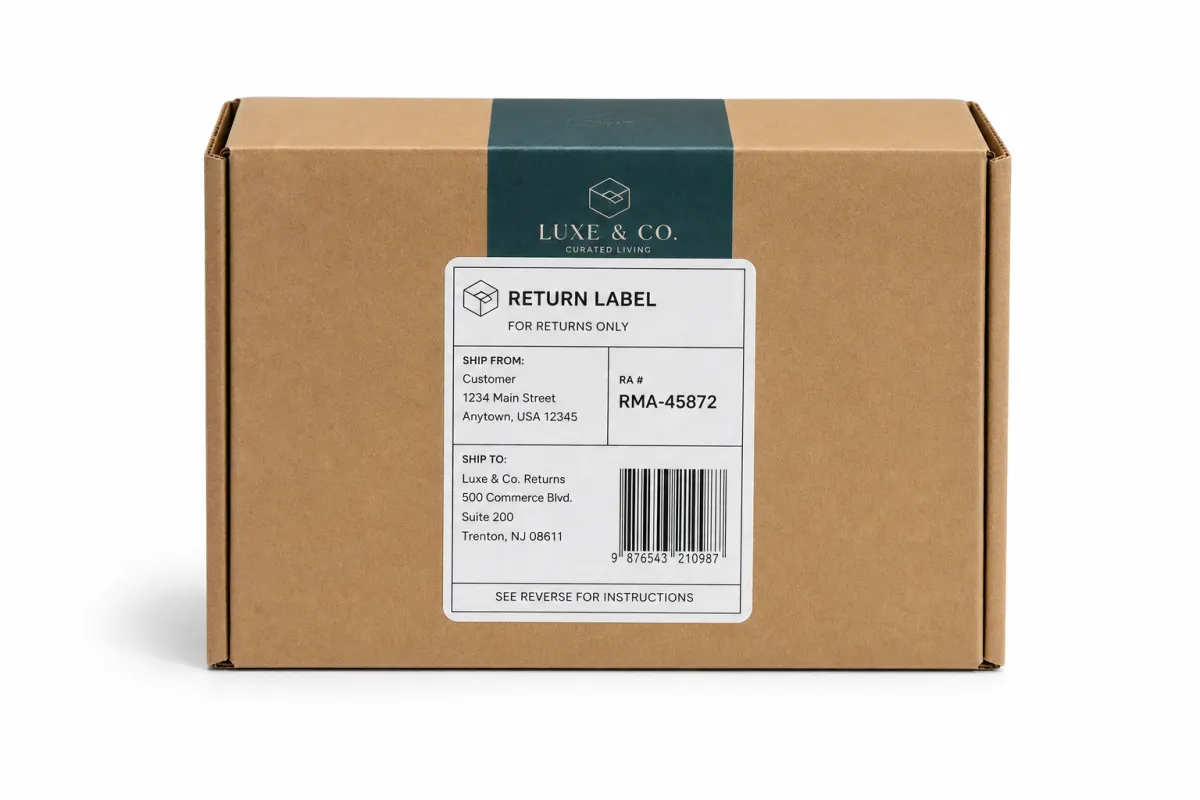
The simplest way to think about return labels for ecommerce boxes is this: they remove friction at the exact point where the customer is already annoyed. Most return problems do not start with the product. They start with a label that is hidden, unclear, or impossible to scan. A buyer opens the box, sees a pile of packing material, and asks a fair question: where is the return information, and am I even supposed to use it?
A proper return label tells the customer where the parcel goes, which carrier can accept it, and how the item gets matched when it lands back at the warehouse. In a lot of cases, the label is printed on a 4 x 6 inch carrier format because that size leaves room for a barcode, address block, routing data, and human-readable copy. Smaller formats can work, but tiny labels punish teams that try to cram too much into one square inch. This is one of those moments where pretty design loses to legibility. Good.
Two common setups show up again and again. One is a label tucked inside the box for self-serve returns. The customer finds it after opening the package and uses it only if a return happens. The other is an outer-pack label used for outbound processing or warehouse handling, where the goal is to keep internal routing clean before the box reaches the customer. Both can work. The right choice depends on how your warehouse runs, how many SKUs you ship, and whether the return needs approval before a label is issued.
- Inside-the-box labels work well for simple, customer-friendly returns.
- Outer-pack labels are better for internal routing, repack, or warehouse identification.
- Carrier-readable labels keep the return moving instead of stalling at drop-off.
- Brand-aligned labels can support the unboxing experience without making returns harder.
For brands, the payoff is straightforward. Return labels for ecommerce boxes can mean fewer tickets, faster refunds, cleaner brand perception, and less chance of a parcel bouncing around the carrier network because the barcode was placed badly or the instructions were vague. Not flashy. Still money in the bank. And unlike a lot of packaging talk, this one shows up in the support queue almost immediately.
If you want a more branded return card or label system, teams often compare stock options through Custom Labels & Tags so the paper, adhesive, and finish match the rest of the pack. The point is not to make the return label fancy for no reason. The point is to make it reliable, readable, and hard to mess up.
How Return Labels for Ecommerce Boxes Work in the Real World
In real operations, return labels for ecommerce boxes follow a plain chain. The customer requests a return. The system approves it, sometimes instantly and sometimes after a review. A label is generated on demand or pulled from a pre-printed insert. The customer prints it, peels it, or scans it from a portal, then attaches it to the parcel and drops it with the approved carrier. After that, the package gets sorted, scanned again in transit, and received at the warehouse, where the return gets matched to the original order.
That chain sounds boring. Good. Boring is what you want in returns. The more moving parts you add, the more chances a package has to get delayed or misrouted. A barcode that scans cleanly at the first drop-off is worth more than a label with a fancy background and weak contrast. Fancy is not a metric. Scan rate is.
Three label types usually show up in these workflows. Static labels carry the same instructions on every box, which works well when returns are simple and the process does not change much. Pre-printed labels are produced in advance and placed inside or on the packaging during fulfillment. Variable-data labels are generated after a return is approved, which gives you order-specific details, updated routing, or carrier-specific instructions. If your catalog is large or your rules change often, variable-data usually saves headaches later.
Placement matters more than people expect. Return labels for ecommerce boxes are commonly placed on an inside flap, on a tear-away panel, or inside a pocket sleeve. Those locations protect the label during shipping while still making it easy to find later. I also like the tear-away approach for premium packaging because it keeps the exterior clean. Nobody wants the outbound experience to look like a warehouse memo board. I have opened enough ugly boxes to know that little details stick.
Carrier handoff is the part people skip over. A readable barcode is not enough if it is cut off by a fold, buried under tape, or printed so lightly that a handheld scanner hesitates. Keep the barcode in a flat area, leave white space around it, and make the human-readable text large enough for quick checking. If a warehouse team has to guess whether a label is valid, the workflow is already leaking time.
Print quality matters too. Basic return labels can run on a 203 dpi thermal printer, but 300 dpi gives a cleaner result if the barcode is small or the copy is dense. That does not mean every project needs premium print resolution. It means the label spec should match the workflow, not the other way around. Good operations care less about beautiful pixels and more about whether the first scan lands. I know that sounds unromantic. It is. Also true.
Key Factors That Affect Return Labels for Ecommerce Boxes
A solid return labels for ecommerce boxes plan starts with the box itself. Size, panel layout, and the amount of empty space on the interior all affect where the label can live. A small rigid mailer gives you very different constraints than a double-wall folding carton. If the box is shallow, a big insert can hide the label. If the box is oversized, the label can feel lost unless the placement is deliberate. Packaging is physical. It does not care about your spreadsheet.
Adhesive choice matters just as much. A permanent adhesive is fine when the label belongs on the outside of a shipper and must survive the full trip. A removable adhesive makes more sense for inside-the-box labels or tear-away panels where the customer needs to peel it later without damaging the pack. If the label has to survive humid lanes, friction from inserts, or rough handling, synthetic label stock or thermal transfer print often holds up better than basic paper.
Branding is another variable. Some teams want a plain functional label because they do not want returns to feel like a second unboxing event. Others want the return label to match the rest of the package so the brand stays consistent from first delivery to eventual exchange or refund. Both approaches are valid. The trick is not to let branding get in the way of scan reliability. A label that looks elegant but prints weak barcodes is just an expensive mistake.
Operational complexity matters too. If one brand ships twelve SKUs in the same carton size, a single return insert with a variable code can work well. If five carriers are involved and each market has different service rules, a universal label may create more confusion than it solves. Return labels for ecommerce boxes should match the actual warehouse workflow, not the org chart slide that made everyone feel tidy for a week.
- Box size affects where the label can be found and how much room it has.
- Adhesive strength determines whether the label stays put or peels at the wrong time.
- Ink durability matters if the package faces moisture, rubbing, or long transit.
- Barcode spacing affects scan success more than decorative print does.
- Carrier rules can override a pretty design in a hurry.
Sustainability is the last big factor, and it deserves a real answer instead of marketing perfume. Many brands want recyclable boxes, minimal waste, and FSC-certified board, which is a reasonable goal. If the label adhesive is too aggressive or the label construction adds unnecessary plastic, the package can become harder to recover cleanly. The better path is usually a well-chosen paper label, a sensible adhesive, and a layout that avoids excess material. For general packaging and material guidance, the EPA's recycling resources at EPA recycling guidance are useful when you are balancing performance with waste reduction.
That is where practical testing comes in. If your return flow depends on a certain tear-away format, test it with the same packing tape, the same insert, and the same box stock you actually ship. A mockup on a desk tells you very little. A packed box that has been stacked, scuffed, and handled by real freight tells you almost everything.
Return Labels for Ecommerce Boxes: Cost and Pricing Factors
The cost of return labels for ecommerce boxes is usually lower than people fear, at least for basic static formats. The real price problem is not always the sticker itself. It is the reprint, the manual lookup, the extra email, the support time, and the package that needs to be handled twice because the first label was wrong. Cheap is not cheap if it breaks the workflow.
Here is a practical way to think about pricing for common setups. The exact number changes with quantity, coverage, print method, and material choice, but these ranges are close enough to help a buyer compare options without pretending every plant quotes the same way.
| Setup | Best For | Typical Unit Cost | Setup Time | Main Tradeoff |
|---|---|---|---|---|
| Static pre-printed paper label | Simple returns, low change rate, inside-the-box placement | $0.04-$0.09 at 5,000-10,000 pieces | Fast | Low flexibility if carrier rules change |
| Variable-data printed label | Order-specific returns, approval-based workflows, multi-SKU catalogs | $0.10-$0.28 | Moderate | More setup and data handling |
| Synthetic or moisture-resistant label | Rough handling, humid lanes, longer transit | $0.15-$0.35 | Moderate | Higher material cost |
| Integrated tear-away panel or pocket sleeve | Premium packaging, high-volume brands, cleaner presentation | $0.18-$0.45 | Longer, tied to the box run | Less flexible once cartons are printed |
If you are quoting return labels for ecommerce boxes at scale, the obvious cost drivers are quantity, material, adhesive, finish, and whether the label is part of a larger custom packaging run. Color printing raises the number a bit, especially if you use multiple spot elements or a branded footer. Integrating the label into the box print can also affect carton pricing because the artwork, die line, and proofing process all get more involved.
Hidden costs are where people get surprised. A bad barcode that fails three times can cost more than a better label stock ever would. A customer service rep who spends five minutes reissuing a label is part of the label cost, even if nobody puts that line on the invoice. Add returns handling, disposal of damaged stock, and the time lost by the warehouse team, and the total cost moves fast.
A slightly better label usually pays for itself. That does not mean you should spec the most expensive substrate just to feel thorough. It means you should spend where failure is expensive. If the label sits inside the box and only needs to survive one clean peel, basic paper may be enough. If it has to survive transit, humidity, and aggressive tape, a stronger label stock is money well spent. That is how return labels for ecommerce boxes stop acting like a nuisance and start behaving like part of the operating system.
Brands that want packaging and label consistency often work with Custom Labels & Tags so the label stock, adhesive, and finish match the rest of the package. That kind of coordination matters more than it sounds. A label that clashes with the carton or falls apart in handling pushes the mess back into the warehouse later.
Step-by-Step Process and Timeline for Return Labels for Ecommerce Boxes
Setting up return labels for ecommerce boxes is not complicated, but it works better when the steps are ordered. The worst versions of this project skip the audit, rush the proof, and assume the warehouse will sort it out later. That is a nice fantasy. It is also how labels get rejected on day one.
- Audit the current return flow. Look at where customers get confused, how many support tickets mention returns, and whether the warehouse is handling labels manually.
- Define the carrier and warehouse requirements. Decide which service levels, barcode formats, and return destinations actually need to be supported.
- Choose the label format. Static, pre-printed, variable-data, tear-away, or sleeve-based. Pick the one that matches the real process, not the prettiest mockup.
- Build the artwork and data fields. Keep the barcode area clean, make the human-readable copy large enough, and avoid clutter that adds zero operational value.
- Print samples and test them. Check scan speed, adhesion, abrasion, and how the label behaves once the box is packed and stacked.
- Run a pilot. Start with one SKU, one region, or one return lane before you expand the system.
The timeline depends on what you are changing. A basic label update can move quickly, often in five to eight business days once the proof is approved. If the label is part of a new carton run, you are now inside the packaging production schedule, which usually takes longer because the box has to be printed, folded, packed, checked, and shipped. A more involved rollout can take 12-20 business days, especially if data fields, carrier rules, or carton artwork need a few revisions.
Testing is where disciplined teams separate themselves from optimistic teams. Return labels for ecommerce boxes should be checked for adhesion, readability, and abrasion after packing, not just before. If the box will face rough transport, use simple distribution testing ideas modeled on ISTA testing methods. You do not need a lab drama session. You need a realistic shakeout that tells you whether the label survives normal handling and still scans cleanly at the dock.
I also like to check the label after a few ugly conditions: a slightly humid room, a box that has been taped twice, and a sample that has been rubbed against another carton for a few minutes. Those are the kind of stupid little stressors that show up in actual shipping lanes. If a label fails there, it will fail in the field sooner or later.
A pilot rollout is the safest way to launch. Start with a high-volume product or one return-heavy region, then measure return completion time, scan success, and ticket volume for two to four weeks. If the new label flow reduces confusion without creating extra steps, expand it. If it creates a second headache, fix the weak point before scaling. No shame in that. Plenty of teams would rather spend a week adjusting the layout than spend six months apologizing for it.
Common Mistakes With Return Labels for Ecommerce Boxes
The most common failure with return labels for ecommerce boxes is painfully simple: the label is placed where nobody can find it. Inside a thick insert. Under a folded flap. Behind tissue paper. Or so close to a seam that the box tape blocks half the barcode. If the customer has to go hunting for the instructions, the design has already lost the argument.
Low-contrast printing causes another mess. Black on dark gray. Tiny copy. A barcode printed too close to a design block. Those choices may look fine on a screen, but carrier scanners and tired customers do not care about your art direction. They care about signal. The same goes for vague wording like "follow the return process" without saying where the label is, whether it needs to be printed, or which carrier should be used.
- Hiding the label behind inserts, folds, or taped seams.
- Using tiny barcodes or low-contrast print that scans poorly.
- Skipping test scans with the actual carrier and printer setup.
- Assuming one format fits all box sizes, SKUs, and service levels.
- Leaving out backup instructions for customers who lose the original packaging.
Process mistakes hurt too. A label can look perfect and still fail because the warehouse prints the wrong carrier format, the data field is mapped to the wrong order number, or the label was tested on a clean desk instead of a packed carton. Return labels for ecommerce boxes need to survive actual operations, not idealized ones. That means test scans, sample returns, and a real check of how the label behaves after the box has been dropped, stacked, and handled by more than one person.
There is also the multiple-item problem. A customer returns two items in one shipment, but the label only references one order line. Or they lost the original box and need a second path. If you do not provide backup instructions, people will improvise. They will combine shipments, use the wrong box, or send the parcel to the wrong return center. None of that is malicious. It is just what happens when the system expects perfect behavior from busy customers.
Good packaging teams prevent that with plain language. They tell the buyer exactly where the return label lives, whether a printer is required, what to do if the label is damaged, and who to contact if the box is gone. That level of clarity is not overkill. It is the difference between a predictable return and a support mess that keeps showing up in different clothes.
Expert Tips and Next Steps for Return Labels for Ecommerce Boxes
My practical advice on return labels for ecommerce boxes is simple: start small, measure the result, and do not let the label project turn into a packaging science fair. Pick one high-volume SKU, one return lane, or one region and see how the flow performs. Watch completion time, scan success, and support volume. Those three numbers will tell you far more than a polished mockup ever will.
Ask your printer or packaging supplier for real samples, not just renderings. I mean actual sheets, actual adhesive, actual substrate. Then test them with the materials you already use. If your box stock is textured, if your tape is aggressive, or if your inserts are bulky, those details can change the way the label performs. A label spec that works on one carton can fall apart on another, and nobody gets a prize for discovering that after launch.
A short warehouse checklist helps a lot:
- Where the return label goes inside the box.
- How the label stays protected during shipping.
- Who signs off on artwork or data changes.
- What to do if the label is damaged or missing.
- Which carrier format applies to which market or SKU.
If your team already buys cartons, inserts, or branded mailers, align the return label plan with the rest of the pack. That is where a coordinated order through Custom Packaging Products can save time, because the carton structure, print layout, and label placement all get considered together instead of one at a time. It is much easier to make smart choices before the run than to fix a layout after boxes are already in the warehouse.
One more thing: keep the instructions plain. Tell the buyer where the label is, what carrier it belongs to, and whether they need to tape over the label or not. Simple copy beats clever copy every time in returns. Clever is for campaigns. Clear is for reverse logistics.
The best return labels for ecommerce boxes are the ones nobody has to think about twice. They are easy to find, easy to scan, and easy to match back to the order. If you review one current return flow this week, identify the biggest failure point, and fix that before adding more complexity, you will probably see a real improvement without blowing up the packaging budget. Start with the weakest link, test it in real packing conditions, and make sure the label can survive tape, scuffs, and a tired customer. That is the sensible way to handle return labels for ecommerce boxes, and it is the part most teams can improve without a giant overhaul.
Where should return labels for ecommerce boxes be placed?
Put them where the customer can find them quickly and where they will not be blocked by tape, folds, or inserts. For many brands, an inside-panel placement works well because it protects the label during shipping and keeps the outside of the box clean. If the label needs to stay visible, test the location with real packaging materials and a few rough-handling passes before you lock it in.
Are return labels for ecommerce boxes expensive?
Not usually for basic labels, especially at volume, but specialty materials, variable data, and custom printing raise the cost. The bigger expense is often operational: failed scans, reprints, and support time can cost more than the label itself. A slightly better stock or a better placement is often cheaper than dealing with messy returns later.
Do return labels for ecommerce boxes need to be pre-printed or can they be generated later?
Both work. Pre-printed labels are faster for simple workflows, and generated labels are better when returns depend on approval or order-specific data. If your catalog is large or your rules change often, generated labels usually give you more flexibility. Use the format that matches the warehouse process, not the one that sounds trendy.
How long does it take to set up return labels for ecommerce boxes?
A basic label update can be quick, while custom packaging, artwork approval, and testing add more time. The timeline depends on how many SKUs you have, how many carriers you support, and whether the label is part of a new box run. Plan for testing before rollout, because fixing a bad label after launch is more annoying and more expensive than doing the setup properly.
What makes return labels for ecommerce boxes fail?
The usual failures are bad placement, poor scan quality, weak adhesive, and instructions that are too vague for customers to follow. Damage during shipping is another common issue, especially when labels rub against tape, seams, or inserts. Test the label in real packing conditions if you want to avoid preventable return chaos.
Strong return labels for ecommerce boxes are not fancy. They are clear, durable, and matched to the actual workflow. If your team treats them like part of the packaging system instead of a loose add-on, returns get easier for the customer, the warehouse, and everyone who has to clean up the mess later.


