Custom Clothing Size Labels: How to Order the Right Ones
A size mark is often the first thing a buyer checks after pulling a garment from a bag or hanger, and it can make the piece feel carefully built or oddly cheap before it is even worn. That detail affects presentation, fit confidence, and brand trust at the same time.
For a packaging buyer, the same discipline that goes into package branding, retail packaging, and custom printed boxes should carry into the label. Clear sizing reduces confusion, supports inventory flow, and helps the garment feel complete from unboxing to first wear.
Why Custom Clothing Size Labels Reduce Returns
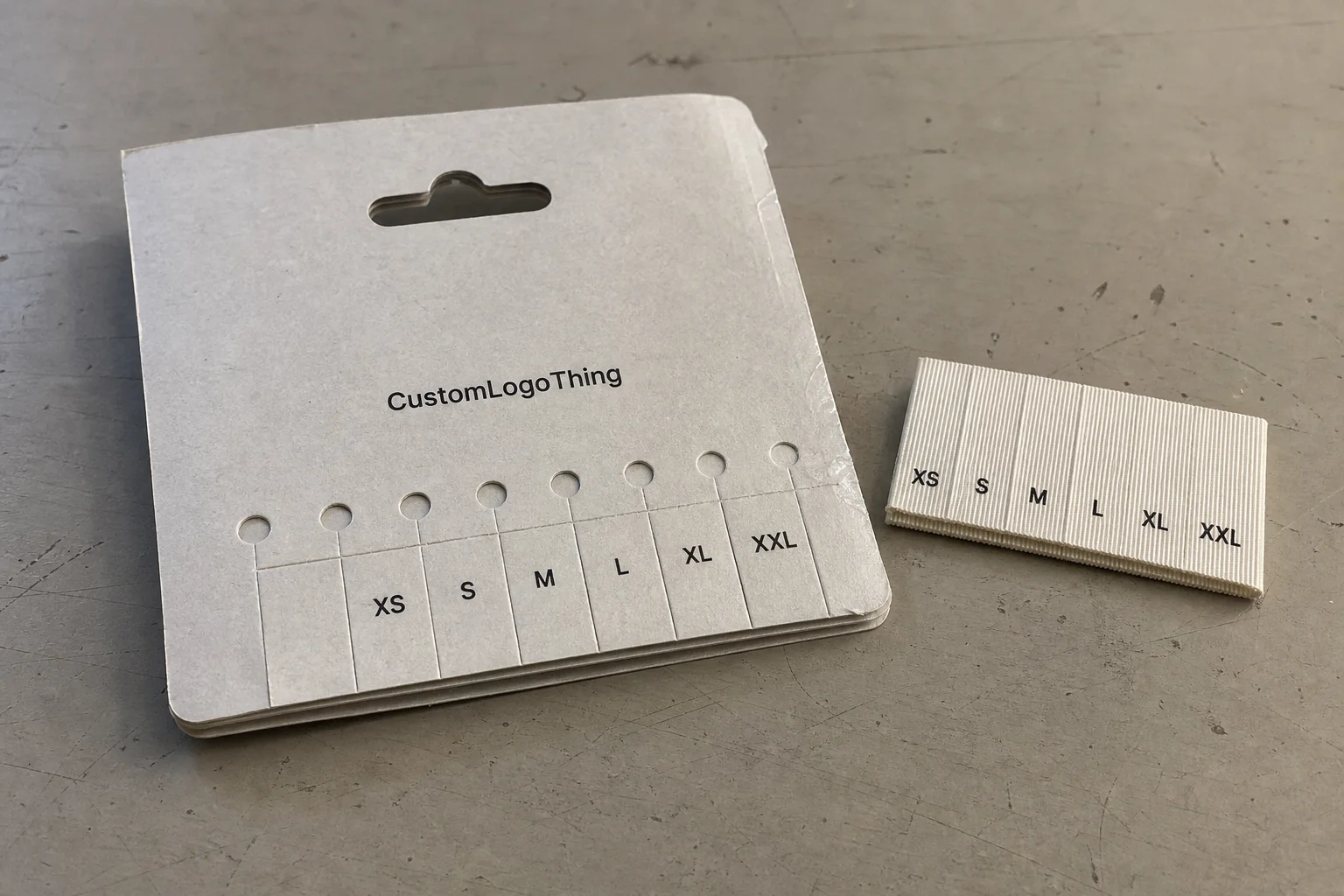
Size labels do more work than most buyers expect. They identify the size, but they also shape the first tactile impression inside the garment. A label that is crisp and easy to read feels deliberate. One that is faded, skewed, or hard to find can make the whole piece feel underbuilt.
These labels can be woven, printed, or heat-applied, but the useful version always does three jobs at once: it tells the customer what they are holding, supports the brand identity, and survives the wear path that garment will actually see.
That matters because size issues are not always product defects. A share of avoidable returns starts with simple friction: the customer misreads the size, the warehouse mis-picks it, or the label wears poorly and creates doubt about the item. A good garment can still lose confidence if the size indicator is tiny, hidden, or printed in low contrast.
Clear labeling is not decoration. It is inventory control, customer reassurance, and brand presentation in one small piece of material.
If your brand is building a broader system around Custom Labels & Tags and Custom Packaging Products, the size label should match the same visual discipline you use elsewhere. That consistency helps the full package feel intentional, from the shipping carton to the collar.
How Size Labels Are Built Into the Garment
Most size labels fall into four practical formats, and the right choice depends on the garment, the feel you want against skin, and how much information has to fit in a very small space. Woven labels give a premium sewn-in look and hold up well to repeated wash cycles. Printed satin or nylon labels are smoother, which makes them a smart option for inner necks and other contact points. Heat-transfer labels remove the physical tag altogether, which many buyers prefer for athletic wear and kids’ apparel. Care-size combination labels combine the size with fiber content and washing instructions, which can simplify the inside of the garment.
- Woven labels for a refined stitched finish and strong durability.
- Printed satin or nylon labels for softness, clarity, and lower bulk.
- Heat-transfer labels for a tagless interior and clean hand-feel.
- Care-size combo labels for brands that want size, fiber content, and care details in one place.
Placement matters as much as format. Neck labels are the default for many tops, but side-seam placement can feel better on lightweight garments where the customer is sensitive to rubbing. Waistbands, hem areas, and internal facing seams also come up often, especially in activewear and childrenswear. The label should be visible enough to read quickly, but not so intrusive that it becomes the thing the customer notices first.
The artwork process is usually straightforward, but it needs discipline. A design that looks fine on a monitor can fail at actual label size if the font is too light, the lines are too thin, or the contrast is too weak. Review production files at the finished dimensions, not just full screen. Tiny type below about 5.5 pt can get fuzzy on woven constructions, and dense text blocks can blur once the label is folded or stitched.
That same design discipline should carry through the rest of the package. If the garment sits inside a box, poly mailer, or folded retail package, the interior details should feel like part of one system. A label that matches the tone of the retail packaging reinforces the brand story without adding noise.
Specs That Affect Fit, Comfort, and Readability
Buyers usually start with the obvious specs, but the small details decide whether the label feels premium or annoying. Width and height control how much text can fit without crowding. Fold style changes both appearance and comfort. Edge finish affects whether the label frays, curls, or creates a hard edge against skin. Ink contrast and thread color affect readability in low light, in garment bags, and on dark fabrics.
If the label is too small, the customer has to hunt for the size. If it is too large, it can wrinkle inside the seam allowance or overlap other construction details. Neither outcome looks good. For smaller neck openings or close-fit apparel, a low-profile label often performs better than a larger decorative one, even if the larger version looks better on screen.
Durability is the other major variable. A label has to survive wash agitation, dryer heat, folding stress, and seam friction. That is not always the same as surviving the garment itself. A printed nylon label may read well on day one and still fail if the ink system is weak. A woven label may hold up structurally but become irritating if the thread density is too high. For higher-volume programs, simple wash-and-abrasion checks before launch can catch problems early, and transit handling reviews inspired by ISTA testing logic are useful when distribution is part of the risk.
Content requirements matter too. Some labels only need the size, while others have to carry fiber content, country-of-origin details, or care symbols for different markets. A clean layout needs room for that information without forcing tiny, unreadable type into the design. For paper components such as hangtags or folded inserts, FSC-certified stock from FSC is a practical choice when your packaging design has to stay consistent across the whole garment presentation.
The simplest way to think about it: the label spec should match the garment category.
- Knitwear usually needs a softer hand-feel and low irritation.
- Activewear often benefits from heat-transfer or tagless construction.
- Outerwear can handle more structure, but still needs clear sizing.
- Kids’ apparel needs readability, softness, and strong wash durability.
Production Steps, Turnaround, and Lead Time
The ordering flow is usually simple on paper: request, artwork review, proof approval, sampling, production, finishing, and shipment. In real production, the slowest step is rarely the loom, printer, or transfer press. It is usually the back-and-forth over artwork accuracy, size breakdowns, fold direction, and where the label sits inside the garment.
A clean brief speeds everything up. If the supplier receives final artwork, confirmed size ranges, placement notes, and a clear quantity breakdown, the proof stage moves faster and the risk of rework drops. If the file is missing garment-specific details, the production team has to make assumptions, and assumptions are expensive.
Typical lead times vary by format and quantity, but a simple woven or printed label order often lands around 10 to 15 business days from proof approval. Heat-transfer jobs can be similar, while very simple runs may move a little faster if the material is already in stock. Sample rounds usually add 3 to 5 business days, and more complex folding, color matching, or special backing can stretch the timeline further.
Rush work is possible, but it depends on material availability, the amount of artwork correction needed, the number of size versions, and whether the order requires special cutting or adhesive behavior. If the labels need to be in place before a launch, photoshoot, or factory cut date, build in slack. Late approvals usually create the problem, not the production run itself.
Sampling is worth it when the label will touch the skin, when the fabric is delicate, or when the size mark will be part of a premium retail presentation. A small proof can answer questions about texture, contrast, and fold behavior that a digital mockup cannot.
Cost, Pricing, MOQ, and Quote Factors
Pricing is driven by a few practical levers: material, print complexity, number of colors, finishing method, order quantity, and whether the label needs special folding or cutting. Higher quantities usually lower the unit cost because setup labor is spread across more pieces. Low quantities almost always cost more per label, which is normal and not a sign that the supplier is padding the quote.
MOQ also depends on production method. Some suppliers set a minimum because the loom or print setup only makes sense at a certain volume. Others can support smaller runs, but the unit price rises. A buyer comparing quotes should always confirm whether setup, plates, artwork revisions, sampling, and freight are included. Otherwise a cheap-looking quote can become the expensive option once the extras are added.
| Label format | Typical MOQ | Rough unit price at 5,000 pcs | Best use case | Main watch-out |
|---|---|---|---|---|
| Woven sewn-in | 500 to 1,000 per design | $0.08 to $0.22 | Denim, knitwear, premium basics | Can feel dense if the thread count is too high |
| Printed satin or nylon | 1,000 and up | $0.05 to $0.16 | Soft interior finish, clear care text | Lower-grade inks can fade or crack sooner |
| Heat-transfer tagless | 500 to 1,000 per design | $0.10 to $0.30 | Performance wear, kids’ apparel, clean interiors | Application temperature and pressure have to be controlled |
| Care-size combination | 1,000 and up | $0.07 to $0.18 | Brands that want one label for multiple functions | Layout can become crowded quickly |
That table is a planning guide, not a quote sheet. Material width, color count, fold style, and order complexity can shift the numbers in either direction. If the label is part of a larger rollout that includes hangtags, cartons, or inserts, it is smarter to compare the total landed cost across the whole package instead of focusing on unit price alone. A cheaper label that wears out early creates reorders, and reorders erase the savings.
For buyers who manage multiple packaging programs, the same logic applies to Custom Packaging Products. Every piece should support the same brand standard, whether the item is a shipping carton, a retail insert, or a garment label.
Common Mistakes That Hurt Accuracy and Durability
One of the most common mistakes is assuming that one label format works for every garment. A woven label that feels fine in a heavyweight sweatshirt can become irritating in a lightweight performance tee. A heat-transfer label that looks great on a smooth knit may fail if the application settings are off. The garment category matters more than the seller’s habit.
Another frequent problem is bad sizing hierarchy. I have seen label systems where the size was technically correct but visually too small to read, or so large that it fought with seam allowance and ruined the inside finish. A good label should fit the construction, not force the construction to work around the label.
Artwork errors are just as costly. Thin fonts, weak contrast, crowded care details, and missing size breaks all trigger reproofs and delay production. If the label needs multiple size systems, like US, EU, and UK, do not compress them into a tiny block with no hierarchy. Buyers read faster when the most important information is visually obvious.
Durability failures usually trace back to one of three issues: poor stitch planning, weak adhesive, or the wrong base material for the wash environment. A sewn label can fray if the edges are not finished well. A printed label can peel if the ink or adhesive is not matched to the fabric. A tagless label can look clean and still fail if the application was rushed.
Another mistake is failing to verify the size table against finished garments. Size assumptions from an old template are not good enough. Cutting tolerances, shrinkage, and fabric behavior all shift the actual fit. If the garment size chart changes, the label system should change with it. Otherwise the buyer ends up with a clean-looking label that points to the wrong product.
Next Steps for Choosing the Right Label Setup
Start with a short spec sheet. It should list the garment type, size range, target hand-feel, wash expectations, and whether the label has to include branding or care content. That one page gives the supplier enough context to recommend the right format instead of just quoting the cheapest one.
Then gather clean artwork, final size breakdowns, and placement notes before you request pricing. The better the brief, the more accurate the quote. It also gives the production team a chance to flag issues early, such as unreadable type, missing size variants, or a layout that will not survive the chosen fold.
Request a sample or proof if the order will be customer-facing. Color, texture, and contrast often look different on fabric than they do on a screen. A one-off sample can also tell you whether the label feels stiff, curls at the edges, or interferes with the garment’s drape.
Before approval, check the label against the finished garment, the timeline, and the budget together. If all three line up, the order is ready. If one is off, fix it before production starts.
What are custom clothing size labels used for beyond showing size?
They help customers identify fit quickly, which reduces confusion at retail and after delivery. They can also carry branding, care instructions, fiber content, or retailer-required information in one small format. The right label improves comfort and presentation, not just inventory control.
Which material is best for custom size labels on clothing?
Woven labels are strong and give a premium sewn-in look. Printed satin or nylon labels are smoother and often better when softness matters against skin. Heat-transfer labels work well when the goal is a tagless interior and a clean finish.
How do I choose the right size label for different garment types?
Match the label format to the fabric and wear conditions, since knits, activewear, and outerwear stress labels differently. Check readability at actual finished size, not just on a design file. Test comfort near seams, necklines, or waistbands before approving a full run.
What affects the price of custom clothing size labels the most?
Material choice, print complexity, quantity, and finishing method are the biggest drivers. Lower quantities usually cost more per label because setup is spread across fewer pieces. Shipping, sampling, and artwork revisions can also change the final quote.
How long do custom clothing size labels usually take to produce?
Lead time depends on artwork approval, material availability, order size, and the label construction chosen. Simple runs move faster than orders with special folds, custom colors, or multiple size variations. Plan extra time if you need samples or if the labels must arrive before a launch date, because a clean proof cycle is the best way to avoid rework.