Custom Jewelry Hang Tags Wholesale: Order the Right Fit
Custom Jewelry Hang Tags wholesale orders look simple until the tag has to do real retail work. It needs to carry brand name, collection name, price, SKU, barcode, care notes, and sometimes origin or metal content. It also has to hang straight, survive handling, and scan without friction. A tag that misses any of those basics creates work for the store and waste for the brand.
The buyer decision is usually not about decoration. It is about readability, durability, cost, and reorder consistency. The best tag fits the product line, supports fast merchandising, and matches the rest of the packaging system instead of looking like a separate project. That is where small setup choices matter more than one-off visual tricks.
“A good jewelry tag disappears into the sale. A bad one becomes the problem the floor staff notices first.”
Why Small Hang Tags Do More Than Price Tags
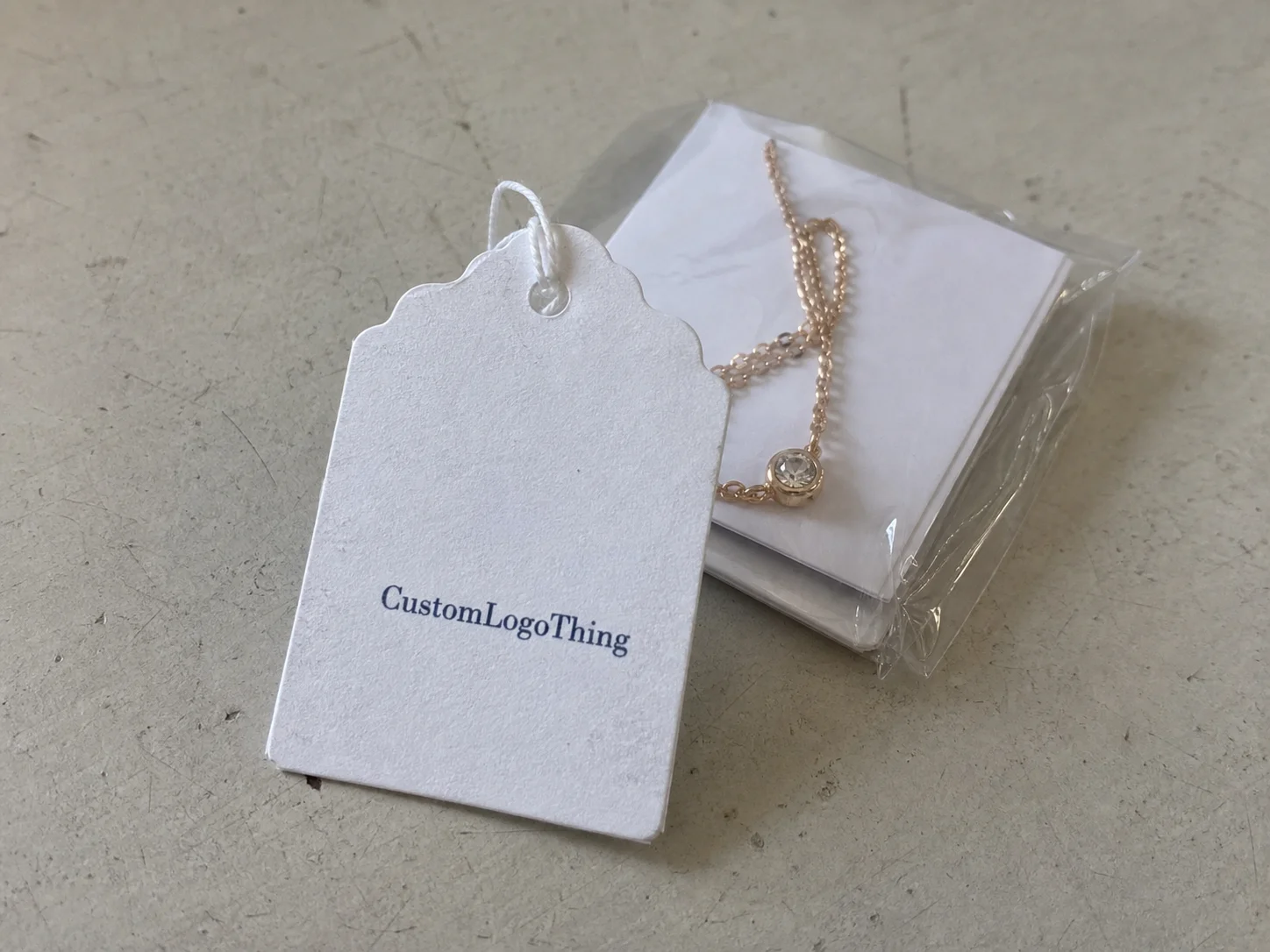
A jewelry hang tag is a compact information system. One side may carry the logo and collection name; the other may need price, barcode, SKU, and care text. Some products also need gemstone details, country of origin, or a QR code tied to product registration. Space disappears quickly, so the layout has to be planned before the quote.
If the type is too small, the tag may look polished on screen but become hard to read in the hand. If the barcode sits too close to the trim or hole, scanning can fail. If the stock is too glossy, glare becomes a problem under retail lighting. These are practical failures, and they add up across a full run.
Retail staff notice the operational issues first. Tags that hang crooked slow down merchandising. Tags with unclear pricing create questions at checkout. Tags with inconsistent typography make a product wall feel less organized. A strong tag reduces those small interruptions, which is the real job of the format.
That is why the category should be treated as part of the selling system, not just a decorative label. The best version is the one the store barely has to think about: readable, durable, and consistent from the first carton to the last reorder.
Custom Jewelry Hang Tags Wholesale: Specs Buyers Should Lock In
Before requesting a quote, lock the spec. “Premium” is not a spec. Neither is “small” or “whatever fits.” A proper estimate needs exact dimensions, stock thickness, print sides, finish, hole style, corner treatment, and whether the tag needs a custom die cut. If the supplier has to guess, the numbers will be less useful.
Size controls readability. A small format works for minimalist earrings or fine chains, but once the tag needs price, barcode, and care text, a larger layout is usually safer. Shape matters too. Rectangles are efficient. Rounded corners wear better. Custom silhouettes can support a stronger brand look, but they add setup and usually extend lead time.
Front and back use should be decided early. A front panel can stay clean with the logo and collection name. The back can carry the barcode, SKU, price, and care instructions. That split keeps the display tidy while preserving the information the floor team needs. If the barcode is required, keep its area flat, high contrast, and free of decorative clutter.
Attachment method also affects appearance and handling speed.
- String or cotton cord works well for lighter pieces and gives a softer, handmade feel.
- Elastic loops are common for delicate chains because they apply quickly and stay discreet.
- Plastic fasteners are better for heavier items or displays that take more handling.
- Pins are less common, but useful in systems where the tag and product must stay locked together.
Finish should be chosen for function, not habit. Matte reads clean and modern. Gloss adds punch, but shows glare and fingerprints faster. Soft-touch feels premium, though it raises cost and can complicate some barcode applications. Foil stamping, embossing, and spot UV improve shelf presence, but each adds labor and tighter file control. The safer approach is to use only the effects that support the product.
If your catalog includes labels, swing tags, and other retail pieces, keep them in one visual system. That is where Custom Labels & Tags and broader Custom Packaging Products help maintain consistency instead of forcing every item to reinvent the brand.
Paper, Plastic, and Specialty Stock Options for Jewelry Displays
Paperboard is still the default for most jewelry tags because it prints cleanly and stays cost-effective at scale. Coated board gives sharper color and stronger contrast for detailed logos. Uncoated stock has a quieter, more tactile feel, which suits minimalist or handcrafted collections. Textured papers can push a line into a more premium lane without heavy decoration.
For buyers tracking sustainability claims, FSC-certified paper is worth asking about. It does not fix a weak design, but it does support documented forestry practices. If sustainability is part of the brand story, the material should match the claim. See fsc.org for the certification framework.
Synthetic stock becomes useful when moisture, repeated handling, or frequent display resets are part of the job. It resists tearing and stays flatter in humid environments. That makes it a practical option for open-air retail, beachwear jewelry, and shops with heavy merchandising turnover.
Specialty materials are worth using only when the result justifies the cost. Black stock with foil creates strong contrast and a luxury feel. Recycled kraft signals a natural, lower-gloss aesthetic. White rigid card supports high-contrast branding and makes small typography easier to read. Each choice changes the message, so it should match the rest of the packaging system.
Shipping and pack-out matter too. If the tags are packed loosely or the carton structure is weak, the print can arrive bent or scuffed. Ask how the supplier packs printed pieces and whether transit protection is part of their process. The same caution used in ISTA guidance applies here: a product that looks fine in production can still fail in transit.
| Stock option | Typical unit cost at 5,000 pcs | Best use case | Tradeoff |
|---|---|---|---|
| Coated paperboard | $0.08-$0.16 | Clean color, everyday retail tags | Less tactile than textured stock |
| Uncoated paperboard | $0.07-$0.14 | Minimal, handmade, or natural branding | Ink can look slightly softer |
| Synthetic stock | $0.14-$0.28 | Humidity, handling, frequent store resets | Higher cost and fewer paper-like finishes |
| Black stock with foil | $0.18-$0.34 | Premium collections and high-contrast branding | More setup and tighter file control |
| Recycled kraft | $0.09-$0.17 | Eco positioning and natural product lines | Lower contrast for small type |
Pricing, MOQ, and Unit Cost Drivers You Can Control
The cheapest quote is rarely the lowest true cost. For custom jewelry Hang Tags Wholesale, price moves with quantity, stock choice, size, print coverage, finishing, die cutting, and attachment method. If any of those change, the quote changes too. Comparing two estimates without matching the spec is not a useful comparison.
MOQ exists because setup work does not shrink just because the run is small. A supplier still has to prepare files, set up the press, check alignment, and control color. That overhead spreads better across larger orders. A small order can still be worth doing, but the unit cost will usually be higher.
There are straightforward ways to lower cost without making the tag look cheap. Standardize the size. Keep the back simple if it does not need extra information. Use one finish instead of several. If multiple SKUs share the same format, swap only the variable data. That keeps the line orderly and reduces waste at the packing table.
For many small to mid-sized wholesale orders, these ranges are common for a standard paperboard tag with ordinary finishing:
- 500 to 1,000 pieces: often $0.22-$0.48 per tag, depending on complexity.
- 2,000 to 5,000 pieces: often $0.10-$0.24 per tag for standard paperboard.
- 10,000 pieces and up: often $0.06-$0.18 per tag, with better efficiency on simpler builds.
Those ranges move quickly if you add foil, embossing, odd shapes, or specialty attachments. A low quote can hide thinner stock, loose color control, or weak finishing that creates waste later. Paying slightly more for tags that apply cleanly is usually cheaper than sorting defects at the fulfillment bench.
Production Steps and Lead Time From Proof to Carton
The workflow should be predictable. Request the quote, confirm the spec, submit artwork, review a proof, approve the sample or soft proof, then move to production. If a supplier cannot explain those steps clearly, the order will probably be messy too.
Prepress is where most avoidable problems show up. Tiny serif type may look elegant on a screen and unreadable on paper. A barcode can fail if it sits too close to a fold, hole, or cut edge. Bleed and safe area still matter because tags are trimmed in the real world, not in a mockup.
The production sequence is usually printing, die cutting, finishing, inspection, packing, and shipment. A plain printed tag moves faster than a custom shape with foil and embossing. A single SKU is faster than a multi-SKU launch with different names, prices, and barcode sets. Those delays are normal, but they should be visible before the order starts.
For standard runs, a reasonable timeline is often 8 to 12 business days after proof approval. More complex orders commonly need 12 to 18 business days, sometimes longer if the design needs revisions or the project requires a sample round first. Shipping time sits on top of that, so leave room if the launch date is fixed.
A practical production checklist keeps the process from drifting:
- Confirm final quantity by SKU.
- Send vector artwork and barcode data.
- Ask for a proof that shows hole placement, trim, and color callouts.
- Test the barcode against your POS requirements before approval.
- Approve only when the layout, material, and attachment method all match the use case.
What Separates a Reliable Wholesale Supplier From a Cheap Quote
The best suppliers get the unglamorous things right. They hold color from reorder to reorder. They keep the dieline accurate. They place the hole where it should be. They catch file problems before production starts. None of that is flashy, which is exactly why it matters.
Color consistency is especially important for jewelry lines that reorder often. If the logo blue shifts from one batch to the next, the display starts to look mismatched. Once the system looks inconsistent, it feels less controlled, and customers notice that kind of drift even if they cannot name it.
Dieline accuracy and hole registration are not optional. A hole too close to the edge tears early. A hole off center makes the tag hang badly. A cheap quote that creates those problems is not cheap. It shifts labor back onto your team, which means the real cost lands later.
Finishing quality matters for the same reason. Tags that arrive curled, scratched, or rough-cut waste time on the packing bench. Someone has to sort them or reject them. A good wholesale supplier should be able to explain how they prevent those problems before the carton leaves the building.
“The right supplier is the one who protects the reorder. Fancy samples do not matter if batch two comes back off color or off-cut.”
If you are comparing vendors, treat Custom Labels & Tags as part of the same packaging system, not as a one-off purchase. Tags, inserts, and other retail pieces should look like they belong to the same brand family.
What to Prepare Before You Request a Wholesale Quote
The fastest quotes come from buyers who send complete information. Quantity by SKU. Finished size. Preferred stock. Print sides. Finish. Attachment style. If you send all of that up front, you get a real number instead of a placeholder.
Send artwork in vector format if possible. Include barcode data, SKU lists, care text, and any legal copy tied to material content or gemstone disclosure. If the tag needs to match a larger packaging system, include those references too so the supplier is not guessing at the style direction.
Decide who approves the proof before you ask for the quote. One approver is better than four people rewriting the same tag. Confirm the launch date as well. A lot of delays happen because artwork was approved late, not because production was slow.
Ask for a sample spec sheet or a quote against your actual quantity range, then compare unit cost, lead time, and finishing on the same basis. A random estimate tells you very little. A matched comparison tells you where the real breakpoints are.
What is the MOQ for custom jewelry hang tags wholesale?
MOQ usually depends on stock, size, and finishing. Standard paperboard tags often start at lower runs than specialty stocks, while foil, embossing, or custom die cutting can raise the minimum or make small runs more expensive. The cleanest comparison is always at the exact spec you want.
How long does jewelry hang tags wholesale production usually take?
Standard printed tags can move quickly after proof approval, while custom shapes and specialty finishes take longer. Artwork fixes, sample approval, and shipping method all affect the final timeline, so the fastest quote is not always the fastest delivery.
Which material is best for custom hang tags for jewelry?
Paperboard is the most common choice because it prints cleanly and keeps cost under control. Use synthetic or water-resistant stock when the tags need extra durability or may see moisture and frequent handling. Choose textured or specialty stock when the brand needs a premium feel and the budget can support it.
Can I print barcodes or SKU numbers on jewelry hang tags wholesale?
Yes. Barcodes and SKUs keep checkout and inventory organized. Keep the code area clean, high contrast, and large enough for scanning. Test the proof against your POS requirements before production starts.
How do I reduce unit cost without cheapening the look?
Use standard sizes, one-sided printing, and fewer special finishes where possible. Consolidate similar SKUs into the same tag format if the brand system allows it. Ask for pricing at multiple quantity tiers so you can see where the real breakpoints are.


