Custom Clothing Swing Tags: Order Smarter, Sell Better
Custom clothing swing tags do more than identify a garment. They carry the first retail impression, hold price and size information, and quietly signal whether a brand understands detail. On a crowded rail, the tag often does the first round of selling before a shopper has touched the fabric. That is why experienced apparel buyers treat custom clothing swing tags as part of the product, not an afterthought attached at the end.
The tag is small, but its effect is not. A clean layout can make a basic tee feel more considered. A weak tag can make a premium knit feel generic. The difference is usually not dramatic artwork or expensive materials alone. More often it comes down to proportion, print clarity, and whether the information is arranged in a way that retail staff and shoppers can read quickly.
Used well, custom clothing swing tags support retail packaging, reinforce package branding, and make the whole garment presentation feel deliberate. Used badly, they crowd the product, confuse store teams, and dilute perceived value. The practical skill is knowing which details earn space and which details should be pushed to the back.
What custom clothing swing tags do on the rack
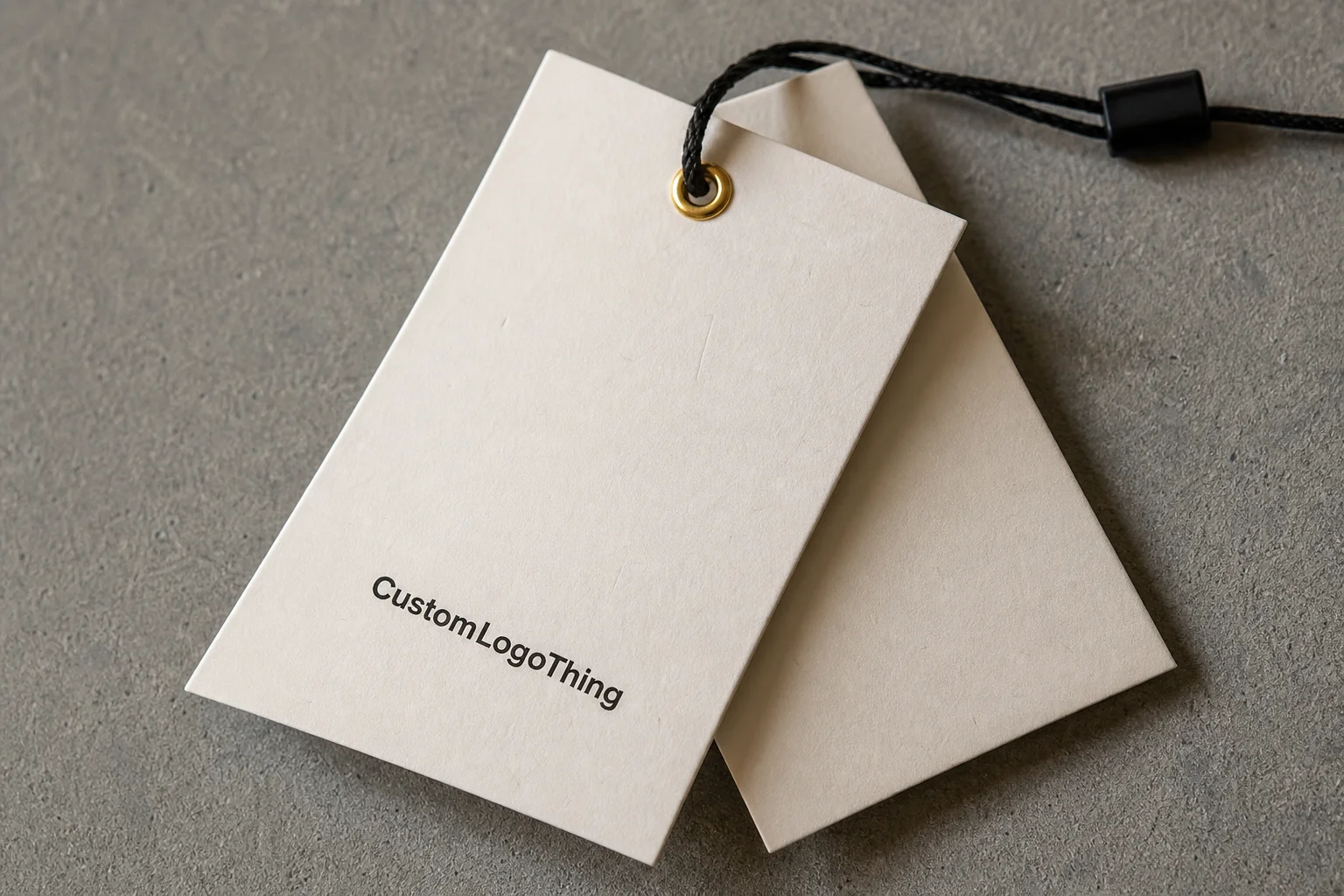
On the rack, a swing tag acts like a sales assistant that never leaves the floor. It introduces the brand, confirms size or price, and often carries the barcode, SKU, or care note that keeps the item moving through retail. In e-commerce, the tag matters too. People zoom in on product photos and use small packaging cues to judge whether the item belongs at the stated price.
That judgment happens quickly. A plain stock tag can make a well-made garment feel flat. A refined tag can make a standard piece feel more intentional. Same item, different signal. Apparel buyers know this because clothes are sold in a market full of near-substitutes, where brand memory often comes from repeated details rather than one dramatic gesture.
Think of the swing tag as a compact piece of product packaging. It can carry:
- Brand name and logo
- Collection name or capsule title
- Price, SKU, and barcode
- Size and colourway
- Care or fibre-content notes
- Short origin or brand story copy
A good tag is not decoration first. It is a selling surface, a logistics aid, and a brand cue in one object.
That is why swing tags deserve the same level of attention as Custom Labels & Tags or Custom Packaging Products. Brands that connect those pieces usually end up with cleaner assortments and fewer production inconsistencies later.
The best tags do one more thing: they help the shopper trust the product without forcing the issue. Kraft stock can support a natural or workwear line. Heavier coated board can help a fashion-led drop feel sharper. Foil can raise the perceived value, but only if the rest of the design is controlled. The object is small; the brand consequence is not.
How the tag structure and print setup work
A swing tag looks simple from the outside, but every production choice affects the final result. The build starts with the substrate: paperboard, kraft board, textured stock, or a coated sheet that holds colour cleanly. Then come thickness, size, shape, hole placement, and attachment method. Cotton string, elastic loops, and plastic fasteners all change how the tag behaves on the garment and during packing.
Apparel tags often sit in the 300gsm to 450gsm range. Heavier stock is common when the brand wants stiffness or a more substantial hand feel. A 350gsm uncoated kraft tag and a 400gsm matte-coated board tag can both work well, but they send different signals. One reads earthy and understated. The other feels cleaner, sharper, and more retail-ready.
Information hierarchy matters more than most teams expect. The front face should carry the quick-read details: logo, collection name, perhaps price or size if that is part of the retail presentation. The back can hold care instructions, fibre content, website details, QR codes, or compliance text. If everything lands on one side, the tag becomes noisy and hard to scan from arm’s length.
Printing method also shapes the result. Digital printing is practical for shorter runs, multiple artwork versions, or frequent SKU changes. Offset printing generally makes more sense for larger orders where colour consistency matters across thousands of units. Specialty finishes such as foil stamping, embossing, debossing, and spot UV can improve the perceived value of custom clothing swing tags, but restraint usually wins. One strong finish is better than a stack of effects that compete with the layout.
There are also production limits that designers should respect. Fine reverse type can disappear on textured stock. Soft-touch lamination can make a premium tag feel good in hand, but it can scuff if the order is packed loosely. Metallic foil looks impressive on a proof, yet it can lose sharpness if the line work is too thin. The file may be print-ready; the design still may not be production-ready.
Some of the most useful tag systems are the simplest. A single die shape, one stock choice, one finish, and a repeatable data structure are easier to reorder and easier to control. Complexity only earns its place if it helps the tag do a better job on the rack.
Cost, pricing, and MOQ tradeoffs
Tag pricing rarely comes from one line item. Buyers usually focus on unit cost and miss the pieces that move the number: quantity, board grade, ink coverage, finish complexity, die cutting, stringing, collation, and packing format. If the order includes sorting by size, kitting by colourway, or packing into sets, labour rises even when the printed tag itself looks simple.
MOQ is just as important. A lower minimum order quantity can look expensive at first glance, but it is often the right choice for a launch, a limited run, or a collection that has not yet proven sell-through. Larger volumes usually reduce the per-unit cost because setup is spread across more pieces. That saving is real, but it disappears quickly if the order is padded with revision cycles or unnecessary finishing.
| Tag style | Typical spec | Best for | Rough unit cost at 5,000 pcs | Brand signal |
|---|---|---|---|---|
| Plain kraft tag | 350gsm kraft, one-colour print, drilled hole | Basics, eco-led ranges, workwear | $0.12-$0.20 | Natural, low-friction, practical |
| Standard printed board tag | 400gsm board, full-colour print, matte finish | Mainline apparel, branded retail packaging | $0.18-$0.32 | Cleaner, more polished, more versatile |
| Premium finished tag | Thick stock, foil, embossing, spot UV, stringing | Hero products, premium drops, giftable lines | $0.28-$0.55+ | Higher perceived value, stronger shelf impact |
These figures are directional, not fixed. A large tag with heavy colour coverage and custom stringing can move upward quickly. So can a modest tag if the order includes artwork revisions, sample rounds, or split deliveries to different warehouses. The quote that looks cheapest on the page is not always the cheapest once the scope is fully counted.
For buyers comparing suppliers, the only fair method is to match specifications line by line. Confirm the size, stock, thickness, colour count, finish, hole position, attachment type, and packing method. If one quote includes loose-packed tags and another includes sorted, strung, and boxed pieces, the gap is not just price. It is scope, labour, and handling.
For a simple launch, the unit cost can sit in the low cents. Premium tags with special finishes can cost several times more. That is normal. The real question is whether the extra spend matches the garment margin, the customer expectation, and the placement of the product in the range.
Production steps and turnaround timing
A well-run tag order follows a clear sequence: brief, specs, artwork, proof, sample approval if needed, print, finish, quality check, pack, and ship. The path is straightforward. The delays usually appear in the gaps between those steps, especially when the brief is incomplete or the artwork is still changing while production is trying to lock the job.
The common slowdowns are predictable. Dielines arrive at the wrong size. Barcodes show up late. Colour expectations are described as “warm” or “clean” instead of being tied to an approved reference. Three people approve one layout and then disagree after it has already gone to proof. Each issue adds time, even if the printing equipment is ready.
Turnaround depends on the build. Simple custom clothing swing tags with standard stock and straightforward print can move quickly once artwork is final. Orders with foil, embossing, custom shapes, laminating, or stringing take longer because there are more production stages and more opportunities for correction. If the order also includes related branded packaging, it is better to plan the timeline together rather than treat each item as a separate emergency.
A practical rule of thumb: standard jobs often land in the 10 to 15 business day range after proof approval. More complex orders can take 15 to 25 business days or more, depending on finish and shipping. Rush work is possible, but it compresses the margin for error. That tradeoff should be acknowledged up front, not discovered after the artwork has already been signed off.
Planning backward from launch is more reliable than planning forward from the purchase order. If stock lands in store on a Monday, the tags need to arrive before packing starts. If the collection is being photographed, the tags need to exist before the shoot. In other words, the swing tag is not the final step. It is one of the first items that shows whether the rest of the operation is under control.
Packaging discipline matters here too. Apparel tags may not need the same compression testing as corrugated shippers, but the surrounding pack-out still affects finish quality. If goods travel in master cartons, a quick check against ISTA guidance is sensible for avoiding transport damage. For sourcing claims and material references, FSC remains the cleanest shorthand for certified paper stock.
Key specs that protect brand consistency
Consistency starts with proportion. A tag that is too large can overpower a small garment. A tag that is too small can disappear on outerwear or layered displays. The best size is usually the one that feels visible without competing with the product. That sounds obvious, yet first orders often miss it because design teams think in layouts while retailers think in handling.
Material choice should fit the brand, not just the mood board. Recycled kraft works well for casualwear, utility lines, and brands that want a natural read. Coated board supports sharper colour and cleaner typography, which helps fashion-led collections or more graphic ranges. Textured stock can suggest quality with very little decoration, especially if the design uses restrained type and generous space.
Durability matters because tags are handled more than most teams expect. They are flipped, pegged, folded, repacked, and stacked. Lamination can protect against scuffing, but it also changes the feel of the surface. Cotton or paper ties support a softer presentation. Plastic fasteners are faster and more practical in some retail environments. Neither option is universally better; the right choice depends on the product, the store handling, and the pack-out method.
Colour consistency is another place where systems pay off. Keep typography rules, icon placement, and data placement templates stable across the range. If size always sits in the same place, staff waste less time hunting for it. If the barcode always appears on the same side, scanning becomes easier. Over time, that discipline reduces friction across custom printed boxes, care labels, inserts, and swing tags because the whole package language starts to feel intentional.
Quality control should be practical and specific. Check that the hole is far enough from the edge to resist tearing. Check that foil does not fill in on fine type. Scan the barcode from the actual surface, not just from the proof file. Confirm that colour stays within tolerance across reprints if the order is likely to repeat. These are small checks, but they prevent waste that shows up later in the warehouse or on the sales floor.
Sustainability should also be concrete. Recyclable substrates, FSC-certified boards, and low-ink layouts make sense when they match the brand and the route to market. Heavy lamination or mixed materials can look premium while making recycling harder. That does not automatically make the choice wrong. It just means the tradeoff should be deliberate rather than accidental. The EPA recycling guidance is a useful reference when you want a clearer sense of end-of-life assumptions and consumer-facing claims.
One more practical point: consistency is not only visual. It is operational. If one season uses 375gsm board and the next jumps to 450gsm, the customer may not notice the spec change immediately, but they will notice a difference in hand feel and stiffness. That kind of drift is how small variations creep into brand memory.
Common mistakes that make tags work against you
The most common failure is overloading the face. Teams try to fit branding, story, care, legal copy, barcode, price, and a promotional message onto one side, then wonder why the tag reads like a notice board. A better rule is simpler: one face for fast recognition, the other for supporting details. If the tag still feels crowded after that split, the hierarchy needs work.
Material mismatch is another quiet problem. A fragile satin-style tag on rugged workwear looks wrong. A thin matte stock on a premium knit can make the whole piece feel less valuable. Buyers often describe that as a “fit” issue, which is fair, but the real cause is usually a mismatch between the substrate and the garment category.
Production errors are more expensive than design errors because they affect the whole batch. Hole placement that sits too close to the edge, trim sizes that vary, colours that shift between runs, or a barcode placed where a fold hides it can all create avoidable waste. The damage is not abstract. Retail staff notice. Shoppers notice. Returns teams usually notice first.
Handling is another stress point. Tags must survive folding, pegging, packing, and repeated touch. If the finish scratches easily or the string tangles, the product looks tired before it reaches the shelf. That is why it is worth testing samples in real handling conditions, not only under studio lights. A tag that looks refined in a mockup may behave poorly in a carton.
There is also a risk in chasing finish for its own sake. Foil, embossing, spot UV, and custom shapes can improve a tag, but only if they support the brand and the budget. Add too many effects and the design starts to compete with the garment. That usually reads as indecision, not luxury.
Put plainly: the wrong swing tag can damage a strong product. It increases shelf friction, introduces doubt, and makes the brand feel less coherent. That is a packaging failure with a sales consequence.
Expert tips and next steps for a stronger order
Start with a tight checklist. Final SKU count. Required copy. Barcode needs. Preferred stock. Finish level. Attachment method. Delivery deadline. If any of those are still moving, the quote is still moving too. The cleaner the brief, the easier it is to compare suppliers on the same basis instead of chasing vague language about value.
Ask for a sample pack or previous job examples whenever possible. A digital proof can confirm size and layout, but it cannot show stiffness, surface feel, or how a finish catches the light. Those details matter most when the tag is expected to support a premium price. A sample often saves more money than it costs because it exposes weak assumptions before production starts.
Compare quotes only after the specs are aligned. If one supplier quotes a 350gsm uncoated board and another quotes 450gsm laminated stock, the numbers do not mean the same thing. The same applies to stringing, packing, and shipping. Good buyers ask for the assumptions in writing because they know the cheapest line item is not the best total order.
If the collection is still being shaped, keep the tag system simple enough to scale. Use one brand face, one data template, and one finishing logic across the range. That makes reorders easier and helps the assortment feel coherent across custom clothing swing tags, labels, and other branded packaging components. It also cuts file chaos, which is rarely visible until someone has to reprint three sizes at once.
The strongest orders usually follow the same sequence: define the hierarchy, narrow the stock choices, confirm quantity bands, approve a proof, and release the job once the details are stable. That keeps margin under control and ties the packaging work to the garment instead of letting it drift into decoration. A good swing tag should make the product easier to trust, easier to sell, and easier to remember. It does not need to shout to do that.
What information should custom clothing swing tags include?
Start with the essentials: brand name, product name or collection, size, price, and barcode or SKU if the item will be scanned at retail. If there is room, add care details, fibre content, or origin information, but keep the front clear enough to read at a glance. The back side is usually the better place for supporting information so the main face stays fast and uncluttered.
How do I choose the right material for custom clothing swing tags?
Match the substrate to the garment and the brand position. Kraft suits eco-led or casual ranges, coated board works well when you want crisp colour, and textured stock supports a more premium feel. If the tag will be handled often, ask about lamination or a heavier board. Samples matter here because digital proofs cannot tell you how the card feels in hand.
What affects the price of custom clothing swing tags most?
Quantity is the biggest driver because setup costs are spread across more units as volume increases. After that, the main cost levers are stock thickness, finishes, special shapes, and whether the tags need stringing or sorting. Rush timing and artwork changes can add cost too, even when the base quote looks competitive.
How long does the production process usually take?
Timing depends on proof approval, print method, finish complexity, and whether the order uses custom die cutting or assembly. Simple jobs move faster when artwork is final and the spec is tight. Special finishes and sample approval steps extend the schedule, so it is safer to build buffer time before launch or store setup.
How can I make custom clothing swing tags look more premium without overspending?
Use one strong material choice and one restrained finish instead of stacking multiple effects that add cost without adding clarity. Clean typography, good spacing, and accurate print usually do more than extra decoration. If you reserve premium treatments for hero products or signature drops, the effect is stronger and the budget goes further.


