Buyer Fit Snapshot
| Best fit | Custom Cmyk Box Printing projects where brand print, material claims, artwork control, MOQ, and repeat-order consistency need to be specified before quoting. |
|---|---|
| Quote inputs | Share finished size, material target, print colors, finish, packing count, annual reorder estimate, ship-to region, and any compliance wording. |
| Proofing check | Approve dieline scale, logo placement, barcode or warning zones, color tolerance, closure strength, and carton packing before bulk production. |
| Main risk | Vague material claims, crowded artwork, missing packing details, or unclear freight terms can make a low unit price expensive after revisions. |
Fast answer: Custom Cmyk Box Printing: Board, Finish, Dieline, and Unit Cost should be specified like a repeatable production item. The safest quote records material, print method, finish, artwork proof, packing count, and reorder notes in one written spec.
Production checks before approval
Compare the actual filled-product size with the drawing, then confirm tolerance on folds, seals, hang holes, label areas, and retail display edges. Reserve space for logos, QR codes, warning copy, and material claims before decorative graphics fill the panel.
Quote comparison points
Review material grade, print process, finish, sampling route, tooling charges, carton quantity, and freight assumptions side by side. A quote is only useful when the supplier can repeat the same color, closure quality, and packing count on the next order.
Custom CMYK Box Printing: What to Know Before You Order
The annoying part of custom cmyk box printing is that a design can look dead-on perfect on a monitor and still come out a little off on the finished carton. Screens glow. Board absorbs. Warehouse lighting changes the whole mood. I’ve watched a rich navy turn flatter than it had any right to be once it hit uncoated stock under overhead LEDs. That gap between the file and the box is where a lot of packaging orders go wrong.
For brands shipping subscription kits, retail products, or plain shipping cartons, custom cmyk box printing sits right in the middle of branding and operations. It is not decoration dressed up as logistics. The box has to fold cleanly, stack well, survive transit, and still make the customer think the brand knows what it is doing. If the art, structure, and finish are not pulling the same direction, the package ends up doing three jobs badly instead of one job well.
Most color complaints start with the same story: the proof looked alive, the production run looked tired, and nobody can explain why. Or the logo printed warm on kraft when the file looked cool on screen. That is usually not a mystery. Good custom cmyk box printing starts with the right material call, the right artwork setup, and a clear understanding of how the box will be handled after it leaves the plant.
What Custom CMYK Box Printing Really Means
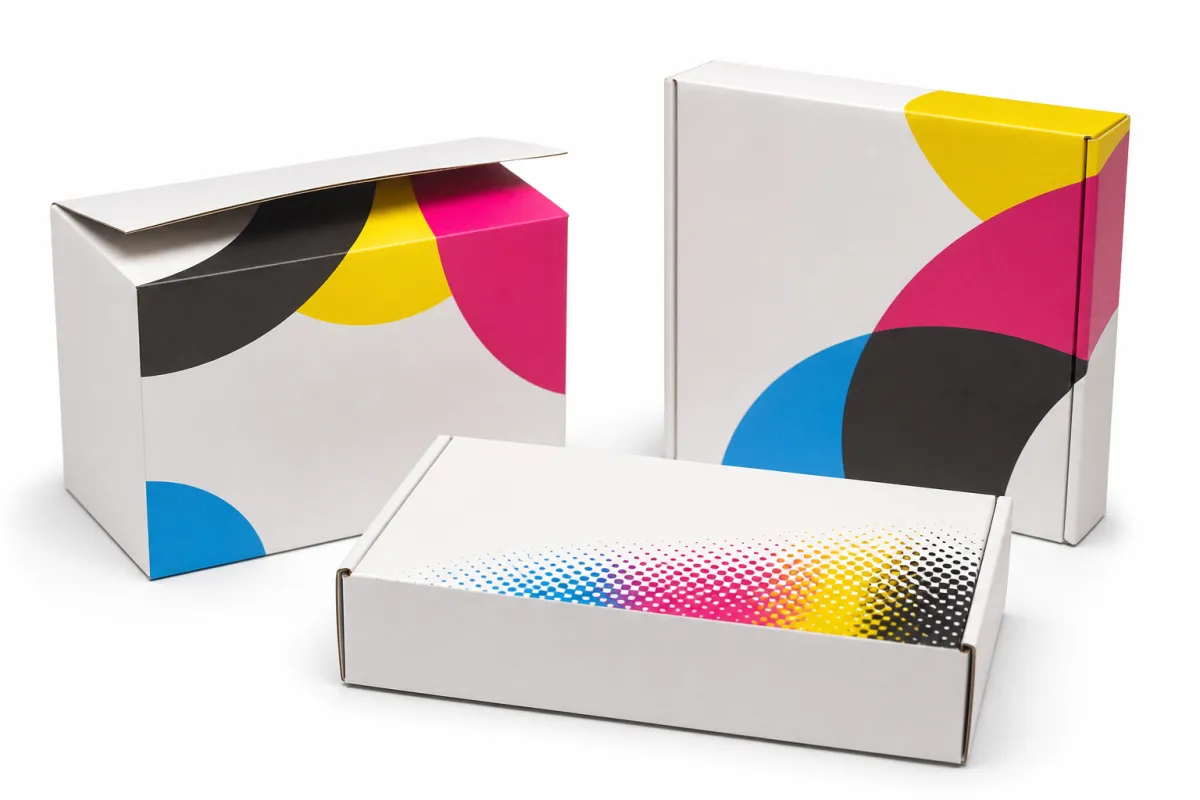
Custom cmyk box printing uses cyan, magenta, yellow, and black inks to build full-color artwork on packaging substrates like corrugated mailers, folding cartons, retail shippers, and insert boxes. Those four process colors mix in controlled amounts to reproduce logos, photos, gradients, patterns, and typography. That is why CMYK is still the standard for a lot of printed packaging. It gives you range without forcing a separate ink setup for every tiny shade in the design.
That range matters because a box has more jobs than people give it credit for. It has to protect the product, carry the brand, and survive the trip from the production floor to the customer’s hands. A printed mailer that looks great but crushes in transit is expensive in the dumbest possible way. A strong box that prints poorly is not much better. Custom cmyk box printing works best when those jobs are treated like one system, not separate departments arguing over whose problem it is.
The main alternative is spot color printing. Spot colors use premixed inks and are usually the better choice when a brand needs an exact match every time. Custom cmyk box printing builds color from process inks instead, which makes it better for photos, gradients, and multi-color layouts. Spot color can win when a brand needs one signature shade to stay tight across a long run. CMYK usually wins when the design needs visual range and flexibility more than perfect one-color purity. There is no moral victory here. Just the right tool.
Packaging is not art first. It is a brand signal, a production object, and a shipping item. That sounds obvious, but a lot of teams still design boxes as if they will never be folded, rubbed, or stacked. They will. Pretty much immediately. Custom cmyk box printing delivers the best result when design and operations get aligned early, before anyone gets emotionally attached to a layout that cannot survive the route.
"A box that looks good in Photoshop and weak in the hand is still a weak box."
If you are comparing suppliers, the manufacturing side matters just as much as the print side. Our Manufacturing Capabilities page shows how print, structure, and finishing fit together. If you are still sorting through formats, the Custom Packaging Products page is a practical way to compare box styles before you lock the spec.
How Custom CMYK Box Printing Works From File to Carton
The workflow for custom cmyk box printing usually starts with the dieline, not the artwork. The dieline defines folds, flaps, cuts, glue zones, and the box shape itself. Once that structure is locked, the artwork gets placed into the correct bleed and safe areas so nothing important lands on a seam or gets trimmed off. If the file is built on the wrong template, the first proof can expose a mess that should have been caught earlier.
File prep slows down more orders than people want to admit. Artwork should be set up in CMYK mode, not RGB, because screens and presses speak different color languages. Images need enough resolution, usually 300 dpi for standard print areas. Text should be outlined or embedded so fonts do not vanish on press. A clean PDF is often the least painful handoff format. For custom cmyk box printing, that prep work can save a full round of revisions and a fair amount of swearing.
Then the print method comes into play. Digital printing usually makes sense for smaller runs, short deadlines, and artwork that changes often. Offset printing usually fits larger quantities and brand programs that want steady output across a bigger volume. Both can look excellent. They just behave differently. Digital printing cuts down on setup time. Offset printing tends to be more economical at scale and can stay very consistent once the press is dialed in. That choice affects custom cmyk box printing more than most buyers expect.
Proofing is the step that saves money. A digital proof shows layout and gives a rough color reference. A printed sample or press-ready mockup gets closer to how the board, coating, and ink will actually behave. For color-sensitive custom cmyk box printing, checking a sample under neutral light is smarter than judging it under a warm office lamp or a fluorescent ceiling light that lies to your face.
After approval, the printed sheets or blanks get cut, folded, glued, and packed. A mailer needs crisp folds so it stays square. A retail carton needs panel alignment because seams and edges sit in the customer’s line of sight. By the time the boxes ship, the production team has already made a stack of decisions that shape the final result of custom cmyk box printing.
A simple version of the process looks like this:
- Define the box structure and dimensions.
- Build artwork on the correct dieline with bleed.
- Choose the print method that fits quantity and timing.
- Review proofs and approve a sample if color matters.
- Finish, convert, and pack for shipment.
What usually causes trouble early
Late artwork changes are the obvious problem, but not the only one. The sneaky issue is a file built with no room for the physical box. A logo too close to a fold can disappear once the carton is assembled. A background that looks clean on screen can show tiny white edges if the bleed is too tight. In custom cmyk box printing, the file is not the box. It is the map, and the map needs to match the terrain.
Key Factors That Affect Color, Durability, and Cost
Material choice is the first major variable in custom cmyk box printing. Corrugated board behaves differently from SBS paperboard, and kraft stock behaves differently from coated white stock. Corrugated boxes are the go-to for shipping strength and stack resistance. SBS or coated board usually gives a smoother surface, which helps with fine detail and brighter color. Recycled stocks can be strong and attractive from a sustainability standpoint, but they may print a little softer depending on the fiber mix.
Coating changes the result again. Matte coating softens the look. Gloss coating pushes color harder. Aqueous coating can add rub resistance without the heavier feel of a film lamination. Some kraft designs skip coating entirely, which can look honest and natural, but uncoated boards are more likely to scuff and absorb ink. If a box is going to get tossed around, that choice matters. Custom cmyk box printing on a soft-touch surface can feel premium, while a glossy aqueous finish may hold up better in transit.
Ink coverage also moves the budget. A design with a small logo and light linework is easier to print than a box wrapped edge to edge in deep color. Large dark blocks use more ink and are more sensitive to density shifts. The same goes for fine gradients and photography. A heavy full-bleed design can still be worth it, but custom cmyk box printing becomes more dependent on calibration, substrate absorbency, and finishing.
Box construction affects cost and performance too. A simple roll-end mailer is not the same thing as a rigid setup box or a crash-lock bottom carton. Larger boxes use more board, take more freight space, and can increase conversion waste. Sometimes a small change in geometry saves more money than a print tweak ever will. That is the part buyers forget: custom cmyk box printing is only one line on the quote.
Print gets the applause. Structure keeps the margin from bleeding out.
For brands shipping across long routes, durability should be tested instead of guessed. Many teams use shipping protocols such as ISTA testing standards to check vibration, drops, and compression. Others review fiber sourcing guidance from the Forest Stewardship Council when certification matters. That is not overthinking it. That is treating custom cmyk box printing like a supply-chain decision instead of a design flourish.
The best result comes from matching the substrate to the route. A parcel box going straight to a customer may need scuff resistance and a clean opening experience. A shipper heading into palletized freight may need stacking strength first, with branding second. Custom cmyk box printing can serve both jobs, but only if the box is built for the real use, not the imagined one.
Custom CMYK Box Printing Costs: What Drives the Price
Pricing for custom cmyk box printing is driven by the mix of quantity, material, setup, and finishing. A quote can look cheap until you notice it assumes a lighter board, a smaller print area, or no coating. That is why comparing “box price” without comparing specs is a fast way to fool yourself.
The biggest lever is quantity. Small runs cost more per unit because the setup work has to be spread across fewer boxes. A 500-unit order often costs more per box than a 5,000-unit run, even with identical artwork. That is true in both digital printing and offset printing, though the breakpoints are different. For custom cmyk box printing, the math is simple: unit price usually drops as volume rises, until machine time, materials, and freight push back.
Design complexity matters too. Heavy ink coverage, multiple panels, special finishes, and repeated revision cycles all add labor. A supplier may need extra prepress checks, color proofing, or plate work. If the job includes coating, spot varnish, embossing, or unusual conversion steps, the cost climbs again. That is not a penalty. It is just the real cost of custom cmyk box printing once the job stops being simple.
Shipping can be a quiet budget thief. Packaging is bulky, so freight charges can matter even when the print price looks decent. Rush fees are another trap. If a launch date forces a short turnaround, the plant may need overtime, expedited delivery, or a tighter production queue. Add revisions after proof approval and the budget can move quickly. A good custom cmyk box printing quote should surface those costs before they become a surprise invoice.
Here is a practical comparison many buyers use as a starting point. These figures are directional, not fixed, because board grade, coverage, finishing, and freight all change the final price.
| Print Approach | Typical Best Use | Setup Burden | Unit Cost Pattern | Common Timeline |
|---|---|---|---|---|
| Digital printing | Small runs, pilots, frequent art changes | Lower | Often higher at very low quantities, then steadier | Often 7-12 business days after proof approval |
| Offset printing | Larger runs, tight color consistency, broader coverage | Higher | Usually drops at scale after setup is absorbed | Often 12-18 business days after proof approval |
| Hybrid approach | Mixed SKUs, repeat programs, complex branding needs | Moderate to high | Depends on how many elements are printed separately | Varies with artwork revisions and finishing steps |
If a supplier gives you a quote, compare it against the same assumptions every time: board type, dimensions, print coverage, coating, quantity, and delivery location. That is the only fair way to compare custom cmyk box printing offers. The cheapest line item can turn into the most expensive order if it leads to a reprint or freight charges nobody mentioned.
Process and Timeline for Custom CMYK Box Printing Orders
A clean timeline for custom cmyk box printing usually follows seven steps: brief, quote, dieline, artwork prep, proofing, production, and shipping. That sounds tidy on paper. Real life is less polite. Most packaging delays happen before the press sees the file. The bad news is that this part is invisible. The good news is that it is fixable.
The brief needs more than size. It should include product weight, shipping route, order quantity, closure style, and whether the box is for ecommerce, retail display, or internal distribution. Once that is clear, the quote becomes useful instead of decorative. A good supplier can suggest the right board, print method, and finish for custom cmyk box printing without making the buyer guess what every option means.
Artwork prep usually takes longer than expected. Dielines may need to be confirmed, images may need conversion, and brand colors may need adjustment if the stock changes how they read. Then comes proofing, which deserves real attention. Tiny text, barcode placement, and fold alignment matter more than people want to admit. For custom cmyk box printing, a 10-minute proof review can save a 10-day reprint.
Production timing depends on method and quantity. Smaller digital jobs can move faster once artwork is approved. Larger offset runs need more setup and may involve plates, drying time, and a longer queue. If finishing is added, the schedule gets longer. Anyone placing custom cmyk box printing orders for a seasonal launch should build in buffer time. One late artwork change can squeeze the entire timeline, and the press is not gonna care that marketing promised a launch party.
Logistics teams should work backward from the warehouse date. If boxes must arrive before product intake, artwork approval needs to happen earlier than the launch team usually wants. If the boxes are part of a subscription cycle or a promotional kit, the window is even tighter because the packing line does not care about optimism. That is where custom cmyk box printing stops being a print order and turns into planning.
A realistic buffer for many packaging programs is a few extra business days beyond the quoted timeline. That does not mean every job will use them. It means the schedule survives when a common snag shows up: a revised dieline, a color correction, a material shortage, or a freight delay. With custom cmyk box printing, a little slack is usually cheaper than a panic shipment.
- Brief and quote: confirm dimensions, quantity, board type, and delivery location.
- Dieline and artwork: build graphics in the correct template with bleed and safe zones.
- Proof approval: verify color, text, folds, and barcodes.
- Production: print, convert, finish, and inspect.
- Shipping: pack for the route and confirm arrival timing.
Common Mistakes That Create Color Shifts or Reprints
The most common mistake in custom cmyk box printing is sending RGB artwork and expecting it to match the screen. It will not. RGB is built for light-emitting displays. CMYK is built for ink on substrate. The color range also changes once the artwork lands on corrugated board, kraft, or coated paperboard. That does not mean matching is impossible. It means the buyer has to respect the medium.
Low-resolution files are another repeat offender. Blurry logos, jagged lines, and soft product images usually point back to artwork that was never print-ready. Fonts can disappear if they are not outlined or embedded. Then there is the dieline problem: a gorgeous design can still fail if important text lands too close to a fold or cut line. In custom cmyk box printing, file hygiene is production insurance, not a design nicety.
Color shifts can show up in less obvious ways too. Rich black backgrounds may print differently from panel to panel if the coverage is too heavy. Tiny text can fill in if press settings are off. Pale tones can disappear on uncoated stock, especially if the board soaks up ink fast. That is why a proof on one material is not a promise on another. Custom cmyk box printing is sensitive to substrate, coating, and light source at the same time.
Logistics assumptions cause their own damage. A box that looks perfect in the studio may scuff when stacked tightly on a pallet or rubbed during transit. Moisture, compression, and vibration all affect print and structure. That is why many packaging teams use test methods aligned with EPA paper and paperboard guidance alongside ship-testing references like ISTA. The goal is not just to protect the product. It is to protect the quality of custom cmyk box printing after the boxes leave the plant.
One useful habit is to review the proof with three questions in mind:
- Will the design still read after the box is folded and handled?
- Will the color still feel right on the chosen board?
- Will the package survive the actual route, not just the photo shoot?
If the answer to any of those is shaky, ask for a sample. Reprints rarely come from one giant mistake. They usually come from five small assumptions nobody challenged early enough. That is the real cost risk in custom cmyk box printing.
Expert Tips and Next Steps for a Better First Order
The easiest way to improve your first custom cmyk box printing order is to write a short packaging spec sheet before asking for quotes. Include box dimensions, product weight, quantity, closure style, whether the box ships alone or inside another carton, and which matters most: price, appearance, or durability. Once those priorities are clear, vendors can give a sharper recommendation.
Ask for a dieline early. That one file usually decides whether the artwork can be built correctly the first time. Next, confirm the substrate. Corrugated, SBS, and kraft can all work, but they do different jobs. If the packaging has to survive warehouse handling and still carry the brand, the material choice should reflect that reality. A good custom cmyk box printing spec starts with the box, not the logo.
It also helps to define the environment before you design. Will the carton be stacked on a pallet? Will it move through a humid facility? Will it be opened at home, on a retail floor, or at a fulfillment center? Those answers change the print and finishing decisions. A matte finish can feel premium and quiet, but a more scuff-resistant coating may be the better call for rough handling. That is where custom cmyk box printing becomes a use decision, not just a style choice.
A small pilot run is worth serious thought if the design is new, the branding is changing, or the route is ugly. A sample can show how the ink sits on the board, how the folds align, and whether the box feels solid in the hand. Teams often treat the pilot as a learning order. That is not timid. It is efficient. In packaging, a controlled mistake costs less than a warehouse-wide correction, especially with custom cmyk box printing.
Finally, the best packaging choices usually connect design and operations. A box that stacks well is easier to receive. A box with clean barcode placement is easier to scan. A box with disciplined branding is easier to spot on a shelf or at the doorstep. That is the quiet value of custom cmyk box printing: it keeps the product looking consistent while still doing the boring work of shipping, storage, and unboxing.
If you want to compare structural options before placing an order, review the available Custom Packaging Products and match them to your product and route. If you need a better picture of how print, conversion, and finishing are handled, the Manufacturing Capabilities overview is the next logical stop. The strongest results come from pairing the art brief with the logistics brief.
My short version is this: define the need, confirm the specs, review the proof, and then place the order. That sequence sounds basic, which is exactly why people skip it and get burned. Follow it once and most of the expensive surprises in custom cmyk box printing never show up.
What file format works best for custom CMYK box printing?
A print-ready PDF is usually the safest choice for custom cmyk box printing, especially if fonts are outlined or embedded and images are placed at proper resolution. Keep the artwork in CMYK mode instead of RGB so the color shift is visible before production. The file should also include the correct dieline, bleed, and safe area so the design fits the finished carton rather than the flat layout alone. If a printer asks for a native file too, send it. That saves back-and-forth later.
How long does custom CMYK box printing usually take?
Simple digital jobs can move quickly after artwork approval, while larger offset printing runs usually need more setup time. Proofing, revisions, and material availability often matter more than the press time itself. For custom cmyk box printing, build in extra buffer if the boxes must arrive before a launch, a seasonal shipment, or a warehouse receiving window, because a late approval can shift the whole schedule. A clean timeline is nice. A realistic one is better.
Is custom CMYK box printing cheaper than spot color printing?
It often is when the design uses many colors, gradients, or photo elements, because custom cmyk box printing can reproduce a wide range without multiple ink stations. Spot colors can be more cost-effective for simple designs with one or two exact brand colors, especially on larger runs. The cheaper option depends on quantity, coverage, and how much setup each method requires. A quote that ignores setup is not really a quote. It is a teaser.
Can custom CMYK box printing match my brand colors exactly?
It can get very close, but exact matches are harder when the stock, coating, or lighting changes the appearance. That is why a proof or sample matters so much in custom cmyk box printing. If color accuracy is critical, ask whether a spot color or hybrid approach would better protect the brand color across the full run. Exact matching is possible sometimes, but not always on every stock. Honest suppliers will say that out loud.
What box material is best for shipping-focused custom CMYK box printing?
Corrugated board is usually the strongest starting point when the box needs stacking resistance and transit protection. Kraft and coated stocks can still work well when branding and sustainability matter, but the structure has to be checked against the product weight and shipping route. For shipping-focused custom cmyk box printing, match the board to the handling conditions before choosing the print spec. The box has to survive the worst day, not the pretty sample day.
If you keep the spec tight and the proof review disciplined, custom cmyk box printing gets a lot easier to buy well the first time. The one thing I’d insist on is simple: get the dieline, a substrate sample, and a printed proof before you approve production. That order prevents most of the expensive surprises.

