Buyer Fit Snapshot
| Best fit | Custom Wine Label Printing projects where brand print, material claims, artwork control, MOQ, and repeat-order consistency need to be specified before quoting. |
|---|---|
| Quote inputs | Share finished size, material target, print colors, finish, packing count, annual reorder estimate, ship-to region, and any compliance wording. |
| Proofing check | Approve dieline scale, logo placement, barcode or warning zones, color tolerance, closure strength, and carton packing before bulk production. |
| Main risk | Vague material claims, crowded artwork, missing packing details, or unclear freight terms can make a low unit price expensive after revisions. |
Fast answer: Custom Wine Label Printing: Retail Fit, Compliance Space, Print, and Cost should be specified like a repeatable production item. The safest quote records material, print method, finish, artwork proof, packing count, and reorder notes in one written spec.
Production checks before approval
Compare the actual filled-product size with the drawing, then confirm tolerance on folds, seals, hang holes, label areas, and retail display edges. Reserve space for logos, QR codes, warning copy, and material claims before decorative graphics fill the panel.
Quote comparison points
Review material grade, print process, finish, sampling route, tooling charges, carton quantity, and freight assumptions side by side. A quote is only useful when the supplier can repeat the same color, closure quality, and packing count on the next order.
Custom Wine Label Printing: What to Know Before You Order
Custom wine label printing can turn a plain bottle into something people actually want to pick up. That is the job. The label has a few seconds to signal quality, style, and whether the bottle feels intentional or kind of thrown together five minutes before the event. If you are ordering for a wedding, a private label launch, a tasting room, a corporate gift, or a seasonal run, custom wine label printing has to do more than look decent in a mockup.
The practical side matters just as much as the design. A wine label has to survive handling, chilling, condensation, curved glass, and the sort of rough treatment that happens in real life. I have seen beautiful labels curl in an ice bucket because someone picked the wrong stock and adhesive combo. Pretty on screen, useless on the bottle. Custom wine label printing is design, materials, and a little common sense all at once. Ignore one of those pieces and the bottle will show it fast.
For brands building branded packaging, the label often does the selling before anyone reads the tasting notes. Buyers scan fast. Shelf decisions happen even faster. A strong label can pull attention from across the room. A weak one gets skipped, even if the wine inside is excellent. Custom wine label printing is one of the few packaging moves that can change perception without changing the product itself.
What Is Custom Wine Label Printing?
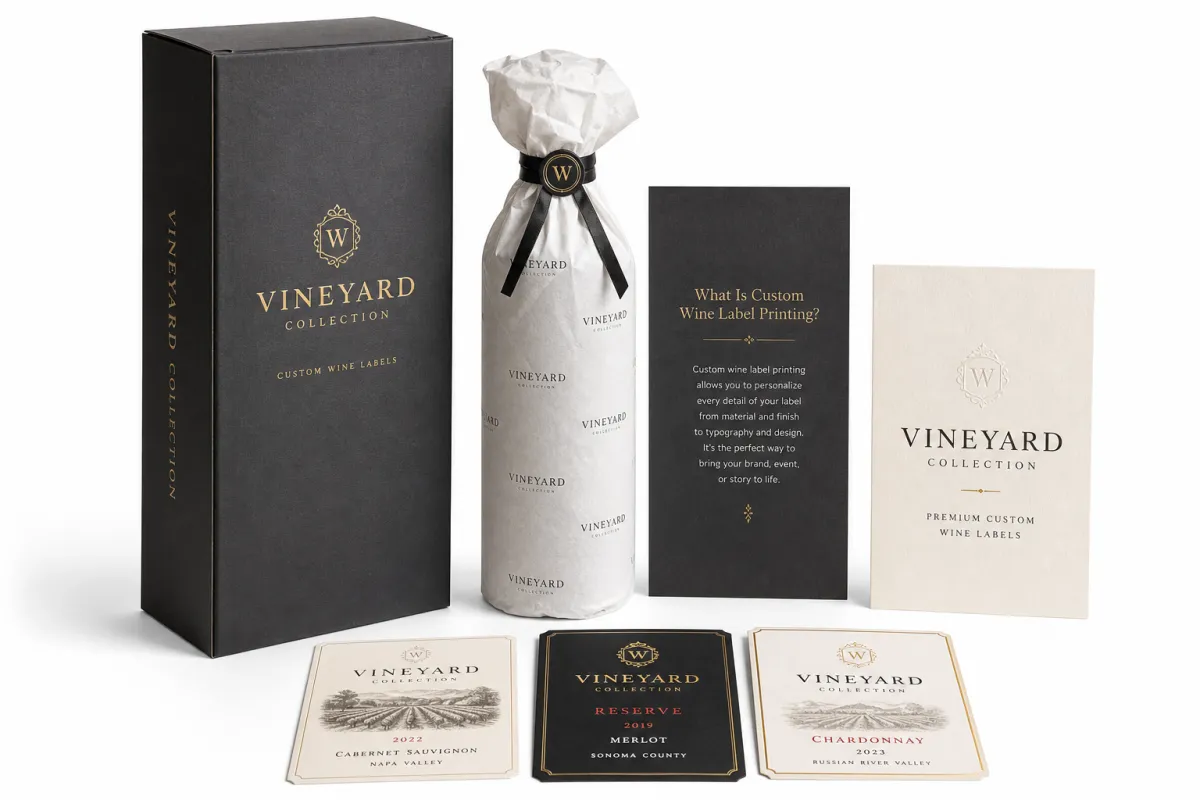
Custom wine label printing is the production of labels made for wine bottles, with the right dimensions, adhesive, material, and finish for the bottle and the conditions it will face. That sounds simple until you try forcing a generic label onto a curved bottle that is cold, damp, and not interested in cooperating. Then the details get very real.
This is not just sticker printing. A proper wine label has to fit the bottle profile, leave space for required text if needed, and stay attached through storage and handling. For some buyers, the label is part of package branding. For others, it is the main reason the bottle feels giftable. Either way, custom wine label printing is where design meets use.
You see it in a few common places:
- Weddings and private events where the bottle becomes a favor or table piece
- Private-label wineries and small-batch seasonal releases
- Tasting room exclusives and club shipments
- Holiday gifts, corporate gifts, and promotional sets
- Limited editions tied to restaurants, vineyards, or collaborations
Each use case changes the label job. A wedding favor label does not need the same durability as a bottle meant for months in cold storage. A tasting room release may need stronger shelf impact than a cellar-stored collectible. Custom wine label printing should match the bottle’s real environment, not the mood board.
The branding value is hard to miss. Buyers judge wine quickly, often from a distance, often before they ever touch the bottle. A sharp label can create the feel of premium product packaging even on a small run. That is why custom wine label printing is often the first upgrade when someone wants a bottle to feel more finished, more giftable, and more expensive than the liquid alone would suggest.
For a broader look at how labels fit into a larger packaging program, see Custom Labels & Tags and Custom Packaging Products. Labels do not sit in a vacuum. They belong to the same visual system as boxes, inserts, and retail packaging.
How Custom Wine Label Printing Works
The workflow is usually simple on paper. In practice, there are plenty of ways to trip over it. Custom wine label printing usually starts with artwork and specifications, then moves to proofing, then production, then finishing and shipping. Skip the specification step and the quote might still look fine while the actual job turns into a headache later.
File review comes first. A printer or packaging vendor checks the dieline, bleed, safety margins, font sizes, and image resolution. They also look at the bottle shape and the area where the label will sit. A tall, narrow label behaves differently from a short wrap. Curved glass changes what “fits” even means. That is why packaging design for wine is not just a graphic exercise. It is measurement work too.
Print method comes next. Smaller runs usually lean toward digital printing because setup is lighter and the math works better for short quantities or multiple versions. Larger runs may benefit from offset printing or offset-style production because the unit cost drops as volume rises. There is no universal answer. The right choice depends on quantity, finish, and whether you need one version or several SKUs.
Before production, the vendor should confirm bottle curvature, exact label dimensions, and whether the adhesive suits the storage environment. That matters because custom wine label printing is often used on chilled glass or bottles that sit in ice buckets. A label that behaves in a dry office can fail in a cold room full of condensation. The label is not tested by the presentation deck. It is tested by water and gravity.
Finishing comes after printing, and this is where a label starts to feel more polished. Options often include matte, gloss, soft-touch, foil accents, spot UV, or texture. Matte reads quieter and often more premium. Gloss reflects more light and can feel energetic on retail packaging. Soft-touch adds a velvety feel, which sounds minor until someone picks up the bottle and notices. Custom wine label printing uses finish to shape perception before anyone opens the wine.
Application is the last real test. The best print job in the world is useless if the label does not apply cleanly. A proper label should lay flat, resist lifting at the edges, and stay in place when chilled or handled. If the bottle will be wet, cold, or touched a lot, the material and adhesive need to be chosen with that in mind. No one wants a label sliding down the bottle like it lost an argument.
A wine label has two jobs: look good from six feet away and survive real handling. If it only does one, it is not finished.
If you want to see where print capability fits into a larger packaging operation, review Manufacturing Capabilities. That gives a clearer sense of how custom wine label printing connects to die cutting, finishing, and the rest of the packaging workflow.
For readers who prefer standards instead of hand-wavy claims, it helps to check the testing language around packaged goods at ISTA. If sustainability matters in the brief, FSC is the paper sourcing standard many buyers ask about. Neither one rescues a bad design. Both help you ask smarter questions before you spend money.
Key Factors That Change Label Quality and Feel
Custom wine label printing can look wildly different depending on a few material choices. Two labels with the same artwork can feel completely different in hand if one uses paper stock and the other uses a waterproof film with a specialty finish. That is why buyers who only compare design mockups miss the part that affects actual performance.
Stock is the first decision. Paper labels are common and often cost less, but they can struggle with heavy moisture. Coated paper improves print clarity and handles moderate handling better. Waterproof film is the safer choice for bottles that will be chilled, bucketed, or stored in damp spaces. Specialty textured stocks can look excellent, but they usually sit higher in price and can complicate application on curved surfaces. In practice, custom wine label printing is a balance between appearance and survival.
Adhesive is the part people forget until the label fails. Standard adhesives may work fine for dry storage, but refrigerated bottles need something stronger and more forgiving. If the wine will be served cold or packed with ice, ask for a moisture-resistant or chill-rated adhesive. Textured glass, recycled bottles, and highly curved shoulders can also affect bond strength. A label that holds perfectly on one bottle may misbehave on another with a slightly different finish. Annoying, yes. Normal too.
Size and shape change both cost and usability. Rectangular labels are easier to produce and usually cheaper. Wrap labels, neck labels, die-cut shapes, and front-back sets add design interest, but they also add setup time and production complexity. In custom wine label printing, every unusual shape is a decision that affects the quote. If the bottle already has a strong profile, a simpler label often works better than a crowded die-cut.
Finish changes perceived value fast. A matte label suggests restraint and a more editorial look. Gloss makes colors feel brighter and more commercial. Foil accents catch the eye and work well for premium positioning, but too much foil can make the bottle look like it is trying too hard. Spot UV adds contrast by making certain areas shiny against a matte field. Texture and embossing add tactile interest, but they are not subtle and they are not free. Custom wine label printing should use finish to support the brand story, not decorate every square inch because the option was available.
Artwork quality is the final filter. A beautiful stock will not rescue blurry logos, weak typography, or pixelated images. File prep matters. Vector art is best for logos and text. Images should be high resolution, and tiny type needs room or it will fall apart once printed. Crowded layouts often look worse on bottle than on screen because glass curves and reflected light make small details harder to read. Good custom wine label printing starts with clean file prep. That part is boring, which is exactly why people skip it.
Here is the quick tradeoff view:
| Option | Typical Feel | Durability | Cost Range Impact | Best Use |
|---|---|---|---|---|
| Paper stock | Classic, lightweight | Moderate | Lower | Dry storage, short-term gifts |
| Coated paper | Crisp, cleaner print | Moderate to good | Low to medium | Tasting room releases, retail display |
| Waterproof film | Sleek, modern | High | Medium to higher | Chilled bottles, ice buckets, shipping |
| Textured specialty stock | Premium, tactile | Varies | Higher | Luxury positioning, limited editions |
If you are also choosing outer packaging, keep the label style aligned with the rest of the product packaging. A slick bottle label paired with a weak shipper or off-brand carton creates a mismatch. The label should feel like it belongs with the rest of the package, not like it wandered in from another project.
Custom Wine Label Printing Cost and Pricing Basics
Custom wine label printing pricing is driven by a few predictable factors: quantity, material, adhesive, finish, size, shape, and whether you need custom cutting or multiple versions. If a quote looks oddly low, one of those factors is probably missing. If a quote looks high, several of them are usually working together.
Short runs cost more per label because setup and proofing get spread across fewer units. Larger orders usually reduce the unit price because the fixed work gets divided over more bottles. That is basic print economics, not magic. A 250-label order can land in a very different price bracket than a 5,000-label order, even if the design never changes. Custom wine label printing rewards volume, but only if you actually need the volume.
As a rough frame, plain labels on standard stock can start relatively low at higher quantities, while special finishes and waterproof materials push the price up quickly. For smaller orders, the per-label cost climbs fast because setup is carrying more of the load. A buyer might see something like $0.18-$0.28 per label at higher quantities for a straightforward format, while a short run with foil, die cutting, or premium stock can land much higher. Those are ranges, not promises. The exact quote depends on the design and the bottle requirements.
Here is where hidden costs show up:
- Setup fees for custom dies or press preparation
- Proofing charges if you need physical samples or multiple revisions
- Rush production when the timeline is compressed
- Shipping for heavy label rolls or boxed sheets
- Color adjustments if you are matching a strict brand palette
Premium upgrades deserve a hard look. Foil, embossing, textured paper, and waterproof materials can all push the price up, but that does not make them bad choices. It means they should be chosen for the right bottle. If the wine is for a quick event giveaway, a restrained label on good stock may be smarter than spending money on effects nobody will notice. If the bottle is headed for retail, stronger finish choices may pay back in shelf presence. Custom wine label printing should support the price you want the bottle to command, not just the enthusiasm of the designer.
Compare total landed cost, not just the line item. A cheap unit price can become annoying once shipping, waste, reorder risk, and rush fees show up. That is why packaging buyers ask for all-in numbers. They have been burned before. Usually more than once.
For brands building a larger line, it helps to compare custom wine label printing against the rest of the packaging budget. A label that looks premium but leaves no room for gift boxes, inserts, or branded cartons creates a strange kind of victory. That is where custom printed boxes and outer packaging planning matter too.
Step-by-Step Guide: Process and Timeline
The cleanest way to handle custom wine label printing is to treat it like a small production project, not a casual art request. If you measure, spec, proof, and test in order, the job moves faster and rework drops. Skip the boring part and you usually pay for it later. Packaging has a habit of collecting its debts.
Step 1: Measure the bottle. Confirm the label area, the curvature, the shoulder shape, and the space you actually have. A bottle may look standard until you measure it. Then the visible panel is shorter than expected or the neck gets in the way. If the bottle will be chilled or gift wrapped, note that too. The use case changes the material choice.
Step 2: Prepare the artwork. Gather logos, copy, barcode requirements if needed, and any legal text. Use vector files for logos when possible. Make sure images are high resolution. Build bleed into the file, keep important text away from cut edges, and avoid fonts so small they disappear under normal viewing conditions. This is where custom wine label printing gets saved from a lot of preventable pain.
Step 3: Request a quote with real specs. Do not ask for “wine labels” in the abstract. Ask for the size, quantity, stock, adhesive, finish, and whether you want sheeted or roll labels. That is the difference between a useful quote and a vague guess. If you also need matching inserts, neck tags, or outer cartons, mention those early so the whole project can be priced together.
Step 4: Review the proof. A digital proof catches layout mistakes, cut lines, bleed, and copy issues. A physical sample or test print catches material feel and color behavior. Color shifts happen. They just do. A deep navy on screen can print darker, flatter, or slightly warmer depending on the stock and press settings. If the color is brand-critical, say so before approval.
Step 5: Approve production. Once approved, custom wine label printing moves into production. Simple digital runs can move quickly. More complex jobs with multiple finishes, special adhesives, or custom dies take longer. A typical project might spend 1-3 business days in quoting and proofing, then several more days in production depending on quantity and complexity. The bigger the run and the fancier the finish, the less anyone should pretend it will happen overnight.
Step 6: Test the label on the actual bottle. This step is not optional if the order matters. Apply one label to the real bottle and leave it in the actual environment: cold storage, humid room, or event prep area. Check for lift, bubble formation, edge failure, and readability. A screen mockup will not tell you whether the label handles condensation or whether the bottle shoulder eats the artwork. Real bottles are the final judge in custom wine label printing.
Here is a practical timeline summary:
- Day 1: Measure bottle, gather files, request quote
- Day 1-3: Proofing and revisions
- Day 3-7+: Production, depending on run size and finish
- Final day: Receive labels and test on the bottle before full use
That timeline can be faster, especially for simple jobs. It can also stretch if files are missing or the project changes halfway through. The fastest jobs are the ones with final copy, clean art, and one clear decision-maker. Everything else adds friction.
Common Mistakes That Waste Time and Money
The most expensive mistake in custom wine label printing is designing for the mockup instead of the bottle. A label can look sharp on a computer and fail completely on curved glass. Then it wrinkles, lifts, or smears once it sees a refrigerator. That is not a print defect. That is a planning defect.
One easy way to waste money is choosing the wrong adhesive or stock for the environment. A label intended for dry storage will not always behave in a chilled display or ice bucket. Condensation is brutal. It finds weak spots. If the bottles will be handled at events, passed around in restaurants, or shipped in mixed conditions, ask for materials made for that use instead of hoping standard paper will act tough.
Bad file prep causes a different kind of pain. Low-resolution art, missing bleed, tiny text, and color files built in the wrong mode can delay production and force rework. This is especially frustrating because it is so preventable. Custom wine label printing runs smoother when the buyer sends files that are already close to print-ready. If you do not have that, ask for prepress help before the order is locked.
Another common misstep is piling on too many finishes. Foil plus embossing plus spot UV plus textured stock sounds impressive in a sales deck. On a bottle, it can become expensive and visually noisy. The label starts competing with itself. Usually one premium element does more than three mediocre ones. That is true in brand packaging generally, and it is true here too.
People also forget to test on the real bottle. A flat proof does not show how the label behaves on glass with a shoulder, seam, or narrow neck. If the bottle has a unique shape, do the test. It is cheaper to spend ten minutes with a sample bottle than to discover the full order has the wrong proportions after shipping.
Some buyers also overestimate how much detail a label can carry. Wine labels are often viewed quickly and at an angle. If the layout is overloaded, the brand name disappears. If the type is too thin, it gets lost. If the bottle is meant for retail packaging or gifting, the core message should be readable first, decorative second. That order matters. Fancy does not rescue confusion.
Custom wine label printing works best when the buyer thinks like a packaging buyer, not just a designer. The bottle has to perform in the real world. That means the label should be easy to apply, durable enough for the use case, and visually simple enough to read quickly.
Expert Tips for Better Wine Labels
Start by designing for distance. In a tasting room, on a shelf, or at a dinner table, the label needs to be legible from arm’s length. The brand name, wine type, and one visual idea should do most of the work. If the label only rewards close inspection, it is probably doing too much. Custom wine label printing should help the bottle stand out fast.
Use finish with discipline. A single foil accent around the nameplate or crest can create a premium point of focus without turning the whole label into a shiny billboard. Matte stock with one polished detail often reads more expensive than a label covered in effects. That sounds backward until you see it in person.
Choose shape based on the bottle, not ego. Curved glass, narrow necks, and sloped shoulders all affect how much label area is actually usable. If the bottle already has strong proportions, a simple rectangle or tall label may be enough. If the bottle is unusual, Custom Die Cutting may be worth the extra setup because it helps the label fit the container instead of fighting it. That is one of the cleaner uses of custom wine label printing.
Order a small test batch when the bottle will go into restaurants, events, or refrigerated retail. A test of 25 to 50 labels can reveal more than ten mockups. You will see whether the adhesive holds, whether the color reads correctly, and whether the label survives handling. In packaging, reality is rarely polite enough to match the render.
Keep the spec sheet. Seriously. Save the exact material, adhesive, size, finish, and file version used for the winning version. That note is gold on a reorder. It removes guesswork, reduces errors, and keeps the next run from turning into a detective story. For recurring product packaging, consistency is part of the brand.
If your label is part of a larger promotion, make sure the whole set looks intentional. The label, carton, insert, and any outer shipper should share the same visual language. That is where custom printed boxes and label work need to talk to each other. If one feels luxurious and the other feels rushed, the customer notices. Maybe not in words, but they notice.
If the project touches sustainability, ask what paper and film options are available, then verify whether they line up with your brand claims. Do not oversell recycled content or FSC sourcing unless the spec actually supports it. Buyers have gotten more skeptical, and honestly, they should.
What to Do Next Before You Place the Order
Before you approve custom wine label printing, measure the bottle and decide exactly how the wine will be used. Will it be chilled? Gifting? Shipped? Displayed on shelf? Handed out at an event? That answer determines the right adhesive, stock, and finish. Labels are practical objects first and design pieces second.
Then request a quote with full specs: size, quantity, stock, finish, adhesive, and any special cutting or versioning. If you need a label for every bottle in a mixed set, say that now. If you need a back label and neck label too, say that now. Vague requests create vague pricing, and vague pricing is how projects drift.
Ask for a proof and check it for bleed, legibility, color accuracy, and bottle fit. If the label includes a barcode, legal copy, or critical product wording, review those areas twice. One typo on a wine label is small on paper and huge on the bottle. That is the kind of mistake people remember.
If the order matters, test one label on the actual bottle before running the full quantity. That is the moment custom wine label printing either proves itself or reveals a problem you still have time to fix. A sample bottle costs far less than reprinting hundreds of labels because the adhesive did not like the glass.
Keep the final artwork, the approved proof, and the spec sheet together. Reorders go faster when someone can open a folder and see exactly what worked last time. That is true for labels, outer cartons, and nearly every other piece of retail packaging. Repeatability is boring. It is also profitable.
Custom wine label printing is not hard once the decision points are clear. Choose the Right stock, match the adhesive to the bottle environment, keep the design readable, and test before launch. That is the difference between a label that supports the wine and one that just sits there looking expensive. The bottle deserves the first one.
How much does custom wine label printing cost per bottle?
Short runs usually cost more per label because setup and proofing get spread across fewer units. Special finishes, waterproof stock, and custom shapes increase the price faster than a plain paper label. Ask for a full quote with setup, shipping, and rush fees so the real cost per bottle is clear.
What material works best for custom wine label printing on chilled bottles?
A moisture-resistant stock with the right adhesive is the safest choice for refrigeration and condensation. If the bottle will live in an ice bucket or cold display, ask for waterproof or chill-rated materials. Test on the actual bottle surface, because textured glass and cold moisture can defeat the wrong adhesive.
How long does custom wine label printing take?
Simple orders can move quickly if the artwork is ready and the proof is approved without revisions. Custom dies, special finishes, and larger quantities add production time. The fastest way to avoid delays is to send clean files, exact specs, and final copy before quoting.
Can custom wine label printing work for small batches?
Yes, but small quantities usually have a higher unit price because setup costs are spread over fewer labels. Digital printing is often the better fit for short runs and multiple label versions. If you only need a few hundred bottles, focus on a clean design and smart material choice instead of overbuying fancy finishes.
What files should I send for custom wine label printing?
Vector files like AI, EPS, or PDF are best for logos and text. Make sure images are high resolution and that the file includes bleed, cut lines, and correct sizing. If you do not have print-ready art, send the best source file you have and ask for prepress help before approval.

