Buyer Fit Snapshot
| Best fit | Custom Coffee Bag Printing projects where brand print, material claims, artwork control, MOQ, and repeat-order consistency need to be specified before quoting. |
|---|---|
| Quote inputs | Share finished size, material target, print colors, finish, packing count, annual reorder estimate, ship-to region, and any compliance wording. |
| Proofing check | Approve dieline scale, logo placement, barcode or warning zones, color tolerance, closure strength, and carton packing before bulk production. |
| Main risk | Vague material claims, crowded artwork, missing packing details, or unclear freight terms can make a low unit price expensive after revisions. |
Fast answer: Custom Coffee Bag Printing: Film, Print, MOQ, and Carton Packing should be specified like a repeatable production item. The safest quote records material, print method, finish, artwork proof, packing count, and reorder notes in one written spec.
Production checks before approval
Compare the actual filled-product size with the drawing, then confirm tolerance on folds, seals, hang holes, label areas, and retail display edges. Reserve space for logos, QR codes, warning copy, and material claims before decorative graphics fill the panel.
Quote comparison points
Review material grade, print process, finish, sampling route, tooling charges, carton quantity, and freight assumptions side by side. A quote is only useful when the supplier can repeat the same color, closure quality, and packing count on the next order.
Custom coffee bag printing does more than make a roast look polished. Shoppers judge the bag before they taste the coffee, which means the package is already doing sales work on the shelf, at the counter, and in every photo a customer uploads. It is branding, protection, and operations planning rolled into one. Not glamorous. Very useful.
That is why custom coffee bag printing should be treated as a packaging decision, not a cleanup task at the end of a launch. The bag has to support aroma retention, keep the line organized across multiple SKUs, and still feel like branded packaging that belongs next to the roast quality you are charging for. A stock pouch with a label can carry a small program. Once a coffee brand needs stronger retail packaging, tighter SKU control, or a more premium wholesale presentation, the printed bag usually wins.
Coffee is a demanding category because the package has to signal freshness and protect flavor at the same time. One-way valves, seal integrity, zipper choice, oxygen barrier, and moisture barrier all matter. Visual cues matter too. Matte black can signal restraint and precision, kraft textures can suggest origin and craft, and gloss can push harder on shelf presence. Those signals shape expectations before the first brew even happens.
From a packaging buyer's point of view, the value is pretty easy to see. Better shelf presence. Easier SKU differentiation. More gift appeal. Stronger consistency between wholesale accounts and direct-to-consumer orders. Even if you also use custom printed boxes for shipments or gift sets, the coffee bag is still the first retail surface many customers notice, which makes custom coffee bag printing one of the most visible pieces of product packaging in the line.
Custom Coffee Bag Printing: Why Packaging Gets Noticed First
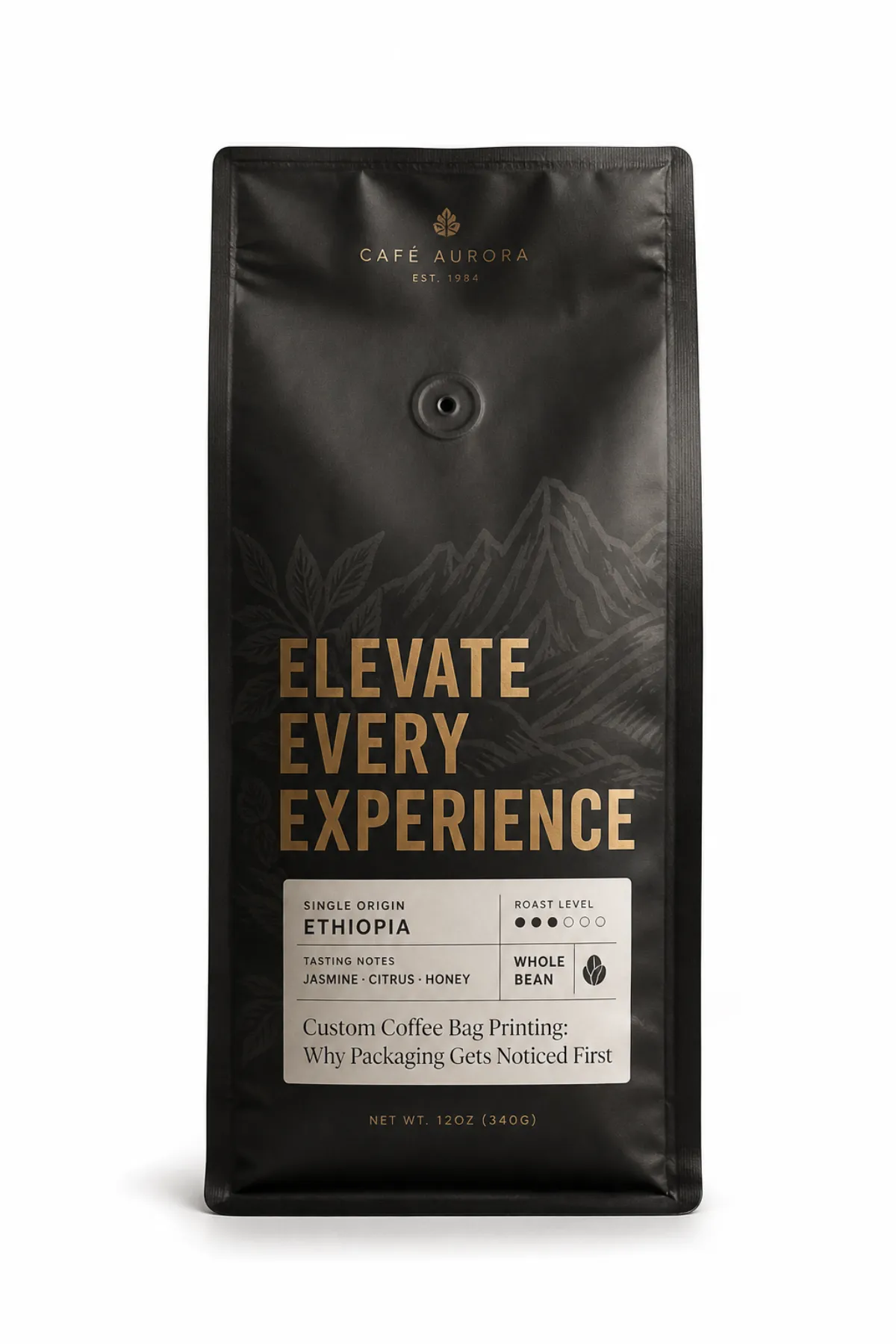
A bag does not need to be expensive to look intentional. It does need to look like it belongs in the category. A coffee buyer scanning a shelf is reading a handful of signals in seconds: roast level, origin, format, freshness, and price tier. That is why custom coffee bag printing often changes conversion more than a tiny tweak to headline copy or a new product photo.
In a cafe, the bag sits close to the register where impulse decisions happen fast. In wholesale, it may sit on a retail shelf beside competitors that are trying just as hard to look premium. In ecommerce, the same package shows up in lifestyle photos, unboxing videos, and subscription shipments. The bag ends up doing three jobs at once: branding asset, selling surface, and functional barrier.
Coffee also has a texture problem, and I mean that in a good way. A paper-forward kraft structure can feel earthy and direct, while a smooth soft-touch laminate can make the product seem more refined. Those tactile cues matter because coffee is often sold through story, not just specification. The packaging has to support that story without undercutting it. If the roast is positioned as a high-end microlot, the bag should not feel flimsy. If the blend is meant to look approachable and everyday, the design should not get so ornate that it slows purchase decisions.
Custom coffee bag printing is also a practical differentiation tool. Many roasters manage half a dozen blends, seasonal releases, decaf options, and maybe a few wholesale-only SKUs. A printed structure makes that portfolio easier to organize than a stack of generic bags with labels. It also lowers the odds of mix-ups during packing. The visual system helps operations as much as marketing, which is rare and welcome.
Photos matter too. A good bag photographs cleanly. A busy one can turn into visual noise on a phone screen. That matters because coffee discovery now happens through retail packaging on Instagram, ecommerce thumbnails, distributor catalogs, and marketplace listings. A package that reads clearly at two inches wide can still hold its own on a shelf. That is not a small advantage.
Custom coffee bag printing starts with a simple question: what should the package do for the business? If the answer is sell, protect, and organize, the rest of the process becomes much easier to judge.
How Custom Coffee Bag Printing Works From Proof to Production
The path from artwork to finished bag is more technical than many first-time buyers expect. Custom coffee bag printing usually begins with a dieline, which is the flat template showing every panel, seal, gusset, zipper zone, and valve position. Good suppliers build the bag around that template first, then place the artwork on top of it. It sounds obvious. It is also where plenty of projects go sideways.
Prepress checks follow. The supplier looks at image resolution, barcode placement, bleed, safe zones, and whether the copy will survive the final bag shape after filling. A logo that looks centered on screen may drift once the pouch expands with coffee. Small type near a seal can vanish. Dark artwork can swallow a low-contrast barcode. None of that is dramatic, but all of it affects whether the printed pack is actually usable.
After that comes print setup. For custom coffee bag printing, the common methods are digital printing and flexographic printing. Digital printing usually works better for shorter runs, faster design changes, and multiple SKUs with different artwork. Flexographic printing tends to make more sense as quantity rises because setup costs spread across more units. Gravure shows up in very high-volume programs, though most roasters never reach the point where that format is the right fit. Offset printing is more common in Custom Packaging Products like folding cartons and inserts than in flexible coffee pouches, which is exactly why process choice matters here.
Print methods at a glance
- Digital printing - best for lower quantities, frequent artwork changes, and faster proof cycles.
- Flexographic printing - strong for repeat orders and larger quantities with tighter unit economics.
- Gravure - useful for large-scale programs where the setup cost can be absorbed across serious volume.
Color management deserves its own mention. Brand colors often need a Pantone target or a specific CMYK build so the coffee line stays consistent across SKUs. That consistency gets harder on textured kraft or matte films than on smoother materials, because the substrate changes how ink sits and how light reflects off the surface. A warm cream can look warmer on paper-based structures; a deep green can darken a lot on an uncoated surface. This is why proof approval should involve more than a quick glance.
Custom coffee bag printing also depends on the supplier's production controls. Some plants run tight tolerances and catch issues early. Others are more relaxed during proofing and less forgiving once the press starts. Ask how they handle registration, whether they provide digital proofs or physical samples, and what happens if the first press sheet misses color. Those answers tell you a lot about how clean the final package will be.
Most mistakes happen before print starts. Low-resolution artwork, missing dieline notes, text too close to the seals, and packaging specs that ignore the bag's shape after filling are common. The projects that move smoothly are usually the ones where the art team, the roaster, and the packaging supplier agree on the practical details before anyone hits approve.
Cost, Pricing, and Order Minimums for Custom Coffee Bag Printing
Pricing looks simple on the surface and messy underneath. Custom coffee bag printing can be shaped by setup fees, artwork preparation, plates or print changes, material choice, zipper style, valve inclusion, shipping, and whether the same design needs to be reprinted later. A quote that looks attractive at first glance can turn less friendly once those items are pulled apart.
The biggest lever is quantity. The more bags you order, the more fixed cost gets spread across the run. That is why a 5,000-unit order often has a very different unit price than a 25,000-unit order, even if the bag structure is identical. Smaller runs still make sense for test launches, subscription trials, or limited seasonal roasts. They are not always the cheapest path, but they can be the smarter cash-flow decision.
For many buyers, the real question is not what is the lowest price. It is what is the best value for this launch size and sales channel. That is where custom coffee bag printing becomes a margin conversation. If your product moves quickly through wholesale, a slightly higher setup cost may be easier to absorb. If you are testing a new origin online, lower minimums may matter more than shaving one more cent off the unit price.
| Print approach | Typical order fit | Setup profile | Typical unit range | Best use case |
|---|---|---|---|---|
| Digital printing | 1,000-10,000 units | Lower setup, faster artwork changes | $0.35-$0.85 per bag | Launches, seasonal SKUs, small roasters |
| Flexographic printing | 10,000-50,000+ units | Higher setup, lower unit cost at scale | $0.18-$0.45 per bag | Core blends, repeat orders, wholesale programs |
| Specialty or high-volume gravure | 50,000+ units | Highest setup, strongest economics at volume | $0.12-$0.30 per bag | Large national programs and long runs |
Those numbers are directional, not universal. A foil laminate with a zipper and valve will cost more than a plain matte pouch. A metallic ink build, white ink on a dark material, or a custom window can change the quote quickly. So can a more complex bag format, especially if the design has tight registration or multiple specialty finishes. Treat any range as a starting point, not a promise.
Ask for quotes that break out the variables. Does the price include proofing? Are plates or setup fees separate? Does the order use the same tooling on reorders, or does the supplier reset the job each time? That last question matters more than many brands realize. A low first-order quote can lose its appeal if every reorder starts from scratch.
From a packaging buyer's point of view, the cheapest quote is not always the least expensive outcome. The better question is whether the bag price, the setup charges, and the reorder terms match the sales plan.
It is also worth comparing custom coffee bag printing against other forms of package branding. A label on a stock pouch may work for a short test, while printed pouches can improve consistency and shelf presence. If the brand is also shipping gifts or sampler sets, the printed bag can pair well with Manufacturing Capabilities that include other branded packaging formats, such as sleeves, inserts, and related retail packaging components.
Picking Materials, Barriers, and Finishes That Protect Flavor
Packaging has one job before anything else: protect the coffee. The artwork matters, but a weak barrier structure can still ruin the product. In custom coffee bag printing, the main threats are oxygen, moisture, and light. If the bag does not slow those down, the roast can stale faster than the marketing team expects.
Kraft laminate is popular because it gives a natural look and can fit certain sustainability narratives. Foil laminate offers stronger barrier performance and is often favored for premium or long shelf-life programs. Mono-material or recyclable constructions are gaining traction, but the trade-off is real: not every sustainable structure performs the same way in every climate, and not every claim is easy to support on a retail shelf. Packaging design and compliance have to stay aligned.
For brands that want to use sustainability language carefully, the source matters. The Forest Stewardship Council explains certification standards for paper-based materials, which helps when a buyer needs documented sourcing rather than a vague green claim. For shipment durability, especially in ecommerce and subscription programs, the ISTA test protocols are useful for judging how a package behaves under drops, vibration, and compression. Those standards do not choose the bag for you, but they do narrow the field.
Finishes change how the bag reads and feels. Soft-touch lamination can make custom coffee bag printing feel premium without shouting for attention. Gloss can increase color brightness and help a bold design stand out on a crowded shelf. Uncoated textures can signal craft, origin, and a more tactile brand voice. None of those choices is automatically better. They just say different things.
There is a practical side to finish selection too. A dark matte bag may look elegant, but dense blacks can hide small copy, especially if the lighting is weak. A kraft-based structure may tell a better story for a small roaster, but it may also limit how vivid the colors appear. A premium finish can support price positioning, yet it may not be worth the extra spend if the product is distributed mostly through wholesale accounts that do not reward the added cost.
Ask four questions before approving materials for custom coffee bag printing:
- Is the bag for whole bean coffee or ground coffee?
- Will it sit in retail, ship direct, or both?
- How long does it need to hold freshness after filling?
- Will the package live near sunlight, heat, or humidity?
These questions sound basic, but they save money. A structure that is fine for a short retail turn may not be enough for a three-month subscription cycle. A look that works on a cafe counter may not survive warehouse handling. Material selection should answer the distribution reality first, then the visual brief second. Otherwise you end up paying for a pretty bag that does a mediocre job. That's not a win.
A Step-by-Step Custom Coffee Bag Printing Timeline
A strong launch schedule starts with a realistic timeline. Custom coffee bag printing projects usually move through a sequence: brief the supplier, lock dimensions, approve the dieline, finalize copy, review proofs, and release production. It sounds straightforward. The friction shows up when a team starts changing inputs after the proof stage has already begun.
Design and proofing often take longer than buyers expect, especially if several people need to sign off on regulatory text, barcode placement, or roast descriptions. Production time then depends on print method and quantity. Digital printing may move faster for lower runs, while flexographic jobs can take longer to set up but pay off in better per-unit economics once volume rises. Finishing choices add their own timing, particularly if the bag needs a zipper, valve, or specialty seal.
Build time around the real launch date, not the hopeful one. If a retail rollout or roast debut depends on custom coffee bag printing, the schedule should include room for the proof cycle, freight transit, inbound inspection, and a small test fill. That buffer is cheap compared with the cost of missing a shelf window or delaying a subscription shipment.
Common delay points are easy to spot if you have managed packaging before. Late copy changes. Unapproved barcodes. Changing the zipper style after proofs are sent. Switching the bag finish at the last minute. Each of those moves can push a run back several days, sometimes more if the supplier has to restart prepress. Good packaging design is not just visual work; it is schedule management.
A practical timeline for custom coffee bag printing often looks like this:
- Week 1: brief, quote, and bag structure decisions.
- Week 2: dieline review and artwork placement.
- Week 3: proof approval and color corrections.
- Weeks 4-5: production, finishing, and packing.
- Weeks 5-6: freight, inspection, and launch prep.
That range can move faster for smaller digital runs or slower for larger flexographic orders. The point is not to force every project into the same box. The point is to avoid scheduling a product launch as if the packaging appears by magic. From a manufacturing perspective, that is where mistakes start.
One helpful habit is to keep a single source of truth for the bag specs. Size, fill weight, valve position, zipper style, artwork version, and copy approval should all live in one place. That sounds administrative, but it cuts down on chaos. When custom coffee bag printing is tied to a dozen different documents, the chance of a production mismatch climbs fast. I have watched teams lose a week because one spreadsheet had the old finish spec and another had the revised one. Nobody enjoys that kind of surprise.
Common Mistakes That Quietly Damage Custom Coffee Bag Printing
The first mistake is designing for the screen instead of the pouch. On a laptop, a crowded layout can still look tidy. On a real bag, the same artwork may feel cramped, hard to read, or visually unstable once the coffee fills out the shape. Custom coffee bag printing rewards hierarchy. The roast name needs breathing room. The origin details need to be legible. The brand mark should lead the eye, not fight every other element on the panel.
The second mistake is ignoring the technical zones of the bag. Seal lines, valve placement, zipper closures, and gussets all take up space. Put critical copy there and it can disappear. Dark materials can also create contrast problems, especially when the artwork uses thin type or low-contrast tones. A bag that looks elegant in a mockup can become hard to shop from across a room if the print spec was not built around the structure.
Operations can wreck a good design just as quickly. Ordering too little inventory creates reprint pressure. Changing SKUs too often can make the line harder to manage. Approving custom coffee bag printing before the roast profile is settled may force a costly revision later. Coffee brands often move fast, but packaging should not have to absorb every last-minute change without pushback.
Messaging mistakes are just as common. Sustainability claims need evidence. Flavor notes should be credible, not melodramatic. A package can promise a clean, bright cup or a chocolate-heavy profile, but if the description gets too cute, it starts to sound fake. The best branded packaging feels clear. It knows the product, knows the buyer, and does not try to perform three jobs at once.
One more issue deserves attention: consistency across the product line. If one SKU uses a kraft look, another a gloss black finish, and a third an unrelated color system, the shelf can start to feel disconnected. That may be fine for a brand built on exploration. It is less helpful if the business depends on a stable visual system. Strong custom coffee bag printing keeps variety inside a recognizable framework.
The same thinking applies to related product packaging. A coffee brand that uses printed pouches, labels, shipping mailers, and custom printed boxes should make sure the visual language carries through all of them. Otherwise the brand looks assembled from separate parts rather than built as one system.
Expert Tips and Next Steps for Better Custom Coffee Bag Printing
Start with a one-page packaging brief. That brief should list roast types, bag sizes, target sales channels, budget range, must-have features, and any claims that need support. For custom coffee bag printing, this is often the difference between a tidy quoting round and three weeks of back-and-forth. Suppliers can work faster when they know what the bag needs to do.
Ask for samples, not just mockups on a screen. Paper texture, zipper action, valve quality, and barrier feel are hard to judge digitally. A pouch that seems premium in a PDF may feel thin in hand. A finish that looks elegant under studio lighting may appear dull in a real retail setting. The tactile side of packaging is too important to guess.
Use one master design system across SKUs. Change the origin, roast level, tasting notes, or color band, but keep the layout logic the same. That strategy makes custom coffee bag printing easier to manage and keeps the brand family visually connected. It also shortens revision cycles because the team is not rebuilding the package from zero each time a new coffee is added.
If you want to compare formats before committing, review your options with a broader packaging partner. Our Manufacturing Capabilities page is a good starting point for understanding what can be produced in-house and what features are available for different packaging programs. That matters because the best solution is not always the most decorative one; it is the one that fits the roast, the channel, and the order volume.
Before you place an order for custom coffee bag printing, send the supplier your dieline, copy, barcode requirements, and timeline. The first proof should be close to production reality, not a rough guess that needs five rounds of cleanup. That one move saves time, protects margin, and lowers the chance that the last revision turns into a launch delay.
There is a simple test I use for coffee packaging decisions: does the bag help the customer choose faster while protecting the product better? If the answer is yes, the package is earning its keep. If not, the design may look nice but still miss the mark. That is the part many brands miss. Custom coffee bag printing is not just about aesthetics. It is about helping the roast travel from production to shelf to cup with fewer weak links in the chain.
The smartest next step is to treat custom coffee bag printing as a repeatable system, not a one-off project. Build the brief. Align the specs. Check the proof. Protect the schedule. Do that well, and the packaging becomes a reliable part of the brand instead of an ongoing source of surprises.
What file format is best for custom coffee bag printing?
A print-ready vector file is usually the safest choice, most often a PDF or AI file, because logos and type stay sharp at full bag size. Outline fonts, embed linked images, and match the supplier's dieline so seals, valves, and zippers do not cover important copy. Include bleed, safe zones, and exact color specs to reduce revision cycles and color drift in custom coffee bag printing.
How long does custom coffee bag printing usually take?
Proofing can move quickly when the artwork is clean, but revisions often add days if copy, colors, or compliance text change. Production time depends on order size, print method, and finish selection, and freight plus inspection can extend the full schedule. The safest approach is to plan backward from the roast launch or retail date so custom coffee bag printing has room for small delays.
What affects the price of custom coffee bag printing most?
Quantity is usually the biggest factor because fixed setup costs are spread over more bags as the run gets larger. Print complexity also matters, including the number of colors, specialty inks, metallic effects, and white ink coverage on dark materials. Functional features such as zippers, one-way valves, and high-barrier films can change the quote in a meaningful way for custom coffee bag printing.
Can I print multiple coffee varieties on the same bag structure?
Yes, many brands use one bag size and one base structure, then vary color bands, origin details, or roast descriptors for each SKU. A shared template keeps production simpler and can lower setup friction, especially if you manage blends, microlots, and seasonal releases. The main thing to check is the minimum order quantity, because splitting custom coffee bag printing across too many versions can raise unit cost.
What should I ask before ordering custom coffee bag printing?
Ask about minimum order quantities, proofing process, lead times, and whether reorders use the same tooling or require a fresh setup. Confirm barrier specs, food-contact compliance, and whether the bag format supports your roast, grind, and shelf-life goals. Request a sample or mockup so you can judge print quality, zipper feel, and finish before approving a larger custom coffee bag printing run.

