Buyer Fit Snapshot
| Best fit | Custom Compostable Folding Cartons MOQ projects where brand print, material claims, artwork control, MOQ, and repeat-order consistency need to be specified before quoting. |
|---|---|
| Quote inputs | Share finished size, material target, print colors, finish, packing count, annual reorder estimate, ship-to region, and any compliance wording. |
| Proofing check | Approve dieline scale, logo placement, barcode or warning zones, color tolerance, closure strength, and carton packing before bulk production. |
| Main risk | Vague material claims, crowded artwork, missing packing details, or unclear freight terms can make a low unit price expensive after revisions. |
Fast answer: Custom Compostable Folding Cartons MOQ: Pricing & Specs should be specified like a repeatable production item. The safest quote records material, print method, finish, artwork proof, packing count, and reorder notes in one written spec.
Production checks before approval
Compare the actual filled-product size with the drawing, then confirm tolerance on folds, seals, hang holes, label areas, and retail display edges. Reserve space for logos, QR codes, warning copy, and material claims before decorative graphics fill the panel.
Quote comparison points
Review material grade, print process, finish, sampling route, tooling charges, carton quantity, and freight assumptions side by side. A quote is only useful when the supplier can repeat the same color, closure quality, and packing count on the next order.
Custom compostable folding cartons moq is usually the first number buyers ask about after a sustainability brief gets approved, and that makes sense. The minimum order tells you more about production reality than a polished render ever will. I have sat through enough packaging reviews to know that a carton can look almost identical on screen and still behave very differently on press, on the folder-gluer, and in transit. The difference lives in board grade, score depth, glue choice, and how much tolerance the line can actually hold.
The practical side of custom compostable folding cartons moq is easy to miss when the carton mockup looks simple. A neat retail carton with standard dimensions, one print side, and a basic tuck closure behaves very differently from a carton with specialty coating, window patching, insert work, and tight shelf presentation. The first version may be straightforward to run. The second can pull in more setup time, more waste tolerance, and more press attention than a buyer expects at the quote stage. That is where the minimum starts to climb.
For branded packaging teams, the better question is not just “what is the minimum?” It is “what quantity gives the best balance of cost, storage, and launch risk?” That is the real job of custom compostable folding cartons moq. The answer shifts with the product, the structure, and the odds that the SKU will change during the next few reorder cycles. If the formula, fill weight, or regulatory copy is still moving, a conservative first run is usually smarter than chasing a lower unit price and hoping for the best.
Custom Compostable Folding Cartons MOQ: What Changes the Buy-In
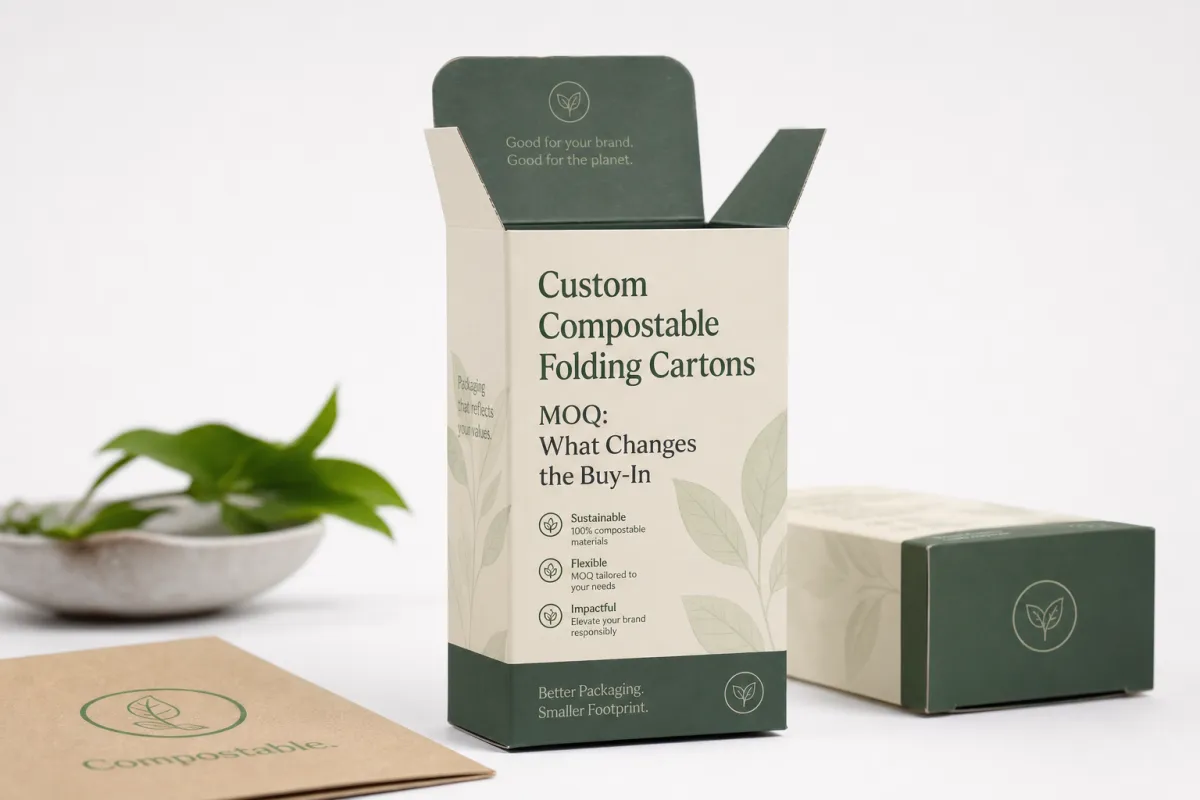
custom compostable folding cartons moq is driven by production efficiency first, and sustainability second. That sounds blunt because it is blunt. A converter has to account for substrate waste, press setup, die-cutting, folding and gluing line speed, pack-out requirements, and the number of changeovers a job will consume. A highly customized carton raises the minimum because the line needs more setup time before it can run cleanly. The buyer is gonna hear about that pretty quickly once the job gets into estimating.
Board grade is one of the clearest examples. A kraft-lined carton with a standard finish may run smoothly and trim cleanly, while a thicker recycled board or specialty fiber blend may need more careful handling to keep score lines consistent and avoid cracking. That affects custom compostable folding cartons moq because the production team wants enough volume to justify the changeover and absorb the normal yield loss that comes with the first part of the run.
Dimensions matter just as much. A carton that nests efficiently on the press sheet and ships in compact master cartons is easier to produce in a smaller quantity than an oversized carton with awkward proportions. If a brand is still refining fill weight or pack size, the first order should not be treated like a permanent specification. A practical custom compostable folding cartons moq protects the buyer from overcommitting to a size that may change after the first retail test. I have seen teams save thousands simply by freezing the dieline before they got seduced by a slightly prettier presentation box.
Inventory is the other side of the equation. A larger order usually lowers unit cost because setup is spread across more cartons, but it also ties up cash and warehouse space. Buyers get caught here more often than they admit. They focus on the lower per-unit number and forget that a carton line can evolve after launch. If the product dimensions shift, the branding changes, or the distribution model changes, leftover cartons become dead stock.
A low MOQ only helps if the carton still runs cleanly on press, folds square, and protects the product through shipment. If those three things are not true, the order is cheap only on paper.
From a packaging buyer’s point of view, custom compostable folding cartons moq is not a sales trick. It is a production reality. The right starting quantity depends on whether the carton is a simple retail shell, a more engineered paperboard carton, or part of a product packaging line that has to survive more than shelf display. Early-stage SKUs usually deserve a modest run, a close read on the market response, and a second order built from actual sales data instead of guesses. That approach is less glamorous, but it is how a lot of good programs avoid expensive reprints.
One rule keeps showing up in successful projects: do not let the sustainability language hide the engineering. Compostable claims can strengthen the brand story, but the carton still has to fit the product, stack neatly, and survive handling in the real world. That is why custom compostable folding cartons moq belongs in the same conversation as structure and artwork, not after them.
- Simple structure: lower setup burden, better chance of a smaller MOQ.
- Custom size: higher risk of extra waste and a higher buy-in.
- Special finishes: more handling, more setup, usually a higher minimum.
- Launch uncertainty: better suited to a conservative first run.
What affects custom compostable folding cartons MOQ?
The biggest drivers are board grade, print coverage, structural complexity, and how much setup a converter needs to run cleanly. Simpler folding carton packaging usually supports a lower minimum order, while custom shapes, inserts, and specialty coatings push the minimum higher. That is why buyers should compare quotes on identical specs before judging value. A quote that looks cheaper can be hiding a smaller board weight, fewer finishing steps, or a spec that will not actually hold up on line.
There is also a human factor here that gets overlooked. Estimators price risk. If the spec is fuzzy, the artwork is unfinished, or the claim language is still being debated, the quote usually gets padded. Not because anyone is trying to play games, but because uncertainty has a cost. If you want a tighter custom compostable folding cartons moq, give the supplier fewer unknowns to carry.
Custom Compostable Folding Cartons MOQ: Materials, Coatings, and Structural Options
Material choice changes the feel of the carton, the print result, and the minimum order. A kraft board gives a natural, understated look that fits many eco-friendly packaging programs, especially brands that want a grounded visual style rather than something polished to the point of feeling artificial. Recycled paperboard can offer a brighter print surface and a different stiffness profile. Uncoated white board often gives sharper image contrast, while FSC-certified stock supports fiber sourcing goals tied to responsible forestry documentation. Each one affects custom compostable folding cartons moq because each one behaves differently in cost and conversion.
Coatings deserve close attention. If the carton needs protection against rub, moisture, or scuffing, the finish has to be chosen carefully so it does not undercut the end-of-life goal. Aqueous or dispersion-style coatings are often more recovery-friendly than film-heavy constructions, but the exact impact depends on the full build, not just the coating name. A brand should never assume that a glossy finish automatically fits a compostability claim. The substrate, ink system, adhesive, and coating all have to be reviewed together. That is one reason custom compostable folding cartons moq is so closely tied to construction details.
Structural choices matter too. A simple tuck-end carton usually keeps the line straightforward. Auto-lock bottoms and crash-lock bases add strength for heavier items, but they also add design and production steps. Sleeves can look elegant for premium retail packaging, yet the added complexity can affect the minimum. Inserts, partitions, and retention features may improve product fit, especially for delicate items, but they increase tooling needs and can push custom compostable folding cartons moq upward.
Decoration is where many projects slide from practical into expensive. Embossing, foil, spot varnish, window cutouts, and complex reverse printing can all create visual impact, but they also change the job’s setup profile. If the carton is meant to be compostable or at least support a recovery-friendly end-of-life path, the decoration list should stay disciplined. A clean, thoughtful print system often does more for package branding than a pile of special effects that do not match the sustainability promise.
If a buyer is not sure where to begin, the best starting point is usually the simplest structure that still protects the product and carries the brand well. That holds for beauty items, supplements, specialty food sleeves, and consumer product display boxes. The more the structure can be standardized, the more predictable custom compostable folding cartons moq becomes.
For brands comparing options, it helps to think in practical categories rather than buzzwords:
- Kraft board for a natural look and lower-ink coverage.
- Recycled paperboard for a more familiar retail presentation.
- FSC-certified stock for fiber sourcing documentation.
- Simple tuck or auto-lock structures for better production efficiency.
- Minimal coating systems for a cleaner recovery story.
Brands that treat custom compostable folding cartons moq as a design constraint usually end up with better results. It forces the team to ask whether a finish is truly doing work, whether the insert is necessary, and whether the structure can be simplified without hurting shelf appeal. That discipline helps both cost and performance, which is exactly what packaging design should do. It also keeps the conversation honest, which matters more than most mood boards would admit.
Specifications That Affect Performance and Compliance
A carton can look right and still fail in use. That is why custom compostable folding cartons moq should never be discussed without the technical spec sheet in front of you. The most useful numbers are usually caliper, stiffness, burst strength, fold endurance, print registration tolerance, and adhesive compatibility. Those are the details that determine whether the carton folds cleanly, keeps its square, and holds up during packing and transit.
Caliper tells you how thick the board is, but stiffness tells you whether it behaves the way the product needs it to behave. A thin board may save money, yet if it flexes too much, the carton can telegraph weak shelf presence. A heavier board may look premium, but if it cracks on the score line or creates an oversized footprint, the extra cost does not buy much. That balance affects both custom compostable folding cartons moq and the long-term reliability of the pack.
Compostability and performance are not the same thing. This is where a lot of packaging copy gets slippery, and honestly, that makes procurement nervous for good reason. A carton can be built around a sustainability goal and still fail to protect the contents if the board and coating are mismatched to the product. Food packaging raises the stakes even more. Grease resistance, odor control, moisture exposure, and shelf-life needs all need to be checked before approval. A buyer should ask for documentation on the exact construction, not a general promise about the line. The phrase custom compostable folding cartons moq only matters if the cartons are actually fit for use.
Claim support matters. If the construction includes certified fiber, ask for the proper chain-of-custody paperwork. If the pack will be shipped through parcel or mixed freight, ask about distribution testing. The ISTA distribution testing standards are useful because they focus attention on real transport stress, not just appearance on a sample table. A carton that passes visual review but fails during shipping becomes an expensive lesson. I have seen that happen with products that looked perfect at the proof stage and then arrived with crushed corners because the pack-out was too optimistic.
For fiber sourcing, the FSC system for responsible forest management is a helpful reference point. It does not solve every packaging question, but it gives buyers a structure for asking better questions about source claims and documentation. That is especially useful in branded packaging programs where procurement, marketing, and compliance all need the same answer. If the carton is being marketed as compostable, ask the supplier to clarify whether the claim applies to the full construction or only to a component. That distinction matters a lot.
Retail shelf life, shipping vibration, pallet compression, and line efficiency all belong in the same discussion. A carton that looks good on a mockup but slows down the packing line is not a good purchase. A carton that satisfies a sustainability brief but drives damage claims is not a good purchase either. That is the kind of practical thinking that keeps custom compostable folding cartons moq grounded in reality.
Before approving a run, a serious buyer should request a small set of technical details:
- Substrate description with board type, basis weight, and caliper.
- Coating notes showing whether the finish affects compostability or repulpability.
- Ink and adhesive details so production does not get surprised later.
- Tolerance range for critical dimensions and folding panels.
- Certification support where the claim depends on FSC or other documentation.
That list may feel technical, but it saves money. It also reduces the chances of a late redesign, which is one of the fastest ways to blow up custom compostable folding cartons moq and delay a launch. If the spec is stable, the quote is cleaner. If the spec is fuzzy, the quote is usually padded to cover uncertainty.
Pricing and MOQ: How Custom Compostable Folding Cartons Are Priced
The price stack is usually more transparent than buyers expect. Board cost, tooling, print plates, finishing, folding and gluing, insert work, packing, and freight all show up somewhere in the quote. That is why custom compostable folding cartons moq has such a direct effect on unit price: the setup cost gets spread across the order. A tiny run may be easy to approve internally, but it often carries a much higher per-unit cost than the buyer first expects.
For simple structures, the entry point can be modest. For a more customized carton, especially one with special coating or a demanding print layout, the minimum usually increases. The quote should always be compared on the same basis. If one supplier is pricing a 350 gsm board with one-color print and another is quoting a heavier stock with a custom insert and multi-pass finish, those are not equivalent offers. A fair comparison of custom compostable folding cartons moq starts with matching spec to spec.
To make the buying logic easier, here is a practical comparison of common order bands. These are not universal numbers, but they are realistic planning ranges for a custom run with typical setup costs:
| Order band | Typical unit cost range | Best fit | Cost behavior |
|---|---|---|---|
| 1,000-2,500 units | $0.55-$1.10 each | Prototype launch, small pilot, internal review | Highest setup burden per carton; best for low-risk validation |
| 5,000 units | $0.22-$0.48 each | Initial retail launch, controlled distribution | Often a practical balance between cost and inventory |
| 10,000 units | $0.16-$0.34 each | Stable SKU, repeat sales, broader rollout | Setup is spread more efficiently; storage planning matters |
| 20,000+ units | $0.12-$0.28 each | Mature product line, consistent reorder cadence | Best cost efficiency, but only if demand is predictable |
Those numbers move depending on board, print coverage, coating, and carton size. A plain kraft carton with a small imprint may sit at the lower end of the range, while a retail-ready carton with heavy coverage, a complex insert, or a more demanding finish may land near the higher end. That is why custom compostable folding cartons moq has to be viewed as a system, not a single number on a quote.
There are a few reliable ways to control pricing without undercutting the sustainability objective. Standardize the footprint where possible. Reduce the number of ink colors. Avoid specialty effects unless they genuinely support the shelf story. Keep the structure simple enough for efficient conversion. And do not overspec the carton just because the product feels premium. Good product packaging should do its job cleanly, not add cost for the sake of it.
Freight deserves attention too. A quote that looks attractive on a unit basis can change fast once pallet count, shipping zone, or rush delivery enters the picture. If the cartons ship flat, ask about pallet density and master carton quantity. That alone can make a meaningful difference in landed cost. For buyers managing multiple SKUs, the most useful custom compostable folding cartons moq is the one that fits both the factory and the warehouse.
One more point gets missed a lot: low MOQs can be expensive not because the carton is complicated, but because the production line still needs to be set up exactly the same way. A short run may still consume dieline review time, proofing time, die-making, press setup, and quality checks. That is why a smaller order is best treated as a risk-control tool, not a cost-savings guarantee. For some brands, that is a smart trade. For others, a moderate first run and a faster reorder plan is the better answer.
Strong Custom Printed Boxes programs and carton programs both benefit from the same discipline: define the spec early, get apples-to-apples quotes, and avoid changing the artwork after the proof stage unless the change is truly necessary. A lot of wasted money comes from late-stage adjustment, not from the base material itself.
Here is a practical pricing mindset that helps:
- Lock the carton dimensions before quoting.
- Choose the simplest structure that still protects the product.
- Limit finishing steps to the ones that matter on shelf.
- Ask for a unit price at two or three order bands.
- Use the quote to decide whether the first run should be conservative or scaled up.
That process keeps custom compostable folding cartons moq tied to the real business question: how much inventory do you want to carry, and how much volatility can you tolerate during launch?
Process and Timeline: From Dieline to Delivery
The production path is straightforward if everyone stays disciplined. A buyer sends the brief, the structure is reviewed, the quote is issued, the dieline is confirmed, artwork is prepared, proofs are checked, samples or dummies are reviewed, production begins, then finishing, pack-out, and shipment close the loop. custom compostable folding cartons moq fits into that sequence because the quantity affects how the job is planned, scheduled, and packed.
What slows a project down is usually not the press run itself. It is the back-and-forth before the run starts. Late copy changes, product size changes, unclear sustainability claims, and a missing coating decision can all add days or even weeks. A busy production schedule can also stretch lead times, especially if the carton needs a particular board grade or a more specialized finishing step. The most reliable way to protect the timeline is to freeze the key variables early. That keeps custom compostable folding cartons moq from shifting after the quote has already been accepted.
From a planning standpoint, I usually advise buyers to ask for the dieline review before any serious artwork work begins. That prevents the common mistake of designing beautiful packaging around a structural assumption that turns out to be wrong. If the fill method is still uncertain, resolve that first. If the product weight is not final, get that locked. If the carton needs to support a claim, confirm the claim language before the print file is built.
The timeline itself depends on complexity, but a practical framework looks like this:
- Brief and review: 1-3 business days, depending on how complete the spec is.
- Quote and dieline confirmation: 1-2 business days after key details are clear.
- Artwork prep and proofing: 2-5 business days, longer if legal copy is still changing.
- Sampling or dummy review: 3-7 business days if a prototype is needed.
- Production and finishing: often 10-18 business days after approval, depending on line load and structure.
- Freight and receiving: varies by region and mode, so confirm before launch.
That is not a promise; it is a planning pattern. If the carton needs special sourcing or the supplier is carrying a full production calendar, the lead time can stretch. On the other hand, a straightforward carton with a stable spec can move quite efficiently. The key is to avoid making custom compostable folding cartons moq a moving target after production planning has already started.
Good receiving behavior matters too. Cartons should be packed so they stay square and ready for use. If a pack-out is sloppy, the warehouse pays for it later in damaged cartons, slow picking, or cartons that do not convert well on line. Production-minded pack-out is part of quality, not an afterthought. That is one reason good packaging suppliers think about the receiving dock almost as carefully as the pressroom.
If a project is tied to a seasonal launch, the schedule should include a safety buffer. Promotions slip, artwork approvals slip, and freight can slip. A buyer who assumes every step will happen on the earliest possible day usually ends up expediting at the worst possible time. A better approach is to plan the custom compostable folding cartons moq around the launch date, not around an idealized calendar.
Why Choose Us for Custom Compostable Folding Cartons MOQ
Our job is to help buyers choose the carton that makes sense for the product, the brand, and the budget. That means we look at the whole system: board choice, structural efficiency, finish selection, shelf appearance, and the practical realities of receiving and fulfillment. With custom compostable folding cartons moq, that kind of technical review can save a buyer from paying for unnecessary complexity.
We also pay attention to the hidden cost drivers that are easy to miss in a quote. A window can add handling. A special coating can complicate the production path. A structure that looks elegant but folds poorly can create headaches on the line. Our approach is to point those things out early and recommend the simpler spec if it does the job well. That is often the smartest path for eco-friendly packaging that still has to perform like real packaging.
Quality control matters because a carton only helps the brand if it arrives consistent. That means checking proof details carefully, watching tolerance on critical dimensions, and packing the cartons so they are ready to use without extra sorting. In practical terms, that supports better brand experience and fewer surprises in the warehouse. For buyers who manage both retail packaging and broader package branding, consistency is not a luxury; it is the standard.
If you want to see a broader range of formats, our Custom Packaging Products page is a good place to start. If you need quick answers about ordering, proofs, and common production questions, our FAQ can help frame the next step before a quote request goes out. For a lot of teams, that small bit of preparation makes custom compostable folding cartons moq much easier to plan.
We also try to speak in numbers, not vague promises. If a carton can run at 5,000 units with a sensible cost profile, we say so. If the smarter move is a smaller prototype order first, we say that too. A good supplier should help the buyer see where the costs sit, where the risk sits, and where the design can be simplified without damaging the product presentation. That is the kind of guidance many procurement teams appreciate because it makes the decision easier to defend internally.
Honestly, the best packaging partnerships are the ones that reduce uncertainty. Buyers do not need hype. They need a clear spec, a clean quote, and a production path that respects the actual shape of the product. That is the standard we use for custom compostable folding cartons moq and for every other carton program we support.
Next Steps to Order Custom Compostable Folding Cartons MOQ
If you are ready to request pricing, gather the essential details first. The strongest quote starts with internal carton dimensions, product weight, desired print coverage, coating preference, target quantity, and any compliance or claim requirements. If the carton is for a food item, a supplement, a cosmetic, or another regulated category, make that clear from the start. Those details help define custom compostable folding cartons moq more accurately and reduce revision cycles.
If the carton is new, ask for a dieline review and a prototype or sample. That is especially useful for a new product line, a tighter shelf fit, or a structure that has not been used before. A sample can reveal issues with panel alignment, closure tension, or display face size long before the production run starts. In my experience, that is one of the least expensive ways to avoid expensive rework later.
Do not choose the first run only by chasing the lowest unit price. Think about launch risk, storage space, and reorder cadence. If the SKU is still evolving, a smaller first order may be the wiser play even if the unit price is slightly higher. If demand is already proven, a larger order may make more sense because it lowers the cost per carton and reduces the frequency of changeovers. That is the real function of custom compostable folding cartons moq: it helps match order size to business reality.
Here is a simple action path that works well for most teams:
- Confirm the carton spec and product fit.
- Approve the dieline before artwork is finalized.
- Request a quote at two or three volume levels.
- Review the proof and sample if the carton is new.
- Place the production order once the timeline and claim language are locked.
If your project also includes broader branded packaging needs, it can help to think about the carton as part of the full shelf story instead of as a standalone box. The carton should support the product, protect the contents, and reinforce the visual identity without creating avoidable cost or inventory pressure. That is the best way to use custom compostable folding cartons moq as a planning tool rather than just a pricing number.
For the right product, the right carton, and the right volume, the buying decision becomes much easier. Keep the structure practical, keep the documentation clean, and keep the first order aligned with real demand. If you need one rule to carry forward, make it this: lock the dieline, simplify the build, and quote at more than one volume before you commit. That is how custom compostable folding cartons moq turns into a useful launch plan instead of an expensive guess.
What is a typical MOQ for custom compostable folding cartons?
MOQ usually depends on board selection, print method, carton size, and how much setup the structure requires. Simple cartons with standard materials can often start lower than highly customized cartons with special coatings or finishes. Ask for quotes on the same spec so you can compare minimums fairly across options. If a supplier gives you a number without the full build, ask for the missing details before you treat it as real.
Can custom compostable folding cartons be used for food packaging?
Yes, but compostability alone does not make a carton suitable for food contact. The board, inks, and coatings must match the product, shelf life, and barrier needs. Request documentation for the exact material build before approving a food-facing application. If the pack needs grease resistance or moisture control, make sure those requirements are tested against the finished structure, not just the base sheet.
Do coatings or windows increase the MOQ for compostable folding cartons?
They often do, because they can add setup steps, material constraints, or special handling during production. Some finishes may be acceptable for recovery goals, while others can complicate compostability claims. If MOQ matters, start with the simplest finish that still protects the product and supports the brand. Fancy details can be useful, but if they do not earn their keep, they are just extra friction.
How can I reduce pricing without losing compostability?
Use a standard carton size where possible and avoid unnecessary structural complexity. Limit print colors, simplify special effects, and choose finishes that do not require extra manufacturing steps. Plan production in a quantity that balances unit cost with realistic inventory demand. The easiest savings usually come from removing wasteful complexity, not from squeezing the supplier on the last penny.
How long does it take to produce custom compostable folding cartons after approval?
Lead time depends on artwork approval, tooling needs, material availability, and production load. Prototype or sample approval can add time, but it helps prevent fit and print issues later. Lock the spec early so the project can move from quote to production without avoidable delays. If the launch date is fixed, build in a buffer because freight, proofs, and internal approvals have a habit of slipping when everyone is already busy.

