Buyer Fit Snapshot
| Best fit | Custom Compostable Sticker Labels projects where brand print, material claims, artwork control, MOQ, and repeat-order consistency need to be specified before quoting. |
|---|---|
| Quote inputs | Share finished size, material target, print colors, finish, packing count, annual reorder estimate, ship-to region, and any compliance wording. |
| Proofing check | Approve dieline scale, logo placement, barcode or warning zones, color tolerance, closure strength, and carton packing before bulk production. |
| Main risk | Vague material claims, crowded artwork, missing packing details, or unclear freight terms can make a low unit price expensive after revisions. |
Fast answer: Custom Compostable Sticker Labels: Material, Adhesive, Artwork, and MOQ should be specified like a repeatable production item. The safest quote records material, print method, finish, artwork proof, packing count, and reorder notes in one written spec.
Production checks before approval
Compare the actual filled-product size with the drawing, then confirm tolerance on folds, seals, hang holes, label areas, and retail display edges. Reserve space for logos, QR codes, warning copy, and material claims before decorative graphics fill the panel.
Quote comparison points
Review material grade, print process, finish, sampling route, tooling charges, carton quantity, and freight assumptions side by side. A quote is only useful when the supplier can repeat the same color, closure quality, and packing count on the next order.
Custom compostable sticker labels can look simple from the outside, but the material decisions behind them are a lot more demanding than most brand teams expect. A label may print beautifully, feel natural in the hand, and still fall short if the adhesive, liner, ink system, or coating does not belong in the same composting pathway. That is why custom compostable sticker labels need to be treated as a full construction, not as a pretty face stock with an eco-friendly story attached to it.
From a packaging buyer’s point of view, the appeal makes sense right away. You want label graphics that support branded packaging, hold up on the shelf, and reinforce sustainability claims without leaving the customer guessing. The tougher part is pairing that visual goal with a build that behaves properly once the pack moves through production, distribution, refrigeration, handling, and disposal. With custom compostable sticker labels, each layer matters: the substrate, adhesive coat weight, liner, inks, and the way the finished label performs on the real container.
That is also why the wording around compostability deserves so much care. Compostable, biodegradable, and recyclable are not interchangeable terms, even though shoppers often treat them as if they were. If a label is described as compostable, the entire construction needs to support that claim in the intended disposal pathway. Brands working on food, beverage, wellness, or takeaway packaging should pay close attention here, because the claim can affect both compliance and shelf presentation. Many teams pair labels with Custom Labels & Tags and broader Custom Packaging Products so the whole pack feels coherent from one component to the next.
One more thing that gets overlooked: compostable is not a magic word. It does not mean a label will disappear in a backyard pile, and it definitely does not mean it belongs in landfill. The end-of-life path matters, and the path is different for industrial composting, home composting, recycling, and landfill. That distinction sounds technical, but it is the kind of detail that keeps a launch honest.
Custom Compostable Sticker Labels: What They Really Are
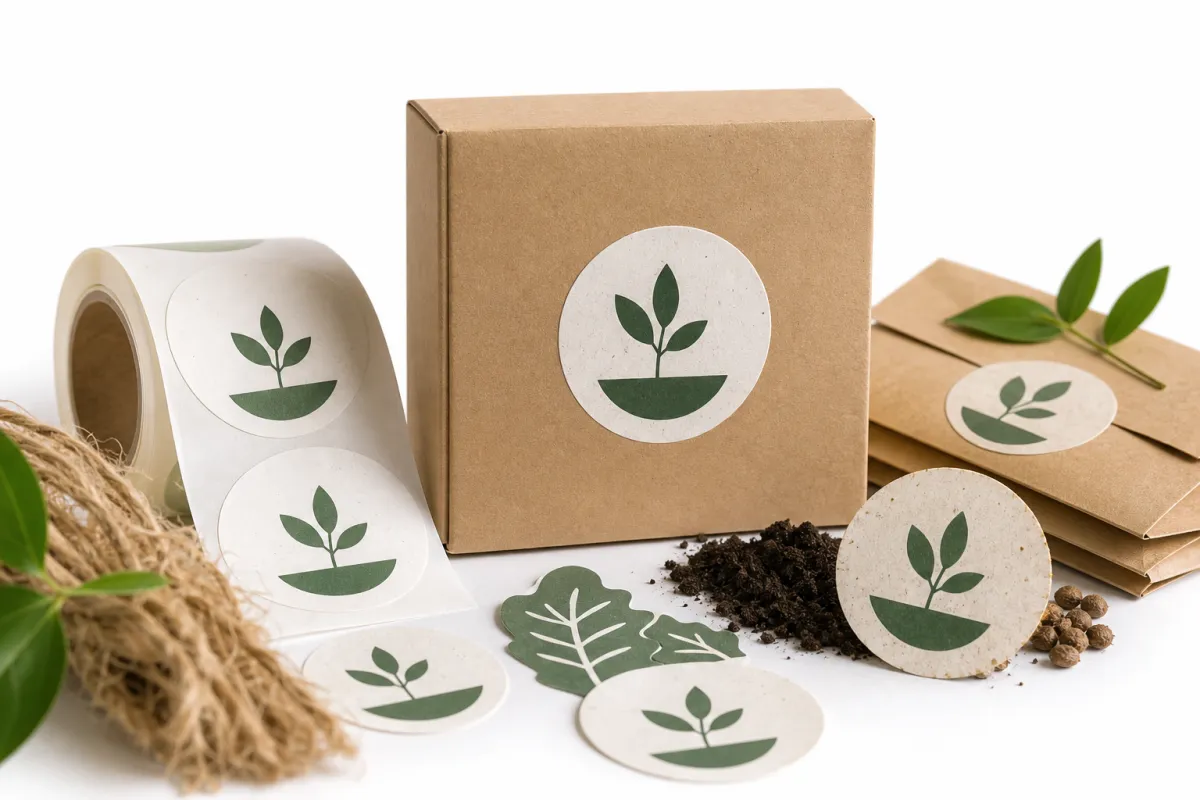
At the simplest level, custom compostable sticker labels are pressure-sensitive labels made from materials selected to break down under the right composting conditions. That usually means a compostable or compost-aware face stock, a compatible adhesive, and, where the application allows it, a liner or backing that follows the same end-of-life logic. The wording sounds tidy, but in production the label is only as compostable as its least compatible layer. One mismatched component can change the outcome quickly.
Many brands first start asking about custom compostable sticker labels while trying to improve the environmental profile of retail packaging without losing a polished presentation. That is a fair goal, and I have seen the same pressure on food jars, beverage cartons, natural cosmetics, supplement bottles, and takeaway containers. The label has to print cleanly, resist scuffing, and still support the sustainability message. In those cases, custom compostable sticker labels become the visual handshake between product branding and disposal intent.
One detail gets missed far too often: compostability is a system-level decision. It is not just a paper choice, and it is not the same as saying a label behaves well in every waste stream. Industrial composting, home composting, recycling, and landfill all create very different conditions, and custom compostable sticker labels respond differently in each one. A label may be certified for industrial composting and still not qualify for a home compost claim. That is normal and expected, even if it feels a little frustrating when you are trying to keep the story clean.
For buyers, the label types usually fall into a few practical groups:
- Paper-based compostable labels for dry goods, cartons, and paperboard surfaces.
- Film-based compostable labels for better moisture resistance or clearer presentation.
- Specialty constructions for chilled, oily, or high-handling applications.
A common mistake is assuming an earth-toned finish automatically means the label is built for composting. Kraft looks, muted inks, and recycled visual cues can support the story, but they do not prove end-of-life behavior. If you are comparing custom compostable sticker labels for a launch, ask for the complete build-up instead of a polished marketing description. That should include face stock basis weight, adhesive type, liner material, and the recommended disposal pathway. Those details say far more than any glossy product sheet can.
Good compostable labeling is not just a style choice. It is a materials decision, a compliance decision, and a production decision all at once.
That is also why many teams review labels alongside the package structure, corrugate components, and finishing options. If the carton, pouch, or bottle already carries a strong brand story, the label should support that story rather than compete with it. A well-matched label can lift perceived quality, support product packaging discipline, and reduce unnecessary waste when the application is specified correctly. Used well, custom compostable sticker labels become part of the packaging system instead of a one-off sustainability gesture.
For a useful outside reference point, the EPA’s composting guidance is a solid starting place for understanding how disposal conditions affect materials. It is not a label-spec document, but it does help frame the environment a compostable item needs in order to break down as intended.
How Custom Compostable Sticker Labels Break Down
Custom compostable sticker labels are designed to break down through a combination of heat, moisture, oxygen, and microbial activity. Industrial composting manages those conditions more tightly than a backyard bin, which is why the same label can behave very differently depending on where it lands. Under the right environment, the material fragments and continues breaking down until it no longer reads as a discrete label component. That does not happen because the label looks natural; it happens because the construction was engineered for that environment.
The face stock is the visible layer, and it may be paper or a compostable film depending on the application. The adhesive matters just as much. A label can carry a compostable-looking face stock and still fail the overall claim if the adhesive is too persistent or chemically out of step with the rest of the build. The ink system matters too, because it needs to fit the intended compost route. Heavy coverage is not automatically disqualifying, but some coatings, varnishes, and metallic effects can complicate biodegradation or raise review questions. The liner is another frequent blind spot. If the release liner is not part of the compostable strategy, the label may still work, but the claim becomes narrower and has to be stated carefully.
I always encourage buyers to evaluate custom compostable sticker labels as a stack rather than a single material. The right construction depends on the container, the storage conditions, and the regulatory language you plan to use. A dry shelf carton for tea bags is a very different assignment from a refrigerated yogurt pot or a chilled bottle with condensation. Takeaway packaging exposed to grease, steam, and handling during transport creates another set of requirements entirely.
And yes, that can make the project feel a little more complicated than a standard label order. It is kinda the tradeoff for getting both the look and the disposal story right. The upside is that once the build is dialed in, the package tends to behave more predictably all the way through the supply chain.
Industrial Versus Home Compostability
These claims are not interchangeable. Industrial compostability usually assumes higher and more controlled temperatures, active aeration, and a managed compost cycle. Home compostability generally needs a more forgiving formulation because the pile is less controlled and slower to heat evenly. A label that passes industrial requirements does not automatically earn a home compost claim, and that distinction should stay clear in packaging design and marketing language.
For brands, the practical takeaway is simple: if you need custom compostable sticker labels for a product that will be disposed of in commercial food-service waste, the test environment may be very different from a consumer home-bin scenario. Use the claim that matches the actual route. If the product packaging is intended for municipal organics collection, say that. If the label is only suited to industrial composting, say that. Precision protects the brand and gives the buyer a clearer picture.
Standards, Documentation, and Proof
Recognized standards and supporting documents should be part of the approval process before artwork is signed off. Common references include ASTM and EN compostability methods, along with supplier test reports and material declarations. The Institute of Packaging Professionals is also a helpful place to follow broader packaging education and materials thinking, especially if your team is trying to align sustainability language with real production behavior. Certification language matters because it gives the claim structure instead of leaving it vague.
When brands skip this step, they often end up with custom compostable sticker labels that are visually attractive but hard to defend. That can create trouble in retail packaging reviews, customer service conversations, and retailer onboarding. A clean file folder with material data sheets, test reports, and written application guidance does more for trust than any marketing phrase ever will.
There are real limits worth respecting. Thick metallized coatings, aggressive acrylic systems, and certain specialty laminations may offer better shelf presence, but they can interfere with compostability goals. The same caution applies to custom printed boxes and other components in the pack system. If one part of the pack uses a finish that clashes with the disposal story, the whole narrative becomes harder to explain. Good package branding should make the customer’s understanding easier, not harder.
In practical terms, the healthiest way to think about custom compostable sticker labels is this: they are a performance material with an end-of-life purpose. They are not just an eco-themed sticker. When the packaging team keeps that mindset from the start, the project usually moves with fewer surprises and better results.
What Drives the Cost of Custom Compostable Sticker Labels
Pricing for custom compostable sticker labels comes down to a handful of concrete variables, and the best quote conversations begin with those variables spelled out clearly. Material choice is the first one. A compostable paper face stock is usually less expensive than a specialty film, although the difference can shrink or widen depending on the adhesive, liner, and compliance requirements. Label size and shape come next, since larger labels use more material and unusual die-cuts create more setup work. Print method, finishing, and quantity then move the number up or down.
For a buyer quoting a 5,000-piece run, a simple one-color or two-color label may land in a very different range than a full-color piece with intricate die work. Smaller runs often carry a higher unit cost because setup, proofing, and die charges are spread across fewer pieces. That pattern holds for custom compostable sticker labels just as it does for conventional labels, though compostable materials can narrow the supplier pool and add sourcing complexity. At larger volumes, the unit price usually improves, though the break point depends on substrate availability and the press method used.
| Label Build | Best Use | Typical Cost Range | Notes |
|---|---|---|---|
| Compostable paper face stock + compostable adhesive + glassine-style liner | Dry goods, cartons, kraft pouches | $0.10-$0.18 each at 10,000 units | Often the most economical route for custom compostable sticker labels |
| Compostable film face stock + compostable adhesive | Chilled bottles, moisture-prone packs | $0.14-$0.26 each at 10,000 units | Better humidity resistance, usually higher material cost |
| High-coverage full-color construction with specialty die-cut | Premium retail packaging | $0.18-$0.32 each at 5,000 units | More setup, more press time, more waste risk during startup |
Those numbers are directional rather than universal, but they help buyers budget with more confidence. If you are comparing custom compostable sticker labels to standard pressure-sensitive labels, the premium often reflects three things: specialty material sourcing, compliance and testing overhead, and lower-volume production. None of that is unusual. It simply means the label is part of a more specific packaging design strategy rather than a generic commodity item.
Shape and tooling also matter more than many teams expect. A square label is easier to run than a custom contour cut with tight internal corners. Variable data, multiple SKUs, and seasonal artwork add handling time. If your brand uses serialized codes, region-specific language, or rotating ingredient panels, the setup becomes more involved. The same thing happens in branded packaging programs that coordinate labels with inserts, cartons, and shipper marks. A coherent system looks simple to the customer because a lot of planning happened behind the scenes.
For budgeting, ask suppliers to quote on a like-for-like basis. That means the same substrate, the same adhesive performance target, the same liner type, the same dimensions, and the same quantity. Without that discipline, one quote may appear cheaper simply because it leaves out a liner upgrade or a compostability document package. That is not a fair comparison. It is just a partial one.
Price only means something when the construction is known. Two custom compostable sticker labels can look similar and behave very differently once you compare the full stack.
Brands also forget the downstream cost of choosing the wrong label. If a label fails on wet bottles, peeled cartons, or cold-fill packaging, rework and scrap can outweigh the premium for better material selection. I have seen projects where paying a little more for the correct label saved the team from application headaches, returned goods, and extra line downtime. That is especially true in eco-friendly packaging launches where the label has to support both the visual story and the disposal story.
So yes, custom compostable sticker labels can cost more than standard labels. The real question is whether they are being specified correctly. The cheapest version on paper is not always the cheapest version in production, and that difference shows up fast once the first shipment reaches the line.
Custom Compostable Sticker Labels Production Timeline and Steps
A clean production timeline for custom compostable sticker labels starts with a practical brief. The sooner you define the package surface, the storage environment, the expected shelf life, and the sustainability claim, the sooner the project moves. A good supplier does not want guesswork; they want enough detail to match the construction to the real use case. If the label is going onto a paper carton, a glass jar, a matte pouch, or a chilled bottle, say so early. If the pack sees refrigeration, condensation, or direct hand contact, that matters too.
The typical flow moves through a few predictable steps: application review, material selection, artwork prep, proofing, sampling, and production approval. For simpler custom compostable sticker labels, you might move from brief to final run in roughly 12-15 business days after proof approval. More complex projects often take 3-4 weeks or longer, especially if certification review, adhesive testing, or specialty inks are involved. That is not slow. It is normal for a material-led project with claims attached.
Artwork readiness makes a bigger difference than most people realize. If the dielines are final, the barcode areas are protected, and the copy is approved, the schedule tends to move smoothly. If the team is still debating matte versus satin, or changing the sustainability statement midstream, the timeline stretches. Custom compostable sticker labels are not difficult to produce once the scope is stable. They are difficult to rush when the scope keeps moving.
Where Delays Usually Happen
Most delays come from one of four places. The first is artwork revisions. The second is sample approval. The third is missing documentation. The fourth is performance concerns on the actual package. A surprising amount of delay can be avoided by testing early on the real container instead of approving a digital proof and hoping the finish behaves later.
That last point matters. A label that looks fine on a monitor may perform differently on a curved bottle, a rough carton, or a surface with slight oil residue. Release characteristics on the liner, tamp pressure at application, and line speed all affect how custom compostable sticker labels behave. If a label is meant for semi-automated application, say that. If it will be hand-applied in small batch production, say that too. The adhesive and liner choice should reflect the actual process, not an idealized one.
For larger packaging programs, I like to build in a short test window before full approval. One round of physical testing can reveal whether the label sits flat, lifts at the edge, or scuffs under packing pressure. It is a modest step, but it prevents expensive rework later. That is true whether the label is supporting product packaging for a food launch or coordinating with custom printed boxes in a premium retail set.
From a scheduling perspective, think in layers. Artwork approval, material availability, and the production window all have to line up. If one layer slips, the others usually follow. The smartest brands treat custom compostable sticker labels as a planned production item, not a last-minute add-on. That mindset reduces surprises and usually improves both the final print quality and the consistency of the first run.
When the project is handled well, the process feels orderly: brief, material match, sample, proof, run. That is how you keep the label aligned with packaging design, shelf impact, and the sustainability claim all at once. It is not glamorous work, but it saves a lot of headaches later.
Common Mistakes With Compostable Label Projects
The first mistake is assuming any “green” label is compostable. It sounds obvious, but it happens constantly. A kraft look, earthy artwork, or recycled content does not automatically create custom compostable sticker labels. The claim has to be supported by the face stock, adhesive, liner, inks, and the intended disposal pathway. Without that, the label may look eco-conscious but still miss the technical mark.
The second mistake is choosing a label that looks good in a sample book and then skipping tests on the actual package. I see this especially with chilled bottles, textured cartons, oily jars, and condensation-prone packaging. A label can perform beautifully on a flat proof and then begin lifting on a cold-fill bottle after a few hours in refrigeration. Custom compostable sticker labels need to be judged in context, not in isolation.
The third mistake is over-specifying adhesive strength. Buyers sometimes ask for a very aggressive bond because they want the label to stay put forever. The problem is that extra aggressiveness can create its own issues, including poorer compostability alignment and a messier disposal experience. Stronger is not always better. The right adhesive is the one that holds through the pack’s actual life cycle and still fits the material system. That is a more disciplined way to approach eco-friendly packaging.
Artwork and Finish Pitfalls
Heavy ink coverage can be fine, but it needs to be planned. Some brands push for deep solids, metallic effects, thick varnishes, or high-gloss coatings because they want premium shelf impact. That can work on some projects, but it also raises the chance of compostability concerns or print stability issues. If the label is meant to support a sustainable product launch, the finish should reinforce that story rather than complicate it.
Another common oversight is ignoring how the label interacts with the rest of the package system. If the bottle, carton, or pouch already carries a strong visual identity, the label should complement it cleanly. If not, the brand can end up with a mismatch between product packaging and package branding. That disconnect is easy to spot at retail, where the pack has only a few seconds to communicate quality and intent.
Then there is the line test. A digital proof never tells the whole story. Tamp pressure, peel speed, liner release, and application angle can all affect the outcome. I have seen teams approve custom compostable sticker labels based on artwork alone, only to find that the real issue was not the print but the way the label fed through the applicator. The label is part of the process, not just the graphic.
Do not test the idea only. Test the actual custom compostable sticker labels on the actual package, under the actual conditions.
Finally, do not skip supplier documentation. If you are making compostable claims on-pack, keep the material declarations, test reports, and application notes together. That habit saves time during retailer review, audit prep, and internal sign-off. It also gives your team a more honest picture of what the label can and cannot claim.
Expert Tips for Better Performance and Cleaner Claims
My first recommendation stays the same on every project: match the label build to the package surface first, then refine the look. That order matters. A beautiful label that fails on a damp bottle is not good packaging, no matter how elegant the artwork appears in the proof. Custom compostable sticker labels perform best when the substrate and adhesive were chosen with the real container in mind.
Ask for material data sheets, compostability documentation, and end-of-life guidance before final approval. A supplier should be able to explain the face stock, adhesive chemistry, liner type, and the claim boundaries in plain language. If the explanation feels vague, keep asking. Honest technical answers are a good sign. Hype is not.
Test under the same humidity, refrigeration, or handling conditions the finished product will see in the field. That might mean a 24-hour chill test, a condensation exposure check, or a rough handling pass in transit-style conditions. These are small tests compared with a full production run, but they can expose weak points early. For custom compostable sticker labels, that early feedback is often the difference between a smooth launch and a rushed fix.
Keep Claims Specific
Specific claims are usually safer and clearer. Say industrial compostable if that is the right claim. Say home compostable only if the construction and documentation support it. If the label only applies to certain components, state that carefully. Vague language creates confusion, especially in retail packaging where consumers are trying to interpret several sustainability messages at once.
It also helps to keep the design honest. Rich color and strong branding have a place, but color builds, line weights, and finishes should serve a purpose. Too many teams overcomplicate the label and then wonder why print consistency suffers. Clean type, clear hierarchy, and sensible die lines often produce a stronger result than a crowded layout. That is true for custom compostable sticker labels, and it is just as true for custom printed boxes or cartons.
If your brand is building a broader eco-friendly packaging story, keep the visual language consistent across labels, cartons, and shipping materials. That consistency supports the consumer’s reading of the pack and keeps the sustainability conversation grounded in real material choices instead of vague symbolism. A coordinated system feels intentional because it is intentional.
One more practical note: compare quotes on the same basis. Material, liner, adhesive, print process, finishing, and quantity all need to match before you compare cost. If you are also sourcing Custom Labels & Tags for adjacent SKUs or ordering Custom Packaging Products for a launch kit, keep the specifications aligned so the whole program stays coherent. That kind of discipline saves time and makes the final shelf presentation stronger.
For brands that want additional technical context, the packaging community at packaging.org is a helpful reference for broader material and packaging thinking. It is a useful reminder that label choice is rarely just a label choice.
What to Do Next Before You Order
Before you place an order for custom compostable sticker labels, start with a short checklist. Define the package surface, confirm the disposal pathway, gather exact label dimensions, and decide whether the claim needs to support industrial composting, home composting, or a narrower use case. Once those basics are clear, the quote conversation becomes much more precise.
Then request samples and test them on the real container. A label on a bottle, jar, carton, or pouch tells you far more than a rendered proof ever will. Check adhesion, edge lift, scuff resistance, and response to the conditions the pack will actually see. Refrigerated storage, steam exposure, oily handling, and shipping vibration all matter. Custom compostable sticker labels are meant to solve a real packaging problem, so they should be evaluated in the same real environment.
It also helps to compare suppliers like-for-like. Do not compare a basic paper label to a specialty compostable film and call that an apples-to-apples quote. Look at substrate, liner, adhesive, print method, die-cut complexity, and quantity. Once those pieces line up, the pricing picture gets clearer and the decision becomes more honest.
- Confirm the exact package material and surface finish.
- State the compostability claim you need in writing.
- Ask for samples and run a physical application test.
- Verify documentation before approving artwork.
- Review the quote against the full construction, not just the unit price.
If you are preparing a supplier brief, include the branding goals, shelf-life expectations, storage conditions, and launch date. That one document can shorten the quoting process and prevent a lot of back-and-forth. It also gives the supplier enough context to suggest a better fit if your first idea is not the best one. For custom compostable sticker labels, that kind of collaboration usually pays off in both performance and clarity.
The smartest next step is to compare the full construction of custom compostable sticker labels, not just the front-facing price, before you place an order. If the face stock, adhesive, liner, and claim all line up, the label can support the product, the brand, and the disposal story in a way that feels credible from the first impression to the last use. That is the kind of outcome worth slowing down for.
FAQ
What are custom compostable sticker labels made of?
They usually combine a compostable face stock, a compatible adhesive, and a liner or backing chosen for the intended disposal pathway. The exact construction should be checked as a whole, because one non-compostable component can affect the claim. That is why custom compostable sticker labels should always be reviewed as a complete system rather than a single material choice.
Are custom compostable sticker labels safe for cold or damp packaging?
Yes, if the adhesive and face stock are selected for that environment and tested on the actual package. Cold-fill, condensation, and refrigerated storage often require a different build than dry shelf packaging. In practice, custom compostable sticker labels for damp or chilled applications need a more careful material match than labels used on cartons or other dry-format product packaging.
How much do custom compostable sticker labels cost?
Price depends on size, shape, material, print method, finishing, and quantity. Smaller runs usually cost more per label, while higher volumes can reduce the unit cost. For many projects, custom compostable sticker labels cost a bit more than standard labels because of sourcing and documentation, but the difference depends heavily on the exact build.
How long does it take to produce custom compostable sticker labels?
Simple projects can move quickly, but sampling, proofing, and compliance checks often add time. Custom shapes, specialty inks, and performance testing can extend the timeline. A straightforward run of custom compostable sticker labels may take around 12-15 business days after proof approval, while more complex work can take several weeks.
Can I use custom compostable sticker labels on food packaging?
Yes, many food and beverage applications use them, but the label must suit the substrate, storage conditions, and regulatory claims. It is smart to verify the supplier's documentation before making compostable statements on-pack. For food brands, custom compostable sticker labels can be a strong fit when the full construction is matched to the package and the handling environment.

