Buyer Fit Snapshot
| Best fit | Custom Copper Foil Boxes Luxury Brand Packaging projects where brand print, material claims, artwork control, MOQ, and repeat-order consistency need to be specified before quoting. |
|---|---|
| Quote inputs | Share finished size, material target, print colors, finish, packing count, annual reorder estimate, ship-to region, and any compliance wording. |
| Proofing check | Approve dieline scale, logo placement, barcode or warning zones, color tolerance, closure strength, and carton packing before bulk production. |
| Main risk | Vague material claims, crowded artwork, missing packing details, or unclear freight terms can make a low unit price expensive after revisions. |
Fast answer: Custom Copper Foil Boxes Luxury Brand Packaging: Board, Finish, Dieline, and Unit Cost should be specified like a repeatable production item. The safest quote records material, print method, finish, artwork proof, packing count, and reorder notes in one written spec.
Production checks before approval
Compare the actual filled-product size with the drawing, then confirm tolerance on folds, seals, hang holes, label areas, and retail display edges. Reserve space for logos, QR codes, warning copy, and material claims before decorative graphics fill the panel.
Quote comparison points
Review material grade, print process, finish, sampling route, tooling charges, carton quantity, and freight assumptions side by side. A quote is only useful when the supplier can repeat the same color, closure quality, and packing count on the next order.
Custom Copper Foil Boxes Luxury Brand Packaging Tips
Custom copper foil boxes luxury brand packaging gets noticed before a single line of copy has a chance. That metallic hit lands fast. In a retail aisle, on a shelf, or in a product grid full of similar-looking options, the box has a split second to say, "this is the better version." That is a lot to ask from paperboard, but packaging has always been expected to pull more weight than the product team admits out loud. For most premium categories, custom copper foil boxes luxury brand projects are where brand identity, product packaging, and the unboxing experience get forced into the same conversation. The structure, the stock, and the finish all matter. A lot.
From a buyer's point of view, copper is appealing because it does not scream. It has warmth. It feels crafted. It reads more considered than silver and less predictable than gold, which makes custom copper foil boxes luxury brand packaging useful for brands that want polish without looking like they tried too hard. If you are comparing branded packaging options or planning a premium retail packaging line, the real questions are practical: how is the foil applied, what board carries it, and how much of the surface actually needs that metallic treatment. If you are mapping out your own Custom Packaging Products, the point is not whether foil looks nice. The point is whether it supports the product, the margin, and the schedule without creating a headache later.
My bias is simple: copper foil works best as a sharp accent, not a full costume. A logo, seal, border, or crest can carry the effect beautifully. Coat every panel in shine and the box starts looking like it wants applause. That usually hurts package branding more than it helps. Custom copper foil boxes luxury brand work feels strongest when the finish is deliberate, the structure feels solid, and every visible decision points in the same direction.
What Custom Copper Foil Boxes Luxury Brand Packaging Really Signals
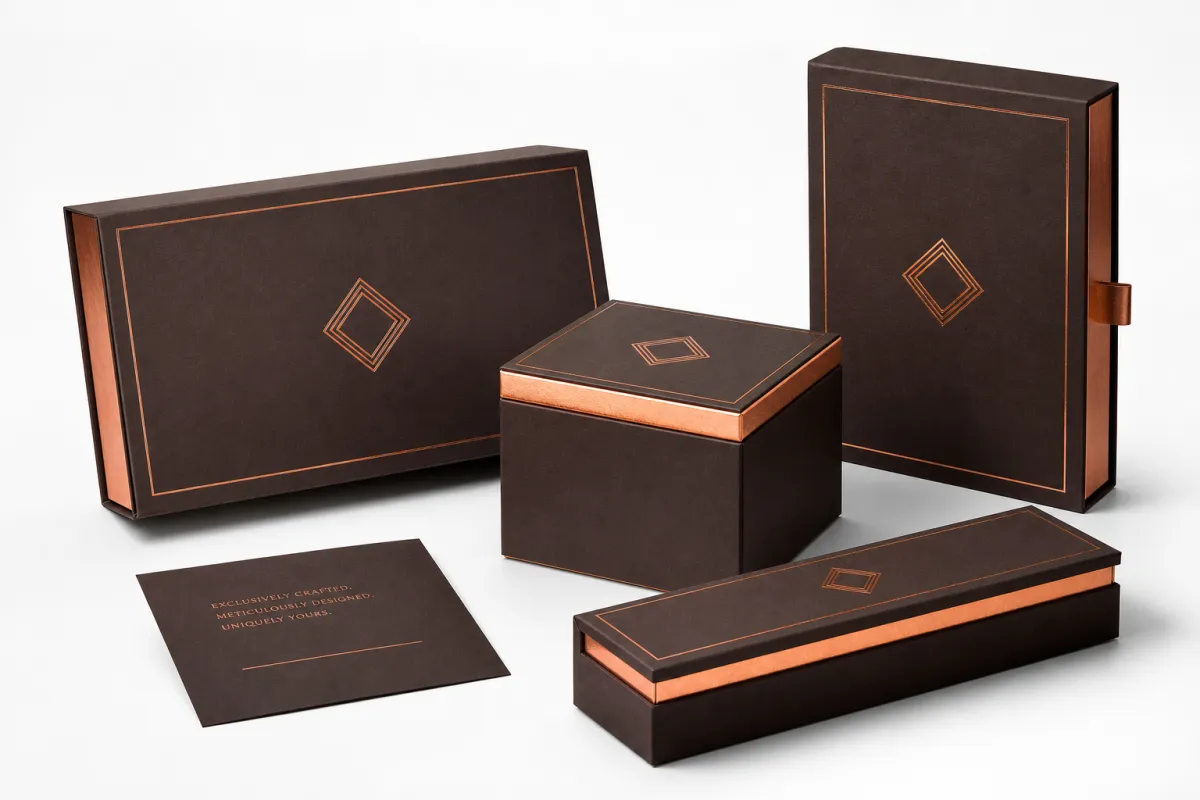
Shoppers read metallic packaging quickly. They may not explain why, but the message lands right away. Copper foil sits in a sweet spot between familiar and distinctive, and custom copper foil boxes luxury brand packaging often signals care, control, and a willingness to spend on the details ordinary cartons skip. That first read matters in retail packaging, where the box has only a few seconds to earn a second glance.
Plain version: a copper foil box is usually a printed carton or rigid setup box with a metallic foil layer applied to logos, borders, seals, monograms, or another focal point. Hot stamping is the most common method. Heat and pressure transfer the foil from the carrier film onto the board. Cold foil and metallic inks exist too, and both can be useful, but copper foil usually delivers a sharper reflection and a more premium feel when the goal is impact. For custom copper foil boxes luxury brand projects, the appeal is not only shine. It is precision.
One small disclaimer, because accuracy matters: most "copper foil" in packaging is a copper-toned metallic finish, not a literal sheet of copper. The term is industry shorthand, and suppliers may use slightly different foil constructions depending on the press, stock, and desired effect. That does not change the visual outcome much for buyers, but it does matter if you are comparing samples or matching across vendors.
Copper gets attention because it behaves differently from the usual metallic suspects. It feels warmer than silver, less expected than gold, and more composed than a generic shimmer effect. Luxury packaging needs that kind of restraint. A fragrance carton, skincare sleeve, spirit box, or high-end accessory package can all benefit from that warm metallic note if the rest of the design stays disciplined. Copper foil can make a logo feel engraved, a panel feel special, or a closure feel ceremonial without turning the whole box into a mirror.
The hand-feel matters more than people think. Pair copper foil with soft-touch lamination, matte coating, embossing, or thicker paperboard and the package changes in the hand, not just in the eye. A rigid box wrapped in 157gsm art paper over 1.5mm or 2.0mm chipboard feels very different from a standard folding carton, and custom copper foil boxes luxury brand buyers often choose that heavier structure because the product needs more presence. The tactile result becomes part of the unboxing experience, which is why the better projects feel considered from the first touch to the final reveal.
Practical note: copper foil does not magically create luxury. Substrate, print quality, registration, and the amount of negative space matter just as much. A restrained layout often looks more expensive than a crowded panel packed edge to edge with metallic decoration.
If you want to compare how different structures and finishes work in the real world, portfolio examples and Case Studies usually help more than mood boards ever will. Seeing how another brand handled foil coverage, closure style, and board thickness makes it easier to turn taste into specs a plant can actually run.
How Custom Copper Foil Boxes Luxury Brand Finishes Work
The production sequence for custom copper foil boxes luxury brand work starts long before a press touches the board. First comes the dieline and structural planning. Then artwork prep, foil tooling, stock selection, print, finishing, conversion, and quality checks. Skip the prep and the foil stage turns into a fight you did not need to start. Even a design that looks clean on screen can come out a little off if the setup is sloppy. A little off is enough to ruin a premium box.
Foil stamping depends on heat, pressure, and registration. The die presses the foil into the exact area defined by the artwork, and alignment has to be tight enough that fine text, thin borders, and nested line work stay readable. Copper foil is more forgiving than flat ink in some cases because the metallic shine can hide tiny imperfections, but it is not magic. Tiny type under 5 pt, hairline rules, and sharp interior corners can break down if the tooling or press setup is not tuned properly. That is why custom copper foil boxes luxury brand jobs with heavy detail usually need more sampling.
Metallic ink and laminated films can mimic the general look at a lower cost, and in some packaging design applications they are the smarter choice. Metallic ink works well when the brand wants broader coverage or when the budget is tighter. Foil stamping still wins on light response and premium feel. Film wrap can cover a panel uniformly, but it can also flatten the design if the goal is restraint. For custom copper foil boxes luxury brand packaging, the better finish is the one that fits the visual hierarchy, not the one that flashes the hardest.
Substrate choice affects the result more than many buyers expect. Coated paperboard gives foil a crisper reflection, so logos and borders look sharp and bright. Uncoated or textured stocks soften the reflection, which can be beautiful if the brand wants something more tactile and crafted. On a rigid box, the wrap paper, liner stock, and chipboard all affect how the finished package behaves in hand. A 2.0mm chipboard setup box wrapped in a soft-touch printed sheet feels richer than a light folding carton, even if both use the same copper foil accents.
Registration and coverage area matter too. Large foil panels are harder to run because the press has to keep even pressure across a wider zone, and any slight shift is easier to spot on a metallic surface. Tight tolerances around corner folds and wrap seams can increase waste during setup. That is normal, not a disaster. It is also why custom copper foil boxes luxury brand projects usually need a few more proofs than a plain printed carton.
Luxury packaging is not about piling on shine. It is about deciding where the eye lands, then refusing to let the box wander off that plan.
I have watched brands approve a gorgeous foil mockup and then ask for "just a little more copper" on the final artwork. Usually that means more than a little, and usually the result is worse. The sample looked expensive because it had air around it. Once every empty space got filled, the whole thing got louder and somehow cheaper. Funny how that works.
For buyers who want a standards-based reference, distribution durability can be checked against ISTA distribution testing guidance, especially if the boxes move through e-commerce, warehouse, or retail channels. A beautiful foil finish still has to survive handling, and testing keeps the conversation tied to shipping reality instead of pretending renderings have gravity.
Key Factors Behind Custom Copper Foil Boxes Luxury Brand Results
The strongest custom copper foil boxes luxury brand designs usually share one trait: visual discipline. The foil shows up first, the matte areas support it, and the negative space gives the metallic accent room to breathe. If everything shines, nothing feels special. If the foil is placed with restraint, the copper tone reads as intentional and premium instead of loud and desperate.
Box style has a big effect on perception. Tuck end cartons are efficient for lighter product lines and can work well for custom printed boxes in beauty, wellness, and accessory categories. Rigid Setup Boxes, drawer boxes, and two-piece lid-and-base boxes send a stronger luxury signal because they feel more substantial and open with more ceremony. For custom copper foil boxes luxury brand programs, the structure should match the product value, the retail channel, and the expected handling. A lightweight carton for a small serum is not the same conversation as a rigid presentation box for a watch, gift set, or specialty confectionery.
Material planning needs specifics, not vibes. For folding cartons, 300gsm to 400gsm coated board is common, depending on product weight and surface coverage. For rigid boxes, 1.2mm to 2.0mm chipboard is typical, wrapped in printed paper or specialty stock. The wrap paper carries the foil and print detail while the chipboard gives structure. If the board is too flexible, the box bows or warps. If it is too heavy for the closure style, it becomes awkward to use. Custom copper foil boxes luxury brand work lives in that balance.
Several finishing combinations support a premium result:
- Soft-touch lamination for a velvety feel that plays well against copper foil.
- Embossing to raise a logo or crest and give it a sculpted effect.
- Debossing for a pressed-in look that feels quiet and expensive.
- Spot UV for selective gloss on matte print, though it needs careful handling beside foil.
- Edge painting on rigid boxes when the edge color is part of the brand identity.
Each finish adds another decision. A box with copper foil, embossing, and soft-touch lamination can look excellent, but only if the artwork has room to breathe and the production plan is realistic. Stack too many effects into a small area and the package loses clarity fast. In luxury branding, restraint usually looks more expensive than complexity. That is annoying, but true.
Brand consistency matters too. Copper foil has to sit comfortably with Pantone colors, label systems, inserts, and any outer shipping carton. A warm copper accent can clash with a cool gray palette if the overall brand identity is not coordinated. The same problem shows up with logo scale. A mark that looks elegant large can turn muddy when reduced. Custom copper foil boxes luxury brand packaging should be reviewed as part of the entire packaging system, not as a standalone graphic floating in a white void.
Good suppliers usually ask for final die lines, approved color references, and a description of the sales channel before they quote. That is a good sign. It means they are thinking about custom copper foil boxes luxury brand performance, not just a pretty mockup.
Custom Copper Foil Boxes Luxury Brand Cost and Pricing
Pricing for custom copper foil boxes luxury brand work depends on more variables than most buyers expect. The biggest cost drivers are the box structure, board grade, foil coverage, number of colors, finish complexity, and whether the design needs custom tooling. A simple folding carton with a small foil logo can cost very differently from a rigid two-piece box with full wrap, embossing, and a custom insert.
Small runs almost always cost more per unit because setup, die creation, press adjustment, and color matching are spread across fewer boxes. A 500-piece order can carry a very different unit price than a 5,000-piece order, even when the box style stays the same. Larger runs lower the per-unit cost, but they also create inventory pressure. A brand that launches 20,000 boxes too early might get a better unit price and still bury cash in stock that sits in a warehouse for months. Not exactly a victory lap.
Hidden costs live in the details. Revision rounds after the quote gets approved can add time and expense. Sample charges may apply for physical prototypes, especially if the supplier has to build a rigid mockup or produce a foil-accurate press proof. Imported materials, specialty stocks, insert die-cuts, and rush scheduling can all push the number upward. Custom copper foil boxes luxury brand buyers should ask for a line-item quote so the comparison stays honest.
A clean way to compare suppliers is to separate setup fees from unit pricing. Ask what is included in the sample, what is included in tooling, and whether foil plates or dies are reusable for repeats. Then compare those numbers against the actual production plan, not just the lowest headline price. The cheapest quote is not always the best fit if the supplier leaves out finishing, shipping, or a critical proof stage.
| Box Style | Typical Use | Common Setup Needs | Indicative Unit Cost at 5,000 Units | Notes |
|---|---|---|---|---|
| Folding carton with copper foil accent | Beauty, wellness, accessories | Die line, foil plate, print proof | $0.28-$0.55 | Good for lighter products and tighter budgets |
| Rigid two-piece box with foil and soft-touch wrap | Fragrance, gift sets, premium retail packaging | Chipboard wrap, foil plate, structural sample | $1.20-$2.80 | Stronger shelf presence and better tactile value |
| Drawer box with foil accent and insert | Jewelry, premium accessories, special editions | Custom tray, outer shell, fit check | $1.60-$3.40 | Higher perceived value, more assembly steps |
Those numbers are ballpark only. Region, paper source, foil area, and order timing can all move pricing around. Even so, they help buyers frame the discussion. A brand comparing custom copper foil boxes luxury brand options can see quickly why a rigid box costs more: the extra board, wrapping labor, insert work, and finishing steps all stack up.
For sustainability questions, board sourcing matters too. If the packaging needs FSC-certified material, ask for it early and verify the chain of custody. The FSC certification standards give buyers a shared language for responsibly sourced fiber, which is useful when a luxury brand wants premium appearance without pretending material sourcing is an afterthought.
Custom copper foil boxes luxury brand projects can be cost-controlled, but the control comes from planning, not from shaving one random feature after the order is already moving.
Step-by-Step Process and Timeline for Copper Foil Packaging
The process usually starts with a brief that defines product size, fill weight, sales channel, and the level of presentation the brand wants. From there, the supplier builds or reviews the dieline, checks fold allowance, and confirms where the copper foil will sit. For custom copper foil boxes luxury brand projects, that first planning round should also include the target budget, expected quantity, and whether the box needs inserts, magnetic closure, or a display-ready form.
After structure comes artwork. The customer needs to approve dimensions, foil placement, logo size, and any texture or finish callouts before sampling starts. If the design uses more than one surface treatment, the proof stage matters more because a screen render can hide problems that show up in production. A copper foil border may look perfect on a monitor and still crowd a seam once the box folds. That happens all the time in custom copper foil boxes luxury brand packaging, which is why good dieline work saves money later.
A simple carton can move faster than a rigid box, but the schedule still depends on proof approval, tooling, and press availability. A straightforward project may take about 12 to 15 business days from final proof approval to shipment. A more complex order with inserts, specialty coating, or multiple proof rounds can stretch into several weeks. I would rather give a buyer a real range than sell them a fantasy that collapses the minute production gets involved.
The usual bottlenecks are predictable:
- Artwork changes after sampling.
- Foil plate corrections when fine detail needs tuning.
- Material shortages or substitution risks.
- Press scheduling conflicts during busy periods.
- Late sign-off from the brand team or retailer.
Brand approval timing deserves special attention. A package for a product launch, holiday release, or retail reset usually has more stakeholders than the production team. Marketing wants the unboxing experience to feel right, operations wants the cartons to arrive on time, and finance wants the numbers to stay inside the margin. Custom copper foil boxes luxury brand orders move best when everyone agrees on the finish direction before tooling starts.
A typical timeline, in practical terms, looks like this:
- Brief and dieline review: 1-3 business days.
- Artwork and foil proofing: 2-5 business days.
- Physical sampling: 3-7 business days depending on structure.
- Production and finishing: 7-20 business days depending on run size.
- Carton packing and shipping: 2-7 business days, longer for international transit.
Those numbers change with seasonality, special materials, and how many approvals are needed. Still, they give buyers a useful planning frame. If a launch date is fixed, build in buffer time for reproofs and shipping delays. That sounds boring. It also prevents a lot of unnecessary panic.
Another reason to ask for press samples or mockups: copper tone, matte contrast, and embossed detail all read differently in person than on a monitor. Custom copper foil boxes luxury brand decisions should be made from physical references whenever possible, not only from digital files.
Ask how the boxes will be packed for transit too. If the supplier bundles finished cartons too tightly or stores them without edge protection, scuffing can happen before the boxes ever reach the warehouse. That damage is avoidable with the right handling instructions and outer cartons built for shipping conditions.
Common Mistakes to Avoid With Copper Foil Luxury Boxes
The first mistake is overusing foil. A luxury box rarely needs copper everywhere. Too much metallic coverage can make the package look busy or cheap because the eye has nowhere to rest. Custom copper foil boxes luxury brand work usually gets better when the foil is reserved for the logo, a seal, a border, or one strong focal point. That restraint gives the finish authority.
The second mistake is designing details that are too small to foil cleanly. Thin lines, tiny fonts, and crowded copy can fail because the metallic layer needs enough area to transfer well and stay readable. If the artwork includes a script logo or a fine serif, check the minimum line weight with the supplier before approval. I see buyers find this out too late all the time, after a design that looked elegant on a screen turns faint in production.
Wrong stock is another issue. A board that is too flexible can dent, while a stock that is too porous can dull the foil. Some buyers choose a textured paper because they like the feel, then wonder why the foil loses crispness. The stock has to support the effect. That is why custom copper foil boxes luxury brand packaging should be tested as a material system, not treated like a graphic overlay pasted on at the last minute.
Rushed approvals create avoidable problems. If the brand signs off before checking registration, foil placement, or color values, the finished box may not match the screen proof. A slight shift in copper placement can make the box feel off-center, and color drift can make the whole package look mismatched against labels or inserts. In product packaging, those small errors are impossible to ignore.
Shipping tests are easy to skip and expensive to ignore. Boxes used in e-commerce or multi-touch retail distribution can see abrasion at corners, pressure at folds, and rubbing where the foil sits on high-contact panels. Testing against common handling conditions, or even following a simplified ISTA-oriented transit check, helps catch weak points before launch. For custom copper foil boxes luxury brand shipments, that matters because scuffs show up fast on metallic surfaces.
Another common miss is forgetting the outer packaging system. The primary box may look elegant, but if the shipper carton crushes the corners or the insert shifts during transit, the premium finish gets wasted. Good package branding depends on the full chain, not only the visible carton.
My rule of thumb: if a finish cannot survive a reasonable shipping path, it is not a luxury finish yet. It is just a showroom finish.
Actionable Next Steps for Better Copper Foil Box Orders
If you are planning custom copper foil boxes luxury brand packaging, start with the basics and make them concrete. Define the product size, choose the box style, decide where the foil should appear, and set a target budget before you ask for quotes. That sequence keeps the project grounded and helps suppliers respond with accurate numbers instead of guesses dressed up as expertise.
Next, gather three reference packages that show the exact finish direction you want. One might show the box structure, another the foil tone, and a third the feel of the paper or coating. That works better than asking for "something premium," because premium means different things to different teams. A supplier can translate a clear reference set into manufacturable details far more easily than a vague mood board.
Ask for a sample, mockup, or press proof if the design depends on subtle copper tone, matte contrast, or embossed detail. The cost of a proof is tiny compared with the cost of redoing a full run. If you need a durable reference point, request an actual finished sample under the same material and finish conditions you plan to order. That is the best way to judge whether the unboxing experience feels right.
Review the quote against the real production plan. Materials, tooling, timeline, and shipping terms should all be visible before you approve the order. If the supplier quotes a low headline price but leaves out foil plates, sampling, or freight, you do not have a clean comparison. Custom copper foil boxes luxury brand decisions are easier when the quote is transparent from the start.
For many brands, the smartest next move is a short supplier conversation that covers structure, finish, and timeline in one call. That keeps the project aligned before artwork starts. If you are comparing multiple vendors, give all of them the same specifications so the pricing comparison is actually useful.
Custom copper foil boxes luxury brand packaging works best when design, structure, and production planning are treated as one system. The foil accent should support the brand story, the box should protect the product, and the schedule should fit the launch instead of forcing a rushed compromise. That is how you end up with packaging that feels intentional in hand, looks strong on shelf, and behaves well in transit.
The practical takeaway is simple: keep the copper area focused, choose a stock that matches the finish, and approve from physical samples before the full run starts. Do those three things and you avoid most of the expensive mistakes. Skip them, and you will probably be paying for shiny regret. Which, honestly, is a terrible budget item.
FAQ
Are custom copper foil boxes better than metallic ink for luxury brands?
Custom copper foil boxes luxury brand projects usually deliver a sharper, more reflective premium signal than metallic ink, especially for logos, seals, and small accent areas. Metallic ink can work better for broad coverage or tighter budgets, but foil usually has more visual depth and a stronger tactile feel. The right choice depends on the look you want, the stock you are printing on, and how much handling the package will take.
How do custom copper foil boxes luxury brand projects affect lead time?
Lead time depends on dieline approval, tooling, sample rounds, and finishing complexity. A simple carton may move faster than a rigid box with inserts or multiple surface treatments, while custom copper foil boxes luxury brand orders with several approval layers can take longer than expected. A safe plan leaves room for artwork revisions and production scheduling, especially if the boxes support a launch date or retail reset.
What stock works best for copper foil box packaging?
Coated paperboard usually gives the crispest foil detail, while textured or uncoated stocks can create a softer and more tactile luxury look. The stock should be stiff enough to hold registration and protect the product in transit. For custom copper foil boxes luxury brand packaging, the best stock is the one that supports both the finish and the shipping path.
What drives the price of copper foil luxury packaging the most?
The biggest drivers are box structure, foil area, finish complexity, and order quantity. Tooling, sampling, and rush production can also add meaningful cost. Pricing is easier to compare when setup charges and unit pricing are separated clearly, because custom copper foil boxes luxury brand quotes can look very different depending on what is included.
How can I prevent custom copper foil boxes from scuffing in transit?
Use durable board, protective coatings, and shipping-ready outer cartons. Test friction points around corners, foil-heavy panels, and insert contact areas before launch. If the boxes will move through retail, warehouse, or e-commerce channels, ask for handling guidance so the finish survives real-world distribution.
Custom copper foil boxes luxury brand projects are strongest when they respect both the visual goal and the production reality. Get the structure, finish, and schedule lined up early, and the package can do more than look expensive. It can support the product, reinforce the brand, and deliver a more polished unboxing experience from the first touch to the final reveal.

