Buyer Fit Snapshot
| Best fit | Custom Rigid Setup Boxes Order projects where brand print, material claims, artwork control, MOQ, and repeat-order consistency need to be specified before quoting. |
|---|---|
| Quote inputs | Share finished size, material target, print colors, finish, packing count, annual reorder estimate, ship-to region, and any compliance wording. |
| Proofing check | Approve dieline scale, logo placement, barcode or warning zones, color tolerance, closure strength, and carton packing before bulk production. |
| Main risk | Vague material claims, crowded artwork, missing packing details, or unclear freight terms can make a low unit price expensive after revisions. |
Fast answer: Custom Rigid Setup Boxes Order: Pricing, Specs, Process should be specified like a repeatable production item. The safest quote records material, print method, finish, artwork proof, packing count, and reorder notes in one written spec.
Production checks before approval
Compare the actual filled-product size with the drawing, then confirm tolerance on folds, seals, hang holes, label areas, and retail display edges. Reserve space for logos, QR codes, warning copy, and material claims before decorative graphics fill the panel.
Quote comparison points
Review material grade, print process, finish, sampling route, tooling charges, carton quantity, and freight assumptions side by side. A quote is only useful when the supplier can repeat the same color, closure quality, and packing count on the next order.
Ask anyone who buys packaging for a living and they will tell you the same thing: a custom rigid setup boxes order is never just about holding a product. It shapes the first physical impression, controls how the product sits, and signals value before the lid even opens. The box is doing three jobs at once. It protects, it presents, and it carries the brand without acting like it is trying too hard.
That matters for retail packaging, gift sets, subscription kits, and product launches that need to feel intentional instead of thrown together at the last minute. A custom rigid setup boxes order gives you control over structure, print, and interior fit. That is why buyers keep using these boxes for cosmetics, spirits, electronics accessories, apparel sets, and corporate gifts that need more polish than a mailer can offer. A folding carton can do a lot. A rigid box just does it with more confidence.
This piece covers the parts that actually change the result: what you can specify, which materials matter, how pricing gets built, and how the production timeline usually moves from brief to shipment. If you are comparing Custom Packaging Products or digging through the FAQ, this will help you ask sharper questions and avoid revisions that slow everything down. For repeat programs, the structure also ties into Wholesale Programs because consistency turns into a real business issue once the box becomes part of the sales cycle.
"A rigid box is not just a container. It is a fitted structure that tells the customer the product inside was planned with care."
Why a Custom Rigid Setup Boxes Order Changes the First Impression
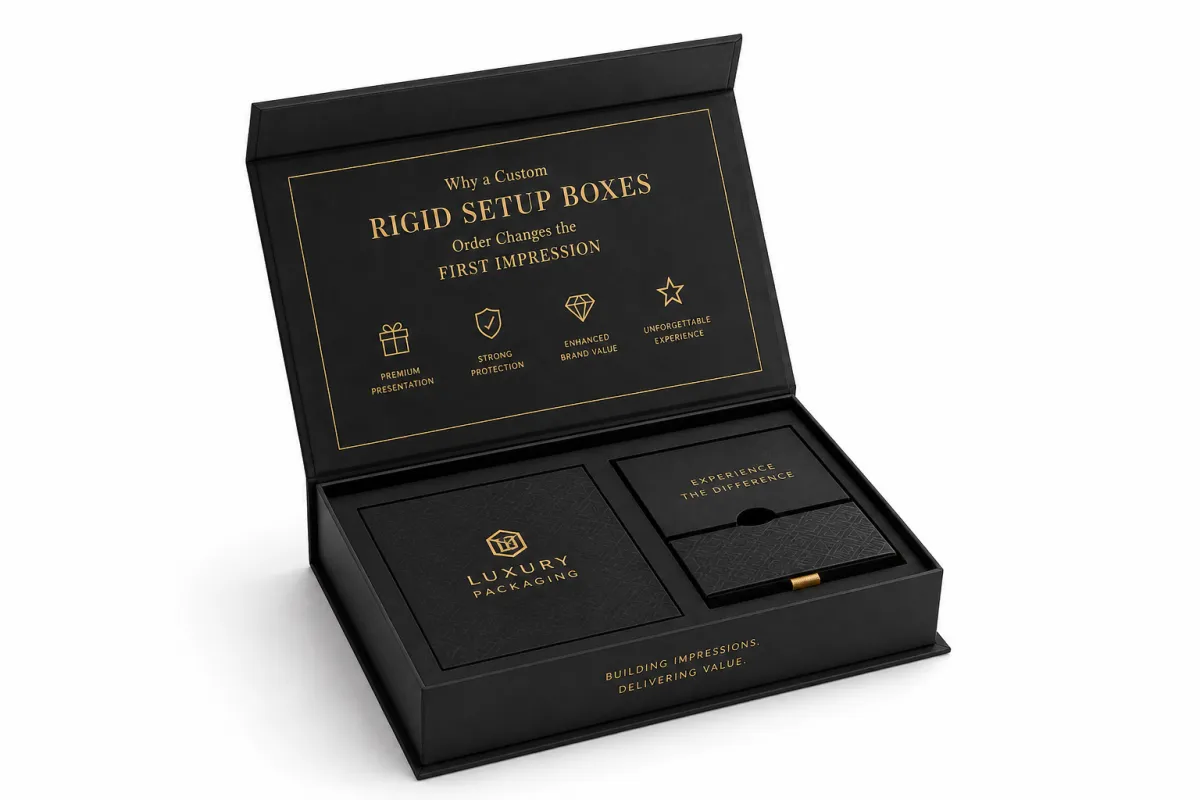
A custom rigid setup boxes order changes how a product is read the second it lands in someone’s hands. A folding carton disappears fast. A rigid setup box keeps its shape, so the customer feels density, stability, and a higher level of finish right away. That is why brands keep using them for launches, curated kits, and premium offers where packaging has to do more than carry artwork. The box becomes part of the pitch, whether anyone planned for it or not.
For a packaging buyer, this is not decoration for decoration’s sake. A rigid setup box reduces collapse, keeps the lid aligned, and gives interior components a better shot at arriving where they belong. If the product has a display role, presentation matters as much as transit performance. A custom rigid setup boxes order can handle both when the item is delicate, segmented, or meant to be revealed in stages. That balance is usually what separates a decent box from one people keep.
Rigid setup boxes earn their keep with products that need a polished opening sequence, a secure insert, or a memorable reveal. Think retail packaging, luxury samples, press kits, gift boxes, and Custom Printed Boxes for ecommerce programs that want the unboxing to feel considered. Buyers usually pick this style when a mailer or corrugated shipper would feel too plain for the story they are trying to tell. And yes, customers notice the difference. More than they admit, anyway.
The process gets easier once the team agrees on the purpose early. Is the goal presentation first, protection first, or a real balance of both? A custom rigid setup boxes order gives you room to decide, but the box performs better when the brief is clear. Define the target audience, the opening feel, and the product fit, and the result usually gets cleaner fast. The quote gets easier to compare too. Funny how that works.
Custom Rigid Setup Boxes Order: What You Can Specify
The structure is simple to describe and exact in production: a thick chipboard body, usually wrapped in printed or specialty paper, built to hold its shape without folding flat. That is the core of a custom rigid setup boxes order. Everything after that is where the decisions start. Lid style, wall depth, wrap stock, interior fit, and decorative finishes all change the look and the unit cost. There is no magic here, just a lot of small choices that add up.
Common styles include lift-off lid boxes, magnetic closure boxes, book-style rigid boxes, telescoping lid boxes, drawer-style boxes, and shoulder-neck constructions. Each one brings a different feel. A lift-off lid stays straightforward and efficient. A magnetic closure gives the customer a more deliberate open-close action. Drawer styles can feel more premium when the product deserves a reveal. A custom rigid setup boxes order should match the product's weight, size, and the way the customer is supposed to interact with it.
Decoration choices matter too. Matte lamination usually reads quiet and refined, while gloss gives more light reflection and stronger color punch. Soft-touch coating adds a velvety surface, but it is not always the right answer if the box needs to resist scuffing in storage. Foil stamping, embossing, debossing, and spot UV can all improve branded packaging, yet each one adds labor and tooling. On smaller runs, that cost shows up fast, so the finish should support the product position rather than get added because it exists. Pretty is fine. Random pretty is expensive.
Interior decisions matter just as much. Inserts can be paperboard, molded pulp, foam, or custom cutouts, and the right choice depends on product weight, fragility, and how many pieces need to stay separated. A custom rigid setup boxes order for a single fragrance bottle does not need the same interior as a box for a charger, cable, manual, and accessory set. If the interior is too loose, the box feels unfinished. If it is too tight, assembly slows down and the pack-out turns annoying. I have seen teams lose half a day to a tray that was off by a couple of millimeters. It is never glamorous, but it is real.
A rigid setup box is usually the better choice than a folding carton when the customer is expected to keep the box instead of tossing it after one use. It also makes more sense when the product has resale value, gift value, or a display role. For shipping-heavy programs, the rigid setup box may still sit inside another shipper, but the presentation box remains the part people remember. That distinction matters when a custom rigid setup boxes order needs to satisfy logistics and brand experience at the same time.
Materials, Sizes, and Structural Specs That Affect Performance
Dimensions are where many buyers lose time. Outer box size, product clearance, insert thickness, and lid depth all have to work together. A custom rigid setup boxes order should start with exact product measurements, then add room for wrap material, board thickness, and the way the insert nests around the item. Tight fit? Even a few millimeters can decide whether the box opens cleanly or binds at the corners. That kind of miss is small on a drawing and huge on the line.
Board choice affects stiffness and price. Common rigid board builds use chipboard in the range of about 1.5 mm to 3 mm, depending on size and load. Wrap papers can include coated art paper, uncoated text stocks, specialty papers, or FSC-certified options where sourcing matters. For responsible fiber sourcing, many buyers check guidance from FSC. A custom rigid setup boxes order with heavier board and a smooth wrap usually feels more substantial, but it also needs careful glue coverage and cleaner corner folding. If the corners are sloppy, the whole thing looks rushed, no matter how nice the artwork is.
Tolerances matter more than a lot of first-time buyers expect. If a rigid box is designed for a set with multiple components, the insert cavities have to match the actual product dimensions, not just nominal sizes from a catalog sheet. That is why a structural sample is useful. It shows whether the box height, panel wrap, and lid fit behave the way the drawings promise. A custom rigid setup boxes order with poor dieline accuracy can look fine on screen and still fail at assembly. Paper does not forgive wishful thinking.
Insert options and fit
Paperboard inserts work well for lighter products and can be printed or wrapped to match the outer box. Molded pulp is a strong option when a more natural look or added cushioning is needed. Foam inserts protect fragile components well, though they can feel out of place in some branded packaging programs unless the presentation is handled carefully. Custom cutouts help when the pack-out is exact and every piece has to lock into place. For a custom rigid setup boxes order, the insert is often the difference between a nice-looking box and a box that actually feels engineered.
Structural details that improve use
Small details make daily handling easier: ribbon pulls for drawers, magnetic alignment for lid closure, finger notches for opening, and reinforced corners for better long-term shape retention. A shoulder-neck construction adds a more architectural reveal and helps the lid sit with better precision. These details add cost, yes. They also improve user experience. The buyer who locks down the opening feel early usually ends up happier with the final custom rigid setup boxes order because the structure supports the story instead of fighting it.
For programs that have to survive distribution handling, testing can be part of the spec conversation. Many teams reference the ISTA test family for transit performance, and depending on the shipping profile, that can include drop, vibration, or compression checks. If you want the broader testing framework, see the guidance at ISTA. A custom rigid setup boxes order does not replace shipper testing. It should be designed to work with it instead of against it.
Pricing, MOQ, and What Drives the Quote
Pricing for a custom rigid setup boxes order comes from a handful of variables, and most of them are controllable. Box size, board thickness, wrap paper, print coverage, insert complexity, and finish level all move the number. Quantity matters just as much because setup work gets spread across more units as the run gets larger. A 500-piece order usually carries a higher per-unit cost than a 5,000-piece order, even if the structure is identical. That is not a trick. It is just how setup-heavy manufacturing works.
For a practical reference, a simple lift-off lid box with light print coverage may land in a very different range than a magnetic closure box with foil, embossing, and a custom insert. At mid-volume runs, buyers often see plain structures quoted much lower than heavily finished presentation boxes. That is normal. The quote should show whether the price difference comes from materials, labor, decoration, or assembly. If it does not, the numbers are hard to compare and easy to misunderstand.
| Box style | Typical use | Relative cost pressure | Notes |
|---|---|---|---|
| Lift-off lid rigid box | Retail packaging, gift sets, simple product packaging | Lower | Efficient structure, fewer moving parts, good for clean branding |
| Magnetic closure box | Premium launches, kits, apparel, accessories | Medium to higher | Stronger presentation value, added hardware and assembly steps |
| Drawer-style box | Samples, collectibles, curated sets | Medium to higher | Needs precise fit for pull action and internal tray alignment |
| Shoulder-neck box | Luxury branded packaging, display pieces | Higher | More material, more assembly, strong reveal and lid alignment |
A useful quote should include more than a unit price. Ask for tooling, sampling, freight, wrap stock, finish line items, and any hand assembly charges. That way you can compare one custom rigid setup boxes order against another without guessing what got buried in the total. If a supplier only gives a headline number, the risk is obvious: add-ons show up later, after the artwork is already approved. Nobody likes that surprise.
MOQ depends on structure. Standard rigid boxes often allow lower starting quantities than highly customized designs, while specialty papers, complex inserts, and heavy decoration can push minimums upward. If budget is tight, simplify the finish stack before you weaken the structural quality. A custom rigid setup boxes order still needs to protect shape and feel like a proper presentation piece. Cutting corners on the board or fit usually costs more in rework than it saves in production.
For buyers planning repeat releases, it helps to ask for price breaks at several quantity levels. That gives a clearer view of where the efficiency kicks in. Sometimes the jump from 1,000 to 2,500 pieces changes the unit price enough to justify holding extra stock. Other times the warehouse burden wipes out the savings. Good quoting lets you decide with actual numbers instead of guesswork.
Production Process and Timeline for a Custom Rigid Setup Boxes Order
A custom rigid setup boxes order usually moves through the same broad sequence: request, specification review, dieline or layout confirmation, proof approval, sampling, production, quality check, and shipment. The steps sound simple. The timing changes every time the artwork changes or the insert gets revised. The fastest projects are the ones where the buyer already knows the size, quantity, print intent, and opening style before asking for a quote. That part sounds boring, but boring is efficient.
Proofing is where many schedules slip. A digital proof can confirm layout, copy, and general placement, but it does not prove fit or surface feel. A structural sample shows the dimensions and closure behavior. A pre-production sample adds a higher level of confidence because it is much closer to the final box. For a custom rigid setup boxes order with a tight insert, the sample stage is usually the cheapest place to catch a problem. Fixing the insert cavity after full production starts is a different story, and not a fun one.
Typical lead times depend on complexity, but a straightforward run may move through proofing and production in a few weeks once approvals are locked. Specialty papers, foil, embossing, and custom inserts add time because they introduce more handling and more checkpoints. If the job includes multiple rounds of artwork revision, the schedule stretches. Rush orders are possible in some cases, though They Work Best when the structure is already final and nobody is still debating finish options.
What slows a job down
The biggest delays usually are not machine problems. They are approval delays. Missing die-line confirmations, incomplete artwork files, vague insert instructions, and late changes to the closure style can push a custom rigid setup boxes order back by days or even weeks. Clear product dimensions, clear brand colors, and one contact for approvals will usually move things faster than chasing five opinions from five directions. That is the part people hear, ignore, and then learn the hard way.
What gets validated at each stage
A digital proof checks the artwork and layout. A sample checks structure, dimensions, and fit. Production checks consistency across the full quantity. A quality review looks at glue points, corner wrap, print registration, magnet placement, and insert alignment. If your package branding depends on repeatability, these checkpoints matter. The custom rigid setup boxes order should not just look right in the mockup; it should repeat cleanly across the run.
The cleanest projects usually happen when packaging design is treated as part of product planning, not a last-minute decoration task. That is especially true for launches with public photos, retail packaging that has to sit on shelf, and gift boxes that get opened in front of customers. The more precise the specification, the less back-and-forth you need during the custom rigid setup boxes order. And the fewer "quick fixes" you need later, the better everybody sleeps.
Why Choose Us for a Custom Rigid Setup Boxes Order
What matters most in a custom rigid setup boxes order is not the promise. It is control over structure, print readiness, and fit. That is where our team is strongest. We pay attention to the things that affect the finished box in the real world: whether the insert holds the product where it should, whether the lid closes with a clean feel, and whether the wrap and finish support the visual direction you actually want.
Good communication saves time and cuts waste. A buyer should know what needs approval, what can change without reworking the whole job, and what will affect cost right away. That is why a straightforward quoting process matters. If you are comparing a custom rigid setup boxes order against other custom printed boxes, the most useful supplier is the one that explains the tradeoffs clearly instead of hiding them behind a low first number. Cheap quotes that fall apart later are usually just expensive in disguise.
Material guidance is another place where experienced packaging teams earn trust. Not every project needs the thickest board or the most decorative finish. Sometimes the smarter move is a cleaner wrap, a simpler insert, and tighter print control. Other times a shoulder-neck structure or a more substantial board makes sense because the product will be kept, gifted, or displayed. The right custom rigid setup boxes order should feel deliberate, not overbuilt.
Consistency matters too, especially when a program repeats across multiple releases. Once the color, closure feel, and insert fit are set, you do not want each reorder drifting in appearance. That kind of variation is common when the specs are loose. A disciplined custom rigid setup boxes order process helps keep repeat jobs aligned so the customer experience stays stable from one run to the next.
For teams managing direct-to-consumer and retail channels at the same time, the packaging has to support different use cases without turning into two separate projects. A rigid box can be adapted for display, gifting, or premium fulfillment, but the build still needs to be practical. That balance is what we focus on. If the structure does not help the product, it should be simplified. If it does help, it should be specified clearly and built the same way every time.
How to Place Your Custom Rigid Setup Boxes Order Without Delays
The easiest way to start a custom rigid setup boxes order is to gather the facts before asking for pricing. Product dimensions, target quantity, preferred finish, insert needs, and delivery deadline give the quote enough information to be useful. If the box has to fit multiple pieces, send the full pack-out list. If the product is fragile, say so. A clean brief usually gets you a cleaner estimate and fewer revisions later.
Artwork files help, but the right supporting details help more. Brand guidelines, color references, photos of packaging you like, and notes on matte versus gloss can shorten the proofing cycle. If your team already has package branding rules, include them at the start. That gives the production side a better shot at matching the look and making the custom rigid setup boxes order feel like a proper extension of the product line.
Before you finalize the spec, decide what matters most: presentation, protection, budget, or speed. Most buyers want all four, but one of them usually leads. If presentation is the priority, choose a stronger finish or a more complex closure. If budget is the priority, simplify the decoration before you weaken the structure. If speed is the priority, keep the insert and artwork changes to a minimum. That kind of clarity makes the custom rigid setup boxes order easier to quote and faster to approve.
It also helps to ask for a sample or proof review before full production, especially for launches, retail packaging programs, and gift sets where the fit needs to be exact. A small sample fee is usually cheaper than reworking a full run. Once you have the sample in hand, check closure feel, insert alignment, print placement, and corner finish. If those details are right, the full custom rigid setup boxes order usually goes much more smoothly.
For buyers who need a repeatable process, the best next step is to send a complete spec sheet and ask for a quote at two or three quantity levels. That keeps the conversation practical and gives you real numbers to work with. A well-planned custom rigid setup boxes order should move from brief to approval without drama. If you want the shortest path, start with the measurements, the pack-out, and the finish priority. That is the part that keeps the whole job from wandering off into revisions nobody needed.
What is the minimum order quantity for a custom rigid setup boxes order?
MOQ depends on box size, structure, print coverage, and finishing complexity. Standard builds may start lower than highly decorated designs, while specialty wraps and detailed inserts usually raise the minimum. If you have a target budget, ask for pricing at a few quantity breaks so you can compare the tradeoff between unit cost and inventory level on the same custom rigid setup boxes order. That gives you a better read than one isolated number ever will.
How long does a custom rigid setup boxes order usually take?
Timing depends on whether you need a digital proof, a structural sample, or a full pre-production sample. Specialty finishes, custom inserts, and artwork revisions can extend the schedule. The fastest custom rigid setup boxes order is the one where dimensions, artwork, and materials are approved early and do not change during production. If they do change, the calendar tends to get cranky fast.
What files do I need to start a custom rigid setup boxes order?
Provide product dimensions, quantity, artwork files, and a clear note on finish preferences. If the box needs an insert, include the product layout and any spacing requirements. Brand guidelines, color references, and photos of comparable packaging help speed up proofing and reduce back-and-forth on the custom rigid setup boxes order. The more concrete the input, the fewer guesswork corrections later.
Can I see a sample before placing the full rigid setup box order?
Yes, many buyers request a digital proof or a physical sample before production starts. A sample is especially useful when the product fit, closure feel, or insert layout is critical. Expect sample costs and timing to vary based on whether the request is structural, printed, or fully finished for the custom rigid setup boxes order. A sample is cheaper than a bad run. That part is pretty hard to argue with.
What affects the final price most on custom rigid setup boxes?
The biggest cost drivers are size, board thickness, wrap paper, insert type, finish level, and quantity. Complex decoration such as foil stamping or embossing adds cost, especially on smaller runs. The most accurate quote comes from a complete spec sheet rather than a rough size estimate for the custom rigid setup boxes order. If you send half the details, you usually get half the accuracy.
Before you request quotes, collect the product dimensions, the full pack-out, the finish priority, and the quantity range you can actually support. That single sheet will save more time than a dozen follow-up emails and will make your custom rigid setup boxes order much easier to price, sample, and approve without the usual back-and-forth.

