Buyer Fit Snapshot
| Best fit | custom corrugated display boxes branding for packaging buyers comparing material specs, print proof, MOQ, unit cost, freight, and repeat-order risk where brand print, material, artwork control, and repeat-order consistency matter. |
|---|---|
| Quote inputs | Share finished size, material target, print colors, finish, packing count, annual reorder estimate, and delivery region. |
| Proofing check | Approve dieline scale, logo placement, barcode or warning zones, color tolerance, and any recyclable or compostable wording before bulk production. |
| Main risk | Vague material claims, crowded artwork, or missing packing details can create delays even when the unit price looks attractive. |
Fast answer: Custom Corrugated Display Boxes Branding: Dieline, Finish, Proof, and Buyer Review should be specified like a repeatable production item. The safest quote includes material, print method, finish, artwork proof, carton packing, and reorder notes in one written spec.
What to confirm before approving the packaging proof
Check the product dimensions against the actual filled item, not only the sales mockup. Ask for tolerance on folds, seals, hang holes, label areas, and retail display edges. If the package carries a logo, QR code, warning copy, or legal claim, reserve that space before decorative graphics fill the panel.
How to compare quotes without losing quality
Compare board or film grade, print process, finish, sampling route, tooling charges, carton quantity, and freight assumptions side by side. A lower quote is only useful if the supplier can repeat the same color, closure quality, and packing count on the next order.
Custom Corrugated Display Boxes: Branding That Sells
Custom Corrugated Display boxes carry a modest profile on the spec sheet and a substantial burden on the sales floor. They have to hold product, draw the eye, and present a brand as ready to buy in only a few seconds, which is often all the time a shopper will give them. That brief window matters in retail because the best product packaging does more than protect the contents; it helps sell them, and custom corrugated display boxes are one of the few packaging formats that can do both jobs without asking the store for extra space or extra effort.
For brand teams, the real opportunity is straightforward: turn structural packaging into a visible selling surface. Custom corrugated display boxes can function like compact retail billboards, carrying color, copy, and product story while still leaving the product easy to reach and replenish. That balance is what separates ordinary retail packaging from packaging that earns attention and helps move inventory.
I have seen plenty of programs where the art looked polished but the display itself fought the shopper. The opposite can happen too: a plain-looking tray with smart structure can outsell a prettier mockup because it is easier to shop and easier to keep tidy. That is kind of the whole point here. Good display packaging needs to work in the aisle, not just in the presentation file.
Custom Corrugated Display Boxes: What They Are
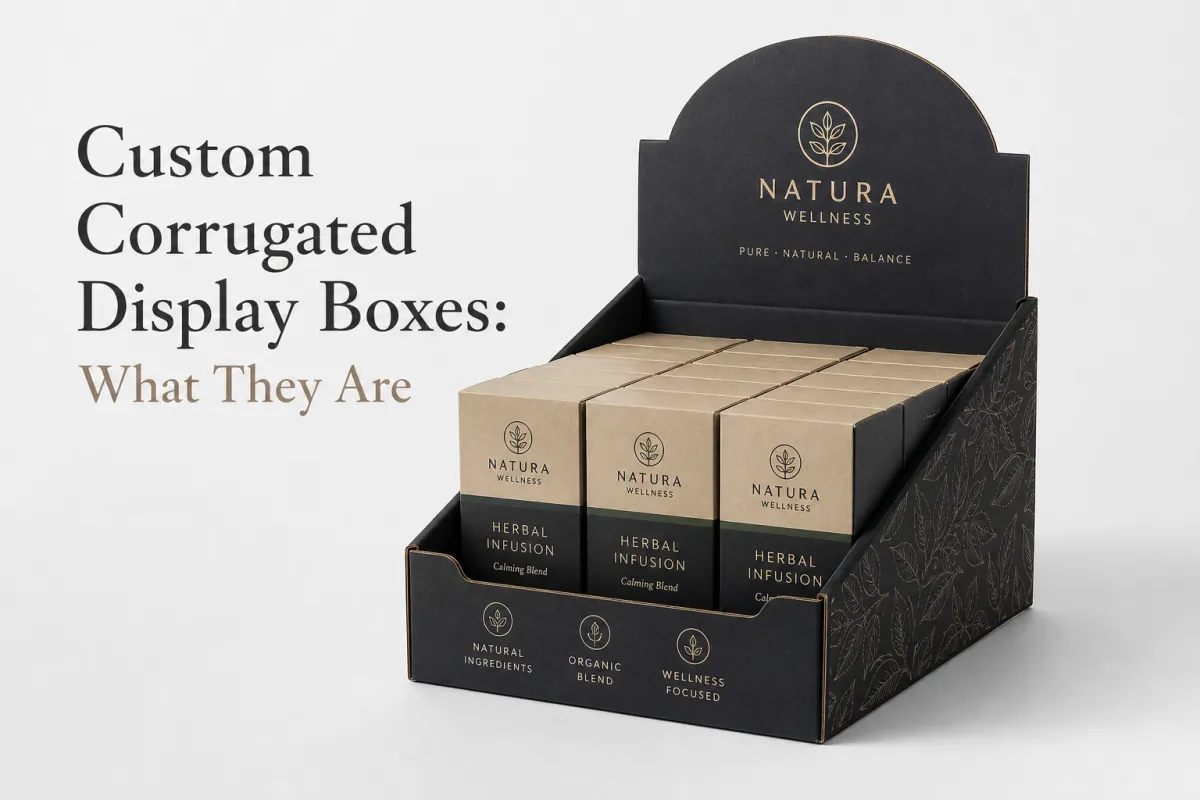
At the most practical level, custom corrugated display boxes are branded corrugated structures made to sit where shoppers can see and touch them, whether that means a countertop, shelf edge, floor set, or pallet display. They are built to present products in a tidy way while still doing what corrugated board does best: keeping the load upright, protected, and manageable from receiving to retail placement.
The difference between a shipping carton and custom corrugated display boxes becomes obvious once the end use enters the picture. Shipping corrugate is built to get product from one place to another with enough strength to survive stacking, vibration, and rough handling. Display corrugate has a second responsibility, and that second responsibility is often the harder one because the structure has to sell the product rather than simply survive the trip. That means more attention to front-facing graphics, tray geometry, product visibility, and the way a store associate will open, set, and refill the unit.
From a packaging buyer’s point of view, custom corrugated display boxes are among the most flexible forms of branded packaging because they can be adapted to almost any retail setting. A countertop display for small cosmetics behaves differently than a pallet-ready tray for snack multipacks, yet the same core logic still applies: make the product easy to understand at a glance, keep it simple to shop, and build the structure strong enough to stay presentable through the promotion window. That is why package branding and structure should never be treated as separate decisions.
There is a reason these displays show up so often in snacks, personal care, accessories, seasonal gifts, and specialty household categories. Custom corrugated display boxes give brands a controlled place to combine color, copy, and product hierarchy in one piece of custom printed boxes that remains cost-conscious compared with harder retail fixtures. If you want a wider view of packaging formats, our Custom Packaging Products page is a useful place to compare options across different packaging design needs.
Good display packaging feels simple because the structure and the graphics are working together behind the scenes. The best custom corrugated display boxes do not just sit there with a logo on them; they tell a shopper what the product is, why it belongs in the basket, and how to grab it without making a mess of the shelf. That is a different job from plain shipping protection, and it is why display-specific planning matters so much.
There is also a trust factor that gets overlooked. If a shopper has to wrestle product out of the tray, or if the display starts looking tired after a day on the floor, the brand can feel less polished even when the formula or product itself is excellent. Packaging cannot fix a weak product, but it can absolutely weaken a good one if the display is built carelessly.
How Custom Corrugated Display Boxes Work on the Shelf
On the shelf, custom corrugated display boxes have to do three things quickly: read clearly from a distance, make sense at arm’s length, and stay useful after shoppers start taking product out. A mockup can look polished in a studio and still fall apart in a store if the front lip is too tall, the face panels hide the product, or the display turns into a loose stack after the first day. In real retail traffic, visibility and access matter as much as print quality.
The structural details are where many programs succeed or fail. Custom corrugated display boxes may use front lips, tear-away windows, divider inserts, inner support walls, or product cutouts to keep items upright and visible. Those parts sound small until the display starts to empty out, because the wrong opening height can make products disappear visually, while the wrong support design can let the box lean, bow, or crush. In practice, the best retail packaging is the one that still looks intentional when half the product has already sold.
Merchandising logic matters just as much as structure. Custom corrugated display boxes should match the product’s facing count, the expected sell-through rate, and the amount of shelf or counter space available. A display that tries to hold too many SKUs gets crowded fast and loses clarity. One that holds too few can feel empty too soon and lose its sense of value. Clean product grouping, a clear benefit statement, and a visible brand mark usually outperform crowded copy blocks every time.
Strong custom corrugated display boxes are really a blend of branded packaging and operational design. The graphics should guide the eye, but the structure should help store staff restock with minimal effort. A display that needs awkward assembly or constant fixing rarely lasts long in a busy aisle. That is why product packaging for retail has to be judged by more than how it looks in approval art; it has to hold up under real hands, real carts, and real store routines.
A display only earns its space if it works after the first shopper touches it. If it looks great in the file but awkward on the floor, the package is doing half the job.
In the field, the little things matter more than people expect. A half-inch of extra front wall, a weak glue joint, or a divider that shifts during replenishment can change how the whole unit behaves. The best retail teams know this already, which is why they ask how a display will perform after opening day, not just how it will photograph.
Key Design Factors for Custom Corrugated Display Boxes
The first design question for custom corrugated display boxes is usually the same: what are the product weight, footprint, and handling pattern? That answer shapes everything that follows. A light personal care item in a small facings tray has very different needs from a denser household product or a taller stacked assortment. Once the load is known, the board grade, flute profile, and reinforcement points can be chosen with much more confidence.
Board selection deserves real attention because not all corrugated board behaves the same. Custom corrugated display boxes may use single-wall construction for lighter promotions, while heavier items often call for stronger compression performance, a sturdier flute profile, or support inserts that spread the load. ASTM D642 compression testing is often referenced for load strength, and for transit behavior many teams look at ISTA protocols such as ISTA 3A, especially if the display will ship pre-packed. For reference material on transport testing, the ISTA website is a good industry resource.
Print choice matters just as much as structure because the decoration method changes the retail impression. Custom corrugated display boxes can be printed with flexography, litho-lamination, or digital decoration, and each path brings a different visual and budget profile. Flexographic print is often practical for simpler graphics and larger runs. Litho-lam can deliver richer image quality and tighter brand color control. Digital print is often attractive for shorter runs, seasonal launches, or versioned artwork. The right choice depends on the brand mood, the color demands, and how much retail polish the program needs to carry.
There is also a sustainability side to the conversation, and it should be handled honestly rather than as a slogan. Many custom corrugated display boxes are made from fiber-based materials that can align with recycled content goals, and some programs specify FSC-certified board for responsible sourcing. If that is part of the brand brief, ask for the exact paper and board spec instead of assuming every fiberboard is the same. For sourcing context, FSC is a useful authority for certified fiber discussions. In branded packaging, sustainability claims only help when the material story is clear and supportable.
For a more direct comparison, here is how common build choices usually stack up in custom corrugated display boxes programs:
| Display Style | Typical Use | Visual Quality | Typical Unit Range | Notes |
|---|---|---|---|---|
| Single-wall flexo tray | Lightweight snacks, accessories, small personal care items | Clean and practical | $0.35-$0.85 | Good for efficient custom corrugated display boxes with straightforward graphics and simple assembly. |
| Litho-lam display | Premium launches, seasonal promotions, strong brand storytelling | High image impact | $0.85-$2.25 | Better for package branding where color accuracy and shelf presence matter more than lowest cost. |
| Reinforced double-wall unit | Heavier goods, bulk items, longer store life | Functional and sturdy | $1.10-$2.80 | Useful when custom corrugated display boxes must carry more weight or survive a longer promotion window. |
One more design point deserves attention: store workflow. Custom corrugated display boxes need to be easy to set, easy to shop, and easy to refill. If the store team cannot understand the build in a minute or two, the display loses time and often loses placement quality as well. Good custom printed boxes are never only a creative exercise; they are an operational tool that has to perform during receiving, set-up, replenishment, and end-of-promo teardown.
If you are planning for a chain rollout, that workflow piece becomes even more important. A display that takes ten extra minutes to assemble may not sound like much, but across a store fleet it can become a real labor headache. That is the kind of detail a good spec should catch before production starts.
Custom Corrugated Display Boxes: Process and Timeline
The typical workflow for custom corrugated display boxes starts with a product brief, not artwork. That brief should include product dimensions, unit weight, pack-out quantity, shipping method, retail setting, and the desired shelf life of the display. Once those basics are clear, the structural concept can be developed around real use instead of assumptions. A display that starts with the right information is far less likely to need expensive revisions later.
After the brief, the structure is usually drafted, reviewed, and adjusted before final art is locked. Custom corrugated display boxes often go through a prototype or sample stage because a physical mockup will reveal problems that a flat drawing cannot show, such as panel height, load balance, tear-line behavior, or whether the product is visible enough once placed inside. That sample step is not busywork; it is the most practical way to reduce avoidable field failures.
Timelines vary because several pieces have to line up before production can begin. Custom corrugated display boxes may move quickly if artwork is final, dimensions are stable, and the structure is simple, but more complex jobs can slow down when proof cycles, retailer compliance checks, or sample approvals run long. A straightforward project often ships in roughly 12-15 business days after proof approval, while a more detailed retail program can take longer if it needs multiple revisions, special finishing, or custom inserts.
Delays usually come from avoidable causes rather than the production floor. Custom corrugated display boxes get held up when teams change artwork late, send incomplete product measurements, or wait too long for planogram confirmation. That is why a good packaging design process is part technical and part project management. The more clearly the retail goal is defined up front, the easier it is to keep the run moving and avoid rushed decisions that weaken the final display.
If the same product line also needs ship-ready corrugated cartons for warehouse movement or e-commerce fulfillment, it helps to keep the display and shipping sides aligned. Our Custom Shipping Boxes page is useful for comparing transit-first structures with display-first formats, because the two pieces often work best as a coordinated system rather than as separate afterthoughts.
One honest caveat: timelines can shift if a retailer asks for a compliance change late in the process, and that happens more often than people expect. It is not a sign of bad planning so much as retail being retail. Build a little buffer into the calendar, and the whole job gets less stressful.
Custom Corrugated Display Boxes: Cost and Pricing Factors
Pricing for custom corrugated display boxes is shaped by several factors at once, and the biggest mistake buyers make is asking for a single box price before the spec is clear. Board grade, size, print coverage, finish, cut complexity, and quantity all matter. A display with large color panels, multiple cutouts, and a reinforced base will cost more than a plain tray, even if both pieces hold the same product count. The material and labor behind the structure are what ultimately set the bill.
Volume changes the math in a very direct way. Custom corrugated display boxes at low quantity usually carry a higher unit price because setup, plates, sampling, and prep are spread over fewer pieces. Larger runs can bring the per-unit number down, but only if the brand can store and sell through the inventory in a reasonable window. That is why the cheapest quote is not always the best program; if the display arrives too early, sits too long, or goes stale before the campaign starts, the savings disappear fast.
There is hidden cost in poor design too. Custom corrugated display boxes that are too hard to assemble, too fragile for the product weight, or too overbuilt for the job can cost more than they should in material waste and store labor. A display that needs extra taping, constant straightening, or manual fixes on the retail floor is not efficient packaging, even if the material bill looked acceptable on day one. In retail packaging, operational friction is a real cost.
From a buying perspective, good quote comparisons should be detailed and honest. Ask for the board spec, flute type, print method, finishing, insert count, sample cost, and any retailer compliance notes. Custom corrugated display boxes are easier to compare apples to apples when every quote spells out the same basics. If a supplier gives only a lump sum, you are left guessing whether the price comes from better materials, simpler construction, or just less support in the program.
A practical pricing range helps frame expectations. A simple, smaller custom corrugated display boxes project in a few thousand units might land in a range like $0.45-$0.95 per unit depending on print coverage and size, while a premium litho-lam display with heavier structure and insert work can move into the $1.25-$2.50 range or higher. Those numbers are not a promise; they are a realistic starting point for budget planning, and the final quote should always be based on the real spec, not a generic box count.
If a quote looks unusually low, there is usually a reason. Sometimes the board is lighter than expected, sometimes finishing has been stripped out, and sometimes the display is simply underbuilt. A good price is one that matches the actual retail job, not just the least expensive line item on the page.
Common Mistakes with Custom Corrugated Display Boxes
The first mistake is designing for the presentation deck instead of the store floor. Custom corrugated display boxes can look excellent on a screen and still perform badly if the shopper cannot reach the product, the front edge hides too much of the item, or the structure tips once the case is partially emptied. A display has to survive the real sequence of events in a store: set, shop, refill, and disturb. If any one of those steps is ignored, the display becomes more fragile than it looks.
The second mistake is trying to say too much. Custom corrugated display boxes often get overloaded with claims, badges, color blocks, and side-panel copy until the message turns muddy. A clear visual hierarchy usually beats a crowded one. The brand name should be easy to find, the primary benefit should be visible quickly, and any secondary claims should support the sale rather than compete with it. Packaging design works best when it gives a shopper one clean reason to pick up the product, not a wall of marketing noise.
The third mistake is underestimating durability. Custom corrugated display boxes used in pallet displays, shipping-to-store programs, or longer promotional windows need enough structural strength to keep their shape. Weak glue joints, thin board, or poor support design can create crushed corners, bowed sides, and uneven product presentation long before the campaign is over. For heavier or denser goods, a stronger board grade and better internal support are usually cheaper than replacing a failed display in the middle of a promotion.
The fourth mistake is approval drift. Custom corrugated display boxes often sit between marketing, sales, operations, and retail requirements, and those groups do not always begin with the same assumption. If the artwork is approved before the structure is validated, or if the retail buyer has not signed off on how the unit will sit on the shelf, the final result can miss the mark in more than one way. Alignment early in the project saves time, reduces revisions, and leads to better branded packaging overall.
There is also a quieter mistake that shows up late: forgetting how the display looks after a week of handling. Once cartons are opened, product is removed, and staff begin tidying the fixture, the display should still feel intentional. If it only works on day one, it is not really finished.
Expert Tips and Next Steps for Custom Corrugated Display Boxes
My first recommendation is to start with the product, not the artwork. Custom corrugated display boxes work best when the team understands product weight, sell-through rate, storage conditions, and the store environment before any visual direction is finalized. Once the structural needs are locked, the branding can be layered on with much more confidence. That order matters because the shape of the display affects the way the graphic story is seen.
Second, ask for a prototype or sample whenever the schedule allows it. Custom corrugated display boxes can reveal practical issues in physical form that never show up in a digital proof, including panel visibility, hand access, stability, and how quickly the unit can be set by store staff. A sample also helps teams judge whether the print scale and color balance feel right in real space. That kind of check is especially useful for retail packaging that will live near eye level or at a checkout counter.
Third, build the brief around a single merchandising job. Custom corrugated display boxes might be intended for launch visibility, seasonal add-on sales, bulk promotion, or a longer shelf presence, but each goal pushes the design in a slightly different direction. A launch display may need stronger branding and sharper shelf pop, while a longer-lived retail display may need a sturdier structure and easier replenishment. Clear objectives help the vendor recommend the right board, print method, and format instead of forcing a one-size-fits-all answer.
Fourth, connect the display program to the rest of your packaging system. Custom corrugated display boxes usually perform better when the brand’s shipping cartons, retail trays, and custom printed boxes use a consistent visual language and spec logic. That does not mean every package should look identical, but it does mean the product family should feel intentional. If you are comparing broader formats, our Custom Packaging Products page and our Custom Shipping Boxes page can help you think through how the pieces work together across the supply chain.
If you are planning a rollout now, a simple action list will keep things moving: confirm product dimensions and weights, define quantity and store format, gather logo and brand assets, choose the print style you can afford, and request a sample before production. That is the cleanest route to custom corrugated display boxes that feel like part of the brand instead of a temporary afterthought, and it is usually the difference between a display that simply exists and one that truly sells.
The takeaway is pretty simple: treat the display as a working retail tool first and a graphic surface second. When the structure matches the product, the print matches the brand, and the build matches store reality, custom corrugated display boxes do their best work without making the retailer babysit them.
What products work best in custom corrugated display boxes?
Products that benefit from quick visibility and easy grab-and-go access usually perform very well, including snacks, cosmetics, personal care items, accessories, and seasonal promotions. Smaller to medium facings are often the sweet spot, because the display can show enough product without becoming crowded. Heavier or awkwardly shaped items can still work, but they usually need stronger board, better internal support, and a more careful structural plan for custom corrugated display boxes.
How long do custom corrugated display boxes usually take?
Timing depends on structure complexity, artwork readiness, sample approval, and production load, so there is no single universal schedule. A simple project with final artwork and a straightforward build often moves faster, while a more detailed retail program may need extra time for revisions, proofing, and compliance checks. The safest approach is to request a timeline early so custom corrugated display boxes can move from concept to production with enough room for signoff.
What affects the price of custom corrugated display boxes the most?
Board grade, size, print coverage, finishing, and order quantity are usually the biggest drivers of price. Structural complexity matters too, because more cuts, scores, inserts, and reinforcement can increase both material and labor needs. The most useful quote for custom corrugated display boxes is the one that spells out the full spec clearly, not just a rough unit count, because that is what lets you compare options fairly.
Can custom corrugated display boxes hold heavy products?
Yes, but the display has to be designed for the weight from the beginning. Heavier products may call for thicker corrugated board, support inserts, a wider footprint, or a reinforced base to keep the unit stable in retail use. A sample or prototype is especially helpful when the load is dense or the promotion will run for a long period, because custom corrugated display boxes need to stay upright after repeated handling.
How do I make custom corrugated display boxes more brand-focused?
Use a clear visual hierarchy so the brand name, product benefit, and call to action are easy to read at a glance. Keep the message focused on one shopper reason to buy instead of loading the face panels with too many claims. Match the print style, color palette, and structure to the brand mood so the display feels like an extension of the identity, and remember that custom corrugated display boxes work best when structure and messaging support the same selling point.
Do I always need a prototype?
Not always, but it is usually worth the time when the display carries meaningful weight, uses a new structure, or will be rolled out across multiple stores. A prototype gives you one last chance to catch issues with fit, balance, opening behavior, and presentation before the run is locked. That small step can save a lot of awkward fixes later, and it tends to pay for itself when the program is more than a simple tray.

