Buyer Fit Snapshot
| Best fit | Custom Cosmetic Cartons with Logo projects where brand print, material claims, artwork control, MOQ, and repeat-order consistency need to be specified before quoting. |
|---|---|
| Quote inputs | Share finished size, material target, print colors, finish, packing count, annual reorder estimate, ship-to region, and any compliance wording. |
| Proofing check | Approve dieline scale, logo placement, barcode or warning zones, color tolerance, closure strength, and carton packing before bulk production. |
| Main risk | Vague material claims, crowded artwork, missing packing details, or unclear freight terms can make a low unit price expensive after revisions. |
Fast answer: Custom Cosmetic Cartons with Logo: Board, Finish, Dieline, and Unit Cost should be specified like a repeatable production item. The safest quote records material, print method, finish, artwork proof, packing count, and reorder notes in one written spec.
Production checks before approval
Compare the actual filled-product size with the drawing, then confirm tolerance on folds, seals, hang holes, label areas, and retail display edges. Reserve space for logos, QR codes, warning copy, and material claims before decorative graphics fill the panel.
Quote comparison points
Review material grade, print process, finish, sampling route, tooling charges, carton quantity, and freight assumptions side by side. A quote is only useful when the supplier can repeat the same color, closure quality, and packing count on the next order.
Custom cosmetic cartons with logo do more work than most people give them credit for. They are often the first thing a shopper notices, the first thing a buyer evaluates, and the first place a brand either looks credible or looks like it rushed the finish. That is why custom cosmetic cartons with logo matter so much in cosmetic packaging: the carton can influence the sale before anyone opens the jar, twists the cap, or smells the formula.
From a packaging buyer’s point of view, the outer carton is not decoration. It serves as branded packaging, product protection, and retail packaging all at once. A well-made carton builds trust, frames the formula, and helps a line look consistent across shelves, display boxes, and unboxing. A weak one can make a solid product feel underdeveloped. Harsh, but accurate.
A carton does not need to shout. It needs to look intentional, fit well, print cleanly, and survive handling without turning into a sad, dented square.
If you are comparing suppliers or planning a launch, start by reviewing the basics on our Custom Packaging Products page. That gives you a clean way to compare custom printed boxes, structures, and finishes before you commit to a run of custom cosmetic cartons with logo.
What Are Custom Cosmetic Cartons with Logo?
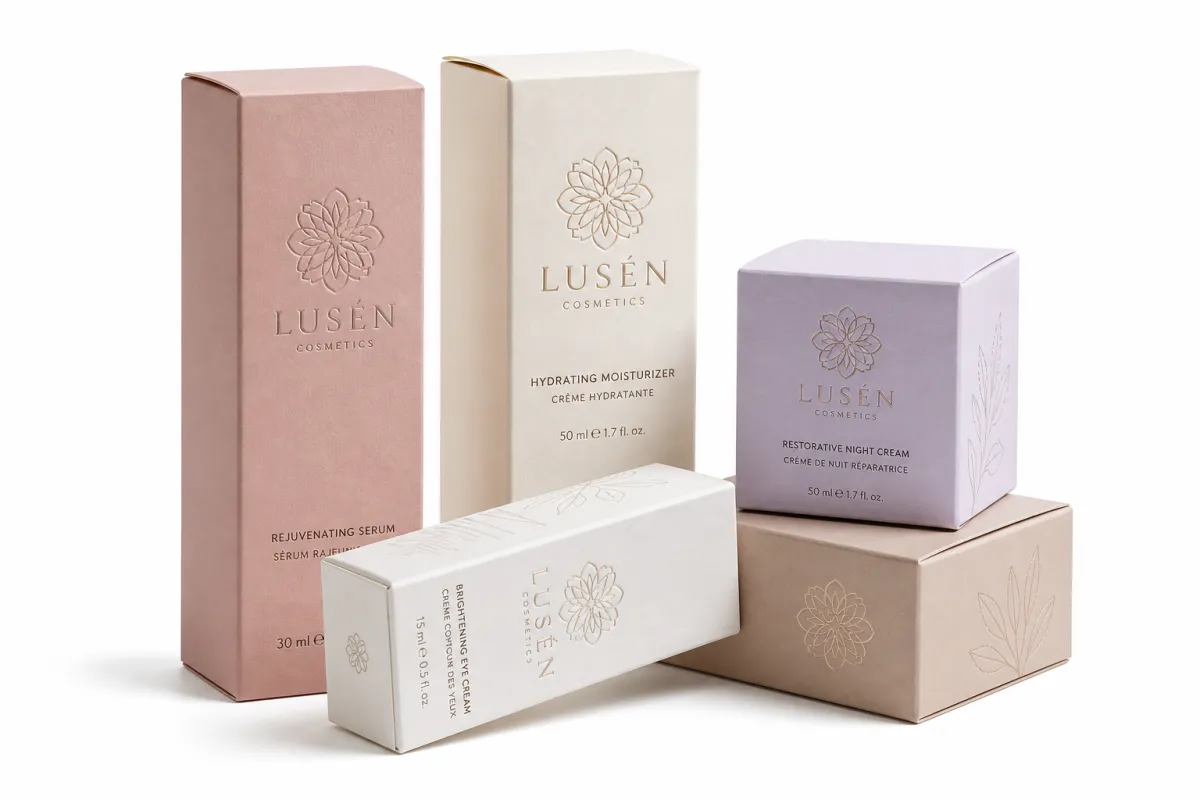
Custom cosmetic cartons with logo are the printed outer boxes used to house beauty and personal care products. They carry the brand mark, product name, usage details, and compliance text while giving the item a finished presentation. In practice, custom cosmetic cartons with logo are where package branding starts to feel tangible. The formula may be excellent, but the carton is what turns it into a shelf-ready product.
These cartons usually wrap around smaller cosmetic items that need both protection and presentation. Think skincare tubes, serums, lip products, eye creams, facial oils, single jars, ampoules, and gift sets. They also appear in product packaging for items that need more structure than a simple pouch or label can offer. If the item can chip, leak, scratch, or disappear visually on shelf, a carton earns its place.
There is also a major difference between a shipping box and a retail carton. A mailer is made to move products safely. A carton is made to present them. That difference sounds obvious until someone orders the wrong thing and wonders why the box looks right in a warehouse but wrong on a shelf. Custom cosmetic cartons with logo belong to retail packaging, not just transit protection.
Structure, logo placement, typography, and finish work together to send a message quickly. A matte white carton with restrained type reads clinical and clean. A kraft board with simple black ink feels earthy and honest. Foil, embossing, and soft-touch lamination push a carton toward luxury. That is the practical side of packaging design: the box tells the shopper how to read the brand before they ever try the product. Good custom cosmetic cartons with logo can make a line feel premium, natural, minimalist, or science-led without changing the formula at all.
People still underestimate custom cosmetic cartons with logo because the box seems simple from a distance. In my experience, the easiest cartons to approve on screen are sometimes the ones that cause the most friction once they are folded and glued. A half-millimeter shift in tuck depth or a logo that sits too close to a seam can make a polished design feel off. The carton is small, but the details are not.
For brands building a full line, custom cosmetic cartons with logo also help keep the collection visually consistent. One system for serums, cleansers, and creams makes the range feel organized instead of random. That consistency matters when shoppers compare five brands in ten seconds. They rarely read every word. They read the overall signal.
Production Steps, Process, and Lead Time
The process for custom cosmetic cartons with logo starts with dimensions, not artwork. If the box size is wrong, everything downstream gets messy. A carton that is too tight can crush the bottle or wrinkle at the seams. A carton that is too loose looks kinda lazy on shelf and can shift during shipping. That is why the first serious step is usually a dieline based on the exact product dimensions, closure style, and any insert needs.
From there, the production flow usually looks like this:
- Confirm product specs - measure width, depth, height, neck clearance, and fragile areas.
- Build or review the dieline - check panel sizes, tuck depth, glue tabs, and safe zones.
- Prepare artwork - add bleed, vector logos, barcode space, ingredient text, and regulatory copy.
- Select material and finish - choose board weight, coating, and any special effects.
- Approve proof - review color, copy, folds, and the final layout before printing.
- Print, cut, finish, and pack - then inspect the run before shipment.
Lead time depends on how complicated the carton is and how prepared the artwork is. A simple run of custom cosmetic cartons with logo may move in about 10-15 business days after proof approval. Add foil, embossing, soft-touch, or a complex die-cut and the timeline often stretches to 15-20 business days, sometimes longer if the queue is busy. That is not a delay problem. That is the real cost of extra steps.
Where do projects usually get stuck? Three places: weak files, slow approvals, and indecisive revisions. Missing bleed can stop a print file. A low-resolution logo can force a redesign. A buyer who keeps asking for “one more tweak” can burn a week without realizing it. Custom cosmetic cartons with logo are much easier to schedule when the art is ready, the specs are locked, and the sign-off chain is short.
Sampling is the other place people save the wrong money. A flat proof checks layout. A digital proof helps confirm color and text. A physical sample shows fit, finish, and fold behavior. Those three solve different problems. Skip all of them and you are basically trusting a PDF with your launch budget. That is not bravery. That is a gamble.
For products that will travel through warehouse handling or e-commerce fulfillment, I like to see packaging tested against real transport stress, not wishful thinking. The ISTA test standards are useful because they remind buyers that a good-looking carton still has to survive movement, vibration, and stacking. Custom cosmetic cartons with logo should do both: look sharp and hold up.
Custom Cosmetic Cartons with Logo: Cost, MOQ, and Quote Basics
Pricing for custom cosmetic cartons with logo is driven by five main variables: board grade, size, print coverage, finish complexity, and quantity. Small changes in any one of those can move the quote more than buyers expect. A clean one-color carton in a standard tuck style is a very different animal from a full-color box with foil, embossing, and a special insert.
As a practical range, a simple custom cosmetic cartons with logo run at 5,000 units might land around $0.18-$0.35 per unit, depending on board and coverage. Add soft-touch, foil, or spot UV and that can move closer to $0.40-$0.75. Smaller starter runs often cost more per unit because setup is spread across fewer boxes. That is not a supplier being dramatic. That is math.
Minimum order quantity, or MOQ, usually exists because printing and die-cutting have fixed setup costs. A supplier may offer a lower MOQ for a simple carton, but once you add specialty finishes or custom structures, the floor often rises. For brands testing the market, that matters. A low-MOQ run can be smart. A too-small run can also leave you paying more later when you reorder in a rush. Custom cosmetic cartons with logo should match your launch plan, not just your enthusiasm.
| Order Tier | Typical Quantity | Approx. Unit Cost | Best Fit | Notes |
|---|---|---|---|---|
| Starter Run | 1,000-2,500 | $0.28-$0.75 | Testing a new SKU | Higher setup cost per unit; keep finishes simple |
| Mid-Volume Run | 3,000-10,000 | $0.16-$0.42 | Launches and line extensions | Best balance of cost, flexibility, and consistency |
| High-Volume Run | 10,000+ | $0.10-$0.28 | Established retail programs | Lower unit cost, but more planning needed for storage |
When you compare quotes for custom cosmetic cartons with logo, do not compare price alone. Compare the exact same spec: box size, paperboard thickness, print method, finish, insert, and shipping terms. I have seen “cheaper” quotes hide thinner board, reduced print coverage, or extra fees for proofing and tooling. That is how a bargain turns into a headache with better branding.
The big extras that surprise buyers are usually foil stamping, embossing, soft-touch lamination, custom inserts, and special coatings. Each one can add a visible upgrade, but not every carton needs all of them. Sometimes a strong color system and one solid finish beat five flashy details. Custom cosmetic cartons with logo should earn their cost. They should not just look expensive in a meeting.
If you want a cleaner quote process, use a simple comparison sheet and send the same brief to every supplier. Keep the product measurements, target quantity, print colors, finish, and regulatory text identical. That is the only fair way to compare custom cosmetic cartons with logo without comparing apples to an overpriced orange.
For sourcing board with verified responsible forestry claims, the FSC framework is worth checking. If your buyer or retailer asks for certification, chain-of-custody documents matter more than marketing language. A carton can look premium and still need real paperwork behind it.
Key Design Factors That Change Shelf Impact
Custom cosmetic cartons with logo rise or fall on a handful of design choices. The structure is one. The board is another. The biggest difference usually comes from the visual system: color, typography, logo scale, and finish. That is the point where packaging design stops being abstract and starts affecting sell-through.
Start with structure. A reverse tuck box is common, economical, and fine for many creams and tubes. A straight tuck front can feel cleaner for premium skin care. A sleeve works well when you want visual simplicity or when the inner item already carries part of the message. Rigid-style presentation boxes are more expensive, but they create a stronger unboxing moment for gift sets and premium treatments. Custom cosmetic cartons with logo should use the structure that fits the product’s job, not just the mood board.
Board choice matters too. SBS gives a bright, crisp white face and works well for clinical, prestige, and color-accurate printing. Kraft feels natural and tactile, which suits cleaner or eco-led branding. CCNB can be a practical option for cost-sensitive runs. For many beauty cartons, 16pt to 24pt board or roughly 300gsm to 400gsm covers the useful range, though the right choice depends on product weight and whether the box needs to stay rigid at retail.
Then there is the logo itself. Too small and it disappears. Too large and the carton starts looking nervous. From arm’s length, shoppers need to read the brand in under two seconds. That means strong contrast, legible type, and a clear hierarchy. Custom cosmetic cartons with logo are not billboard ads. They are small sales tools that have to work at shelf distance, in photos, and in a hand.
Finishes change perceived value fast. Matte lamination often reads calm and modern. Soft-touch coating feels more premium, especially for skincare. Foil can signal luxury, but use it with restraint unless you want the box to shout for attention. Spot UV is useful when you want a logo or pattern to pop without covering the whole surface in shine. The best carton finishes support the story instead of competing with it.
Regulatory layout is where a lot of pretty packaging gets ruined. Ingredient space, net weight, barcode placement, country of origin, warnings, and claim language all need breathing room. If the brand copy crushes the compliance text, the carton starts to feel crowded and amateur. Good custom cosmetic cartons with logo balance branding with the boring bits. And the boring bits are what keep the box saleable.
For multi-SKU lines, design the system first and the shades second. That means one type hierarchy, one logo position rule, one barcode zone, and a repeatable color family. A line of custom cosmetic cartons with logo should look like a family, not a group chat where nobody agreed on the dress code. If your products span cleanser, serum, and eye cream, consistency is worth more than one-off cleverness.
Step-by-Step Guide to Ordering Custom Cosmetic Cartons with Logo
Ordering custom cosmetic cartons with logo gets much easier when you treat it like a controlled process instead of a burst of inspiration. The cleanest launches start with a spec sheet. That sheet should include product dimensions, container shape, closure style, weight, whether the container is glass or plastic, and any fragile zones that need more support. If the product can rattle inside the box, the carton is not finished yet.
- Write the product brief - list the exact dimensions and the formula type.
- Choose the carton style - tuck-end, sleeve, rigid, or another form that fits the product.
- Confirm the material - select board thickness, print side, and coating.
- Prepare print files - use vector logos, bleed, and safe zones.
- Request quotes using the same spec - do not let each supplier quote a different build.
- Review the proof carefully - check copy, folds, finish marks, and barcode placement.
- Approve only after sample review - especially for premium custom cosmetic cartons with logo.
- Lock the reorder spec - save the final version so future runs stay consistent.
Artwork prep deserves more respect than it gets. A logo file that looks fine on a website can be too low-resolution for print. Small text can disappear if the safe zone is ignored. Barcode placement matters because scanners are less forgiving than design teams. If you want custom cosmetic Cartons with Logo That print cleanly the first time, send vector artwork whenever possible and leave enough room for folds, gluing, and trim.
A good supplier should offer at least one proof stage, and for riskier launches I prefer a physical sample too. A flat proof shows layout only. A digital proof gives you a rough color and position check. A production sample tells you whether the carton fits, folds, and closes the way it should. If your product is glass or the carton has a tight fit, the sample is cheap insurance. Custom cosmetic cartons with logo are not the place to discover a half-millimeter mistake.
Before approval, verify three things: the carton fits the product, the finish matches the brand, and the copy is legally complete. That last part gets missed more often than it should. Ingredient lists, warnings, and claims should not be an afterthought. Once the proof is approved, production can move, but only if the spec is stable. Every revision after that costs time, and time is usually what the launch calendar does not have.
For teams buying more than one format, it helps to align the carton order with other custom printed boxes and branded packaging items so the first launch looks like one coherent system. A serum carton, a cleanser carton, and a mailer do not need to match exactly. They do need to speak the same visual language.
Common Mistakes That Waste Time and Money
The costliest mistake is simple: people design custom cosmetic cartons with logo before they confirm the actual product size. Then the bottle arrives, the carton is too tight, and the entire run is compromised. Measure the container first. Measure it again if the closure is unusual. If there is a pump, dropper, or raised shoulder, account for it.
Another classic problem is overdesign. Too many finishes can make a carton feel busy instead of premium. A busy carton can also blow up the budget fast. I have seen brands add foil, embossing, soft-touch, spot UV, and a custom insert to the same box, then wonder why the unit cost stopped making sense. Custom cosmetic cartons with logo usually get stronger, not weaker, when one or two clear design moves do the work.
Poor artwork files create another mess. Low-resolution logos, weak contrast, and tiny text can force reprints or awkward fixes. If the print team has to guess what your logo should look like at 100% scale, something is wrong. Custom cosmetic cartons with logo deserve proper artwork setup, not a screenshot and a prayer.
Under-ordering is a quiet budget killer. A brand may save a little on the first order, then pay more later for a rush replenishment, split shipment, or short-run reorder. That often happens when the launch sells faster than expected, which sounds nice until the carton supply becomes the bottleneck. Plan launch quantity, test sell-through, and first reorder together. That is the sane way to handle custom cosmetic cartons with logo.
Skipping real-world testing is another one. A carton may look gorgeous on screen and still crush at the corners, scuff during transit, or fit so loosely that the product bangs around. If the box is for e-commerce, test it through a handling route. If it is for shelf display, check it under store lighting and from arm’s length. Good custom cosmetic cartons with logo need to hold up in both places.
One more trap: approving the proof too quickly. People review on a bright screen, assume the folds are fine, and move on. Then daylight reveals a barcode too close to a fold, or a dark background that makes the text hard to read. Slow down for the final check. That five minutes can save a full reprint. Not glamorous. Very useful.
Expert Tips and Next Steps for Your Launch
If you want custom cosmetic cartons with logo to do real work, keep the system simple. Build one master brief with dimensions, copy, finish, color references, and logo placement rules. Then use that same brief for every supplier quote. You will get cleaner comparisons, fewer surprises, and better consistency when you reorder.
My honest take: one strong visual decision usually beats five weak ones. Maybe that is a specific material, maybe it is a deep matte finish, maybe it is a bold but disciplined type system. Either way, custom cosmetic cartons with logo tend to perform better when the brand commits to one clear idea instead of layering on every effect the sales rep mentions.
Plan for reorders before the launch even ships. Estimate how many cartons you need for the first sell-in, the test run, and the next replenishment. If you wait until the last pallet is gone, you are gonna be back in rush mode, and rush mode is where budgets get chewed up. Good custom cosmetic cartons with logo are easier to keep consistent when the reorder math is done early.
I also recommend saving the final spec details in one place: board stock, coating, approved color values, dieline version, and supplier notes. That record becomes the baseline for every future run. Without it, a brand can drift over time, and the boxes stop matching the original intent. Consistency is boring until you realize it is the thing customers actually notice.
If the budget allows, ask for both a flat sample and a production sample on key launches. The flat sample confirms layout and sizing. The production sample tells you whether the fold, glue, and finish behave the way the spec promised. That small extra step often saves a lot of frustration. Custom cosmetic cartons with logo are easier to scale when the first run is boring in the best possible way: predictable.
Before you place the order, run a last check: confirm the quote, confirm the proof, confirm the materials, and confirm the launch quantity. Then make sure the carton supports the product you are actually selling, not the one you imagined in the brand deck. That is the point of custom cosmetic cartons with logo. They should make the formula easier to trust, easier to display, and easier to buy.
For brands that are serious about branded packaging, retail packaging, and a clean product packaging system, the next move is straightforward: lock the spec, compare quotes on equal terms, approve a physical sample, and place the run with enough margin to absorb reorders. Do that well and custom cosmetic cartons with logo become an asset instead of a recurring fire drill.
Frequently Asked Questions
What should I include on custom cosmetic cartons with logo?
Include the logo, product name, net weight or volume, ingredients or key claims, barcode, and any required legal or regulatory text. Leave enough space for folds and safe zones so nothing important disappears when the carton is assembled. For custom cosmetic cartons with logo, the visual hierarchy should stay simple: brand first, product name second, details third.
How much do custom cosmetic cartons with logo usually cost?
Cost depends on size, board type, print coverage, finish, and quantity. Smaller runs usually carry a higher unit cost because setup is spread across fewer cartons. Specialty features like foil, embossing, soft-touch coating, or inserts can raise the price fast. The cleanest way to compare custom cosmetic cartons with logo is to match the exact same specs across suppliers.
What is the minimum order quantity for custom cosmetic cartons with logo?
MOQ varies by supplier and box complexity, but custom printed cartons usually need enough quantity to cover setup costs. Simple cartons may allow lower minimums than cartons with specialty finishes or unique structures. If you are testing a product, ask for a starter run and a reorder plan instead of guessing. That is usually the smarter path for custom cosmetic cartons with logo.
How long does production take for custom cosmetic cartons with logo?
Production time depends on proof approval speed, printing method, finishing, and order size. Simple runs move faster than cartons with foil, embossing, or complex die-cuts. If the artwork is not ready, the timeline slips before production even starts. In practical terms, custom cosmetic cartons with logo often need about 10-20 business days after approval, depending on the build.
Do I need a dieline before requesting a quote for custom cosmetic cartons with logo?
A dieline is not always required, but exact product dimensions are, because the box has to fit correctly. If you already have a dieline, it helps speed up quoting and artwork setup. If you do not have one, ask the supplier to build it from your product measurements. That is usually the fastest way to keep custom cosmetic cartons with logo on track.
If you are planning a launch, custom cosmetic cartons with logo should be treated as part of the product, not an afterthought. Start with the exact measurements, choose a structure that fits the formula, and keep the artwork disciplined enough to survive real production. Then compare quotes on the same spec, approve a physical sample, and lock the reorder file before the first boxes ship. That is the practical path to custom cosmetic cartons with logo that protect the product, support the brand, and hold up once they reach the shelf.

