Custom Cosmetic Pouch: Buy Smarter for Your Brand
Nothing makes branded packaging look expensive faster than a flimsy pouch that wrinkles, leaks, or arrives with a weak zipper and a slightly crooked print. A custom cosmetic pouch solves that problem when it is sized correctly, built around the product inside, and finished with enough discipline to survive real handling. That is the difference between packaging that supports the brand and packaging that quietly undermines it.
Most buyers begin with the logo and work backward. That is usually the wrong order. Start with the product, the channel, and the way the pouch will be handled. A serum sample, a travel kit, and a gift set inside a retail box all ask for different structures, different closures, and different tolerances for cost. Once those use cases are separated, the spec sheet gets much easier to control.
From a packaging buyer’s point of view, the best pouch is not the fanciest one. It is the one that fits, seals properly, ships without drama, and still looks intentional beside the rest of the product packaging. That usually means making tradeoffs on material, closure, print coverage, and finish instead of trying to maximize every feature at once.
Why a custom cosmetic pouch changes the whole unboxing
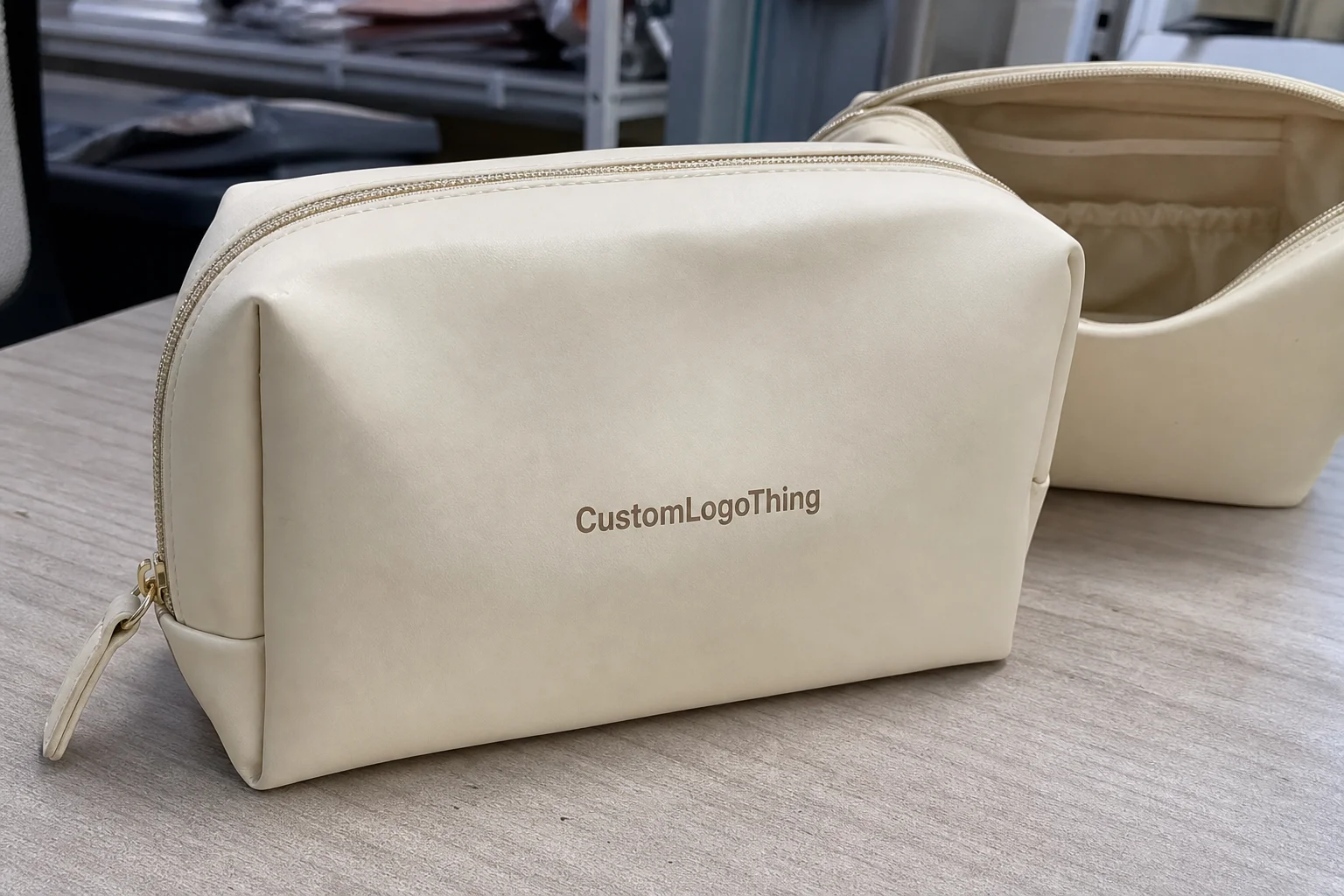
A custom cosmetic pouch is a branded flexible package used for makeup, skincare, travel kits, samples, and gift sets. In practical terms, it is a soft-format bag or pouch that keeps products together while carrying your logo, color system, and basic product information. That makes it useful for storage and presentation, which is why it appears in retail packaging, subscription kits, promotional bundles, and direct-to-consumer orders.
The material choice matters more than the sales language around it. Plastic-based pouches are popular for three reasons: they resist moisture better than paper-only formats, they stay light enough to keep shipping costs under control, and they can be made clear, frosted, metallic, or fully printed without much added weight. Those are practical advantages, not just style points.
Buyers often use pouch, bag, and case as if they mean the same thing. They do not. A pouch is usually soft and flexible, often zipper-closed or heat-sealed. A bag tends to be larger and more utility-driven. A case implies something more structured and protective, which can push the spec toward EVA, molded inserts, or a harder shell. Mixing those terms in a quote request creates confusion and slows everything down.
There is also a common mistake on the buyer side: assuming the most premium-looking option is automatically the right one. It is not. A clear pouch may be perfect for showing product color. A matte frosted pouch may be better when you want a cleaner, more cosmetic feel. A fully opaque pouch may be the sensible choice if the contents need privacy or protection from light. The right answer depends on channel, product size, and budget, not on a mood board.
If the pouch is supposed to feel premium, the closure and finish do more work than another logo color. People notice what they touch first.
For buyers building a broader packaging system, the pouch should sit comfortably beside labels, cartons, and Custom Packaging Products. Consistency matters more than most teams expect. A pouch that clashes with your custom printed boxes creates visual noise, even if customers cannot explain why the set feels off.
How cosmetic pouch construction and printing actually work
The structure starts with the film. Most cosmetic pouches use one or more layers of PE, PVC, EVA, TPU, or laminated films. Each one behaves differently. PE is common, flexible, and cost-effective. PVC is clearer and often feels firmer, although some buyers avoid it for odor or sustainability reasons. EVA and TPU usually feel more durable and more premium, especially when the pouch needs extra shape or better resistance to wear. Laminated films are used when barrier performance, print quality, or a specific surface finish matters.
Thickness matters too, and more than many first-time buyers expect. A thin pouch can look elegant, but it may collapse, crease, or scuff too easily. A thicker film adds structure, but at a certain point it becomes bulky and awkward to ship. For many cosmetic uses, thickness commonly falls somewhere around 0.12 mm to 0.30 mm depending on material type, intended use, and whether the pouch needs a soft hand feel or a firmer profile.
Closure style is another decision with real consequences. A simple zipper works for reusable packs and travel sets. Heat sealing works when tamper evidence or one-time sealing matters more than repeated opening. Slider closures cost more, but they are easier for consumers who will reuse the pouch. Gussets add capacity and improve standing stability, though they also change the die line and increase freight volume.
Printing should follow artwork complexity, not wishful thinking. Screen print works well for simple logos and limited color counts. Gravure becomes efficient at larger volumes and for consistent, detailed coverage. Digital print is useful for lower quantities and more complex artwork, although it can cost more per unit and may not match the surface finish of a mass-run gravure job. If your branding depends on tiny type or subtle gradients, say that early. Otherwise the proof stage becomes a correction stage.
Finish changes perception quickly. Matte reduces glare and often reads as more premium. Gloss increases shine and can make colors punch harder. Frosted film looks cleaner than a basic transparent pouch. Metallic accents can elevate the design, but they can also look noisy if the artwork is crowded. Soft-touch surfaces feel good in hand, yet they add cost and can be less forgiving in production than standard gloss.
Usability still wins the argument. A pouch that looks polished but does not close reliably is a bad pouch. Buyers Should Check resealability, leak resistance, clarity, and tamper signals before obsessing over logo placement. For cosmetic products, especially liquids and creams, the handling experience is part of the brand promise.
If you want a practical reference point for terminology and industry context, packaging.org is useful. For shipping and transit testing, the standards side matters just as much; the ISTA test programs are a sensible benchmark when a pouch has to survive real distribution instead of sitting safely on a sample table.
Key specs that affect cost, durability, and shelf appeal
The biggest cost drivers are usually size, material thickness, print colors, pouch shape, zipper type, and special finishes. A small flat pouch in one color with a standard zipper sits in a completely different cost bracket from a large gusseted pouch with full-bleed artwork and a matte laminated surface. The more tooling, setup, and handling the job needs, the more the unit price moves.
MOQ is tied to that complexity. Factories do not set minimums just to be difficult. Setup time, material conversion, print calibration, and inspection all need to be spread across enough units to keep the run efficient. A simple pouch may work at a lower quantity. A more complex shape, specialty finish, or multi-color print job usually needs a higher MOQ to land at a usable price.
Durability is not the same thing as thickness. A bulky pouch can be harder to store, heavier to ship, and less pleasant for customers to reuse. A flimsy film, on the other hand, can crease badly, scuff in transit, and make a cosmetic line look bargain-bin. The right choice depends on whether the pouch is meant for retail display, e-commerce shipment, travel use, or in-box promotion.
Branding features affect the shelf much faster than many teams expect. Clear windows show product color, which helps when the item inside has visual appeal. Full-bleed print gives more control over storytelling. Metallic accents catch light quickly, but they need a clean layout or they start to feel cluttered. Hang holes are not glamorous, yet they matter in retail packaging because merchandisers care about display efficiency.
Compatibility should not be treated as an afterthought. Some formulas carry oils, fragrance, or solvents that can interact with certain films, seals, or inks. If the product is liquid, test for leak resistance and closure integrity. If it is a balm or cream, check whether the material picks up odor or shows staining over time. A pouch should fit the formula, not just the logo.
| Option | Typical Use | Relative Cost | Strengths | Tradeoffs |
|---|---|---|---|---|
| PE flat pouch | Samples, simple kits, low-friction promotional use | Low | Lightweight, flexible, easy to produce | Less premium feel, limited structure |
| PVC or laminated clear pouch | Retail visibility, travel sets, display-friendly packs | Low to medium | Clear product view, decent print flexibility | Can feel less premium if too thin |
| EVA or TPU pouch | Reusable cosmetic kits, higher-end branding | Medium to high | Better durability, stronger tactile feel | Higher unit cost, more material weight |
| Laminated printed pouch | Brand-heavy retail packaging, full-color artwork | Medium | Strong graphic impact, more finish options | More setup detail, can raise MOQ |
That table is not a universal pricing chart. It is a buyer’s shortcut. Actual numbers shift with dimensions, artwork, labor, and the number of features you add. Still, it helps to compare structures before you ask for quotes on the wrong format and waste a week.
Custom cosmetic pouch pricing, MOQ, and quote basics
Unit price is driven by four things: material, setup, labor, and quantity. Material covers the actual film and closure components. Setup covers printing plates, color matching, and production calibration. Labor covers conversion, sealing, inspection, and packing. Quantity matters because fixed costs get diluted across more pieces when you order more units.
For practical budgeting, simple pouch runs can land around $0.18-$0.35 per unit at higher volumes, while more premium constructions can move much higher depending on material, finish, and closure style. Smaller orders can easily jump above that because setup costs are spread across fewer units. If a quote looks unusually low, check the spec details twice. Often the missing cost is hiding in the material choice or in the assumptions.
Quotes need exact specs. No one can price a serious custom cosmetic pouch from “something around this size” and a JPEG logo. A useful quote request should include dimensions, film type, thickness, closure style, artwork colors, print coverage, finish, and final packing format. If the pouch needs individual polybagging, carton inserts, or retail labeling, say that up front.
Buyers usually save money in boring ways. Standard sizes are cheaper than unusual proportions. Fewer print colors usually cost less than a full artwork spread with multiple registration points. Simpler zippers cost less than specialty closures. Reducing revisions also matters because proof changes create delay and sometimes extra setup cost. Packaging is mostly math with branding layered on top.
Here is a practical comparison that helps separate a reasonable quote from a loose one:
- Simple flat pouch: lower setup, lower unit cost, faster approval
- Printed gusset pouch: better shelf presence, moderate cost increase
- Premium reusable pouch: stronger brand feel, higher MOQ, higher cost
Compare apples to apples. A quote for a plain clear pouch is not equivalent to a quote for a frosted pouch with a zipper and two-color print. That sounds obvious, yet it is exactly how people end up buying the wrong custom cosmetic pouch and then deciding packaging is “too expensive.” Usually the real issue is that the spec was under-defined.
If you are planning broader packaging across multiple SKUs, it helps to keep the pouch specs aligned with your other lines, including labels and Custom Packaging Products. That consistency makes packaging design easier to manage and keeps the shelf story coherent.
Production steps and lead time from idea to shipment
The process usually follows a predictable sequence: inquiry, spec confirmation, artwork prep, sampling, approval, production, inspection, packing, and shipping. Skipping steps does not make the job faster. It usually creates a revision loop later when the result does not fit the product or the print files do not match the material.
Sampling is not one thing. Material swatches tell you how the film feels and how it handles light. A print proof shows color placement and general layout. A pre-production sample matters most because it reflects the actual structure, closure, and finish before the full run starts. If the sample is not on final material, treat it as a reference rather than a promise.
Timing depends on the route. A simple sample may take about 7-10 business days. Mass production often lands around 12-20 business days after approval for straightforward pouch orders, and more complex jobs can take longer. Freight is separate. Air shipment can be fast but expensive. Sea freight is cheaper on volume but slower. That is the boring truth nobody likes when a launch date is already tight.
Delays usually come from the same few problems: missing dielines, low-resolution artwork, last-minute spec changes, and approval bottlenecks. If you want to move faster without wrecking quality, finalize the size early, lock the material choice before proofing, and keep design changes to a minimum once sampling starts.
For any pouch intended to travel well, think in transit terms, not only in showroom terms. Distribution testing, drop resistance, and vibration handling all matter when the product is leaving a production floor and moving through real logistics. That is why standards-based thinking matters, and why some teams reference ISTA protocols before approving final packaging.
Common mistakes buyers make when ordering pouch packaging
The first mistake is choosing size before measuring the actual product and closure clearance. A pouch needs room for the product, the zipper or seal area, and sometimes a little extra space for finger access. If you guess, you end up with a pouch that is too tight, too loose, or strangely proportioned.
The second mistake is picking a material because it looks nice on a render. Some films are visually attractive but behave badly with oils, serums, or sharp-edged inserts. Others show scuffing more than buyers expect. A custom cosmetic pouch should be judged for chemical compatibility and handling performance, not just screenshots.
The third mistake is stuffing the design with too much copy. Cosmetics brands like claims, ingredients, directions, benefits, and taglines. Fair enough. But a pouch has limited real estate. If the graphic turns into a crowded billboard, it stops looking premium and starts looking desperate. One strong visual system usually does more than six competing messages.
The fourth mistake is ignoring closure quality. A weak zipper or poor seal strength leads to leakage, reduced reuse value, and a lot of customer irritation. Nobody wants to explain why a “premium” pouch shed serum inside a tote bag. If the product is liquid or semi-liquid, test it under real use conditions, not just with a quick squeeze on a sample bench.
The fifth mistake is asking for too many custom features on a small run. Yes, you can want a custom shape, special finish, complex print, hang hole, zipper, and window. The quote will still arrive, and the economics will be ugly. There is a limit to how much customization can be squeezed into a low quantity without making the cost hard to justify.
- Measure the product with clearance, not just the label size.
- Match material to formula, not just to color.
- Keep the artwork readable at actual pouch size.
- Test closure and seal strength before launch.
For sustainability-minded teams, it is also worth checking whether the pouch spec aligns with the brand’s broader material goals. If you are making claims around recyclability or FSC-linked paper components elsewhere in the line, the pouch should not create a credibility gap. Misaligned product packaging choices are easy for customers to notice, even if they never mention them directly.
Practical expert tips for a better custom pouch order
Start with the product, not the artwork. Define size, fill weight, viscosity, odor profile, and storage conditions first. That gives you the functional guardrails. After that, the visual work becomes easier because the package is built around a real use case instead of a mood board.
Use one hero design element. One. Maybe two if there is discipline behind it. A strong logo, a color block, a transparent window, or a distinctive finish will usually do more than trying to cram every brand story point onto the pouch. Good branding is clear. It is not noisy.
Request a sample or proof that matches the final material. A generic mockup is useful for internal approval, but it does not tell you how the film feels, how the zipper behaves, or how the print reads at actual size. If the pouch is meant for premium gifting or retail packaging, that difference matters.
Think about Retail and Shipping separately. What looks good on a shelf may perform badly in a fulfillment box, and what ships well may not catch attention in store. A clean way to handle that tension is to design for the stricter requirement first, then check whether the other channel still works. If not, adjust early.
Keep your reorder files organized. Save approved artwork, final dimensions, closure spec, and sample references in one place. The next production run goes faster when nobody has to reconstruct the whole decision trail from old emails and half-finished PDFs. That is operations discipline, not glamour.
When you are comparing options, ask a blunt question: does this pouch make the product easier to use, easier to trust, or easier to gift? If the answer is no, the design is probably carrying too much vanity and not enough function. That is usually where budget gets wasted.
Bottom line: a well-specified custom cosmetic pouch supports the product, improves brand perception, and avoids the expensive mistake of approving packaging that looks good in a mockup but underperforms in the real world. Buy for fit, closure, and finish first. Then tune the branding so it actually helps the sale instead of getting in the way.
What is the best material for a custom cosmetic pouch?
The best material depends on the product. PE and laminated films are common for flexible, lower-cost packaging, while EVA or TPU can feel more durable and premium. If the contents are oily, liquid, or fragrance-heavy, choose a material with better barrier performance and chemical resistance. For retail presentation, frosted or matte finishes usually look cleaner than ultra-thin clear film.
How much does a custom cosmetic pouch cost per unit?
Unit cost depends on size, material thickness, print colors, finish, and order quantity. Smaller quantities usually cost more per piece because setup and printing costs get spread over fewer units. The fastest way to lower cost is to simplify the structure and keep the artwork and specs consistent.
What is the usual MOQ for custom cosmetic pouches?
MOQ varies by factory and construction method, but custom printed pouches often require a minimum run to cover setup and production efficiency. More complex shapes, specialty finishes, and multi-color printing usually push MOQ higher. Standard sizes and simpler specs are usually easier to produce in lower quantities.
How long does production take for a custom cosmetic pouch?
Timing depends on sampling, approval speed, print complexity, and order size. Simple orders move faster; custom shapes or detailed print jobs take longer. Freight method matters too, so production time is only part of the total timeline.
Can a custom cosmetic pouch be used for liquids and travel sets?
Yes, but the closure and seal strength matter a lot more than people think. For liquids, choose leak-resistant construction and test the pouch under real handling conditions. Travel sets usually benefit from compact sizing, durable material, and easy resealing.


