Buyer Fit Snapshot
| Best fit | Custom Debossed Packaging Boxes projects where brand print, material claims, artwork control, MOQ, and repeat-order consistency need to be specified before quoting. |
|---|---|
| Quote inputs | Share finished size, material target, print colors, finish, packing count, annual reorder estimate, ship-to region, and any compliance wording. |
| Proofing check | Approve dieline scale, logo placement, barcode or warning zones, color tolerance, closure strength, and carton packing before bulk production. |
| Main risk | Vague material claims, crowded artwork, missing packing details, or unclear freight terms can make a low unit price expensive after revisions. |
Fast answer: Custom Debossed Packaging Boxes: Design, Cost, and Process should be specified like a repeatable production item. The safest quote records material, print method, finish, artwork proof, packing count, and reorder notes in one written spec.
Production checks before approval
Compare the actual filled-product size with the drawing, then confirm tolerance on folds, seals, hang holes, label areas, and retail display edges. Reserve space for logos, QR codes, warning copy, and material claims before decorative graphics fill the panel.
Quote comparison points
Review material grade, print process, finish, sampling route, tooling charges, carton quantity, and freight assumptions side by side. A quote is only useful when the supplier can repeat the same color, closure quality, and packing count on the next order.
Custom Debossed Packaging boxes can change the feel of a product before anyone even opens it. I still remember standing beside a press line in Shenzhen and watching a cosmetics lid go through a 60-ton machine. The artwork did not change. The board did not change. A slight shift in impression depth did. That tiny adjustment turned a decent sample into something people instinctively wanted to pick up again.
That reaction is the reason custom debossed packaging boxes matter. A carton that gets opened and discarded has done one job. A carton that gets opened, touched, and kept has done two, and the second job is where packaging starts earning its place in the margin. In my experience, custom debossed packaging boxes are especially effective for brands that want restraint instead of noise. The tactile cue says "this was thought through" long before the product gets to speak.
There is also a practical side. A 1200gsm rigid box wrapped in 157gsm art paper can feel more expensive than a full-color carton that costs 20% more to print. That sounds counterintuitive until you hold both samples. One feels like design. The other feels like decoration. Customers can tell the difference quicker than most briefs do.
What Custom Debossed Packaging Boxes Are
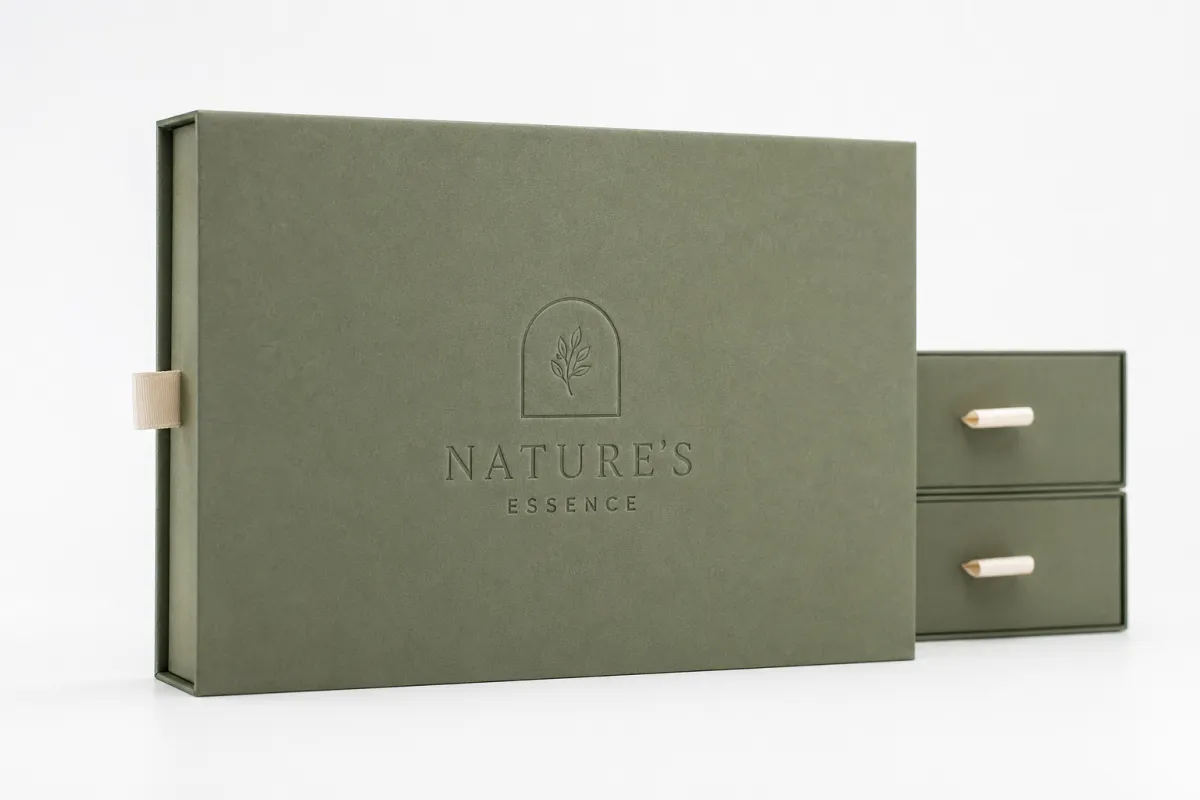
Custom debossed packaging boxes use pressure to press a design inward into the board surface. The logo, monogram, border, or pattern sits below the plane of the material instead of rising above it. That recess catches light in a subtle way, and the hand feels the difference even if the eye catches only a faint shadow line. On a finished 350gsm C1S carton, that tiny detail can be the whole point.
Debossing is not embossing. Embossing raises the design. Debossing sinks it. Foil stamping adds shine or color with a metallic layer, while print-only decoration depends on ink, contrast, and coating. For quiet luxury, custom debossed packaging boxes often do a better job than louder effects because the finish feels deliberate rather than busy. No shouting. No over-explaining. Just a clear signal.
You see this approach in cosmetics, specialty food, apparel, gifting, and subscription packaging. A debossed lid on a rigid candle box can make a $24 product feel closer to an object people leave on a dresser instead of tossing into recycling. A tea brand in London and a fragrance line in Los Angeles may use the same finish, but the emotional read can be totally different. That is why the detail matters more than the category.
Depth takes discipline. More pressure does not automatically mean a better result. The strongest custom debossed packaging boxes usually balance board thickness, artwork simplicity, and impression depth so the recess stays crisp and the paper fiber does not look bruised. Fine serifs, tight spacing, and too much copy can collapse the effect fast. On the press, elegance usually comes from subtraction. Or put another way: leave the box alone enough to breathe.
"If the box feels right in the hand, customers forgive a lot of things." A cosmetics buyer told me that during a review in Guangzhou, and I have never really shaken it off. The tactile signal lands first. After that, people are surprisingly generous about the rest, even when the unit price sits around $0.15 to $0.28 at 5,000 pieces.
Custom debossed packaging boxes work best when a brand wants to say less, not more. One clear mark, one calm surface, and a board that keeps its shape usually look more confident than a design trying to prove itself with five effects at once. Loud packaging can be expensive to make. Quiet packaging often ends up looking more expensive once it is in the wild, especially if the run ships from Shenzhen to a domestic warehouse in Los Angeles within 18 to 22 days door to door.
How Do Custom Debossed Packaging Boxes Work?
Custom debossed packaging boxes work by pressing a metal die or plate into paperboard, rigid board, or a wrapped surface so the design sits below the material plane. That inward movement creates a shadow line, and that shadow is what gives the box its tactile pull. On the right substrate, custom debossed packaging boxes feel calm and precise; on the wrong one, they can look tired or crushed. The difference is small on paper and obvious in the hand.
In practical terms, the press applies controlled force, the board compresses in a measured way, and the recess holds its shape after the tooling lifts away. The cleaner the board and the more disciplined the artwork, the sharper the finish. That is why custom debossed packaging boxes usually perform best with minimalist branding, stronger paperboard, and enough testing to confirm the impression depth before production starts.
A good deboss also depends on balance. Too shallow, and it disappears under normal lighting. Too deep, and the board starts to look bruised. I have watched buyers ask for a stronger hit because they wanted the logo to feel "more premium," then change their minds once they saw fiber crush around the edges. The better question is not how deep the impression can go. It is how much depth the stock can hold cleanly.
How Custom Debossed Packaging Boxes Are Made
The production path starts with artwork and ends with controlled pressure. A logo or design is converted into tooling, usually a die or plate, and that tooling is set on the press so the impression lands exactly where the dieline calls for it. With custom debossed packaging boxes, the operator is watching registration marks, checking alignment, and tuning dwell time so the board gets enough force without losing its shape. In a Dongguan plant, a skilled operator can spot a 0.2 mm shift before the run goes sideways. It looks simple from the outside. It is not simple. Not even close.
In press checks, a tiny change in pressure can separate a clean recess from a fuzzy edge. That is why test pulls matter. A solid run of custom debossed packaging boxes usually begins with samples, moves to a proof, then ends with a close look at depth, edge sharpness, folding behavior, and how the carton reacts once it is assembled. If the sample feels tired in the hand, the final run will not rescue it later. The press has a memory, but it is not that forgiving. A 24-hour sample turnaround is possible in Shenzhen if the art is final and the board is already in stock.
The substrate matters more than most buyers expect. Coated folding carton usually gives a sharper impression because the surface is smoother. Rigid box board delivers a heavier hand feel and usually supports a more luxurious presentation. Specialty papers can look beautiful, though some textures soften the recess or blur detail under pressure. I have seen the same deboss look razor-clean on 350gsm C1S artboard and oddly sleepy on a 320gsm textured sheet from Zhejiang. Same art. Same file. Different mood. Packaging can be rude like that.
Two main approaches show up most often. Blind debossing uses texture only, with no ink or foil inside the impression. Registered debossing aligns the recess with print, foil, or a coated panel. Blind debossing suits minimalist custom debossed packaging boxes. Registered debossing works better when the logo needs to sit inside a printed field or coordinate with a metallic accent. A blind deboss on a navy lid can feel calmer than a gold foil mark, and at $0.18 per unit it may leave more budget for the insert tray.
Boards have limits. Fibers crush after a certain point, and that limit is not a theory exercise; it is a factory one. Ask for too much depth on a thin sheet and the result can show halos, warp, edge distortion, or a worn-looking mark that no luxury brand wants. The best custom debossed packaging boxes respect what the substrate can carry instead of trying to bully it into submission. On a 300gsm sheet, a deep stamp can ruin the panel; on 1200gsm rigid board, the same stamp can stay crisp across 10,000 units. Paper can be stubborn. So can procurement teams.
- Artwork prep: clean vector files, clear line weights, and a deboss layer marked on the dieline.
- Tooling: die or plate made to match the logo or graphic area, usually finished in 3 to 5 business days.
- Press setup: pressure, dwell time, and alignment tuned for the board.
- Press checks: test pulls reviewed before the full run starts.
- Finishing: folding, gluing, and packing after the tactile feature is locked in.
At a trade meeting with a snack brand in Shanghai, I watched a supplier push a 1 mm-deep impression on a thin paperboard tray and call it premium. The sample looked dramatic on the table. Once folded, every fiber crush line showed itself. The buyer rejected it in under a minute and moved to a subtler 0.4 mm impression that made the final custom debossed packaging boxes feel calmer and more expensive. I could almost hear the board sigh with relief.
Key Factors That Shape the Finish and Price
If you are comparing custom debossed packaging boxes, substrate comes first. Board thickness, coating, fiber content, and surface smoothness all affect how crisp the recessed image looks and how much setup the press team needs. A smoother and better-built sheet may cost more at the start, yet it often saves time during setup and produces a cleaner finish on the final box. I have learned the hard way that the cheapest board is rarely the cheapest result, especially when a 350gsm C1S carton at $0.15 per unit outperforms a lower-grade sheet that needs a second sampling round.
Design complexity comes next. Tiny text, dense linework, and delicate logos need tighter tolerances. Tighter tolerances usually mean more tooling care, more sample work, and more press attention. I have seen a simple monogram look elegant at scale, while a detailed crest on the same board turned muddy because the lines were too fine for the stock. That is one of those moments where a brand says, "Can you just make it a little sharper?" and the answer is, politely, not if physics is invited.
Run length changes the math quickly. Tooling costs stay relatively fixed, so a short run spreads that setup across fewer boxes and pushes the per-unit figure higher. Larger production lowers the unit price, which is why custom debossed packaging boxes tend to make the most financial sense once the order volume can absorb the die charge. A tooling fee of $180 to $420 can feel sharp on 300 units, then disappear into the background on 5,000 pieces. That setup fee can sting a little, but it stops feeling dramatic once you stop pretending 300 boxes should price like 30,000.
Depth, placement, and the number of debossed areas matter just as much. One centered logo on a lid is easier than three impression zones that have to align across a sleeve, a tuck flap, and an insert. Multiple hit areas call for more press time and tighter control, and that adds cost in ways buyers often miss during the first quote review. Every extra hit is another chance for the press to remind you who is actually in charge, especially on a three-part setup that has to hold registration within 0.5 mm.
Brand context sits in the background too. Some boxes need to ship flat. Some need to live on a retail shelf. Some need to survive repeated handling in a boutique or subscription setting. If the box has to feel premium before the customer opens it, custom debossed packaging boxes often earn their keep because the tactile cue carries part of the brand story for you. A $42 candle in New York or a $68 skincare set in Seoul will benefit from a box that feels engineered, not just printed. That is a subtle kind of persuasion, and subtle is underrated.
| Option | Best Use | Typical Setup | Approx. Unit Cost at 5,000 Pieces | Notes |
|---|---|---|---|---|
| 350gsm C1S artboard | Retail cartons, sleeves, lighter cosmetics | Moderate tooling, clean press response | $0.15 to $0.24 | Good balance of crisp detail and efficiency for custom debossed packaging boxes |
| Rigid box board | Luxury presentation boxes, gifting, electronics | More substantial setup, stronger hand feel | $0.48 to $0.82 | Excellent for premium branded packaging and deeper impressions |
| Textured specialty paper over board | High-end gift packaging, artisan goods | Careful testing to protect detail | $0.29 to $0.57 | Beautiful look, but not every logo stays sharp in custom debossed packaging boxes |
| Soft-touch laminated board | Cosmetics, subscription, prestige retail packaging | Extra finishing pass, refined hand feel | $0.25 to $0.46 | Pairs well with blind debossing when the brand wants a matte, tactile finish |
For brands shopping through Custom Packaging Products, I always suggest comparing two board options side by side rather than settling for one. The lower-cost sheet may look fine on paper and still make the custom debossed packaging boxes feel flatter in hand. A slightly heavier board can sharpen the edge, reduce rework, and save a second sampling round. The difference sounds minor until you hold both samples and realize one of them feels like a brand and the other feels like paperwork.
Shipping weight, storage space, and brand perception also shape every quote. A box that looks beautiful but ships poorly can erode margin fast. A design that consumes too much warehouse space can create headaches for a small fulfillment team. Packaging design has to survive the back room, the truck, and the retail shelf, not just the mockup file. That part gets ignored until someone in operations starts muttering under their breath in a 14,000-square-foot warehouse, and then everyone suddenly cares.
Custom Debossed Packaging Boxes: Pricing and Timeline
Pricing for custom debossed packaging boxes makes more sense when it is split into two buckets: tooling and unit cost. Tooling covers the die or plate. Unit cost covers board, finishing, press time, packing, and any handwork after the impression is made. That distinction matters because a quote that looks expensive at the front end may still be the best value once the run size grows. I have seen teams obsess over a few cents per unit and completely miss the tooling line, which is a little like shopping for a car and forgetting the engine exists.
On a recent quote review in Dongguan, a simple blind deboss on a 350gsm C1S carton came in at $0.15 per unit for 5,000 pieces, with tooling billed separately at $220. A rigid presentation version with foil and a deeper impression landed closer to $0.62 per unit at the same quantity. Those figures are not a promise. Plants vary. Board grades vary. Press conditions vary. They do, though, reflect how custom debossed packaging boxes usually price out on the floor.
Here is the timeline I usually give buyers when artwork is clean and the supplier has the right board in stock:
- File review: 1 to 2 business days for dieline, artwork, and deboss area checks.
- Tooling: 3 to 5 business days to create the die or plate.
- Sample approval: 2 to 4 business days, depending on whether one or two rounds are needed.
- Production: 6 to 10 business days for a mid-size run of custom debossed packaging boxes.
- Quality check and packing: 1 to 2 business days.
- Freight or delivery: depends on destination and shipping method.
That puts a straightforward project at about 12 to 15 business days from proof approval if the schedule stays stable and nothing changes. Once a client starts revising artwork after the proof is locked, the clock stretches. I have seen a cosmetics launch slip because the marketing team adjusted the logo spacing after the die had already been cut, which forced the custom debossed packaging boxes back into correction. Nobody said "fun" while that happened. Nobody. In a rush scenario, even a 48-hour artwork change can turn a 15-day plan into a 20-day plan.
Two outside standards help teams keep the process disciplined. The first is ISTA, which is useful when you want to think about distribution testing and how the pack behaves in transit. The second is FSC, which matters when sourcing paper and board responsibly for branded packaging programs. A supplier in Shenzhen or Ho Chi Minh City that can speak clearly about both usually saves time later.
Ask suppliers for both a per-box price and a landed cost estimate. The landed number should include tooling, samples, freight, and any secondary finishing so you can compare quotes without hidden gaps. I have seen teams choose the cheapest unit quote only to find that freight and sample charges made the final custom debossed packaging boxes more expensive than a clearer all-in proposal from another supplier. A cheap quote with surprise add-ons is not cheap. It is just delayed frustration.
Step-by-Step Guide to Ordering Custom Debossed Packaging Boxes
The strongest orders begin with the product, not the decoration. Before asking for a price on custom debossed packaging boxes, define the message the box has to carry: luxury, freshness, precision, warmth, or giftability. A serum bottle, candle, or subscription item all ask for slightly different tactile cues, and the surface treatment should support that story instead of distracting from it. I tend to ask people what they want the customer to feel first, because "make it pop" tells me almost nothing, and neither does "premium" without a number, a product weight, or a launch date.
Step one is structure and material. A folding carton works well for lighter products and retail packaging. A rigid setup box gives more presence and protects the impression better during handling. For custom debossed packaging boxes, I usually want the product weight, shipping method, and expected shelf life of the carton before I recommend a board grade. Otherwise you are guessing, and packaging guesses tend to be expensive ones. A 180g face cream jar and a 1.2 kg gift set should not land on the same specification sheet.
Step two is artwork preparation. The deboss area should be marked clearly on the dieline, and the logo file should be clean enough that line weight, spacing, and font size survive the press. Small typography is risky on custom debossed packaging boxes, especially when the customer wants a deep impression and a matte finish, because the board has less forgiveness once pressure enters the picture. I am a fan of simpler art here. Simple is not boring. Simple is readable. On a 12-point serif, a 0.25 mm line can vanish; on a bold sans serif, the same press mark stays legible.
Step three is sampling. Never skip it. Digital mockups can show placement and color, but they cannot show how custom debossed packaging boxes will feel in the hand, how the board folds, or how the edge of a logo catches the light. I have watched buyers move from a flat print-only version to a debossed one after touching a sample because tactile appeal is often stronger than a render suggests. Screens lie a little. Paper tells the truth immediately, and it does it with a texture you can feel in under ten seconds.
Step four is proof approval. At this stage, the client should check registration, depth, color interaction, and carton performance through folding, packing, and basic transit handling. If the lid closes too tightly or a fold line breaks near the impression, the issue should be fixed before production, not after 10,000 custom debossed packaging boxes have already been printed and packed. That is the kind of mistake that keeps project managers awake and makes accountants stare into the middle distance. A clean proof on Tuesday can save a Friday freight booking.
For brands building a larger packaging system, I often suggest reviewing the full range of our custom packaging products at the same time. That makes it easier to align custom debossed packaging boxes with inserts, mailers, sleeves, or retail cartons so the kit feels like a single family rather than a stack of unrelated parts. A brand that ships from one fulfillment center in New Jersey or a third-party warehouse in Nevada benefits when all the components are spec'd together from the start.
Here is a practical order checklist I give new buyers:
- Dimensions: product size, fill weight, and any insert requirements.
- Quantity: target run size, plus a realistic overage buffer.
- Finish: print, foil, soft-touch lamination, or blind debossing.
- Deadline: launch date, receiving window, and shipping plan.
- Brand references: sample cartons, mood boards, or competitive packaging design examples.
That checklist saves time because it gives the supplier enough detail to quote custom debossed packaging boxes accurately the first time. It also cuts down on the back-and-forth that slows launches and drains budget through revisions. If you have ever sat through six rounds of "just one more tweak" on a 2,000-piece order, you know exactly why I push this.
Common Mistakes to Avoid with Debossing
The biggest mistake is overloading the artwork. Dense gradients, tiny taglines, and crowded logos may look strong on screen, then fold into a weaker shape once the press hits the board. On custom debossed packaging boxes, restraint often reads more premium than excess. I know that sounds almost too obvious, but I have watched smart teams forget it anyway because everybody loves a design review when there is a big monitor and too much caffeine.
Another common problem is choosing a substrate that is too light. A thin board can crush, warp, or show fiber break once pressure rises. I saw this on a premium tea carton line in Hangzhou where the marketing team pushed for a thinner sheet to save $0.01 to $0.02 per unit. The custom debossed packaging boxes looked acceptable from a distance, yet close up the impression had a worn, dented edge. The savings were real, but so was the regret.
Skipping samples is risky, especially when the team assumes the digital proof tells the full story. It does not. Custom debossed packaging boxes can look nearly identical on a screen while behaving very differently in the hand, and that tactile surprise shows up only when the first physical sample arrives. And yes, people still say, "It will probably be fine." That sentence has caused more packaging headaches than I can count, especially when the deadline is five business days away.
Finish compatibility is another place where projects go sideways. Certain coatings and laminations can reduce impression clarity or change how the press behaves, especially if the surface has too much slip or too much stiffness. I have had buyers ask for high-gloss film, deep deboss, and tiny typography on the same custom debossed packaging boxes, then wonder why the detail looked crowded. Each finish adds a constraint, and the press can solve only so many at once. It is not a miracle machine, no matter how people talk about it in meetings.
Lead time gets underestimated as well. Tooling needs room. Sampling needs room. Approvals need room. If your retail packaging has to meet a campaign date or freight booking, build extra margin into the schedule. A rushed launch team always asks for custom debossed packaging boxes to move faster than physics allows, and that is how mistakes get locked into production. A project planned for 14 business days can slip to 19 the moment the die changes or the board arrives late from a mill in Zhejiang.
For shipping and distribution, I like to think in the same disciplined way the ISTA test framework does: if the box is going to travel, stack, shake, and sit in a warehouse, the tactile finish has to survive that trip without losing its shape. That mindset saves trouble later and, honestly, saves a few people from having to explain themselves in a meeting that nobody wants to be in.
Here are the errors I watch for most often:
- Too much detail: small type and crowded graphics lose clarity.
- Too little board strength: the impression crushes or distorts the carton.
- No sample round: digital approval is not a tactile approval.
- Finish conflict: coating or lamination fights the deboss.
- Late changes: artwork edits after tooling slow the whole run.
In a supplier negotiation for a specialty candle brand in Austin, I once watched the buyer trade a full-color front panel for a simpler mark and a stronger deboss. The job became easier to run, and the final custom debossed packaging boxes looked more expensive because the design stopped trying to impress with everything at once. That was one of those rare meetings where everyone left the room a little happier than they entered it.
Next Steps for Custom Debossed Packaging Boxes
If you are ready to move, start with the basics: dimensions, product weight, quantity target, and brand references. Those four details help a supplier quote custom debossed packaging boxes without guessing, and they make it easier to compare one factory’s answer against another’s. The more concrete your input, the cleaner the packaging proposal will be. No mystery. No "we'll figure it out later." Later is where budgets go to hide, and a $3,500 packaging buy can become a $4,200 one surprisingly quickly.
Then ask for at least two material options and two deboss depths. That comparison shows how the same artwork behaves across different boards and keeps the conversation grounded in reality. One of the strongest things about custom debossed packaging boxes is that the finish can shift from subtle to luxurious with only a few changes in stock, thickness, or pressure. I like seeing those side by side because they tell the truth faster than any sales pitch. A 350gsm C1S sample and a 1200gsm rigid sample can settle a debate in under a minute.
Request a sample kit or press proof, and examine it under the lighting you actually use in the office, studio, or store. A box that looks calm under cool LED light may read richer under warm retail lighting, and the reverse can happen too. That is one reason custom debossed packaging boxes should always be reviewed in the hand, next to the product they will carry. A render cannot tell you how a shadow will behave at the point of sale, and the shadow is often the whole story. I have seen a deboss disappear under 5000K light and suddenly look beautiful under a 3000K shelf display.
Budget for tooling, samples, freight, and any secondary finishes before you lock the project. It is easier to approve a complete plan than to discover a surprise after the quote has already gone to finance. I have seen teams save themselves a painful second round by treating custom debossed packaging boxes as a full project cost, not just a per-unit line item. That simple shift avoids the kind of awkward silence that follows a budget overrun email. If the total lands at $1,980 for a 5,000-piece order, finance can plan for it; if freight adds $240 later, everyone has to reopen the spreadsheet.
When the final review comes around, ask one last question: does the box still say the right thing about the brand when it is closed, picked up, opened, and set back down? If the answer is yes, the design is doing its job. The strongest custom debossed packaging boxes feel intentional from the first touch to the last unboxing, and they leave the customer with the sense that someone cared about every millimeter.
For brands building premium retail packaging, Custom Printed Boxes, or a larger branded packaging system, I would start with a small test run, compare the samples side by side, and trust the tactile result more than the computer render. That is usually where the real answer lives. Computers are useful, of course. They just do not have fingertips, and they cannot tell you whether a 0.5 mm recess feels crisp or merely decorative.
custom debossed packaging boxes are at their best when they feel calm, precise, and practical all at once. Choose the Right board, keep the artwork disciplined, and leave enough time for tooling and proofing. The result is packaging that does more than hold a product; it helps the product feel worth opening, worth keeping, and worth remembering. For custom debossed packaging boxes, that is the whole point: not louder branding, but better branding. That is the part brands want, even if they do not always say it out loud.
How much do custom debossed packaging boxes cost?
Pricing usually depends on die or plate tooling, board type, box style, run size, and whether you add print, foil, or soft-touch coating. On a 5,000-piece order, a simple 350gsm C1S carton can land around $0.15 per unit, while a rigid gift box with foil and a deeper deboss may reach $0.62 per unit. Tooling often falls between $180 and $420. Ask for both tooling cost and landed cost so you can compare quotes accurately. I always tell buyers to look at the whole bill, not just the shiny part that makes the spreadsheet feel nice.
What materials work best for custom debossed packaging boxes?
Thicker paperboard and rigid board usually produce the cleanest impressions because they hold detail without crushing. A 350gsm C1S artboard is a strong starting point for folding cartons, while 1200gsm greyboard wrapped in printed paper works better for luxury presentation sets. Smoother coated stocks can create sharper edges, while textured papers may soften the effect. The best choice depends on the depth of the deboss and how premium the final box should feel. If the brand wants a crisp, polished look, I usually lean toward a stronger board rather than gambling on a flimsy one.
How long does it take to make custom debossed packaging boxes?
Timeline typically includes artwork setup, die making, sample approval, production, and freight delivery. A straightforward project can take 12 to 15 business days from proof approval, assuming the board is available and the artwork is final. Simple projects can move quickly if materials are in stock, while complex premium boxes need more sampling time. Build in extra time if your launch date is fixed, because approval delays are one of the biggest scheduling risks. The fastest way to lose a week is to "just make one more change" after the proof is already approved.
Can debossing be combined with foil or spot UV?
Yes, debossing is often paired with foil stamping or spot UV to create contrast between texture and shine. The order of operations and exact registration matter, so the supplier should confirm what can be achieved cleanly on your substrate. A restrained combination usually looks more premium than trying to use every finish at once. I like one strong accent far more than three effects fighting for attention, especially on a 350gsm carton or a soft-touch laminated rigid box.
Is debossing better than embossing for premium packaging boxes?
Neither is automatically better; debossing creates a recessed effect, while embossing raises the design above the surface. Debossing often feels more understated and modern, especially for minimalist branding and luxury presentation. Choose the effect that best matches the brand personality, artwork, and board thickness. If the goal is quiet confidence, custom debossed packaging boxes usually land that message beautifully, whether the order ships from Shenzhen, Dongguan, or Guangzhou.

