Buyer Fit Snapshot
| Best fit | Sustainable Packaging projects where brand print, material claims, artwork control, MOQ, and repeat-order consistency need to be specified before quoting. |
|---|---|
| Quote inputs | Share finished size, material target, print colors, finish, packing count, annual reorder estimate, ship-to region, and any compliance wording. |
| Proofing check | Approve dieline scale, logo placement, barcode or warning zones, color tolerance, closure strength, and carton packing before bulk production. |
| Main risk | Vague material claims, crowded artwork, missing packing details, or unclear freight terms can make a low unit price expensive after revisions. |
Fast answer: Sustainable Packaging: Buyer Fit Matrix should be specified like a repeatable production item. The safest quote records material, print method, finish, artwork proof, packing count, and reorder notes in one written spec.
Production checks before approval
Compare the actual filled-product size with the drawing, then confirm tolerance on folds, seals, hang holes, label areas, and retail display edges. Reserve space for logos, QR codes, warning copy, and material claims before decorative graphics fill the panel.
Quote comparison points
Review material grade, print process, finish, sampling route, tooling charges, carton quantity, and freight assumptions side by side. A quote is only useful when the supplier can repeat the same color, closure quality, and packing count on the next order.
What is sustainable packaging, really? Strip away the buzzwords and you usually get a set of practical trade-offs: less empty space, fewer mixed materials, smarter printing, better protection, and a clear plan for what happens after the box is opened. A package can look eco-friendly and still waste corrugate, ink, fuel, or shelf space. That is why what is sustainable packaging works better as a systems question than a material-label question. If you want the short version, it is packaging that does less harm without getting lazy about performance.
From a packaging buyer's point of view, the conversation gets real fast. Oversized cartons add inches of air, and that extra volume quietly raises freight cost, warehouse space, and damage risk all at once. So what is sustainable packaging is not about forcing everything into paper. It is about building product packaging that uses only what it needs, protects what matters, and fits the recovery systems already in place. The smartest answer usually starts with size, then moves to substrate.
For brands that invest in branded packaging, Custom Printed Boxes, or retail-ready shipper formats, the answer matters even more. The right package branding should support the product, not smother it with extra layers. And yes, the right packaging design can cut waste and improve the unboxing experience at the same time. That part gets missed a lot when people ask what is sustainable packaging. It is not just a material choice. It is a design choice, a logistics choice, and a recovery choice.
What Is Sustainable Packaging? Definition and Why It Matters
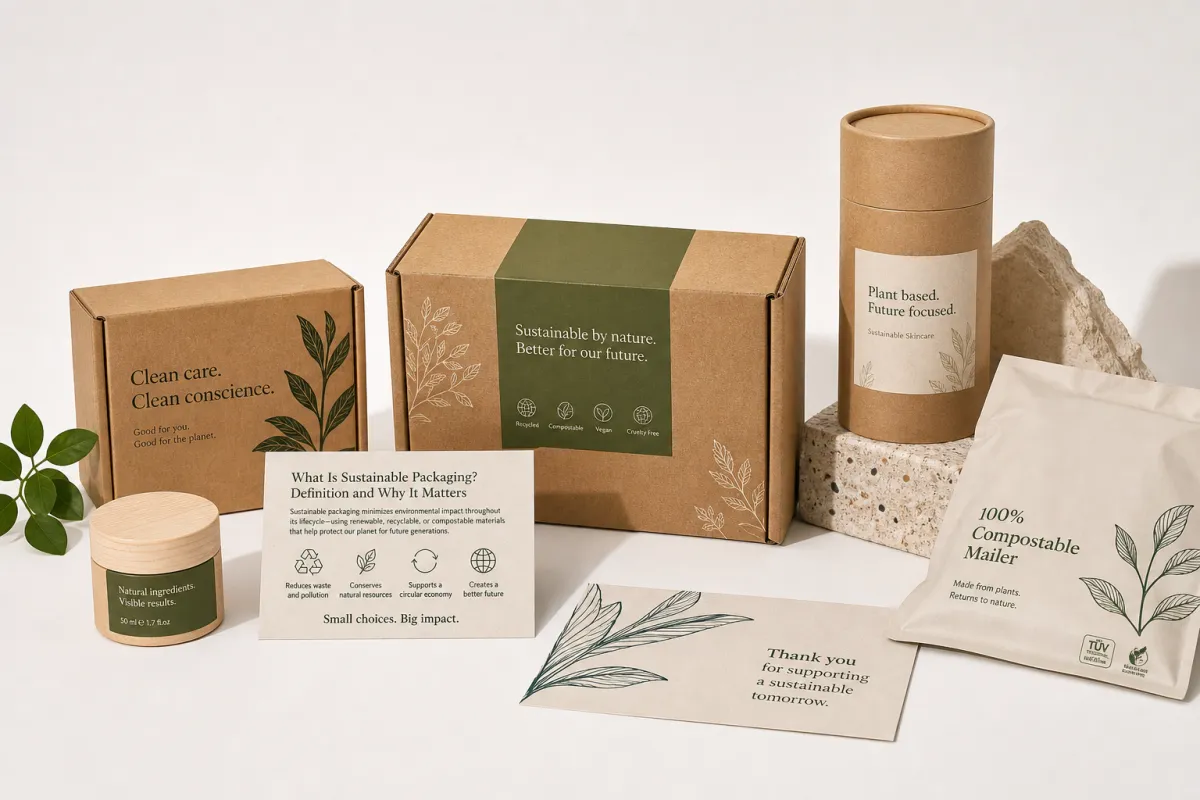
At its simplest, what is sustainable packaging? It is packaging designed to reduce environmental impact across the full life cycle: materials, manufacturing, shipping, use, and end-of-life recovery. That sounds broad because the problem is broad. A package is not just a shell. It is structure, marketing space, logistics gear, and sometimes part of the product's safety system. Each job brings a different set of sustainability decisions, which is exactly why a life cycle assessment can be useful when the stakes are high.
Here is the part people confuse most often. Recyclable, recycled, compostable, reusable, and source-reduced are not the same thing. A carton made with 80% recycled fiber may still be too large. A compostable mailer may be hard for consumers to dispose of correctly. A reusable tote can be great for one channel and awkward for another. So when someone asks what is sustainable packaging, the practical answer is usually the format that balances material use, performance, and recovery for a specific use case. Mono-material design often helps because it removes friction from sorting and recycling.
Why does that matter right now? Buyers, retailers, regulators, and freight teams are all pushing in the same direction. Retailers want cleaner claims and easier-to-handle packs. Brands want stronger differentiation without bloated materials. Operations teams want fewer damages and faster packing. Transportation costs still punish every extra inch. In practice, what is sustainable packaging is also a cost-control conversation, which is why it shows up in product development meetings far outside the sustainability team. Add extended producer responsibility to the mix and the pressure gets even louder.
There is also a credibility issue. Green claims without proof backfire. ASTM test data, FSC chain-of-custody documentation, recycled content statements, and clear disposal guidance carry more weight than vague language or a green panel on the front. Packaging buyers do not need slogans. They need evidence. That is especially true for retail packaging and premium custom packaging, where the box has to look good, ship well, and survive a consumer's hands. If the claim is vague, the market usually notices.
A package that survives the trip, fits the product, and uses the least material it reasonably can is usually the greener one. The hard part is proving "reasonably" with actual data instead of gut feel.
One more point deserves a straight answer: what is sustainable packaging is not a single material choice. It is a chain of better decisions. Sometimes that means moving from multi-layer construction to a mono-material format. Sometimes it means shrinking the carton footprint by 15% and removing a dunnage component. Sometimes it means using recycled corrugated board with a simpler print layout. These are not flashy gestures. They are the kinds of changes that actually move waste and cost. They also make the rest of the supply chain less annoying.
How Sustainable Packaging Works Across the Supply Chain
To understand what is sustainable packaging, follow the package instead of the slogan. It starts with sourcing and converting, where fiber, resin, coatings, and adhesives are chosen. It moves into printing and die-cutting, where design choices can either help recovery or make it messier. Then it goes through packing, palletizing, shipping, use, and disposal or reuse. Every step can add or subtract impact.
Source reduction is often the strongest lever because it cuts more than one problem at once. Remove 10% of the board weight and you may lower raw material use, freight density, and warehouse storage. Remove half an inch of empty space and you may reduce dimensional weight charges and the chance of product movement in transit. That is why what is sustainable packaging often starts with size, not substrate. A smaller, better-structured carton may outperform a more "eco" material in the real world because it simply uses less.
Material choice still matters. Paperboard works well for many retail presentation packs and lightweight products. Corrugated board is the workhorse for shipping and e-commerce. Molded fiber is gaining ground for inserts and protective trays, especially where a rigid, fibrous feel supports brand perception. Mono-material plastics can make recovery easier in some applications, and flexible formats can cut weight sharply when the product and distribution system allow it. None of these is automatically best. The right answer depends on product load, transit distance, and end-of-life pathway.
That is the operational side of what is sustainable packaging. The visual side matters too. A package that is easier to open, easier to sort, and easier to recycle is better than one that looks "natural" but frustrates the user. Simple graphics, controlled ink coverage, and fewer decorative laminations can help. So can smarter packaging design that treats structure and shelf presence as one job instead of two separate projects. The result is less waste and less guesswork.
If you want a useful benchmark, start with the full system. Ask: does the package protect the product in storage, on the line, in distribution, and in the consumer's home? Does it fit current recycling systems? Does it slow packing labor? Does it raise return rates? If the answer to any of those is yes, what is sustainable packaging becomes less abstract and a lot more measurable. That is where the real decisions start.
For guidance on recovery systems and material categories, the U.S. EPA recycling resources are a solid starting point. For transit and distribution testing, the ISTA standards are widely used in shipping-focused packaging work. Both are useful when teams want more than a nice-looking mockup.
Key Factors That Make Packaging Actually Sustainable
What is sustainable packaging in measurable terms? It usually comes down to six or seven decision points that can be scored, tested, and compared. Ignore one of them and the whole package can drift toward waste. That is why strong packaging teams look at the full list instead of chasing one green feature and calling it a day. The point is not purity. The point is balance.
- Material footprint - How much raw material is needed per unit, including board weight, film thickness, and insert volume.
- Recycled content - Whether the substrate includes post-consumer or post-industrial material, and how steady that supply is.
- Recyclability - Whether the format can realistically enter current recovery systems where the product is sold and used.
- Compostability - Whether the material is certified for a real disposal route, not just marketed as compostable.
- Reusability - Whether the package can survive multiple trips or uses without turning into a burden.
- Compatibility - Whether coatings, adhesives, and inks work with existing sorting and recycling streams.
Right-sizing deserves its own mention because empty space is expensive in more ways than one. Oversized packaging uses more corrugate, more void fill, more truck space, and more shelf real estate. It also increases the odds of product movement. A package that looks "safe" because it is big can be less sustainable if it creates more waste, more fuel use, and more damage claims. That is one reason what is sustainable packaging usually starts with dimensional discipline and not a mood board.
Inks, coatings, adhesives, and lamination choices are easy to miss because they do not dominate the bill of materials. They can still make or break recovery. A heavy plastic film can block fiber recycling. A dark ink load can complicate visual sorting. A pressure-sensitive label with the wrong adhesive can reduce recoverability. Even a nice-looking soft-touch finish can be the wrong choice if the product is sold into a recycling-heavy market and the finish creates a barrier. Good package branding should improve the pack, not bury it in materials the system cannot handle.
Protection and shelf life matter too. That surprises people who think sustainability starts and ends with less material. A heavier package that prevents spoilage or breakage can be the better environmental choice because it avoids product waste. Food packaging is the obvious example, but the logic extends to cosmetics, electronics, and fragile consumer goods. A box that reduces returns by 8% can outperform a lighter box that looks better on paper. So what is sustainable packaging? Often, it is the format that protects the product long enough for the product itself to be used. Waste that never gets created is still the cleanest kind.
Transparency matters as much as structure. Claims should be tied to evidence: recycled content percentages, chain-of-custody documents, drop-test or compression-test results, compostability certifications where relevant, and clear recovery instructions. If a supplier cannot explain how a package behaves in actual use, the sustainability claim is weak. That is true whether the pack is a simple mailer or premium custom printed boxes for a retail launch. It is also true for the cheapest option on the quote sheet.
Sustainable Packaging Process and Timeline: From Brief to Shipment
The process is usually less mysterious than people think. A good team starts by auditing the current pack, then maps the problem before proposing a new structure. That is the most practical way to answer what is sustainable packaging for a specific brand. The answer changes depending on whether the issue is cost, damage, shelf impact, packing speed, or recovery. Same question. Different priorities.
- Audit the current package - Measure dimensions, material weight, damage rate, labor time, and shipping cost.
- Set the goal - Reduce board weight by 12%, remove a plastic insert, improve line speed, or cut dimensional weight charges.
- Choose materials - Compare corrugated, paperboard, molded fiber, mono-material film, or hybrid structures.
- Prototype - Build sample packs and check fit, graphics, closure strength, and assembly time.
- Test - Use drop, compression, vibration, and transit simulation methods aligned with the distribution profile.
- Refine - Adjust flaps, caliper, insert geometry, adhesive coverage, or print coverage.
- Scale - Confirm supplier capacity, QC tolerances, and line compatibility before production.
Timeline varies. Simple graphic updates on an existing structure may move in 10 to 15 business days after proof approval. A structural redesign with new tooling, specialty coatings, or recycled-content verification can take several weeks longer. That is not a delay so much as the cost of doing the work properly. Sustainability claims without testing are guesses, and guessing in packaging usually gets expensive. It also gets repeated, which is worse.
Testing is where the idea meets reality. Drop tests check how corners, seams, and closures behave after impact. Compression tests matter for palletized loads and warehouse stacking. Transit simulation can reveal whether the pack holds up under vibration and repeated handling. Line-speed trials show whether the chosen adhesive set or fold sequence slows down production. If a new structure saves fiber but adds 12 seconds per unit on the packing line, the total outcome may be worse.
That is why what is sustainable packaging cannot be separated from operations. A design that looks elegant in a render may fail in a warehouse if it jams a line or arrives crushed. A design that looks plain may outperform because it is easy to assemble, easier to recycle, and cheaper to ship. Sometimes the most sustainable solution is also the least dramatic one. Good packaging tends to be boring in the best possible way.
For brands using Custom Packaging Products, the best starting point is usually performance requirements, not surface decoration. Size the pack to the product first. Then build the branding around the structure. That order tends to produce better results than the reverse. It also saves time, which nobody ever complains about after the fact.
Honestly, a lot of packaging projects get cleaner fast once the team stops pretending decoration can fix a bad structure. Protection, fit, and recovery first. Fancy second. That shift clears out a lot of nonsense and makes what is sustainable packaging easier to answer with actual numbers.
What Is Sustainable Packaging? Costs and What Changes Pricing
Cost is where most teams stop talking in abstractions. So let's be direct: what is sustainable packaging from a pricing angle? Sometimes it costs more per unit. Sometimes it costs less. Often it lands in the middle once freight, storage, labor, and damage are included. The only honest answer is that unit price is not the whole story. Total landed cost is the part that matters.
Here is a practical way to compare options. These numbers are directional, not universal, and they assume a medium-volume run rather than a tiny sample order.
| Packaging option | Typical unit range | Operational impact | Sustainability notes |
|---|---|---|---|
| Standard corrugated mailer | $0.28-$0.55 each at 5,000 units | Easy to source; good for shipping and e-commerce | Strong recyclability when kept mostly fiber-based |
| Source-reduced corrugated mailer | $0.25-$0.48 each at 5,000 units | Less board, lower dimensional weight, less storage | Often one of the best answers to what is sustainable packaging |
| Molded fiber insert with paperboard carton | $0.40-$0.85 each at 5,000 units | Good protection for fragile products; can add assembly steps | Useful when plastic inserts are being phased out |
| Mono-material flexible pouch | $0.12-$0.30 each at 10,000 units | Lightweight and efficient, but not for every product | Can improve recovery if local systems accept the material |
| Premium retail carton with specialty finish | $0.55-$1.20 each at 5,000 units | Strong shelf presence; higher print and finishing complexity | Can still be sustainable if the structure is lean and the finish is compatible |
The biggest price drivers are predictable. Substrate choice matters, but so do order quantity, print complexity, coatings, tooling, and automation compatibility. Recycled-content materials can carry a premium if supply is tight. Specialty coatings, foil, and heavy lamination add cost quickly. A custom cutter rule or new insert mold adds upfront expense, though that can fade over higher volumes. If a buyer only looks at the first invoice, what is sustainable packaging may appear expensive. If the buyer looks at total landed cost, the answer often changes.
There is also a freight argument that people underestimate. Reducing package dimensions by even a small amount can improve pallet utilization. That may increase units per pallet, lower truckloads, or reduce dimensional-weight charges for parcel shipments. On a 25,000-unit annual run, small savings per unit can add up to a meaningful budget difference. The same is true for labor. A faster-assembling pack may shave seconds off each order, and seconds become hours quickly. That is not dramatic. It is just math.
For branded packaging and retail packaging, the trick is finding the point where brand presentation and total cost line up. A cleaner structure with simpler print can look more premium than a crowded one. That is one reason sustainable custom printed boxes can be surprisingly competitive once the design is disciplined. The cheapest box is not always the cheapest packaging.
Ask suppliers for scenario-based quotes. Compare the current pack against a source-reduced version and a premium sustainable option. Then ask for labor estimates, freight estimates, and likely damage-rate changes. That side-by-side view gives a much clearer answer to what is sustainable packaging than a unit-price spreadsheet ever will. Quotes are useful. Context is better.
Common Mistakes When Choosing Sustainable Packaging
The first mistake is treating one green attribute as proof of overall sustainability. A package can be recyclable in theory and still be poorly recovered in practice if local systems do not collect it. That is a common issue with certain plastics, composite structures, and niche films. So what is sustainable packaging if the recycling stream cannot handle it? Usually, it is not as sustainable as the marketing says. Labeling does not fix infrastructure.
The second mistake is overdesign. Extra layers, mixed materials, decorative wraps, and unnecessary coatings can make recovery harder and raise cost without improving performance. I see this a lot in packaging design reviews: a team adds a liner, a sleeve, an insert, a seal, and a special finish, then wonders why the package gets heavier and less recyclable. Fancy is not the same thing as efficient. Sometimes it is the opposite. Sometimes it is just expensive clutter.
The third mistake is ignoring the product. Packaging is there to serve the product, not the other way around. Fragile items, perishables, and high-value goods often need a more protective structure. If a "greener" pack raises damage or spoilage, the total environmental cost can be worse. Product waste is still waste. That is why what is sustainable packaging needs to include protection, shelf life, and handling conditions. Skip that part and the whole thing falls apart.
The fourth mistake is misunderstanding compostable claims. Compostable packaging usually needs the right facility and the right disposal behavior. If consumers do not have access to industrial composting, the package may end up in landfill or the wrong recovery stream. That does not make compostable formats useless. It just means the claim must match local reality. A package that is compostable in one market may be a poor fit in another.
The fifth mistake is skipping tests. Swapping materials without checking line performance or transit behavior can create new failure points. A lighter carton can crush. A new adhesive can slow down a pack-out line. A different coating can scuff in distribution. A design that saves 8 grams of material but doubles returns is not a win. What is sustainable packaging, in that case? Probably an unfinished experiment with a nice label.
One simple safeguard helps a lot: test the new format against the current one using the same criteria. Measure damage, pack time, freight density, and recovery route. If the new package only looks better on a render, keep working. If it performs better in practice, you have something worth scaling. That is how the better options separate themselves from the pretty ones.
That is the difference between surface-level "green" and actual improvement. The second one takes more work. It also sticks around longer. Customers notice the difference even if they cannot name it.
Expert Tips and Next Steps for Smarter Packaging Decisions
If you are trying to answer what is sustainable packaging for your own product line, start small and stay specific. Audit one current package. Find the two biggest waste drivers. For many brands, those are usually excess size and unnecessary mixed materials. Fix those first. The gains are often easier to measure, and they create momentum for the next round of improvements. Momentum matters because packaging projects like to stall in meetings.
A practical packaging scorecard helps. Put protection, sustainability, Cost, and Production speed on the same sheet. If one option wins on eco-claims but loses badly on damage rate, it is not a clean win. If another option uses a little more material but cuts freight and returns, it may be the better answer. A scorecard keeps the decision grounded in facts instead of preference. It also keeps the loudest person in the room from winning by default.
Ask suppliers for proof points. Recycled content statements. Test data. FSC documentation where fiber claims matter. End-of-life guidance that matches the market where the product ships. If a supplier can model structural changes before samples are approved, even better. That kind of support can save both time and wasted prototype rounds. It also gives you a cleaner answer when somebody asks what is sustainable packaging and expects more than a shrug.
- Start with a packaging audit, not a redesign fantasy.
- Measure the current carton size, weight, and damage rate.
- Test one source-reduced option alongside the current pack.
- Check whether the finish, adhesive, or insert blocks recovery.
- Compare total landed cost, not just unit price.
For brands building long-term systems, sustainable decisions tend to compound. A slightly smaller mailer can reduce freight. A cleaner insert can speed assembly. A simpler print spec can improve recyclability. A better-structured retail carton can support stronger package branding without extra layers. That is why what is sustainable packaging is not a slogan. It is the result of practical design choices that reduce Waste Without Sacrificing performance. Small changes stack up fast.
If your team is evaluating Custom Packaging Products, make the brief specific: product dimensions, weight, transit method, shelf requirements, target recycled content, and recovery expectations. The better the brief, the better the answer. And the better the answer, the less likely you are to buy waste disguised as packaging. Specific briefs beat vague intentions every time.
To close the loop, what is sustainable packaging? It is packaging that does its job with less waste, less confusion, and fewer hidden penalties. It protects the product, respects the supply chain, and gives the consumer a clear path after use. That is the standard worth aiming for, especially when custom design gives you the chance to get it right from the start. If a package is smaller, simpler, and still protects the product, you are probably headed in the right direction. If it only looks green, keep digging. Marketing is cheap. Shipping is not.
What is sustainable packaging made from?
It can be made from recycled paperboard, corrugated board, molded fiber, mono-material plastics, or other lower-impact substrates. The material matters, but the full design matters more. Size, coatings, inks, adhesives, and end-of-life recovery all affect the answer to what is sustainable packaging. A good choice depends on the product, shipping environment, and disposal route. There is no single magic substrate that wins every time.
Is sustainable packaging always recyclable?
No. Some sustainable formats are reusable or compostable instead, and some recyclable items are only accepted in limited local systems. A package is not automatically sustainable just because it has a recycling symbol. The best answer depends on local infrastructure and the product's protection needs. Recovery has to exist in the real world, not just on the label.
Does sustainable packaging cost more?
Not always. Upfront material prices may be higher, but savings can show up in freight, storage, damage reduction, and faster packing. Right-sized packaging often lowers total cost even if the substrate itself is not the cheapest option. The smartest comparison is total landed cost, not just unit price. That is where what is sustainable packaging often turns into a budget win.
How do I know if packaging is truly sustainable?
Look for measurable proof: recycled content, source reduction, testing data, certifications, or clear recovery instructions. Ask whether the package performs well at scale, because failed packaging creates waste fast. Be cautious of broad claims that are not tied to a specific material, region, or use case. Real proof beats pretty claims every time.
Can custom packaging still be sustainable?
Yes, and often that is where the biggest gains happen because custom design can remove excess size, weight, and filler. Custom packaging makes it easier to match protection to the product, which reduces damage and replacement waste. The best custom solution balances brand presentation, operational efficiency, and end-of-life recovery. That is usually what people mean when they ask what is sustainable packaging and want a useful answer, not a marketing line.

