Custom Die Cut Boxes Wholesale Pricing: What to Expect
Custom die cut boxes wholesale pricing looks tidy on a quote sheet until the real work starts adding line by line, and I mean the kind of line items that make a buyer pause, squint, and mutter something under their breath in front of a spreadsheet. Die charges show up. Board upgrades show up. Freight from Shenzhen to Los Angeles shows up. I remember one run where a carton quoted at $0.24 per unit ended up closer to $0.31 once the plant added make-ready waste, glue time, carton packing, and the labor needed to keep the stack clean at the end of the line. That is why I always tell buyers to read custom die cut boxes wholesale pricing as a landed number, not a cheerful headline in an email that looks better than it behaves.
On a packaging floor in Shenzhen’s Longhua district, a buyer once told me the quote was cheap enough to order twice. He said it with a grin, which I appreciated, because the sample arrived two weeks later on the wrong caliper board, and the carton needed a stiffer insert before it could hold the product without bowing like a tired shelf. That mistake added $0.06 per unit before shipping even entered the conversation, and the correction ate another three business days. The factory did not create the problem. The spec did. That is the kind of gap that makes custom die cut boxes wholesale pricing feel inflated when the actual issue is incomplete planning and a little too much optimism.
Wholesale buying still has the edge, though. Once the die line is approved, the board grade is fixed, and the print layout is locked, repeat orders move with less friction and usually cost less per unit because the plant does not have to relearn the job from scratch like it is meeting the same box for the first time. I see custom die cut boxes wholesale pricing behave best when the buyer has a stable carton structure, a clear packaging schedule, and a product line that can repeat without constant redesign, especially on runs of 3,000 to 10,000 pieces. More units, fewer surprises, tighter production, and better control over product packaging, retail packaging, and branded packaging costs tend to follow. Honestly, that part is not glamorous, but it saves real money on the second, third, and fourth purchase order.
The lowest quote is often the one that forgot something important. Sales teams can leave out waste percentages, glue time, folding labor, palletization, or even carton loading, then act surprised when the final invoice climbs by 12% to 18%. Real custom die cut boxes wholesale pricing needs every step accounted for, from die making in Dongguan to truck pickup in Ningbo or Qingdao. That is not sales language. It is arithmetic with a box on top of it, and arithmetic usually wins by Friday afternoon.
"The cheap quote was missing half the job." A client said that after a 5,000-piece run came in with the wrong insert depth and an extra freight line nobody mentioned. I have heard some version of that sentence more than once, and usually with the same exhausted tone, especially after a factory in Guangzhou had already packed the pallets and the buyer was staring at a new $180 charge.
Custom die cut boxes wholesale pricing can beat standard runs, though the specs have to be tight and the board has to suit the product instead of the other way around. A 350gsm C1S artboard carton for a 6 x 4 x 2 inch skincare set is a very different animal from a 16pt kraft mailer carrying a 1.2-pound accessory kit, and the price should reflect that difference. Packaging design is never free, and anyone who has watched Custom Printed Boxes move from a mockup on a screen to a carton line in a real factory knows the difference between a pretty concept and a buildable structure. I have a soft spot for elegant box engineering, but I have no patience for a spec that only works in a slideshow.
Custom die cut boxes wholesale pricing by material and style
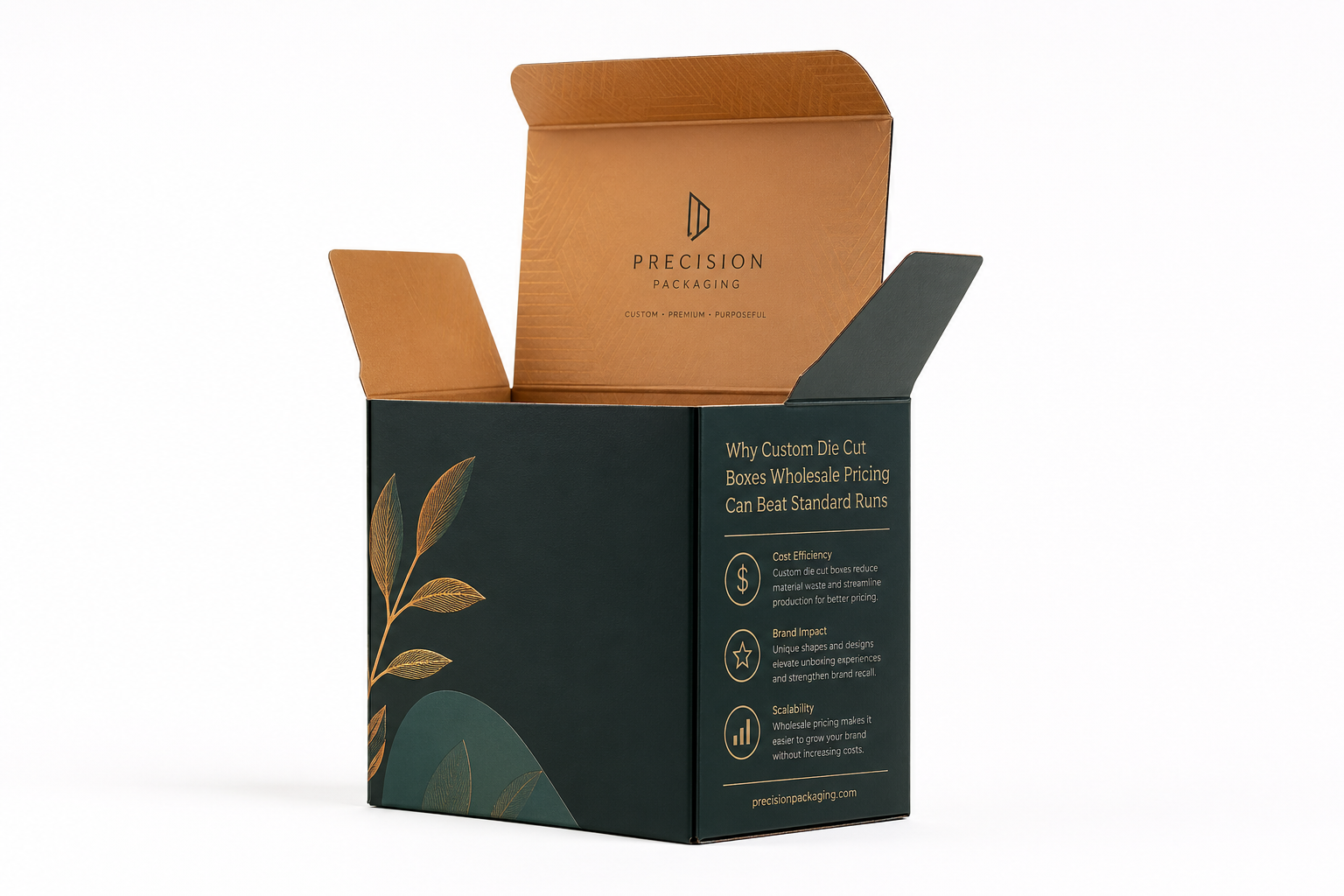
Material choice changes custom die cut boxes wholesale pricing faster than many buyers expect. SBS, corrugated, and kraft all behave differently on press, during folding, and through shipping from factories in Shenzhen, Dongguan, or Xiamen. A 350gsm C1S artboard gives you a smooth face for sharp graphics and package branding, while an E-flute corrugated shell brings more crush resistance and usually a higher unit cost. Kraft sits in a useful middle range for brands that want a natural look without paying for heavy finishing. I have always liked kraft for certain product lines because it feels honest in the hand, and customers tend to notice that on a shelf in Chicago or Miami.
The box style matters just as much as the paper. Mailer-style die cuts with locking tabs, product sleeves with tight folds, tuck-end cartons, and display-ready formats all use different amounts of labor. A 3-panel mailer with a 1.5-inch side wall is not the same job as a 2-piece sleeve with an internal insert, even if both cover a similar footprint. Every extra fold, dust flap, and internal panel adds handling time, and handling time shows up in custom die cut boxes wholesale pricing whether the quote sheet says so plainly or not. I have watched a simple tuck-end box sail through quoting, then a locking mailer with the same footprint come back higher because the fold pattern demanded more setup attention. The box may look similar on a shelf, but the factory knows the difference immediately.
Finish choices move the number too. Matte varnish usually stays lighter on the budget than full gloss. Foil stamping, embossing, and spot UV can make retail packaging feel polished, but each treatment adds setup time and machine time. I have seen a spot UV panel add $0.08 to $0.15 per box on a mid-size run because the client wanted a very specific shine on the logo, and the foil pass on a 5,000-piece order added another $260 in setup. The effect was excellent. The cost was real. And yes, the client loved the shine right up until the invoice arrived.
If you are comparing custom die cut boxes wholesale pricing across materials, ask for the stock name, caliper, coating, and insert work in writing. "Kraft" is not a spec by itself. Neither is "corrugated." I want the exact flute, liner grade, inside print requirement, and whether the board is 14pt, 16pt, 18pt, or 350gsm C1S before I trust the number, because vague descriptions are where box quotes go to hide their little surprises.
| Material or style | Typical setup cost | 500 units | 5,000 units | Best use |
|---|---|---|---|---|
| 14pt SBS die cut carton | $180 to $320 | $1.05 to $1.55 each | $0.32 to $0.58 each | Cosmetics, supplements, small electronics |
| E-flute corrugated mailer | $220 to $420 | $1.25 to $1.85 each | $0.48 to $0.82 each | Shipping cartons, subscription kits, heavier retail packaging |
| Kraft sleeve with tuck ends | $160 to $280 | $0.88 to $1.30 each | $0.28 to $0.49 each | Natural-branded packaging, lightweight product packaging |
| Display-ready folded box with insert | $240 to $480 | $1.45 to $2.20 each | $0.62 to $1.05 each | Retail shelf display, promo kits, premium custom printed boxes |
Those ranges come from jobs I have quoted in Shenzhen, Dongguan, and Ningbo, not promises etched into a mill contract. They still show the pattern clearly: custom die cut boxes wholesale pricing drops sharply once the run is large enough to spread setup and labor across more cartons. For brands building package branding that needs to look clean on a shelf and survive warehouse handling, material choice is one of the first places the money moves. I have seen a buyer spend days worrying about a 2% print shift while the real cost driver was the board grade, which is a very packaging-industry way to lose an afternoon. A little funny, sure, but also expensive.

Die lines, sizes, and specifications that change the price
Exact dimensions drive board usage, machine setup, and how many cartons fit on a sheet. I have seen a carton slip from 16-up to 12-up because the width changed by 2 mm and the nest stopped working efficiently on the press sheet. That tiny shift changed custom die cut boxes wholesale pricing by almost 9% before anyone touched the artwork, and the plant in Dongguan did not need to say a word for the math to make itself known. Packaging design has to start with the box size, not the mood board, no matter how pretty the mood board is.
A clean dieline saves money. Wrong bleed, a safe zone that runs too close to the cut, or panel measurements that do not match the product all stretch the proof cycle and invite correction fees. I prefer vector dielines in PDF or AI format with fold lines, glue tabs, and cut marks clearly labeled, plus a 0.125-inch bleed and a 2 mm safe zone around the edge. That may sound dull. It also keeps custom die cut boxes wholesale pricing from getting padded with avoidable revisions. I have had to explain more than once that a box does not care how inspired the concept felt on Tuesday afternoon; it cares whether the panels actually close.
Print coverage matters too. A one-color exterior on kraft costs less than full-coverage CMYK on both sides, and the jump gets steeper if you add PMS spot colors or white ink under a dark board. Interior print, barcode placement, and inserts all add onto the base price. For a retail box with four-color exterior print, a blank inside, and one corrugated insert, I would rather quote the structure honestly than pretend custom die cut boxes wholesale pricing lives in one neat unit number. It never does, no matter how badly we want a perfect number in the first pass.
Even a small change in height can alter sheet layout. A 1.5 inch carton may fit one more lane than a 1.6 inch carton, which sounds absurd until the layout saves hundreds of dollars across a 10,000-piece production run. That is the kind of detail I check before I accept custom die cut boxes wholesale pricing as final. In packaging, final should mean something. If the math changes after the proof, the box is not the only thing that got cut.
For retail-facing graphics, keep the dieline clean and the specs honest. A sloppy file usually leads to a sloppy quote. Once the factory starts guessing, custom die cut boxes wholesale pricing stops feeling like pricing and starts feeling like a negotiation over missing information, and that usually costs another 1 to 2 days in back-and-forth emails. I have never met a supplier who loved guessing, and frankly, I do not blame them. Guessing is how a simple job turns into a headache nobody asked for.
How is custom die cut boxes wholesale pricing calculated at scale?
Quantity changes the math quickly. At 500 units, setup is heavy enough to make the per-box price look sharp. At 1,000 units, the number starts to soften. By 5,000 units, the quote usually settles into a more practical range. At 10,000 units, custom die cut boxes wholesale pricing can fall again, provided freight, storage, and cash flow do not erase the savings. Large runs can feel strangely comforting once the setup gets absorbed, like the first hard part of the job already happened and the rest is just disciplined repetition on a line outside Guangzhou or Suzhou.
The pattern is simple enough. The per-unit cost usually drops as quantity rises, then the savings flatten once the plant has already spread setup across enough cartons. A buyer once asked why 10,000 boxes did not cost half of 5,000. I told him paper mills, finishing departments, and freight carriers do not run on generosity. The answer was blunt, and it was true. Wholesale pricing has breakpoints, not magic, and I have never seen a factory invent magic just because the buyer was in a hurry.
Tooling, prototype samples, finishing complexity, and tight tolerance requirements all push the quote upward. A new cutting die might run $180 to $450 depending on size and complexity, while a printed mockup sample can run $35 to $120 in a city like Dongguan or Xiamen. If a product needs a foam insert and a tight fit, the factory may slow the line to keep tolerances in check, and that shows up in custom die cut boxes wholesale pricing immediately. I have had to explain to more than one brand owner that "tight fit" sounds simple until a board edge starts fighting back. Paper has a way of reminding you who is in charge.
I had a negotiation in Dongguan’s Houjie district where the supplier wanted to charge extra for a three-piece insert system. We changed it to two pieces, adjusted the fold direction, and saved $260 on tooling plus about $0.04 per unit on labor. That looks small until you multiply it across 8,000 boxes. Then it becomes real money, the kind buyers feel in the budget, the kind that suddenly makes the spreadsheet less smug.
For buyers comparing order tiers, the pattern usually looks like this:
- 500 units: best for testing fit and color, while custom die cut boxes wholesale pricing is least forgiving because setup is spread thin.
- 1,000 units: the first point where a meaningful step-down usually appears, especially on simple custom printed boxes.
- 5,000 units: often the sweet spot for branded packaging, where unit cost and freight settle into a healthier balance.
- 10,000 units: useful for repeat sellers, provided warehouse space and cash timing are under control.
Shipping changes the answer too. Flat-packed cartons cost less to move than assembled cartons, and ocean freight behaves very differently from domestic truck freight. A 10,000-count flat-pack order can ship from Shenzhen to Long Beach in a very different way from a smaller assembled run, even if the box price looks better on paper. That is why I keep saying custom die cut boxes wholesale pricing has to be read as a landed total. The unit price is only one piece of the story, and if somebody tells you otherwise, they are probably trying to keep the spreadsheet looking friendly.
One more point belongs here. If the project has strict transit requirements, I lean on the same testing language the industry uses instead of guessing. The guidance at ISTA test methods helps frame drop, vibration, and compression concerns before a carton gets knocked around in a warehouse lane, especially on ISTA 3A and 1A protocols. If the packaging is meant to protect product packaging through real shipping abuse, that matters far more than a polished render.
For sourcing claims, I also ask whether the paper or board needs FSC documentation. The certification details at FSC chain-of-custody matter for brands that sell into retail accounts with paperwork checks, particularly when the mill in Jiangsu or Vietnam needs a current certificate number. That part of custom die cut boxes wholesale pricing is not glamorous, yet it keeps procurement conversations from turning messy later. I have sat through enough compliance emails to know nobody enjoys chasing certificates after the boxes are already on a boat.
Production process, proofing, and timeline expectations
The order flow stays straightforward when the buyer comes prepared. Quote request first. Dieline confirmation second. Digital proof third. Physical sample if needed. Production after approval. Shipping last. On a 3,000-piece mailer or a 12,000-piece retail carton, the more complete the specs are at the start, the faster custom die cut boxes wholesale pricing turns into an actual order instead of a trail of back-and-forth messages. I have learned, sometimes the hard way, that every missing detail has a way of reappearing later with interest.
I use a realistic timing range: 24 to 48 hours for a quote when the box dimensions, quantity, stock, finish, and delivery ZIP are clear; 1 to 3 days for proof approval if the artwork is press-ready; 7 to 15 business days for production after approval, plus freight time from the factory to the port. If the design still needs revisions or the finish queue is backed up, custom die cut boxes wholesale pricing will not make the clock move faster. Paper ignores urgency slogans. The factory does too, which is only annoying if you were hoping for the universe to bend around your launch date.
Most delays happen in three places. A proof comes back with missing bleed or a barcode too close to a fold. A sample lands close but not exact, so another round gets requested. Special finishes like foil or spot UV need their own schedule slot, usually 2 to 4 extra business days. I have watched a simple retail packaging job stall for four extra days because the buyer changed the logo size after proof approval. That was not the factory being slow. That was the file moving, then moving again, then suddenly becoming "urgent." Those moments always feel a little ridiculous in hindsight.
Tell the supplier whether the box ships flat or assembled, whether inserts are needed, whether a coating has to resist scuffing, and whether the carton has to pass a drop or compression test. If you know the target market, say so. A subscription mailer for San Diego is one structure, and a shelf carton for Dubai is another, and custom die cut boxes wholesale pricing will reflect that difference. No one quotes a shipping box like a luxury cosmetic tray unless they enjoy losing margin, and I have yet to meet a factory manager who wakes up hoping to undercharge himself.
If the packaging design includes a window, magnet, or hidden tab, say that before the quote. I have seen buyers try to add those features after the first round, and the factory almost always has to rework the structure. Rework costs more every time, often $0.03 to $0.07 per box on a run of 5,000 pieces, and that is before anyone counts the lost days. That is why I treat custom die cut boxes wholesale pricing as a planning tool, not a screenshot for internal bragging rights. Screenshots do not save you when the carton line starts asking real questions.
Why buy from us instead of chasing the cheapest quote
I have spent enough time on factory floors in Shenzhen, Dongguan, and Ningbo to know that a quote is only as solid as the people standing behind it. A low number means little if the supplier cannot hold color, misses the dieline, or swaps the board without telling you. When I buy for clients, I care about consistency, communication, and fewer production mistakes. That is the real value behind custom die cut boxes wholesale pricing when a job has to ship clean and on time. I would rather have a quote that survives production than a bargain that evaporates when the first pallet leaves the dock.
Supplier relationships matter more than people think. A factory that knows your board spec, finish preferences, and packing format can move faster and make fewer errors. I have negotiated enough board shipments to know that half a day spent clarifying liner grade can save a full day of rework later. A stripped-down quote never shows that. Custom die cut boxes wholesale pricing from a trusted source usually costs less in the long run because the errors stay smaller, the communication is cleaner, and nobody has to pretend a mistake was “within tolerance” when everyone can see the scuff.
The difference between a serious quote and a placeholder number is easy to spot. One lists the exact material, the real lead time, and freight guidance to your ZIP code in Dallas, Seattle, or Atlanta. The other looks low enough to get attention. Placeholder quotes often leave out setup, sample charges, export packing, or the finish you actually need. I have seen buyers chase the cheapest number and later discover it did not include carton loading, palletizing, or the coating they wanted. That is not savings. That is a trap with clean formatting, and the formatting is usually very polite about it.
We keep the conversation practical. If a finish pushes custom die cut boxes wholesale pricing beyond a target budget, I say so. If a structural change gives you a better unit rate, I say that too. If the run is too small for a heavy corrugated build, I will say that before you waste time. Straight answers travel faster than polite fiction, and they save a lot of email threads that nobody wanted to begin with, especially on a 2,500-piece launch where every day matters.
If you are comparing options for Custom Packaging Products, I would rather you see the tradeoffs clearly than fall in love with a sample that cannot be produced profitably. If you are ready to scale repeat orders, our Wholesale Programs are built for buyers who need predictable output, not one-off guessing, with production schedules that can hold a 12- to 15-business-day window after proof approval.
"The cheapest quote usually forgot one of the four things that matter: material, labor, freight, or time." I have said that in client meetings more than once, and it keeps people from making expensive mistakes. Sometimes I repeat it because I can see the room trying not to make the same mistake twice, usually while a 10,000-piece order is already being penciled into the budget.
One last point belongs here. We work with branded packaging that has to look right in a customer photo and still survive a shipping lane from Shenzhen to Chicago or from Xiamen to New York. The quote has to match the reality of production, not the fantasy version. Custom die cut boxes wholesale pricing only helps if it lets you order with confidence and avoid reprints, rush fees, and angry phone calls. Nobody wants to explain a budget overrun because a box decided to be delicate after leaving the factory.
What to do next if you need a wholesale quote
Before you ask for pricing, gather the basics: box dimensions, quantity, material, finish, print colors, and delivery ZIP code. If you have a target budget, include that as well. It helps shape the quote around what you can actually spend, whether the box is 8 x 5 x 2 inches or a larger 12 x 9 x 4 inch mailer. Without those details, custom die cut boxes wholesale pricing is little more than a rough guess, and guesswork wastes everybody's time. I have seen a ten-minute spec check save days of back-and-forth, which is a pretty good trade in my book.
Clean inputs get the fastest quotes. Send a dieline if you have one. If not, send a rough sketch with measurements, a 0.125-inch bleed note, and a note on what the box has to hold. Tell us whether you want samples first, whether the box will be retail packaging or shipping packaging, and whether the design needs inserts or special coatings. Those details turn custom die cut boxes wholesale pricing into a real number faster than a long email chain ever will. Long email chains, in my experience, mostly breed confusion and a strange number of “just circling back” messages.
My preferred order stays simple: request a quote, confirm specs, approve the proof, review the sample if the job needs it, then move into production. That sequence saves money because each step locks one variable before the next one begins. If the box is part of a larger package branding rollout for a 2,000-unit or 20,000-unit launch, keep the artwork and structure stable from the beginning. Changing both at once is how budgets go sideways, and I have watched a calm project turn into a very expensive scavenger hunt because somebody wanted “just one small tweak.”
If you want the cleanest path, send the following in one message: dimensions, quantity, board or paper stock, finish, ink colors, insert details, shipping ZIP, and whether the boxes need to arrive flat or assembled. Add a dieline if you have it. That is the fastest route to accurate custom die cut boxes wholesale pricing, and it gives us enough information to avoid the small mistakes that turn a good project into a slow one. I would much rather build from a tidy spec than play detective after the fact.
Custom die cut boxes wholesale pricing works best when the buyer treats it like a planning tool, not a mystery. Give me the specs, give me the target, and I can help you compare options without the usual nonsense. If you are ready to move, send your dimensions, quantity, material, finish, and ZIP code now, and I will help you get custom die cut boxes wholesale pricing that makes sense for your run, your freight, and your brand.
Takeaway: the fastest way to better custom die cut boxes wholesale pricing is to lock the structure, stock, finish, and shipping method before quoting starts. If those four pieces are clear, the number gets cleaner, the schedule gets tighter, and the box you approve is much closer to the box that shows up on the dock.
FAQ
What is the minimum order for custom die cut boxes wholesale pricing?
Many jobs begin around 500 to 1,000 units, though the real MOQ depends on board type, print method, and finishing. Smaller runs usually cost more per box because setup and labor get spread across fewer units, especially on 14pt SBS cartons or E-flute mailers. Ask for price breaks at 1,000, 3,000, and 5,000 units so you can see where custom die cut boxes wholesale pricing starts improving in a meaningful way. I like those checkpoints because they show the real turning points instead of making everybody guess.
How do shipping costs affect custom die cut boxes wholesale pricing?
Freight can change landed cost more than the box price itself, especially on larger or heavier carton runs leaving Shenzhen, Ningbo, or Xiamen. Flat-packed boxes ship differently from assembled cartons, so the format matters. I always recommend asking for a landed quote if you want the number that actually hits your budget, not just the factory-side custom die cut boxes wholesale pricing. A cheap box that arrives with expensive freight is not cheap; it is just wearing a disguise.
Can I get samples before approving custom die cut boxes wholesale pricing?
Yes, and you should if fit, fold, or finish matters to your product. A structural sample checks dimensions and locking tabs, while a printed proof checks color and layout. Sample costs are often credited back on production orders, depending on the job, so a sample is usually a smart spend before you lock in custom die cut boxes wholesale pricing. I have rarely regretted a sample. I have absolutely regretted skipping one.
What details are needed to quote custom die cut boxes wholesale pricing accurately?
Send box dimensions, quantity, board or paper stock, print coverage, finish, and shipping ZIP code. Include whether the box needs inserts, windows, special coatings, or retail-ready packing, and specify whether you want 350gsm C1S, 14pt SBS, or an E-flute corrugated build. If you already have a dieline, send it. That saves time, reduces quote errors, and gives you a much cleaner custom die cut boxes wholesale pricing estimate. The more the factory has to guess, the more the quote starts acting like a placeholder with a logo on it.
How long does production take after I approve custom die cut boxes wholesale pricing?
Quotes can usually turn around in 24 to 48 hours when the specs are complete. Proof approval may take 1 to 3 days, depending on how many revisions are needed. Production often takes 7 to 15 business days after approval, plus freight time. If the job includes foil, embossing, or complex inserts, custom die cut boxes wholesale pricing may stay the same while the schedule stretches a bit. That extra time is usually the price of doing the structure properly instead of rushing into a headache.