Buyer Fit Snapshot
| Best fit | Wholesale Packaging Custom Printed projects where brand print, material claims, artwork control, MOQ, and repeat-order consistency need to be specified before quoting. |
|---|---|
| Quote inputs | Share finished size, material target, print colors, finish, packing count, annual reorder estimate, ship-to region, and any compliance wording. |
| Proofing check | Approve dieline scale, logo placement, barcode or warning zones, color tolerance, closure strength, and carton packing before bulk production. |
| Main risk | Vague material claims, crowded artwork, missing packing details, or unclear freight terms can make a low unit price expensive after revisions. |
Fast answer: Wholesale Packaging Custom Printed: Buyer’s Playbook should be specified like a repeatable production item. The safest quote records material, print method, finish, artwork proof, packing count, and reorder notes in one written spec.
Production checks before approval
Compare the actual filled-product size with the drawing, then confirm tolerance on folds, seals, hang holes, label areas, and retail display edges. Reserve space for logos, QR codes, warning copy, and material claims before decorative graphics fill the panel.
Quote comparison points
Review material grade, print process, finish, sampling route, tooling charges, carton quantity, and freight assumptions side by side. A quote is only useful when the supplier can repeat the same color, closure quality, and packing count on the next order.
Most brands do not lose margin on advertising first. They lose it on packaging decisions that looked small during a sample review in week one and turned expensive by month three, especially when the line item for wholesale packaging custom printed boxes or mailers was built on a quote that ignored carton cube, pallet height, and repack labor. I have seen teams approve a 120 x 80 x 60 mm insert tray without checking the 3PL's shelf slot depth in Edison, New Jersey, then pay twice: once for the original run and again for rework, relabeling, and replacement shipments. Packaging gets treated like decorative trim on a house until the roof starts leaking and the warehouse asks for a second PO, which is exactly why a wholesale packaging custom printed strategy needs to be handled as an operating decision rather than a last-minute aesthetic choice. That is kinda the whole ballgame.
At a client meeting in Austin, two skincare brands sat across the same conference table with the same 30ml serum and the same $34 retail price. Brand A used a 400gsm C1S folding carton with a matte aqueous coat, a 0.5 mm paperboard insert, and a locked 24-unit master case configuration that fit neatly on a 48 x 40 inch pallet. Brand B used a cheaper 300gsm carton, skipped transit testing, and chose a taller box that left 18 mm of dead air in each shipper. The result was plain enough: Brand A landed at $0.42 Packaging Cost Per Unit and under 0.8% damage claims, while Brand B looked cheaper at $0.36 on paper and then absorbed $0.11 per unit in freight inefficiency and damage-related credits. Same retail price, different contribution margin by 7.3 points, and that is the kind of math that makes procurement meetings go quiet.
I still see buyers compare quotes line by line without calculating total landed packaging cost down to the millimeter and the minute. Unit price matters, of course, but it is not the full story when a pallet from Shenzhen arrives in Savannah, Georgia, or when a DTC pack-out team in Columbus, Ohio spends 14 extra seconds folding a carton by hand. The right wholesale packaging custom printed plan improves shelf visibility, cuts pack-line errors, protects products in parcel transit, and supports cleaner inventory planning with fewer emergency airfreight charges. A weak plan does the opposite while hiding the pain in separate budget lines, which is a polished way of saying the invoice looks tidy and the P&L starts bleeding in another department. If a carton adds even 12 seconds to pack-out, that cost is gonna show up somewhere.
This playbook gives you a practical buying framework for wholesale packaging custom printed: format selection by product type, technical specs that prevent reprints, cost levers that move real dollars, timeline controls that keep launches on schedule, and a clear RFQ-to-purchase process built for teams that need answers in 12 to 15 business days instead of vague promises. You will also see where Custom Packaging Products and Wholesale Programs fit for scaling branded packaging without guesswork.
Why Wholesale Packaging Custom Printed Changes Margin Math
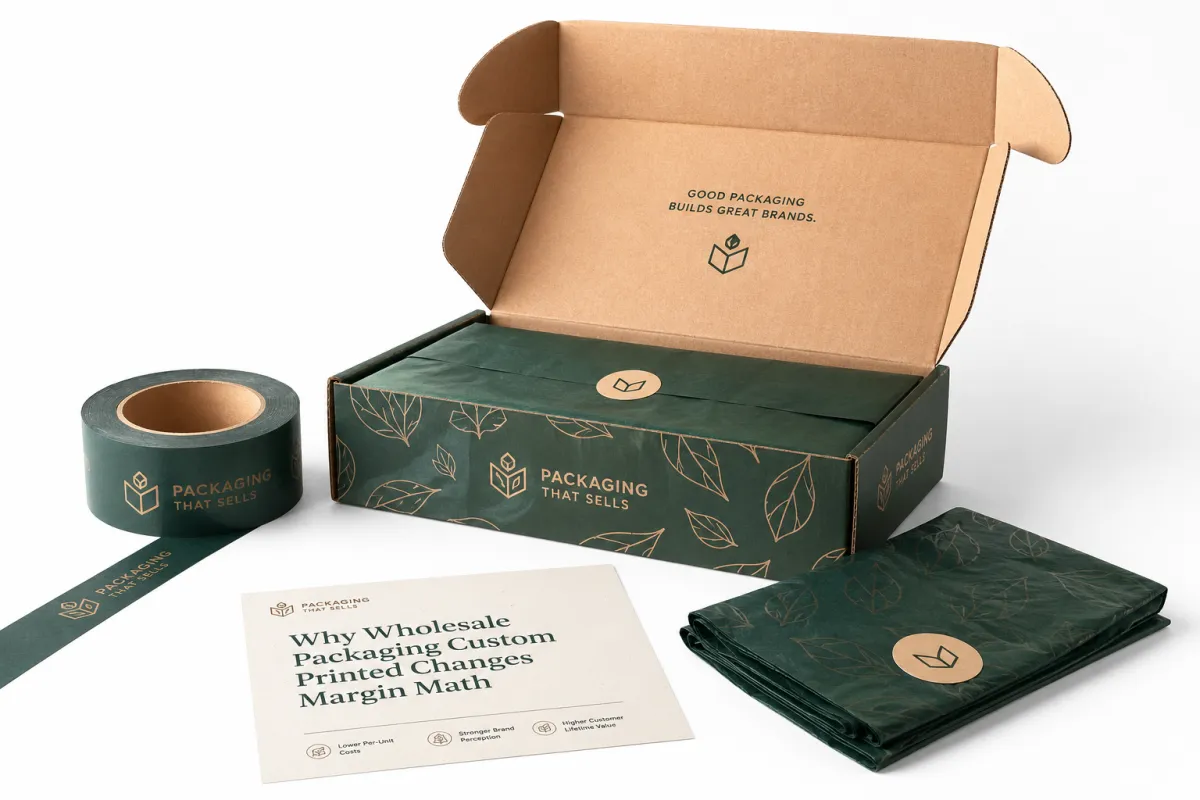
Start with one number: landed packaging cost per sellable unit, not invoice cost. Landed cost includes material, print, finishing, outbound freight, inbound freight, storage footprint, pack-line efficiency, and returns impact. In a recent project for a nutrition brand shipping from Secaucus, New Jersey to six US fulfillment hubs, the invoice for wholesale packaging custom printed cartons was $0.29 each at 100,000 units, but landed cost reached $0.37 after pallet optimization, inner-pack labor, and damage write-offs were included. That 8-cent gap shaped quarterly margin more than their coupon strategy, especially on a 42,000-unit monthly sell-through.
I visited a Shenzhen facility in Bao'an District where the production manager showed me two master cartons side by side on a blue steel packing table, both built for the same product count and the same board grade. One design increased pallet utilization from 84% to 92% simply by rotating the carton orientation and reducing the headspace by 9 mm, and freight per thousand units dropped by $61 on the next Ningbo-to-Los Angeles sailing. No new material, no new print method, just structural logic. That kind of gain shows up often in wholesale packaging custom printed work once structure and logistics enter the conversation before artwork is locked, and I still remember the buyer's face when the math finally pointed in the right direction.
Many teams still treat packaging design as a visual stage and operations as a later stage. Packaging Design and Cost engineering need to happen together, ideally in the same kickoff meeting with the dieline, the freight quote, and the 3PL packing spec on the table. A premium unboxing moment can coexist with disciplined economics when priorities are defined early: front-panel brand impact, opening mechanics, transit durability, and case-pack geometry. The strongest packaging teams behave like part design studio, part factory-floor reality check, with one foot in creative and the other in a corrugator in Dongguan.
For buyer teams, I recommend a four-part decision lens for every wholesale packaging custom printed project:
- Commercial: target unit cost band, margin floor, and minimum order cadence.
- Operational: case-pack efficiency, pick/pack speed, and storage constraints by 3PL site.
- Quality: print tolerance, color consistency, and transit performance by channel.
- Brand: shelf contrast, tactile finish, and package branding consistency across SKUs.
Use that lens and you avoid the expensive loop of "approve fast now, fix later." In my experience, disciplined wholesale packaging custom printed planning reduces reprint risk, protects launch dates, and keeps margin math honest by forcing the team to resolve structure, substrate, and freight assumptions before a purchase order is signed. It also keeps procurement from sending those awkward all-hands emails that begin with "We have an opportunity to revisit our assumptions" and end with a rush order to Shanghai.
Wholesale Packaging Custom Printed Options by Product Type
Format choice should follow product behavior, channel pressure, and customer expectation, not trend photos or whatever looked polished at a trade show in Las Vegas. I regularly map wholesale packaging custom printed programs into six core formats: folding cartons, rigid boxes, corrugated mailers, pouches, labels, and inserts, with a separate cost model for each SKU family. The product should lead the decision, not the mood board, and a 180 g snack pouch should not be forced into the same structure logic as a 1.4 kg glass diffuser bottle.
Format-to-use-case mapping
- Folding cartons: efficient for retail packaging, cosmetics, supplements, and light electronics; typical board range 300gsm to 450gsm.
- Rigid boxes: premium gifting and high-ticket items; chipboard 1.5mm to 2.5mm with wrapped art paper.
- Corrugated mailers: e-commerce protection; E-flute and B-flute common, often 32 ECT or 44 ECT depending on weight.
- Pouches: powders, snacks, and refill systems; PET/AL/PE or PE mono-material depending on barrier and sustainability goals.
- Labels: rapid SKU variation and promotions; paper or BOPP with permanent or removable adhesive.
- Inserts: onboarding cards, compliance sheets, and upsell touchpoints that increase retention.
Print method selection affects color fidelity and economics. Offset printing gives strong color control for medium to long runs in wholesale packaging custom printed orders, especially when a Pantone 186 C logo has to match across cartons printed in Qingdao and corrugate printed in Monterrey, Mexico. Digital excels in short runs, faster version changes, and pilot launches, with no plate cost and a workable 500 to 2,000 unit entry point for test markets. Flexographic works well for high-volume corrugated and shipping cases where speed and consistency are central. I have seen teams argue over print method like it is a personality test, but the honest answer is usually simple: pick the process that fits the run length, the shipping profile, and the date on the launch calendar.
I once sat in a supplier negotiation in Dongguan where a client wanted rich metallic gradients on a 20,000-unit mailer. Offset looked ideal visually, but flexo plus a strategic spot color and a revised artwork hierarchy cut their unit cost from $0.74 to $0.58 while keeping brand recognition intact in unboxing videos shot on iPhone 15 Pro in Brooklyn and Austin. That is the real craft of wholesale packaging custom printed: focus spend on what customers actually notice, then trim the features nobody mentions after the first purchase.
The right structure also depends on product physics. A 1.2 kg glass bottle needs different support than a 220 g sachet refill, and a fragrance set with three vials needs more crush resistance than a single cosmetic jar. Storage humidity in Miami, cold-chain exposure in Toronto, and channel handling frequency in a Los Angeles 3PL all matter. Subscription kits face repeated parcel stress; retail shelf packs face visual competition at 2 to 4 feet distance. Your Custom Printed Boxes should reflect those realities, not a single template. I still get a little twitchy when someone says, "Can't we just use the same box for everything?" Sure, if the goal is chaos and returns.
| Product Scenario | Recommended Format | Print Method | Typical MOQ | Unit Cost Range (USD) | Best Fit Channel |
|---|---|---|---|---|---|
| 30ml skincare bottle | 400gsm folding carton + insert | Offset CMYK + 1 Pantone | 5,000 | $0.18-$0.34 | Retail + DTC |
| Premium watch accessory | 2.0mm rigid box | Offset wrap + foil | 2,000 | $1.20-$2.80 | Gift + boutique |
| Subscription snack kit | E-flute corrugated mailer | Flexo 2-color | 10,000 | $0.42-$0.79 | E-commerce |
| Protein powder refill | Stand-up pouch | Rotogravure or digital | 8,000 | $0.24-$0.63 | Retail + online |
Every strong wholesale packaging custom printed decision matrix starts with four inputs: weight, fragility, storage condition, and channel mix. If one of those is missing, quote accuracy drops fast. If two are missing, you are basically buying a surprise shipment from a factory in Huizhou and hoping the carton's mood matches the product's weight.
Specifications That Prevent Reprints and Delays
Technical detail saves money. A vague spec sheet burns it. In wholesale packaging custom printed production, reprints usually trace back to five preventable gaps: wrong dimensions, mismatched board grade, incomplete print file setup, unclear tolerance, and weak approval controls. A 2 mm error on the dieline or a 1.5 mm shift in tuck depth can turn a clean run into a warehouse headache, especially if the product ships from both New Jersey and California.
Structural specs that matter first
Document finished size in millimeters with clear inside and outside dimensions. A "120 x 45 x 180 mm" carton sounds precise until the team forgets to define orientation and tuck style, or until the insert is measured as a flat blank instead of a formed tray. Board grade should be explicit: for example, 350gsm C1S artboard with an 18-22 pt caliper target, or E-flute corrugated at 32 ECT minimum for parcels under 2.5 kg. If you need compression performance, ask for edge crush data and trial pack results at full case weight. I have seen a 2 mm difference in box depth ruin insert fit and create a week of expensive silence from the warehouse in Dallas.
Closure style affects both user experience and line speed. Auto-lock bottoms can reduce hand-fold time by 15 to 25 seconds per case during manual packing, which matters if a fulfillment team in Indianapolis is assembling 600 units per hour. Dust flaps, tear strips, and tamper labels each add cost and process steps, so they should be tied to real risk reduction, not default assumptions. My opinion: if a feature does not solve a handling, safety, or brand problem, it probably deserves a hard side-eye and a line item review.
Pre-press and print controls
For wholesale packaging custom printed files, include 3 mm bleed, 2 to 3 mm safe zones, embedded fonts or outlined text, and barcode quiet zones sized to scanner requirements. CMYK is fine for broad graphics, but Pantone is often required for strict brand consistency, especially for cosmetic boxes printed in Shenzhen or Dongguan where multiple SKUs run on the same shift. Trapping settings, minimum line thickness, and black text registration rules should be confirmed before proofing. I generally require minimum 6 pt for positive text and 7 pt for reversed text on coated stock to avoid fill-in on press, and I want those rules in writing before a single plate is made.
Barcode clarity is non-negotiable. A beautiful carton that fails POS scans is operational debt with a glossy finish. Use a verified barcode grade target and request test scans on coated and uncoated samples if finishes vary by SKU, because a soft-touch laminate and a matte aqueous coat can behave very differently under retail scanners in Chicago and Atlanta. I have watched a launch stall because someone decided the barcode "looked fine" on a PDF. Looked fine to whom, exactly? The scanner did not care, and neither did the warehouse receiver.
Compliance and performance checks
Food-contact projects need substrate and ink declarations aligned to destination regulations, with FDA food-contact safe inks for US sales and EU declarations for cross-border shipments into Germany or the Netherlands. Transit-heavy packs should reference ISTA test protocols, especially ISTA 3A for parcel shipment profiles and ISTA 6-Amazon for marketplace fulfillment. For sustainability claims, verify chain-of-custody language through FSC and avoid unsupported claims. For handling and test guidance, the resources at ISTA are useful for buyer teams managing multi-carrier shipping risk from Ontario to Phoenix.
"We approved artwork in 48 hours and spent 5 weeks correcting fit." A client told me this after a supplement launch slipped because their bottle shoulder radius was never tested against insert geometry, and the final formed sample from a facility in Foshan needed a 4 mm pocket adjustment. I remember the room going very quiet after that line.
Mockups and samples are cheap insurance in wholesale packaging custom printed programs, especially when the first sample comes by air courier from Hong Kong and the production lot is scheduled for ocean freight two weeks later. Approve three gates: dieline sign-off, color proof sign-off, and physical fit sample sign-off. Then lock revision control with date, owner, and approval code. No verbal approvals. No "latest file" ambiguity. No mysterious final-final-v7-artwork-reallyfinal.ai nonsense either, because every packaging team has met that file and regretted it.
- Pre-press checklist: final dieline layer locked, bleed confirmed, Pantone values confirmed, barcode tested, legal text reviewed, print direction marked, pack-out diagram approved.
- Sample checklist: fit test with actual product, drop check at shipping weight, opening sequence verified, scuff resistance tested, photo record archived.
These details turn wholesale packaging custom printed from a creative exercise into a controlled commercial process with fewer reprints, fewer delays, and fewer 6 p.m. panic messages about a carton that is 3 mm too short.
Pricing, MOQ, and Cost Drivers in Custom Printed Wholesale Packaging
If you want better pricing, separate fixed costs from variable costs. That sounds obvious, yet many quote reviews mix them and hide the true economics of wholesale packaging custom printed. I have sat through enough procurement calls in Chicago, Seattle, and Newark to know that "lowest quote wins" is a great slogan right up until the first freight invoice shows up from a port in Long Beach or Savannah.
What you are actually paying for
- One-time costs: tooling, cutting dies, print plates, and initial color setup.
- Recurring costs: substrate, ink, finishing, conversion labor, packing, and freight.
- Risk costs: reprint allowance, defect handling, and expedited shipment exposure.
Example from a current beverage accessory program: 50,000 folding cartons, 4-color offset, matte aqueous coat, glued side seam, and an insert printed on 250gsm SBS. Tooling and setup came to $1,180 one time. Unit manufacturing was $0.214. Export packing was $0.012. Ocean plus drayage allocated to the run was $0.028 from Ningbo to Oakland. True landed packaging was $0.254 per unit before duty. The factory-only number looked better by 16%, but it was incomplete, and incomplete quotes are usually what create expensive surprises later.
MOQ exists for a reason. Setup-heavy jobs need enough volume to amortize fixed prep, plate time, and press calibration, while digital workflows can lower MOQ for pilot runs in wholesale packaging custom printed plans with 1,000 to 3,000 units, though per-unit prices will often be 20 to 45% higher than long-run offset economics. That does not make digital bad. It just means the math changes depending on whether you are validating a product in Brooklyn or feeding a mature replenishment program in the Midwest.
Quantity breaks and cash planning
Going from 5,000 to 20,000 units might drop cost from $0.31 to $0.21, but carrying 15,000 extra units ties cash, shelf space, and revision flexibility, and it can also trap obsolete copy if a compliance line changes in Q3. I tell procurement teams to model three scenarios: conservative demand, base demand, and aggressive demand. Then calculate total cost including storage and obsolescence risk. In fast-iterating brands, a slightly higher unit price with faster revision cycles can outperform a low price trapped in stale inventory. I have seen "cheap" stock sit in a warehouse in Phoenix long enough to make everyone regret the purchase order.
Cost levers buyers control directly
- Right-size dimensions: removing 8 mm of box height can cut board use 5 to 9% depending on layout.
- Material substitution: 400gsm to 350gsm may work if structure is reinforced smartly.
- Color discipline: reduce spot colors where brand impact is unchanged.
- Finish restraint: limit foil and emboss to front focal panel.
- Shipment strategy: consolidate lanes and align incoterms with internal capabilities.
For apples-to-apples quote comparison in wholesale packaging custom printed, standardize your RFQ fields: dimensions, board spec, color process, finish type, tolerance, pack-out, delivery term, destination, and QA acceptance criteria. If one supplier omits plate cost or freight assumptions, normalize the sheet before ranking. Otherwise you are comparing apples, oranges, and one very optimistic spreadsheet from a sales rep who has not seen your freight lane.
| Quote Element | Supplier A | Supplier B | Supplier C | Buyer Checkpoint |
|---|---|---|---|---|
| MOQ basis | Per SKU | Combined artwork | Per size | Confirm inventory impact |
| Tooling fee | $950 | $0 (embedded) | $1,220 | Separate fixed from variable |
| Lead time | 14 business days | 18 business days | 12 business days | Verify from proof approval |
| Defect policy | Reprint at 2%+ | Credit at 3%+ | Case-by-case | Lock threshold in PO terms |
The teams that win on wholesale packaging custom printed economics do one thing consistently: they negotiate with complete specs, not partial assumptions. The quote gets better because the brief gets better, whether the box is being printed in Dongguan, the inserts are being die-cut in Shenzhen, or the final pack-out is happening in Ohio. That is not magic. It is just fewer excuses and better inputs.
Process and Timeline: From Brief to Delivered Packaging
A reliable wholesale packaging custom printed timeline has clear gates, owners, and fallback paths. I break it into seven phases with realistic ranges, usually measured from the first brief call to carton receipt at the warehouse dock in 12 to 15 business days for straightforward domestic programs and 18 to 35 days for ocean-linked orders. If someone promises a complex run in three days and smiles too much while doing it, I start looking for the catch.
Phase-by-phase timeline
- Discovery and scope: 2 to 4 business days. Confirm product specs, channel mix, target cost, and compliance needs.
- Structural design: 3 to 7 business days. Dieline drafts, load assumptions, and pack-out logic.
- Artwork prep: 2 to 6 business days depending on SKU count and legal text review.
- Sampling and proofing: 5 to 10 business days including physical sample transit.
- Production approval: 1 to 3 business days with signed color and structure release.
- Mass production: 8 to 15 business days based on format and finishing complexity.
- Logistics and delivery: 3 to 7 days domestic, 18 to 35 days cross-border by ocean route.
I have seen launches slip because phase ownership was vague. One beauty client had five stakeholders approving artwork but no final approver, so their wholesale packaging custom printed proof cycled through 11 revisions, added 19 days, and triggered $4,800 in avoidable rush freight from Los Angeles to Phoenix. After we set a single approval owner with a 48-hour response SLA, their next run shipped on time with two revision rounds, which was a much healthier way to spend a Monday.
Bottlenecks are predictable: late copy changes, material stock-outs, untranslated regulatory text, and customs document errors. Build buffers where delay risk is highest, not randomly, and assign one person to own every gate from dieline sign-off to carton label verification. For example, add 3 business days buffer before production lock and 5 days in international transit windows during peak shipping periods like Q4 or Lunar New Year. It is not glamorous, but neither is calling a warehouse to beg for a faster truck because marketing found a typo at 6 p.m. on a Friday.
Risk controls that protect launch dates
- Dieline gate: no artwork placement until structural sign-off is complete.
- Color gate: no mass print until approved digital proof and physical drawdown match tolerance.
- Sample gate: no PO release until fit test and transit check pass.
- Logistics gate: no dispatch until shipping marks, carton labels, and documents are verified.
Communication cadence matters in wholesale packaging custom printed programs. Weekly checkpoint calls, written revision logs, and same-day escalation rules keep teams aligned across New York, Guangzhou, and the fulfillment center in Reno. I recommend a short standing agenda: spec changes, risks, approvals due, and ETA confidence, with a one-page tracker shared before the call so nobody spends 20 minutes asking for context.
Contingency planning should include split shipments, approved alternate substrates, and pre-cleared secondary freight options. Not every plan needs all three, but high-stakes product launches often do, especially if the next production window in Shenzhen lands six weeks after your retail ship date. That depends on your revenue exposure and stockout tolerance, and I would rather overprepare than explain to sales why the hero SKU is sitting on a vessel outside Long Beach.
Why Choose Us for Wholesale Packaging Custom Printed Programs
Buyers do not need hype. They need repeatable outcomes, transparent costs, and a supplier who can explain a 350gsm SBS board choice without hiding behind vague language. Our wholesale packaging custom printed programs are built around measurable controls: material consistency, print repeatability, and documented QA checkpoints.
Capability you can audit
We work across folding cartons, corrugated, labels, and insert systems with a qualified supplier network in Shenzhen, Dongguan, Foshan, and two North America partner sites in Ohio and Ontario for shorter replenishment cycles. Material options include 300gsm to 450gsm SBS/C1S, E-flute to BC-flute corrugated, and specialty substrates where justified by the product or the route. Every wholesale packaging custom printed project runs through pre-press review, press calibration checks, and outgoing AQL sampling criteria tied to your tolerance thresholds, so the final pack is not a mystery when it reaches the dock.
Consultative support tied to commercial goals
You get packaging engineers for structure, pre-press specialists for file integrity, and account managers who track budget and launch calendar risk across each milestone. That mix matters. A visually excellent package that misses pallet efficiency targets is still a commercial miss, especially if the master carton adds 0.6 cubic feet per case and inflates freight on a 40,000-unit order. We align packaging design choices to contribution margin, fulfillment velocity, and customer experience metrics. In plain language: the box has to look good, survive the trip, and not wreck the numbers.
"You were the first team to show us defect trend charts by SKU and not just send a pass/fail note." - Operations director, US home goods brand after a 120,000-unit rollout through a facility in Dallas and a backup warehouse in Ontario.
Operational metrics and transparency
- On-time delivery: 96% across active programs measured against confirmed ship window.
- Reported defect rate: typically under 1.2% with documented corrective actions for variance.
- Reprint response: containment plan within 24 hours, root-cause summary within 3 business days.
- Quote clarity: line-item visibility for tooling, unit pricing, finishing, packing, and freight assumptions.
Procurement teams value our revision tracking because every update is timestamped and owner-tagged. Brand teams value proactive alerts when substrate lead times shift from 10 days to 18 days or when foil stock is constrained in South China. Finance teams value predictable landed-cost reporting with freight assumptions stated in the quote. This is how wholesale packaging custom printed scales without surprise cost spikes, and surprise cost spikes are exactly as fun as they sound.
If your team is comparing sourcing paths, review our Wholesale Programs for volume frameworks and our Custom Packaging Products catalog for structure options mapped to channel requirements, including carton grades, rigid board builds, and mailers sized for parcel networks in the US and Canada.
Action Plan: How to Place a Better Wholesale Packaging Custom Printed Order
Execution beats theory. Here is the process I would run this week for a new wholesale packaging custom printed order, based on projects that had to launch under tight commercial deadlines in 6 to 8 weeks, not six months.
Step-by-step actions for your internal team
- Collect product data: measure product dimensions to 0.5 mm precision, record weight in grams, and note fragile points.
- Define channel mix: split forecast by retail, DTC parcel, and marketplace fulfillment to set durability requirements.
- Set budget band: define target and ceiling, for example $0.26 target and $0.31 ceiling at 20,000 units.
- Rank finish priorities: list must-have and optional features so cost trade-offs are intentional.
- Choose approval owner: one final signatory for structure and artwork to avoid timeline drift.
Ready-to-send RFQ checklist
- SKU list with quantities per variant and replenishment cadence.
- Final or near-final artwork files in editable and print-ready formats.
- Dieline requirements, board grade targets, and color process preferences.
- Testing requirements such as ISTA parcel simulation and barcode scan standard.
- Delivery windows, ship-to locations, and preferred incoterm.
- Defect acceptance threshold and reprint/credit policy expectation.
Negotiation should be factual. Ask for tiered pricing at 5,000, 10,000, 25,000, and 50,000 units, and request the freight quote separately so the board cost does not hide behind ocean surcharges. Request staggered deliveries to balance unit economics and cash flow. Explore substrate alternatives that preserve front-panel brand impact while reducing cost in less visible areas, such as replacing a full soft-touch laminate with a selective matte varnish or reducing an insert from 350gsm to 300gsm SBS. In one negotiation for a wellness client, switching to selective matte varnish cut spend by 14% with no decline in customer ratings over 90 days, which was one of those satisfying moments where the numbers and the aesthetics finally agreed.
A pilot-to-scale path works well for most wholesale packaging custom printed programs. Run a controlled batch first, maybe 3,000 to 8,000 units depending on channel exposure and launch risk, then track three metrics for 30 to 45 days: damage rate, pack-line speed, and return reasons tied to product packaging. If the pilot ships from a plant in Dongguan and the next run is planned for a facility in Guadalajara, lock the revision history so the two lots match on size, color, and glue pattern.
My recommendation: build a 6-week internal clock. Week 1 for scoping and RFQ, week 2 for quote normalization, weeks 3 to 4 for sampling and approvals, week 5 for production lock, week 6 for dispatch coordination. Teams that follow this cadence usually avoid emergency changes that inflate wholesale packaging custom printed cost by 10 to 20%, and if you have ever paid an airfreight premium because somebody forgot to approve the back panel copy, you already know why I care about that timeline so much.
Before you approve the order, lock three things in writing: exact finished size, board grade, and freight term. That keeps the project honest from the first sample to the last carton on the dock, which is the part that actually protects margin.
How Do You Compare Wholesale Packaging Custom Printed Quotes?
Compare quotes by standardizing every field before you rank price. For wholesale packaging custom printed projects, that means matching dimensions, board grade, print process, finishing, pack-out, delivery term, destination, and QA tolerance on the same worksheet. Then separate one-time tooling from recurring unit cost, and ask each supplier to show freight, duty, and reprint assumptions clearly. If one quote looks dramatically lower, trace the difference back to the spec, because the cheapest line is often missing something that will cost you later in production or transit.
FAQ
What is the typical MOQ for wholesale packaging custom printed orders?
MOQ depends on format and print method. Setup-intensive offset or flexo jobs usually need higher volume, while digital can support smaller pilots. For many wholesale packaging custom printed carton projects, I see practical entry points around 3,000 to 5,000 units, with stronger pricing after 10,000, especially if the run is moving through a press line in Shenzhen or Dongguan. Ask suppliers for tiered scenarios and confirm whether MOQ applies per SKU, per size, or combined across artwork versions. If someone gives you one number with no context, I would press for details immediately.
How do I accurately compare quotes for custom printed wholesale packaging?
Standardize specs before asking for numbers: exact size, board grade, color process, finish, packing method, and delivery terms. Separate one-time charges from recurring unit costs. Then compare landed cost, including freight, duty, and rework risk, on the same worksheet for every supplier. This makes wholesale packaging custom printed quote comparisons fair and commercially useful, and it prevents the classic "cheapest quote wins" mistake, which is rarely as cheap as it looks once the cartons reach the warehouse in Dallas or Toronto.
How long does wholesale packaging custom printed production usually take?
Complexity drives timing more than press speed. Sampling and approvals often consume the largest share, especially if you need a physical sample shipped from China to the US for hand-fit testing. A common range for wholesale packaging custom printed is 12 to 15 business days from proof approval for straightforward carton runs, plus transit. Build time for revisions, material sourcing, and customs where relevant, and assign milestone owners with hard dates. I would rather tell a launch team the truth early than apologize after a missed ship date.
Which material is best for my custom printed wholesale packaging project?
The best material depends on product weight, fragility, moisture exposure, and channel handling stress. For light retail cartons, 350gsm C1S may be enough; for e-commerce impact resistance, E-flute corrugated often performs better, and for premium gift sets a 2.0mm rigid board with wrapped art paper can be the right fit. In wholesale packaging custom printed planning, request two or three substrate options with cost and performance trade-offs before final sign-off. My honest view: the best material is the one that protects the product and supports the margin, not the one that sounds nicest in a sample room.
Can I reduce costs without weakening brand impact in wholesale custom printed packaging?
Yes. Optimize dimensions, reduce unnecessary color complexity, and focus premium effects on high-visibility panels. Keep what customers notice first, simplify what they rarely inspect. Pilot those changes and track outcomes in a 30-day window so you are not guessing. Well-managed wholesale packaging custom printed programs can lower total cost while keeping strong branded packaging and customer perception, and I have seen brands save real money here without sacrificing the parts of the pack people actually remember.
One final reminder for your team: treat wholesale packaging custom printed as an operating system, not a one-time purchase. Lock the finished dimensions, board grade, print method, and approval owner before the order leaves the room, then use the sample gate and the freight term to keep the project honest. With clear specs, disciplined approvals, and a 6-week execution window, you can launch faster, protect contribution margin, and scale wholesale packaging custom printed confidently across every SKU you plan next. That is the part I keep coming back to, because the strongest packaging programs do not just ship boxes; they protect the business behind them, from the first sample in Shenzhen to the last carton on a dock in Newark.

