Custom Donut Boxes That Protect Freshness, Shape, and Shelf Appeal
Custom donut boxes do more than carry pastries from the case to a car. They manage steam, reduce glaze transfer, protect raised toppings, and shape the first impression before the box is opened. That is a packaging issue, not just a printing one.
For a bakery buyer, the box has to do four jobs at once: preserve appearance, survive handling, support quick service, and make the product feel worth the price. Miss one of those, and sell-through often suffers in ways that are hard to reverse. A donut that looks compressed, dull, or crowded rarely recovers in the customer’s mind.
The smarter starting point is the pack-out, not the artwork. The structure decides most of the outcome, and the graphics only work if the carton supports the product instead of fighting it. For buyers comparing broader Custom Packaging Products, the same rule applies: choose the format first, then build the design around it.
Why Custom Donut Boxes Change Sell-Through
A donut is sold visually. Once steam builds inside a closed box, powdered sugar starts clinging to the lid, or frosting contacts the board, the perception of freshness drops fast. That is why custom donut boxes matter so much: they are the last part of the product the customer sees before deciding whether it still feels premium.
Retail packaging for donuts has a narrow margin for error. If the box traps moisture, the glaze can look wet or dull. If the board is weak, stacked boxes bend in transit and the toppings take the damage. If the opening is awkward, staff waste time during the rush. All of that affects how quickly product moves across the counter.
Good packaging solves practical problems before it tries to impress anyone. That usually means a clean opening style, enough stiffness to hold shape, and just enough visibility to let the donuts sell themselves. In practice, the most effective boxes are rarely the flashiest. They are the ones that keep the product looking untouched and the handoff feeling simple.
The box should sell the donut before the customer opens it. That standard matters because a package that prints well but protects poorly still costs money in waste, complaints, and slower repeat orders.
That is why order planning should start with the number of donuts per box, the height of the frosting, the route the box will travel, and how long it will sit before it is eaten. Once those basics are clear, custom donut boxes become a controlled buying decision instead of a guess.
How the Structure Protects Freshness and Appearance
The structure carries more weight than many buyers expect. Venting, closure style, board stiffness, and interior clearance all affect moisture, grease resistance, and crush protection. A box that looks fine flat on a sample table can fail once it is filled, stacked, and moved through a real bakery line.
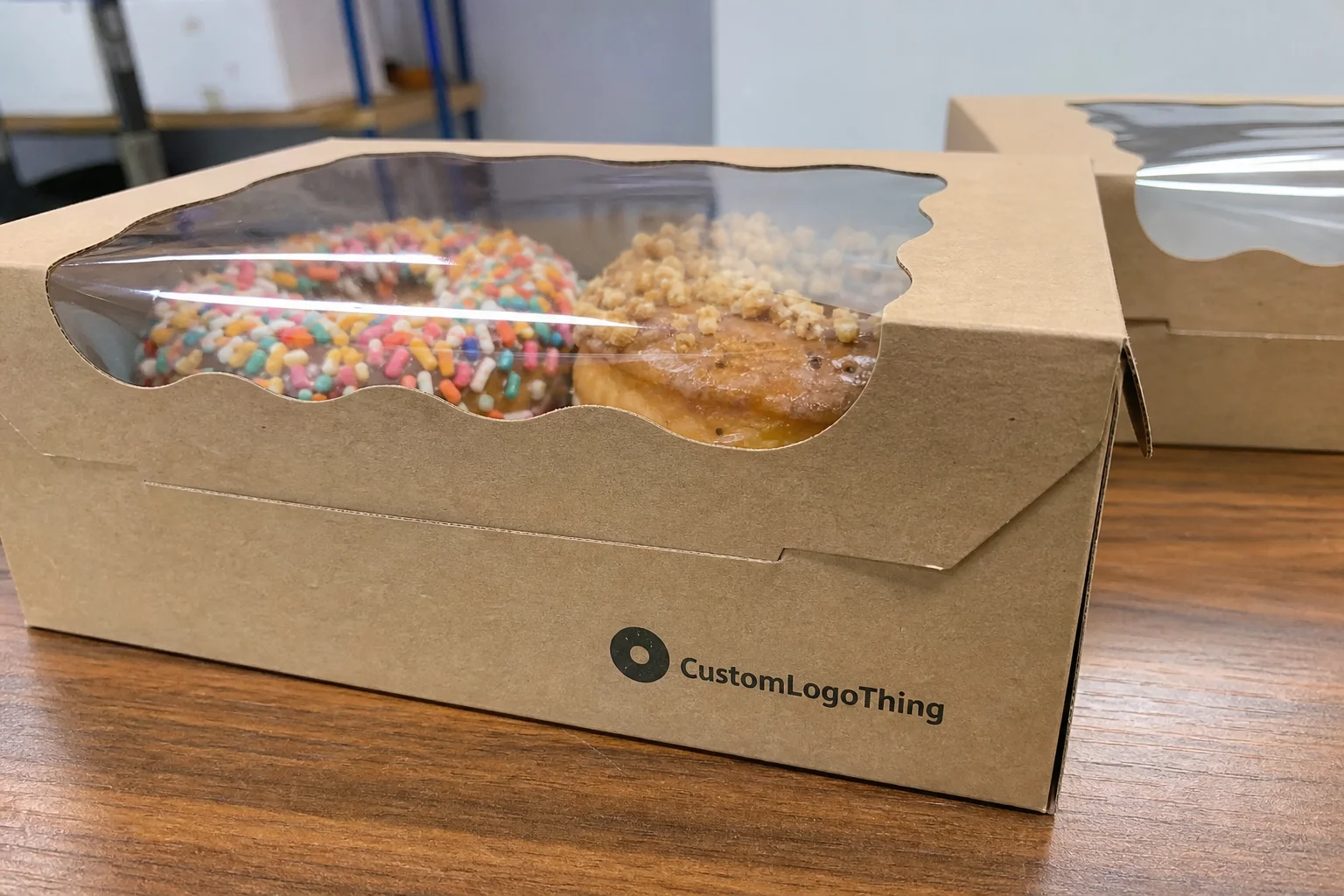
There are three common formats. A simple carry box works well for counter sales and short trips. A windowed display box adds visibility, which helps impulse buying and makes branding easier to see. An insert-supported box is better when donuts have tall toppings, cream fillings, or loose decorative elements that need separation.
Handling matters too. Staff usually fill the box, close it, stack it, and hand it off in quick sequence. If the lid is too snug, icing gets dragged. If it is too loose, the contents shift. Powdered donuts can mark the inside of the lid almost immediately, and cream-topped varieties are especially vulnerable to contact damage. A few millimeters of clearance can matter more than a fancy print treatment.
Visibility helps, but only to a point. A window can raise shelf appeal because people buy with their eyes first. Too much exposure, though, can invite condensation, weaken the structure, or create a hygiene concern if the product sits in a display case for a while. The best window size usually reveals enough to show freshness without turning the carton into a weak frame around the product.
For shipments or delivery runs, ask whether the format has been tested under stacked handling or vibration. If the boxes will travel beyond a short counter handoff, compare the pack against guidance from ISTA packaging test methods. That is not overkill; it is a practical way to reduce crushed lids and wasted product.
One more variable is venting. If the donuts are meant for immediate sale, some airflow can help reduce trapped moisture. If the product is being transported longer distances, stronger board and a tighter closure may be the better answer. There is no universal structure that works for every bakery. The right choice depends on the dough, the frosting, the route, and the time between packing and eating.
Board Weight, Windows, and Finish Choices
Board selection usually starts with thickness and food-use expectations. For many bakery runs, 14- to 18-point paperboard or roughly 300-400 gsm stock is enough for counter use and short transport. Move up in stiffness if the box will be stacked, delivered, or reused as a carrier. Heavier board costs more, but it also cuts down on bent corners and box collapse.
Window film adds visibility, but it should be used with intention. A large window can improve shelf appeal in retail packaging, especially for rings with bright glaze or strong decoration. Yet a window also reduces board area and can weaken the structure if the layout is poorly planned. The sweet spot is usually a window that shows the hero donuts, not the whole tray.
Finish matters because donuts are sensory products. Matte finishes can feel softer and more bakery-forward. Gloss can make colors punchier and help photography on the shelf. Soft-touch coating sounds premium, but it is not always the right call for greasy environments because fingerprints and smudges can show quickly. If the box will live near sugar, butter, or glaze residue, practical cleanability matters more than a luxury tactile effect.
Food-contact behavior deserves attention for glazed, sugared, cream-filled, and heavily frosted donuts. Ask whether the inner surface has a coating that resists migration and whether the print area stays outside product contact zones. This is where custom printed boxes can look polished and still fail if the liner or coating choice is wrong.
| Option | Best For | Typical Unit Cost Range | Practical Tradeoff |
|---|---|---|---|
| Standard tuck-top carry box | Counter sales, short trips, simple assortments | $0.18-$0.32 per unit at 5,000 pieces | Lower cost, fewer features, less visual merchandising power |
| Windowed custom donut boxes | Display-driven sales, gift sets, retail counters | $0.24-$0.42 per unit at 5,000 pieces | Better visibility, slightly more complexity, added film and die-cut cost |
| Insert-supported premium box | Tall toppings, mixed assortments, delivery orders | $0.32-$0.58 per unit at 5,000 pieces | Best protection, more assembly time, higher program cost |
If you are balancing appearance and durability, think like a shopper. Enough product should show to trigger appetite. Too much exposure, and the box stops doing its structural job. That tension is common in custom donut box packaging, and it is usually solved by testing a few real samples under real packing conditions, not by approving a rendering alone.
For buyers who want cleaner paper sourcing, FSC certification is worth asking about. A supplier that can document responsibly sourced paperboard through FSC standards gives procurement teams a more defensible story, especially if branded packaging is part of a broader sustainability claim.
Cost, MOQ, and Quote Variables
Unit price is only one part of the story. The real cost of custom donut boxes depends on dimensions, board weight, ink coverage, coatings, windows, inserts, and order volume. A low quote can still become expensive if the box slows assembly or damages product. That is why total program cost is the better measure.
Minimum order quantity changes the economics. If you are testing a new look or running a seasonal flavor line, a smaller MOQ may be the safer path even if the per-unit price is higher. If you are rolling out across several locations, a larger run can cut unit cost significantly, but only if the spec is locked before production starts.
Here is the information that removes most of the guesswork:
- Exact box dimensions, including internal clearance for tall toppings.
- Pack count per box, such as single, half-dozen, or dozen.
- Artwork status, including whether files are print-ready or still being developed.
- Ship-to location, because freight can swing landed cost meaningfully.
- Target turnaround, since rush schedules often change material or production options.
For a buyer, the cheapest quote is rarely the best value if the box crushes in delivery, stains easily, or takes too long to assemble. A better quote is the one that gives accurate die lines, realistic lead time, and stable repeat pricing when you reorder. That matters even more for branded packaging programs that need consistency across multiple stores.
If you are comparing suppliers, ask whether they can quote both standard and custom printed boxes using the same dimensions. That makes it easier to compare apples to apples. It also helps when you want a premium version for gifts and a simpler version for daily sell-through. Our Custom Packaging Products catalog is useful for that kind of side-by-side comparison.
There is one practical detail buyers sometimes miss: print coverage can affect yield. Large solid backgrounds, especially deep colors, may show scuffs faster and can be less forgiving on certain paperboards. If the box will be handled a lot or stacked in bulk, cleaner layouts often perform better than heavy coverage.
Production Steps and Lead Time
The production flow is usually straightforward, but delays happen in predictable places. A typical job moves through specification gathering, structural sampling, artwork proofing, approval, production, packing, and freight. If any one of those steps gets fuzzy, the schedule stretches.
Samples move faster when dimensions are clear and the design team has clean artwork. They slow down when the buyer is still deciding whether to add a window, change the insert layout, or adjust the pack count. Early decisions matter here. Every late change forces another round of checking, and custom donut boxes are not forgiving when the closure line or window placement shifts by even a small amount.
For a standard run, sample timing is often a few business days for a plain structure and longer if tooling or print mockups are involved. Full production commonly lands around 12-15 business days after proof approval, though complex finishing, peak-season scheduling, or freight constraints can extend that. Buyers should treat those numbers as planning ranges, not promises.
You can shorten lead time with a few disciplined choices:
- Use a standard size rather than a custom dimension unless the product truly needs it.
- Limit the ink count and keep the artwork clean.
- Choose a simpler closure and skip unnecessary inserts.
- Lock the spec before the order is released.
Simplicity has a production advantage too. Fewer components mean fewer points of failure. That matters in busy bakeries where staff are folding, filling, and closing boxes in quick succession. If a package requires two extra motions per unit, the labor cost can exceed the material savings very quickly.
For shipments that will face stacked transport, ask for testing aligned with ISTA-style procedures or at least comparable internal handling checks. That is a practical way to catch weakness before a full run ships, not after.
Color proofing is another point that deserves attention. A logo that looks sharp on a screen can print differently on paperboard, especially under warm bakery lighting. If the brand depends on a specific red, black, or metallic accent, ask for a physical proof or a controlled color reference before approving the run.
Common Ordering Mistakes Bakery Buyers Make
The most common mistake is undersizing. Tall frosting, chocolate drizzle, and decorative toppings need room. If the lid touches the product, the box fails even if the print is beautiful. Buyers often discover this only after the first fill test, which is a costly time to learn it.
A second mistake is choosing a weak board for stacked transport. A box that works for counter handoff may not survive a delivery bag, a tote, or a short courier route. Grease migration can also sneak up on teams that focus only on print quality. If the inner surface is not right, the board can look stained or soft before the box reaches the customer.
Another issue is assembly speed. Premium-looking packaging that takes too long to fold can slow a morning rush and frustrate staff. A bakery box should look polished, yes, but it also needs to behave in a real service environment. If the team has to fight the closure every time, the format is wrong.
Branding errors matter too. Cluttered layouts, weak contrast, oversized windows, and busy graphics can all compete with the product instead of framing it. Good package branding should point the eye toward the donut, not steal attention from it. If the logo disappears once the box sits in a bright case, the print strategy needs another pass.
Before approving a sample, check this list:
- Does the tallest donut clear the lid with room to spare?
- Does the box stay rigid when held from one end?
- Does the finish show fingerprints or grease too quickly?
- Can staff assemble it without slowing service?
- Does the product still look fresh after a short wait?
That checklist is simple, but it catches the failures that usually matter most. The goal is not to create the fanciest carton in the room. The goal is to ship a box that keeps donuts presentable until the customer opens it.
There is also a seasonal issue worth planning around. Warm-weather shipping can make condensation and frosting smear more likely, while cold storage can make some coatings show scuffs or brittleness more quickly. A package that behaves well in January may need a different balance of board and finish in July.
Expert Tips for Better Reorders and Rollout
The smartest buyers standardize one base structure and vary the artwork, label, or sleeve. That keeps cost under control while still letting the line feel fresh. It also makes reordering easier because the size, board, and closing method do not change every cycle. If flexibility matters, build it into the print layer, not the die line.
Test the box under the same conditions it will face in service. Refrigerated storage, glaze transfer, stacked transport, and handoff at the counter all tell you something different. A sample that looks perfect on a desk can behave very differently after an hour in a delivery bag. That is why real-condition testing matters more than a polished mockup.
Suppliers should be judged on more than price. Ask about tolerance discipline, proofing process, and reorder consistency. If the second run drifts from the first, the whole brand experience starts to wobble. In retail packaging, consistency is part of quality. Buyers feel the difference even if they cannot name it.
From a procurement angle, the best rollout plan is simple: measure the donuts, confirm the pack count, request a spec quote, and compare samples under actual use. If the box performs well, then scale the order. If not, change the structure before you commit to volume. That saves money and avoids stale-looking product on the shelf.
For buyers who want a broader selection of trays, sleeves, and cartons alongside custom donut boxes, our Custom Packaging Products range makes it easier to keep the structure consistent across different bakery items.
Custom donut boxes work best when they are treated as sales tools, not afterthoughts. Get the dimensions right, choose the board for the actual handling environment, and insist on a finish that supports the product instead of masking it. Do that, and the box helps the donuts stay cleaner, travel better, and reach the counter looking ready to sell.
How do I choose the right size for custom donut boxes?
Measure the widest donut and the tallest decoration first, then add clearance so frosting and toppings do not touch the lid. Decide the pack count before quoting, since single, half-dozen, and dozen formats usually need different internal layouts.
What material works best for custom donut box packaging?
A sturdy food-safe paperboard is usually the baseline because it balances print quality, stackability, and cost. Choose heavier board when boxes will be transported, stacked, or handled repeatedly; lighter board can work for short counter transfers.
Do windowed custom donut boxes keep pastries fresh?
A window helps shoppers see the product, but freshness depends more on venting, board choice, and how long the donuts sit before sale. Use a window when visibility supports sell-through, but avoid oversized openings if condensation, grease, or transport damage is a concern.
What affects the unit cost of custom donut boxes?
Size, board weight, print complexity, coatings, windows, inserts, and order volume all affect unit cost. The cheapest box price is not always the best buy if it creates product damage, slower assembly, or more waste.
What should I have ready before requesting a quote for custom donut boxes?
Have dimensions, donut count, artwork status, target quantity, and delivery location ready before you ask for pricing. If you can, share a sample or reference photo so the supplier can confirm structure, finish, and lead time more accurately.