Buyer Fit Snapshot
| Best fit | Custom Drawer Box Packaging Wholesale projects where brand print, material claims, artwork control, MOQ, and repeat-order consistency need to be specified before quoting. |
|---|---|
| Quote inputs | Share finished size, material target, print colors, finish, packing count, annual reorder estimate, ship-to region, and any compliance wording. |
| Proofing check | Approve dieline scale, logo placement, barcode or warning zones, color tolerance, closure strength, and carton packing before bulk production. |
| Main risk | Vague material claims, crowded artwork, missing packing details, or unclear freight terms can make a low unit price expensive after revisions. |
Fast answer: Custom Drawer Box Packaging Wholesale: Board, Finish, Dieline, and Unit Cost should be specified like a repeatable production item. The safest quote records material, print method, finish, artwork proof, packing count, and reorder notes in one written spec.
Production checks before approval
Compare the actual filled-product size with the drawing, then confirm tolerance on folds, seals, hang holes, label areas, and retail display edges. Reserve space for logos, QR codes, warning copy, and material claims before decorative graphics fill the panel.
Quote comparison points
Review material grade, print process, finish, sampling route, tooling charges, carton quantity, and freight assumptions side by side. A quote is only useful when the supplier can repeat the same color, closure quality, and packing count on the next order.
Custom Drawer Box Packaging Wholesale can look like a branding choice until a 2-3 mm dimension slip forces a new pallet pattern and freight climbs by 10% to 18% on a full run. I have seen that happen more than once, and the bill is never subtle. The box stops acting like a nice presentation piece and starts behaving like a cost-control device, because every millimeter affects nesting, stackability, and how quickly a warehouse team can move product without damaging corners or scuffing labels.
For packaging buyers working at scale, custom drawer Box Packaging Wholesale is really about lowering landed cost, limiting damage claims, and keeping replenishment steady enough that demand does not outrun supply. A well-built drawer box reduces wasted cube, keeps the product seated during transit, and shortens the time your team spends reworking returns or replacing crushed units. The smartest projects begin with structure, not artwork, because structure decides whether the package survives the route. That is why this format behaves more like logistics planning than decoration.
Why custom drawer box packaging wholesale starts with a surprising cost leak
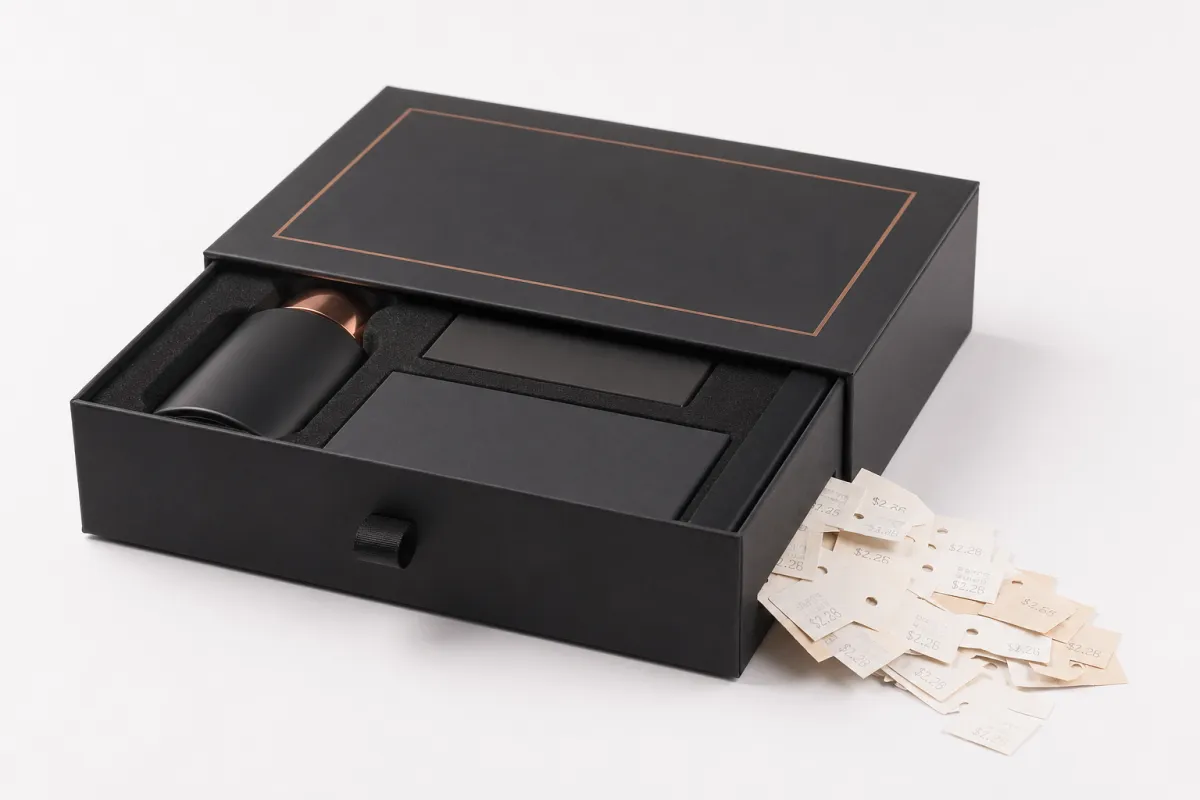
The leak is usually geometry, not print. A drawer box that is 3 mm too wide, or a tray depth that leaves too much headspace, can turn a clean pallet pattern into one that needs extra wrap, more corner protection, and sometimes another pallet layer just to stay within freight limits. In custom drawer box packaging wholesale, that means volume planning matters more than surface decoration, even if the artwork gets the first round of attention.
The buyer's real question is blunt: does this format lower the cost per retail-ready pack once freight, handling, and reject rates are counted? If the answer is yes, custom drawer box packaging wholesale earns its place. If the answer is only that the box looks premium, the budget usually gets squeezed somewhere else, often in board thickness or quality control, and that shows up later as dented corners or inserts that slip out of position.
Premium tea sets, fragrance discovery kits, and compact medical devices often move better in a true drawer structure than in a one-size tote. The internal cavity can be tuned to the product footprint while the outer sleeve stays tight enough for stacking. A well-specified drawer box also gives a cleaner opening motion, which matters to retail packaging teams and ecommerce pickers who need product to slide out without snagging. That small movement tells the buyer a lot about the build.
"A drawer box should justify its footprint by protecting the product, presenting the shelf face cleanly, and moving through the warehouse without drama."
Labor is part of the equation too. Better-fitting custom drawer box packaging wholesale can cut time spent adding void fill, re-taping flaps, or hand-staging items into bins before outbound shipment. That does not sound dramatic on paper, yet on a run of several thousand units it changes the rhythm of the line. The box stops being a passive container and starts acting like a tool.
Before artwork files open, the decision tree should be obvious. Start with the material budget, then the structural design, then supplier reliability, then lead-time risk. Branding belongs after those pieces line up. If the spec cannot survive pallet movement, humidity swings, or rough retail handling, the logo will not rescue it. Good custom drawer box packaging wholesale work starts with the box that ships cleanly.
In a real commercial workflow, the first meeting usually sounds boring, and that is a good sign. The buyer brings dimensions, product weight, a photo of the item in its secondary wrap, a target stack height, and a rough sales forecast. The supplier returns with a material recommendation, a tolerance band, and a freight estimate. That exchange keeps a drawer-box program from turning into a costly redesign halfway through production.
Product details: materials, structure, and finish options that affect performance
Material choice changes both appearance and runnability. For lightweight premium items, a rigid structure built around 1.2-1.8 mm grayboard wrapped in printed paper may be enough, especially when the product has its own internal support. Heavier products often justify thicker caliper or a board-and-flute hybrid, where E-flute gives a cleaner profile and B-flute adds more crush resistance. In custom drawer box packaging wholesale, heavier board does not always mean better performance, but it often buys more stability when cartons are handled several times before they reach a store or distribution center.
SBS stock and kraft-coated stock behave differently under pressure and under light. SBS gives a brighter print face and cleaner color on brand-heavy graphics, while kraft-coated liners support a more natural look that fits sustainability-first positioning. Good packaging design aligns board with the channel, because retail packaging sitting under bright lighting has different demands than a mailer box intended for direct shipping. With custom drawer box packaging wholesale, those choices influence the quote and the shelf impression at the same time.
Structure matters just as much as material. A one-piece drawer with a friction-fit sleeve is simple and economical. A telescoping side rail design gives better control for deeper products and helps keep the drawer aligned during opening and closing. Split-lid or two-stage drawer builds create a more premium feel, yet they also add setup time and can increase waste if tolerances are not tightly held. Deep-tray versions work well for kits and bundled sets, especially when the box needs to hold multiple components without rattling. That is where the structure becomes a manufacturing decision, not just a graphic one.
Finish choices move the budget faster than most teams expect. Water-based coatings usually keep the line cleaner and are easier to position for lower-odor projects, while UV or specialty inks may still be chosen for specific adhesion or color-performance demands. Soft-touch lamination adds a matte, velvety feel, but it also adds a noticeable cost premium. Foil, embossing, and spot UV bring strong shelf appeal, yet each one adds setup considerations. In this packaging category, the practical move is to decide which finish supports sales and which one only decorates the surface.
- Soft-touch lamination helps premium categories feel more refined, but it can show scuffing if the shipping route is rough.
- Spot UV works best when the artwork has enough contrast to make the gloss hit readable from a few feet away.
- Foil stamping adds brand presence, but tight registration is critical or the effect starts to look off-center.
- Varnish is usually the most budget-friendly way to protect the print surface while keeping the finish straightforward.
Insert systems are where function gets very real. Cut-to-fit dividers hold bottles, jars, or device parts in place, while honeycomb cushioning can replace foam when sustainability goals matter. Foam inserts still have a place when the product is fragile or oddly shaped, but they should be measured against the weight penalty and the recycling story. For regulated products, tamper-resistant closures or structured sleeves can help maintain first-open integrity without making the drawer hard to operate. In custom drawer box packaging wholesale, insert design often decides whether the product arrives in a clean presentation or rattles loose in transit.
Retail buyers also read the box with their hands and scanners, not only with their eyes. Edge-to-edge registration shows whether the printer held alignment through the run. Barcode placement needs a quiet zone that stays clear of folds, glue seams, and glossy reflections. Opening force matters too; if the drawer drags too hard, the customer experience suffers, and if it slides too loosely, the whole pack feels underbuilt. That is why the box should be judged with a handling test, not only a mockup photo.
For product development teams, the best collaboration packet includes brand colors in Pantone or CMYK values, legal copy placement, scan zones for tracking labels, and an opening direction that matches the retail or ecommerce workflow. A packaging buyer who sends those items early usually gets a cleaner proof cycle and fewer surprises. The spec becomes easier to quote, easier to build, and easier to repeat in wholesale runs for this format.
One practical rule holds up well: if the outer sleeve carries the visual load, keep the drawer panel calmer so the box does not become noisy in the hand. If the drawer itself is the hero surface, then the sleeve can stay restrained and serve as the structural frame. Either way, consistency in paper grain, coating direction, and crease quality matters, because those details control how the box folds, slides, and stacks in production.
On a production floor, I have watched a beautiful concept fail because the grain ran the wrong way. It looked fine on screen. In hand, the crease cracked. That kind of problem is boring until it is expensive. Then it is very, very boring.
Specifications that protect your shipment: fit, load, and compliance standards
Before pricing, define how the box must behave in transit. Set the maximum filled weight, the intended stack height, the target compression resistance, and the kind of vibration or shock the package will see during transport. A drawer box for light fragrance samples does not need the same crush performance as a branded medical kit, but both need a clear spec. That is the practical backbone of custom drawer box packaging wholesale.
Dimension workflow should be locked in writing. Start with a CAD file or dieline, then confirm the internal depth, side clearance for inserts, and the tolerance band that accounts for board swell, print build, and glue-up variation. A production floor can tolerate some natural movement in paper-based materials, but the box still needs a controlled fit. In custom drawer box packaging wholesale, a 1 mm tolerance sounds tiny, yet it can decide whether a drawer glides cleanly or binds halfway open.
Procurement reviews usually lean on a few standard tests. Edge crush resistance helps estimate stacking performance. Burst testing gives another signal on board strength. Top compression matters when cartons are layered on a pallet or placed in case packs. Puncture resistance matters when the box travels through a mixed freight network where corners take abuse. Tape seal durability may not sound glamorous, but it matters for glued or folded closures that need to survive both storage and distribution. The strongest drawer-box programs use a test plan instead of a visual-only approval.
For long-haul shipping, palletization details matter almost as much as the carton spec. Boxes should be oriented the same way whenever possible, with labels placed on the same panel so line workers and receivers do not waste time searching for data. Corner reinforcement can help protect outer cases, and standardizing box height increments improves truck utilization. That kind of detail sounds minor until freight cost per unit begins to climb. Then every efficient inch matters.
Compliance adds another layer. Food-contact zones, migration concerns, moisture control, and export documentation all need to be checked before final approval if the product category requires them. Not every drawer box is intended for direct contact with food, and not every coating is suitable for sensitive contents. For sustainability claims, a buyer should ask for evidence rather than vague promises. The FSC framework is useful when fiber sourcing matters, and the broader materials conversation often benefits from the guidance available through the EPA. Those references do not replace testing, but they do help frame a cleaner procurement standard for wholesale packaging.
A few mistakes show up again and again. Overhanging inserts create pressure points that deform sleeves. Barcode misalignment slows receiving and can trigger avoidable re-labeling. Grain direction problems can cause misfeed or cracking at the crease. Weak glue lines may pass a hand check but fail after a few temperature swings. These are small issues in the drawing stage and expensive issues on the floor, which is why the production spec should be checked against actual behavior, not just a render.
If you want a useful internal benchmark, define three numbers and keep them consistent across revisions: internal fit tolerance, allowable defect rate, and maximum transit damage rate. Once those numbers are set, the supplier can quote more cleanly, and your team can compare samples without guessing. That is the point where the project becomes a controlled operational tool rather than a creative experiment.
Pricing and MOQ: custom drawer box packaging wholesale cost model made clear
Pricing makes more sense when it is split into buckets. Material cost covers board, wrap paper, inserts, and coatings. Structure complexity covers the die, gluing, assembly sequence, and any special folding requirement. Finishing covers print coverage, foil, embossing, lamination, or UV. Tooling covers setup and any dedicated cutting forme or sample plate. Labor and freight are the last two pieces, and both can move a quote more than people expect. That is the real math behind custom drawer box packaging wholesale.
MOQ behavior changes with every design choice. A simple structure may be practical at 500 units because setup is modest and the run can be handled efficiently. A more premium build with heavy coverage or a custom insert usually becomes more economical at 1,000, 2,500, or 5,000 units because the fixed costs spread out faster. In this category, low MOQ is not always the cheapest project; it is just the safest place to validate demand.
Sample and pre-production charges need to be visible. A design review fee may apply if the dieline needs cleanup. A proofing charge may cover color checking and layout corrections. A production sample can carry its own cost when the build includes special materials or a unique insert. Some programs waive those fees against the final order, but that depends on volume and complexity. Buyers get better control when they ask for the sample terms separately from the unit price.
A transparent order formula helps the finance team compare suppliers fairly:
Unit price = (fixed setup + variable unit cost + QA + packaging labor + freight allocation) / order units
That formula keeps the conversation honest. It also makes pricing traps easier to spot. Oversized packs can trigger freight surcharges. Rush artwork revisions can add art and plate charges. Specialty inks can raise cost if the printer has to source a custom match. Overnight shipment of proof files or samples can erase the savings from a good run. These are the hidden pressure points in the buying process.
| MOQ band | Typical use | Indicative unit price | What usually drives the number |
|---|---|---|---|
| 500 units | Pilot launch or seasonal test | $1.25-$2.40 | Setup spread is high, and special finishing can dominate the quote |
| 1,000 units | First commercial replenishment | $0.82-$1.65 | Better balance between print efficiency and fixed costs |
| 2,500 units | Steady retail or ecommerce supply | $0.54-$1.10 | Tooling and QA costs are spread more efficiently |
| 5,000 units | Program order or repeat SKU | $0.38-$0.88 | Material procurement and line speed usually improve the landed rate |
Those ranges are examples, not promises, because artwork coverage, insert count, coating choice, and freight route all change the final result. Still, the pattern is stable: unit cost drops most sharply when a buyer moves from the pilot tier to the first real production tier. That is why this packaging format usually pays off only after the spec is frozen and the demand plan is believable.
One effective tactic is two-stage MOQ logic. Start with a pilot run that confirms fit, print, and handling. Then commit to a ramp run only after the sample is signed off and the sell-through data makes sense. This protects cash flow without forcing the buyer into a speculative large order. It is one of the cleanest ways to manage the project without gambling on a single oversized order.
If the project also needs secondary cartons, display units, or protective inserts, start with our Custom Packaging Products page to map material options, then compare volume terms through Wholesale Programs once the specification is locked. That sequence keeps the buying process aligned with actual replenishment needs instead of estimated wish lists.
For buyers who want a practical budget guardrail, I usually suggest reserving 8% to 12% of the initial packaging budget for sample work, revisions, and freight volatility. It is not always used, but it gives the project room to absorb real-world change without forcing a late compromise on board quality or finish. That mindset makes the cost story easier to defend internally because it is complete, not partial.
Process and timeline for custom drawer box packaging wholesale execution
A realistic production timeline starts with clean inputs. Day 0 to Day 2 is design intake: dimensions, product weight, print files, insert notes, and shipping assumptions. Day 3 to Day 7 is structural review and cost validation, where the dieline gets checked and any material conflicts are flagged. Day 8 to Day 12 is proof or prototype work. Day 13 to Day 20 is approval, revision control, and pre-production planning. Then the line moves into production windows. That is a common rhythm for custom drawer box packaging wholesale, though a complex build can move more slowly.
The biggest timeline drag is rarely the machine. It is late edits. If the artwork keeps changing after the dieline is approved, the whole schedule slips. If the board stock has to be substituted because of availability, the print run may need color adjustment. If the insert needs secondary tooling, another lead-time layer gets added. That is why the project works best when the buyer freezes the spec before asking for a production slot.
For standard routes, a typical cycle can land in the 2 to 4 week range after final approval, especially when the material is already available and the finishing package is straightforward. Priority channels can move faster when the supplier has open press time, but that usually comes with higher cost and tighter sign-off windows. Accelerated work should be used only when the demand spike is real, because rushing the order into the schedule tends to increase both freight and revision risk.
Buyer responsibilities are straightforward, but they matter. The project needs a master file, a confirmed dieline, a sample sign-off, and a pre-shipment checklist. If the cartons are going to a distribution center, the load plan should be confirmed before production ends, not after. A good supplier will keep file control tight, but the buyer still has to make sure the approved version is the one that gets released. That discipline keeps the program from drifting into expensive rework.
Quality control should be measured, not vague. First-article inspection checks the first sample against the approved spec. In-process checks verify print position, glue strength, and cut quality while the run is active. Final lot audit looks at sample counts, defect rate, and dimensional drift. Acceptance criteria should be numeric whenever possible, such as a dimensional tolerance band, an allowable color delta, or a maximum reject percentage. That is how the program stays dependable from one order to the next.
- First-article inspection confirms the build before the run expands.
- In-process checks catch weak glue, misregistration, and edge wear early.
- Final lot audit verifies count accuracy, print consistency, and carton integrity.
- Pre-shipment review confirms pallet height, label placement, and transport readiness.
There are backup options when the timeline gets tight. A staged release can ship part of the order first and the balance later. Split factory planning can keep one line running while another handles finishing or inserts. Alternative paperboard substitutions can preserve strength while avoiding stock delays, as long as the revised material stays within the agreed spec. Used correctly, these options protect the order without turning it into a moving target.
One practical note from the production floor: keep the approval chain short. Too many reviewers create tiny revisions that add up to a new proof, and every new proof means another clock reset. If you want the program to deliver on time, designate one final decision-maker and one backup. That alone saves more schedules than most buyers realize.
Why choose us for custom drawer box packaging wholesale reliability and scale
Reliability is not a slogan. It is a set of habits. The strongest custom drawer box packaging wholesale programs use one point of contact, controlled file revisions, and documented sign-off gates so the order does not drift between quoting and production. That sounds basic, but it is often the difference between a clean repeat program and a box that needs correction halfway through the run.
Risk reduction begins before tooling. A careful design review can catch weak flaps, poor insert fit, awkward grain direction, and print areas that are too close to a fold. Pre-press checks can identify color mismatches and barcode issues before a sheet is cut. Build audits can show whether the drawer slides too tightly or too loosely. Good service is built on catching those problems while they are still cheap.
Buyers also care about measurable service terms. Tolerance ranges should be consistent from run to run. Defect-rate tracking should be visible, not hidden. Replacement policy should be written clearly if cartons arrive outside spec. Spare inventory options matter when a launch runs faster than forecast. That is the kind of support that makes the program easier to manage over time, especially for brands that reorder often.
There is a real difference between transactional promises and operational reliability. A transactional supplier may quote a good price and still leave the buyer to chase updates. A reliable packaging partner will set an approved timeline, confirm response times for escalations, and tell you early if a material delay could move the ship date. In wholesale packaging, honest communication is worth more than a polished sales line.
Scale handling matters too. Smaller runs need careful batch planning so cash is not tied up in inventory. Larger lots need smoother staging into storage, pick-and-pack, and freight movement. A dependable supplier can coordinate those moving parts without forcing the buyer to redesign the SKU every time volume changes. That matters because growth should not create a packaging bottleneck.
For buyers comparing formats, a drawer box is often one of the best places to invest in branded packaging because it protects the product while still giving a premium opening experience. The box can carry strong package branding without becoming fragile or wasteful, and the format can be adapted across many categories of custom printed boxes. If you are still mapping the broader line, our Custom Packaging Products catalog is a useful starting point, while Wholesale Programs can help frame the economics of recurring orders. That combination supports the project with less guesswork.
Traceability is another trust signal. Material batches should be documented, revision history should be visible, and the final approved sample should be easy to compare against the run. When a supplier can show what changed, when it changed, and who signed off, the buyer can make decisions faster. That matters more than a flashy presentation when the order is tied to launch dates and inventory commitments.
One final advantage is predictability. If a buyer knows the tolerance band, the lead-time range, and the replacement path before the order starts, the whole project feels calmer. Calm projects cost less in meetings, less in labor, and less in emergency freight. That is the kind of value that makes the specification worth getting right the first time.
What should you confirm before ordering custom drawer box packaging wholesale?
Confirm the fit, the finish, the freight plan, and the approval path before you send the order to production. Those four checks prevent most avoidable delays because they connect the creative side to the operational side. A good drawer-box project is not just about appearance; it is about whether the box fits the product, survives the route, and arrives in a form your team can actually use.
- Dimensions should include internal fit, insert clearance, and the tolerance band for board variation.
- Material should match the product weight, stack height, and shelf or shipping environment.
- Finish should support the brand story without adding avoidable cost or scuff risk.
- Logistics should cover pallet pattern, freight method, and the receiving location's rules.
For a clear buying process, keep one file set, one spec sheet, and one final decision-maker. That reduces revision churn and makes the quote easier to defend. If any of those three items are still moving, the order is not ready yet. That is true for a pilot run and even more true for a scale order.
Conclusion: next steps to launch custom drawer box packaging wholesale this quarter
The cleanest path to custom drawer box packaging wholesale is to lock the size, lock the material, and lock the shipping model before anyone argues over decorative details. If the spec is tight, the quote gets sharper, the production plan gets shorter, and the outbound handling gets easier. That is the practical payoff: less rework, more predictable cost, and cleaner movement through the warehouse.
Start with the product dimensions and the target gross weight per unit, then add a 5% tolerance for inserts and accessories before you request a quote. That keeps the box from being too tight after the first production sample. Next, submit one finalized CAD file, one material preference, and one shipping model, whether that means domestic pallet, regional DC, or direct-store distribution. This is the simplest way to keep the program grounded in real operations.
Then choose a pilot quantity tied to actual demand and sign an acceptance template for sample, tolerance, and print checks. Once that is done, approve a staged timeline that includes production, inspection, and reserve inventory dates so replenishment can begin before stock drops below reorder point. The more explicit those milestones are, the fewer surprises you will get.
As a final go-live check, confirm sample photos, measured key dimensions, unit-cost breakdown, and freight assumptions before you release the first order. Those four items tell you whether the project is ready or still needs one more round of review. For brands that care about branded packaging, retail packaging, and Product Packaging That behaves as well as it looks, the best results come when the commercial details are handled first and the visual details are built on top of them.
Custom drawer box packaging wholesale works best when the box is treated as a shipping tool, a presentation tool, and a cost-control tool at the same time. Get those three parts aligned, and the launch has a much better chance of staying on budget, arriving on time, and looking right the first time.
How much does custom drawer box packaging wholesale usually cost per unit at different MOQ levels?
Unit pricing drops as fixed tooling and setup are spread across more cartons, and the biggest reduction usually happens between the pilot MOQ and the first scale tier. Expect higher cost only when you request low-volume special finishes, custom inserts, or tight tolerance tests, because those become explicit line items in the quote. For a clean comparison, ask for a three-tier table that shows MOQ, unit price, and total landed cost for the project.
What is a realistic MOQ for custom drawer box packaging wholesale for first production?
Most commercial buyers start at 500 to 1,000 units for a confirmed style, with 2,500 or more reducing unit cost and setup impact more noticeably. Complex structures, custom tooling, and premium coatings often require a higher first-order MOQ to keep lead-time and quality on target. A smart path is a pilot lot for physical validation, then a committed ramp lot once carton integrity and print consistency are signed off.
How long does custom drawer box packaging wholesale production and delivery take from approval?
Typical cycles range from about 2 to 4 weeks for standard material and print routes, with longer windows for large paperboard constraints or finish-heavy builds. Most delays come from late revisions or rejected first samples, so the fastest route is locked artwork plus pre-approved dielines. Rush options exist, but they usually add costs in both production and freight, so they make sense only for confirmed demand spikes.
Which specs should I send first to get an accurate custom drawer box packaging wholesale quote?
Send finished dimensions, product weight, fragility notes, insert style, and the intended stack orientation first. Also include expected shelf or pallet stack heights, branding print files, barcode placement, and minimum quantity target so the quote can be built correctly. If you add a clear material priority, such as budget, premium, or sustainability-first, the supplier can narrow the quote faster.
Can custom drawer box packaging wholesale improve transport efficiency without raising packaging budget?
Yes, when the design is optimized for cube efficiency. Better depth control, stronger but lighter board combinations, and standardized fold patterns often reduce transport cost per unit. Budget can improve because fewer damages, fewer chargebacks, and fewer expedited replacements offset the packaging spend over a few shipments. The cleanest way to measure it is with a fixed scorecard for damage rate, landed cost, and shelf pull time after the first two cycles.

