Buyer Fit Snapshot
| Best fit | valentine packaging for ecommerce options for packaging buyers comparing material specs, print proof, MOQ, unit cost, freight, and repeat-order risk where brand print, material, artwork control, and repeat-order consistency matter. |
|---|---|
| Quote inputs | Share finished size, material target, print colors, finish, packing count, annual reorder estimate, and delivery region. |
| Proofing check | Approve dieline scale, logo placement, barcode or warning zones, color tolerance, and any recyclable or compostable wording before bulk production. |
| Main risk | Vague material claims, crowded artwork, or missing packing details can create delays even when the unit price looks attractive. |
Fast answer: Valentine Packaging for Ecommerce Options: Claims, Protection, MOQ, and Cost should be specified like a repeatable production item. The safest quote includes material, print method, finish, artwork proof, carton packing, and reorder notes in one written spec.
What to confirm before approving the packaging proof
Check the product dimensions against the actual filled item, not only the sales mockup. Ask for tolerance on folds, seals, hang holes, label areas, and retail display edges. If the package carries a logo, QR code, warning copy, or legal claim, reserve that space before decorative graphics fill the panel.
How to compare quotes without losing quality
Compare board or film grade, print process, finish, sampling route, tooling charges, carton quantity, and freight assumptions side by side. A lower quote is only useful if the supplier can repeat the same color, closure quality, and packing count on the next order.
Best Valentine Packaging for Ecommerce can look elegant on a mood board and still fail in the mail. A carton that arrives crushed under a heavier parcel does not feel romantic; it feels expensive. The best valentine packaging for ecommerce has to do three things at once: protect the product, survive transit, and still open like a gift. Easy to say. Much harder in a warehouse, where speed, space, and labor keep pushing back.
Packaging decisions get costly fast when they ignore shipping physics. A pretty box that adds half an inch on every side can bump the parcel into a higher dimensional-weight tier. A delicate insert that takes forty seconds to assemble becomes a staffing headache by the third truckload. A seasonal finish that looks clean in a render can chip, dent, or scuff before the customer even sees it. The best valentine packaging for ecommerce is the format That Holds Up on the actual route, not the one that only behaves under studio lights.
Every February, I see the same pattern. Jewelry needs different support than apparel. Candles need more restraint than flat gift sets. A rigid box can make a necklace feel like a keepsake, yet that same box can flatten margin on a low-ticket item. The best valentine Packaging for Ecommerce is chosen when product fragility, order value, and fulfillment speed are evaluated together. Separate them, and the decision turns into decoration theater.
There is also a simple truth that tends to get overlooked: Packaging for Gifting behaves like a hybrid of marketing and machinery. One minute it is brand storytelling. The next, it is logistics math. The best valentine packaging for ecommerce sits right at that intersection, where emotional impact and operational reality stop fighting each other.
Quick Answer: Best Valentine Packaging for Ecommerce
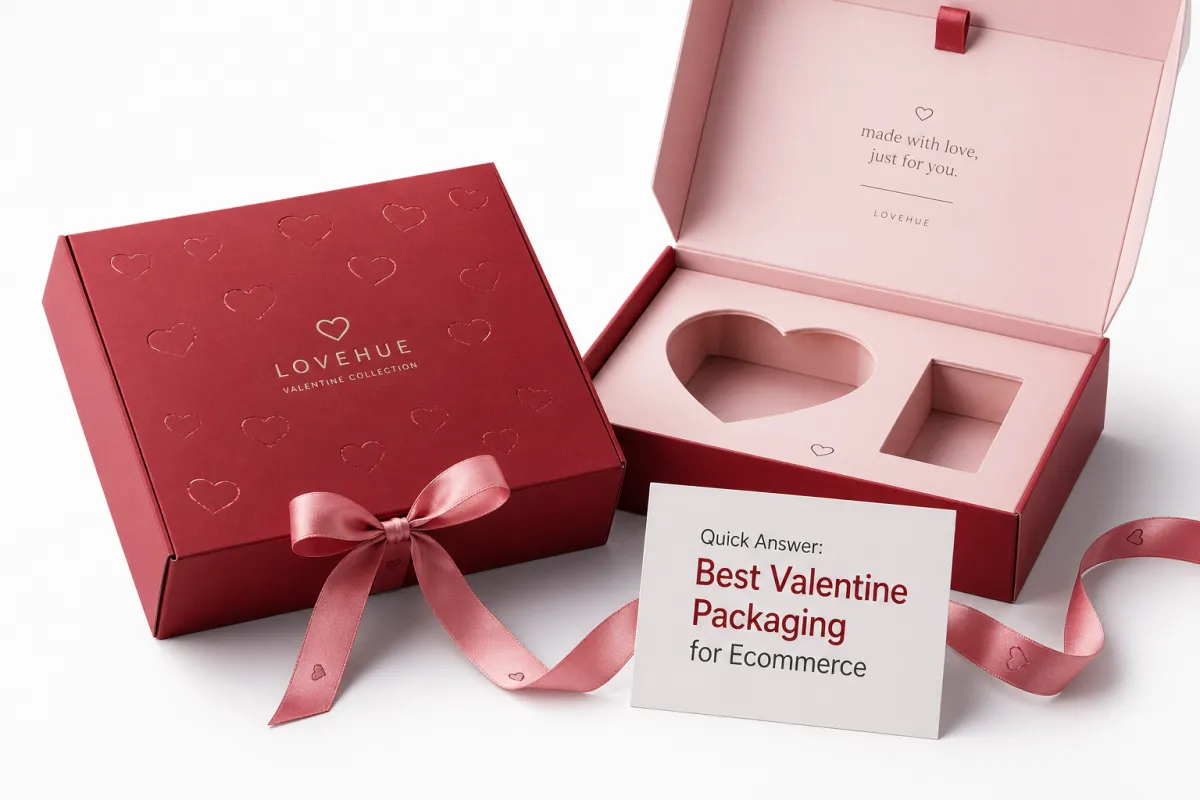
If you need the short answer, a custom mailer box is the best valentine packaging for ecommerce for most direct-to-consumer gift lines. It ships flat, assembles quickly, gives you room for branded storytelling, and feels intentional without pushing the item into luxury pricing territory. For premium jewelry or high-AOV gifts, a rigid box can be worth it. For soft goods and low-fragility bundles, folding cartons or kraft mailers may make more sense. The right choice changes with product risk, average order value, and how much margin you can spare.
Use this checklist before ordering anything:
- Protection: Will the package survive compression, drop impact, and corner hits?
- Unboxing value: Does it feel like a gift rather than a transport container?
- Unit cost: What is the landed cost after freight, inserts, and waste?
- Labor time: How long does one pack-out take under speed pressure?
- Sustainability: Can you use FSC board, paper inserts, or reduced material without making it feel flimsy?
- Speed to ship: Can fulfillment keep pace when orders spike in February?
Most brands overvalue surface beauty and undervalue the trip from printer to porch. The best valentine packaging for ecommerce is the one that arrives looking almost identical to how it left the warehouse. That usually means board strength, fit consistency, and closure design matter as much as foil accents, matte lamination, or a printed interior.
A package that looks luxurious in a mockup but arrives bent is not premium packaging. It is a return label waiting to happen.
For most stores, the strongest position is somewhere in the middle, not at the extremes. Usually that means a well-sized custom mailer box, sometimes with a fitted insert, sometimes with a sleeve, sometimes with a paper-based cushion layer. The best valentine packaging for ecommerce keeps the product safe and the margin intact at the same time.
What Is the Best Valentine Packaging for Ecommerce?
The honest answer is that no single format wins every campaign. The best valentine packaging for ecommerce is a decision matrix disguised as a box. Product, volume, average order value, and customer expectation decide the answer. Change one of those variables and the result can flip.
That is why teams that pick a winner too early often overbuild. A rigid box might be perfect for a premium candle-and-scent line in November, then become a drag on a $20 scarf drop in February. A better approach is to define your valentine gift box strategy by order type and run a short comparison. The best valentine packaging for ecommerce can be different for your top seller and your premium variant of that same product.
So the right test is operational, not emotional. Take two formats, pack ten real orders each, and compare damage rate, average pack-out time, and customer reaction score. The best valentine packaging for ecommerce becomes obvious when one option protects the product, keeps the brand tone intact, and stays inside your total cost per delivered order.
In the same pass, account for ecommerce gift packaging seasonality. Demand usually jumps fast. A one-time order spike can expose packaging failures that were invisible at launch scale. If your packaging is fragile in week two, you will not feel it in week one. You are gonna feel it in refunds, late shipments, and bad reviews.
The best valentine packaging for ecommerce is therefore less about finding the fanciest structure and more about choosing the one with consistent behavior under stress.
Top Valentine Packaging for Ecommerce Options Compared
Comparing formats side by side makes the trade-offs concrete. Each option solves a different problem, and each one creates a different cost profile. A seller shipping chocolate truffles does not have the same needs as a seller shipping a sweatshirt bundle or a sterling silver necklace. The wrong structure can still look beautiful in a presentation file and fail as a business decision.
Custom Mailer Boxes are the safest default for most Valentine orders. They ship flat, build quickly, and offer enough surface area for effective print coverage. In a typical run, cost often lands around $0.55 to $1.20 per unit at 5,000 pieces, depending on board grade, print level, and finish. The best valentine packaging for ecommerce in this category usually uses 16- to 32-ECT corrugated board or a sturdy paperboard mailer, matched to product weight and drop risk.
Rigid gift boxes sit at the luxury end. They carry more perceived value, stronger shelf presence, and a more keepsake-like feel. Cost rises quickly. At scale, a simple rigid setup can land around $1.80 to $4.50 per unit before inserts or specialty finishes. If your average order value can support that structure, the best valentine packaging for ecommerce might be rigid. If it cannot, the margin curve starts to wobble in a hurry.
Folding cartons with inserts work well for lightweight items like small candles, cosmetics, and compact gift sets. They are efficient on materials and easy to print with sharp detail. Crush resistance is the catch. A folding carton often needs a stronger outer shipper if the item is fragile. That extra layer can erase the efficiency advantage faster than teams expect. Even so, the best valentine packaging for ecommerce for small, stable gifts can absolutely be a folding carton inside a protective shipper.
Sleeve-and-box systems are useful for bundles. The sleeve adds seasonal graphics and color, while the base tray or drawer holds the product. This format works especially well for chocolates, candles, and curated kits. When the fit is tight, it feels polished. When the fit is off, the sleeve shifts and the reveal weakens. The best valentine packaging for ecommerce in this format depends on exact tolerances and repeatable assembly.
Kraft and paper mailers remain the fastest and least expensive option for apparel or soft goods. They are simple to stock, easy to pack, and light on labor. A basic mailer can land around $0.12 to $0.28 per unit, depending on size and print. They are not the right answer for every Valentine offer. If the product needs a premium reveal or includes fragile components, kraft mailers are usually a compromise rather than the best valentine packaging for ecommerce.
Here is the comparison in plain terms:
| Format | Best For | Typical Unit Cost | Assembly Time | Main Strength | Main Trade-Off |
|---|---|---|---|---|---|
| Custom mailer box | Most gifts, apparel bundles, mid-range product packaging | $0.55-$1.20 | 15-30 seconds | Strong balance of branding and protection | Less upscale than a rigid box |
| Rigid gift box | Jewelry, premium sets, high-AOV gifts | $1.80-$4.50 | 30-75 seconds | Luxury feel and keepsake value | Higher cost and more cube |
| Folding carton | Lightweight products, small inserts, retail packaging crossover | $0.18-$0.45 | 10-20 seconds | Excellent print efficiency | Usually needs outer protection |
| Sleeve-and-box system | Bundles, chocolates, candles, curated kits | $0.40-$1.10 | 20-40 seconds | Flexible and visually distinctive | Fit precision matters |
| Kraft mailer | Apparel, soft goods, low-fragility items | $0.12-$0.28 | 10-15 seconds | Low cost and simple fulfillment | Limited premium presentation |
The practical takeaway is blunt: the best valentine packaging for ecommerce is usually the format that matches product risk and order value, not the most decorative render. A sturdy custom mailer box covers the widest range of use cases. Rigid boxes win when the product and margin justify them. Folding cartons and sleeves can be excellent in a narrow lane, but they are not universal winners.
Detailed Reviews of the Best Valentine Packaging for Ecommerce
Practicality matters here. The best valentine packaging for ecommerce is not a single format, and differences between structures show up fast once the boxes move out of mockups. I look at three things first: compression resistance, pack-out speed, and the gap between visual concept and transport behavior. That gap is where seasonal launches often lose money.
Custom Mailer Boxes are the most balanced choice. In warehouse terms, they store flat, move quickly through batch picking, and build fast. In branding terms, they accept full print coverage, interior branding, and controlled premium touches without becoming a handling problem. If you want custom printed boxes that feel tailored without slowing the line, this is often the safest starting point. For many stores, the best valentine packaging for ecommerce is a mailer with a fitted insert, a printed inside lid, and a restrained finish such as matte aqueous or soft-touch lamination.
Mailer boxes work because they are honest. They do enough without pretending to be jewelry cases. A good mailer handles candles, apparel, small gifts, and bundled sets with less operational drama than many rigid alternatives. Tight sizing keeps shipping volume under control, and that matters because dimensional weight can add several dollars to a parcel before the customer even opens the box. A half-inch of extra height can be the difference between one billing tier and the next. Across a seasonal campaign, those changes compound.
Rigid boxes behave differently. They feel more ceremonial, create a stronger opening sequence, and reinforce premium expectations. They also demand more space and more labor. A telescoping rigid box can be ideal for a premium pendant set, but it often needs careful insert placement and more floor area than a mailer. The best valentine packaging for ecommerce at the luxury tier often relies on rigid construction because the box becomes part of the gift value. That choice works when the product price can support it. It becomes wasteful when it cannot.
Here is a frequent miscalculation: teams often confuse “high perceived value” with “high return on packaging investment.” They are not the same thing. Rigid boxes can lift conversion, but only if the incremental margin holds. A $20 candle usually cannot support that premium structure. A $140 jewelry piece can. The best valentine packaging for ecommerce should strengthen the economics, not flatten them.
Folding cartons are the quiet workhorse. They shine in product packaging where the item is lightweight, compact, and already somewhat protected. Think lip balm sets, confectionery, or small cosmetic kits. Their print quality is excellent, and material efficiency is strong. The limitation is crush resistance. A folding carton is rarely enough by itself for parcel shipping unless the product is exceptionally stable. The best valentine packaging for ecommerce in this category often pairs with a stronger outer shipper.
That outer shipper is not a compromise; it is design logic. It means the system does two jobs: branding on the inside, protection on the outside. Problems start when brands ask one thin carton to do everything. Bent corners, collapsed lids, and complaints about broken contents usually follow. If you are using folding cartons, pair them with fit-tested outer packaging and test stack-up with real samples, not only a render.
Sleeve-and-box systems are more niche, but they can be excellent for curated sets. A sleeve gives you seasonal graphics without printing a full new base structure every cycle. The drawer or tray creates the reveal. The downside is complexity. Tolerances matter. If the sleeve is loose, the package feels cheap. If it is tight, fulfillment slows down. The best valentine packaging for ecommerce in this format is the one that balances visual impact with repeatable assembly and predictable labor.
Kraft and paper mailers deserve a fair reading too. They are not glamorous, but they are efficient. For apparel, tote bags, or soft gift items, they keep costs controlled and often align with a minimal brand narrative. They rarely become the best valentine packaging for ecommerce for a premium gift-first campaign, though. They can be the right operational choice, but the emotional signal is limited.
The overlooked angle is the protective insert. Even a premium structure behaves poorly if the item can move. A $0.40 add-on that stabilizes a topper and reduces defects can create more revenue protection than a $0.80 finish upgrade. I have watched brands save far more by tightening insert fit than by adding a fancy coating.
If the package is part of the gift, do not treat it like a commodity shipper. That mistake hurts conversion and repeat purchase rates more than most teams expect.
For brands building seasonal lines, packaging works better as a tiered system than as a single decision. Your standard ecommerce packaging can remain practical, while a Valentine edition adds a decorative sleeve, richer insert, or higher-grade board. If you need a starting point, explore Custom Packaging Products that can be adapted to gift campaigns without forcing a full rebuild of the pack-out process.
Price Comparison: What Valentine Packaging Costs in Ecommerce
The best valentine packaging for ecommerce has to make financial sense, and pricing should begin with landed cost rather than printed box price alone. That distinction matters more than many teams want to admit. A lower quote can hide higher freight, more labor, more returns, or greater storage friction. Once those are included, the cheaper-looking option is often not cheaper at all.
For planning, I break cost into three buckets: unit cost, setup cost, and operational cost. Unit cost is the package itself. Setup cost covers dielines, proofs, tooling, and approval rounds. Operational cost includes assembly time, storage, insert handling, and damage replacement. If a supplier cannot explain all three, the quote is incomplete. The best valentine packaging for ecommerce is almost never chosen on unit cost alone.
Typical budget ranges look like this:
- Kraft mailers: $0.12-$0.28 each, depending on size and print coverage.
- Folding cartons: $0.18-$0.45 each, with higher prices for heavy ink or specialty coatings.
- Custom mailer boxes: $0.55-$1.20 each, often the most balanced option for branded packaging.
- Sleeve-and-box systems: $0.40-$1.10 each, depending on fit, board, and finish.
- Rigid boxes: $1.80-$4.50 each, before complex inserts, magnets, or premium wraps.
The numbers help, but they do not tell the whole story. A mailer that costs $0.90 and packs in 20 seconds can beat a $0.40 carton that requires an outer shipper, an insert, and extra handling. The best valentine packaging for ecommerce is often the format with the lowest total cost per shipped order, not the lowest invoice price per box.
Dimensional weight is a major hidden cost center. A box does not become more expensive only because it is larger on paper. It can also move into a worse carrier billing tier, especially when the product itself is light. I have seen packaging shifts add between $1.50 and $3.50 in shipping cost per order because the structure looked stronger in a render but taller in the tote. The best valentine packaging for ecommerce should be measured against the shipping table, not only the design proof.
Minimum order quantity matters as well. Small brands often pay more for flexibility, while larger brands spread setup across bigger runs. A 1,000-piece order may be the right test size, but the per-unit price is usually higher than a 5,000- or 10,000-piece run. That is not a pricing trick. It is production reality. If demand is seasonal and uncertain, the flexibility may be worth the premium. If demand is predictable, larger runs usually improve economics.
There is another hidden cost: replacement shipments. If one format drives a 2% damage rate and another drives 0.5%, the “cheaper” option can become expensive quickly. For seasonal gifting, I would rather pay a little more for stronger structure than spend February chasing broken orders. The best valentine packaging for ecommerce protects revenue as much as it protects the product.
At this scale, the smallest operational gains matter. If one format reduces average labor by ten seconds, on a 3,000-order campaign that saves over eight labor-hours. On a tight team, that can be the difference between shipping on time and holding orders in a queue. The best valentine packaging for ecommerce is therefore partly a finance decision and partly a workforce strategy.
Process and Timeline for Valentine Packaging
Timing is as strategic as materials. The best valentine packaging for ecommerce can fail if the project starts too late. Production may look fast on paper, but proofing, revisions, freight, and fulfillment testing consume real time. Brands that land launch-ready campaigns early usually started several weeks before competitors, even if the final artwork changed twice along the way.
The process should begin with the product and the actual path to the customer. Measure finished dimensions, include insert depth and closure gap, and decide whether the package ships direct to the consumer or moves through a secondary retail workflow. A sample that fits in a photo but not in a carton is a costly mistake. Once the item is measured, choose structure and then fit graphics to structure, not the other way around. The best valentine packaging for ecommerce comes out of measurement and transit simulation, not only an aesthetic revision cycle.
A practical timeline often looks like this:
- Week 1: Finalize product dimensions and packaging goals.
- Week 2: Review structure options and request dielines.
- Weeks 3-4: Approve artwork and sample a prototype.
- Weeks 5-6: Run revision checks, fit tests, and assembly trials.
- Weeks 7-9: Production, quality inspection, and freight.
That schedule is not universal. Stock structures move faster. Heavily finished custom printed boxes can take longer. As a working model, though, it prevents common mistakes: rushing the dieline, weakening structure, or dropping a finish just to meet ship date. The best valentine packaging for ecommerce deserves enough lead time to be tested properly.
Standards matter here too. If a packaging supplier cannot explain drop testing, compression testing, or transit simulation, that is a warning sign. Useful references include ISTA testing standards and broader shipping-performance guidance such as EPA sustainable materials resources. The project does not need to become a materials science thesis, but it should be grounded in real distribution conditions.
Assembly testing saves money later. Build ten to twenty units exactly as the team will build them on launch day. Time the pack-out. Check whether the closure holds after handling. Record how long it takes to place inserts, tissue, or void fill. Verify print registration remains aligned once the package is filled. The best valentine packaging for ecommerce should be validated in real pack-out conditions, not only on a render.
Freight risk rises when packages cross long lanes or borders. If packaging is arriving from overseas, give yourself a wider buffer. If domestic, still protect yourself with replenishment planning. Missing launch week costs more than carrying moderate safety stock. The best valentine packaging for ecommerce is useful only if it is on hand when orders start climbing.
How to Choose the Best Valentine Packaging for Ecommerce
The best valentine packaging for ecommerce should be selected in this order: product first, volume second, brand promise third, shipping economics fourth, customer experience fifth. Reverse that sequence and you often end up with attractive packaging that creates operational friction. Friction later appears in labor, freight, breakage, and customer service tickets.
Start with the product. Fragile gifts need different support than soft goods. Glass candles, jars, and delicate jewelry benefit from tighter inserts, stronger board, and careful closure design. Apparel does not need that same structural protection, but it may need a better reveal. The best valentine packaging for ecommerce is the one that addresses the most likely failure mode of the item inside.
Then look at volume. A boutique brand shipping 100 gifts can afford slower assembly for a stronger reveal. A larger operation shipping thousands of orders needs faster pack-out, cleaner storage, and less tolerance for human inconsistency. This is where branded packaging can help or hurt. A complex structure looks impressive in a pitch deck, but if it doubles labor, it becomes a bottleneck. The best valentine packaging for ecommerce should scale with the team building it.
Next, test the brand promise. Some brands should feel romantic and luxurious. Others should feel playful, eco-conscious, or clean and modern. Packaging design should reinforce that signal, not blur it. A kraft-heavy look can suit an earth-minded brand. A soft-touch black box can support premium jewelry. A bright, color-rich mailer can work for energetic gifting. The best valentine packaging for ecommerce is the one that matches the emotional memory you want the buyer to keep.
Check the shipping math. Use actual dimensions, weight, and carton counts. See what happens to carrier pricing when the box size changes by half an inch. Ask what freight class, pallet pattern, and storage footprint do to total cost. It is surprising how often teams approve a larger package because it “looks safer,” then discover the shipping rate erases the visual upgrade. The best valentine packaging for ecommerce should pass that calculation.
Think about customer experience. Does the package open easily? Does it feel secure in hand? Can the recipient reuse it or keep it displayed? Keepsake value matters more than many teams admit. A package that gets tossed immediately does less for brand memory than one the customer wants to reuse. That does not mean every package should become a display object. It means the best valentine packaging for ecommerce should create a positive emotional anchor without making opening frustrating.
Material choice matters too. FSC-certified board can support a sustainability story without stripping away perceived quality, and paper-based inserts often feel more premium than teams expect when executed well. If sustainability is in the brief, verify supplier claims carefully and look for credible chain-of-custody language from organizations like FSC. Sustainable does not have to look cheap, and premium does not have to mean excessive. The best valentine packaging for ecommerce can sit in the middle with confidence.
For a stronger comparison, include one practical metric in your brief: conversion from product page to cart with each packaging concept. It may sound outside packaging scope, but it sits inside the commercial system. The best valentine packaging for ecommerce not only protects goods; it influences whether customers perceive value at first sight. Track this before and after launch where possible.
If you need a practical starting point, browse Custom Packaging Products and compare a few structural options before committing to one style. Seeing mailers, cartons, and rigid formats side by side usually clarifies the decision faster than another round of mockups. The best valentine packaging for ecommerce becomes easier to identify once you compare real structures, not just artwork concepts.
Our Recommendation and Next Steps
My recommendation is straightforward: for most brands, the best valentine packaging for ecommerce is a custom mailer box with a tight fit, strong board, and enough print surface to tell a seasonal story. It is the strongest all-around answer for cost, protection, and fulfillment speed. If the gift is expensive, fragile, or positioned as luxury, move up to a rigid box. If the product is soft, light, and low risk, folding cartons or kraft mailers may be enough.
Even then, I would not choose blind. Order samples from your top two formats and compare them side by side under real conditions. Put actual products inside. Time the assembly. Shake the box. Drop-test it from a realistic height. Check print clarity, corner strength, and closure behavior. The best valentine packaging for ecommerce is the one that performs after the sample room stops looking polished and the warehouse starts moving fast.
Before launch, lock three items: the dieline, the artwork, and the insert dimensions. Then verify freight timing and set a reorder threshold so you are not guessing as sales rise. Seasonal packaging performs better when the process starts early, especially if you are trying to protect both margin and customer experience.
If you are scaling a gift campaign, define one hero format and one fallback format. That gives flexibility if inventory, freight, or demand changes. The best valentine packaging for ecommerce is not only a beautiful package; it is a repeatable system that lets your team ship on time without improvising at the last minute.
For most businesses, the smartest next move is to choose the format that wins on total cost, transit protection, and assembly speed. Do that, and the best valentine packaging for ecommerce stops being a guess. It becomes a repeatable decision you can test, reorder, and improve season after season.
Frequently Asked Questions
What is the best valentine packaging for ecommerce if I ship fragile gifts?
Use a rigid box or a reinforced mailer with a fitted insert so the item cannot shift during transit. For fragile gifts, the best valentine packaging for ecommerce should be tested with a real ship test, not only approved visually. Glass, chocolate, and candles are especially sensitive to crush and movement.
How much should valentine packaging for ecommerce cost per order?
Set the target on total landed cost, not only the printed box price. Freight, assembly, and replacement risk can change the real number quickly. For lower-AOV items, the best valentine packaging for ecommerce usually stays in a tighter cost band, while higher-value gifts can justify a more premium package if presentation supports the price.
How far in advance should I order Valentine packaging?
Start sampling several weeks before your launch window so you have time to review structure, artwork, and fit. The best valentine packaging for ecommerce also needs buffer for production and freight, because seasonal demand can slow everything down if you wait too long.
Is sustainable packaging still premium enough for Valentine gifts?
Yes, when the structure, board choice, and finishing are handled carefully. Recycled board, paper-based inserts, and restrained coatings can still feel high-end. The best valentine packaging for ecommerce does not need heavy plastic or excess material to feel special; it needs good proportion, print quality, and a thoughtful reveal.
Which packaging type is fastest to fulfill for ecommerce Valentine orders?
Pre-glued mailer boxes and simple folding cartons usually pack the fastest because they need less assembly time. The best valentine packaging for ecommerce for a high-volume operation is often the one that reduces touch points, keeps storage simple, and avoids extra steps at the packing table.
The clearest path is usually the boring one: sample two formats, test them with real products, and measure damage, pack-out time, and shipping cost before you commit. If you want the best valentine packaging for ecommerce, that three-part test will tell you more than another polished render ever will.


