Buyer Fit Snapshot
| Best fit | Custom Ecommerce Mailers MOQ projects where brand print, material claims, artwork control, MOQ, and repeat-order consistency need to be specified before quoting. |
|---|---|
| Quote inputs | Share finished size, material target, print colors, finish, packing count, annual reorder estimate, ship-to region, and any compliance wording. |
| Proofing check | Approve dieline scale, logo placement, barcode or warning zones, color tolerance, closure strength, and carton packing before bulk production. |
| Main risk | Vague material claims, crowded artwork, missing packing details, or unclear freight terms can make a low unit price expensive after revisions. |
Fast answer: Custom Ecommerce Mailers MOQ: Pricing, Specs, and Order should be specified like a repeatable production item. The safest quote records material, print method, finish, artwork proof, packing count, and reorder notes in one written spec.
Production checks before approval
Compare the actual filled-product size with the drawing, then confirm tolerance on folds, seals, hang holes, label areas, and retail display edges. Reserve space for logos, QR codes, warning copy, and material claims before decorative graphics fill the panel.
Quote comparison points
Review material grade, print process, finish, sampling route, tooling charges, carton quantity, and freight assumptions side by side. A quote is only useful when the supplier can repeat the same color, closure quality, and packing count on the next order.
custom ecommerce mailers moq sounds like a sourcing question. It usually starts there. But the real money problem is postage, not print. I have seen brands spend extra on a cleaner design, then lose the savings because the mailer was too wide, too deep, or just plain awkward for the product. That is why custom ecommerce mailers moq deserves the same attention as artwork, board grade, and shipping dimensions. The wrong spec changes the landed cost. Fast.
Custom ecommerce mailers MOQ: what buyers need to know
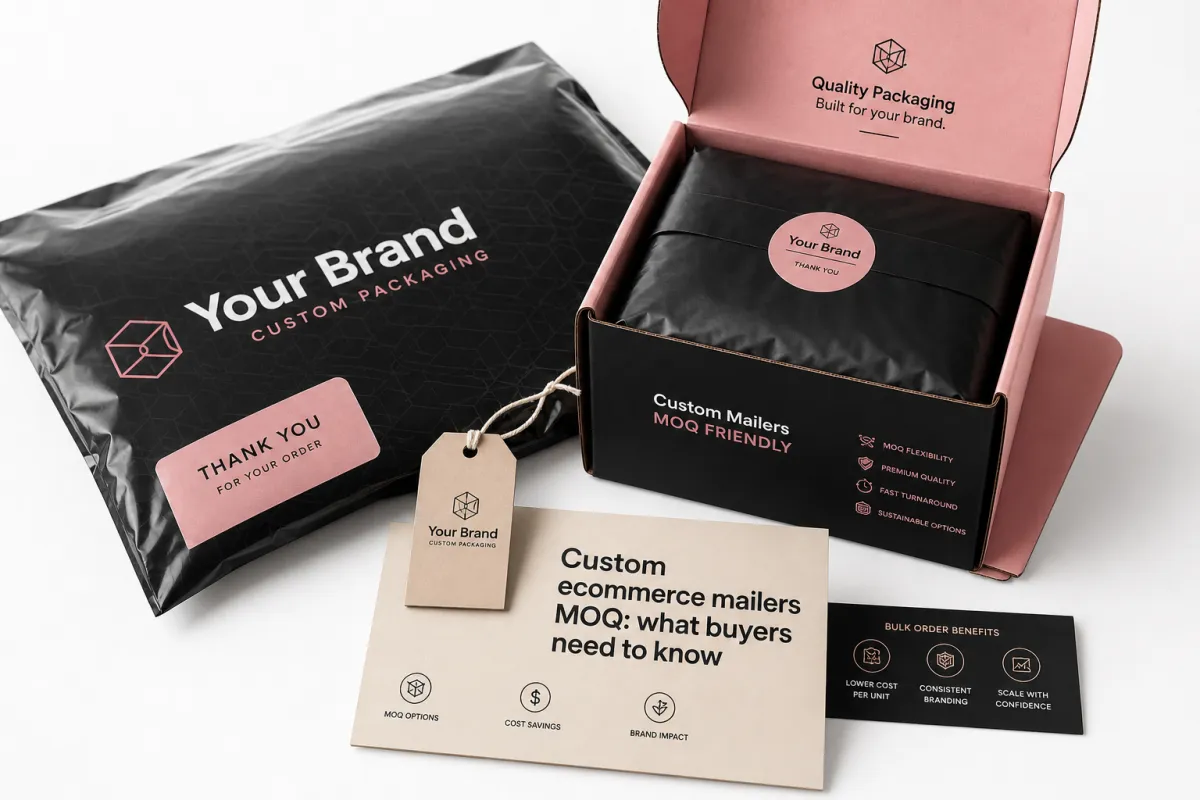
For a packaging buyer, custom ecommerce mailers moq means the smallest quantity a supplier will run for your size, structure, and print setup. Simple idea. Not always simple in practice. A factory has to set up board, plates, dies, press settings, and finishing steps before the first sellable unit comes off the line. Spread that setup across a tiny order and the unit cost climbs. That is the math. Not supplier drama.
That is also why custom ecommerce mailers moq is tied to production reality, not just a line on a quote sheet. Material sourcing, machine time, ink coverage, and finishing all affect the minimum. A supplier may quote 250 units for a plain mailer with one-color print, then push the floor higher for a folded structure, inside printing, or heavy coverage. Same line. More setup. Higher threshold. Pretty boring, but that is how it works.
People love to stare at print cost and call it the whole story. It is not. Outer dimensions can drive dimensional-weight charges harder than decoration ever will. A box that is half an inch too wide on each side can keep costing you long after the artwork has been approved and forgotten. I have watched teams obsess over foil samples while the carrier bill quietly ate the margin. That is why custom ecommerce mailers moq should be judged with carrier rules sitting right there in the room.
Here is the practical comparison buyers need:
- Stock mailers are quick to launch, but they often force filler, labels, or weird workarounds that weaken brand presentation.
- Custom mailers take more effort up front, yet they can tighten the fit, reduce void fill, and improve the unboxing moment.
- Custom ecommerce mailers moq sits between those two realities: enough volume to justify setup, not so much that a launch gets buried in inventory.
For a small brand, the right custom ecommerce mailers moq is the one that matches monthly volume without strangling cash flow. For a larger brand, it is the one that keeps fulfillment centers on the same spec. Different scale, same goal: keep inventory, setup, and repeatability in the same lane. That sounds tidy because it is tidy, at least on paper.
Industry references help buyers and suppliers speak the same language. Resources such as packaging.org and the testing guidance at ISTA are useful when teams want packaging decisions grounded in actual performance instead of wishful thinking.
The best mailer is not the prettiest one on the sample shelf. It is the one that lowers total landed cost and still looks deliberate in the customer’s hands.
That is the whole point behind custom ecommerce mailers moq. The minimum quantity only makes sense if the box size, print plan, and shipping profile work together. Miss one of those, and the savings evaporate. Usually quietly. Then all at once.
Value proposition: why custom mailers outperform generic packs
The strongest case for custom ecommerce mailers moq is not decoration. It is commerce. A custom mailer turns a shipping container into a branded touchpoint, and that changes how the customer reads the product before it is even opened. Repeat purchase rates, social sharing, perceived quality — all of that gets a nudge. A clean mailer with the right print coverage can make a modest product feel sharper and more intentional.
That matters because branded packaging does more than look polished. It shortens the distance between product packaging and brand memory. If a customer receives three orders in one month, the pack that feels organized and consistent is the one they remember. Generic cartons still ship the product. They just do not do much for package branding. They are fine. They just do not whisper "premium" to anybody.
There is a practical side too. Custom sizing cuts down on filler, tape, and packing steps. In high-volume fulfillment, a few seconds per pack adds up faster than people expect. A right-sized mailer can simplify the workstation, reduce the number of SKUs a team has to handle, and make training easier. For companies already selling Custom Poly Mailers for light items, a corrugated mailer may be the better move for heavier or more fragile goods.
| Option | Typical MOQ | Approx. unit cost | Best use case |
|---|---|---|---|
| Stock mailer + label | Very low | $0.20-$0.80 | Speed, test launches, temporary programs |
| Custom poly mailer | 500-1,000+ | $0.12-$0.45 | Apparel, light accessories, high-volume ecommerce |
| Custom corrugated mailer | 250-1,000+ | $0.70-$2.10 | Beauty, supplements, gift sets, premium retail packaging |
The table shows the part most teams miss: custom ecommerce mailers moq is only one input. The real question is whether the unit cost, protection level, and visual impact justify the setup. A cheaper pack that damages product or weakens the unboxing experience is not cheaper. It is deferred loss with a nice spreadsheet.
For brands building a broader packaging system, the mailer also has to fit the rest of the Custom Packaging Products lineup. A subscription box may need custom printed boxes for one channel and mailers for another. That is not duplication. That is segmentation. Different products need different structures, and the packaging should respect that.
Product details: materials, construction, and branding options
custom ecommerce mailers moq gets easier to manage once you understand the structure choices. Most ecommerce mailers are made from corrugated board, paperboard, or rigid-style stock. Corrugated is the workhorse. It handles crush better, prints well, and survives parcel handling more reliably than thin carton stock. Paperboard is lighter and cleaner-looking, but it usually fits lower-stress shipments or insert-style use. Rigid-style mailers push the presentation premium, though they raise freight and unit cost. That comes with the territory.
Board choice drives performance. E-flute corrugated is common for mailers because it balances print quality and protection. B-flute is thicker and gives more stiffness, which helps when products have sharp corners or need extra resistance in transit. For some retail packaging programs, a laminated paperboard face creates a more refined surface for photography-heavy artwork, foil accents, or soft-touch finishes.
Construction details matter just as much as the board. Self-seal strips speed up packing. Tear-open tabs make the customer experience easier. Locking flaps improve closure consistency. Return-friendly structures reduce friction for apparel and exchange-heavy categories. If your team is weighing custom ecommerce mailers moq against setup complexity, every one of those choices affects tooling and proofing. A fancier closure sounds nice until the pack line starts cursing at it.
Branding options can stay restrained or go fully loaded, depending on budget and launch goals:
- Full-wrap print for high visibility and a strong shelf-to-door impression.
- Inside print for a surprise moment during unboxing.
- Spot color graphics for clean, lower-setup programs.
- Foil and specialty finishes for premium lines, though they usually raise MOQ and lead time.
- Targeted messaging panels for QR codes, care instructions, or subscription reminders.
For beauty, supplements, accessories, and apparel, the best choice is rarely the same. Beauty and supplements often need more rigidity and a cleaner presentation. Apparel usually benefits from lighter weight and simpler fold geometry. Accessories may need inserts or locking tabs to keep movement down. The right custom ecommerce mailers moq should reflect product behavior, not just the artwork concept somebody fell in love with on Tuesday.
Experienced teams compare mailers with Custom Poly Mailers and custom printed boxes before they sign off on a spec. The cheapest structure is not always the smartest one. If a poly mailer saves postage and keeps the item safe, that may be the right answer. If a corrugated mailer prevents dents or strengthens brand perception, it may justify the higher unit cost.
One useful rule: if the product can survive a rough conveyor lane, choose the lightest structure that still gives the brand a credible presentation. If it cannot, raise the board grade before you chase a fancier print finish. That is the cleanest way to keep custom ecommerce mailers moq under control while still shipping something that feels intentional.
Specifications for custom ecommerce mailers MOQ planning
Good quotes start with good specifications. custom ecommerce mailers moq depends on more than the box shape, because every extra variable adds setup time and pricing uncertainty. The main drivers are internal dimensions, board grade, print coverage, color count, closure style, and whether the mailer needs inserts or special finishing. If a buyer sends only a rough size and a logo, the supplier has to guess. Guessing is not a pricing strategy.
The most important specification is the internal dimension. Outer size affects shipping. Inner size affects fit. If the product has a bottle, folded garment, kit, or accessory tray, the dimensions need to be based on the finished packed product, not the item sitting alone on a desk. A quarter inch can matter if the package is sliding into dimensional-weight pricing. That is why custom ecommerce mailers moq should be planned with carrier math in mind.
Artwork files matter too. A dieline should show fold lines, glue zones, and trim. Bleed needs to extend past the cut line so artwork does not stop short after finishing. Safe zones protect logos and copy from getting clipped. If a brand plans inside printing or multiple seasonal versions, each version may need its own proof path. Small issue on a screen. Production headache on press. Ask me how I know. No, actually, don’t.
Here is the specification checklist I would want before requesting custom ecommerce mailers moq pricing:
- Finished product dimensions and target internal mailer dimensions.
- Board type, thickness, and any recycled or FSC requirements.
- Print method, number of colors, and whether inside printing is needed.
- Closure type, insert needs, and whether the pack must be return-friendly.
- Quantity by SKU, even if the plan includes only a pilot order.
- Artwork files, dieline notes, and brand color references.
For performance-sensitive programs, teams often look at ISTA test methods or ASTM-style transport evaluation to reduce risk before scaling. That does not mean every mailer needs lab testing. It means the bigger the shipping promise, the more useful a formal test plan becomes. A mailer that passes a handling test is easier to defend internally than one chosen because it "looked fine" on a screen.
If your package line includes multiple formats, compare the mailer against other Custom Packaging Products before ordering. Some companies discover that one mailer size can cover two products with only a simple insert change. That lowers inventory pressure and keeps the custom ecommerce mailers moq from splintering across too many SKUs.
Custom ecommerce mailers MOQ and pricing: how quotes work
The pricing structure behind custom ecommerce mailers moq is usually straightforward once you know the moving parts. Size is the first driver. Bigger mailers use more board and usually cost more to ship. Board type is the second driver, because stronger or more premium stock increases material spend. Print complexity is the third, since multiple colors, full coverage, and inside printing all raise setup effort. After that come finishing, freight destination, and the actual number of units.
Lower quantities almost always carry a higher unit cost. That is not a penalty. It is setup math spread across fewer pieces. A 500-unit run can make sense for a launch, but a 5,000-unit run usually cuts the unit cost sharply because the prep work gets diluted. The curve is not linear. It drops fast near the low end, then slows down as volume rises. That is why the right custom ecommerce mailers moq is not always the smallest one.
At a practical level, buyers often see ranges like these for corrugated mailers, assuming ordinary print complexity and no unusual finishing:
- 250-500 units: higher setup impact, often better for pilots or special launches.
- 1,000-2,500 units: a common balance point for growing ecommerce brands.
- 5,000 units and above: stronger cost efficiency and better planning leverage.
There are pricing traps too. Over-customization can multiply the quote. A mailer with foil, inside print, unique inserts, and two size variants may look elegant, but it can behave like several separate jobs. Rush production adds another layer. So does late artwork. If a team changes the dieline after proof approval, the quote may need to be refreshed. That is why custom ecommerce mailers moq should be locked before design gets too far along.
Cash flow matters. A startup may be able to afford a low minimum but not the storage that follows. A larger brand may want the volume break but not the working capital tied up in a single style. The right answer is often a tiered order: start with a manageable quantity, validate packout and shipping, then move to a higher reorder once the design and dimensions are proven. That is a lot smarter than chasing the lowest printed number on a quote sheet and pretending the rest will sort itself out.
If you are also evaluating branded shipping materials or coordinating with retail packaging, treat the decision as a system. A package that looks good in one channel but stores poorly in the warehouse is a bad trade. A mailer that packs quickly but damages product is worse. The strongest custom ecommerce mailers moq supports finance and operations at the same time.
One more point on timing and price: freight can erase a good quote if it is ignored. Domestic shipping may be manageable, but oversized cartons or international freight can change the landed cost dramatically. Ask for the full delivered number, not just the production price. The unit cost on paper is only part of the story. The invoice knows the rest.
Process and timeline: from quote to delivery
A clean process saves more money than most people expect. custom ecommerce mailers moq moves through a series of steps that all depend on the previous step being right. The usual sequence is inquiry, spec review, quote, dieline setup, artwork upload, proofing, sampling, production, and freight. Skip one piece and the clock stretches. The process is simple. The risk lives in the details.
Timelines should be broken into pieces rather than treated as one vague promise. Prepress can take one to three business days if the files are ready. Sampling or physical approval may add a few more days, especially if the buyer wants to see print accuracy or structure before committing. Production often runs in the 10-20 business day range, depending on quantity and finish. Freight is separate, and it can be fast or slow depending on destination and mode. That is why a quote should never be read as a single number without context.
Most delays happen in predictable places. Artwork revisions are a common one, especially if color expectations were not defined early. Late dimensional changes are another. The third is final approval, because teams often circulate proofs between marketing, operations, and finance before anyone signs off. If a package has to be approved by multiple people, custom ecommerce mailers moq should be planned with extra time in the schedule.
Buyers can shorten the timeline by preparing a few things before asking for a quote:
- Finished product dimensions and the target packed size.
- Estimated monthly volume and launch quantity.
- Artwork in vector format with brand colors noted.
- Any special requirements such as FSC paper, inside print, or return-use design.
- A decision on whether the order needs a sample before production.
The smartest teams treat the first order as a learning cycle, not a one-time transaction. They confirm the fit, review the packout speed, test transit performance, and then improve the spec on the reorder. That is where a supplier’s packaging design support becomes valuable. A supplier who can talk through dieline changes, print coverage, and inventory planning is usually worth more than one that only sends a price.
For broader reference on shipping and packaging expectations, industry materials from packaging.org can help teams align on terminology, while ISTA remains a strong source for parcel testing language. Neither replaces a production quote, but both reduce confusion before you commit to custom ecommerce mailers moq.
Why choose us and what to do next
Custom Logo Things is built for buyers who want clear packaging answers, not vague promises. That matters because custom ecommerce mailers moq is often treated like a mysterious supplier decision, when it should be a transparent discussion about structure, quantity, and cost. The right partner explains where the number comes from, what can lower it, and which changes affect lead time or appearance.
Good support shows up in the details. Dieline guidance reduces artwork errors. Sample review catches fit issues before production. Color control keeps branded packaging consistent across reorders. And low-friction reordering matters more than many teams realize, because the first order is usually the hardest one. Once the spec is proven, the reorder should feel like a repeatable system instead of a new project with a nicer invoice.
Here is the part buyers should focus on before placing an order: monthly demand, storage capacity, and shipping goals. If a brand ships 300 units a month, a 5,000-unit minimum may create unnecessary inventory pressure. If the same brand plans a seasonal launch, a lower custom ecommerce mailers moq might be smart for the first wave, followed by a larger reorder after the product settles. Let volume decide the purchase. Habit is a terrible procurement policy.
For teams comparing options, it helps to think in sequence:
- Confirm the product dimensions and the protection level required.
- Choose the structure that fits the shipping method and presentation goals.
- Decide on finish, print coverage, and any inside messaging.
- Match the order size to launch risk and monthly usage.
- Request a sample, proof, or price break table before final approval.
If you are still building the larger packaging plan, the FAQ can answer common questions quickly, and the Custom Packaging Products page can help you compare mailers with other formats. For lightweight apparel, Custom Poly Mailers may be the better fit. For heavier or more premium goods, a corrugated mailer may protect margins better than a lower-cost option that fails in transit.
My practical view is simple: order the lowest custom ecommerce mailers moq that still protects cash flow, shipping economics, and brand consistency. Then validate the spec, measure the packed parcel, and adjust on the reorder. That is the disciplined way to buy packaging, and it is usually the way that saves the most money over time.
Common questions before you order
What is a typical custom ecommerce mailers MOQ?
It depends on size, print method, and structure, but many custom ecommerce mailers moq quotes start at a few hundred units rather than pallet-level quantities. Simple one-color runs can sometimes stay lower; premium finishes or inserts usually push the minimum higher because setup costs must be spread across more boxes.
How much do custom ecommerce mailers cost at low MOQ?
Low-MOQ orders usually carry a higher unit cost because tooling, press setup, and proofing are divided across fewer pieces. Material choice and print complexity matter more at small quantities, so the cleanest way to compare quotes is to review unit price, freight, and any extra fees together. That is the only honest way to judge custom ecommerce mailers moq pricing.
What artwork files do I need for custom ecommerce mailers MOQ quotes?
A dieline, vector artwork, and clear dimensions are the starting point for accurate pricing. It also helps to provide color references, finish preferences, and whether you need inside printing or multiple versions. If you do not have a dieline yet, ask for one before finalizing artwork so the layout matches the actual mailer size.
How long does production take after approval?
Production timing depends on quantity, print complexity, and finish, but the clock usually starts after final proof approval. Sampling and artwork revisions can add time, so buyers who move faster on approvals usually get to shipping sooner. Freight time is separate from production time, so confirm both if you are working toward a launch date.
Can I order multiple sizes under one custom ecommerce mailers MOQ?
Sometimes, but separate sizes often need separate setup and separate minimums unless they share the same production plan. If you need several SKUs, it may be smarter to start with the highest-volume size and add the others in later orders. Ask for a split-run or tiered quote so you can compare one mixed order against multiple single-size orders.
If you are ready to move forward, gather the dimensions, decide on finish, estimate monthly volume, and request pricing with your preferred custom ecommerce mailers moq. The right number is the one that supports your launch, your storage reality, and your shipping costs at the same time.
That is the action item: lock the packed dimensions first, then compare MOQ against freight and storage, and only then decide whether the mailer should be custom or stock. If those three numbers do not line up, the packaging spec is not ready yet. No need to make it more complicated than that.

